

A soundproof cubicle is more than just a box—it’s an enclosed, modular workspace that actively blocks outside noise while soaking up sound from within. For anyone trying to get deep work done, take a confidential call, or just escape the constant buzz of an open office, it's an absolute game-changer.
The Rising Demand for Quiet Workspaces
The modern open-plan office was sold as a hub of collaboration, but for many, it's become a major source of distraction. While the goal was to bring people together, these wide-open layouts often create a storm of noise that crushes focus and privacy. For office managers and business leaders, finding a solution isn't just about employee comfort anymore; it's a strategic move for a healthier bottom line.
The numbers don't lie. With over 65% of modern workplaces now using open-plan designs, the complaints about constant interruptions are getting louder. In fact, research shows that all that extra noise can slash productivity by a staggering 40%. It’s no surprise the global market for soundproof office booths is projected to leap from $400 million in 2026 to $704 million by 2034. The demand for quiet is real.
To put this into perspective, here are some of the most common noise problems we see and how a soundproof cubicle directly solves them.
Common Noise Problems and Soundproof Cubicle Solutions
| Common Office Distraction | Impact on Employees | Soundproof Cubicle Solution |
|---|---|---|
| Nearby conversations and chatter | Inability to focus on complex tasks, frequent errors. | High-wall panels and sealed doors block conversational noise, creating a "cone of silence." |
| Unrelated phone calls and video meetings | Difficulty hearing on their own calls, privacy concerns. | An enclosed space ensures private calls remain private and keeps external noise out. |
| General foot traffic and movement | Constant visual and auditory interruptions break concentration. | Solid or frosted glass walls provide a visual barrier, reducing the "fishbowl" effect. |
| Loud equipment (printers, etc.) | Adds to the overall ambient noise level, increasing stress. | The insulated structure dampens all external sounds, providing a calm environment. |
As you can see, these aren't minor annoyances—they're significant roadblocks to productivity and employee well-being that soundproof cubicles are specifically designed to overcome.
Why Acoustic Privacy Matters
Acoustic privacy isn't just about making things quieter. It’s about giving your employees the right environment to do their best work. Without a place to escape the noise, your team faces real challenges that hit your business right where it hurts.
Here’s what you gain by focusing on acoustic privacy:
- Enhanced Focus and Concentration: People can finally dive into deep work without being pulled away by a conversation happening ten feet away. The result is higher-quality, more efficient output.
- Improved Confidentiality: Roles in HR, finance, or leadership require discretion. Sensitive phone calls and one-on-one meetings can happen without an audience.
- Reduced Employee Stress: Let's face it, constant noise is draining. Giving people a quiet refuge helps lower cognitive overload and makes for a much happier, less-stressed team.
A Practical and Effective Solution
This is where a soundproof cubicle from a trusted provider like Cubicle By Design becomes your most powerful tool. These structures let you reclaim quiet and privacy without needing to tear down walls or completely rethink your office layout. It's a targeted investment that pays you back with better efficiency and happier employees.
For those looking to implement quiet productivity solutions in a broader office context, it's worth a look to explore premium office solutions designed for efficient work environments.
This guide will walk you through everything you need to know about creating a quieter, more productive workplace. We’ll get into the science behind soundproofing, check out different options like our private office cubicles and workstation cubicles, and even show you how to use our Custom Cubicle Designer to map out your perfect space. Feel free to explore our full range of cubicles to get started.
How Soundproofing Actually Works in an Office
If you want to create a genuinely quiet workspace, you have to realize that "soundproofing" isn't a single magic bullet. It’s really a two-part strategy. Think of it like this: some materials are built to block sound from getting into a space, while others are made to absorb the sound that’s already bouncing around inside. A truly effective soundproof cubicle has to do both.
This infographic really puts the problem—and the solution—into perspective.
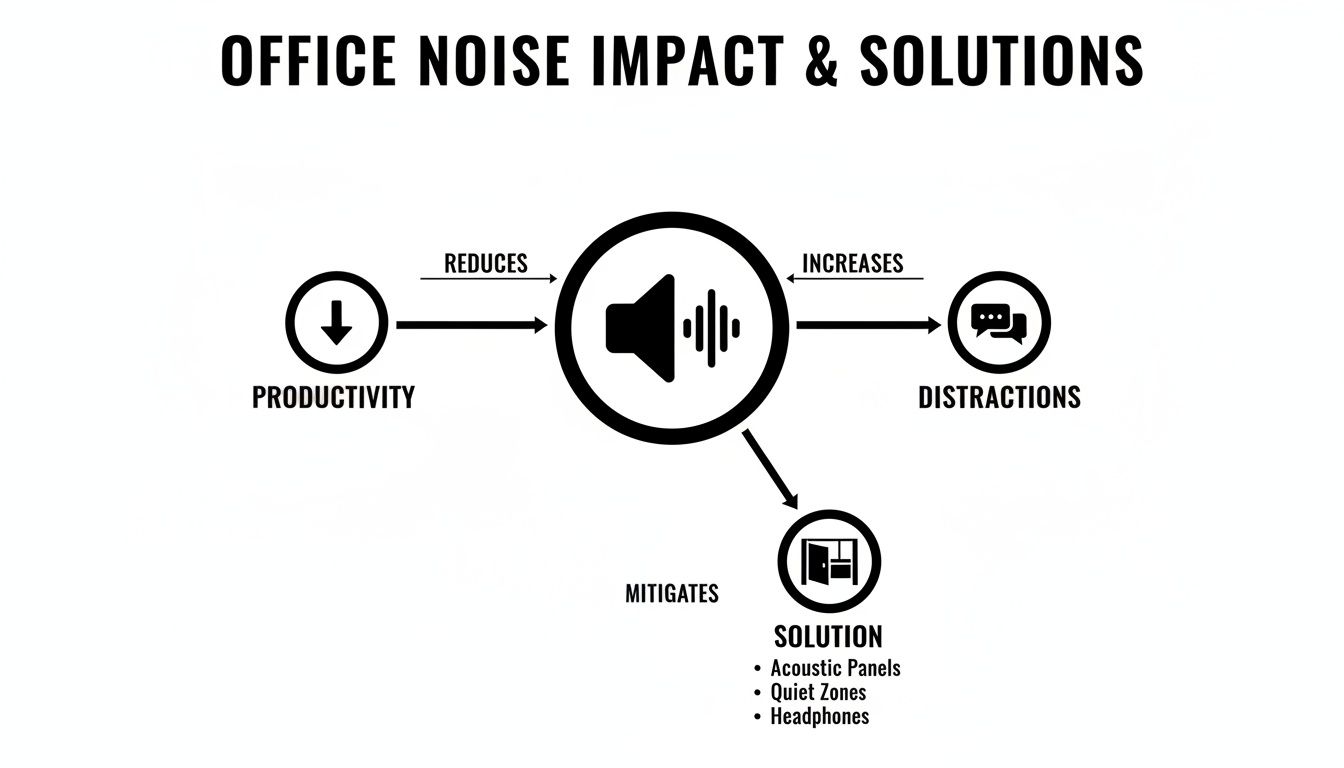
The connection is crystal clear: when office noise goes unchecked, distractions shoot up and productivity plummets. This is exactly why purpose-built solutions like acoustic cubicles are no longer a luxury, but a necessity. To choose the right one, you need to get familiar with two key ratings that measure acoustic performance.
Blocking Sound With STC
First up is the Sound Transmission Class (STC). This number tells you exactly how well a barrier—like a cubicle wall, a door, or a piece of glass—stops sound from passing straight through it. The higher the STC rating, the better it is at isolating you from the outside world.
Imagine sound as water trying to get into a boat. A cubicle with a low STC is like a boat with a flimsy, leaky hull; the water just seeps right in. But a cubicle with a high STC rating? That's a boat with a thick, perfectly sealed hull that keeps every last drop of water out.
Even the smallest gap can completely undermine your efforts. A tiny 1% gap in a wall can let 30% of sound leak through. A 5% gap can let in as much as 90% of sound. This is why high-STC materials and airtight construction are non-negotiable for a truly soundproof space.
This "blocking" action is what prevents distracting hallway chatter, a coworker's phone call, and the general office buzz from derailing your focus.
Absorbing Sound With NRC
While STC handles noise trying to get in, the Noise Reduction Coefficient (NRC) deals with sound inside the cubicle. This rating, on a scale from 0 to 1, measures how much sound a material soaks up, stopping echoes and reverberation in their tracks. A 0 means it absorbs nothing (like a concrete wall), while a 1 means it absorbs everything (like an open window).
Think of NRC like adding a sponge to a room. If you’re in a space with hard, reflective surfaces like bare drywall and a tile floor, any sound you make just bounces around endlessly, creating a harsh, distracting echo. That's a low-NRC environment.
Now, picture that same space with soft, fabric-covered walls, plush carpeting, and acoustic ceiling tiles. These materials act like sponges, grabbing and trapping sound waves before they can bounce. This high-NRC environment feels quieter, more comfortable, and makes conversations much clearer. For a private cubicle, a high NRC is crucial for making sure your phone calls sound crisp and the space doesn’t feel like an echo chamber.
Bringing It All Together for a Quiet Space
An effective soundproof cubicle strikes the perfect balance between high STC and high NRC ratings. It’s a team effort.
- High STC: You get this from dense, solid materials. Think full-height panels, solid-core doors with proper seals, and acoustic glass. These elements form a robust barrier to block external noise.
- High NRC: This comes from porous, sound-absorbing materials on the inside surfaces, like fabric-wrapped acoustic panels. These trap sound waves, killing echo and improving the clarity of sound within the space.
By combining these two principles, you create a space that’s not only shielded from outside distractions but is also acoustically comfortable on the inside. This dual approach is the foundation of any effective quiet zone in a bustling office. For a deeper look at creating these dedicated areas, you can learn more about our comprehensive office acoustics solutions.
The Anatomy of an Effective Soundproof Cubicle
What really separates a truly soundproof cubicle from a standard office partition? It all comes down to the construction details. A genuinely quiet space is built from the ground up with a clear purpose, combining different materials that work in harmony to both block and absorb sound. The result is a true sanctuary from the constant hum of office noise.
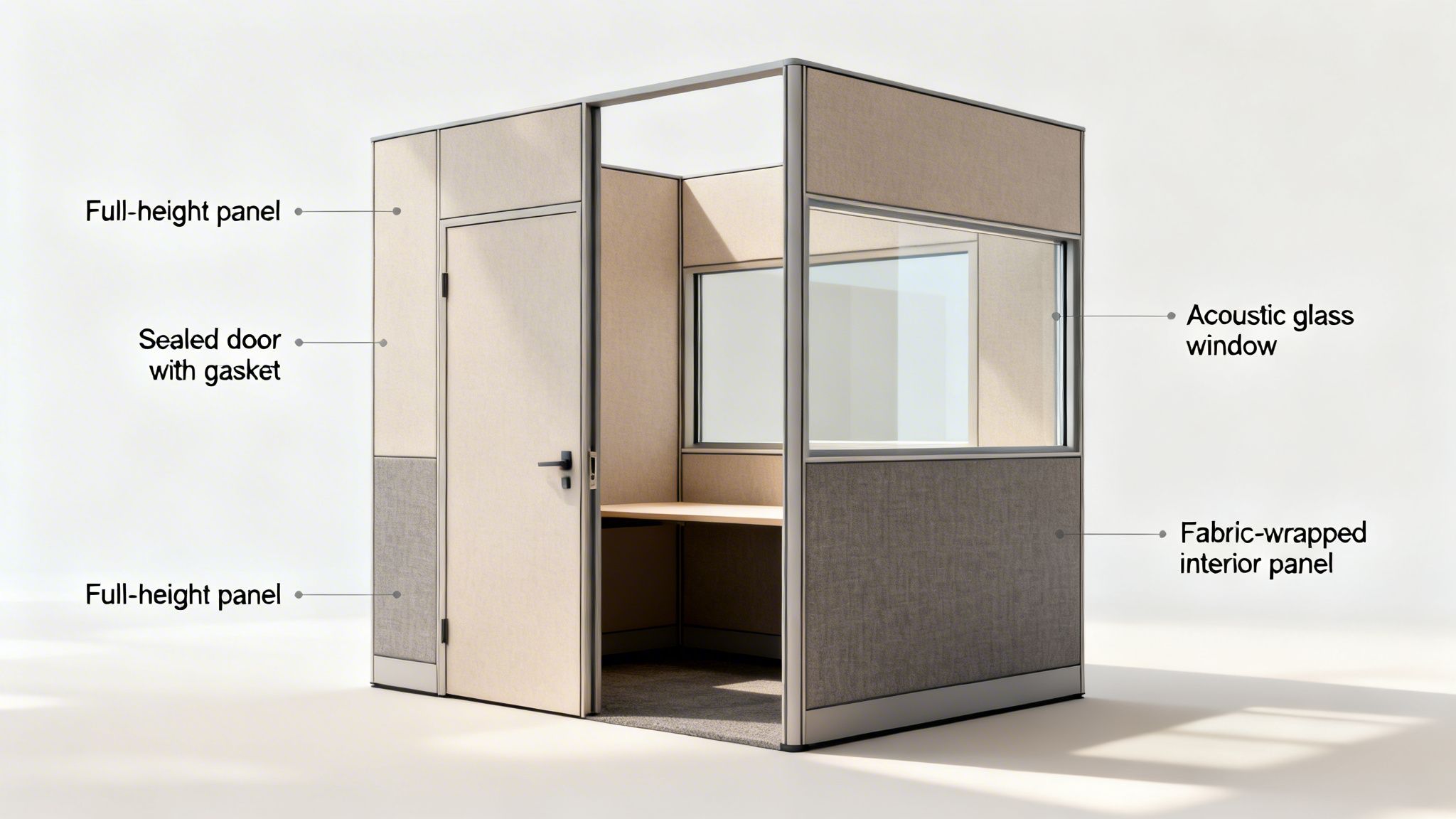
Let’s pull back the curtain and look at the key features that create an effective acoustic enclosure.
Full-Height Panels Are Essential
The very first thing you need for serious sound blocking is height. Think of sound waves like water—they will find and flow through any opening they can. Low-walled cubicles simply let conversations and distractions spill right over the top, making any other acoustic features pretty much useless.
A proper soundproof cubicle has to have full-height panels that either reach the ceiling or are topped with a solid roof. This creates a complete six-sided box that physically traps sound, maximizing its STC (Sound Transmission Class) rating by cutting off the easiest path for noise to travel. If you don't have this, you're not getting true sound isolation.
Even a tiny gap can completely derail your sound control efforts. A mere 1% gap in a barrier can let in as much as 30% of sound, while a 5% gap can torpedo performance by up to 90%. This is exactly why floor-to-ceiling construction is a non-negotiable for real acoustic performance.
Airtight Seals and Solid-Core Doors
Following that same "no gaps" principle, the door is the next major weak point you have to address. A typical hollow-core office door offers almost no defense against sound. For an effective soundproof cubicle, you need a solid-core door and, just as importantly, high-quality acoustic seals that run around the entire frame.
When the door closes, these seals compress to create an airtight barrier, stopping sound from sneaking through the cracks. It’s a simple feature, but it makes a massive difference in the unit's overall STC rating. Without it, the door is basically an open invitation for noise.
The Role of Acoustic Glass
Privacy doesn't have to feel like a penalty box. Modern acoustic setups use specialized acoustic glass to keep things feeling open and bright, all without giving up sound performance. This is a far cry from your standard window pane.
Acoustic glass is usually made of laminated panes with a special interlayer designed to dampen sound vibrations. This allows you to build private offices that still feel connected to the rest of the workspace but remain an acoustic island. It’s the perfect compromise between visual openness and auditory privacy, so employees can focus without feeling "boxed in."
Absorptive Interior Panels for Clarity
Once you’ve successfully blocked noise from getting in, you have to manage the sound inside the cubicle. Hard, reflective surfaces like bare walls or glass can create a distracting echo chamber—a nightmare for phone calls and video meetings. This is where materials with a high NRC (Noise Reduction Coefficient) save the day.
A quality soundproof cubicle will be lined with soft, porous materials like fabric-wrapped acoustic panels. Instead of reflecting sound, these surfaces are designed to absorb sound waves, stopping them from bouncing around the small space.
This accomplishes two critical things:
- It sharpens speech clarity, making virtual meetings and calls sound crisp and professional.
- It creates a more comfortable and less draining acoustic environment for the person working inside.
The demand for these quiet spaces is skyrocketing for a reason. The sound-proof booths sub-market is projected to jump from $500 million in 2025 to $850 million by 2033. The ROI is clear: pods that deliver 40dB+ noise reduction can boost employee focus by 35-50%. You can explore the materials that make this possible by checking out our guide to office cubicle panels.
Designing Your Ideal Acoustic Workspace
Now that you've got the basics of acoustics down, the fun part begins: designing a space that actually solves your office's noise problems. This is where your ideas for a quieter, more productive workplace meet our solutions. At Cubicle By Design, we give you the building blocks to turn that vision into a reality.
The trick is to match the right product to your specific needs. Whether you’re just trying to carve out a few quiet corners or build an entire department of private workstations, the configuration you choose is everything.
Matching Products to Your Acoustic Goals
Every office is different. A high-energy call center has far more demanding acoustic needs than a quiet administrative area. That's why we don't believe in a one-size-fits-all approach. We offer a whole range of products so you can tailor the solution to your environment.
Think about it like building a private meeting room. You'd use things like specialized conference room doors to get the privacy you need. The same idea applies here—you have to pick the right components for the job when selecting your cubicles.
A great starting point for many offices is our popular Flagship Series 7 Cubicles. They’re incredibly flexible, with different panel heights and material options that let you strike the right balance between privacy, collaboration, and your budget.
For jobs that demand total quiet and confidentiality, our private office cubicles give you a complete, six-sided enclosure. But for teams that need to focus while still feeling connected to the office buzz, our workstation cubicles are an excellent middle ground. It all comes down to the work being done inside them.
Matching Cubicle By Design Products to Your Needs
To help you narrow down the options, we've put together a quick comparison of how our different product lines can help you manage office sound. Compare our product series to find the perfect acoustic solution for your office environment.
| Product Series | Key Acoustic Feature | Ideal Application |
|---|---|---|
| Flagship Series 7 Cubicles | Configurable panel heights and absorptive fabric options. | Creating focused workstations in an open-plan office where some ambient noise is acceptable. |
| Private Office Cubicles | Full-height walls, a solid roof, and a sealed door for maximum sound blocking (high STC). | Confidential meetings, HR functions, executive work, or any task requiring deep, uninterrupted concentration. |
| Glass Wall Systems | Laminated acoustic glass that blocks sound while maintaining visual openness. | Building separate quiet zones, meeting rooms, or team pods without sacrificing natural light or a modern look. |
This push for dedicated quiet zones isn't just a hunch; it's a major trend. The market for indoor soundproof cabins shot up to USD 8.27 billion in 2024 and is expected to climb to USD 12.51 billion by 2032. This surge shows that more and more businesses realize that controlling sound is a must-have for productivity today.
Turn Your Vision into a Plan
The best way to figure out what your space needs is to play around with different layouts and features. That's exactly why we created our interactive Custom Cubicle Designer—it puts you in the driver's seat.
Using the designer, you can:
- Select your privacy level: Choose from low, medium, or high walls to get just the right amount of sound isolation.
- Pick your materials and finishes: Test out different fabrics and surfaces to boost sound absorption (NRC).
- Configure your layout: Arrange desks, storage, and power to build a workstation that fits your team's workflow perfectly.
This tool closes the gap between a rough idea and a solid plan, giving you a clear picture of how your soundproof cubicles will look and feel in your office. It's a crucial step in creating a space that doesn’t just look good, but works even better.
To see how these principles come to life, check out our guide on modern office cubicle design.
Soundproof Cubicles in Real-World Scenarios
The technical ratings and acoustic specs are one thing, but how do soundproof cubicles actually hold up in a real, bustling office? It’s time to move past the theory and see what these principles look like in practice. Let’s look at a couple of stories of how smart cubicle design solved some serious noise problems for different businesses.
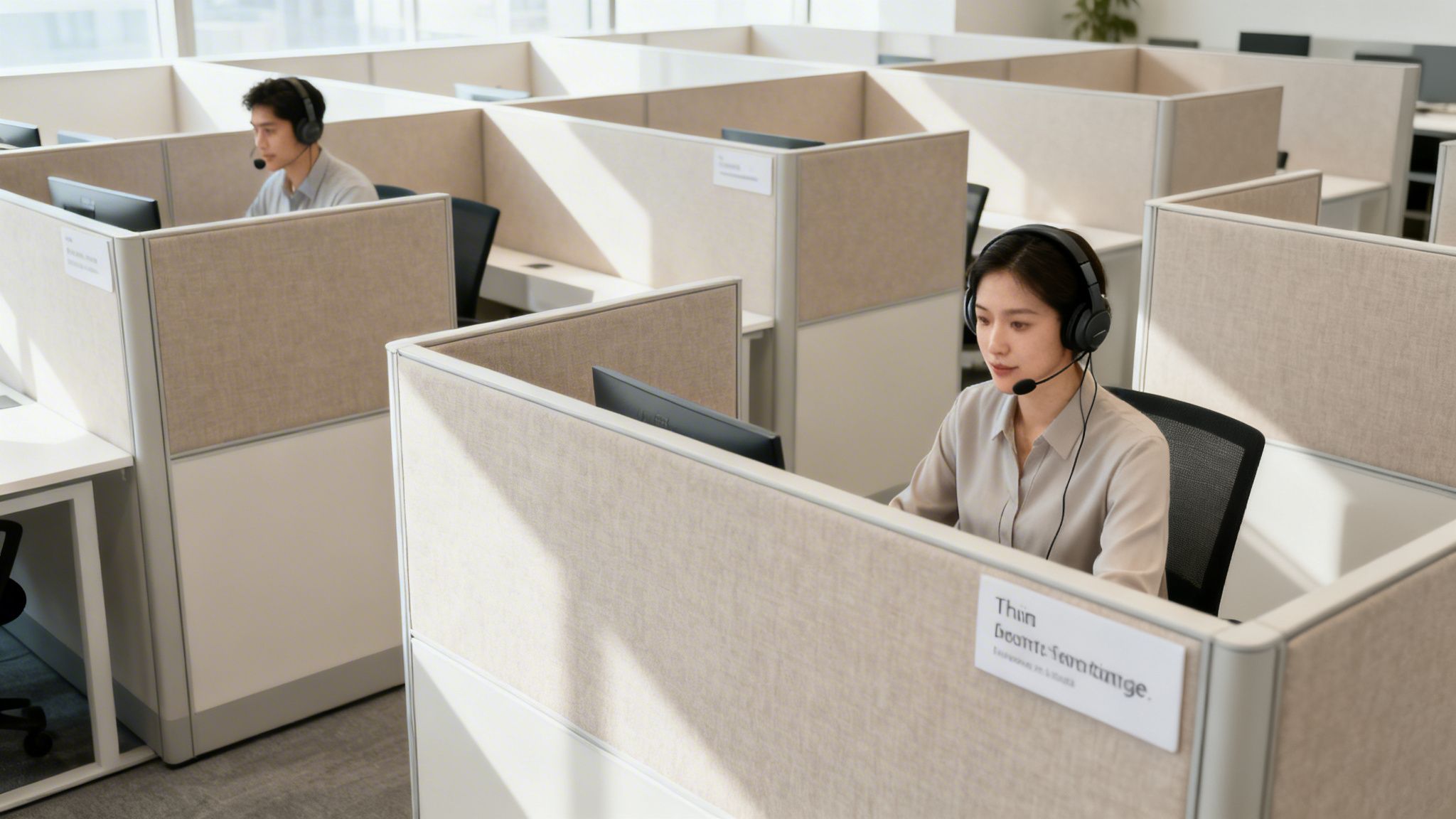
These examples really show how acoustic solutions from Cubicle By Design aren't a one-size-fits-all product. They can be shaped to fit exactly what your workspace needs, whether it's a high-volume call center or a flexible hybrid office.
The Busy Call Center Transformation
Picture this: a booming customer service company with a big problem. Their open-plan call center was a mess of noise. Agents couldn't hear their customers clearly over the chatter of their colleagues, which led to mistakes, having to repeat information, and some very unhappy clients. Concentration was shot, and the constant noise was leading to serious employee burnout.
The Solution:
The firm decided to overhaul their layout, bringing in high-panel, fabric-wrapped cubicles. These weren’t just basic dividers; they were chosen specifically for their sound-dampening qualities.
- Height for Blocking: The tall panels reached well above a seated person's head. This created a solid physical barrier that stopped sound from traveling directly between agents, giving each workstation a much-needed STC boost.
- Fabric for Absorption: The fabric-covered panels were key for improving the NRC rating. They soaked up ambient sound and echoes, preventing agents' own voices from bouncing around the room and adding to the chaos.
The Outcome:
The results were immediate and frankly, pretty dramatic. Call clarity improved so much that customer satisfaction scores jumped by over 20% and handle times dropped. Agents reported feeling way less stressed and found it much easier to focus, which meant better performance and lower staff turnover. You can get a closer look at this kind of setup and explore more options for effective call center office cubicles.
The Hybrid Corporate Headquarters
A large corporation went all-in on a hybrid work model, but their office space just wasn't built for it. The open floor plan, once a beacon of collaboration, was now a source of frustration. People on Zoom calls were constantly being talked over by their in-office coworkers, and those in the office were distracted by one-sided virtual meetings happening all around them.
This situation is a perfect example of why you need dedicated quiet zones. The answer wasn't to get rid of the open areas, but to balance them with purpose-built private spaces.
The Solution:
They found a great middle ground by blending their existing open workstation cubicles with new, dedicated private office cubicles. These fully enclosed pods were strategically placed around the office, giving anyone an on-demand quiet spot when they needed it.
The Outcome:
These soundproof pods quickly became the most popular spots in the office for important video calls, confidential chats, or just buckling down on deep-focus work. The open areas still served as hubs for casual collaboration, but the office finally had a healthy balance of "quiet zones" and "active zones." The feedback from employees was fantastic, with 85% of staff saying they could now manage their workday much more effectively. The booking system they set up for the pods was an instant hit, proving just how badly a solution like this was needed.
Planning Your Installation and Investment
So, you’re sold on the idea of bringing acoustic privacy into your office. That’s the easy part. Now for the practical side: how do you actually get from a great idea to a fully installed, quiet workspace? Let's walk through the details, from the budget and real value to the technical nuts and bolts that make it all work.
First things first, think of this as an investment, not just an expense. The upfront cost is one thing, but the return on investment (ROI) is where the real story is. The payoff comes from a workforce that can finally focus. Studies have shown that cutting down on noise can sharpen employee focus by a staggering 35-50%, a number that goes straight to your bottom line.
Calculating the True Value
Just think about the hidden cost of lost productivity. When an employee is constantly fighting off distractions, the wasted time and drop in work quality can cost a company thousands each year. A soundproof cubicle carves out a dedicated zone for deep work, private calls, and focused projects, putting a stop to that loss. When you look at it that way, the ROI isn't just a number on a spreadsheet—it's undeniable.
Key Technical Considerations
Beyond the budget, a few technical details make the difference between a good installation and a great one. Planning for these upfront means no headaches down the road.
- Power and Data Integration: Modern work runs on connectivity. Our cubicles are built from the ground up to easily integrate power outlets and data ports, so your team has everything they need, right where they need it.
- HVAC and Airflow: An enclosed space needs fresh air. We’ll work with you to make sure your new layout doesn't block your building’s HVAC system, keeping the air comfortable and healthy for everyone.
- Building and Fire Code Compliance: Safety is something we never compromise on. Our designs are created with building codes in mind, accounting for things like sprinkler coverage and emergency exits to ensure every single installation is 100% compliant.
Your Partner from Start to Finish
This might sound like a lot to juggle, but you’re not in it alone. The team at Cubicle By Design is here to guide you through every step of the process.
Our whole process starts with a simple conversation to understand exactly what you need. We'll help you use tools like our Custom Cubicle Designer to turn your vision into a real plan, whether that's a single private office cubicle or an entire floor of focused workstation cubicles.
From that point on, our experts take over with full project management to handle all the moving parts. We coordinate everything from delivery to the final build-out, making sure the entire process is smooth and efficient. If you want a peek behind the curtain, you can learn more about our professional office furniture installation services. Our one and only goal is to make your switch to a quieter, more productive office completely seamless.
Common Questions About Soundproof Cubicles
Making a big change to your office always brings up a few questions. Investing in a soundproof cubicle is a major decision, and you want to be sure you're making the right call. We get it. Here are the answers to the questions we hear most often from business owners and facility managers, laid out plain and simple.
How 'Soundproof' Are These Cubicles Really?
Let’s be honest: "soundproof" is a strong word. A better way to think about it is sound-isolating. No cubicle in an open office can create a vacuum of absolute silence, but a well-designed one can knock down the noise so much that it's no longer a distraction.
Think of our private office cubicles. They're built to turn normal conversational speech into an unintelligible murmur. The goal is what we call "speech privacy"—you can focus without hearing every word your neighbors say, and they can't overhear your confidential calls.
Can They Be Moved or Reconfigured Later?
Absolutely. In fact, that's one of their biggest selling points. Unlike building out traditional drywall offices, our cubicle systems are completely modular.
When your company grows, teams get reorganized, or you just want to refresh the layout, these cubicles can be taken apart, moved, and reassembled in a new configuration. It’s a smart investment that can actually change and grow right along with your business.
This modularity is a core principle of modern office design. It allows companies to respond quickly to changing needs without the high cost and disruption of a major renovation, ensuring your workspace remains efficient for years to come.
What About Ventilation and Fire Safety?
The safety and comfort of your team are never something to compromise on. Our cubicles are specifically designed to work with your building's existing HVAC and safety systems, not against them.
During the space planning phase, we map everything out to make sure every soundproof cubicle gets proper airflow. We also design every layout to comply with local fire codes, ensuring sprinkler coverage and clear pathways are always maintained. You get the quiet you need without cutting corners on safety.
How Does the Ordering Process Work?
We’ve made it as straightforward as possible. It all starts with your ideas, which you can start playing with right now using our online Custom Cubicle Designer. After that, our team is with you every step of the way.
- Consultation & Design: We’ll talk through what you need, what your team does, and help you lock in the perfect layout.
- Quotation: You get a clear, itemized quote. No guesswork, no hidden fees.
- Project Management: We take care of all the logistics, from placing the order to scheduling the delivery and installation day.
- Professional Installation: Our own experienced crew will build your new workstation cubicles quickly and correctly, minimizing disruption to your workday.
Think of us as your partner from that first sketch to the final walkthrough. We’re here to make sure it all goes off without a hitch.
Ready to create a quieter, more productive workplace? At Cubicle By Design, we specialize in designing flexible and modern office solutions. Explore our full range of cubicles to find the perfect fit for your team.