

07 Apr Transform Your Office with a Door in Glass Wall
Office managers usually reach the glass wall decision after the easy part is over. The team agrees they want more daylight, cleaner sightlines, and a few enclosed rooms for calls, meetings, and focused work. Then the door becomes the sticking point.
Such situations lead many projects to drift off course. A door in glass wall system looks simple in a brochure, but the wrong choice creates daily friction. Doors swing into circulation paths, sliders leak sound, patch fittings loosen under heavy use, and electrical coordination gets messy fast when the room sits next to modular workstations.
Most first-time buyers do not need more polished product photos. They need to know what works in a real office, what compromises are unavoidable, and where it makes sense to spend money. They also need a way to make smart decisions without hiring a full design team for every detail.
Integrating the Perfect Door in Your Glass Wall System
A common office scenario goes like this. The conference room needs privacy, the manager offices need transparency, and the open area still has to feel connected. The glass partitions go in smoothly on paper, but the moment door choices come up, the layout starts changing.
A swing door may block a corridor. A sliding door may solve the footprint problem but weaken speech privacy. A frameless pivot may look sharp in renderings yet feel too exposed in a room used for HR conversations. That tension is normal.
The practical answer starts with use, not aesthetics. A door in glass wall assembly has to match the room’s job. A small huddle room, a private office, a training room, and an interview room should not all get the same door.
Three questions usually sort the project quickly:
- How private is the room really? If people need to discuss payroll, legal, or performance issues, the door should favor sealing and predictability over a minimal look.
- How tight is the footprint? In narrow aisles and compact office plans, swing clearance becomes a design problem, not a minor detail.
- Who uses it all day? A door that sees constant traffic needs commercial-grade hardware and a forgiving operation.
Tip: If you are still deciding room functions, delay final door selections until the furniture plan is stable. Door conflicts often show up only after workstation depth, storage, and circulation are drawn accurately.
Good planning also means treating the glass front and the door as one system. The header, floor conditions, hardware, access control, and nearby furniture all interact. That is why many facilities teams review room fronts alongside their glass wall systems for offices instead of treating the door as a late add-on.
The best results come from resisting the showroom mindset. The right door is not the one that looks cleanest in isolation. It is the one that still works six months later when the office is full, the room schedule is tight, and nobody wants to think about the door anymore.
Understanding Framed and Frameless Door Options
Framed and frameless doors solve different problems. They are not just two visual styles. They carry different structural expectations, acoustic trade-offs, and tolerance for imperfect jobsite conditions.
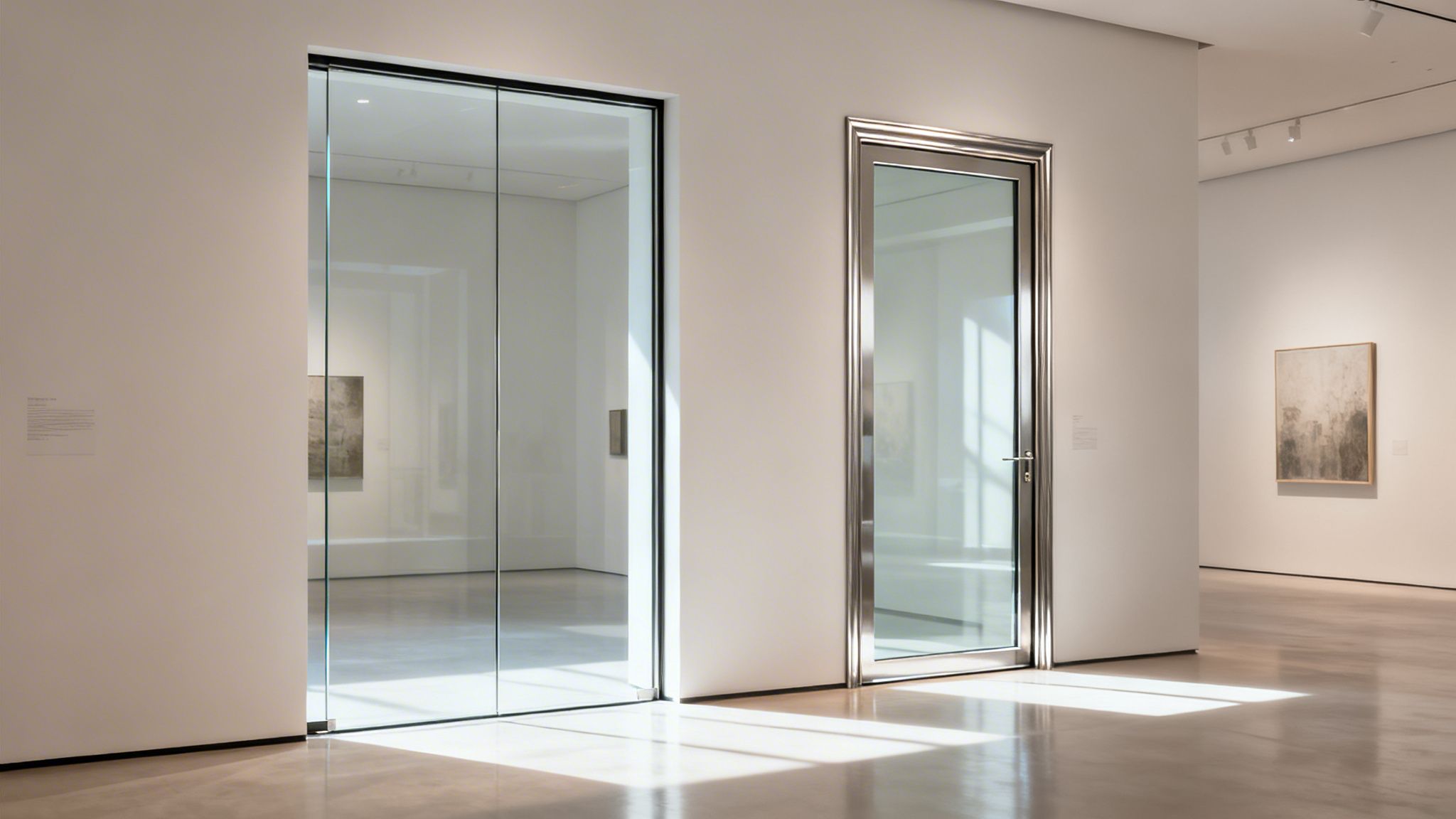
Framed doors feel more forgiving
A framed glass door is like a picture frame around artwork. The perimeter is visible, defined, and supportive. In an office, that usually means an aluminum frame tied cleanly into the surrounding wall system.
That frame helps in ways brochures rarely emphasize. It gives the installer more control over alignment, makes seals easier to integrate, and usually handles busy traffic better. When floors are not perfectly level, framed systems are often less fussy.
This is one reason many facilities teams use framed fronts near modular areas and circulation-heavy zones. If your project includes glass cubicle walls, framed doors often coordinate more easily with adjacent panels, power routes, and furniture lines.
Frameless doors favor visual continuity
Frameless doors are closer to a gallery-wrap canvas. The glass reads as one continuous plane, with discreet fittings and less visible structure. They can look excellent in executive offices, design studios, and client-facing conference rooms where appearance matters.
The trade-off is that the glass and hardware have to do more work. The system relies on precise fabrication and tighter field conditions. Small installation issues stand out more because there is less frame to absorb them visually.
Fixed glass wall panels often use 1/2-inch (12.7 mm) thick laminated low-iron glass, with headers sized specifically by door type. Pivot doors use a 1-3/4 inch wide by 1-3/16 inch high header, while sliding doors use a 1-3/4 inch high by 3-3/8 inch wide header, and shimming blocks can accommodate floor unevenness up to 46 mm, according to the CARVART specification. That matters because frameless systems depend heavily on correct header and floor coordination.
Which one usually works better
There is no universal winner. There is only fit.
A framed door is usually the safer choice when you need:
- Better acoustic potential
- Cleaner integration with access control
- More tolerance for uneven floors
- A simpler path for frequent daily use
A frameless door is often the right choice when you need:
- A minimal appearance
- High daylight transfer
- A lighter visual line in small offices
- A stronger architectural statement
Practical rule: If the room has to perform first and impress second, framed usually wins. If the room has to impress first and the privacy demands are moderate, frameless becomes more attractive.
The mistake is choosing frameless because it looks “higher end” without checking whether the room needs stronger seals, easier serviceability, or more forgiving installation tolerances. In many first office projects, the framed option ends up being the more professional choice because it causes fewer downstream headaches.
Choosing Between Swing and Sliding Door Mechanisms
Once the frame style is set, the operating method becomes the next real fork in the road. This choice affects circulation in often underestimated ways.
Swing doors suit enclosed rooms
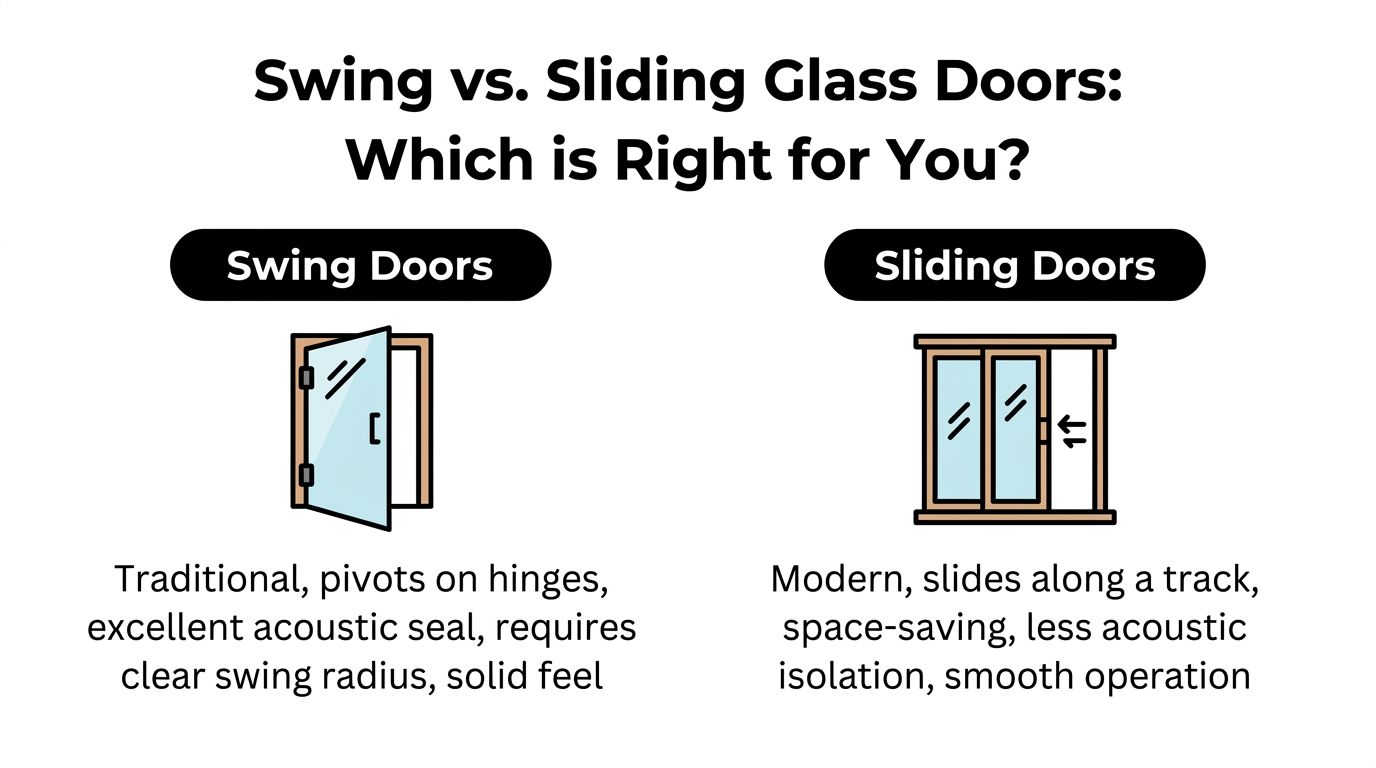
Swing doors feel familiar because they are. A hinged or pivoted leaf closes with a solid motion, works well with closers and seals, and tends to feel more secure in private offices and conference rooms.
That said, swing doors consume floor area every time they open. In a roomy perimeter office, that may not matter. In a compact interior room next to workstations or storage, it matters a lot.
You also need to watch where the leaf lands. A glass swing door should not cut across a major circulation route, interfere with filing, or force someone to sidestep a chair to get in.
Sliding doors protect usable floor space
Sliding doors solve the swing-radius problem. They move laterally, which makes them useful in smaller rooms, tighter hallways, and layouts where desks sit close to the front.
They are especially helpful in offices planned around modular furniture because they preserve the area near the opening. If you are laying out enclosed rooms near workstations, review the relationship early with office sliding doors, not after the furniture is already set.
The trade-off is seal quality. Sliding doors rarely close as tightly as a well-detailed swing door. They can still work very well, but they are usually a weaker acoustic choice unless you add better edge detailing and hardware.
The mechanism comparison that matters
| Feature | Swing Doors (Pivot/Hinged) | Sliding Doors (Top-Hung/Barn) |
|---|---|---|
| Spatial footprint | Needs clear swing area | Saves floor space near the opening |
| Acoustic potential | Usually stronger with seals | Usually weaker unless detailed carefully |
| User feel | Traditional and solid | Smooth and modern |
| Traffic flow | Can interrupt circulation if poorly placed | Better in tight layouts |
| Maintenance focus | Hinges, closer, latch alignment | Track alignment, rollers, soft-close parts |
| Best-fit rooms | Private offices, meeting rooms | Compact rooms, pinch points, small fronts |
Top-hung usually beats flush-track in offices
In commercial interiors, top-hung sliders often age better than flush-track concepts when the floor sees dirt, debris, or frequent cleaning. A clean floor line looks nice, but office environments are not photo studios. Tracks at the floor can become a maintenance issue if coordination is sloppy.
That does not mean flush details never work. It means they should be specified carefully, especially in busy spaces.
A practical selection approach looks like this:
- Choose swing when speech privacy, closure consistency, and room formality matter more than floor footprint.
- Choose sliding when every square foot near the opening counts and the room use can tolerate some acoustic compromise.
- Choose pivot over standard hinge when the design wants a more architectural feel and the surrounding system supports it.
- Choose top-hung sliding when you want cleaner long-term service in a commercial office setting.
Key takeaway: If people will complain about noise, start with swing. If people will complain about cramped circulation, start with sliding.
Many first-time specifiers overvalue aesthetics here. Daily movement patterns are usually the better guide. If the room front sits beside benching, storage towers, or a main aisle, the wrong door mechanism becomes visible immediately because everyone has to work around it.
Selecting Hardware and Patch Fittings That Last
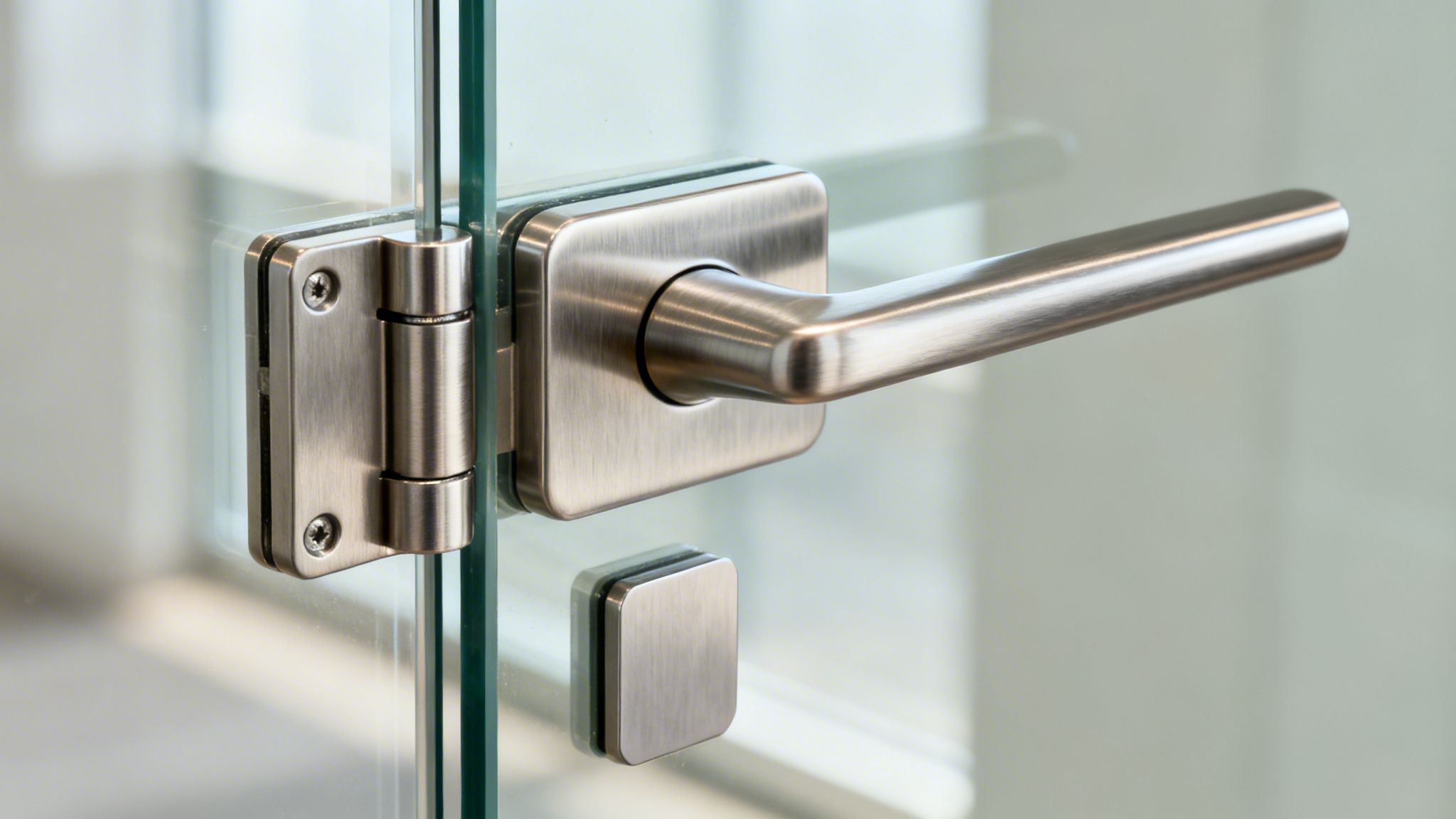
The fastest way to ruin a good-looking glass front is cheap hardware. The glass gets the attention, but the hardware takes the abuse.
Start with the load, not the finish
Facilities teams often choose handles and fittings by appearance first. That is backwards. Start with door weight, frequency of use, and closer requirements. Then pick the finish.
For frameless glass doors, patch fittings and pivots need special attention because they carry both structural and alignment demands. For framed doors, hinge quality and closer compatibility matter more than the profile shape of the pull.
Heavy-duty hinges for frameless glass doors can support up to 400 lbs for single doors. Standard hardware handles up to 176 lbs, while heavy-duty options manage up to 353 lbs. Interior non-fire-rated doors also need opening forces kept under the 5 lbf ADA standard, according to Texas Glass Door hardware specifications. Those are not decorative details. They determine whether the door feels controlled or troublesome.
Hardware choices that hold up in offices
Some components consistently earn their keep in commercial settings:
- Closers: A self-closing door helps with privacy, safety, and room discipline. In meeting rooms, it also prevents doors from being left cracked open all day.
- Pulls and lever sets: Ladder pulls look clean, but they are not always the best answer if you need latching hardware or controlled entry.
- Locks and strikes: Conference rooms, HR rooms, and IT spaces often need more than a passage set. Confirm access expectations early.
- Seals: These are easy to value-engineer out, and that usually creates regret later.
Ask better vendor questions
The right conversation with a supplier is rarely “What hardware package comes standard?” A better sequence is:
- What closer is paired with this leaf weight and width?
- How is the bottom edge controlled on a frameless pivot?
- Can the lockset coordinate with access control later if we phase it?
- What gets serviced most often after installation?
- What hardware finish hides fingerprints and wear in daily use?
One useful planning step is to compare the door package to the rest of the furniture environment. If the enclosed rooms sit within a larger workstation plan, the finish and operation should feel intentional next to adjacent panels and workstation cubicles, not like an isolated storefront detail dropped into an office.
Tip: If the vendor cannot explain how the closer, lock, pull, and seals function together as one assembly, the package is not resolved yet.
A door in glass wall system succeeds when the hardware disappears into routine use. People should not have to pull too hard, push twice, catch the leaf with a shoulder, or wait for a drifting slider to settle. Long-term performance starts with the boring parts. That is usually where the smart money goes.
Navigating Acoustics Privacy and Code Compliance
Most buyer frustration with glass rooms comes from one of three issues. The room is louder than expected, privacy is weaker than promised, or the installation runs into code questions late in the process.
Acoustics usually fail at the edges
People tend to focus on the glass itself. The bigger acoustic story is at the perimeter. Gaps at the head, jamb, and bottom of the door can undermine an otherwise respectable assembly.
That is why framed swing doors often outperform cleaner-looking alternatives in real workplaces. They make it easier to use perimeter seals, door bottoms, and more controlled closure. If the room is for interviews, manager conversations, or concentrated solo work, those details matter more than a minimal sightline.
Some systems are built specifically around this trade-off. Full framing and integrated profiles can deliver sound protection up to 39 dB, as noted in the earlier specification discussion. That is not a guarantee of silence, but it is a reminder that acoustics come from system detailing, not from glass alone.
For broader workplace planning, it helps to align room fronts with office acoustics solutions instead of treating sound control as a late fix.
Privacy is visual and conversational
A clear room can still be private enough for many uses if sound is controlled. On the other hand, a frosted band or decorative film can improve visual privacy while doing very little for speech privacy.
That is why room purpose matters. If people only need visual separation, films and partial frosting may solve the problem. If they need conversational privacy, door seals and closure quality become the first concern.
Code and safety cannot be an afterthought
Accessibility and life-safety requirements influence door choice early. Opening force, clear passage, maneuvering space, hardware operation, and local code interpretations all shape what is practical.
Security also belongs in this conversation. In a 2024 survey, 51% of facility professionals identified glass doors and windows as the perimeter systems most likely to fail against intruders. Confidence in glass performance against firearms dropped nearly 10% from 2022 to 2024, according to Campus Safety’s glass security coverage. For office interiors, that does not mean every room needs hardened glazing. It does mean security assumptions around glass should be deliberate, not casual.
A practical compliance review should include:
- Door force and operation: Interior doors need to open without excessive force and without awkward user effort.
- Clear opening: Confirm the door and hardware leave adequate usable passage.
- Safety glazing: Make sure the specified glass and markings suit the application.
- Locking function: Avoid hardware choices that create egress problems.
- Security level: Match the room’s exposure and risk profile to the actual glass and hardware package.
Practical rule: If the room handles confidential conversations, start with the door perimeter details. If the room handles public-facing traffic, start with accessibility and durability. If the room has elevated security concerns, review glazing and locking assumptions before finishes.
The cleanest-looking option is not always the compliant one, and the most transparent room is not always the most usable. In office glass fronts, good specification is mostly about choosing which compromises you can live with every day.
Installation Coordination and Cost Considerations
Most installation problems are coordination problems in disguise. The glass itself is usually not the issue. The issue is what happened before the glass arrived.
Field conditions decide how smooth the install feels
A door in glass wall system depends on accurate measurements, stable floor conditions, and a realistic sequence. If flooring changes height at the room front, or the ceiling condition shifts after measurements, the door package may need rework.
Many first projects lose time at this stage. The facilities manager assumes the glass vendor will “make it work” in the field. Good crews can solve some issues, but not all of them. Glass systems are less forgiving than painted drywall when dimensions drift.
Cabling is where many projects stall
Electrical and data routing become difficult fast in glass-heavy plans, especially when enclosed rooms sit beside modular stations. A 2025 IFMA report found that 74% of facilities managers struggle with power and data cabling integration in glass-heavy office designs, and 40% of projects face delays due to non-compliant cable routing, as summarized in this folding glass wall reference. In practice, that is one reason framed partitions remain useful. They can conceal conduits and simplify certain power pathways.
If your office plan combines enclosed glass fronts with benching, private offices, and reconfigurable stations, cabling should be resolved with the furniture plan. Do not leave it for the electrician to improvise after the walls are approved.
This is also the stage where project teams often coordinate office furniture installation alongside room fronts so the trades are working from one sequence instead of reacting to each other on site.
What usually drives cost
Without inventing a universal number, the main budget drivers are consistent across projects:
- Glass specification: Laminated, low-iron, specialty finishes, and security-oriented glass affect price.
- Door type: Frameless and sliding systems often demand more precise hardware and installation.
- Hardware package: Closers, locks, access prep, and acoustic details add up quickly.
- Field complexity: Uneven floors, off-module room sizes, and retrofit conditions raise labor.
- Trade coordination: Electrical, flooring, and ceiling conflicts cost money when resolved late.
A few cost-control moves usually help:
- Standardize room fronts where possible. Repetition simplifies procurement and install.
- Lock furniture and wall layouts together early. This reduces site changes.
- Avoid decorative customization that adds no functional value.
- Spend on hardware before spending on cosmetic upgrades.
One office-planning option teams use during this phase is the Cubicle By Design custom cubicle designer, which lets planners work through layout, dimensions, privacy levels, and electrical options before room-front decisions drift into guesswork.
The cheapest-looking path on paper often gets expensive in coordination. The better strategy is to simplify the interfaces between the glass, the furniture, and the power plan.
Your Glass Door Decision Making Checklist
The most useful checklist is not a generic buying guide. It is a short set of questions that force clarity before a quote turns into a commitment.

Ask these before you approve anything
- What is the room used for most of the day? A focus room, interview room, and casual meeting room should not share the same assumptions.
- Which matters more here, footprint or acoustic control? That answer usually settles swing versus sliding.
- Do the floors and ceilings support the system cleanly? If the field conditions are rough, minimal details become harder to execute well.
- Will the room need a lock now or later? Future-proofing access is easier before fabrication.
- Is the nearby furniture fixed or likely to change? Reconfigurable plans benefit from more flexible coordination choices.
- Who will maintain the hardware? Serviceability should influence hardware selection.
Confirm these details in writing
A lot of frustration comes from assumptions that never make it into shop drawings or approvals.
| Checkpoint | Why it matters |
|---|---|
| Framed or frameless | Affects acoustics, alignment, and look |
| Swing or sliding | Affects circulation and room usability |
| Glass type | Influences privacy, safety, and feel |
| Hardware finish | Impacts wear appearance and cleaning |
| Locking function | Shapes security and egress behavior |
| Door closer type | Controls safety, seal consistency, and user experience |
Final filter: If the vendor proposal looks polished but does not clearly address room use, hardware, field conditions, and coordination, it is still incomplete.
For broader planning, it also helps to review the surrounding workspace. Enclosed rooms rarely live alone. They connect to circulation, shared areas, and adjacent cubicles or private office cubicles. The strongest door decisions come from looking at the office as one operating system, not a collection of isolated products.
Frequently Asked Questions About Doors in Glass Walls
Can I add a door to an existing glass wall
Sometimes. Modular systems are more adaptable because a fixed panel can often be replaced with a door module if the header and adjacent conditions allow it. Fully custom, permanently installed glass fronts are usually harder to modify. In many retrofits, replacing one section becomes more realistic than trying to alter one panel in place.
What lead time should I expect
Lead time depends on how standard the opening, glass, and hardware package are. A common finish and a straightforward swing door usually move faster than oversized glass, custom hardware, or special locking prep. The practical lesson is to decide earlier than you think you need to.
What usually costs more
Frameless doors, sliding systems, laminated glass upgrades, acoustic detailing, and access-control-ready hardware usually push the budget upward. A simpler framed swing door often keeps both procurement and installation more manageable.
Which door type is safest for a first project
If the room needs dependable privacy and the layout has enough clearance, a framed swing door is usually the least risky specification. It is easier to seal, easier to coordinate, and generally proves more satisfactory for occupants over time.
If you are planning enclosed rooms, reconfiguring hybrid seating, or trying to coordinate glass fronts with modular furniture, Cubicle By Design can help you evaluate layouts, workstation options, and room-adjacent planning with practical office furniture guidance.