

If you ask someone to picture an office cubicle, they're probably thinking of a 6'x6' space. It's the classic, the industry standard that gives you 36 square feet of personal workspace. This size really hit the sweet spot for balancing an employee's needs with the practical realities of an office floor plan. At Cubicle By Design, we've seen this dimension serve as the foundation for countless efficient office layouts.
What The Standard Cubicle Size Means Today
You can think of the 6'x6' cubicle as the reliable sedan of the office world. It's functional, gets the job done, and works for a huge range of professional roles. But just knowing the average isn't enough anymore.
A modern office needs a more thoughtful approach than just defaulting to the standard. Different jobs demand different tools, different amounts of space, and different levels of privacy. The right size is always more important than the average one.
The 6'x6' footprint still reigns supreme, comfortably accommodating about 80% of general administrative roles. Panel heights usually land somewhere between 53 to 65 inches, striking a great balance between private, focused work and easy collaboration. To give you a real-world idea, a 10,000-square-foot office can typically fit around 225 of these workstations once you account for aisles and common areas.
Common Cubicle Sizes At A Glance
To help you get a feel for the different options, here's a quick rundown of the most common cubicle footprints and what they're typically used for.
| Cubicle Size (W x D) | Total Square Feet | Primary Use Case |
|---|---|---|
| 5' x 5' | 25 sq ft | High-Density, Call Center, Task Work |
| 6' x 6' | 36 sq ft | Standard Professional, Admin Staff |
| 6' x 8' | 48 sq ft | Professional with More Equipment |
| 8' x 8' | 64 sq ft | Management, Focused Work, Meetings |
Getting a handle on these basic sizes is the first step toward creating a workspace that actually helps your team do their best work. For a more detailed breakdown, you can dive into our complete guide on standard cubicle dimensions.
Matching Cubicle Dimensions To Job Functions
Picking the right cubicle isn't just about filling up your floor space; it’s about creating an environment that actually helps people do their best work. A one-size-fits-all approach is a recipe for frustration and lost productivity, since different roles have wildly different needs for space, privacy, and collaboration. The real secret is matching the cubicle footprint directly to the job function.
Think of it like choosing the right tool. You wouldn't use a sledgehammer for a delicate repair, and you definitely wouldn't give a tiny desk to a designer who needs to spread out massive blueprints. When the dimensions fit the daily tasks, you're giving your team the resources they need to knock it out of the park.
This breakdown shows how the standard 6×6 cubicle hits that crucial balance between personal workspace and overall efficiency.
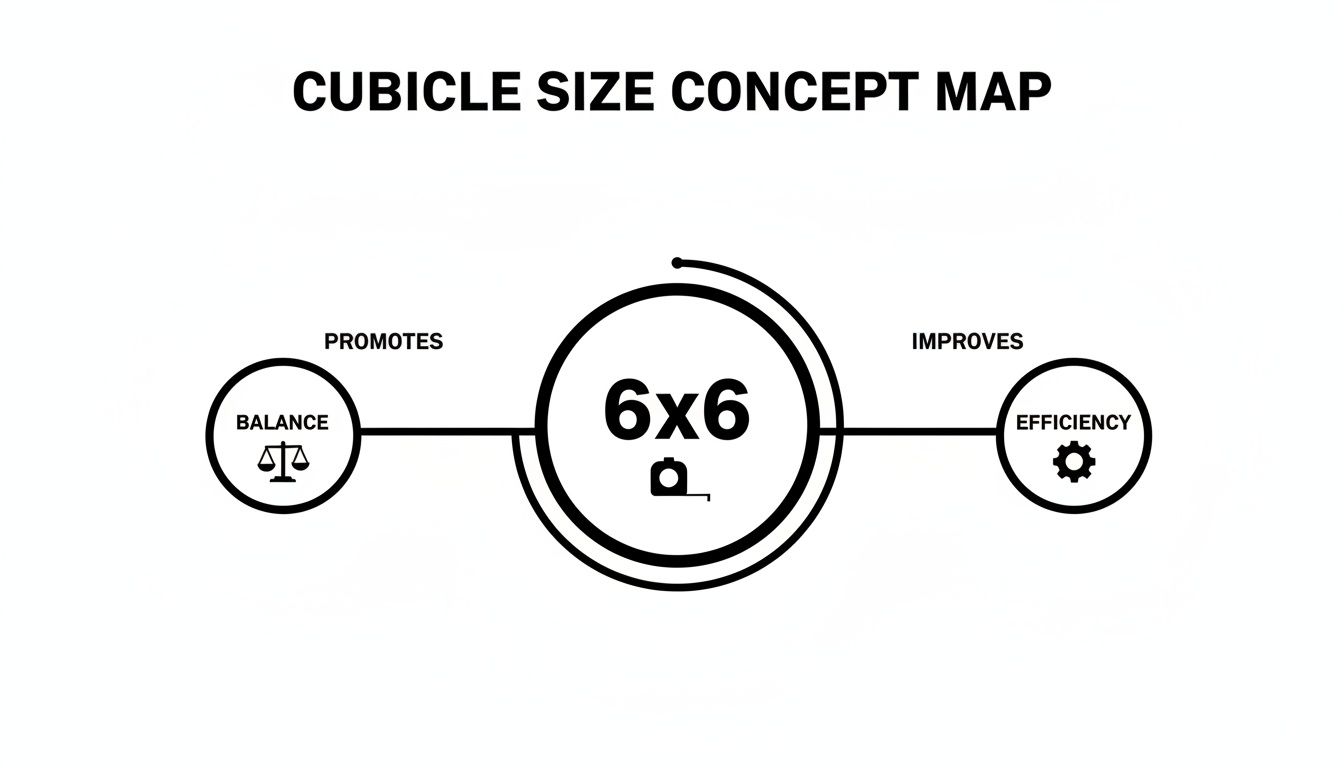
As you can see, this common size provides a solid middle ground, making it a dependable starting point for a lot of office layouts.
Small Footprints For High-Volume Roles
For high-density environments like call centers or data entry teams, efficiency is everything. The goal is to maximize your headcount in a given space while still giving each person a functional spot to work. This is where smaller cubicles really shine.
A 5'x5' workstation, giving you 25 square feet, is the go-to solution here. This compact size provides just enough room for a computer, a phone, and minimal paperwork. It’s perfect for task-oriented roles that don't require much storage or elbow room, allowing you to boost your team size without leasing more real estate.
The Professional Sweet Spot
The 6'x6' and 6'x8' cubicles are the undisputed workhorses of the modern office. These sizes hit that sweet spot for most professional and administrative staff, offering a healthy balance of personal space and floor plan efficiency. A 6'x6' cubicle provides 36 square feet, which is plenty of room for a dual monitor setup, a decent chair, and personal storage.
When a role demands a bit more—maybe extra equipment or surface area for laying out documents—the 6'x8' is an excellent upgrade. Its 48 square feet can easily accommodate an L-shaped desk, creating separate zones for computer work and other tasks. There's a reason you see these versatile sizes in so many corporate offices.
Spacious Workstations For Management And Focus
Managers, executives, and anyone whose role requires deep concentration or frequent private meetings need more than just a desk. They need a functional office within the office, and that's where larger dimensions come into play. An 8'x8' cubicle or bigger essentially transforms a standard workstation into a semi-private office.
With 64 square feet or more, you suddenly have enough room for a large desk, guest chairs for one-on-one meetings, and beefed-up storage like filing cabinets or bookcases. Our private office cubicles are a perfect example of this.
These larger footprints are almost always paired with higher panels—65 inches or more—to provide the acoustic and visual privacy needed for confidential discussions and heads-down, focused work.
It's interesting to see how this fits into the bigger picture. Globally, the average office space per employee ranges from 75 to 175 square feet, with cubicle sizes generally shrinking over the decades. In North America, the gold standard is around 150-175 sq ft per person. A typical 36-48 sq ft cubicle fits nicely into that, leaving plenty of room for collaborative zones and walkways. You can learn more about how typical office cubicle sizes fit into these broader design trends.
Planning Your Office Layout Beyond The Cubicle
Choosing the perfect cubicle size is a huge first step, but how you arrange them on the floor is what truly separates a functional workspace from a frustrating maze. Think of your office floor plan as a small city. The cubicles are the buildings, but you absolutely need well-planned roads (aisles) and essential utilities (power and data) to make it a place people can actually work.
This is where effective space planning comes in. It’s all about creating a natural flow for people walking around, making sure everyone can get to printers and break rooms, and keeping the whole place accessible. Without that foresight, even the best-designed cubicles will just lead to a cluttered, unproductive mess.
Mastering Aisle Width And Accessibility
One of the most common—and costly—mistakes we see is underestimating aisle space. Trying to cram in one too many workstations might look good on paper, but in reality, it just creates traffic jams and major accessibility problems. Following ADA guidelines isn't just about checking a legal box; it's a best practice for creating a comfortable office for everyone.
To keep things moving and stay compliant, your main walkways should be a bare minimum of 36 inches wide. For those high-traffic "main streets" that see people coming and going all day, you really want to expand that to 44-48 inches.
And don't forget about chair "swing space"! Someone pushing back from their desk can instantly block an aisle. Building in a little extra buffer prevents those constant "excuse me's" and accidental collisions.
Integrating Power And Data Seamlessly
In any modern office, reliable access to power and data is completely non-negotiable. The trick is to plan for these utilities before a single cubicle panel is installed. Trust us, retrofitting electrical and network drops later is a massive headache that costs way more in time and money than just doing it right from the start.
Think through these key elements while you're still in the planning phase:
- Outlet Placement: How many plugs does each person really need? Count up monitors, computers, phone chargers, and desk lamps. Most modern cubicles have slick integrated power poles that hide the wiring right inside the panels.
- Data Ports: Is your team plugging into wired Ethernet, or are you all-in on Wi-Fi? Plan where your data ports will go right alongside the electrical outlets for a clean, organized setup.
- Future Growth: Always plan for more capacity than you need today. It's so much easier to add a few extra data drops now than it is to tear things apart to expand your network later.
When you're mapping out the big picture, knowing how to work with floorplans and commercial spaces is fundamental to getting the design right. A truly great layout considers how every single element—not just the average cubicle size—works together. For a deeper dive into creating a layout that works, check out our expert advice on office space planning and design.
How To Choose The Right Cubicle Size For Your Team
It’s one thing to know the average cubicle size, but it’s another thing entirely to find the right size for your people. That's where a truly productive office is born. The best choice has less to do with industry standards and everything to do with the real-world demands your team faces every single day.
To get this right, you have to go beyond just the measurements and really think about daily workflow. Start by asking detailed questions about how your team actually gets their work done. This is the foundational step that ensures you’re investing in a solution that helps them, not hinders them.
The goal is to create a workspace that feels custom-fit to the tasks performed within it. When the environment aligns with the work, employees are empowered to perform at their best, leading to better focus and higher quality output.
This isn’t just about buying furniture; it's a strategic decision that digs into your team's specific needs.
A Practical Checklist For Choosing The Right Size
Use this checklist to break down what each role or department requires. Answering these questions will give you a crystal-clear picture of what your team truly needs to thrive, ensuring you pick a footprint that actually enhances how they work.
- What are their primary daily tasks? Is the job all about deep, focused work like coding or writing? Or is it more about collaboration and constant communication? This first question helps you figure out the right balance of privacy and desk space.
- What equipment is essential? Make a real list of everything that needs to live on or around the desk. Think about the number of monitors, docking stations, physical phones, or any specialized hardware. A dual-monitor setup alone usually demands a wider workstation to keep things from feeling cramped.
- How much storage do they need? Do your people need quick access to physical files, bulky binders, or product samples? You'll want to plan for built-in storage like pedestals or overhead bins to keep their work surfaces clear and organized.
- Is collaboration or privacy the priority? For teams that need to talk constantly, lower panels might be the way to go. But for roles that handle sensitive information or require intense concentration, you'll want taller panels and a more spacious layout.
- How will hybrid work impact your needs? If employees are only in the office a few days a week, you might lean toward a more flexible, hoteling-style setup. This approach can save a ton of space while still giving everyone a fully-equipped station when they need it.
Thinking through these points gets you out of a generic conversation about average sizes and into a specific plan tailored to your organization. It's a deliberate approach that makes sure your investment directly supports your team's success. For more on this, you can read our guide on whether cubicles are right for your office to gain some extra perspective.
Visualizing Your Space With Sample Floor Plans
Theory and checklists are great, but sometimes you just have to see it to believe it. To make all these concepts click, let's walk through three completely different floor plans for a hypothetical 2,000 sq ft office. Seeing how the average cubicle size plays out in a real-world scenario can really spark some ideas for your own space.
Pay attention to the trade-offs each example makes between headcount, individual space, and the overall feel of the office. Each layout tells a different story about a company’s priorities—whether it’s maximizing every square foot or building a more open, collaborative culture.
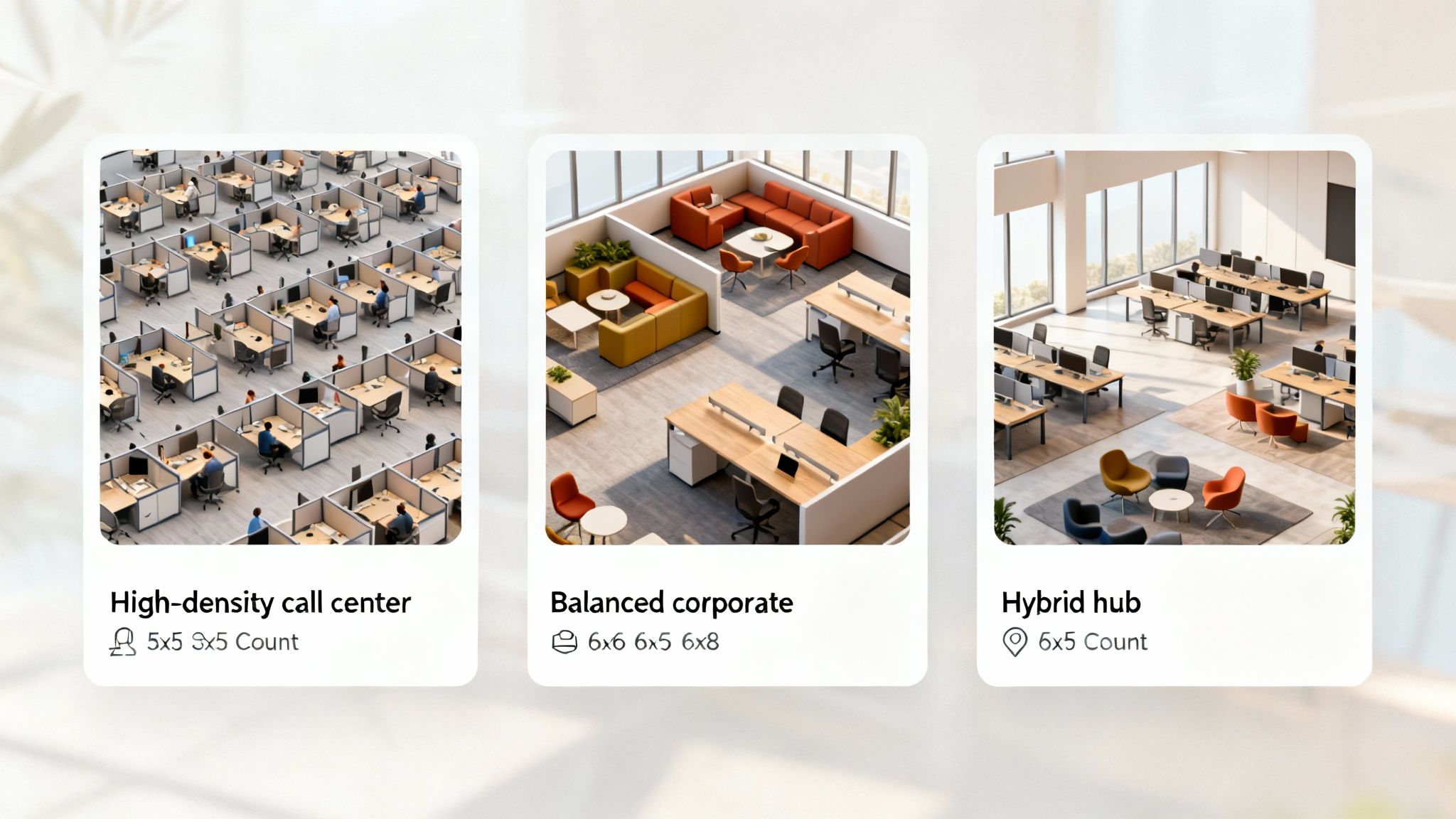
Layout 1: The High-Density Call Center
Picture a fast-paced sales floor or a busy support center. Here, the number one goal is fitting as many people as possible without it feeling chaotic. This layout leans heavily on compact 5'x5' workstation cubicles to get the job done.
- Capacity: You can comfortably fit approximately 30-35 employees in this setup.
- Atmosphere: It’s all about high energy. The environment is buzzing, and information flows fast.
- Best For: Phone-heavy, task-based roles that don't require a ton of desk real estate.
Layout 2: The Balanced Corporate Office
This is the classic, tried-and-true approach. It’s a smart blend of different cubicle sizes to serve a variety of roles within the company. It might feature standard 6'x6' cubicles for most of the team, slightly larger 6'x8' stations for supervisors, and a few 8'x8' private office cubicles for managers who need more privacy.
- Capacity: This balanced plan works well for around 20-25 employees.
- Atmosphere: The vibe is structured and professional. There are clear departmental zones and a functional, easy-to-understand flow.
- Best For: Traditional company structures with diverse roles that demand different levels of space and privacy.
Layout 3: The Modern Hybrid Hub
This layout is all about flexibility and reflects the huge shift in how we work today. It has fewer dedicated workstations—maybe a handful of spacious 6'x8' stations for deep focus—but adds in open collaborative zones, touchdown spots for visiting staff, and small meeting pods.
- Capacity: This model is designed for a smaller on-site headcount, typically 12-18 employees at any given time.
- Atmosphere: It feels open, dynamic, and collaborative. It encourages people to move around, interact, and work together.
- Best For: Companies embracing a hybrid model where the office is mainly a hub for team projects, meetings, and building connections.
This trend toward adaptable, multi-purpose spaces is also taking over the coworking world. Data from shared workspaces shows the average North American facility provides about 97 sq ft per person, mixing dedicated desks with flexible hot-desking options to meet changing demands.
Hopefully, seeing these layouts gives you a solid starting point. When you’re ready to start playing with your own ideas, you can transform your office with our interactive cubicle designer and bring that vision to life.
Common Questions About Cubicle Sizes And Planning
Even the best-laid plans run into a few last-minute questions. When you're designing an office layout, getting clear answers to those lingering details can make the final steps feel a whole lot smoother. We’ve put together a few of the most frequent questions we hear about cubicle sizes and how they fit into the bigger picture.
Think of this as your final check-in before you commit to a design. By sorting out these common points now, you can move forward feeling confident that you’ve covered all your bases for a truly great workspace.
What Is The Most Common Cubicle Size In Modern Offices?
The classic, go-to size for a standard cubicle is 6'x6', giving you a solid 36 square feet of personal workspace. It’s been a popular choice for decades for a good reason—it just works. This footprint strikes a great balance, easily fitting a desk, an ergonomic chair, and a bit of storage without making an employee feel boxed in.
Office design trends come and go, but the 6'x6' cubicle remains a cost-effective and efficient staple. It’s a workhorse for a huge range of professional and administrative roles. In fact, many of our modular cubicles are ordered in this very configuration because of its proven ability to balance employee comfort with smart floor plan usage.
How Do I Account For Walkways And Common Areas In My Layout?
This is a big one. It's easy to get caught up in the number of workstations and forget to leave room for people to actually move around. Planning for circulation and shared areas is a critical step that, if missed, can lead to a cramped, frustrating office.
As a rule of thumb, major walkways need to be at least 44-48 inches wide. This isn't just for comfort; it ensures you meet ADA guidelines and allows two people to pass without doing a sideways shuffle. For the smaller aisles between rows of workstation cubicles, you’ll want a minimum of 36 inches.
Here’s a helpful trick: once you’ve calculated the total square footage for all your cubicles, tack on an extra 25-35%. That buffer will cover your hallways, break rooms, printer stations, and other shared spaces.
Are Smaller Cubicles Becoming More Popular With Hybrid Work?
The shift to hybrid work has had an interesting, and somewhat divided, impact on cubicle sizes. On one hand, yes, some companies are leaning into smaller, unassigned "hoteling" stations. Think compact 5'x5' setups that support a team that’s in and out of the office. It’s a practical way to maximize space when you don't have a full house every day.
On the other hand, many businesses are going in the completely opposite direction. They see the office as a destination for focused, collaborative work and want to make the on-site experience a major draw. For them, upgrading to spacious 6'x8' or even 8'x8' private office cubicles makes coming to the office more comfortable and productive. The right move really boils down to your company's culture and what you want your physical workspace to achieve.
What Cubicle Panel Height Is Best For Privacy?
Panel height is your primary tool for controlling both visual distractions and the ambient noise level in the office. The right height is all about the kind of work your team is doing.
Here’s a quick breakdown of the most common choices:
- Low Panels (around 42 inches): These are perfect if you want to cultivate an open, collaborative vibe. They allow for easy conversation and sightlines across the room but offer almost no privacy.
- Mid-Height Panels (53-54 inches): This is the sweet spot and our most popular option. It provides "seated privacy" for focused work but still lets managers see across the office when they stand up.
- High Panels (65 inches or taller): When a role requires deep concentration or involves confidential information, tall panels are the way to go. They create serious visual and acoustic separation, giving you a private office feel within a flexible system.
Getting these details right can make or break an office design. You can play around with all these options and more using our interactive Cubicle Designer tool.
At Cubicle By Design, our goal is to help you build a better workplace with furniture that truly fits your team. From the first sketch to the final installation, we’re here to provide the expertise and products to bring your vision to life.
Ready to start designing your ideal office? Visit us online today!