


Most facilities managers reach the same point eventually. The office feels too open for focused work, too closed off for collaboration, or too patchworked after years of quick fixes. A few cubicles here, a drywall room there, one conference area that leaks sound, and a reception zone that looks darker than it should.
That’s usually when glass enters the conversation.
Glass for office planning isn’t only about making a space look modern. It’s a tool for shaping how people work. It can define rooms without cutting off daylight, create privacy without making the floor feel heavy, and help a workplace feel more organized without a full structural rebuild.
The tricky part is that many first-time buyers focus on appearance first. They compare clear versus frosted glass, or framed versus frameless systems, before they’ve answered the harder questions. How much sound control do you need? Which areas require safety glazing? What will maintenance look like after installation? How do you compare glass walls to cubicles in a way that’s fair over the long term?
Those are the questions that matter most on a real project.
If you’re planning a renovation, expanding a hybrid workplace, or trying to turn an open office into a layout with better focus and privacy, the right glass system can help. But the right answer depends on where the glass goes, how the room will be used, and what trade-offs your team can live with.
Glass for Office A Complete Guide to Designing a Modern Workplace
A modern office has to do two jobs at once. It needs spaces where people can talk, meet, and move freely. It also needs places where people can concentrate, take private calls, and work without constant interruption.
That tension is why glass walls have become such a practical design choice. They separate space visually and physically, but they don’t shut down the office the way solid walls often do. When used well, they help an office feel brighter, more defined, and more professional.

Why glass works in so many office layouts
Think about the rooms most companies need today. A meeting room for team huddles. A manager office that still feels connected to the floor. A quiet room for video calls. A front area that looks polished but not intimidating.
Glass can support each of those goals because it solves several problems at once:
- Space definition: It creates real boundaries, so circulation paths and work zones feel intentional.
- Light sharing: Natural light can travel deeper into the floorplate instead of stopping at drywall.
- Visual connection: Teams stay aware of each other without sitting in a fully exposed open plan.
- Adaptability: Many glass systems fit renovation work better than traditional built construction.
For a facilities manager, that combination matters. You’re not buying a style. You’re buying a way to organize people, sound, privacy, and traffic.
Where people usually get stuck
Most confusion starts with one false assumption. If a glass wall looks simple, people assume specifying it will be simple too.
It isn’t.
Practical rule: Start with use cases, not finishes. A conference room, a private office, and a reception divider can all use glass, but they often shouldn’t use the same glass package.
The right decision depends on a few project questions:
- Who uses the room? Executives, clients, HR staff, call center agents, or general office teams all need different levels of privacy.
- What kind of noise lives nearby? A quiet admin suite has different acoustic demands than a sales floor.
- How permanent should the layout be? Some organizations want flexibility for future reconfiguration.
- What does code require in that location? Doors, sidelites, and low glazing can trigger safety requirements.
Good glass design is rarely about one product choice. It’s about balancing transparency, speech privacy, safety, and budget so the office works in daily use, not just on move-in day.
Understanding the Building Blocks of Office Glass Systems
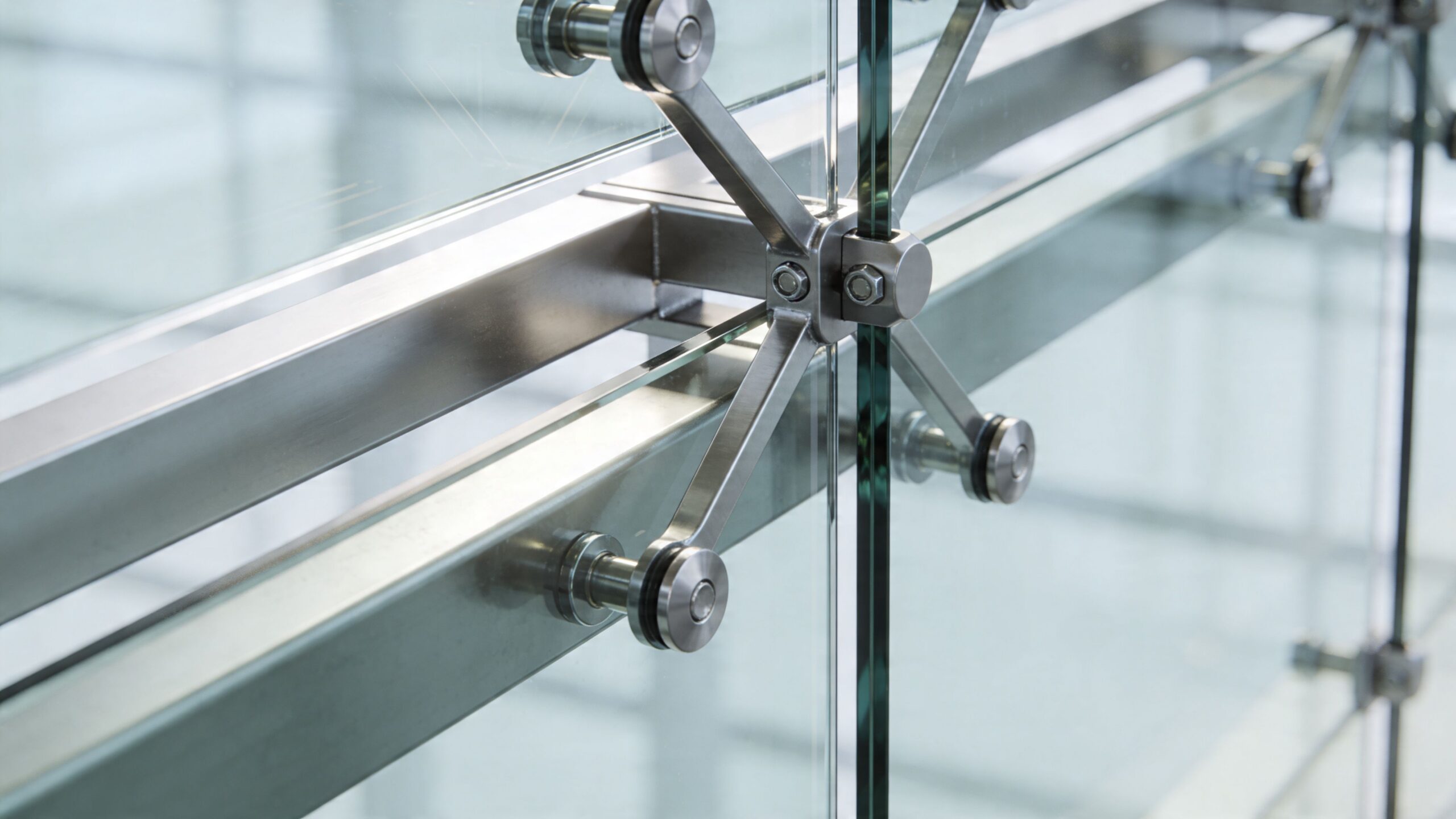
A simple way to understand office glass systems is to separate them into two parts. First, there’s the glass itself, which acts like the core material. Then there’s the system that holds it, which includes the channels, framing, doors, hardware, seals, and connections to the building.
If you only evaluate one side of that equation, you can make an expensive mistake. Strong glass in a poorly planned system won’t perform the way you expect. A clean-looking wall system paired with the wrong glass type can create code problems or weak acoustic results.
The glass as the core material
In office interiors, the first term you need to know is tempered glass. For office environments, tempered glass is the preferred material because of its strength and safety performance. It has flexural strength up to four times that of standard annealed glass, and if it breaks, it fragments into small, blunt granules rather than sharp shards, which is why it’s used to meet safety requirements in locations like doors and partitions under standards such as ANSI Z97.1, according to General Glass tempered glass guidance.
That matters in everyday office conditions. People push doors open with laptops in hand, move rolling chairs into walls, and move through tight corridors during busy hours. Office glass has to handle real contact, not just look clean in renderings.
There’s also laminated glass, which combines layers with an interlayer between them. In office work, laminated glass often comes up when teams want better sound control or another layer of safety performance. It’s commonly specified for spaces where privacy matters more than pure visual minimalism.
The wall system as the support structure
The second building block is the framing or support package. That includes the visible or hidden structure that keeps the panel stable and aligns it with the rest of the room.
A few details in that system affect daily performance more than people expect:
- Door hardware: Handles, closers, pivots, and rails influence feel, swing clearance, and long-term wear.
- Perimeter seals: Small gaps can have a big effect on sound leakage.
- Floor and ceiling conditions: Uneven slabs and ceilings can change installation complexity.
- Panel labeling: Safety labels need to remain visible where required for compliance.
If you’ve ever wondered why one glass conference room feels solid and quiet while another feels rattly and exposed, the answer is often in these support details.
If you want a plain-language explanation of stress, impact, and temperature-related failure, this short guide on why glass breaks is a useful primer before you review specifications with an installer.
Vocabulary that helps during planning
Keep these terms in mind during meetings with vendors, architects, or installers:
| Term | What it means in practice |
|---|---|
| Tempered | Heat-treated safety glass used where strength and break pattern matter |
| Laminated | Multi-layer glass used when added acoustic or safety performance is needed |
| Monolithic | A single piece of glass rather than layered construction |
| Framed system | Glass supported by visible metal framing |
| Frameless system | Glass with minimal visible framing for a cleaner visual line |
Once you understand those basics, product comparisons become much easier and much less intimidating.
Framed vs Frameless Walls A Practical Comparison
Framed and frameless systems can both work well. The better choice depends on what you need the wall to do after the novelty wears off.
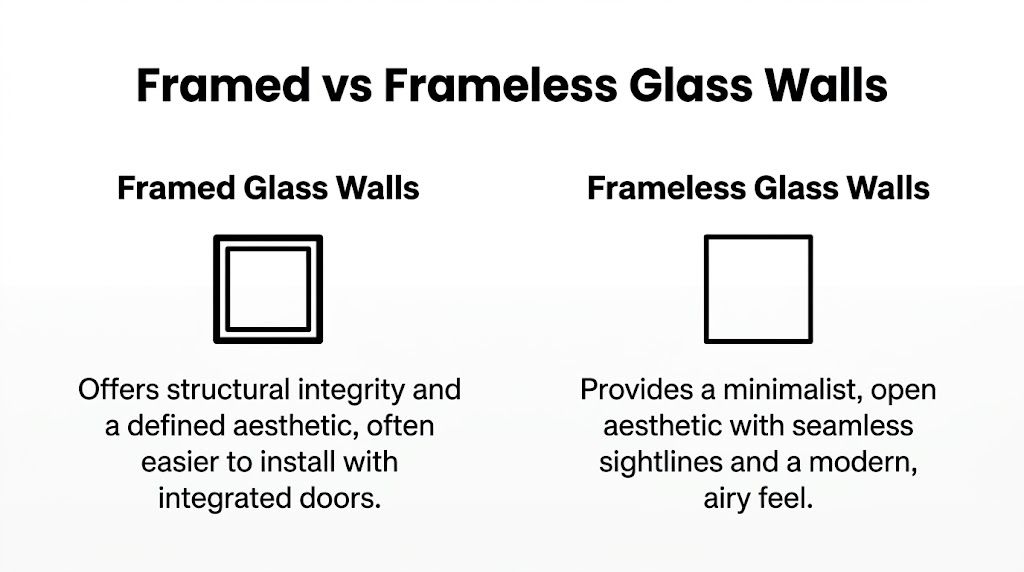
Some buyers choose frameless because it looks lighter. Others choose framed because it feels more architectural and forgiving in real buildings. Both instincts are valid. The difference is in where each system gives you more flexibility and where it asks for more compromise.
Aesthetics and visual effect
Frameless walls are usually the first thing people picture when they say they want a modern office. Sightlines stay clean, corners feel lighter, and rooms look less boxed in. They’re especially popular in reception areas, executive offices, and meeting rooms where transparency is part of the design language.
Framed walls create a different feel. They look more structured, more defined, and often a bit more intentional in busy work environments. In some offices, that’s a benefit. A framed perimeter can visually tie the partition into nearby furniture, doors, and architectural details.
If you’re comparing specific product families, framed systems often align with applications like Series 7 Framed 800 and 700, while a more minimal look aligns with Series 7 Frameless 500. The style decision matters, but it shouldn’t be your first decision.
Installation and site conditions
Real buildings are rarely perfectly straight. Floors drift. Ceilings bow. Existing columns interrupt ideal layouts.
That’s where framed systems often feel easier to manage. The frame can help absorb minor field variation and create cleaner transitions around doors and wall ends. Frameless systems can absolutely be installed well, but they usually demand tighter coordination and cleaner site conditions to achieve the look people expect.
A few situations tend to favor framed construction:
- Older buildings with more tolerance issues
- Projects with frequent door use where visible structure adds a sense of solidity
- Phased renovations where glass must meet existing construction that isn’t perfectly uniform
For door planning, swing clearances, and hardware coordination, it helps to review examples of a door in glass wall before finalizing layout decisions.
Acoustics and daily use
Framed systems often make it easier to build in perimeter sealing and a more enclosed feel. That doesn’t automatically make them quiet, but it can make acoustic detailing more straightforward.
Frameless systems can still perform well acoustically when specified correctly, especially with the right glass package and seals. But the cleaner the visual profile, the more important the detailing becomes. If the project team underestimates small gaps, the room may look premium and still disappoint in use.
The room that looks the most open usually needs the most discipline in detailing.
Budget and trade-offs
Framed walls often give you more visual structure for the money and may be a practical fit when installation conditions are less predictable. Frameless walls usually command more attention because they foreground the glass itself, which means precision and finish quality become part of the value proposition.
If your top goal is a minimalist client-facing space, frameless may earn its cost. If your top goal is a durable, repeatable system across multiple offices or team rooms, framed may be easier to standardize.
A good comparison meeting should end with a plain question: do you want the partition to disappear, or do you want it to organize the room? The answer usually points you in the right direction.
Designing for Privacy and Focus with Acoustic and Visual Options
Privacy is where many glass projects either succeed or disappoint.
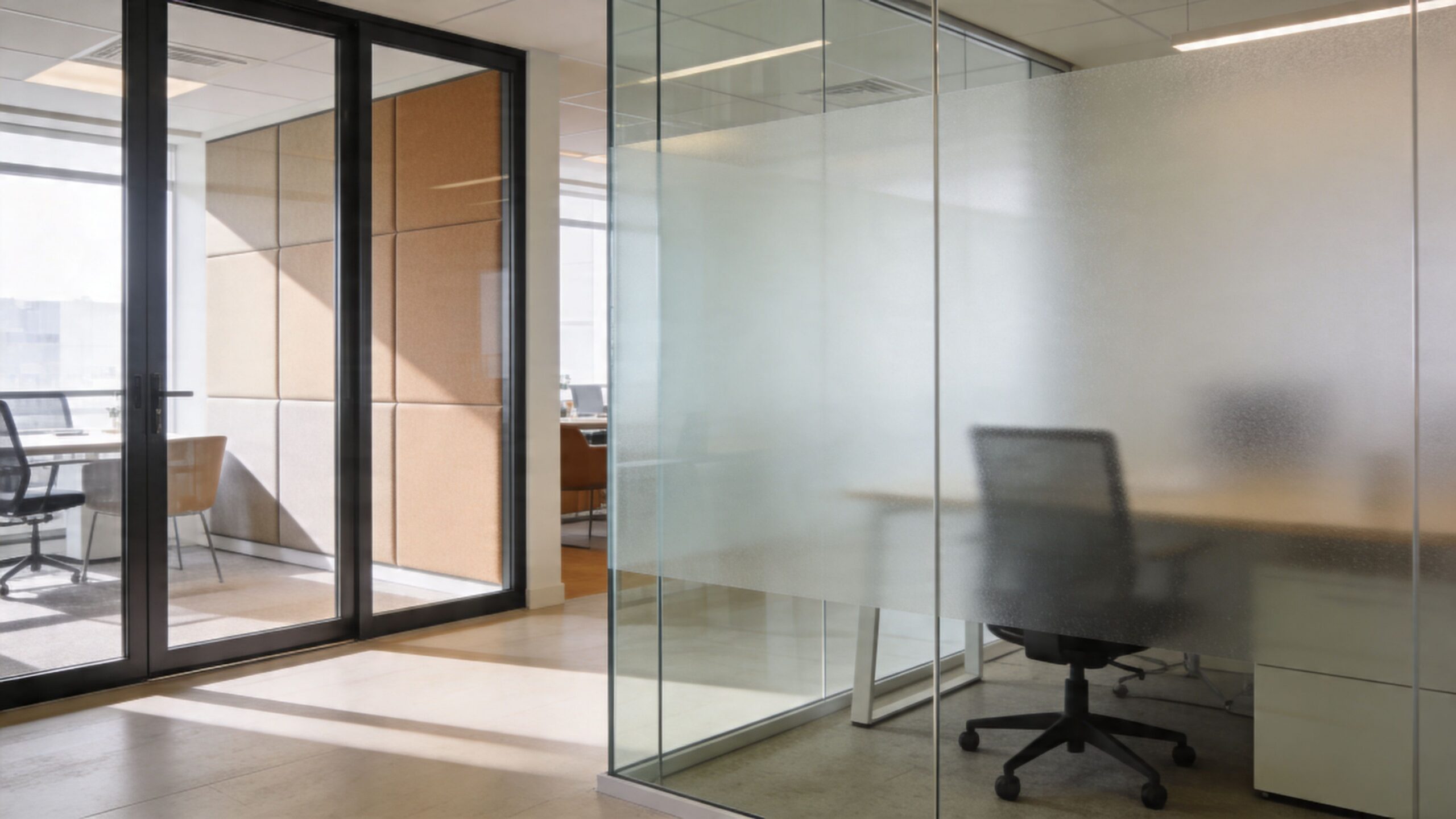
People often use the word “privacy” as if it means one thing, but in office planning it usually means two separate issues. Visual privacy asks whether people can see into a room. Acoustic privacy asks whether they can hear what’s happening inside it. You can solve one and still fail the other.
That’s why a frosted conference room can still leak every word of a budget meeting, and a clear glass room can sometimes perform better acoustically than expected if the glass type and seals are right.
What STC means in plain language
The term you’ll hear most often is STC, or Sound Transmission Class. You don’t need to become an acoustical engineer to use it well. Just think of STC as a shorthand for how much a wall helps reduce sound transfer.
For office glass, the package matters. A standard 3/8″ monolithic tempered glass panel might offer an STC rating of 34-38, while 1/2″ laminated glass can reach 40-45. The laminated interlayer helps damp sound vibration and can reduce perceived noise leakage by 5-10 dB, according to Vitro technical data sheets.
That difference is meaningful in everyday work. It can change a room from “I can follow the conversation outside” to “I know people are talking, but I can’t make out the content.”
Why glass alone doesn’t solve noise
The next point trips up a lot of first-time buyers. A strong glass specification doesn’t automatically give you a quiet room.
Sound often escapes through the weakest parts of the assembly:
- Door edges and thresholds
- Head conditions at the ceiling
- Wall intersections
- Open paths above adjacent cubicles or around nearby construction
This is why two rooms built with similar glass can feel very different. One has continuous seals and coordinated adjacent finishes. The other has a beautiful panel package and several easy paths for sound to slip around it.
Matching the privacy tool to the room
Different spaces need different combinations of visual and acoustic control.
| Room type | Visual privacy need | Acoustic privacy need | Typical glass approach |
|---|---|---|---|
| Conference room | Medium to high | High | Laminated glass, better seals, partial frosting if needed |
| Private office | Medium | Medium to high | Clear or lightly frosted glass with attention to door details |
| Focus room | High | High | Higher-performance acoustic package and minimal gaps |
| Reception divider | Low to medium | Low | Visual design may matter more than speech privacy |
If you’re planning a broader strategy for noise control, office acoustics solutions can help you think beyond the glass itself and coordinate ceilings, panels, and absorptive finishes.
A glass wall is only one part of the acoustic boundary. The room around it matters just as much.
Visual privacy options that don’t overcomplicate the project
Not every room needs switchable glass or a premium acoustic build. Sometimes a simpler treatment solves the core problem.
Common options include:
- Frosted film: Good for sightline control in meeting rooms and HR spaces.
- Gradient film: Useful where you want seated privacy but still want openness above.
- Etched or decorative patterns: Better when branding matters in client-facing zones.
- Clear glass with room placement discipline: Works well when confidentiality is low and daylight is a priority.
The key is to specify privacy based on task, not anxiety. If the room hosts casual check-ins, don’t overbuild it. If it handles confidential calls, don’t underspecify it and hope behavior will compensate.
Real-World Applications How to Use Glass in Your Office
Glass works best when it responds to a specific operating problem. A floor plan usually has a few recurring friction points. Meetings disturb nearby desks. Managers need enclosed offices without visual isolation. Employees struggle to find a place for calls. Visitors walk in and don’t understand the layout.
Those are practical design problems, and glass can solve them in different ways depending on the room.
Conference rooms inside an open floor
This is the most common use case. A team wants enclosed meeting space without building opaque boxes in the middle of the office.
Glass makes sense here because it preserves visibility and keeps the space from feeling carved up. But this is also the room type where expectations tend to run too high. A common misconception is that glass walls completely solve noise. In reality, acoustic glass partitions may achieve STC 35-45, but in hybrid layouts with cubicles, performance can be reduced by flanking paths, and poor acoustics can contribute to a 15% drop in productivity in spaces like call centers, as noted in this discussion of frosted glass partitions and acoustic limits.
That means conference rooms need more than panels. They need door seals, nearby absorptive materials, and careful placement away from the noisiest circulation routes.
Private offices that still feel connected
Managers often want enclosure without disappearing behind drywall. Glass office fronts solve that well, especially when teams value visibility and quick access.
A private office usually benefits from a balanced approach. Full transparency can feel too exposed for some roles, while heavy frosting can make the office feel closed off. Many teams land somewhere in the middle, using clear glass with selective privacy film at seated eye level.
This is also where glass can pair effectively with adjacent modular furniture. If you’re considering a mixed environment, examples of glass cubicle walls are useful for understanding how enclosed rooms and open workstations can coexist without the floor feeling fragmented.
Phone booths and quiet rooms
Not every office needs another conference room. Many need a small, enclosed place for one person to take a video call, handle a sensitive conversation, or focus briefly without leaving the floor.
Glass works well here because the room remains visible and easier to supervise operationally. You can tell whether it’s occupied. The room doesn’t feel claustrophobic. The surrounding office keeps its sense of openness.
A few practical details matter more than finish selections:
- Door swing: Make sure the booth doesn’t conflict with circulation.
- Ventilation: Small rooms need airflow planning.
- Acoustic seals: Tiny gaps become very noticeable in compact spaces.
- Placement: Don’t put a quiet booth directly beside the loudest team zone.
Reception and front-of-house spaces
Reception is where glass often delivers the clearest visual payoff. It can define entry, waiting, and adjacent meeting space while keeping the front area bright and easy to traverse.
Frameless systems are often attractive here because they create cleaner sightlines. But don’t let the front-of-house look drive every other room decision. What works beautifully in reception may not be the right answer for HR, finance, or a call-heavy operations team.
The smartest office layouts treat glass as a kit of parts. One style for the lobby, another for enclosed offices, and another for spaces where acoustic control matters more than pure transparency.
Navigating Safety Codes and Long-Term Maintenance
This is the part many teams leave too late. By the time code questions come up, the layout is approved, the finish choices are moving, and nobody wants to hear that a detail needs to change.
But safety glazing isn’t optional. In commercial interiors, glass located in hazardous areas such as doors, sidelites, and certain low glazing locations often needs to meet specific safety requirements. Labels matter because inspectors and project teams use them to confirm compliance.
The non-negotiable code checklist
Use this as a working checklist during planning and submittals:
- Confirm hazardous locations early: Doors, sidelites, and low partitions often trigger safety glazing requirements.
- Verify the glass type: Tempered or laminated safety glass may be required depending on location and code interpretation.
- Keep labels visible until approval: If labels are removed too soon, inspections can become more complicated.
- Coordinate with local authority review: Building departments may apply code language with local expectations in mind.
If your team needs support with field coordination, sequencing, or final punch work, office furniture installation is part of the project conversation, not something to treat as an afterthought.
Maintenance that protects the investment
A glass wall can look durable on day one and still age poorly if maintenance is improvised. Most long-term problems aren’t dramatic failures. They’re smaller issues that build up slowly, such as scratched film, residue at seals, loose hardware, or cloudy-looking panels caused by the wrong cleaning routine.
Good maintenance habits are simple:
- Use the right cleaners: Avoid abrasive materials that can damage finishes or films.
- Check hardware regularly: Doors get the most wear, so pivots, pulls, and closers deserve periodic review.
- Inspect seals and joints: If the room starts sounding louder over time, perimeter details may be the reason.
- Document replacements carefully: Swapping a panel later should preserve the original safety and finish intent.
Glass walls don’t ask for difficult maintenance. They ask for consistent maintenance.
Think about compliance and upkeep together
A well-run project treats safety, inspection, and upkeep as one chain. The same discipline that helps a project pass inspection also helps it perform better years later. Labels are tracked. Hardware schedules are clear. Cleaning methods are documented. Replacement procedures are known before someone needs them in a hurry.
That approach saves time and reduces avoidable surprises after occupancy.
Planning Your Budget Understanding Costs and ROI
The fastest way to misjudge a glass project is to compare sticker prices only.
If you line up glass walls against basic cubicles and stop there, glass can look expensive. If you look at lifespan, light use, maintenance, and future reconfiguration value, the picture changes. That’s why facilities managers should think in terms of total cost of ownership, not only first cost.
What the upfront numbers actually tell you
Verified cost guidance shows that frameless glass walls can cost $150-250 per square foot installed, compared with $80-120 for traditional cubicles. The same source notes that glass can provide nearly double the usable lifespan over fabric panels and reduce lighting costs by up to 30%, which is why long-term ROI deserves as much attention as the install number, according to this workplace cost discussion.
That doesn’t mean glass is always the better financial choice. It means you need to compare like with like. A reception enclosure, executive front, or enclosed meeting room serves a different purpose than a standard workstation panel. The budget question is whether the system supports the work well enough over time to justify the investment.
A practical way to build a business case
When I help a team frame this decision, I usually separate the budget into four buckets.
| Budget bucket | What to include |
|---|---|
| Material cost | Glass type, thickness, framing, doors, hardware, films |
| Installation cost | Field measurement, delivery, staging, coordination, labor |
| Operating cost | Cleaning, resealing, hardware adjustment, replacement risk |
| Value return | Longer service life, better daylight use, layout flexibility |
This makes discussions more honest. A lower initial quote may still become the weaker value if it creates expensive upgrades, disappointing acoustics, or a shorter service life.
For teams comparing multiple room types or phased renovations, estimation workflows borrowed from adjacent trades can help structure scope review. Even a tool built for another partition-based trade, such as drywall estimating software, can be a useful reference point for thinking about quantity takeoffs, labor assumptions, and revision control during early budgeting.
Questions that keep budgets realistic
Before approving a layout, ask these questions:
- Where does glass create the most operational value? Usually not every room needs the same specification.
- Which spaces can stay modular? Some offices benefit more from workstation systems than full-height glazing.
- What code-driven upgrades might appear later? Surprises here can distort the project cost.
- How likely is reconfiguration? A hybrid office with changing team sizes should price flexibility into the plan.
If you want a baseline for comparing enclosed and open-plan options, a cubicle price guide can help frame decisions before you finalize where glass belongs and where standard workstation solutions make more sense.
The smartest budget is rarely “glass everywhere” or “glass nowhere.” It’s glass where performance, visibility, and longevity justify the spend.
Bringing Your Vision to Life with Cubicle By Design
By the time a glass project reaches purchasing, most of the important decisions have already been made. Not the finish selections. The critical decisions. Which rooms need privacy, where acoustics matter most, how circulation works, and where the budget should go first.
That’s why planning matters more than impulse.
For buyers who want to coordinate glass with modular workstations, Cubicle By Design offers a connected way to think through layouts, enclosed spaces, and furniture systems together. The Custom Cubicle Designer helps teams visualize dimensions and configurations, while the company’s cubicles, private office cubicles, and workstation cubicles support planning for offices that mix openness with structure.
That kind of ecosystem is useful when your project isn’t only about one conference room. Many workplaces need a coordinated solution across private offices, meeting rooms, touchdown areas, and open team seating.
The strongest glass for office projects don’t come from choosing the most minimal wall or the most dramatic finish. They come from matching each space to the way people work, then carrying those decisions through code review, installation, and daily use.
If your next step is turning a rough idea into a layout that works, start with the floor plan, the room list, and the actual privacy needs. The product choices get much easier after that.
If you’re planning a new office, expansion, or reconfiguration, Cubicle By Design can help you turn requirements into a workable layout with glass walls, cubicles, and support for planning, specification, and installation.