

Staring at a blank office floor plan can feel a little daunting. Where do you even begin? But thinking about office furniture layout isn't just about where the desks go—it's about building a powerhouse for productivity and collaboration. Your layout is one of the most powerful tools you have to shape company culture and drive real performance.
Thinking Beyond the Desk: Your Guide to Smarter Office Design in 2026
A well-designed office isn't just another line item on an expense report; it's a strategic asset. The goal is to move past the idea of a room full of desks and create a space that actually helps your team work in all the different ways they need to. This guide is here to cut through the noise, giving you practical blueprints and solid strategies to build a workspace that works for you.
This isn't just a niche idea; it's a huge industry shift. The global office furniture market was valued at a massive USD 107.26 billion in 2024 and is expected to climb to USD 180.20 billion by 2032. What’s driving that growth? The demand for smart, flexible furniture that supports modern work, especially now that 58% of U.S. companies have settled into permanent hybrid models.
Before we jump into specific layouts, it’s helpful to have a quick reference for the core ideas that make an office design truly effective.
Core Principles of Modern Office Layouts
| Principle | Objective | Key Benefit |
|---|---|---|
| Zoning | Create distinct areas for different work activities (focus, collaboration, social). | Empowers employees to choose the right environment for their task. |
| Circulation | Design clear, intuitive pathways for movement throughout the office. | Reduces disruptions and improves flow between different zones. |
| Adjacency | Place teams and zones that frequently interact near each other. | Fosters spontaneous collaboration and streamlines workflows. |
| Acoustics & Privacy | Manage noise levels to support both quiet work and active discussion. | Increases concentration and reduces workplace stress. |
| Lighting | Maximize natural light and provide quality task lighting where needed. | Boosts employee mood, well-being, and productivity. |
| Power & Cabling | Ensure convenient access to power and data ports in all work areas. | Supports a flexible, tech-enabled workforce without tripping hazards. |
These principles are the foundation. Now, let's look at how to put them into action with a smart framework.
Adopting a Strategic Framework
The first real step is to see your floor plan not as one big space, but as a collection of zones. This approach, often called activity-based zoning, is incredibly effective.
Think of it like planning a small town with different districts:
- The Library: These are your quiet zones, designed for deep focus and individual work.
- The Town Square: These are collaborative hubs where teams can meet, brainstorm, and hash out ideas.
- The Park Cafe: These are your social spots for breaks, informal chats, and building a sense of community.
This way of thinking acknowledges that one person does many different things in a day. By creating dedicated zones, you give your team the freedom to pick the space that fits what they’re doing right now, leading to better focus and more organic teamwork.
Your office layout is the physical expression of your company culture. A layout that offers flexibility, choice, and comfort sends a powerful message: you trust and value your team's unique ways of working.
The Right Furniture for the Job
Of course, these ideas need the right tools to become a reality. This is where modular furniture systems are a game-changer. Flexible solutions give you the power to create and adapt these zones without getting into expensive, permanent construction.
For truly forward-thinking offices, you can even integrate smart building solutions that manage lighting and climate control automatically. These technologies work hand-in-hand with a flexible furniture strategy. As you'll see, these concepts connect directly to the major workplace design trends reshaping offices today. This guide will give you a clear roadmap to turn these principles into real, tangible results for your business.
Mastering the Fundamentals of Space Planning
It's tempting to jump right into sketching a floor plan or imagining where the new desks will go. But before you move a single piece of furniture, it's worth understanding the handful of core ideas that separate a truly functional office from a frustrating one. The best office furniture layout ideas are always built on a few time-tested, human-centered concepts.
This is all about balancing how your team works best (productivity), what your company feels like (culture), and your ability to adapt down the road (flexibility).
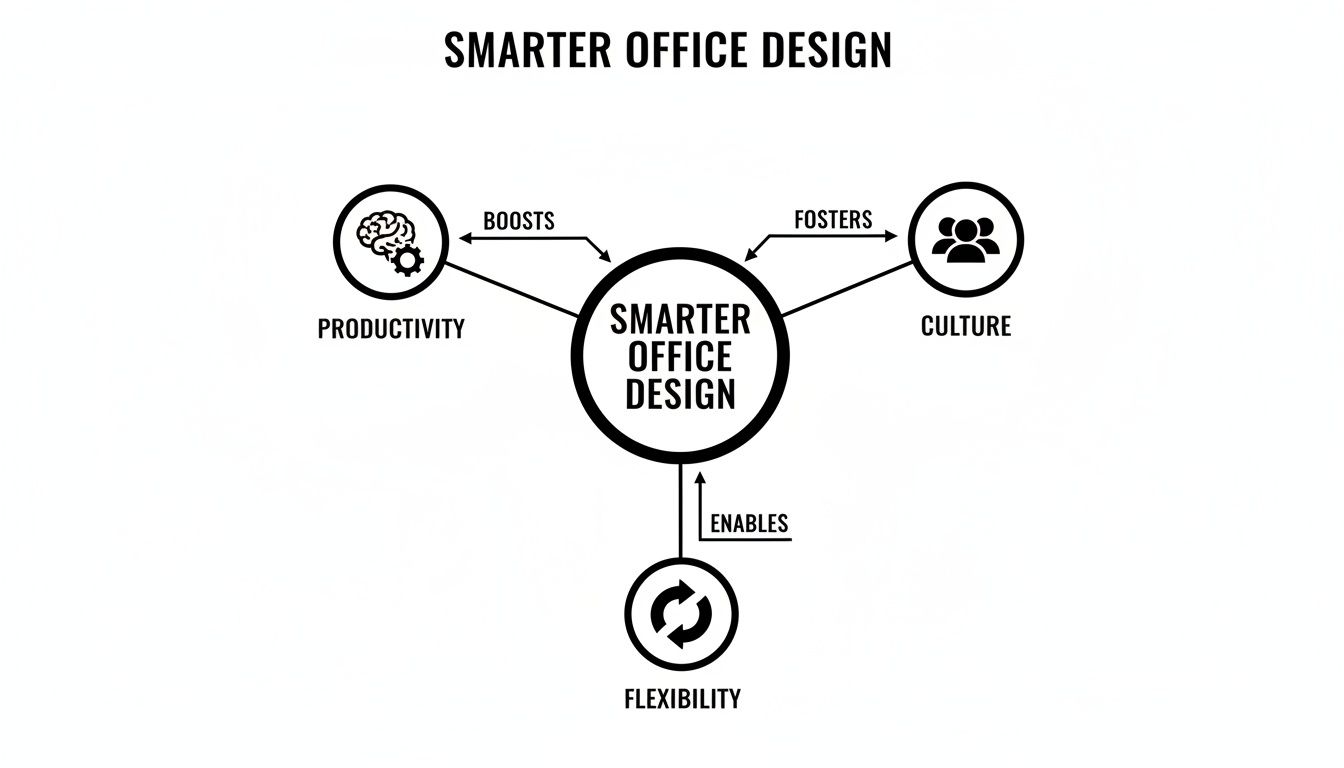
As you can see, these three pillars are completely connected. A layout that helps people get work done almost always improves the office vibe, and both depend on having the flexibility to make changes. Once you get a feel for these key principles, you can plan your space with real confidence.
Understanding Office Circulation
Think of your office’s circulation as its circulatory system—the main arteries people use to get from the entrance to their desks, to meeting rooms, and over to the coffee machine. When circulation is bad, you get workflow traffic jams, constant distractions, and a low-grade sense of chaos.
A smart layout keeps these pathways clear, wide, and intuitive. The goal is simple: let people move around without having to weave through a maze of desks or interrupt colleagues who are deep in focus. Good circulation is the unsung hero of an organized and efficient office.
The Power of Adjacency
Adjacency is a straightforward but incredibly powerful concept: put people and teams who work together often, near each other. If your sales and marketing teams are in constant communication, it makes zero sense to stick them on opposite ends of the floor. That just creates an invisible barrier to getting things done.
By strategically grouping departments, you don’t just save steps—you encourage the spontaneous conversations and quick problem-solving sessions that drive innovation. This principle is a cornerstone of effective office layouts.
This goes for more than just teams. It also means putting shared resources, like printers or supply closets, in central locations that are easy for everyone to get to.
Managing Acoustic and Visual Privacy
Let's be honest: noise is probably the biggest complaint in modern offices, especially in open-plan setups. Acoustic privacy isn't about creating a library-like silence. It’s about managing sound so people can actually concentrate when they need to. This is where zoning becomes your best friend—creating dedicated quiet zones away from loud, collaborative hubs.
Visual privacy is just as critical. Even in a quiet area, constant movement in someone's peripheral vision can completely break their concentration. Here’s how to strike a balance between openness and personal space:
- High-Paneled Cubicles: For roles that demand deep, uninterrupted work, using private office cubicles can create a protected bubble that blocks out both noise and visual clutter.
- Sound-Absorbing Materials: Think about incorporating materials like acoustic panels, carpeting, and even certain fabrics on furniture to soak up ambient noise.
- Glass Wall Systems: Modern glass partitions offer a fantastic compromise. They keep the office feeling bright and visually connected while providing serious acoustic separation. It’s the best of both worlds.
This strategic approach isn't just a hunch; it's a global trend. The Asia-Pacific region, with its commanding 41.2% share of the office furniture market, is a hotbed for this, driven by rapid urbanization that demands smarter layouts. In that region, 60% of new setups now include ergonomic furniture. The results? Firms using flexible, well-zoned layouts have seen 22% lower absenteeism and 12% higher employee satisfaction.
These are lessons you can apply directly when using modular workstation cubicles to get that perfect mix of private and open spaces.
With these fundamentals in your back pocket, you're in a much better position to start planning a space that actually works for your team. For a deeper look, you can learn more about the specifics of the space planning process.
Actionable Layout Ideas for Every Work Style
Alright, let's get down to brass tacks. Theory is one thing, but you need inspiration you can actually use. The best office layout isn't just about looking good—it's about directly supporting the way your team gets work done. Here, we'll shift from general principles to real-world blueprints for today's most common office styles.
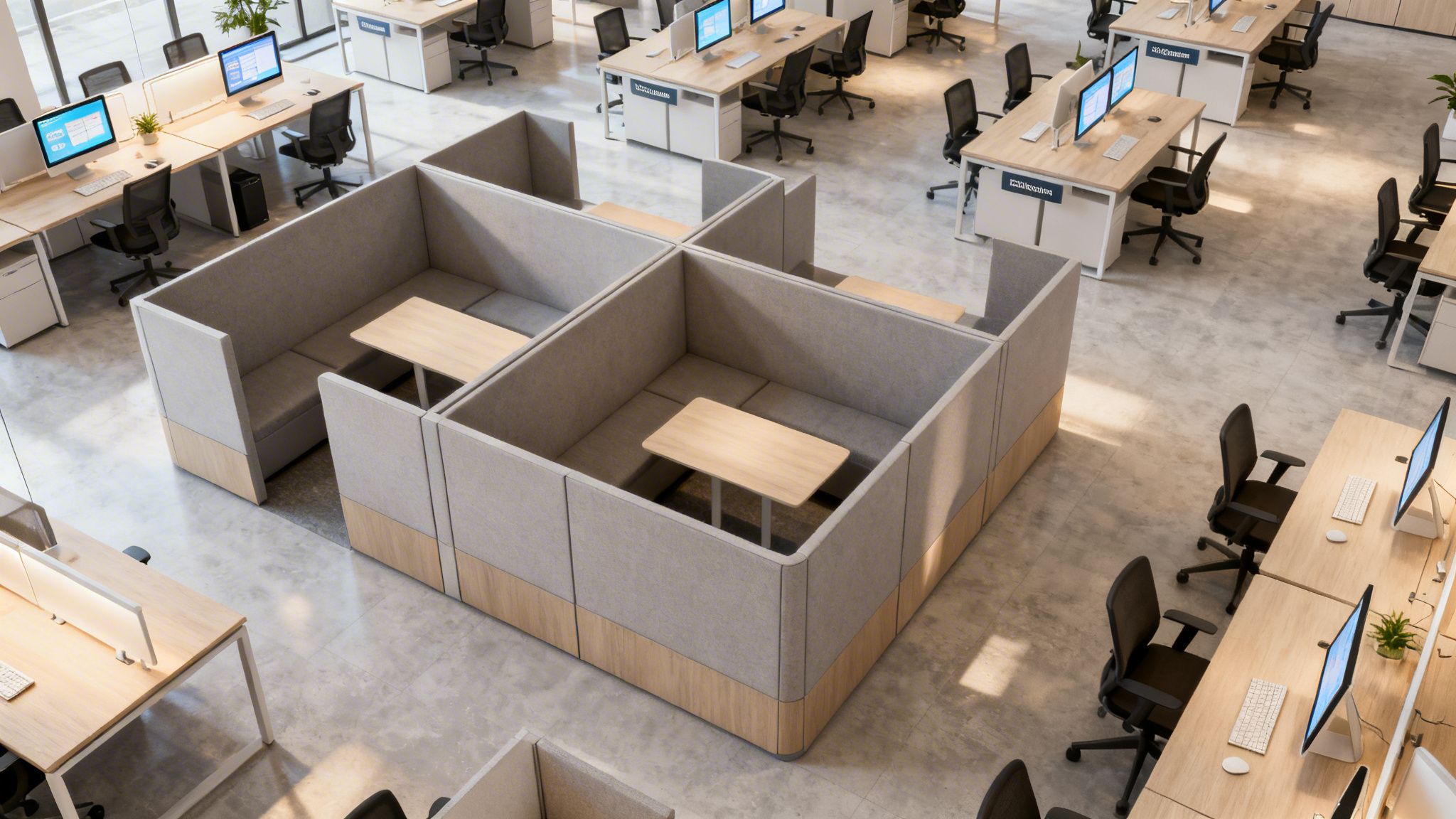
We'll look at four different models and see how the right furniture and flow can solve real business problems. Whether you need to spark creativity, protect deep focus, manage a hybrid schedule, or supercharge a call center, there's a layout that can help.
The Collaborative Hub
The collaborative hub is all about buzzing energy and easy interaction. Think of it as your company's town square—a place designed to get people talking and ideas flowing. It’s a natural fit for creative agencies, marketing departments, or any team that thrives on constant communication.
This layout ditches the long, isolating rows of desks. Instead, you create "neighborhoods" by clustering workstation cubicles into pods of four or six. The real magic, though, happens in the spaces between these work zones. You’ll want a mix of agile breakout areas:
- Whiteboard walls for those sudden brainstorming breakthroughs.
- Lounge areas with comfy seating for casual chats and check-ins.
- High-top tables for quick, stand-up team huddles.
The whole point is to tear down the physical barriers to communication. Of course, the downside is just as obvious: a high potential for noise and distraction. It's not the right setup for roles that demand quiet concentration. Digging into the trade-offs of an open office vs a cubicle can help you figure out if this high-energy model is truly for you.
The Focused Retreat
At the complete opposite end of the spectrum is the focused retreat. This layout puts individual concentration and privacy above all else. It's the go-to choice for law firms, accounting practices, software developers, and any profession where deep, uninterrupted work is what really moves the needle.
The foundation of this design is the high-paneled private office cubicle. These workstations act as personal sanctuaries, effectively blocking out both the sights and sounds that kill focus. The floor plan is usually more linear and organized, with clear boundaries between each person's space.
A well-designed focused retreat acknowledges a simple truth: for many jobs, productivity is directly tied to the ability to concentrate without interruption. This layout is an investment in deep work.
To keep it from feeling too isolated, you can mix in small, bookable meeting rooms and a central café or break area. The main drawback is that you lose the spontaneous collaboration that open plans are known for. It’s all about finding the right balance for your team.
The Dynamic Hybrid Office
With hybrid work here to stay, the purpose of the office has fundamentally changed. It’s not just a place to sit and type anymore; it’s a destination for connection, collaboration, and reinforcing company culture. A dynamic hybrid layout is built for this new reality.
This model is all about flexibility and giving people choices. It's a blend of different spaces:
- Hot Desks: Unassigned workstations that anyone can grab when they're in the office.
- Quiet Zones: Areas with reservable desks or pods for heads-down tasks.
- Team "Anchors": Dedicated zones where specific departments can gather and work together.
- Social Hubs: Large, inviting common areas designed to encourage connection and casual conversation.
This approach lets you optimize your office space for a headcount that changes daily. The biggest hurdle is managing it all—it demands a good desk booking system and a company culture where everyone respects the shared spaces. You can see how these different zones could fit together using our powerful custom cubicle designer tool to visualize your ideal mix.
The High-Performance Call Center
A call center is a unique beast with very specific needs. Success is all about employee comfort, focus, and efficiency. The layout must be meticulously planned to control acoustics and promote good ergonomics, as these factors directly impact agent performance and, just as importantly, job satisfaction.
While the layout often involves rows of workstations to maximize space, modern designs put employee well-being first. Using cubicles with sound-absorbing panels is non-negotiable; they cut down on cross-talk and make the environment far less chaotic.
Here are the key things to get right in a high-performance layout:
- Acoustic Panels: Cubicles should have fabric-covered, high panels to absorb sound.
- Ergonomic Seating: High-quality, adjustable chairs are absolutely essential for people sitting for long shifts.
- Clear Sightlines: Supervisors need a clear view of their team so they can offer support when needed.
- Breakout Spaces: Accessible quiet rooms or comfortable lounges give agents a place to decompress.
By focusing on these elements, you create a call center that isn’t just efficient but is also a more pleasant and supportive place to work. At Cubicle By Design, we have deep experience designing layouts that nail these specialized requirements.
Turning Your Office Layout Ideas Into a Plan
Alright, you've got some great ideas floating around for your new office layout. Now comes the part that can feel a bit daunting: turning that vision into a real, workable plan. It's easy to feel overwhelmed, but breaking it down into a step-by-step process makes it not only manageable but even exciting. Think of it like this: you wouldn't build a house without a blueprint, right? The same logic applies here.
Following a clear process is your best defense against those little details that can turn into massive headaches down the road. Let's walk through the five checkpoints that will get your layout planned out perfectly.
Step 1: Get to Know Your Space and Your Team
Before you even glance at a furniture catalog, you need to start with the fundamentals: the physical space you have and the people who work in it. Grab a tape measure and map out your floor plan. You need to know exactly where every pillar, window, door, and existing power outlet is. These are your non-negotiables.
At the same time, take a hard look at how your team actually works. Who needs to be in constant communication? Who needs absolute quiet to do their best work? How many people are actually in the office on a typical Tuesday? This initial data gathering is the single most important step. Every decision you make from here on out will be built on this foundation.
Step 2: Ask Your Employees What They Need
Your team members are the real experts on how the current office works—and how it doesn't. Skipping this step is a huge missed opportunity. A simple, anonymous survey can uncover a goldmine of information about their daily frustrations and what they need to be productive.
Try asking questions like:
- What’s the biggest roadblock to your productivity in our current office?
- Can you easily find a quiet spot when you need to focus?
- Are there enough spaces for our team to collaborate effectively?
- If you could change one thing about our office, what would it be?
This isn't just about making people feel included; it's about collecting critical on-the-ground intelligence. Their feedback can shine a light on problems you didn't even know existed and point you toward a layout that genuinely supports the way they work.
Step 3: Block Out Your Activity Zones
Now that you have your measurements and your team's feedback, you can start zoning. This is where you mentally carve up your floor plan into distinct areas for different types of work, just like we talked about earlier. Dedicate specific spots for:
- Focus Work: Think areas with private office cubicles with higher panels or designated quiet desks.
- Collaboration: Create open clusters of workstation cubicles, whiteboard walls, and small, informal meeting tables.
- Socializing: A comfortable breakroom or lounge that invites people to relax and chat.
- Support: A central hub for printers, office supplies, and shared storage.
A well-zoned office is a productive office. By giving every activity a designated home, you reduce distractions and empower employees to find the right environment for their task at hand.
Step 4: Don't Forget the Critical Infrastructure
This step is so often overlooked, but it's absolutely vital. A gorgeous new layout means nothing if no one can plug in their laptop. You have to map out your power and data needs before you decide where every piece of furniture goes. Are there enough outlets? More importantly, are they in the right places?
Modern furniture systems often solve this problem for you. For instance, modular cubicles from a provider like Cubicle By Design often come with integrated raceways that hide all the cabling and bring power right to the desktop. Planning for this now saves you from a future tangled in extension cords and tripping hazards. For a deeper dive into the nuts and bolts, be sure to check out our complete office space planning guide.
Step 5: See Your Design in 3D Before You Buy
Finally, before you sign a single purchase order, you need to see your plan come to life. Trying to visualize a 2D floor plan in three dimensions is harder than it sounds, and mistakes at this stage get expensive fast. This is where visualization tools become your secret weapon.
Instead of just hoping for the best, use a tool like our free Custom Cubicle Designer. It lets you drag and drop different furniture pieces, play with spacing, and see a realistic 3D model of your proposed layout. You can spot potential traffic jams, make sure everything truly fits, and test out a few different ideas—all without any risk. This final check turns your plan from guesswork into a confident, well-executed reality.
Why Modular Furniture Is Your Smartest Investment
In a fast-moving business, a fixed office layout can feel like an anchor holding you back. That's why it's so important to stop thinking about just "buying furniture" and start thinking about "investing in a system." Modular office furniture isn't about desks and panels; it’s a strategy for staying agile that protects your workspace and your budget for the future.
Unlike building out drywall offices or buying bulky, standalone desks, modular systems are built to adapt. You can easily reconfigure them, expand them as your team grows, or even pack them up and move them to a new office with very little disruption. This flexibility saves you from the huge costs and downtime that come with a traditional renovation.
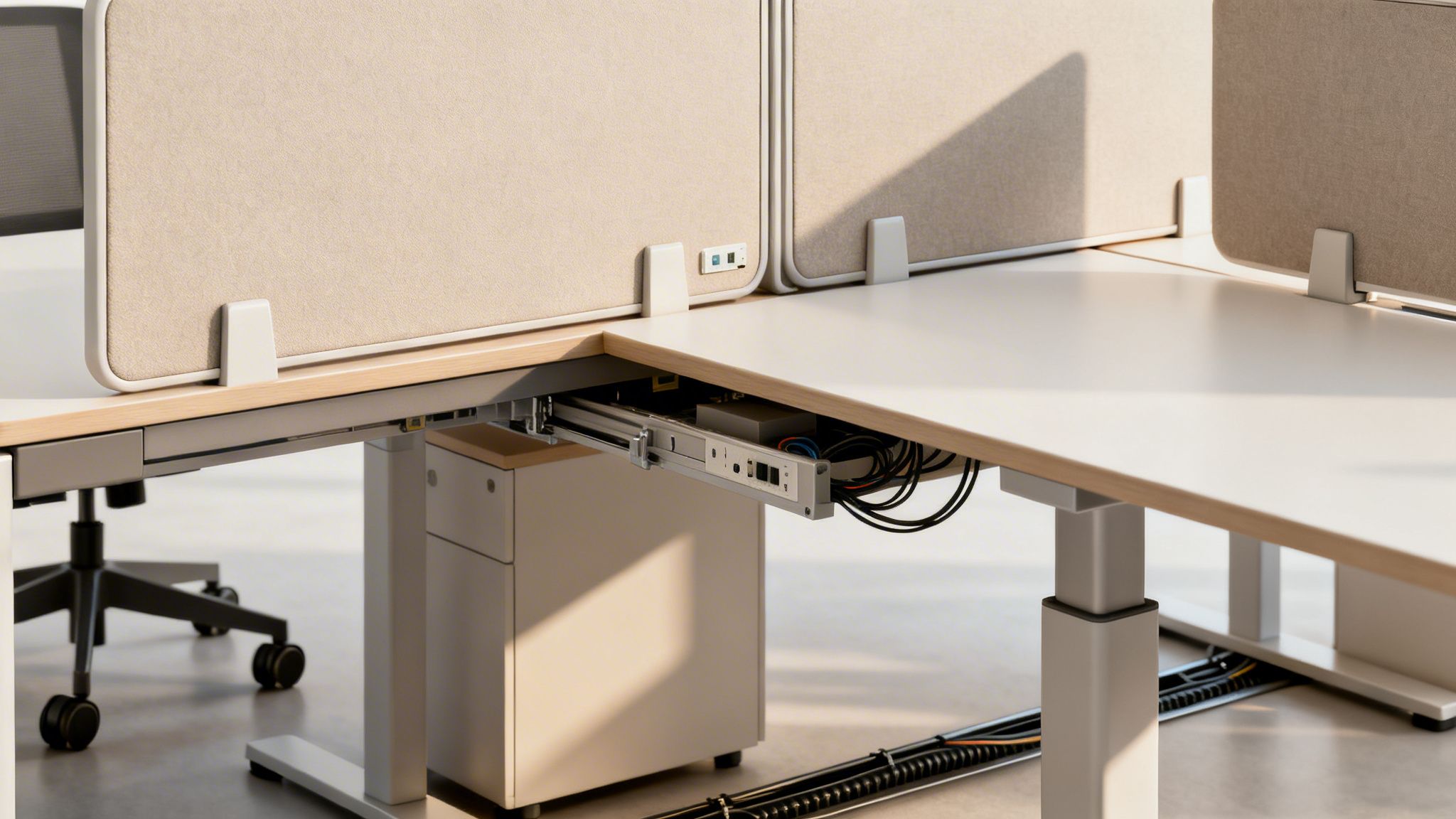
This ability to change on the fly is a massive financial win. Businesses that can scale their physical space up or down without calling in the construction crews see a much higher return on their furniture investment. Instead of buying all new furniture when you need a new floor plan, you just rearrange the pieces you already have.
A Startup's Smart Growth in Action
Let's look at a real-world scenario. Imagine a small tech startup with 12 employees. They start out with an affordable open-plan layout using low-paneled workstation cubicles to build team spirit and keep communication flowing. It’s a simple setup that encourages everyone to collaborate while they get their product off the ground.
A year later, they’ve secured funding and hired a new sales team and a few senior developers. Suddenly, their needs are completely different. The sales team needs more acoustic privacy for calls, and the developers need quiet zones to do deep, focused work.
Instead of tearing the office apart, they just reconfigure their modular system. Using the same core components from Cubicle By Design, they:
- Add taller panels to the existing developer desks, creating a dedicated "focus zone."
- Build a new pod of private office cubicles for the sales team, giving them the privacy they need for calls.
- Repurpose the original low panels to create a small collaborative hub in another corner of the office.
The result? They completely transformed their office to meet their new business needs over a single weekend, all with the furniture they already owned. That's the power of a modular strategy.
The Technical Details That Make a Difference
Beyond just moving panels around, a quality modular system solves some of the most common office headaches. These systems are engineered from the ground up to make your space more functional and a lot easier to manage.
One of the biggest wins is integrated cable management. We’ve all seen the nightmare of extension cords and power strips snaking across the floor—it’s ugly, unprofessional, and a serious trip hazard.
Modular cubicle systems are designed with built-in "raceways" or channels that neatly hide all power and data wiring. This brings connectivity directly to the desktop, creating a clean, professional, and safe environment.
This built-in infrastructure also makes reconfiguring your layout incredibly simple. You don't have to call an electrician every time you want to move a desk. If you want a closer look at these systems, you can check out our guide on what modular furniture is and how it works.
The Perfect Balance of Privacy and Openness
Another key feature is the ability to use different panel heights within the same system. This lets you fine-tune your office furniture layout ideas to create the perfect mix of privacy and connection, zone by zone.
- Low Panels (39” to 47”): These are great for collaborative teams. You get privacy when you're sitting down, but it’s still easy to talk to your neighbors.
- Medium Panels (53”): This height gives you full visual privacy while seated, cutting down on distractions without making the space feel closed off.
- High Panels (65” and up): For true acoustic and visual separation, high panels are the way to go. They’re perfect for creating quiet zones or private offices without having to build walls.
By mixing and matching these panel heights, you can design a space that supports every kind of work style, all within one cohesive system. This level of customization is what makes modular furniture the smartest investment for any growing business.
Answering Your Top Office Layout Questions
Embarking on a new office design always brings up a host of questions. To help clear up any lingering doubts, we’ve gathered some of the most common queries we hear from office managers and business owners just like you. Here are our straightforward answers to get you planning with confidence.
How Much Space Do I Really Need Per Employee?
This is almost always the first question, and the truth is, there's no single magic number. As a good rule of thumb, a modern office that needs to balance different work styles should aim for 125 to 175 square feet per person. That gives you enough breathing room for individual workstations, pathways to get around, and shared amenities.
Of course, that average can swing quite a bit depending on your industry and how you work.
- High-Density Layouts: A bustling call center or a super-collaborative tech space might tighten things up to 75 to 100 square feet per person to get the most out of their floor plan.
- Executive-Heavy Layouts: On the other end, a law firm or financial services company with a lot of private offices could easily need 200 to 250 square feet per person to accommodate those larger, enclosed spaces.
Before you do anything else, though, check your local building and fire codes for mandatory minimums per occupant. Once you have that baseline, you can play around with different densities using a free tool like our Custom Cubicle Designer. It’s a great way to see how a layout will feel before committing, ensuring it’s functional and comfortable, not cramped.
What Is the Best Way to Reduce Noise in an Open Office?
Ah, the classic open-office complaint: noise. It’s a real problem, but it’s absolutely manageable. The key is to think in layers—one single solution won’t cut it. Imagine you’re building sound-blocking defenses throughout your space.
First, use smart zoning to put some physical distance between loud and quiet activities. Carve out designated "quiet zones" far from high-traffic spots like the kitchen or main entrance. Using high-paneled private office cubicles in these areas is an easy way to create an instant sound buffer.
Next, start adding sound-absorbing materials anywhere you can. Think about:
- Acoustic panels on the walls or hanging from the ceiling.
- Plush, high-pile carpeting instead of hard floors.
- Upholstered furniture in lounges and common areas.
- Cubicle panels made with sound-dampening fabrics.
Finally, you have to contain the biggest culprits. Installing small, enclosed phone booths or "escape pods" gives people a private place for calls and virtual meetings. Even a simple perk like providing company-sponsored, noise-canceling headphones can empower employees to control their own focus. The systems from Cubicle By Design are specifically engineered with acoustics in mind, helping you build a workplace where people can actually concentrate.
How Do I Create a Layout That Works for a Hybrid Team?
When it comes to hybrid teams, one word reigns supreme: flexibility. The office isn't just a place to sit and work anymore. It’s become a destination for collaboration, team-building, and the kind of focused work that’s tough to do at home. Your layout has to support this new role by offering a menu of different work environments.
The goal is an "agile" office that can easily adapt to a headcount that changes daily. This means designing a healthy mix of spaces:
- Unassigned "Hot Desks": Open workstations available on a first-come, first-served basis.
- Reservable Focus Stations: Private or semi-private desks people can book when they need a full day of deep work.
- Collaborative Zones: A variety of spaces for teamwork, from casual lounges to formal conference rooms.
- Team "Neighborhoods": Designated zones where specific departments can gather when they’re in the office on the same day.
The successful hybrid office is a "destination office"—a place that offers more value than an employee's home setup. It achieves this by providing choice, connection, and the right tools for every type of work.
This is where modular furniture becomes your best friend. It lets you reconfigure your space on the fly as your team's on-site needs evolve. A cluster of workstation cubicles might serve as hot desks one month and become a dedicated project hub the next. That adaptability is what makes sure your office investment continues to pay off.
Where Do I Start When Planning a New Office Layout?
It’s tempting to jump right into picking out furniture and finishes, but the best plans always start with a little homework. Resist that urge and focus on gathering data first. I promise, it will make every other step smoother and more effective.
A solid plan really just begins with three steps:
- Measure and Analyze Your Space: Get a totally accurate floor plan and be sure to note where every fixed element is—columns, windows, doors, and especially power outlets.
- Analyze Your Team's Workflows: Talk to your people. Watch how they work and send out surveys. You need to understand who collaborates with whom, who needs quiet, and what your true daily occupancy looks like now.
- Define a Clear Budget: Figure out what you can realistically spend on the whole project: furniture, installation, tech, and any construction or electrical work you might need.
Once you have that information, you can start blocking out your zones and exploring different office furniture layout ideas. At this stage, we can’t recommend using an online planning tool enough. Seeing your layout in 3D helps you catch potential issues—like awkward traffic flow or a desk that’s nowhere near an outlet—before you’ve spent a single dollar on new cubicles.
Ready to turn these ideas into a reality for your workspace? The experts at Cubicle By Design are here to help you plan, design, and install a layout that perfectly fits your team's needs and your company's budget. Explore our solutions and start designing your better workplace today!