


Let's talk about space planning. Forget dusty blueprints and complicated software for a moment. At its heart, space planning is simply the art and science of making an interior space work for the people who use it. It’s far more than just deciding where to put the desks and the coffee machine. It’s about creating an environment that flows, functions, and feels right.
A thoughtful layout can make the difference between a team that collaborates seamlessly and one that feels disconnected, or between a retail store that guides customers effortlessly and one that feels chaotic. That’s why at Cubicle By Design, we see it as the foundation of any successful workplace.
The True Goal of Space Planning
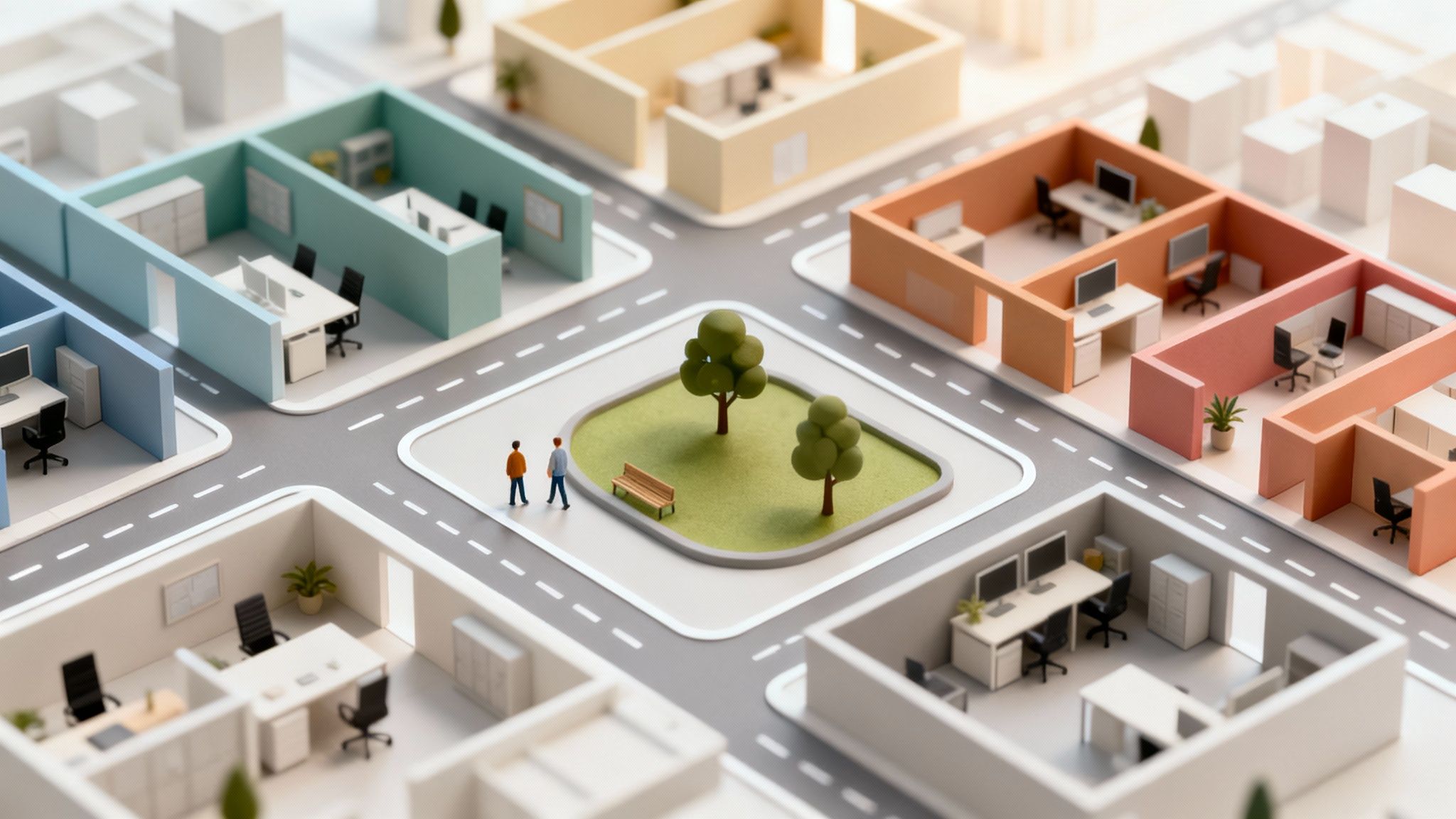
When people hear "space planning," it's easy to picture someone just shuffling furniture on a floor plan. But the real goal runs much deeper. Think of it as crafting a physical roadmap for your business's success, one that directly impacts workflow, productivity, and even your company culture. It’s less about interior design and much more about operational architecture.
A great way to wrap your head around this is to imagine your office as its own little city.
- Circulation paths are the city streets, making sure people can move from A to B without hitting traffic jams around the printer.
- Department zones become distinct neighborhoods. Each has its own vibe and purpose but is logically connected to the others it depends on.
- Common areas—like break rooms and lounges—are the public parks. They’re designed to spark those chance encounters and build a real sense of community.
Every single element is placed with a purpose. The result is an office that just works. Movement is easy, collaboration happens naturally, and the daily grind feels a little less like, well, a grind. To really dig in, it helps to understand what is space planning from a foundational level.
From Blueprint to Business Results
Here's where the rubber meets the road. Good space planning can take abstract company goals and turn them into tangible, everyday realities. When the sales team and marketing team are on opposite ends of the building, you're practically building communication silos. But put them near each other, and you might just find that a random coffee-break chat sparks the next big campaign idea.
To give you a clearer picture, here’s a quick breakdown of how strategic planning connects to real-world results.
At a Glance: The Goals and Outcomes of Space Planning
| Core Goal | Business Outcome |
|---|---|
| Optimize Workflow | Increased productivity and less wasted time. |
| Enhance Collaboration | More innovation and stronger team cohesion. |
| Improve Employee Well-being | Better morale, lower stress, and reduced turnover. |
| Maximize Real Estate | Efficient use of every square foot, lowering overhead. |
| Ensure Safety & Compliance | A safe environment that meets all legal codes. |
| Strengthen Brand & Culture | An office that reflects your company's values and identity. |
As you can see, the layout is far from a trivial detail.
The core idea is that the physical environment is not a passive backdrop; it is an active tool that can either help or hinder your organization's performance. A well-planned space removes physical barriers to success, making work more intuitive and efficient.
Ultimately, this whole process is about creating a space that actively champions your team’s success. When you stop and consider what your employees need to succeed, you’ll quickly realize that a well-designed workspace isn’t a perk—it’s a necessity. It’s a direct investment in your people's ability to shine, turning your office from a line item on the budget into a powerful business asset.
The Seven Pillars of an Effective Space Plan
A truly great office layout doesn’t just happen by chance. It’s built on a solid foundation of seven distinct pillars, each one tackling a critical piece of how your team actually works, moves, and connects. When you start thinking through these pillars, abstract ideas turn into a practical checklist. This ensures your final design is a strategic asset, not just a room full of furniture.
Think of it as a system where every element leans on the others. If you drop the ball on one pillar—say, you totally misjudge your workflow—you’ll see a domino effect. Suddenly, your circulation routes are a mess, and teams that need to be together are on opposite sides of the floor.
Pillar 1: Workflow Analysis
Before you even think about placing a single desk, you have to understand how work gets done. Workflow analysis is really just mapping out the daily operational dance of your teams—how information, tasks, and people move through your company.
Picture a software development team. The project manager is constantly checking in with the lead developer, who needs to be in close contact with the QA testers. A layout that separates these people with long hallways or, even worse, different floors, is actively working against their natural process. A solid workflow analysis spots these critical connections and makes sure the physical space helps them, not hinders them.
Pillar 2: Occupancy Planning
Next up, you have to figure out who needs space and when. Occupancy planning is way more than just a headcount; it’s about building a model that reflects how people work today. In a hybrid world, not every employee needs a dedicated desk from Monday to Friday.
This pillar helps you answer the big questions:
- On an average day, how many people will actually be in the office?
- What kinds of spaces do they need? Think focus pods, big collaborative zones, or just a few touchdown desks for drop-ins.
- How can the space adapt to future growth or a shift in work styles?
For example, your data might show that even with 100 employees, you never have more than 65 in the office at one time. That insight alone saves you from overspending on desks and frees up budget for things people will actually use, like project rooms or a quiet library zone.
Pillar 3: Adjacency Needs
Once you know how your teams operate and who’s coming in, you can figure out where they should sit. Adjacency needs are all about creating strategic "neighborhoods" in your office, placing teams and people who rely on each other close together.
A classic example is the bond between sales and marketing. When those teams are within earshot, a quick, spontaneous chat can spark a brilliant campaign idea or align their strategies in minutes. On the flip side, bad adjacency kills communication, forcing everyone to rely on emails and scheduled meetings for simple questions. The office itself becomes a source of friction.
Pillar 4: Circulation Routes
With your office neighborhoods mapped out, you need to design the "streets" that connect them. Circulation routes are simply the pathways that guide people through the office. The goal is to create intuitive and efficient corridors that prevent traffic jams and just feel natural.
A poorly planned path might force people to cut right through a quiet, heads-down work zone just to get to the coffee machine, creating constant distractions. A smart layout directs foot traffic logically, separating the busy "highways" from the quiet "residential streets." Designing these paths is a massive part of finding the perfect office layout for your business.
Pillar 5: Acoustic and Visual Privacy
A productive office has to strike a balance between collaboration and concentration. This is where acoustic and visual privacy come in. It’s about creating a varied landscape of environments, because not every task is meant for a loud, open area.
A successful space plan provides a spectrum of zones. It offers vibrant, open areas for team brainstorming, semi-private nooks for small group work, and fully enclosed pods or private offices for deep, focused tasks. This variety empowers employees to choose the environment that best suits their immediate needs.
This means being smart about using partitions, sound-absorbing materials, and designated quiet zones so that productivity isn’t sacrificed for an open-plan aesthetic. For example, well-placed private office cubicles can create necessary sanctuaries for concentration.
Pillar 6: Technology and Infrastructure
Modern offices run on power and data. The sixth pillar, technology and infrastructure, is about weaving power outlets, data ports, and Wi-Fi access right into the space plan from the very beginning. You have to make sure the layout supports the tech your team uses every single day.
Forgetting this pillar leads to a hazardous mess of extension cords or forces you to place furniture in awkward spots. A forward-thinking plan anticipates where people will plug in their laptops, where you'll need presentation screens, and where servers should live, building a seamless tech backbone into the office itself.
Pillar 7: Compliance and Accessibility
Finally, your space must be safe, inclusive, and legal for everyone. This last pillar is all about meeting building codes, fire safety regulations, and accessibility standards, like those outlined in the Americans with Disabilities Act (ADA). To get more ideas on building efficient and compliant spaces, looking into optimal space planning strategies can offer some great frameworks.
This covers everything from ensuring aisles are wide enough for wheelchair access to planning proper emergency exit routes and providing ergonomic workstations. A layout that isn’t compliant isn’t just a legal risk; it’s a failure to create a welcoming and fair environment for your employees and visitors.
Your Step-by-Step Space Planning Process
Jumping into a space planning project can feel like a huge undertaking, but breaking it down into a structured process turns a mountain into a series of manageable hills. Instead of just guessing, this step-by-step approach makes sure every decision is thoughtful, backed by data, and directly supports your business goals. A clear roadmap is the best way to prevent expensive mistakes and ensure the final layout actually works for your team.
We can boil the whole thing down to three core phases: Analysis, Design, and Compliance.
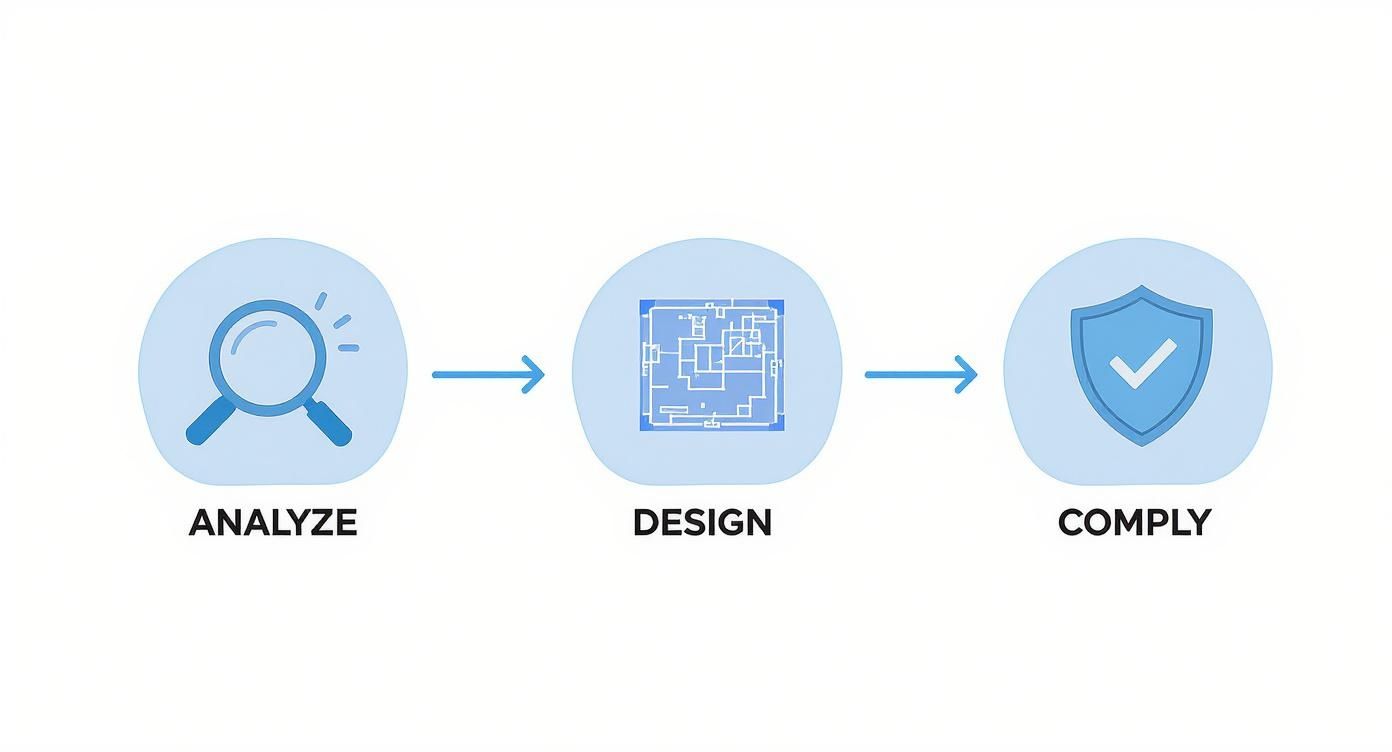
This simple visual nails a key point: great space planning starts with deep analysis long before anyone picks out furniture, and every design choice has to be double-checked against compliance rules.
Let’s walk through the six practical steps that bring a truly functional office to life.
Stage 1: Discovery and Goal Setting
First thing's first: you have to define what success looks like. This initial stage is all about deep conversations with the people who matter—from the C-suite to department heads—to really get to the heart of the project's objectives.
You need to ask the big questions. Are you trying to spark more hallway conversations and collaboration? Do you need to make room for a growing team or figure out a new hybrid work model? Getting these goals down on paper creates a North Star that will guide every single decision you make from here on out.
A project without clear goals is like a ship without a rudder. The objective here is to create a unified vision, ensuring that the final space plan is a direct answer to the company's most pressing needs and future aspirations.
Stage 2: Data Collection and Workspace Analysis
With your goals set, it’s time to gather the facts that will shape the design. This is about more than just a headcount. It means getting a real, honest look at how your current space is actually being used day-to-day.
This critical phase often involves:
- Employee Surveys: Asking your team about their daily workflow, what drives them crazy about the current setup, and what they need to do their best work.
- Observation Studies: Simply watching how people move, where they congregate, and how they interact within the office.
- Utilization Data: Looking at hard numbers, like meeting room booking rates, to see which areas are packed and which are gathering dust.
For example, you might find that your massive boardroom is only booked 30% of the time, while the small two-person huddle rooms are always full. That’s a game-changing insight. It stops you from wasting money on another huge conference room and points you toward building the smaller, flexible spaces your team is crying out for.
Stage 3: Schematic Design and Block Planning
Now the fun begins. In this stage, you start turning all that data and all those goals into a high-level visual plan. We're not talking about specific desks or paint colors yet.
Instead, block planning is like creating a basic neighborhood map for your office. You’ll sketch out a simple floor plan, assigning general zones or "blocks" for different departments, common areas, and quiet-work zones. It's all about making sure teams that need to be close are neighbors and that the main walkways (or circulation paths) feel natural and intuitive.
Stage 4: Detailed Layout Creation
Once the block plan gets the thumbs-up, it’s time to zoom in. This is where you move from those broad zones to a precise floor plan showing the exact placement of every single desk, chair, and filing cabinet.
This is where the right tools make a world of difference. Using something like the Cubicle By Design Cubicle Designer lets you play around with different setups for workstation cubicles and private office cubicles, seeing how it all fits together in 3D before you commit. You’ll lock in everything from desk dimensions to where the power outlets and storage units need to go.
Stage 5: Implementation and Project Management
This is where the plan becomes reality. It’s all about coordinating with vendors, contractors, and installers to bring the detailed layout to life. Solid project management is absolutely essential here to keep everything on schedule and on budget.
This phase covers furniture orders, managing any construction, and overseeing the final installation. Clear, constant communication between everyone involved is the key to a smooth transition from a blueprint to a physical workspace.
Stage 6: Post-Occupancy Review
The job isn’t done when everyone moves in. A few months after your team has settled into the new space, a post-occupancy review is a must. This final step is about circling back to gather feedback and see if the new design is hitting the mark.
Are those new collaboration zones actually getting used? Has the new layout solved the problems you identified back in Stage 2? This feedback is pure gold. It allows you to make small tweaks and gives you invaluable lessons for any future projects. It helps you learn what went right and avoid making the same mistake twice. You can learn more by exploring some of the common mistakes in office planning and how to avoid them in our detailed guide.
Solving Today's Hybrid Workplace Challenges
The days of the static, one-size-fits-all office are long gone. The biggest puzzle we're all trying to solve now is how to design for a hybrid workforce, where the number of people in the office can swing wildly from one day to the next. The real win is creating an agile, flexible space that can handle both heads-down focus work and lively collaboration, no matter who’s clocked in.
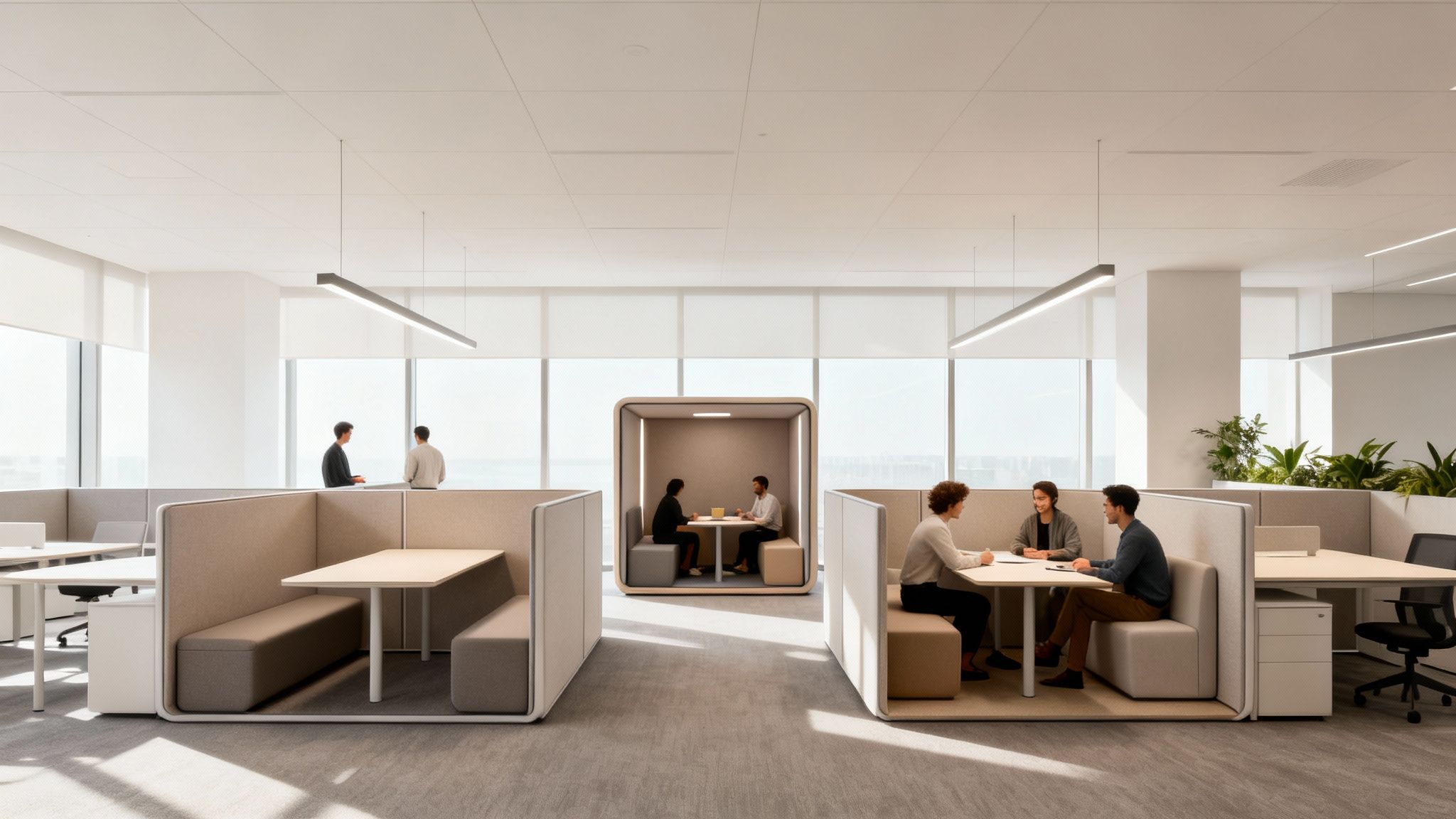
This new reality has brought ideas like hot-desking (unassigned seats) and hoteling (reservable desks) from the fringe to the mainstream. Instead of giving every single person a permanent desk, companies are creating shared resources for whoever needs them. It’s a smarter way to use your real estate and finally acknowledges that the office is just one of many places where work gets done.
Designing a Landscape of Work Zones
The secret to a great hybrid office is variety. Forget the monotonous sea of desks. Today's best layouts create a diverse ecosystem of "work zones," each built for a specific kind of task. This gives people the power to pick the right spot for the job at hand.
A well-planned office landscape usually includes:
- Focus Zones: Quiet nooks with individual workstations or pods, perfect for deep concentration.
- Collaboration Zones: Open, energetic spaces with whiteboards and flexible furniture to get team brainstorms going.
- Social Zones: Comfy lounge areas and coffee bars that spark those informal chats where great ideas are often born.
- Private Zones: Enclosed rooms or booths for confidential calls or one-on-one meetings.
When you take this zonal approach, the office stops being a place people have to be and becomes a valuable resource—a destination they choose to use for things they can't do as well at home. It’s about offering different types of cubicles and spaces to match every task.
The goal is to build an environment so intuitive and supportive that it becomes a competitive advantage. When employees have the autonomy to choose their ideal work setting, engagement and productivity naturally follow.
The Power of Data-Driven Decisions
Guesswork is the enemy here. You can't just eyeball it when deciding on the right mix of shared and dedicated spaces—you need real data. While corporate real estate leaders are increasingly tracking how their offices are used, there’s a big difference between having the numbers and knowing what to do with them.
A global occupancy planning report found that while 74% of companies now collect utilization data, only 7% feel they're excellent at analyzing it. This really highlights the challenge, but also the huge opportunity. If you're curious about the trends, you can dive into the full occupancy benchmarking report to see what others are learning.
Embracing Modularity and Flexibility
For this agile model to work, the furniture has to be just as adaptable. Modular systems are the foundation of a future-proof office, letting you reconfigure layouts on the fly as your team’s needs change, all with minimal disruption.
For instance, you can arrange adaptable Workstation Cubicles into a team pod for a big project, then easily break them apart into individual stations once it's done. For those times when true privacy is a must, Private Office Cubicles offer an enclosed, quiet space without the headache and permanence of traditional construction.
Even creating new zones or adjusting department footprints is made simpler with solutions like modular office walls, which give you separation without calling in the renovation crew. When you prioritize scalable solutions, you're building a workspace that can grow and change right alongside your business, making sure it stays a valuable asset for years to come.
How Technology Is Reshaping Space Planning
Technology hasn't just tweaked space planning; it's completely flipped the script. We've moved from a static, one-and-done project to a living, breathing strategy. Gone are the days of rolling out old blueprints and doing a simple headcount. Now, smart tools feed us real-time data, taking the guesswork out of the equation and helping businesses make much sharper decisions.
This whole evolution is powered by tech that gives us a deep, honest look at how a workspace is actually being used. These tools help companies cut down on energy waste, make the office a better place for employees, and pivot their physical environment at a speed that was once unimaginable. Investing in space management technology isn't a luxury anymore—it's how you stay competitive.
The Rise of Data-Driven Design
The biggest game-changers here are Internet of Things (IoT) sensors. These are small, discreet devices you can stick under desks, in meeting rooms, and throughout common areas to see what’s happening in real time. Instead of just guessing which spots are popular, you get cold, hard data. You can see exactly which desks are getting used, how often conference rooms are actually booked, and where people tend to congregate.
This kind of information is pure gold for understanding what your office truly needs. For example, if the data shows that your massive 12-person conference room sits empty most of the week while your small huddle rooms are always packed, you know exactly where to put your money in the next office refresh. This data-first approach makes sure your decisions are grounded in reality, not just assumptions. You can read more about how these shifts are changing offices in our guide to workplace design trends.
AI and Predictive Analytics
Just collecting data is only half the story. The real magic happens when you start analyzing it, and that’s where Artificial Intelligence (AI) steps in. AI-powered software can chew through huge amounts of occupancy data to spot patterns and even predict what you'll need next. It can forecast which days will be busiest in the office, suggest the best desk-to-employee ratio for your hybrid setup, and help you make smarter long-term decisions about your real estate.
By looking at how your space has been used in the past, AI can anticipate future demands. This lets you get ahead of the curve and adjust your layout proactively instead of just reacting to problems after they pop up. It’s what separates a good space plan from a great one.
This blend of IoT and AI is the engine behind "smart spaces"—environments that are adaptive, efficient, and built for how we work today. The global smart space market is expected to skyrocket from USD 17.85 billion in 2025 to a staggering USD 74.51 billion by 2035, which just goes to show how quickly companies are jumping on board. You can dive deeper into this growth in the smart spaces market report.
Ultimately, tools and expertise from firms like Cubicle By Design are making offices more responsive, efficient, and much better aligned with what people actually need to do their best work.
Finding the Right Partner for Your Office Design
Let’s be honest: taking a space plan from a drawing to a fully built-out office is a huge undertaking. It’s tempting to try and manage it all yourself, but bringing in a professional partner is often the single best decision you can make. It can be the difference between a frustrating, flawed layout and a seamless one that actually helps your business run better.
An experienced vendor isn't just selling you furniture. They bring years of know-how, access to powerful design software, and the project management skills to save you time and prevent expensive do-overs. Think of them as the translators who turn your team’s wish list into a real, functional, and code-compliant workspace. At Cubicle By Design, this is what we live and breathe—guiding clients from that first rough idea to the final, finished office.
Vetting Your Potential Partner
To make sure you’re choosing the right team, you need to dig a little deeper with your questions. A great choice starts with knowing exactly what to ask.
Before you sign on the dotted line, make sure you get clear answers on these points:
- Workflow Analysis: How will you get to know our team’s day-to-day work to make sure the new layout actually helps us?
- Visualization Tools: Can you show us what the office will look like in 3D before we commit? A good partner will have something like a Cubicle Designer tool that brings the plan to life.
- Product Flexibility: Show us how your systems, whether it's workstation cubicles or private office cubicles, can grow and change with us down the road.
- Project Management: What’s your process for handling everything from the order to the final install, and who is our go-to person through it all?
The right partner acts as an extension of your team. Their job is to listen to your problems, use their expertise to solve them, and handle all the complicated details so you can stay focused on your business.
At the end of the day, working with a seasoned professional turns your office design into a smart investment in your team's productivity and happiness. By asking the right questions upfront, you can find a vendor who will deliver a space truly built for your success.
Common Questions We Hear About Space Planning
Diving into a new office layout always sparks a few questions. It's a big project, and it's smart to get a handle on the basics before you start. Let's walk through some of the most common questions we get from clients to help clear things up.
Costs, Timelines, and Key Considerations
1. How much should I budget for professional space planning?
There's no single price tag, because every project is different. The cost really depends on the size and complexity of your space, how detailed the design needs to be, and exactly what services you're looking for. Some firms charge a percentage of the total project cost, others bill by the hour, and some work on a fixed fee.
The best way to figure it out is to get a few detailed quotes from potential partners, like us here at Cubicle By Design, so you can find a good fit for your budget.
2. How long does the space planning process typically take?
Timelines can be all over the map. A simple office refresh might only take a few weeks, but a major, down-to-the-studs renovation could stretch over several months. The process moves through a few key phases: discovery, data gathering, design, and finally, implementation.
Clear goals and quick, decisive feedback from your team are the two biggest things that will keep your project on track and moving forward.
3. What are the most common mistakes to avoid?
We see two big missteps that can really derail a space planning project. The first is failing to plan for future growth. Boxing yourself in with a layout that only works for today can force you into another expensive redesign way sooner than you'd like.
The second is ignoring employee feedback. This is a huge one. If you don't understand how your team actually works, you're almost guaranteed to create a layout that frustrates them. You have to build in flexibility and get your people involved right from the start.
A well-executed space plan directly addresses how people feel at work. Thoughtful design that reduces friction, provides choice, and supports different work styles sends a clear message that employee well-being is a priority.
4. Can a better layout actually improve team morale?
Absolutely. Think about it—an office that's frustrating to move through or doesn't have the right mix of spaces for focus and collaboration adds a low-level of stress to every single workday.
On the flip side, a well-designed office that gives people variety and a sense of control over their environment can be a massive boost for job satisfaction and morale. A good layout can improve everything from workflow in workstation cubicles to providing quiet spaces with private offices. It shows your team you’re invested in giving them a great place to work.
Ready to transform your office with a layout designed for success? The team at Cubicle By Design is here to help. Explore our full range of cubicles or bring your vision to life with our free cubicle designer tool today.