



An office shutdown, relocation, or reconfiguration usually looks manageable on paper until the furniture list gets real. Desks, task chairs, filing, benching, reception pieces, glass panels, powered workstations, and full cubicle runs all have to leave the site in the right order, through the right path, under the right building rules. If that sequence breaks down, the project gets expensive fast.
That’s why experienced facilities teams don’t treat removal as junk hauling. They treat it like a decommissioning project with logistics, compliance, asset decisions, and lease-closeout pressure tied together. The practical challenge is simple. Clear the space, protect the building, avoid damage, keep records, and decide what should be reused, sold, donated, recycled, or discarded.
Your Complete Guide to Office Furniture Removal
If you’re staring at a floorplan full of unwanted furniture and a move-out deadline that won’t move, you’re in a familiar spot. Most office managers inherit removal as the last item on the checklist. In practice, it should be one of the first.
The scale of the waste problem explains why. In the United States, up to 8.5 million tons (17 billion pounds) of office assets, including furniture, are discarded into landfills annually, according to 2018 EPA estimates cited by Davies Office. That figure alone is enough to change how a company should think about office furniture removal services.
A proper plan does more than get old furniture out of the way. It helps you control labor, reduce disruption, document what left the site, and preserve options for resale, donation, or recycling. It also sets up the next phase of the workplace. If your team is reconfiguring rather than exiting, the removal scope should tie directly to your installation sequence, power plan, and occupancy timeline.
That’s where experienced coordination matters. A team that handles both removal logistics and the next workspace phase will usually spot problems earlier, especially around phased scheduling, access windows, and panel system disassembly. If you need a practical benchmark for bundled support, office furniture installation and disposal services show how removal fits into a larger workplace project rather than sitting in its own silo.
One useful outside perspective comes from relocation planning. This overview of Commercial movers, Office Moving Services is worth reviewing because it highlights the operational value of using specialists when timelines, inventory control, and handoffs matter.
Practical rule: If the furniture removal affects your lease turnover, IT schedule, cleaning vendor, or new installation date, it’s no longer a haul-away job. It’s a managed project.
Understanding the Different Types of Removal Services
Not every vendor who says they handle office furniture removal services is offering the same thing. That mismatch causes a lot of avoidable trouble. A company hires a low-scope hauler for what is really a decommissioning job, then discovers too late that no one is managing disassembly, loading sequence, donation paperwork, or final broom-clean turnover.

Basic hauling
A basic hauler removes unwanted furniture and gets it offsite. That’s useful when the inventory is light, the pieces are already loose, and there’s no value left to recover. Think scattered chairs, broken laminate desks, or leftover furniture from a small suite cleanout.
What this model usually does not cover is detailed inventory, systems furniture breakdown, coordination with building management, or post-project documentation. It solves the transport problem, not the project problem.
Asset liquidation
A liquidator looks at the same office and asks a different question. Which items still have market value?
This approach makes sense when the space contains clean, desirable inventory with resale potential. Executive seating, newer workstations, and certain private office pieces are the usual candidates. It can offset project cost, but liquidation alone still may not solve building access, site restoration, or scheduling against other trades.
Full decommissioning support
This is the closest comparison to a general contractor mindset. A decommissioning partner manages removal as one coordinated operation, not a pile of separate tasks.
Typical responsibilities include:
- Inventory review: Identifying what stays, what moves, and what exits the business.
- Disassembly planning: Breaking down cubicles, powered systems, and large casegoods in the right sequence.
- Building coordination: Reserving elevators, confirming loading dock rules, and aligning with move-out conditions.
- Documentation: Tracking disposal paths, donation records, and closeout status.
- Site readiness: Leaving the space in the condition required for landlord or contractor handoff.
If your project includes swing space, phased occupancy, or reusing furniture in another part of the building, this model is usually the right one. It also pairs better with layout changes and future procurement. Teams planning those next steps often benefit from reviewing office relocation support in the same decision cycle.
Storage is another point people underestimate. Furniture often gets parked in a back room “temporarily” and turns into a long-term obstacle. If that’s part of your situation, these strategies for office storage efficiency are useful because they force a cleaner decision between storing, reusing, and removing.
The right vendor scope is the one that matches your risk. The more dependencies attached to the removal, the less sense a bare-bones hauling model makes.
A Step-by-Step Office Decommissioning Checklist
Most difficult cleanouts don’t fail on lifting or loading. They fail in planning. The team starts with “remove everything,” then spends the next week untangling exceptions, power issues, elevator conflicts, and landlord punch-list items.
Treat the job like a project closeout with a written sequence and named responsibilities.
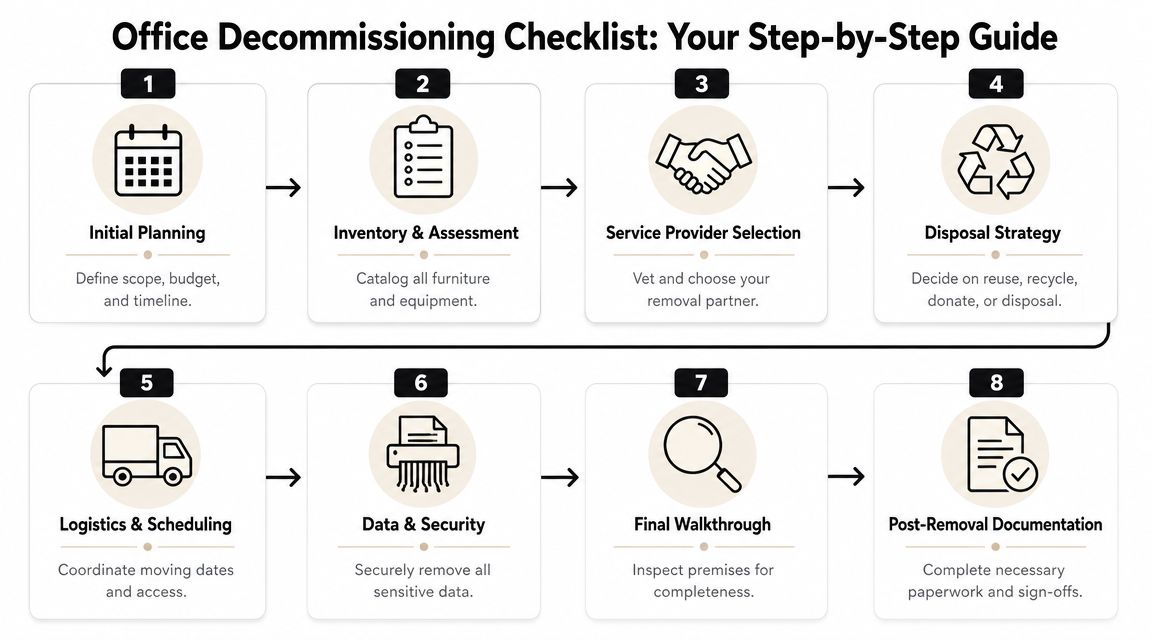
Start with a real inventory
A furniture count scribbled on a notepad isn’t enough. You need a room-by-room inventory that distinguishes between standard loose furniture and modular systems. Powered workstations, panel runs, overheads, storage towers, glass elements, and reception units all need separate handling assumptions.
For planning purposes, categorize inventory by function and destination:
-
Keep and relocate
Pieces moving to another floor or another office. -
Remove and recover value
Furniture suitable for resale or donation. -
Recycle or discard
Damaged, obsolete, or low-value items.
When companies are reusing benching or systems inventory, it helps to compare what they have against current workstation types such as workstation cubicles so the team doesn’t waste labor moving products that no longer fit the next layout.
Build the removal timeline backward
The move-out date should never be the first real deadline in your plan. Work backward from lease turnover or contractor access and identify the dates that control the job. Freight elevator bookings, IT disconnects, security access, final cleaning, and landlord inspections often matter just as much as the truck date.
Use a checklist that includes:
- Access approvals: Confirm elevator reservations, dock access, insurance requirements, and approved work hours.
- Utility sequencing: Ensure powered furniture and connected devices are shut down before crews start dismantling.
- Trade coordination: Align movers, cleaners, IT, and maintenance so one team doesn’t block the next.
- Final acceptance: Define who signs off on space condition before the crew leaves.
A move-out often ends with cleaning and condition disputes, so a practical reference like this guide by Extreme Carpet Cleaning LLC can help facilities teams think through what a landlord or property manager is likely to notice on final walkthrough.
Handle systems furniture with technical discipline
Modular furniture is where inexperienced crews get into trouble. For systems like Series 7, disassembly isn’t just a matter of unscrewing panels and stacking parts. According to ABH Services, expert disassembly for modular cubicle systems requires powering down integrated electrical systems per NEC Article 605 and using proprietary torque-limited tools to avoid frame warping, which occurs in 25% of rushed DIY removals.
That one detail should change how you staff the job. If your office includes powered panel systems, glass sections, or integrated cable management, assign the work to technicians who know the product category and can label parts for reuse. Random demolition-style labor usually creates hidden replacement costs.
When a crew removes modular furniture in the wrong order, the damage often isn’t obvious until reinstall. Bent frames, missing connectors, and mislabeled power parts show up later.
For larger or more complex projects, professional office decommissioning is the right benchmark because it treats removal, documentation, and closeout as one managed operation.
Prepare the site before the first truck arrives
The fastest crews still lose time in a poorly prepared space. Walk the site and clear personal items, boxed records, and loose electronics before furniture work begins. Tag assets that must remain. Protect corners, elevator interiors, and paths of travel if the building requires it.
This is also the moment to verify what belongs to the landlord versus the tenant. Wall-mounted accessories, attached whiteboards, floor monument feeds, and non-furniture fixtures often get misclassified.
Close out with paperwork and a final walkthrough
The last hour matters. Walk every room with your checklist, not from memory. Confirm furniture counts, damage notes, abandoned items, and what documentation you need for disposal, donation, or recycling.
A clean closeout usually includes:
- Removal manifest: What left the site and by what route.
- Exception log: Missing items, damage, or pieces left by client direction.
- Building confirmation: Notes from management on dock, elevator, and suite condition.
- Internal handoff: Records for accounting, facilities, or sustainability reporting.
A disciplined walkthrough makes you look organized because it proves the job was controlled, not improvised.
Decoding the Costs and Pricing of Furniture Removal
Pricing frustrates office managers because many vendors keep the estimate vague until late in the process. That makes comparison difficult, especially when one quote includes disassembly and building coordination while another only covers loading and hauling.
The most useful way to read pricing is to separate how a vendor charges from what the vendor is including.
Common pricing models
According to College HUNKS, many providers omit clear breakdowns such as per-item fees ($50-150 for desks), volume-based pricing (1/4 truckload ~$300-500), or add-ons like disassembly ($20-50 per unit). That lack of transparency is exactly why two estimates can look close at first and land far apart once the work starts.
The usual models look like this:
- Per-item pricing: Best for small cleanouts with a limited, known list of desks, chairs, or cabinets.
- Volume pricing: Better for mixed loads where the exact item count is less important than truck space and disposal volume.
- Project pricing: Best for larger offices, phased removal, or any site with real coordination demands.
What pushes the quote up or down
The furniture itself is only one cost driver. Access conditions and labor complexity often decide whether a removal is straightforward or expensive.
Ask vendors to break out these variables:
- Disassembly scope: Loose chairs are one thing. Powered panel systems and glass-fronted private offices are another.
- Building conditions: Tight service corridors, limited dock time, and elevator reservations slow production.
- Sorting requirements: If you want some assets relocated, some donated, and some discarded, the crew needs more time and labeling discipline.
- Schedule constraints: After-hours and staged work usually cost more because the crew can’t move continuously.
- Documentation needs: Donation records, recycling reporting, and chain-of-custody handling add administrative work.
Budgeting advice: The cheapest quote is often the one with the most assumptions hidden inside it.
How to compare proposals without getting burned
A good quote should tell you the removal path, not just the price. If a proposal doesn’t mention disassembly, site protection, access assumptions, debris handling, and final condition, it isn’t complete enough to compare.
Use a simple review test:
| Quote question | Why it matters |
|---|---|
| Does the price include disassembly? | Modular systems can turn a cheap quote into a change order. |
| Is debris removal included? | Packaging, broken parts, and incidental waste can create extra charges. |
| What access assumptions were made? | Dock restrictions and elevator limits affect labor hours. |
| Is site closeout defined? | You need to know what “finished” means before the crew leaves. |
If you need a baseline for furniture budgeting alongside removal, a cubicle price guide helps teams compare the cost of keeping, replacing, or reconfiguring inventory instead of looking at removal in isolation.
Sustainable Disposal and Asset Recovery Strategies
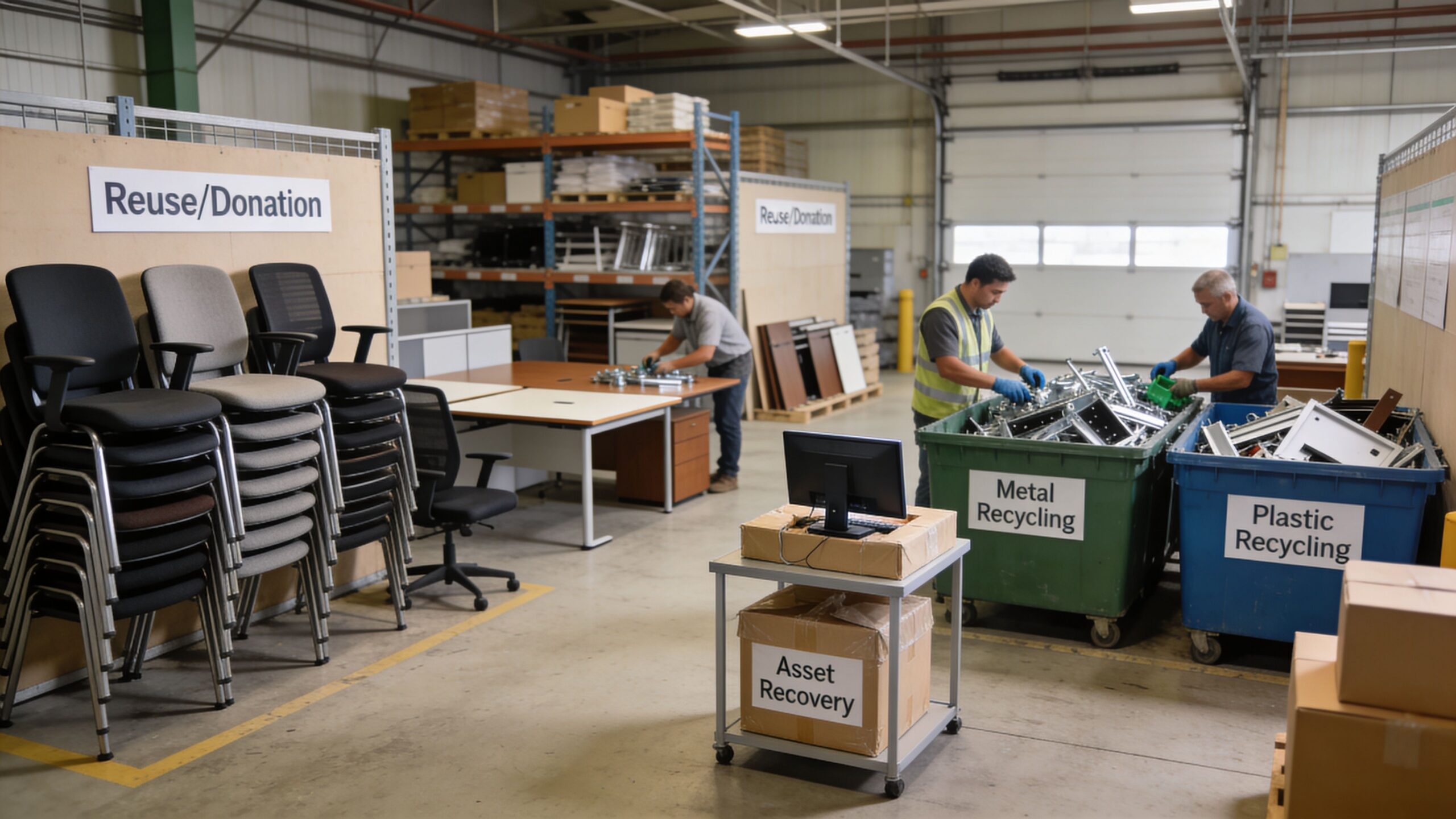
Smart removal planning doesn’t end with “get it out.” The better question is what each category of furniture should do next. Some pieces belong in reuse, some belong in secondary markets, some should go to donation channels, and some need recycling. Landfill should be the last answer, not the default one.
That approach is both practical and defensible. It lowers waste, improves reporting, and can reduce the net cost of the project.
Use the disposal hierarchy, not guesswork
According to Green Standards, office furniture removal prioritizes a disposal hierarchy of reuse (40-60% recovery), resale/donation (20-30%), recycling (10-20%), and landfill (under 10%). The same source also notes the potential for tax deductions up to $5K per office via IRS 170(e)(3) for donations.
That hierarchy is useful because it gives facilities teams a decision order:
- Reuse first: Move viable inventory into another department, floor, or location.
- Resale or donation next: Recover value or create a documented charitable path.
- Recycle after that: Separate materials and approved streams where practical.
- Landfill last: Reserve disposal for damaged, contaminated, or non-recoverable items.
Comparing office furniture disposal options
| Method | Financial Outcome | Environmental Impact | Logistical Effort |
|---|---|---|---|
| Reuse | Avoids replacement spending | Strong, because the furniture stays in service | Moderate, since pieces must be tracked and reassigned |
| Resale | Can return some project value | Strong, because products remain in circulation | Higher, because condition and marketability matter |
| Donation | May support tax documentation | Strong, especially for usable inventory | Moderate to high, depending on recipient requirements |
| Recycling | Usually lowers waste exposure | Better than disposal when materials can be separated | Moderate, with sorting and handling requirements |
| Landfill | Pure cost center | Weakest option | Low upfront effort, but poorest long-term outcome |
The operational point is simple. The more organized your inventory is before removal starts, the easier it is to sort assets into these channels without slowing the crew.
Match strategy to furniture type
Not every piece deserves the same exit path. Open-plan workstations, storage, and private office inventory should be reviewed separately. High-privacy setups, enclosed stations, and clean executive inventory often justify a closer look before disposal, especially if they align with categories like private office cubicles.
This is also where a full-service provider can help without turning the site into a sorting bottleneck. Some firms handle inventory tagging, removal sequencing, and liquidation support in one workflow. One example is used office furniture liquidation, which reflects the practical overlap between decommissioning and asset recovery.
A piece of furniture is only “waste” after you’ve ruled out reuse, resale, donation, and recycling with some discipline.
How to Evaluate and Hire the Right Removal Partner
A weak removal vendor rarely fails in the sales call. The problems show up later, during COI requests, elevator reservations, powered-station teardown, and final landlord walk-throughs. By then, your timeline is already exposed.

Check risk before you check price
Price matters, but bad assumptions cost more than a higher quote. Start with scope control.
Ask for insurance certificates, a written scope of work, site assumptions, and one named project lead. If the proposal does not spell out access hours, loading conditions, disassembly responsibilities, debris removal, and closeout standards, expect field decisions that add labor time and create disputes.
A qualified partner should answer a few operational questions without hesitation:
- Who is the onsite supervisor, and will that person be present during critical phases?
- What building access assumptions are included in the quote?
- Who handles modular disassembly, electrical components, and low-voltage disconnect coordination if needed?
- How will reusable furniture be separated from scrap or trash during the move-out?
- What does the site look like at turnover, and what closeout documentation is included?
Specific answers usually reflect a crew that has done this work at scale. General answers usually mean your team will be solving problems in real time.
Treat data security and site control as part of the same job
Office furniture removals often uncover IT assets that nobody included in the initial inventory. Monitors, docking stations, printers, badge readers, and old hard drives tend to surface once drawers, credenzas, and storage units are opened. According to Action Junk Hauling, office cleanouts frequently involve IT assets, which is why secure handling procedures need to be defined before pickup starts.
Ask a direct question. How does the vendor separate furniture removal from secure electronics handling?
If the answer is vague, keep looking. For sites with any data sensitivity, require chain-of-custody procedures, documented handoff points, and proof of destruction when applicable. A removal crew does not need to be your certified data destruction provider, but they do need a controlled process that keeps furniture work from contaminating IT disposal.
If a vendor plans to toss electronics in with general debris, they should not be on the shortlist.
A short visual overview can help your internal stakeholders understand what a more professional process looks like before you approve a vendor:
Red flags that usually predict a bad project
The same warning signs show up in troubled decommissions again and again:
- Handshake-only agreements: If the scope is not written down, disagreements about labor, debris, patching, and final condition are almost guaranteed.
- No finish-line definition: “Removal complete” should mean furniture, loose parts, anchors, packaging, and debris are addressed according to the contract.
- No disposition reporting: If your company tracks sustainability, donations, recycling, or resale, confirm reporting requirements before award.
- No building coordination plan: Trucking and labor are only part of the job. The vendor also needs to handle dock rules, elevator scheduling, protection requirements, and landlord expectations.
- No future-state thinking: Removal should support the next workplace decision, not create another pile of unsorted inventory your team has to manage later.
That last point matters more than many buyers expect. The best partner does not treat removal as an isolated pickup. They treat it as the first phase of a workplace change, whether that means a clean exit, a phased restack, or preparation for new furniture. Cubicle By Design supports that broader process by tying removal planning to reuse decisions, reconfiguration needs, and the next layout conversation, which helps facilities teams avoid paying twice for the same handling mistakes.
Frequently Asked Questions and Next Steps
How long does an office furniture removal project usually take
It depends on scope, building access, and how much disassembly is involved. A small office with loose furniture can move quickly. A larger suite with powered cubicles, elevator reservations, and sorting requirements needs a real schedule, not a rough guess.
Can removal happen after hours or on weekends
Yes, many office furniture removal services can work around building rules and occupancy needs. The key is confirming approved hours, security access, elevator use, and loading dock procedures in writing before the crew is dispatched.
Should we store furniture we might reuse later
Only if you’ve already identified where it will go, who owns the decision, and how long you’re willing to carry it. Unplanned storage often turns into delayed disposal with extra handling cost attached.
What’s the most common mistake companies make
They wait too long to make disposition decisions. When the crew arrives and nobody has decided what stays, what moves, and what gets donated or discarded, labor slows down and mistakes multiply.
The cleanest projects tie removal to the next workplace decision. If you’re exiting a space, that means a controlled closeout. If you’re reconfiguring, it means using the removal to clear the path for a more functional layout, cleaner inventory standards, and a better fit between furniture and the way the team works.
Cubicle By Design can support that next step with practical planning, furniture solutions, and workspace configuration tools that connect decommissioning decisions to the new environment. If you’re preparing for a move, downsizing, or redesign, start with Cubicle By Design and use the Custom Cubicle Designer to map out a workspace that fits your floorplate, privacy needs, and team workflow.