

At its core, the open office vs. cubicle debate comes down to a simple trade-off: cubicles are built for individual focus and privacy, while open offices are meant to spark spontaneous collaboration and transparency. Figuring out which is right for you means deciding whether your team’s daily grind demands deep concentration or a constant, free-flowing exchange of ideas.
Framing the Open Office vs Cubicle Debate
Choosing an office layout isn't just about aesthetics; it's a major business decision that hits everything from productivity and company culture to your bottom line. We're moving past the hype to give you a real, data-driven look at both options, helping you pick the environment that will actually help your team win. The modern workplace, heavily influenced by the tech scene, has largely swung toward the collaborative buzz of open-plan spaces, leaving the traditional, structured cubicle behind.
But the "right" answer isn't a one-size-fits-all solution. It hinges entirely on your team's specific workflows and what they need to do their best work. At Cubicle By Design, we believe in creating spaces that are purpose-built for performance. Before we get into the nitty-gritty, here’s a quick look at how these two layouts stack up.
| Feature Comparison | Open Office Layout | Cubicle Layout |
|---|---|---|
| Primary Goal | Foster collaboration and transparency. | Provide privacy and enable focused work. |
| Acoustic Control | Minimal; high potential for noise and distractions. | High; partitions absorb sound and reduce interruptions. |
| Personal Space | Shared and communal; limited personal territory. | Defined and individual; allows for personalization. |
| Ideal For | Sales, marketing, and creative teams. | Finance, legal, engineering, and call centers. |
| Initial Cost | Often lower due to fewer materials. | Higher due to partitions and individual setups. |
This table is a great starting point, but the real decision comes from understanding how these factors play out day-to-day in a real business. You have to think about the deeper issues:
- Deep Work vs. Collaborative Tasks: Does your team need long, uninterrupted stretches to solve complex problems? Or do they thrive on quick, informal brainstorming sessions that pop up throughout the day?
- Employee Well-being: How will the layout impact stress, job satisfaction, and morale? Studies consistently show that constant noise and a lack of privacy can seriously drag people down.
- Cost Beyond Construction: An open plan might look cheaper upfront, but you have to weigh the potential hidden costs. Lost productivity from distractions and higher employee turnover can quickly erase those initial savings.
Ultimately, navigating the open office vs. cubicle choice requires an honest look at your company’s operational DNA. By exploring the latest workplace design trends, you can get a better sense of what’s possible. This guide will walk you through a detailed comparison to help you make the right call for your team's long-term success.
The Strategic Case for Modern Office Cubicles
Let's be honest, modern cubicles have come a long, long way from the drab, uninspired boxes of the past. Today, they're strategic assets for creating an environment that supports deep, focused work—something that's absolutely critical for any role demanding high concentration. In the ongoing open office vs cubicle debate, the cubicle makes a powerful case for boosting individual productivity simply by providing a bit of personal space and acoustic control.
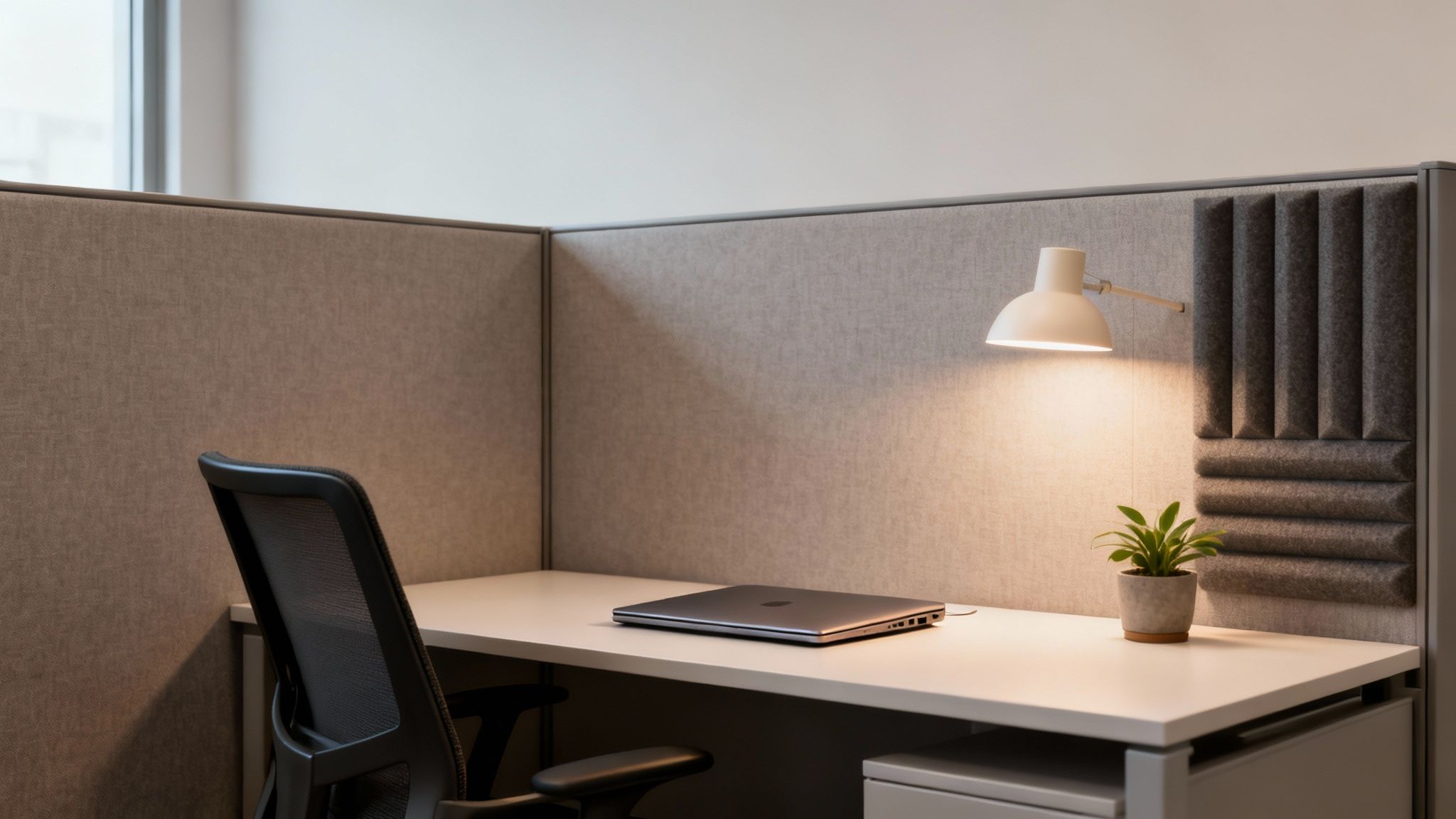
This dedicated space translates directly to fewer interruptions and less stress for your employees. For the business, the benefits are tangible: greater accuracy on detailed tasks and a real improvement in overall job satisfaction. Think about it—the cubicle was originally invented to solve the chaos of those old-school rows of desks.
And the research still backs this up. One study found that employees in open offices face 62% more interruptions and spend a staggering 73% less time on actual work compared to those in more private spaces. In sharp contrast, cubicle users reported 29% fewer interruptions and dedicated 20% more time to focused efforts.
Tailoring Privacy for Peak Performance
One of the biggest strengths of modern cubicle systems is just how adaptable they are. Unlike a rigid, one-size-fits-all open plan, cubicles can be configured to meet the specific needs of different teams. Your finance department, which handles sensitive data, obviously needs a different level of privacy than a highly collaborative marketing team.
Solutions from Cubicle By Design are engineered for this exact purpose. For instance:
- Private Office Cubicles offer higher partitions and sound-dampening materials, creating quiet zones for roles that demand confidentiality and intense focus.
- Workstation Cubicles strike a balance with lower partitions, allowing for easy communication within teams while still cutting down on cross-office distractions.
This ability to create purpose-built zones means you can actually support how each employee needs to work. By controlling acoustics and visual distractions, you're empowering your team to perform at their best. Our guide on the benefits of a modern office cubicle digs deeper into this.
By investing in a well-designed cubicle layout, companies are not just buying furniture; they are investing in sustained productivity, reduced error rates, and a healthier, less stressful work environment for their employees.
A Smart Investment in Productivity
The versatility of today’s cubicles also extends to their physical design. With adjustable partition heights, a huge range of materials, and integrated storage and power options, you can create a workspace that's both highly functional and looks great. That’s a level of customization an open office simply can't match.
Using a tool like our Custom Cubicle Designer, you can visualize and build a layout that aligns perfectly with your company’s goals. When you give your team the private, focused spaces they need to do their best work, you’re positioning your entire organization for greater efficiency and success. The modern cubicle is no longer just a workstation; it’s a strategic tool for building a more productive workplace.
Understanding the Appeal of Open Office Plans
In the ongoing open office vs cubicle debate, it's easy to see why open-plan designs got so popular. They came with big promises: saving money, boosting collaboration, and creating a modern, transparent vibe that just felt fresh and forward-thinking. And for certain fast-paced, highly collaborative teams, this layout can genuinely spark spontaneous conversations and build a sense of shared purpose.
By knocking down physical walls, the idea was to break up rigid hierarchies and let ideas flow freely. The initial setup is often cheaper, too, since you can fit more people into a smaller footprint without buying a bunch of partitions. This mix of potential savings and an energetic atmosphere made the open office a go-to for companies looking to shake things up.
The Rise and Reality of Open Concepts
The trend really took off in the 2000s, with tech giants leading the charge. Google, for instance, famously revamped its headquarters in 2005. Facebook later one-upped everyone, building the world’s largest single-floor open layout for 2,800 employees. But the promised jump in productivity often never showed up.
In fact, research now shows that workers can lose up to 20% of their day to distractions in these setups. One major study found a jaw-dropping 70% drop in face-to-face interactions as people retreated behind their headphones to find focus. You can learn more about how these office trends impact employee productivity across different settings.
The very design that was supposed to get people talking ironically led to more Slack messages and emails instead of real conversations. While the appeal is understandable, the reality check often comes with hidden costs that are easy to miss at first glance.
Examining the Hidden Costs
The problems with an open office go way beyond just noise. That initial savings on the build-out can get eaten up pretty quickly by long-term operational costs, sometimes creating a negative return on your investment.
These hidden costs usually pop up in a few key areas:
- Documented Productivity Drops: The constant buzz of conversations, people walking by, and general background noise makes deep, focused work almost impossible. This fragmented attention leads to more mistakes, especially on detailed tasks.
- Increased Employee Absenteeism: Open layouts are perfect breeding grounds for germs. When one person gets sick, the lack of physical barriers means it spreads like wildfire, leading to more of the team calling out sick. Stress levels can also climb, contributing to burnout.
- Decreased Job Satisfaction: Having no privacy is mentally exhausting. Employees often feel like they're always "on display" and can't find a quiet moment to decompress. Over time, this really hurts morale and can lead to higher turnover.
While open layouts may work for specific collaborative functions, they often undermine the focused work crucial for most roles. This creates a significant, and often unmeasured, loss in overall productivity that businesses cannot afford to ignore.
Ultimately, the vision of a buzzing, collaborative workspace is attractive, but the day-to-day reality often falls flat. The constant sensory overload and lack of personal space can torpedo the very productivity the layout was meant to inspire, making it a poor fit for many businesses. A truly effective office design has to support both group work and the universal need for individual focus.
Comparing Office Layouts Across Key Business Metrics
Deciding between an open office and a cubicle layout isn't just about aesthetics; it's about digging into how each setup performs against your core business goals. Forget the simple pro/con lists. A real side-by-side comparison across key metrics is the only way to see the true operational impact of your choice. This is where we move past the trendy debate and get down to what really works.
The data often tells a story that the "open-plan" hype doesn't. This infographic paints a pretty clear picture of the hidden costs.
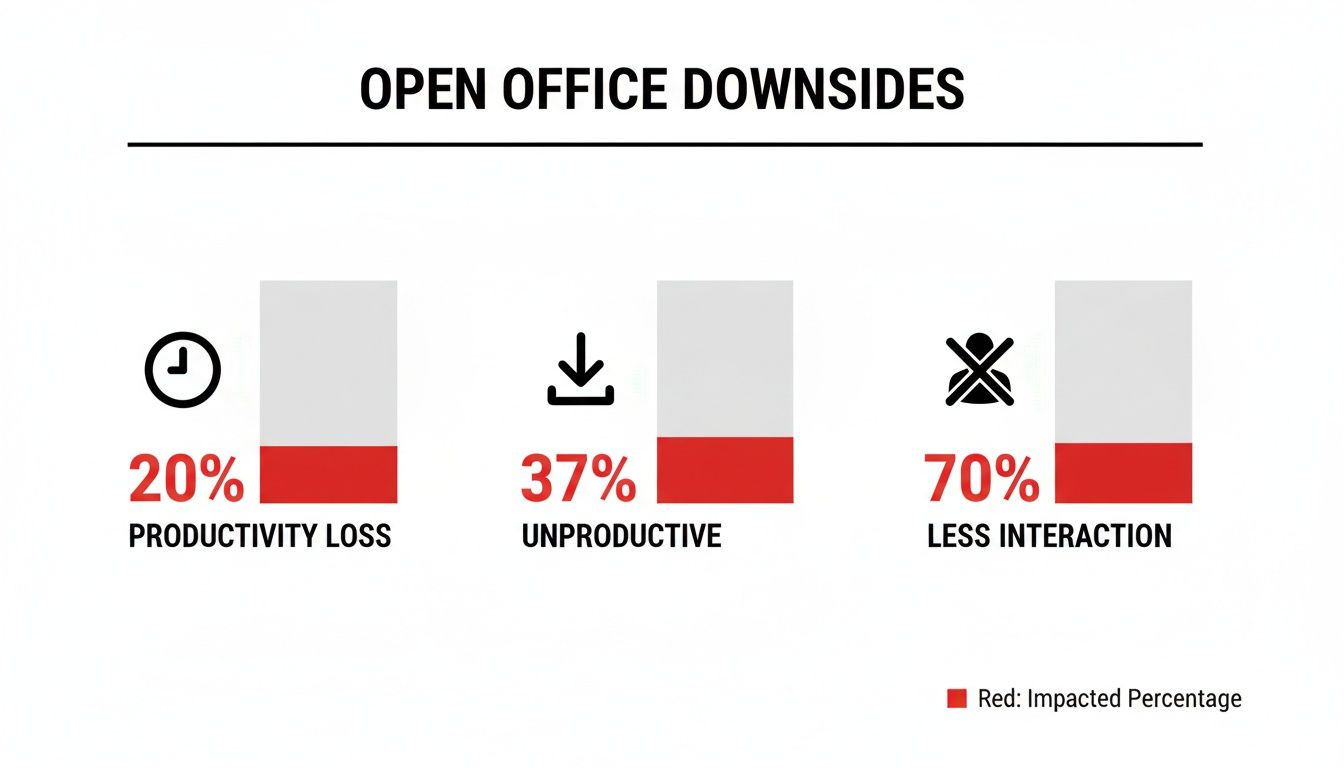
When you look at the numbers, you start to see how the promise of collaboration can backfire, running headfirst into the realities of how people actually focus and get work done.
Let's break down the practical differences. The following table gives a detailed breakdown comparing the two office layouts across key business factors, helping you weigh the trade-offs for your specific organizational needs.
Open Office vs Cubicle: A Practical Comparison
| Business Metric | Open Office Layout Performance | Cubicle Layout Performance |
|---|---|---|
| Individual Focus | Low. High potential for constant visual and auditory distractions. | High. Physical and acoustic barriers create a dedicated zone for deep work. |
| Spontaneous Collaboration | High. Lack of barriers encourages impromptu conversations and quick huddles. | Moderate. Requires intentional movement but prevents disrupting others. |
| Structured Teamwork | Low. Can be disruptive to the entire office. Lacks private, dedicated areas. | High. Best paired with separate meeting rooms for focused group sessions. |
| Employee Privacy | Very Low. Little to no personal space, leading to a feeling of being monitored. | High. Provides a sense of personal territory and psychological comfort. |
| Space Efficiency (Density) | Very High. More people can fit into a smaller footprint. | Moderate to High. Less dense but offers far greater functionality per square foot. |
| Initial Cost | Lower. Fewer materials and less complex furniture reduce upfront investment. | Higher. More materials and installation time lead to a greater initial cost. |
| Long-Term ROI | Questionable. Productivity losses and higher turnover can negate initial savings. | Strong. Boosted productivity, fewer errors, and better retention deliver lasting value. |
| Employee Wellness | Low. Can increase stress and facilitate the spread of illness. | High. Reduces sensory overload and provides a healthier, controlled environment. |
| Flexibility | High for simple rearrangements, but poor for creating functionally different zones. | High for strategic reconfiguration. Modern systems are modular and adaptable. |
This comparison highlights that the "best" layout is entirely situational. What works for a high-energy sales floor might be a disaster for a team of accountants.
Productivity And Focus
In the great open office vs cubicle debate, productivity is where the battle lines are drawn. Open offices are sold on the idea of constant communication, but this feature often becomes a bug. It can easily lead to a state of continuous partial attention, where background chatter and constant movement make deep, focused work next to impossible.
Cubicles, by their very nature, are engineered to fight back against those distractions. By providing clear physical and acoustic barriers, they give employees a dedicated zone to concentrate without being pulled in a dozen different directions. For any role where precision is non-negotiable—think finance, engineering, or legal—that quiet space isn't a luxury; it's a necessity.
Collaboration And Communication
An open office’s main selling point has always been collaboration. Removing barriers absolutely allows for more spontaneous chats and quick brainstorming, which can be great for fast-moving creative or sales teams that thrive on that energy.
The problem is, that collaboration is often shallow. For structured, meaningful teamwork, a cubicle layout combined with dedicated meeting rooms is a much more effective setup. It lets teams collaborate on purpose, without derailing colleagues who need to put their heads down. Finding the right mix is key, and our guide on improving workplace productivity has more strategies for this.
The most effective workplaces don't force a single mode of work. They provide distinct zones for different activities—quiet cubicles for focus, open lounges for casual chats, and enclosed rooms for serious collaboration.
Cost And Space Efficiency
On paper, open offices look like the cheaper option. You can cram more desks into a smaller footprint, which cuts down on rent and the initial spend on furniture. This density is a huge part of their appeal.
But that's a short-sighted calculation. The higher upfront cost of a quality cubicle layout from a provider like Cubicle By Design often delivers a much stronger return on investment. That return comes from sustained productivity, fewer costly errors, and lower employee turnover driven by burnout and a frustrating work environment.
Employee Wellness And Privacy
Employee well-being is tied directly to a sense of control over one's own environment. Open offices provide almost no personal space or privacy, which can crank up stress levels and create a feeling of being constantly watched. And let's not forget the other documented downside: germs spread like wildfire, leading to more sick days.
Cubicles give people that crucial sense of personal territory. They let employees customize their space and create a shield from the sensory overload of a busy office. That psychological comfort is a huge factor in long-term job satisfaction.
Flexibility And Scalability
Open layouts are often pitched as being more flexible since you can just add or move desks around as your team grows. For a startup in constant flux, that sounds great.
But modern cubicles offer a smarter, more strategic type of flexibility. Systems like our Workstation Cubicles are designed from the ground up to be reconfigured. You can easily create new team zones or adjust department layouts as your business evolves. This adaptability, combined with the built-in benefits of privacy, makes them a far better long-term solution. You can even experiment with your own layout using our online Custom Cubicle Designer to see what's possible. And for roles that demand total discretion, our Private Office Cubicles deliver a fully enclosed, distraction-free environment.
How to Design Your Ideal Hybrid Workplace
The "open office vs. cubicle" debate often forces a choice that just doesn't reflect how modern teams work. The truth is, the most effective workplaces don't pick a side—they smartly blend the best of both. Creating a hybrid environment that caters to different work styles isn't just a trend; it's essential for attracting top talent and getting the most out of your team.
This is about moving past a one-size-fits-all approach. The real goal is to build an office with a variety of settings, so employees can pick the environment that fits the task at hand. That's how you empower people to do great work, whether they need total silence or a dynamic, collaborative buzz.
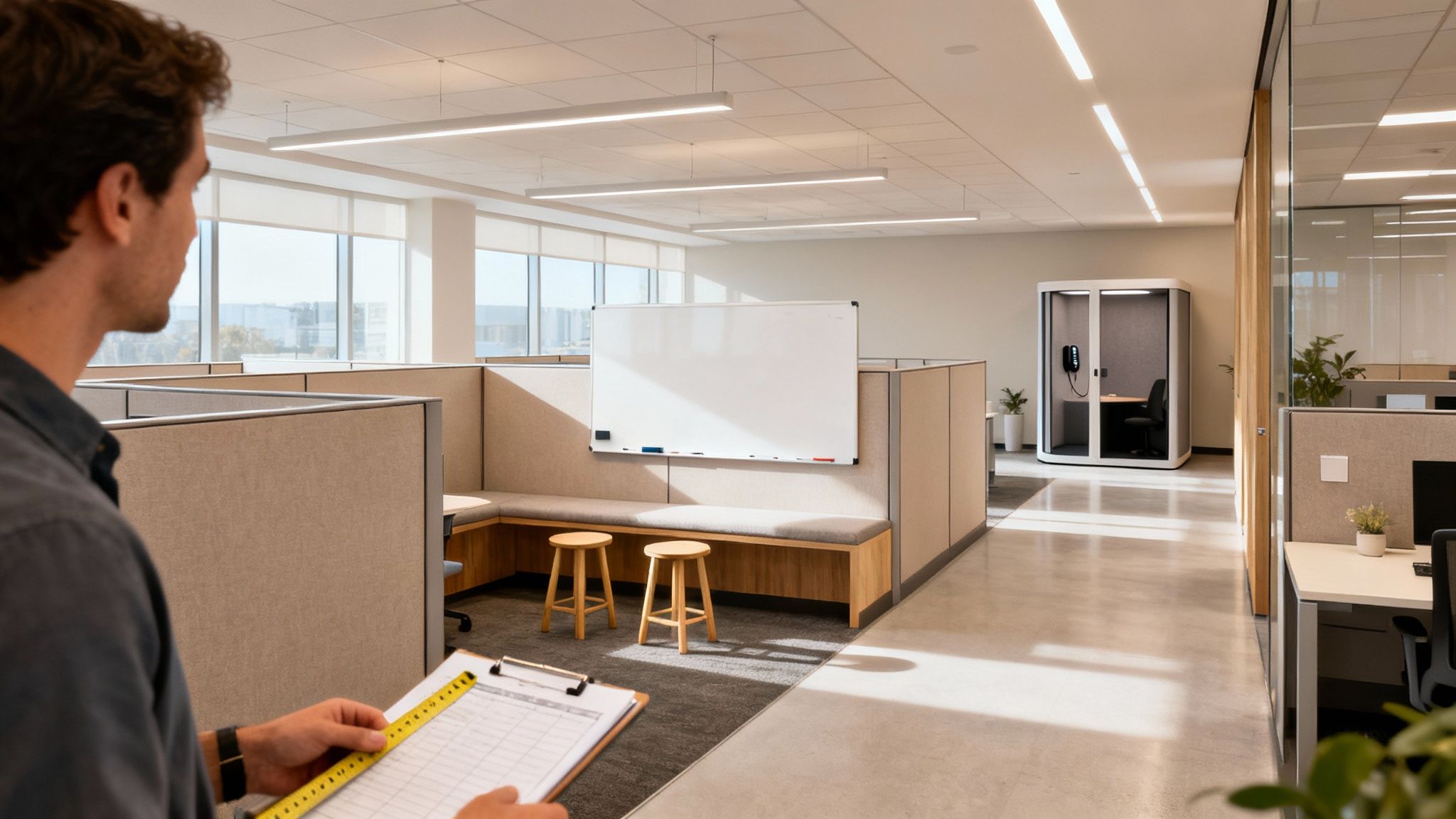
Implementing Office Neighborhoods and Zones
One of the most powerful ways to design a hybrid workplace is by creating "neighborhoods" or "zones." This just means dividing the office into distinct areas, each with a clear purpose. When you thoughtfully allocate space this way, you create a balanced ecosystem that serves the very different needs of your people.
Think of your office like a small city with unique districts. Each one has its own function, but they all contribute to a vibrant community. That’s exactly how office zones work, giving you structure and choice within your floor plan.
A great zoned layout might include:
- Focus Zones: These are your quiet libraries. Outfitted with high-walled Workstation Cubicles, they are designated for deep, concentrated work where interruptions are kept to a minimum.
- Collaborative Hubs: Set up with open-plan benches or clustered workstations with lower walls, these areas are built for teamwork, brainstorming, and those spontaneous conversations that spark great ideas.
- Communication Pods: Small, enclosed phone booths or pods are a must-have. They provide a private spot for video calls and one-on-one meetings without disrupting colleagues in the focus zones.
- Social and Breakout Areas: Comfortable lounges and café-style seating create informal spots for employees to recharge, connect, and hold casual meetings. These spaces are critical for building a strong company culture.
Achieving Agility with Modular Solutions
The magic ingredient for creating these zones is flexibility. Old-school, permanent construction is expensive and a nightmare to change when your company evolves. This is where modular office solutions from Cubicle By Design really shine. Our systems are built to be reconfigured, letting you adjust and redefine your layout with almost no downtime.
Using modular components gives businesses a truly agile environment. You can scale up a department, create a new project zone, or rethink a layout to improve workflow—all without a major renovation. That adaptability is what future-proofs your office design.
For example, you could set up a large collaborative hub for a new product launch. Later, as the project shifts to development, you can easily reconfigure that same space into individual focus stations. Our range of cubicles and partitions makes it happen, giving you a cost-effective way to keep your workspace in sync with your business. And if you need more permanent-feeling divisions, you should look into our modular office walls, which offer a fantastic balance of structure and adaptability.
Start Visualizing Your Perfect Space
Designing a hybrid office can feel like a huge undertaking, but modern tools have made the planning process easier than ever. You can start bringing your vision to life right now by using an interactive platform to map out your ideal floor plan.
Our online Custom Cubicle Designer is a powerful tool that puts you in the driver's seat. It allows you to play with different layouts, set dimensions, pick out materials, and adjust privacy levels to match your team’s workflow and your budget. This hands-on approach helps you see exactly how the space will function before you commit.
For hybrid teams, it's also crucial that employees are set up for success both in and out of the office. Check out this ultimate work from home office setup guide to round out your strategy. By mixing thoughtful zoning with flexible, modular furniture, you can build a workspace that truly empowers every single employee.
Your Decision-Making Checklist for the Right Office Layout
Making the final call in the open office vs cubicle debate isn't about chasing trends. It's about taking a hard, honest look at your company's unique DNA and choosing a layout that actually helps you hit your business goals.
To make sure you land on a design that boosts productivity instead of crushing it, walk through this checklist. Answering these questions will point you toward the right fit.
Analyze Your Team's Core Workflows
First things first: what do your people actually do all day? A high-energy, buzzing layout that works wonders for a sales team will be an absolute nightmare for detail-oriented engineers. The goal here is to match the environment to the work.
- How much of the day requires deep, uninterrupted focus? Be realistic. If more than 50% of your team needs quiet time for complex problem-solving or heads-down work, a cubicle-heavy or hybrid model is non-negotiable.
- How does collaboration really happen? Are we talking about spontaneous, quick huddles between desks, or more structured, planned meetings? Open plans are built for the former, while cubicles paired with dedicated meeting rooms are a much better fit for the latter.
- What about privacy and security? Teams like HR, finance, and legal handle sensitive information daily. They need the acoustic and visual privacy that solutions like Private Office Cubicles were designed to provide.
Evaluate Employee Feedback and Wellness
Your employees are on the front lines of your current workspace every single day. They know what works and what doesn't, and their feedback is gold. Ignoring their needs isn't just a bad look—it's a fast track to low morale and high turnover.
The best office designs are always human-centric. They put the well-being and productivity of people first, recognizing that a comfortable, functional environment is a direct investment in the company's bottom line.
Think about asking them directly through anonymous surveys or small focus groups. What are their biggest frustrations with the current setup? Do they feel like they have the right spaces to do their jobs well?
Plan for Future Growth and Flexibility
The office you design today needs to work for the company you'll be tomorrow. A rigid layout can quickly become a huge operational headache as you grow and scale.
Keep these long-term factors in mind:
- Scalability: How easily can you reconfigure the space for new hires or shifting department sizes? Modern workstation cubicles offer a modular flexibility that you just don't get with fixed open-plan furniture.
- Budget vs. ROI: An open office might seem cheaper upfront, but you have to weigh that against the long-term ROI of a cubicle layout that reduces distractions and costly errors.
- Bringing It to Life: How do you get from a rough idea to a functional floor plan? This is where an expert partner makes all the difference. The team at Cubicle By Design provides the professional space planning needed to create a workspace that's both effective and efficient. Explore our full range of cubicles and start playing around with layouts in our Custom Cubicle Designer.
Common Questions on Office Design
When you’re weighing the open office vs. cubicle decision, a few key questions almost always come up. Let's tackle these head-on, cutting through the noise to get to the practical answers business leaders and office managers need.
Are Cubicles More Expensive Than Open Office Plans?
It’s easy to look at the initial price tag and assume an open office is the cheaper route. You’re buying less furniture and fewer materials, after all. But that's a shortsighted view that ignores the total cost of ownership. The real expense of an open plan often sneaks up on you later in the form of operational drains.
Constant distractions are notorious for slashing productivity, which leads to missed deadlines and costly mistakes. That stressful, noisy environment can also contribute to higher employee turnover and more sick days—both of which hit your bottom line hard. A well-designed cubicle layout might require a larger upfront investment, but it often pays for itself by fostering real focus and cutting down on those long-term expenses.
A productive employee in a focused environment will always generate more value than a distracted one in a cheaper seat. The true cost of an office layout is measured in output, not just initial setup fees.
Can a Cubicle Layout Support a Collaborative Culture?
Absolutely. The idea that cubicles are collaboration-killers is an old, tired stereotype. Modern office design isn't about choosing one or the other; it's about creating a balanced ecosystem that supports every kind of work. The best strategy pairs focused cubicles with thoughtfully placed common areas.
Think of your office in terms of "zones" for different activities:
- Deep Work Zones: This is where you place dedicated Workstation Cubicles so employees can concentrate without being interrupted.
- Collaboration Hubs: These are your open lounges or breakout rooms, fully equipped for brainstorming sessions and team huddles.
- Private Spaces: Small, enclosed pods or rooms are perfect for sensitive phone calls and one-on-one conversations.
This approach gives your team the freedom to choose the right space for whatever they're working on. It’s a far more effective way to support both individual focus and dynamic teamwork than a one-size-fits-all open plan could ever be.
How Do We Transition from an Open Office to Cubicles Smoothly?
Moving from an open layout to a cubicle-based one takes some real planning if you want to avoid disrupting workflow and get your team on board. The most effective way to do it is with a phased approach, guided by professional space planners. Working with experts at Cubicle By Design means you can map out a transition that actually works with your team’s rhythm and your building's layout.
Communication is just as important. You have to clearly explain the "why" behind the change. Frame it as a positive move, highlighting the benefits like less noise, better focus, and having a dedicated personal space again. When your team understands the new layout is designed to make their work life better, they’re much more likely to get behind it. You can even get them involved by using a tool like our Custom Cubicle Designer to help them visualize the new space. And for roles that need total discretion, pointing out the addition of Private Office Cubicles can be a huge win.
Ready to design a workplace that truly works for your team? The experts at Cubicle By Design offer professional space planning and a full range of modern cubicles to create an office that boosts focus and productivity.