
The Ultimate Guide to Soundproof Office Cubicle Solutions | Cubicle By Design

The constant buzz of an office—phones ringing, side conversations, keyboard clicks—isn't just a minor annoyance. It's a productivity killer. A soundproof office cubicle is more than just a workstation; it’s a dedicated space engineered to block and absorb that noise, carving out a quiet zone for focus and private conversations. It’s the key to turning a chaotic environment into a powerhouse of efficiency.

The High Cost of Noise in the Modern Workplace

In today's popular open-plan offices, sound has nowhere to go but everywhere. A single sales call can easily derail an entire team's focus. All those small, constant interruptions really add up, chipping away at concentration throughout the day. Studies have shown that workers lose a shocking amount of productive time every single day simply because of noise. That's not just a nuisance; it's a real, tangible cost hitting your bottom line.

Think of it this way: a noisy open office can quickly become a "distraction factory." Every ringing phone and impromptu chat pulls your employees' attention away from what they need to be doing. Their brains have to work overtime just to filter out the background chatter, which leads to mental fatigue, more mistakes, and higher stress levels. This makes it incredibly difficult for people to do deep, focused work or handle sensitive client calls.
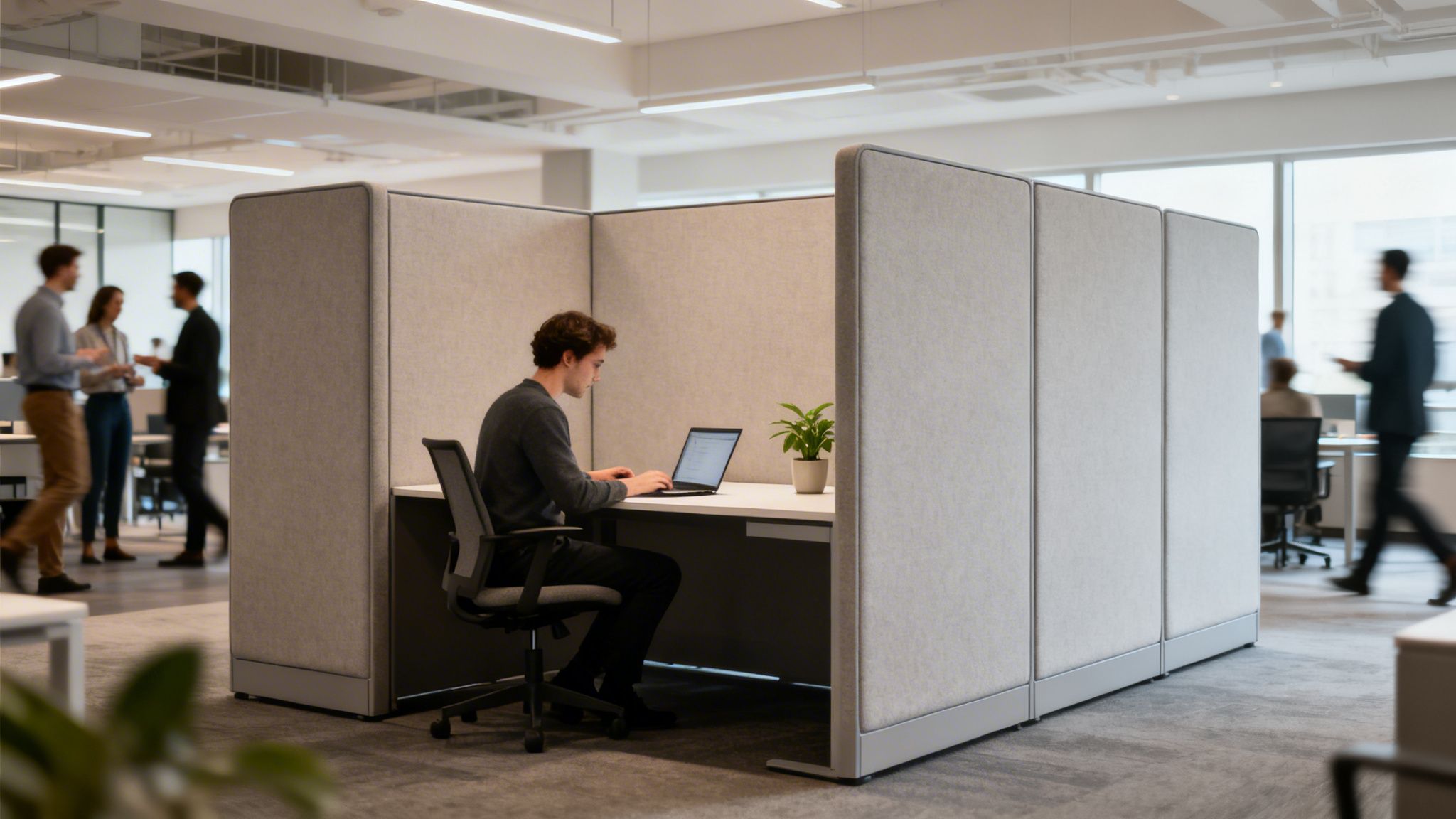
A man works on a laptop inside a modern, soundproof office cubicle designed for focus and privacy.

Restoring Focus and Privacy

A soundproof office cubicle is the most direct fix for this problem. Standard cubicles might offer some visual separation, but they do very little for acoustics. These specialized workstations, on the other hand, are built from the ground up with sound-absorbing materials and designs that create a real acoustic barrier.

By containing sound, these cubicles give individuals their focus back without completely isolating them from the team. They provide a much-needed sanctuary for any task that requires serious concentration, like writing, analyzing data, or holding confidential calls.

The payoff from creating a quieter workspace is almost immediate. When you implement a soundproof cubicle system, you’ll see some major improvements:

  • Improved Employee Concentration: With fewer distractions, employees can get into "the zone" faster and stay there longer. The result is a dramatic boost in their quality and quantity of work.
  • Enhanced Confidentiality: For anyone in HR, sales, legal, or healthcare, a sound-dampened space isn't a luxury—it's a necessity for protecting private information.
  • Reduced Workplace Stress: A calmer environment lowers the mental load and chronic stress that comes from being in a noisy office all day. That means better morale and higher job satisfaction.
  • Increased Overall Efficiency: Less time spent being interrupted means less time wasted trying to get back on track. Your whole team can get more done, which directly fuels business growth.

A Strategic Investment in Performance

It's a mistake to think of a soundproof cubicle as just another piece of furniture. It’s a strategic tool for getting the best performance out of your team. At Cubicle By Design, we help businesses solve these exact challenges with sophisticated systems.

Whether you need fully enclosed Private Office Cubicles for total privacy or high-paneled Workstation Cubicles for focused team pods, the goal is always the same: create an environment where your people can thrive. You can start exploring what it takes for improving workplace productivity with a smarter layout designed with our Cubicle Designer. When you invest in acoustic control, you're investing directly in your team's success—and your company's.

Decoding the Science of Soundproof Cubicles

What’s the real difference between a regular cubicle and a genuinely soundproof office cubicle? It all comes down to the science of acoustics. Once you get a handle on a couple of key ideas, you can see past the marketing fluff and find a workspace that actually delivers peace and quiet.

Think about office noise in two ways: it can either punch straight through a wall, or it can bounce around the room like a pinball, creating echo and distraction. To quiet a space down, you have to tackle both. This is where a couple of important ratings come into play.

The Dam and The Sponge Analogy

Let's imagine all that unwanted office chatter is a river flowing right at your desk. To manage it, you need two things: a solid dam to stop the flow and a big sponge to soak up any water that makes it into your space.

  • Sound Transmission Class (STC): This is your dam. STC is a number that tells you how good a wall is at stopping sound in its tracks. A higher STC rating means the wall is a better sound blocker, turning a loud conversation just outside into a faint, distant murmur.

  • Noise Reduction Coefficient (NRC): This is your sponge. NRC measures how much sound a surface can absorb. The rating goes from 0 to 1, and the closer you get to 1, the more sound gets soaked up, killing echoes and reverb inside your cubicle.

A truly effective soundproof office cubicle has both. It’s built with high-STC walls to act as a dam against outside noise and high-NRC surfaces to work as a sponge for any sound inside, creating a quiet, balanced workspace.

Essential Components of an Acoustic Cubicle

Hitting those high STC and NRC numbers doesn't happen by accident. It's all about using the right materials and smart design, because a cubicle's sound control is only as good as its weakest point. A few gaps or cheap, thin panels can ruin the whole effect.

The goal is to create a complete seal. Even a tiny opening can let in a shocking amount of noise, just like a small crack in a window can let in a bone-chilling draft. Every single component matters.

Here are the key pieces that have to work together to build an effective sound barrier:

  • Full-Height Walls: The biggest factor, by far, is wall height. You need panels that go from the floor all the way to the ceiling (or very close to it). This stops sound from just hopping over the top, a problem that makes standard low-walled cubicles useless for acoustic privacy.

  • High-Density Core Materials: Mass blocks sound. It’s that simple. Soundproof cubicles are built with heavy, dense materials in their core, like compressed mineral wool or special composites that physically stop sound waves. This is a world away from the hollow, lightweight panels in most cubicles.

  • Acoustic Fabric and Surfaces: To crank up the NRC "sponge" effect, panel surfaces are wrapped in special sound-absorbing materials. These acoustic fabrics have a porous texture that traps sound waves instead of letting them bounce around, which cuts down on echo within the space.

  • Airtight Seals and Gaskets: Sound travels on air, so any gap is a potential leak. True acoustic cubicles use specialized gaskets and seals to close every gap—between panels, around the door, and along the floor and ceiling. This creates an airtight box that sound struggles to get into.

When you understand these basics, you can start looking at different office acoustics solutions and see why a purpose-built system is so much better than trying to patch up a standard cubicle. It's the combination of blocking mass and absorbing surfaces that gives you real speech privacy and the focus you need.

Strategic Office Design for Acoustic Privacy

Getting real control over office noise means looking beyond a single soundproof office cubicle. A truly effective plan takes the entire office layout into account. When you thoughtfully design the space, you can create an environment that naturally quiets distractions and helps people focus.

Instead of just banking on cubicle walls to do all the work, you can use the layout itself to manage sound. This means creating specific zones for different kinds of work, which helps keep noise contained right where it starts and stops it from spilling across the entire floor.

Creating Dedicated Acoustic Zones

A smart move is to divide your office into zones based on how loud the activities are. Think of it like a well-designed library—you have your silent reading areas, and then you have separate rooms for group study. The same idea works wonders in an office, making sure loud conversations don't derail tasks that require deep concentration.

  • Quiet Zones: These spots are reserved for heads-down, focused work. You’ll want to place them far from high-traffic hallways, break rooms, and the reception desk. Outfitting these zones with high-paneled cubicles can make them even quieter.
  • Collaboration Hubs: These are the energetic spaces built for team meetings, brainstorming, and quick chats. By grouping these activities together, you keep the noise bundled up and away from the quiet zones.
  • Mixed-Use Areas: For areas that serve multiple purposes, flexible furniture and movable partitions are your best friend. For more on this, check out our guide on panel privacy screens, which can help create temporary sound separation whenever you need it.

Even modern office trends like hot desking strategies, which are all about flexibility, show just how much demand there is for good acoustic solutions. The more open and dynamic the layout, the more you need reliable options to give people a quiet place to land.

A well-thought-out office layout can significantly cut down on noise pollution. The table below outlines a few strategies and the kind of acoustic impact you can expect from each.

Acoustic Layout Strategies and Their Impact

Layout Strategy Description Best For Acoustic Impact
Zoning Creating separate areas for quiet work, collaboration, and breaks. Offices with diverse work styles and activity levels. High. Effectively contains noise at its source and protects quiet areas.
Buffer Zones Using hallways, storage areas, or plant life to create physical separation. Large open-plan offices needing to break up the space. Medium. Reduces direct sound travel between different functional areas.
Staggered Layout Arranging cubicles in a non-linear, staggered pattern. Preventing a direct line of sight and sound travel down long rows. Medium. Disrupts sound waves and adds a degree of perceived privacy.
Centralized Hubs Placing high-noise equipment (printers, copiers) in a central, enclosed room. Any office looking to isolate a major, consistent source of noise. High. Removes a significant source of background distraction from the main floor.

By choosing the right combination of these strategies, you're not just placing furniture—you're actively shaping the acoustic character of your workspace.

Supporting Your Cubicles with Environmental Acoustics

The walls of your cubicles shouldn't be your only line of defense against noise. The room itself—the floors, ceilings, and walls—plays a huge part in either echoing sound or soaking it up. Weaving sound-absorbing materials into the broader office environment gives you a strong acoustic foundation.

Think of your office like a concert hall. The shape of the room, the materials on the walls, and the seating arrangement all work together to control the sound. Your office is no different—every surface contributes to the overall acoustic experience.

This boils down to two core ideas in acoustic design: blocking sound and absorbing it.
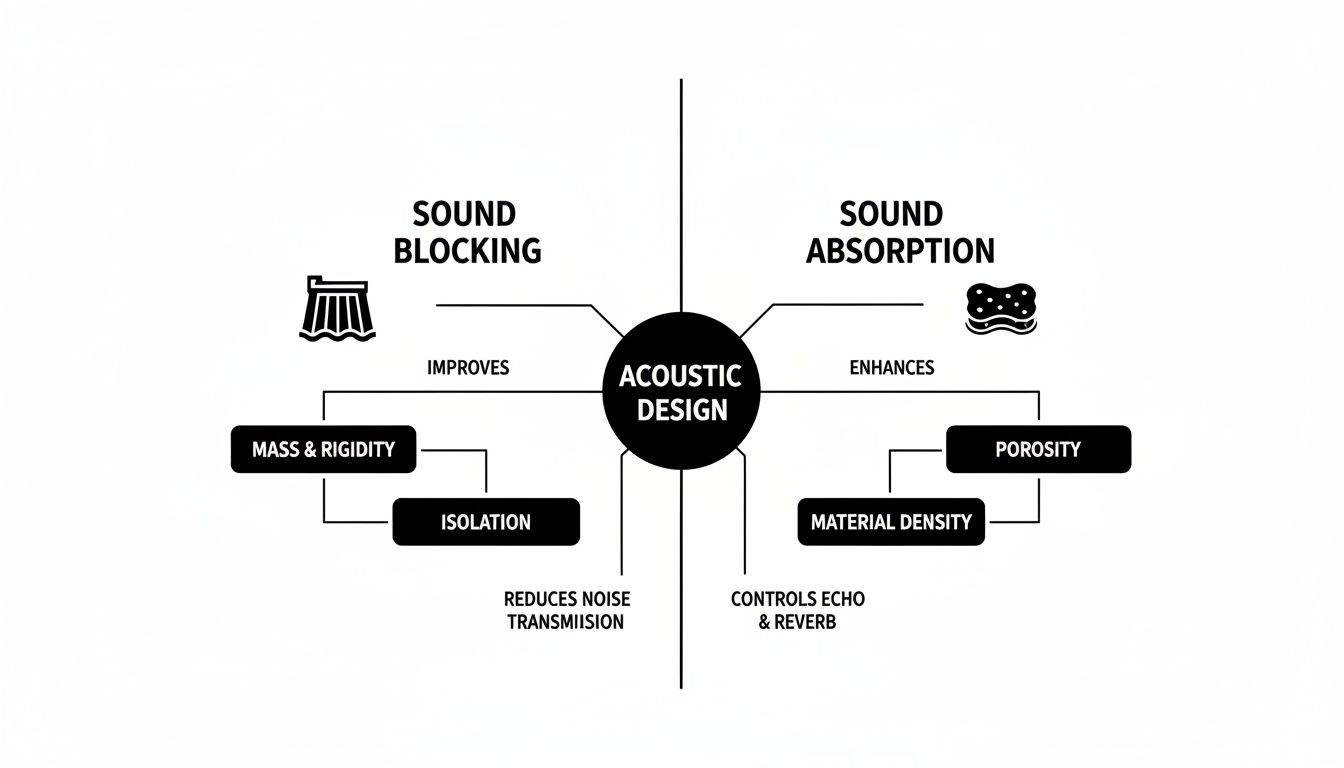
A mind map illustrating acoustic design principles for soundproof office cubicles, differentiating sound blocking (mass, isolation) from sound absorption (porosity, material density).

As you can see, blocking sound relies on heavy, dense materials to stop it in its tracks, while absorption uses soft, porous materials to trap sound waves. A great office design uses a bit of both.

Tailoring Your Layout with Smart Design Tools

An effective layout doesn't happen by accident. It takes careful planning that considers how your team actually works, from foot traffic patterns to which departments need to be near each other. This is where modern design tools really shine.

For instance, our Cubicle Designer lets you play with different layouts virtually before you commit. You can test various workstation configurations, see how they fit your floor plan, and find the sweet spot between productivity and acoustic comfort.

When you combine smart zoning, environmental acoustics, and strategic layout planning, you’re doing more than just buying furniture. You’re designing a workspace that actively supports focus and well-being. This big-picture approach ensures your investment in a soundproof office cubicle truly pays off.

Choosing Your Ideal Soundproof Cubicle System

Trying to find the right soundproof office cubicle can feel like a maze. But it really comes down to two main options: fully enclosed private offices or workstations with high panels. Each gives you a different degree of quiet, and the best one for you depends entirely on what you're trying to achieve, your budget, and the kind of work your team does.

This isn't just about picking a product off a shelf. A bustling call center has completely different noise challenges than a quiet zone for developers. Once you understand the key differences, you can pick a system that actually delivers the peace and privacy your team needs to focus.

The Fortress: Private Office Cubicles

When you need absolute speech privacy and the best possible sound isolation, nothing beats a fully enclosed system. These are basically small, modular rooms you can build right on your main office floor, giving you the highest level of acoustic control you can get in a cubicle.

Think of them as your first choice for any work where confidentiality is a must. Our Private Office Cubicles are engineered for this exact purpose, creating a true sanctuary from the noise of an open office.

A private office cubicle is like a protective bubble. It creates a controlled acoustic space where sensitive conversations can’t be overheard and outside distractions are almost totally shut out. This is critical for roles in HR, legal, finance, or for any executive.

You should seriously consider a fully enclosed system if you need:

  • Total Speech Privacy: Perfect for confidential client calls, patient consultations, or any internal meeting where you can't risk being overheard.
  • Maximum Focus: The best solution for employees who do deep, analytical work and can’t afford even small interruptions from office chatter.
  • Executive Spaces: Gives leadership a quiet, professional spot to think, plan, and hold private talks without being isolated from the main floor.

The Barrier: High-Paneled Workstations

For a lot of offices, the goal isn't total silence—it's just cutting down on distracting background noise. This is where high-paneled Workstation Cubicles are the perfect fit. These setups use tall, sound-absorbing panels to build a solid acoustic wall around each person's space.

They aren't completely sealed off, but these workstations do a fantastic job of blocking and soaking up the ambient chatter that drives everyone crazy in open-plan offices. The tall panels stop sound from traveling directly between desks, which dramatically reduces cross-talk and other distractions. It's a great middle-ground, offering privacy while still letting people feel connected to the rest of the team.

Making the Right Choice for Your Team

Picking the right kind of soundproof office cubicle means you need to be honest about how your team actually works. There's no single "best" choice—just the best fit for your specific problems. This chart breaks down how the two systems compare.

Feature Comparison Private Office Cubicles High-Paneled Workstations
Acoustic Performance Highest. The full enclosure provides top-tier sound blocking and absorption. High. Cuts down on ambient noise significantly and gives good speech privacy.
Best Use Case Confidential calls, executive offices, HR, legal, and deep focus work. Call centers, heads-down development teams, and general focus areas.
Spatial Footprint Takes up more space because of the door and full walls. More space-efficient; can be arranged in denser layouts.
Flexibility Very modular but has a more "closed-off" feeling. Balances privacy with a feeling of connection to the rest of the office.

Often, the smartest layout is a mix of both. You might set up a large area with high-paneled workstations for your main teams and then add a few private office cubicles that anyone can use for quiet calls or one-on-one meetings.

No matter what you decide, the real secret is customization. Here at Cubicle By Design, we help you plan a layout that solves your exact acoustic and space challenges. You can browse our huge selection of cubicles or even design your own setup with our Cubicle Designer tool to see exactly how the perfect solution will look in your office.

Integrating Power and Technology

A truly functional soundproof office cubicle is more than just a quiet box—it has to be a fully connected workstation, too. A common mistake we see is treating power and data as an afterthought, which can completely undo your investment in acoustics. Drilling crude holes for wires creates major sound leaks, defeating the whole purpose of high-performance panels.

The right way to do it requires planning from the very beginning. The goal is to run all your wiring for power outlets, USB ports, and network cables through dedicated channels built right into the cubicle’s frame. This approach keeps that critical airtight seal intact while hiding all the clutter.
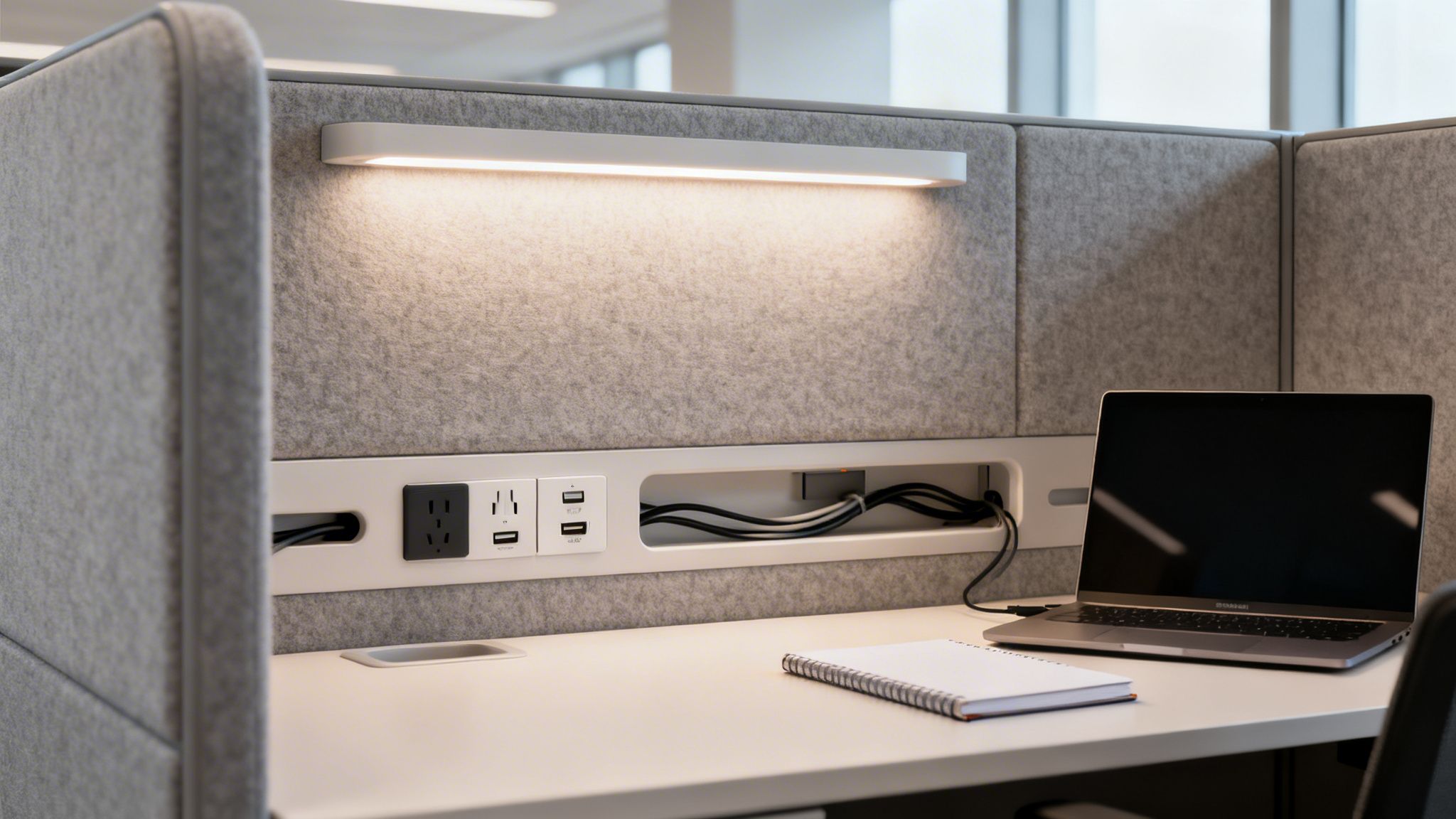
Modern soundproof office cubicle with integrated task lighting, power outlets, laptop, and notebook on a white desk.

Planning for Your Team's Power and Data Needs

Before you settle on any layout, you need to map out your team's tech requirements. Don't just think about today; consider what they might need a year or two down the road. Will they need dual monitors, charging stations for multiple devices, or hard-wired internet for rock-solid connections?

When planning the electrical side of your soundproof office cubicle, it’s absolutely critical that all wiring and connections meet national regulations. For instance, following standards like the Australian Electrical Wiring Standards is a smart move for safety and efficiency, no matter where you are, because it underscores the importance of certified installation practices.

A well-designed system anticipates your needs. By planning for sufficient outlets and data ports from the start, you avoid the messy and acoustically damaging "daisy-chaining" of power strips and extension cords later on.

A solid power strategy should include:

  • Sufficient Electrical Outlets: Plan for at least two to four outlets per person to handle computers, monitors, phone chargers, and task lighting.
  • Integrated USB Ports: Built-in USB-A and USB-C ports are pretty standard now, offering easy charging for phones and tablets without a clunky adapter.
  • Hard-Wired Data Ports: For any role that depends on a stable, high-speed internet connection, dedicated ethernet ports are a must.
  • Clean Cable Management: Look for systems with raceways or channels in the base of the panels. These hide wires, prevent trip hazards, and keep the whole setup looking clean.

Smart Integration Without Compromise

Modern cubicle systems from Cubicle By Design are engineered with exactly these needs in mind. We can route power and data through base-level raceways that are completely separate from the main acoustic core of the panels. This design ensures that adding technology doesn’t create weak points for sound to bleed through.

This integrated approach also gives you a clean, professional look. All the wiring is tucked away inside the cubicle structure, popping out only where you need an outlet or port. This gets rid of the visual clutter and makes the workspace as functional as it is quiet.

For more complex situations, you might need to bring power down from the ceiling. You can learn more about how to do that safely and cleanly with an office cubicle power pole. By choosing a system designed for smart tech integration from the start, you make sure your investment in a quiet office also supports a productive one.

Measuring the ROI of a Quieter Office

Thinking about a soundproof office cubicle as just another furniture purchase is missing the point. It’s a direct investment in your company’s performance. While there's an initial cost, the return on that investment (ROI) shows up quickly in real, measurable business outcomes. A quieter office is a more profitable one.

The financial upside is all about how people work. When your employees are fighting constant distractions, productivity nosedives, mistakes start piling up, and stress levels go through the roof. Those aren't just feelings; they have a direct, dollars-and-cents impact on your bottom line.

From Cost to Business Growth

A soundproof office cubicle gets right to the heart of these problems. Take a high-stakes sales center, for example, where call clarity is everything. Cutting down the background chatter means fewer misunderstandings with clients, which leads to sharper communication and, ultimately, better sales numbers. The money spent on acoustics directly fuels revenue.

It's a similar story in fields like healthcare administration or financial services, where protecting sensitive information isn't just good practice—it's the law.

An enclosed cubicle isn't just about focus; it's a vital tool for staying compliant with regulations like HIPAA. The cost of a single data breach, both in fines and lost client trust, can easily eclipse the expense of outfitting your entire team with the right acoustic solutions.

This shift in thinking is crucial. You aren't just buying cubicles; you're buying risk mitigation and a smoother, more efficient operation.

Quantifying the Gains

The returns aren't just theoretical. They appear as solid metrics that actively drive your business forward. By creating a space where people can actually concentrate, businesses consistently see improvements in a few key areas. These gains are what build the case for a powerful ROI.

Think about these concrete business results:

  • Higher Productivity: With fewer interruptions, employees can get into a state of deep work and stay there. That means more tasks get done right each day.
  • Fewer Costly Errors: When people can focus, mistakes in data entry, coding, or financial reports drop significantly.
  • Improved Employee Morale: A less chaotic and stressful environment makes for happier, more engaged employees. It’s a huge boost for your company culture.
  • Reduced Turnover: Happy employees stick around. Given how much it costs to recruit, hire, and train someone new, employee retention is a massive financial win.

For anyone in charge of workplace efficiency, our guide on facilities management best practices offers even more ideas for building a high-performance environment.

In the end, a soundproof office cubicle isn't a simple capital expense. It’s an asset that fuels productivity, safeguards your operations, and gives you a competitive edge that pays for itself again and again.

Your Soundproof Cubicle Questions Answered

Even when you see the benefits, you probably have some practical questions about how a soundproof office cubicle actually works in the real world. Let’s get into the most common questions we hear about performance, cost, and customization so you can feel confident about your decision.

How Much Noise Can a Soundproof Office Cubicle Really Block?

A high-quality soundproof cubicle makes a massive difference—far more than a standard setup could ever hope to. Systems with a high Sound Transmission Class (STC) rating are engineered to turn disruptive office chatter and nearby phone calls into a barely-there hum. This is what you need for true speech privacy during sensitive conversations and deep, focused work.

But its real effectiveness comes down to a few key elements working together:

  • High-Density Materials: The panels are built with a dense core that physically stops sound waves from punching through the wall.
  • Full-Height Panels: Walls that go all the way to the ceiling (or very close to it) are critical for preventing sound from just spilling over the top.
  • Airtight Sealing: Gaskets and seals around every panel and door eliminate the tiny gaps where sound loves to leak through.

These are the features that define a true acoustic solution from Cubicle By Design and create a workspace where you can actually hear yourself think.

Are Soundproof Cubicles Much More Expensive?

Acoustic cubicles do have a higher upfront cost, and that’s because of the advanced materials and engineering involved. But their real value is in the return on investment. The gains in productivity, the reduction in costly errors, and improved employee happiness often mean they pay for themselves over time. A quieter office directly translates to a healthier bottom line.

Think of it this way: the cost is upfront, but the benefits—like better focus and fewer mistakes—compound every single day. It's an investment in your team's performance, not just another furniture expense.

At Cubicle By Design, we have options to fit different budgets. Whether you need a fully enclosed Private Office Cubicle or a set of high-paneled Workstation Cubicles, our team can help you find a solution that delivers the acoustic performance you need without breaking the bank.

Can I Just Add Soundproofing to My Existing Cubicles?

Retrofitting your current cubicles with acoustic panels is a decent first step. It can definitely help absorb some of the ambient sound in the room, cutting down on echo and general background buzz. However, if you're looking for true sound blocking and speech privacy, a purpose-built soundproof system is in another league entirely.

A purpose-built cubicle is designed from the ground up as a complete acoustic system. That means it’s engineered to eliminate all the structural weak points and gaps where sound sneaks through in a standard setup. Retrofitting helps, but it just can’t provide the same level of comprehensive isolation.

How Long Does It Take to Design and Install These Cubicles?

The timeline really depends on the size of your project and how much customization you need. The good news is that modern tools have made the process much, much faster. Using our online Cubicle Designer tool, for example, you can create and visualize entire layouts in a fraction of the time it used to take.

Once you’ve settled on a design, our production and professional installation process is built to be efficient and minimize disruption to your business. We give you a projected timeline with every quote, so you’ll know exactly what to expect from start to finish.


Ready to create a quieter, more productive office? The experts at Cubicle By Design can help you plan, design, and install the perfect acoustic solution for your team. Explore our full range of customizable cubicles to get started.
Read More

Your Guide to Finding the Perfect Soundproof Cubicle

A soundproof cubicle is more than just a box—it’s an enclosed, modular workspace that actively blocks outside noise while soaking up sound from within. For anyone trying to get deep work done, take a confidential call, or just escape the constant buzz of an open office, it's an absolute game-changer.

The Rising Demand for Quiet Workspaces

The modern open-plan office was sold as a hub of collaboration, but for many, it's become a major source of distraction. While the goal was to bring people together, these wide-open layouts often create a storm of noise that crushes focus and privacy. For office managers and business leaders, finding a solution isn't just about employee comfort anymore; it's a strategic move for a healthier bottom line.

The numbers don't lie. With over 65% of modern workplaces now using open-plan designs, the complaints about constant interruptions are getting louder. In fact, research shows that all that extra noise can slash productivity by a staggering 40%. It’s no surprise the global market for soundproof office booths is projected to leap from $400 million in 2026 to $704 million by 2034. The demand for quiet is real.

To put this into perspective, here are some of the most common noise problems we see and how a soundproof cubicle directly solves them.

Common Noise Problems and Soundproof Cubicle Solutions

Common Office Distraction Impact on Employees Soundproof Cubicle Solution
Nearby conversations and chatter Inability to focus on complex tasks, frequent errors. High-wall panels and sealed doors block conversational noise, creating a "cone of silence."
Unrelated phone calls and video meetings Difficulty hearing on their own calls, privacy concerns. An enclosed space ensures private calls remain private and keeps external noise out.
General foot traffic and movement Constant visual and auditory interruptions break concentration. Solid or frosted glass walls provide a visual barrier, reducing the "fishbowl" effect.
Loud equipment (printers, etc.) Adds to the overall ambient noise level, increasing stress. The insulated structure dampens all external sounds, providing a calm environment.

As you can see, these aren't minor annoyances—they're significant roadblocks to productivity and employee well-being that soundproof cubicles are specifically designed to overcome.

Why Acoustic Privacy Matters

Acoustic privacy isn't just about making things quieter. It’s about giving your employees the right environment to do their best work. Without a place to escape the noise, your team faces real challenges that hit your business right where it hurts.

Here’s what you gain by focusing on acoustic privacy:

  • Enhanced Focus and Concentration: People can finally dive into deep work without being pulled away by a conversation happening ten feet away. The result is higher-quality, more efficient output.
  • Improved Confidentiality: Roles in HR, finance, or leadership require discretion. Sensitive phone calls and one-on-one meetings can happen without an audience.
  • Reduced Employee Stress: Let's face it, constant noise is draining. Giving people a quiet refuge helps lower cognitive overload and makes for a much happier, less-stressed team.

A Practical and Effective Solution

This is where a soundproof cubicle from a trusted provider like Cubicle By Design becomes your most powerful tool. These structures let you reclaim quiet and privacy without needing to tear down walls or completely rethink your office layout. It's a targeted investment that pays you back with better efficiency and happier employees.

For those looking to implement quiet productivity solutions in a broader office context, it's worth a look to explore premium office solutions designed for efficient work environments.

This guide will walk you through everything you need to know about creating a quieter, more productive workplace. We’ll get into the science behind soundproofing, check out different options like our private office cubicles and workstation cubicles, and even show you how to use our Custom Cubicle Designer to map out your perfect space. Feel free to explore our full range of cubicles to get started.

How Soundproofing Actually Works in an Office

If you want to create a genuinely quiet workspace, you have to realize that "soundproofing" isn't a single magic bullet. It’s really a two-part strategy. Think of it like this: some materials are built to block sound from getting into a space, while others are made to absorb the sound that’s already bouncing around inside. A truly effective soundproof cubicle has to do both.

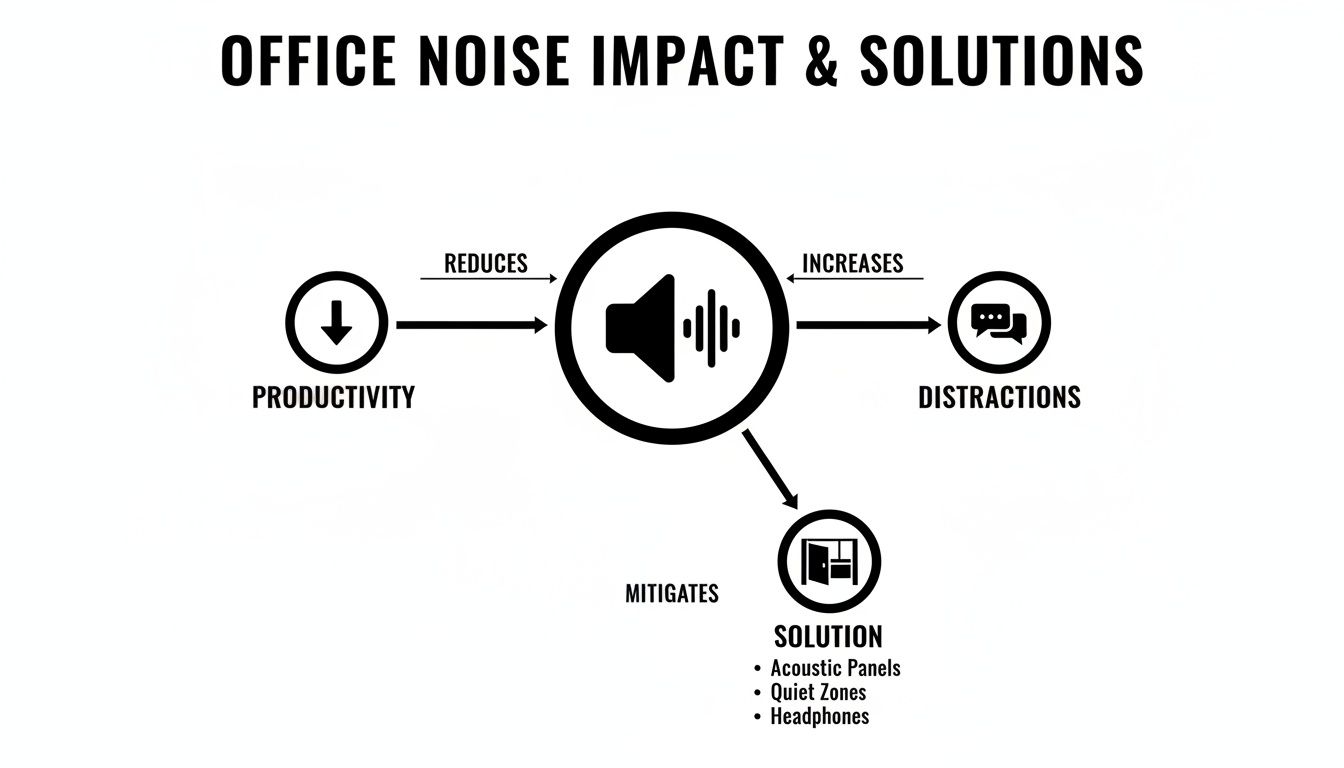
This infographic really puts the problem—and the solution—into perspective.

An infographic showing that office noise from open-plan designs reduces productivity and increases distractions, with solutions like acoustic panels, soundproof cubicles, quiet zones, and headphones.

The connection is crystal clear: when office noise goes unchecked, distractions shoot up and productivity plummets. This is exactly why purpose-built solutions like acoustic cubicles are no longer a luxury, but a necessity. To choose the right one, you need to get familiar with two key ratings that measure acoustic performance.

Blocking Sound With STC

First up is the Sound Transmission Class (STC). This number tells you exactly how well a barrier—like a cubicle wall, a door, or a piece of glass—stops sound from passing straight through it. The higher the STC rating, the better it is at isolating you from the outside world.

Imagine sound as water trying to get into a boat. A cubicle with a low STC is like a boat with a flimsy, leaky hull; the water just seeps right in. But a cubicle with a high STC rating? That's a boat with a thick, perfectly sealed hull that keeps every last drop of water out.

Even the smallest gap can completely undermine your efforts. A tiny 1% gap in a wall can let 30% of sound leak through. A 5% gap can let in as much as 90% of sound. This is why high-STC materials and airtight construction are non-negotiable for a truly soundproof space.

This "blocking" action is what prevents distracting hallway chatter, a coworker's phone call, and the general office buzz from derailing your focus.

Absorbing Sound With NRC

While STC handles noise trying to get in, the Noise Reduction Coefficient (NRC) deals with sound inside the cubicle. This rating, on a scale from 0 to 1, measures how much sound a material soaks up, stopping echoes and reverberation in their tracks. A 0 means it absorbs nothing (like a concrete wall), while a 1 means it absorbs everything (like an open window).

Think of NRC like adding a sponge to a room. If you’re in a space with hard, reflective surfaces like bare drywall and a tile floor, any sound you make just bounces around endlessly, creating a harsh, distracting echo. That's a low-NRC environment.

Now, picture that same space with soft, fabric-covered walls, plush carpeting, and acoustic ceiling tiles. These materials act like sponges, grabbing and trapping sound waves before they can bounce. This high-NRC environment feels quieter, more comfortable, and makes conversations much clearer. For a private cubicle, a high NRC is crucial for making sure your phone calls sound crisp and the space doesn’t feel like an echo chamber.

Bringing It All Together for a Quiet Space

An effective soundproof cubicle strikes the perfect balance between high STC and high NRC ratings. It’s a team effort.

  • High STC: You get this from dense, solid materials. Think full-height panels, solid-core doors with proper seals, and acoustic glass. These elements form a robust barrier to block external noise.
  • High NRC: This comes from porous, sound-absorbing materials on the inside surfaces, like fabric-wrapped acoustic panels. These trap sound waves, killing echo and improving the clarity of sound within the space.

By combining these two principles, you create a space that’s not only shielded from outside distractions but is also acoustically comfortable on the inside. This dual approach is the foundation of any effective quiet zone in a bustling office. For a deeper look at creating these dedicated areas, you can learn more about our comprehensive office acoustics solutions.

The Anatomy of an Effective Soundproof Cubicle

What really separates a truly soundproof cubicle from a standard office partition? It all comes down to the construction details. A genuinely quiet space is built from the ground up with a clear purpose, combining different materials that work in harmony to both block and absorb sound. The result is a true sanctuary from the constant hum of office noise.

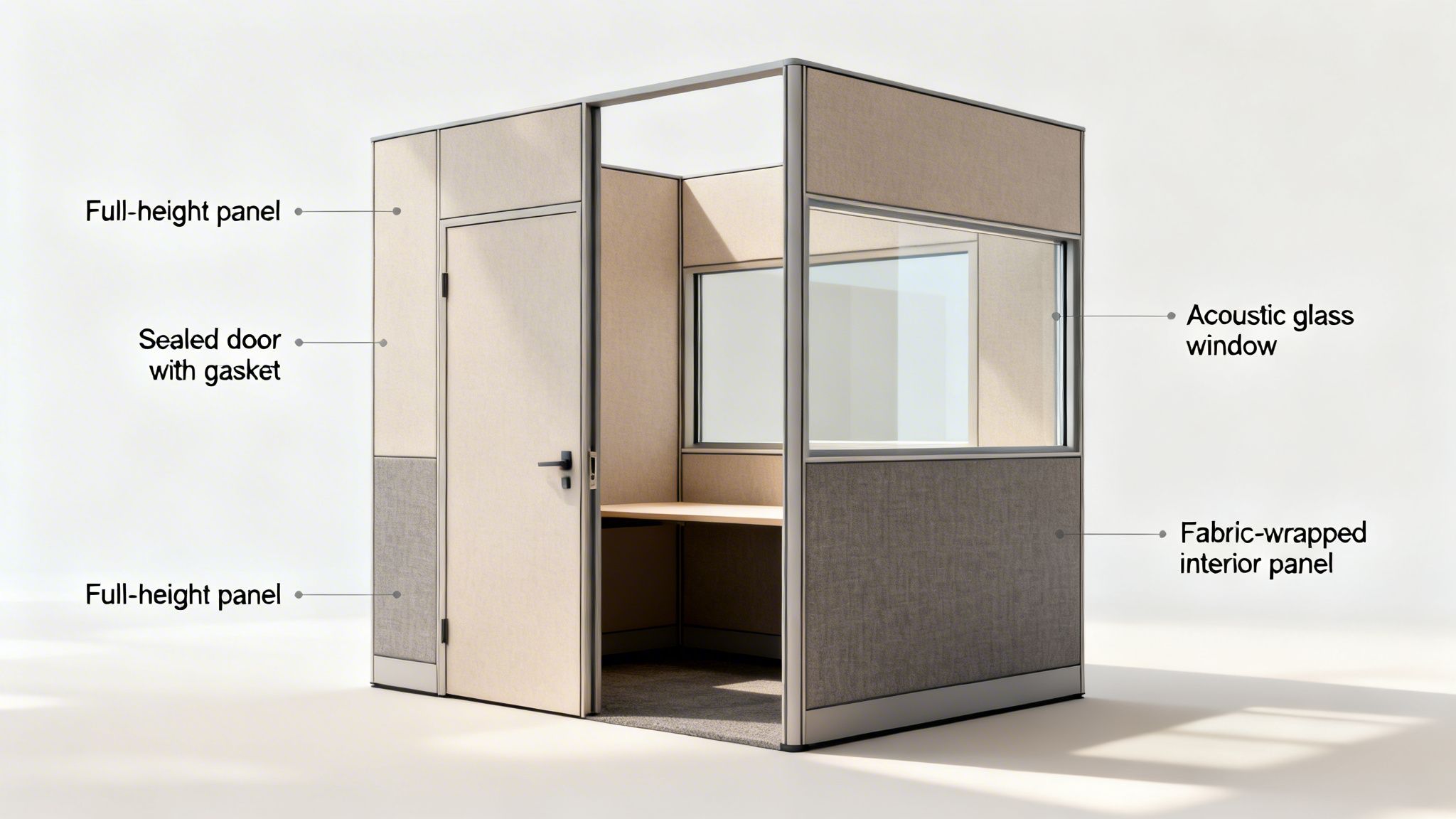
A detailed view of a modern soundproof cubicle office pod featuring an acoustic glass window, a sealed door, and an interior desk setup for focused work.

Let’s pull back the curtain and look at the key features that create an effective acoustic enclosure.

Full-Height Panels Are Essential

The very first thing you need for serious sound blocking is height. Think of sound waves like water—they will find and flow through any opening they can. Low-walled cubicles simply let conversations and distractions spill right over the top, making any other acoustic features pretty much useless.

A proper soundproof cubicle has to have full-height panels that either reach the ceiling or are topped with a solid roof. This creates a complete six-sided box that physically traps sound, maximizing its STC (Sound Transmission Class) rating by cutting off the easiest path for noise to travel. If you don't have this, you're not getting true sound isolation.

Even a tiny gap can completely derail your sound control efforts. A mere 1% gap in a barrier can let in as much as 30% of sound, while a 5% gap can torpedo performance by up to 90%. This is exactly why floor-to-ceiling construction is a non-negotiable for real acoustic performance.

Airtight Seals and Solid-Core Doors

Following that same "no gaps" principle, the door is the next major weak point you have to address. A typical hollow-core office door offers almost no defense against sound. For an effective soundproof cubicle, you need a solid-core door and, just as importantly, high-quality acoustic seals that run around the entire frame.

When the door closes, these seals compress to create an airtight barrier, stopping sound from sneaking through the cracks. It’s a simple feature, but it makes a massive difference in the unit's overall STC rating. Without it, the door is basically an open invitation for noise.

The Role of Acoustic Glass

Privacy doesn't have to feel like a penalty box. Modern acoustic setups use specialized acoustic glass to keep things feeling open and bright, all without giving up sound performance. This is a far cry from your standard window pane.

Acoustic glass is usually made of laminated panes with a special interlayer designed to dampen sound vibrations. This allows you to build private offices that still feel connected to the rest of the workspace but remain an acoustic island. It’s the perfect compromise between visual openness and auditory privacy, so employees can focus without feeling "boxed in."

Absorptive Interior Panels for Clarity

Once you’ve successfully blocked noise from getting in, you have to manage the sound inside the cubicle. Hard, reflective surfaces like bare walls or glass can create a distracting echo chamber—a nightmare for phone calls and video meetings. This is where materials with a high NRC (Noise Reduction Coefficient) save the day.

A quality soundproof cubicle will be lined with soft, porous materials like fabric-wrapped acoustic panels. Instead of reflecting sound, these surfaces are designed to absorb sound waves, stopping them from bouncing around the small space.

This accomplishes two critical things:

  • It sharpens speech clarity, making virtual meetings and calls sound crisp and professional.
  • It creates a more comfortable and less draining acoustic environment for the person working inside.

The demand for these quiet spaces is skyrocketing for a reason. The sound-proof booths sub-market is projected to jump from $500 million in 2025 to $850 million by 2033. The ROI is clear: pods that deliver 40dB+ noise reduction can boost employee focus by 35-50%. You can explore the materials that make this possible by checking out our guide to office cubicle panels.

Designing Your Ideal Acoustic Workspace

Now that you've got the basics of acoustics down, the fun part begins: designing a space that actually solves your office's noise problems. This is where your ideas for a quieter, more productive workplace meet our solutions. At Cubicle By Design, we give you the building blocks to turn that vision into a reality.

The trick is to match the right product to your specific needs. Whether you’re just trying to carve out a few quiet corners or build an entire department of private workstations, the configuration you choose is everything.

Matching Products to Your Acoustic Goals

Every office is different. A high-energy call center has far more demanding acoustic needs than a quiet administrative area. That's why we don't believe in a one-size-fits-all approach. We offer a whole range of products so you can tailor the solution to your environment.

Think about it like building a private meeting room. You'd use things like specialized conference room doors to get the privacy you need. The same idea applies here—you have to pick the right components for the job when selecting your cubicles.

A great starting point for many offices is our popular Flagship Series 7 Cubicles. They’re incredibly flexible, with different panel heights and material options that let you strike the right balance between privacy, collaboration, and your budget.

For jobs that demand total quiet and confidentiality, our private office cubicles give you a complete, six-sided enclosure. But for teams that need to focus while still feeling connected to the office buzz, our workstation cubicles are an excellent middle ground. It all comes down to the work being done inside them.

Matching Cubicle By Design Products to Your Needs

To help you narrow down the options, we've put together a quick comparison of how our different product lines can help you manage office sound. Compare our product series to find the perfect acoustic solution for your office environment.

Product Series Key Acoustic Feature Ideal Application
Flagship Series 7 Cubicles Configurable panel heights and absorptive fabric options. Creating focused workstations in an open-plan office where some ambient noise is acceptable.
Private Office Cubicles Full-height walls, a solid roof, and a sealed door for maximum sound blocking (high STC). Confidential meetings, HR functions, executive work, or any task requiring deep, uninterrupted concentration.
Glass Wall Systems Laminated acoustic glass that blocks sound while maintaining visual openness. Building separate quiet zones, meeting rooms, or team pods without sacrificing natural light or a modern look.

This push for dedicated quiet zones isn't just a hunch; it's a major trend. The market for indoor soundproof cabins shot up to USD 8.27 billion in 2024 and is expected to climb to USD 12.51 billion by 2032. This surge shows that more and more businesses realize that controlling sound is a must-have for productivity today.

Turn Your Vision into a Plan

The best way to figure out what your space needs is to play around with different layouts and features. That's exactly why we created our interactive Custom Cubicle Designer—it puts you in the driver's seat.

Using the designer, you can:

  • Select your privacy level: Choose from low, medium, or high walls to get just the right amount of sound isolation.
  • Pick your materials and finishes: Test out different fabrics and surfaces to boost sound absorption (NRC).
  • Configure your layout: Arrange desks, storage, and power to build a workstation that fits your team's workflow perfectly.

This tool closes the gap between a rough idea and a solid plan, giving you a clear picture of how your soundproof cubicles will look and feel in your office. It's a crucial step in creating a space that doesn’t just look good, but works even better.

To see how these principles come to life, check out our guide on modern office cubicle design.

Soundproof Cubicles in Real-World Scenarios

The technical ratings and acoustic specs are one thing, but how do soundproof cubicles actually hold up in a real, bustling office? It’s time to move past the theory and see what these principles look like in practice. Let’s look at a couple of stories of how smart cubicle design solved some serious noise problems for different businesses.

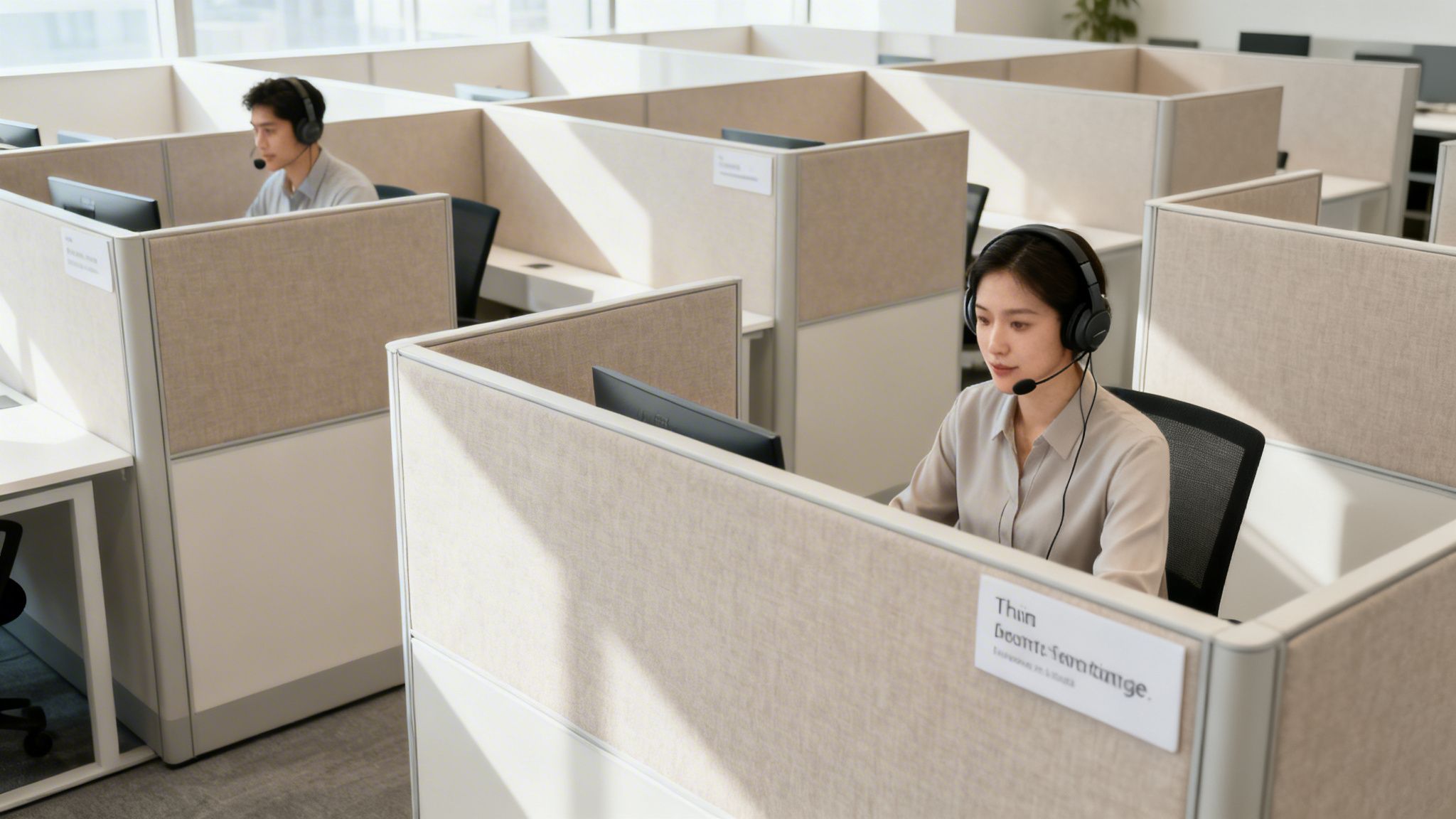
Two customer service representatives wearing headsets work in modern call center office cubicles with sound-absorbing panels.

These examples really show how acoustic solutions from Cubicle By Design aren't a one-size-fits-all product. They can be shaped to fit exactly what your workspace needs, whether it's a high-volume call center or a flexible hybrid office.

The Busy Call Center Transformation

Picture this: a booming customer service company with a big problem. Their open-plan call center was a mess of noise. Agents couldn't hear their customers clearly over the chatter of their colleagues, which led to mistakes, having to repeat information, and some very unhappy clients. Concentration was shot, and the constant noise was leading to serious employee burnout.

The Solution:
The firm decided to overhaul their layout, bringing in high-panel, fabric-wrapped cubicles. These weren’t just basic dividers; they were chosen specifically for their sound-dampening qualities.

  • Height for Blocking: The tall panels reached well above a seated person's head. This created a solid physical barrier that stopped sound from traveling directly between agents, giving each workstation a much-needed STC boost.
  • Fabric for Absorption: The fabric-covered panels were key for improving the NRC rating. They soaked up ambient sound and echoes, preventing agents' own voices from bouncing around the room and adding to the chaos.

The Outcome:
The results were immediate and frankly, pretty dramatic. Call clarity improved so much that customer satisfaction scores jumped by over 20% and handle times dropped. Agents reported feeling way less stressed and found it much easier to focus, which meant better performance and lower staff turnover. You can get a closer look at this kind of setup and explore more options for effective call center office cubicles.

The Hybrid Corporate Headquarters

A large corporation went all-in on a hybrid work model, but their office space just wasn't built for it. The open floor plan, once a beacon of collaboration, was now a source of frustration. People on Zoom calls were constantly being talked over by their in-office coworkers, and those in the office were distracted by one-sided virtual meetings happening all around them.

This situation is a perfect example of why you need dedicated quiet zones. The answer wasn't to get rid of the open areas, but to balance them with purpose-built private spaces.

The Solution:
They found a great middle ground by blending their existing open workstation cubicles with new, dedicated private office cubicles. These fully enclosed pods were strategically placed around the office, giving anyone an on-demand quiet spot when they needed it.

The Outcome:
These soundproof pods quickly became the most popular spots in the office for important video calls, confidential chats, or just buckling down on deep-focus work. The open areas still served as hubs for casual collaboration, but the office finally had a healthy balance of "quiet zones" and "active zones." The feedback from employees was fantastic, with 85% of staff saying they could now manage their workday much more effectively. The booking system they set up for the pods was an instant hit, proving just how badly a solution like this was needed.

Planning Your Installation and Investment

So, you’re sold on the idea of bringing acoustic privacy into your office. That’s the easy part. Now for the practical side: how do you actually get from a great idea to a fully installed, quiet workspace? Let's walk through the details, from the budget and real value to the technical nuts and bolts that make it all work.

First things first, think of this as an investment, not just an expense. The upfront cost is one thing, but the return on investment (ROI) is where the real story is. The payoff comes from a workforce that can finally focus. Studies have shown that cutting down on noise can sharpen employee focus by a staggering 35-50%, a number that goes straight to your bottom line.

Calculating the True Value

Just think about the hidden cost of lost productivity. When an employee is constantly fighting off distractions, the wasted time and drop in work quality can cost a company thousands each year. A soundproof cubicle carves out a dedicated zone for deep work, private calls, and focused projects, putting a stop to that loss. When you look at it that way, the ROI isn't just a number on a spreadsheet—it's undeniable.

Key Technical Considerations

Beyond the budget, a few technical details make the difference between a good installation and a great one. Planning for these upfront means no headaches down the road.

  • Power and Data Integration: Modern work runs on connectivity. Our cubicles are built from the ground up to easily integrate power outlets and data ports, so your team has everything they need, right where they need it.
  • HVAC and Airflow: An enclosed space needs fresh air. We’ll work with you to make sure your new layout doesn't block your building’s HVAC system, keeping the air comfortable and healthy for everyone.
  • Building and Fire Code Compliance: Safety is something we never compromise on. Our designs are created with building codes in mind, accounting for things like sprinkler coverage and emergency exits to ensure every single installation is 100% compliant.

Your Partner from Start to Finish

This might sound like a lot to juggle, but you’re not in it alone. The team at Cubicle By Design is here to guide you through every step of the process.

Our whole process starts with a simple conversation to understand exactly what you need. We'll help you use tools like our Custom Cubicle Designer to turn your vision into a real plan, whether that's a single private office cubicle or an entire floor of focused workstation cubicles.

From that point on, our experts take over with full project management to handle all the moving parts. We coordinate everything from delivery to the final build-out, making sure the entire process is smooth and efficient. If you want a peek behind the curtain, you can learn more about our professional office furniture installation services. Our one and only goal is to make your switch to a quieter, more productive office completely seamless.

Common Questions About Soundproof Cubicles

Making a big change to your office always brings up a few questions. Investing in a soundproof cubicle is a major decision, and you want to be sure you're making the right call. We get it. Here are the answers to the questions we hear most often from business owners and facility managers, laid out plain and simple.

How 'Soundproof' Are These Cubicles Really?

Let’s be honest: "soundproof" is a strong word. A better way to think about it is sound-isolating. No cubicle in an open office can create a vacuum of absolute silence, but a well-designed one can knock down the noise so much that it's no longer a distraction.

Think of our private office cubicles. They're built to turn normal conversational speech into an unintelligible murmur. The goal is what we call "speech privacy"—you can focus without hearing every word your neighbors say, and they can't overhear your confidential calls.

Can They Be Moved or Reconfigured Later?

Absolutely. In fact, that's one of their biggest selling points. Unlike building out traditional drywall offices, our cubicle systems are completely modular.

When your company grows, teams get reorganized, or you just want to refresh the layout, these cubicles can be taken apart, moved, and reassembled in a new configuration. It’s a smart investment that can actually change and grow right along with your business.

This modularity is a core principle of modern office design. It allows companies to respond quickly to changing needs without the high cost and disruption of a major renovation, ensuring your workspace remains efficient for years to come.

What About Ventilation and Fire Safety?

The safety and comfort of your team are never something to compromise on. Our cubicles are specifically designed to work with your building's existing HVAC and safety systems, not against them.

During the space planning phase, we map everything out to make sure every soundproof cubicle gets proper airflow. We also design every layout to comply with local fire codes, ensuring sprinkler coverage and clear pathways are always maintained. You get the quiet you need without cutting corners on safety.

How Does the Ordering Process Work?

We’ve made it as straightforward as possible. It all starts with your ideas, which you can start playing with right now using our online Custom Cubicle Designer. After that, our team is with you every step of the way.

  1. Consultation & Design: We’ll talk through what you need, what your team does, and help you lock in the perfect layout.
  2. Quotation: You get a clear, itemized quote. No guesswork, no hidden fees.
  3. Project Management: We take care of all the logistics, from placing the order to scheduling the delivery and installation day.
  4. Professional Installation: Our own experienced crew will build your new workstation cubicles quickly and correctly, minimizing disruption to your workday.

Think of us as your partner from that first sketch to the final walkthrough. We’re here to make sure it all goes off without a hitch.


Ready to create a quieter, more productive workplace? At Cubicle By Design, we specialize in designing flexible and modern office solutions. Explore our full range of cubicles to find the perfect fit for your team.

Read More