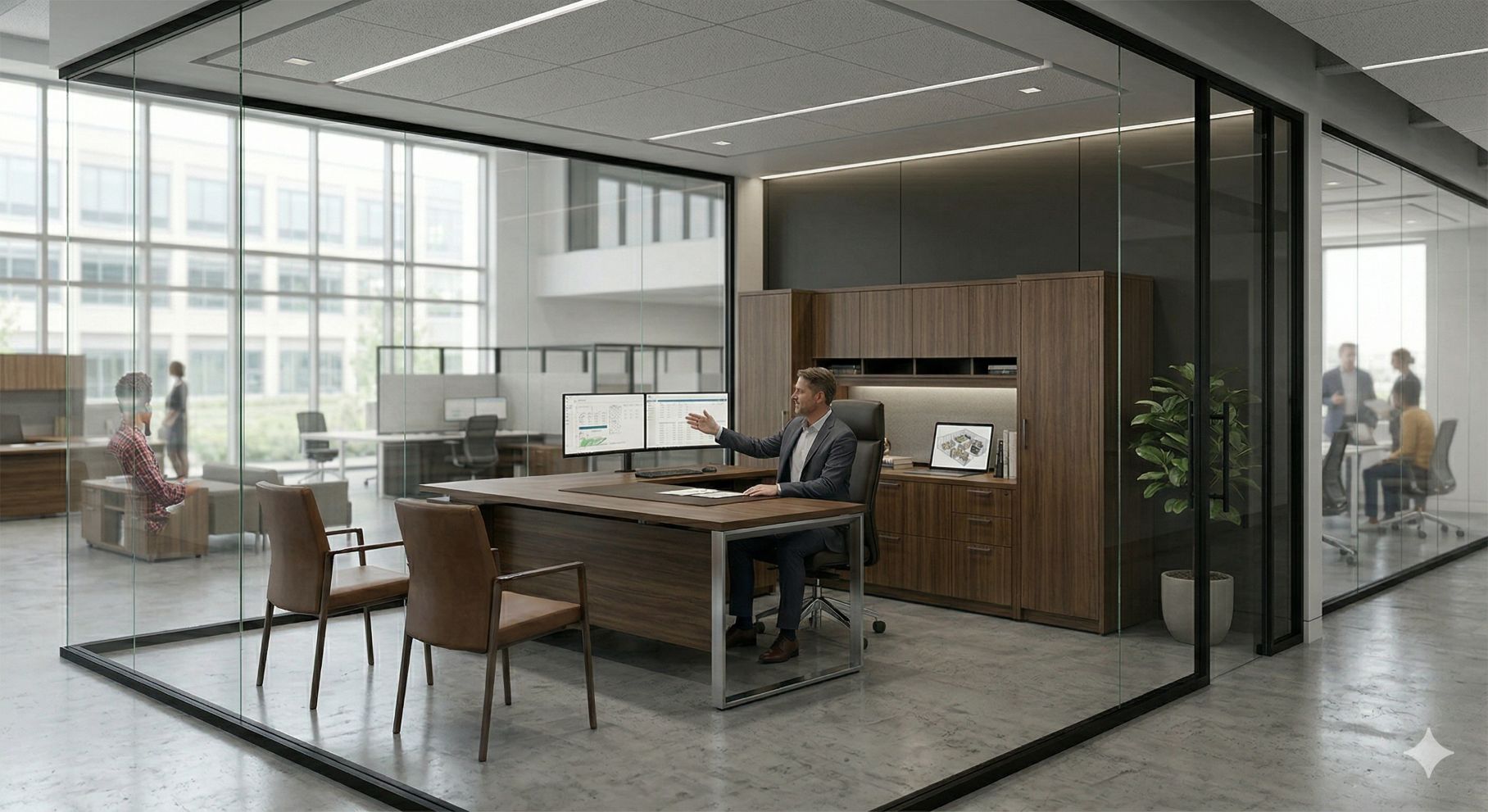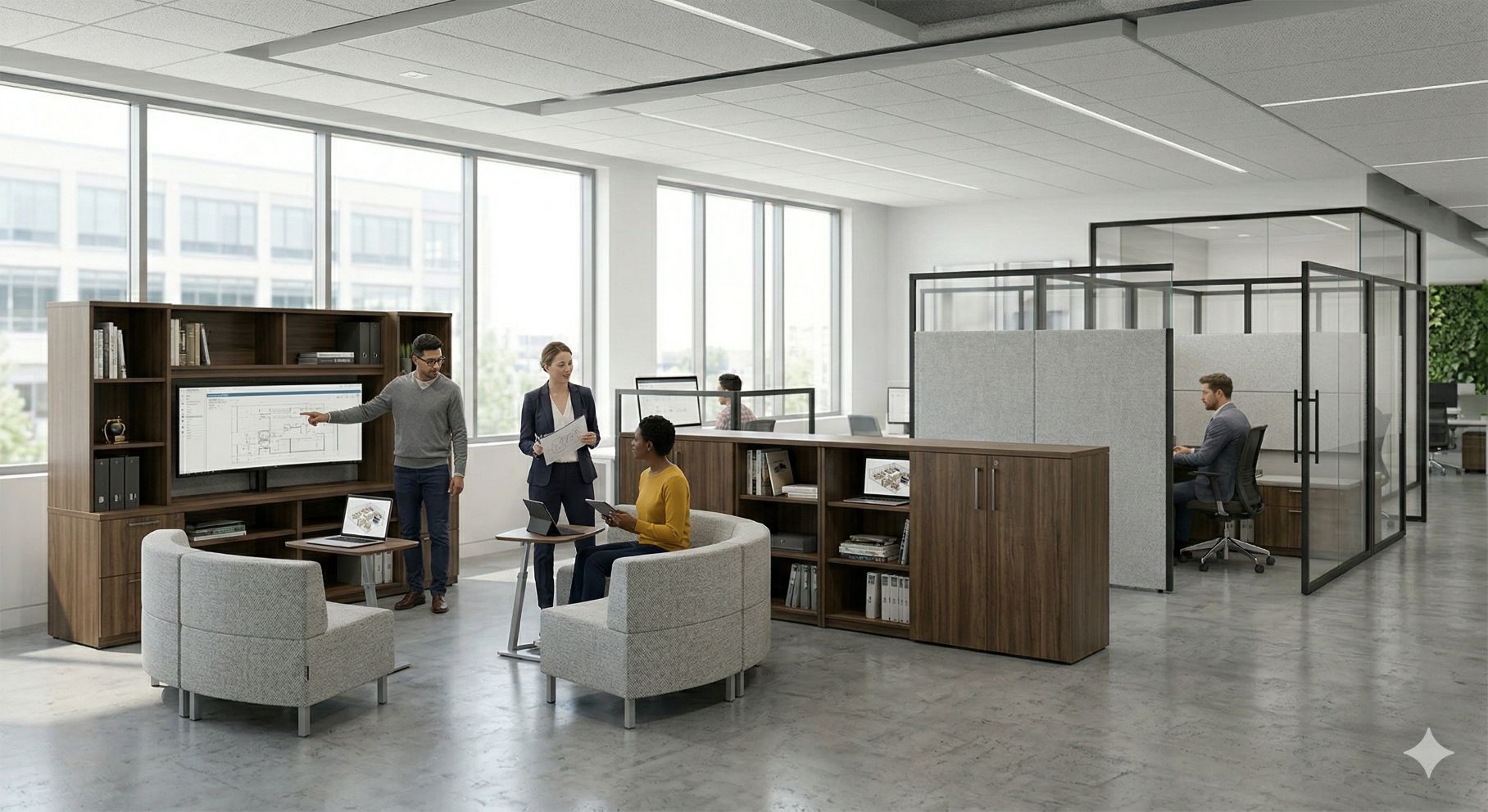

Offices usually don’t lose efficiency all at once. It happens a little at a time. Papers start landing on desktops because base storage is full. Shared supplies migrate to whatever surface is open. Someone adds a small organizer, then another, and the work area gets tighter instead of cleaner.
That’s often the point where a facilities manager starts looking up instead of outward. Vertical space is still available, but it has to be used in a way that supports the room, the workflow, and the wall itself. A wall mount hutch can solve the clutter problem well, but only when it’s treated as part of the office system instead of a last-minute add-on.
In practical terms, that means thinking beyond storage volume. You have to consider how the hutch relates to desks, monitor heights, circulation paths, wall construction, and future reconfiguration. A good installation creates order without crowding the user. A bad one turns an empty wall into a maintenance issue.
That’s the lens used at Cubicle By Design. Efficient office planning isn’t just about fitting in more furniture. It’s about using the right storage format in the right place so the workspace stays usable over time.
Reclaim Your Workspace with a Wall Mount Hutch
A familiar scene plays out in growing offices. The desk started clean. Then the printer paper moved there temporarily. A stack of client files followed. Pens, chargers, notebooks, headsets, and extra forms took over whatever open edge was left. The room still has square footage, but the actual working surface keeps shrinking.
That’s where a wall mount hutch starts making sense. It pulls storage off the floor and off the desk, then puts it where it can support the workstation instead of fighting it. For teams working in compact private offices, shared stations, or reconfigured hybrid layouts, that shift matters.

A wall mount hutch works best when the office has already hit a space threshold. You don’t want another floor cabinet blocking circulation. You don’t want workers storing essentials across the room because nearby storage is full. You want frequently used items close, but not sprawled across the desktop.
What changes when storage moves upward
A well-placed hutch helps in a few immediate ways:
- It clears primary work surfaces so people can use the desk for focused work.
- It shortens reach to common items like binders, forms, supplies, and reference materials.
- It reduces visual clutter when doors or mixed open-closed storage are used.
- It preserves floor area for movement, seating, and equipment access.
Practical rule: If the desk has become the default storage zone, the problem usually isn’t employee habits alone. The storage plan is undersized or poorly placed.
For some offices, a desk-and-hutch combination is the right starting point rather than a retrofit. If you’re evaluating complete workstation layouts, a desk with credenza and hutch configuration can help you compare overhead storage against floor-based alternatives.
Defining the Modern Office Hutch
A wall mount hutch in a commercial office isn’t the same thing as decorative shelving, and it isn’t a bulky credenza lifted off the floor. It’s a storage unit designed to add accessible overhead capacity while keeping the footprint below usable.
That difference matters. Residential shelving often prioritizes appearance and light-duty display use. Traditional freestanding storage solves capacity, but it consumes floor area and can make small offices feel boxed in. A wall-mounted office hutch sits between those two. It’s functional storage with a smaller spatial penalty.

What it is in office planning terms
In planning practice, a wall mount hutch is usually specified to serve one of three roles:
- Task-adjacent storage above a desk or return, where users need quick access to active materials
- Shared support storage in team areas, where forms, supplies, or light equipment need a home
- Integrated modular storage that aligns with a broader workstation or panel system
The category is established, not experimental. Commercial retailers continue to offer wall-mounted hutches in standard widths such as 60 inches and 72 inches, which reflects ongoing use in office layouts rather than a purely residential niche, as shown in this commercial wall-mounted storage hutch listing.
Why it keeps showing up in dense layouts
The reason is simple. It solves a recurring office problem without taking up valuable floor area. That’s especially useful in spaces where every aisle, chair pullback, and storage zone has to work harder than it did in older, larger-floorplate offices.
A modern hutch also supports cleaner sightlines. When storage shifts upward and becomes more integrated, the workstation feels more intentional. That’s one reason hutches fit naturally into compact team environments such as call center cubicles, where density and organization have to coexist.
A good office hutch doesn’t just store more. It stores in the part of the room that usually goes underused.
Where it outperforms other options
Use a wall mount hutch when you need storage that is:
| Storage type | Strength | Limitation |
|---|---|---|
| Wall mount hutch | Preserves floor space and keeps items near the workstation | Requires proper wall evaluation and mounting |
| Residential shelving | Easy visual display | Usually not intended for office-duty loads or enclosed storage |
| Freestanding storage | High capacity and easy relocation | Adds bulk at floor level and can tighten circulation |
Choosing Your Hutch Style and Finish
The right wall mount hutch should solve a storage problem without introducing a visual one. In other words, it has to work hard and still look like it belongs with the desks, panels, and finishes already in the room.
Open, closed, or mixed storage
Open-shelf hutches suit fast-access items. They work well in touchdown spaces, shared admin zones, and collaborative rooms where people need to grab supplies quickly. The trade-off is exposure. Everything stays visible, including the mess if no one maintains it.
Closed-door hutches create a calmer look. Solid fronts hide everyday clutter. Glass or frosted inserts keep the unit lighter visually while still defining a storage boundary. These are often better for client-facing offices, executive workspaces, and areas where paper storage can easily look untidy.
Combination units usually offer the most flexibility. A few open bays can hold binders or display pieces, while closed sections handle the less photogenic stuff. That hybrid approach tends to age well because office storage needs rarely stay fixed.
Finish choices that hold up in real use
Material and finish choices affect more than style.
- Laminate is practical for most offices. It’s consistent, easy to match across larger furniture programs, and straightforward to maintain.
- Veneer gives a warmer, more furniture-forward look. It can be a good fit in private offices or board-adjacent spaces where the room needs more presence.
- Metal-accent or utility-focused builds fit back-office, healthcare-adjacent, or industrial settings where cleanability and durability matter more than softness.
Field note: The finish that looks best in a sample chip isn’t always the one that ages best in a busy office. Fingerprints, edge wear, and cleaning habits matter.
A hutch should also relate to the furniture around it. If the office uses coordinated panel systems and desking, match tone, hardware feel, and line thickness where possible. That’s one reason many teams evaluate hutches alongside custom office cubicles rather than as a separate purchase.
For offices refreshing the desk layer at the same time, comparing modern desks for office environments can help narrow the right hutch profile. Slim desks usually pair better with lighter-looking overhead storage. Heavier executive desks can handle more visual mass above.
A simple selection filter
If you’re narrowing options, ask these questions:
- What needs to be hidden? If the answer is “most of it,” start with doors.
- Who uses the storage? Shared-use areas usually need simpler, more durable configurations.
- How formal is the room? The more public the workspace, the more finish consistency matters.
- Will the layout change later? Modular-looking hutches generally adapt better than highly stylized pieces.
Sizing Spacing and Load Capacity
Most wall mount hutch problems start in planning, not installation. The unit looks shallow, so people assume it’s light-duty. But commercial hutches are often wider than they are deep, and that changes the engineering conversation.
One example of a commercial wall-mount glass-door hutch measures 71″ W × 14-3/4″ D × 15-3/4″ H, while another wall cabinet is listed at 24″ H × 30″ W × 13″ D or 16″ D, with a Z-bracket for mounting, according to this commercial hutch specification listing. Those proportions tell you something important. These units don’t challenge the floor. They challenge the wall.
Width matters more than many buyers expect
A wide hutch places stress on fasteners and brackets. The deeper the contents and the wider the cabinet, the more attention the installer has to give to anchor points, bracket alignment, and loaded use conditions.
That’s why empty weight isn’t enough. Facilities teams should plan for the loaded weight, plus the way that load is distributed. Paper, binders, manuals, and office supplies don’t sit weightlessly just because they’re stored overhead.
Spacing above the workstation
A hutch has to coexist with the user below it. In practical layout terms, check:
- Monitor clearance so screens don’t force the unit too high or too low
- Headroom for seated users and anyone leaning forward at the desk
- Reach range so the bottom shelf isn’t awkward to access
- Service space for task lights, cable drops, and monitor arms where applicable
If the workstation is part of a broader modular setup, comparing standard cubicle dimensions helps align hutch size with panel heights, desk widths, and circulation needs.
Wider hutches often look efficient on paper. On the wall, they demand better anchorage and better planning.
How to think about load capacity in practice
Use this decision framework before approving a model:
| Planning factor | What to verify |
|---|---|
| Cabinet width | Whether the wall can support the leverage created across the span |
| Depth | Whether the projection interferes with monitors or movement |
| Bracket system | Whether the mounting approach matches the wall condition |
| Stored contents | Whether the likely load is light supplies or dense materials |
| Anchor locations | Whether multiple secure points are available where needed |
What works and what doesn’t
What works is matching the hutch to the actual use case. Shallow, wide units can be excellent above focused workstations if the wall is ready for them and the storage load is predictable.
What doesn’t work is selecting by appearance first and asking structural questions later. That’s how teams end up with a cabinet that fits the elevation drawing but not the building.
For offices using integrated workstation packages, reviewing workstation cubicles can be helpful because those systems often account for overhead storage relationships earlier in the planning process.
Secure Mounting Methods Explained
A wall mount hutch is only as good as its load path. If the cabinet can’t transfer weight into framing members or an appropriate structural surface, the installation is weak no matter how attractive the finish looks.
Assembly guidance for wall-mounted hutches commonly relies on a cleat, bracket, or similar support strategy. In one installation example, the process includes measuring and marking the wall, setting a wooden wall cleat level, drilling pilot holes, and fastening into appropriate points so the unit can seat correctly on the mount, as shown in these wall mount hutch assembly instructions. The principle is straightforward. The wall has to carry the load, not the drywall face alone.
Common mounting methods in office settings
Some approaches are more forgiving than others, but each has a proper use case.
| Method | Best For | Pros | Cons |
|---|---|---|---|
| Wall cleat | Wide hutches and units needing distributed support | Spreads load across a wider area, helps with leveling | Depends on solid fastening into framing or suitable structure |
| Z-bracket | Commercial cabinets designed for bracket hanging | Clean support method, common in manufactured systems | Requires accurate alignment and compatible wall conditions |
| Direct-to-stud fastening | Simpler units where framing lines up well | Strong when properly located | Limited by stud position and cabinet design |
| Heavy-duty anchors | Select situations where manufacturer allows them | Useful when direct framing access is constrained | Not a substitute for structure when loads are substantial |
What facilities managers should reject
Never approve an installation approach that treats drywall as the structure. Drywall can cover the wall. It should not be expected to act like framing.
Also be cautious with walls that aren’t straightforward. Plaster, concrete block, masonry, and specialty partition assemblies all change the hardware conversation. So do glazing-adjacent conditions. If the hutch is being integrated near glass office partitions, the mounting plan should be reviewed as part of the broader wall system, not as a separate field improvisation.
Installer check: Ask exactly where the load is going. If the answer is vague, stop the install conversation there.
For a useful parallel, the same logic applies to other heavy wall-mounted items. This guide on the best way to hang large mirrors is worth reviewing because it explains why wall condition and support method matter more than surface appearance.
The practical review before anyone drills
Before installation begins, confirm:
- Wall type and whether it can accept the intended mounting method
- Stud or structural locations behind the finish surface
- Bracket compatibility with cabinet width and weight distribution
- Leveling plan so the cabinet seats correctly
- Installer responsibility for final hardware selection in field conditions
If the project includes multiple units or mixed wall conditions, office furniture installation support helps coordinate those decisions before they become punch-list issues.
Installation Checklist and Safety Compliance
The overlooked part of a wall mount hutch project isn’t usually the cabinet. It’s the commercial environment around it. In offices, a perfectly solid installation can still be a bad decision if it interferes with life safety, circulation, or building requirements.
Facilities teams need a checklist that goes past “find studs and level the bracket.” Planning discipline demonstrates its value in these situations.

The pre-install review
Before the unit is unpacked, verify these items:
- Wall construction: Drywall over studs, masonry, block, or another condition that changes fastener choice
- Stud spacing and anchor points: Enough support in the right places for the actual cabinet width
- Height above finished floor: High enough for usability, low enough for safe access and proper clearance
- Path of egress: The hutch can’t narrow or obstruct circulation where people need to move freely
- Sprinkler and clearance conditions: Overhead storage must not interfere with sprinkler performance or required clearances
Commercial guidance often skips those last two, but they matter. Office planning resources note that wall-mounted storage can affect sprinkler coverage, egress, and other required clearances, which means facilities teams may need review by the authority having jurisdiction depending on the location and installation context, as discussed in these office wall mount hutch instructions and compliance notes.
Here’s a useful installation visual before field work starts:
The on-site sequence that avoids callbacks
A clean installation usually follows a disciplined order:
- Clear the work zone so ladders, lifts, and tools don’t compete with active staff.
- Review the manufacturer’s instructions before hardware decisions are made in the field.
- Mark all mounting points carefully and confirm level before drilling.
- Install brackets or cleats securely into the planned support locations.
- Set the cabinet and verify seating before any loading happens.
- Test stability empty first, then add contents gradually.
- Check door swing, nearby equipment, and cable routing before sign-off.
Storage mounted safely can still fail the workplace if it blocks an exit route or compromises sprinkler performance.
Cable management and system planning
If the hutch sits over powered workstations, account for cable movement and service access. Don’t trap cords behind the unit where they can’t be maintained. Don’t force monitor cables into sharp bends just because the hutch looked centered on the wall.
Planning software offers assistance. The Cubicle By Design designer tool lets teams configure dimensions, storage, and related workstation elements earlier, which is useful when hutches need to align with privacy panels, electrical paths, and wall conditions.
Procurement Maintenance and Long-Term Value
Buying a wall mount hutch well means buying the whole outcome, not just the box. The procurement review should include the cabinet, the mounting method, the wall condition, the installation responsibility, and the service implications later.
What to ask before issuing the order
Start with the questions that protect the project:
- Is the mounting hardware specified clearly? If not, field confusion is likely.
- Does the finish match the rest of the office system? Close enough rarely looks close enough once installed.
- Who owns final site verification? Someone has to confirm wall suitability before the crew arrives.
- What support exists after delivery? Replacement parts, hardware clarification, and punch resolution matter.
If your team is comparing broader furniture packages, an office furniture buying guide can help structure those decisions so the hutch isn’t evaluated in isolation.
Maintenance that actually extends service life
Wall-mounted storage doesn’t need complicated upkeep, but it does need consistency.
Wipe laminate and painted surfaces with finish-appropriate cleaners. Check hinges, bracket tightness, and door alignment during routine facilities reviews. If users begin overloading the cabinet with dense materials, reset expectations early. The mounting system was chosen for a use case, not for whatever eventually gets stuffed into it.
Buy the hutch that fits the wall, the workflow, and the room. Not just the elevation.
Why the right choice holds value
A well-planned wall mount hutch gives you more than storage. It protects desk space, supports cleaner workflows, and helps the office stay organized as teams grow or reconfigure. The long-term value comes from avoiding the hidden costs of poor fit, rushed installation, and compliance mistakes.
For facilities managers, that’s the standard. The hutch should still look right, feel stable, and make sense operationally long after move-in day.
If you’re planning a workstation refresh, expansion, or reconfiguration, Cubicle By Design can help you evaluate storage, wall conditions, modular furniture options, and installation requirements before a wall mount hutch becomes a field problem.