

The holiday season is approaching, and with it comes the urge to make the office feel less mechanical and more human. In a lot of workplaces, that impulse shows up as tangled tinsel, a few drooping snowflakes, and desk toys that start out cheerful but quickly become clutter. That approach rarely works in a modern office where people still need to focus, move safely, meet with clients, and feel comfortable spending long hours at their workstations.
Better christmas cubicle decorating ideas start with the furniture system you already have. Cubicle panels, glass dividers, shelves, tackboards, overhead storage, and circulation paths all give you built-in structure. When you decorate with those elements in mind, the office looks intentional instead of improvised. The result is festive, but still polished.
That matters more than many teams realize. A 2023 Statista survey found that 68% of employees report higher satisfaction when their workspaces adapt seasonally, while only 35% say those decorations are well-executed. In the same source, over 87% of office workers said holiday-themed workplaces promote teamwork and ease workplace stress. The takeaway is simple. Employees respond to seasonal change, but most offices need a better operating system for how they decorate.
At Cubicle By Design, that idea fits naturally with designing a better workplace. Seasonal décor shouldn’t fight your layout. It should work with it. If you’re managing one department, an entire call center floor, or a mixed space with both open stations and enclosed offices, the best holiday setups use modular furniture as the canvas and treat décor as a layer, not a pile.
1. Modular Cubicle Accent Panels and Fabric Wraps
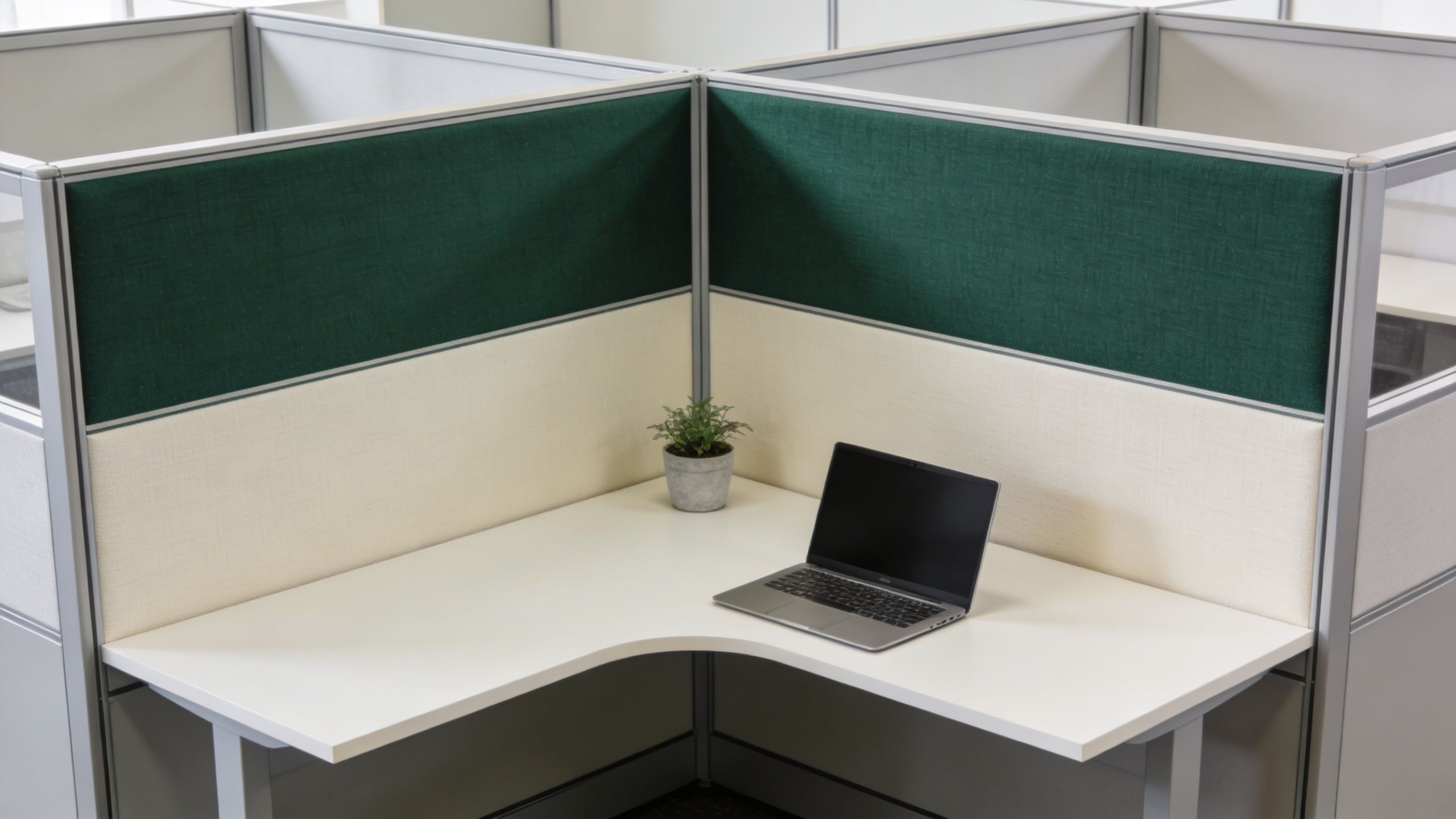
Fabric wraps and accent panels are one of the cleanest ways to bring holiday color into an office without turning every workstation into a separate DIY project. They attach to the visual plane of the cubicle, not the working surface, so people keep their desk space while the whole floor still gets a seasonal refresh.
This works especially well in modular environments where panel dimensions repeat. A facilities team can treat the office like a kit of parts. Instead of handing employees loose décor and hoping it looks consistent, managers can deploy coordinated inserts, sleeves, or fabric overlays across departments. On a professional floor, winter whites, evergreen tones, matte metallics, or branded holiday colors tend to land better than loud novelty prints.
What works in practice
If you’re outfitting several rows at once, match the décor to the geometry of the system first. Panel width, seam placement, tackability, and corner conditions matter more than the artwork. That’s why it helps to start with the actual office cubicle panels you’re working with instead of choosing graphics first and forcing them onto the furniture later.
A good rule is to decorate at eye level or just above seated sightlines. Mid-height surfaces carry color through the room without making the office feel visually top-heavy. That also avoids the common mistake of loading every inch of panel space with garland, cards, and printed cutouts.
Practical rule: If a panel treatment makes the workstation feel smaller, it’s too much. Seasonal décor should frame the cubicle, not compress it.
There’s also a storage reality here. Fabric wraps and removable panel skins are worth the effort only if you can reuse them. That means labeling by department, storing flat, and documenting where each size belongs. Offices that skip this step usually end up reordering pieces or abandoning the idea after one year.
Best use cases
- Branded winter themes: Use coordinated fabric tones that align with your company palette instead of defaulting to bright red and green.
- Shared team identity: Give each department one approved variation so the floor feels unified without looking identical.
- Mixed privacy layouts: Pair festive fabric panels with glass-front stations so the office keeps its openness while still reading as seasonal.
A polished panel program doesn’t get the same attention as a giant novelty display. That’s exactly why it lasts. It respects the furniture, scales well, and looks intentional from the reception area to the last workstation row.
2. LED String Lights and Smart Lighting Integration

Lighting changes the mood of a cubicle faster than almost any other decoration. It can also go wrong faster than almost any other decoration. Harsh color-changing strands, overloaded outlets, and cords draped across aisles make an office feel chaotic in a day.
Subtle LED lighting, mounted high and kept warm in tone, tends to work best. A 2022 Statista survey cited by Homestyler’s Christmas cubicle decorations article found that 67% of office workers said tasteful Christmas cubicle decorations improve belonging and concentration, with a reported 12 to 15% uplift in daily productivity metrics during the holiday season. That same verified dataset also notes low-clutter décor and light electrical loads, which is exactly the lane smart lighting should stay in.
How to keep it professional
The safest-looking installations usually look the safest because they are. Mount the lights near the upper edge of the cubicle, tuck the lead neatly, and avoid anything that hangs into monitor space or shoulder-level circulation. If the bulb shape is decorative, keep the line short. If the line is long, keep the bulb profile small.
For furniture-integrated setups, start with lighting solutions designed to live with the workstation instead of fighting it. That’s where office cube lighting becomes useful. You can build a festive layer on top of task lighting rather than replacing the office’s actual working light with holiday ambiance.
A lot of teams copy residential Christmas displays at work, and that’s usually the wrong model. Offices need visibility, screen comfort, and predictable shutoff. If you want inspiration for cleaner installs and routing discipline, it helps to study flawless Christmas light displays and then scale the idea down to office standards.
Smart choices and common mistakes
- Use warm white first: It reads more professional than multi-color strands in most corporate settings.
- Test one row before full rollout: Light that feels cozy in a sample bay can feel glaring across a whole floor.
- Add a diffuser where needed: Bare LEDs can reflect on monitors and glass partitions more than people expect.
Keep the festive glow above the work zone. The desk still needs to function like a desk.
Battery options can work for short installations or contest days, but permanent holiday-season use usually goes smoother when facilities can control timing and maintenance centrally. Done right, lighting makes the office feel intentional after dark and more welcoming during early winter mornings. Done poorly, it becomes visual noise with a power problem attached.
3. Desktop and Shelf Displays with Seasonal Décor
Not every holiday setup needs to be architectural. Sometimes the most successful christmas cubicle decorating ideas are the smallest ones, especially in offices where people want personal expression but management still needs consistency.
A well-run desktop décor program gives people room to personalize without swallowing their work area. That balance matters. If every desk becomes a dense collection of plush figures, mugs, paper trees, and candy bowls, the office starts to look less festive and more obstructed. Small, curated displays work better because they leave space for the actual job.
Give décor a defined footprint
The simplest policy is also the most effective. Assign a specific zone for seasonal items. That might be one corner of the desk, one shelf bay, or a small tray on the return surface. Once décor has a footprint, employees know where it begins and where it stops.
Overhead storage and vertical accessories help a lot here. Instead of filling the work surface, employees can stage a small village, card display, or miniature winter scene on cubicle hanging shelves. That keeps keyboards, notebooks, and monitors clear while still giving the station some personality.
This is also where inclusive decorating works best. International teams often prefer a shared winter or year-end theme at desk level, then use designated display spaces for holiday traditions that are more personal or culturally specific. That approach keeps participation open without forcing one visual language on everyone.
Practical limits that help
- Keep it low profile: Decorations shouldn’t block screens, sightlines, or passing conversation.
- Use one visual theme: Mini trees, paper accents, and one or two figurines usually look better than a mix of unrelated items.
- Plan cleanup early: Post-holiday clutter happens when nobody owns takedown and storage.
The famous example of Angela Westfield’s cubicle log cabin in Minneapolis shows how elaborate this tradition can get. Her 18-hour cubicle Christmas log cabin build earned a standing ovation from coworkers. It’s a great reminder that creativity can energize a workplace. It’s also a reminder that most offices need categories and boundaries if they want that energy without derailing operations.
In practice, the best individual displays feel edited. They show care, not accumulation. Employees still get a sense of ownership, and the office still reads as professional.
4. Themed Cubicle Divider Graphics and Window Clings

Window clings and divider graphics are the quiet professionals of office holiday décor. They can transform a glass-heavy office quickly, but they don’t consume desk space, collect dust like fabric garland, or create the visual weight of hanging ornaments.
They’re especially effective in modern offices that use glass panels, low partitions, and shared light. Frosted snowflakes, abstract winter branches, tonal stars, and branded seasonal motifs can add a lot without closing off the room. In client-facing spaces, this is often the safest place to decorate because the finish looks deliberate and temporary rather than improvised.
Why graphics scale better than loose décor
Loose decorations vary wildly by installer. Graphics don’t. Once the artwork is approved and the dimensions are right, application becomes repeatable from one department to the next. That matters if you’re decorating dozens of stations or a whole suite with mixed partitions and glass fronts.
The current market has leaned into this format. Verified trend data tied to Square Signs’ office holiday decorating ideas reports a surge in procurement of tools like PVC signage and self-adhesive brick wall stickers in startup and small business settings. The broader lesson isn’t that every cubicle should become a gingerbread house. It’s that removable graphic materials have become a practical way to decorate at scale.
For offices with a lot of glazing, clings usually outperform hanging décor because they preserve circulation and keep the festive layer inside the architecture of the space. You still get visibility across departments, and the office doesn’t feel crowded.
A glass panel already gives you a clean canvas. Use it like one.
Installation advice that saves rework
- Test transparency first: Some frosted graphics look elegant on paper and too opaque once installed.
- Stay within sightline bands: Keep heavy patterns away from seated eye level if people need visibility across teams.
- Standardize your motif: Repeating one or two graphic types across the floor looks stronger than a different design on every panel.
If you’re planning a larger decorative program, professional inspiration helps. A detailed guide to holiday window decals can help teams think through finish, application, and visual restraint before they order.
The best divider graphics don’t scream Christmas from the parking lot. They make the office feel lighter, more seasonal, and more finished once you’re inside it.
5. Acoustic Ceiling and Upper Wall Garland and Swag Installation
Garland works best when it stays out of the workstation. That’s the shift many offices miss. They drape greenery across monitor arms, pin it to panel faces, and wrap it around desk edges where it sheds, snags, and crowds the actual work zone.
Move that material up, and the whole strategy improves. Ceiling lines, beam edges, upper wall runs, and the tops of taller partitions let you add holiday volume without sacrificing desktop usability. This is especially effective in larger offices where individual desk décor disappears visually but overhead treatment can unify the entire floor.
Decorate the shared architecture, not the task area
Upper-level garland creates a background layer. It catches attention from corridors, break areas, and team bays without interrupting daily work. In open-plan departments and call centers, that overhead banding often carries farther than any single cubicle display.
This approach also pairs naturally with sound-conscious office planning. In spaces where acoustics already matter, décor should respect the same logic. Using the office’s upper zones while keeping cubicle faces and worksurfaces clearer supports a cleaner visual field around office acoustics solutions, especially in busy multi-team environments.
Where teams go wrong
- Too much weight: Garland that looks light can still sag, detach, or distort lightweight attachment points.
- Wrong material: Some decorative greenery sheds badly or looks tired after a short run under office HVAC.
- Poor placement: Hanging too low turns décor into an obstacle instead of an accent.
The best overhead installs get treated like a facilities project, not a craft session. That means approved attachment methods, documented locations, and a removal plan before the first strand goes up. Install after hours if possible, especially if ladders, lifts, or corridor staging are involved.
A lot of office managers also overlook how visible upper décor becomes in hybrid settings. If your team joins video calls from the office, tasteful overhead garland in the background can warm up the space without making every individual desk feel decorated.
Field note: When a decoration has to share space with keyboards, coffee, paperwork, and cable runs, it usually loses. Put it where the office can enjoy it without managing around it.
Upper-level garland isn’t the flashiest idea on this list. It may be the most efficient one for large teams. It reads as cohesive, keeps clutter off desks, and respects how people use their cubicles.
6. Color-Coordinated Cubicle Reconfiguration with Seasonal Finishes
The week after Thanksgiving often exposes a common problem. One department adds red and green desk décor, another hangs silver accents, and the floor ends up looking pieced together instead of planned. In modular offices, the better move is to set a palette at the system level and let the furniture carry it.
Color-coordinated reconfiguration works best when it starts with finishes you already own. Panel fabrics, tack surfaces, laminate tops, overhead storage, metal trim, and translucent elements all affect how seasonal color reads across a floor. A controlled mix of evergreen, white, charcoal, warm wood, or brushed metallic finishes usually feels professional longer than novelty reds scattered from cubicle to cubicle.
Reconfigure with finishes first, décor second
Use the existing modular system as the base layer. Shift a few stations to open up a cleaner sightline, group similar panel colors within one team neighborhood, or relocate storage so the strongest finish appears at the aisle instead of being buried inside the workstation. Those moves change the look of the office without adding clutter or creating clean-up work in January.
I usually recommend treating holiday reconfiguration like a small-scale churn project. Start with one zone, confirm clearance at entries and shared paths, and check that any swapped panels or accessories still support the way that team works. A layout that looks festive but removes write-up space, reduces privacy, or blocks access to power is a poor trade.
A few finish strategies hold up well in real offices:
- Palette discipline: Choose two or three seasonal tones and repeat them across panel fabric, accessories, and shared surfaces.
- Department zoning: Give each team bay a variation within the same palette so the floor feels coordinated, not identical.
- Permanent plus temporary layering: Let permanent finishes do most of the visual work, then add a small amount of removable décor.
- Shared display alignment: Match nearby cork boards and magnetic boards for team messaging to the same color plan so circulation areas and workstations read as one environment.
This approach also solves a compliance issue. Loose décor tends to migrate onto monitors, task lights, sprinkler-adjacent areas, and egress paths. Finish-based updates stay cleaner because they use approved furniture components and defined attachment points instead of improvised add-ons.
December is often a practical time to do this work because many offices are already adjusting seat counts, hybrid neighborhoods, or team adjacencies for the new year. Fold the seasonal refresh into those moves. If the office needs churn anyway, use that labor to improve the visual order of the floor at the same time.
Color-coordinated reconfiguration is one of the few christmas cubicle decorating ideas that can make the office look better after the season ends. That is the advantage. You are not just decorating workstations. You are improving the workplace using the modular system already in place.
7. Festive Bulletin Boards and Message Board Displays
Not every decoration has to be visual scenery. Some of the most effective seasonal elements are communication tools that happen to look festive. Bulletin boards, magnetic boards, and shared message surfaces give the holiday season a focal point without asking every cubicle to carry the full burden of decoration.
That matters in offices where not everyone wants to decorate their own station. A shared display gives people a way to participate through messages, photos, announcements, event voting, or gift exchange coordination while keeping personal workspaces more neutral.
Make one surface do real work
A strong holiday board has a job. It might collect charity drive updates, showcase team photos, display contest entries, or serve as the sign-up hub for food days and year-end events. Once it does something useful, people engage with it. If it only exists as a decorative backdrop, interest fades quickly.
Physical infrastructure proves helpful. A properly placed cork board and magnetic board near a break room, elevator bank, or team corridor becomes part of office traffic flow. It catches attention without interrupting anyone’s desk setup.
Boards also offer one of the easiest ways to keep holiday expression inclusive. A winter theme, gratitude wall, year-in-review display, or employee-created art board can welcome a wider range of traditions than a narrowly themed Christmas-only station competition.
Keep content fresh and readable
- Assign ownership: One small rotating team should update the board regularly.
- Use larger visual blocks: Tiny printouts and scattered cards make a board look accidental.
- Mix official and employee content: Company notices alone feel flat. Personal contribution makes the display stick.
Verified data from the workplace satisfaction research cited earlier shows that well-executed seasonal adaptation matters because employees notice the difference between effort and execution. A message board is a simple place to get that execution right. It doesn’t require power, doesn’t compete with monitors, and can evolve throughout the month.
A shared board often does more for culture than ten overdecorated desks, because everyone can see it and everyone can contribute.
If you run decorating contests, this is also the cleanest place to post categories, finalists, and voting instructions. One visible board can organize the season without adding more clutter to the cubicle floor.
8. Ambient Scent and Seasonal Fragrance Programs
Scent is the trickiest item on this list because it can improve a space for some employees and make it unusable for others. That doesn’t mean you should never use it. It means fragrance needs a stricter standard than visual décor.
In most offices, the safest approach is to keep scent out of individual cubicles and reserve it for approved shared zones, if it’s used at all. Break rooms, reception, and controlled common areas are easier to manage than workstations where employees have different sensitivities and no easy way to opt out.
Compliance matters more here than creativity
Verified background data around HR-approved workplace decorating identifies a real gap in most holiday décor advice. The Homestyler article on space-saving Christmas cubicle decoration ideas includes the note that a 2025 SHRM survey found 68% of HR professionals enforce holiday décor guidelines, with allergen risks and extension cords among the concerns raised. Even without leaning on every projected detail in that dataset, the practical message is clear. Policy, safety, and employee comfort belong in the conversation.
That’s why standalone personal diffusers are usually the wrong move in cubicle environments. They create uneven scent levels, duplicate fragrances, and make it hard for facilities or HR to respond to complaints consistently. If a workplace uses seasonal fragrance, it should be controlled, subtle, and easy to disable.
Better ways to handle holiday scent
- Choose one shared fragrance only: Pine, vanilla, or another mild profile works better than competing scents.
- Limit scent to selected areas: Keep high-sensitivity zones and primary work areas fragrance-free.
- Document feedback: What seems pleasant to one team can be a distraction or health issue for another.
There’s also a professionalism issue. Strong fragrance can make even a beautiful office feel cheap or overdone. Seasonal atmosphere should support the workplace, not dominate it.
One more practical note. If your décor plan already includes visual richness, music for events, and food in communal areas, you may not need scent at all. Offices often layer too many sensory signals at once. In most corporate environments, restraint wins.
8-Item Christmas Cubicle Decor Comparison
| Option | Implementation 🔄 | Resource Needs ⚡ | Expected Outcomes 📊⭐ | Ideal Use Cases 💡 | Key Advantages ⭐ |
|---|---|---|---|---|---|
| Modular Cubicle Accent Panels and Fabric Wraps | Medium, custom measurement and production (6–8 weeks); tool-free install | Moderate upfront cost for large scale; reusable; storage space required | High visual cohesion and improved acoustics; consistent, professional finish, ⭐⭐⭐⭐ | Department-wide refreshes, call centers, corporate campuses seeking unified look | Reusable; professional appearance; acoustic benefits; sustainable |
| LED String Lights and Smart Lighting Integration | Low–Medium, plug‑and‑play for basic; smart systems need IT/network setup | Low energy use; requires outlets/batteries or networked power; moderate hardware cost | Strong ambient effect, energy savings, scheduled control, ⭐⭐⭐⭐ | Offices wanting programmable ambiance, virtual events, shift signaling | Energy-efficient; schedulable; wellness and branding options |
| Desktop and Shelf Displays with Seasonal Décor | Low, individual setup and removal; minimal facilities work | Low cost; little to no power; storage needed for personal items | Moderate morale and personalization benefits; inconsistent visual quality, ⭐⭐⭐ | Assigned desks, hybrid teams, multicultural celebrations | Low cost; empowers employees; easy to change |
| Themed Cubicle Divider Graphics and Window Clings | Medium, custom design and careful application; hire installers for scale | Moderate cost for custom printing; reusable; possible installer fees | High area transformation; preserves sightlines when done well, ⭐⭐⭐⭐ | Glass-heavy offices, client-facing areas, open plans needing privacy/branding | Large visual impact; reversible; professional for client spaces |
| Acoustic Ceiling and Upper Wall Garland and Swag Installation | High, requires trained installers, fall protection, safety review | Moderate–high labor and material cost; fire-rated products; possible permits | High ambient effect without desk clutter; installation risk and maintenance needs, ⭐⭐⭐ | Large open-plan floors, corridors, enterprise installations | Uses vertical space; unifies look; minimal workstation interference |
| Color-Coordinated Cubicle Reconfiguration with Seasonal Finishes | High, significant planning, documentation, and reconfiguration time (2–3 months) | High cost and labor; space-planning or vendor support; potential temporary relocations | Very high transformational impact and improved flow when executed, ⭐⭐⭐⭐ | Organizations with 50+ cubicles seeking a coordinated seasonal redesign | Full-space transformation; flexible revert; boosts employee experience |
| Festive Bulletin Boards and Message Board Displays | Low, simple install; requires ongoing content management | Low cost; minimal materials; staff time for updates | Moderate engagement and communication benefits; visible company culture, ⭐⭐⭐ | Break rooms, common areas, hubs for hybrid/distributed teams | Low cost; encourages participation; flexible and inclusive |
| Ambient Scent and Seasonal Fragrance Programs | Medium, requires health/safety review and possible HVAC integration | Moderate installation and recurring cartridge costs; compliance monitoring | Subtle multi-sensory enhancement but risk of sensitivities, ⭐⭐ | Executive suites, client areas, or limited zones after employee survey | Enhances mood and memory; remote scheduling; professional systems minimize overpowering scents |
Design a Festive and Productive Holiday Workplace
At 8 a.m. on the first Monday in December, the difference between a polished holiday office and a distracting one is obvious. In one workplace, lights are clipped cleanly to panel systems, graphics align with divider sizes, walkways stay clear, and the office still works. In the other, tape fails, cords cross aisles, desktop décor crowds the work surface, and facilities is already fielding complaints.
The best christmas cubicle decorating ideas start with the office system you already have. Modular panels, glass fronts, overhead storage, shelves, and shared surfaces give you reliable attachment points and natural zones for decoration. That matters at scale because a holiday program for six workstations is a styling exercise. A holiday program for sixty is an operations decision.
Good results come from controlled layering. Use a base treatment that suits the furniture, such as fabric wraps, divider graphics, or approved lighting. Add selective personal décor where it will not interfere with monitors, task lighting, paperwork, or cleaning access. In larger offices, common-area garland, coordinated color choices, and message boards can carry the seasonal feel without forcing every employee to decorate their own station.
This approach is easier to manage.
Facilities teams can install, inspect, and remove a coordinated setup faster than a desk-by-desk collection of improvised decorations. HR can set clear participation rules. Employees still have room to personalize their space, but within boundaries that protect safety, accessibility, and a consistent visual standard.
Holiday décor also affects how the workplace feels to clients, candidates, and staff. A well-planned setup signals care, order, and attention to detail. That is not superficial. Physical space shapes behavior, concentration, and how welcome people feel in the office, especially during a season when schedules get crowded and shared spaces see heavier use.
Modular furniture gives office managers a real advantage here. Panels can take wraps and graphics without damaging walls. Glass sections can carry temporary clings without blocking the whole office. Benching and workstation runs make it easier to repeat a design language across departments, while private offices can support quieter accents that match a more formal setting.
The trade-off is restraint. Too much decoration on every surface makes the office harder to clean, harder to maintain, and harder to work in. The strongest holiday workplaces usually limit the number of materials, repeat a narrow color palette, and choose a few high-visibility interventions instead of covering every panel in novelty items.
If you are planning updates around your current layout, start with the furniture types that shape daily work. Subtle lighting and divider treatments often fit well in workstation cubicles, while window clings and more polished seasonal accents tend to read better in private office cubicles with glass elements. From there, a broader range of cubicles can help you match décor choices to panel height, storage, privacy level, and traffic flow.
Digital atmosphere can support the same goal for hybrid teams. For offices that want visual consistency between physical and remote work settings, ideas around creating a cozy digital environment can complement the on-site program without forcing identical decorations into every setting.
A festive office should still feel like a well-run workplace. The holiday layer works best when it respects the furniture system, the building rules, and the people using the space every day.
If you want holiday décor that works with your office instead of fighting it, Cubicle By Design can help you plan around the system you already have or specify a better one for future seasonal updates. From modular panels and glass walls to scalable workstation layouts and finish options, the team helps office managers and facilities leaders create flexible, polished spaces that support morale, productivity, and day-to-day operations.