

Picking the right conference room table size is a classic balancing act. You want to fit as many people as comfortably as possible, but you also need to leave enough room for people to actually move around. It’s a common mistake to get a table so big it completely chokes the room's flow, making the whole space feel cramped and awkward.
The secret isn’t just the table itself; it’s the breathing room—the negative space around it—that truly makes a conference room functional.
What to Consider Before Choosing Your Table Size
Deciding on the perfect conference table goes way beyond just picking a style you like. It's a strategic move that shapes the entire feel and function of your meeting space. Before you even think about pulling out a tape measure, you need to nail down the core factors that will drive your decision. Getting this right ensures your investment pays off for years to come.
A great table can turn a simple room into a powerhouse of productivity. A poor choice? It's just a source of daily frustration. Thinking through these key elements first lays the groundwork for a space that actually works. And if you're looking for a wider view on furnishing your entire workspace, our comprehensive office furniture buying guide is a great place to start.
Defining Your Room's Primary Purpose
First thing's first: what is this room really for?
- Formal Board Meetings: Is this where you'll host high-stakes client presentations or executive pow-wows?
- Collaborative Team Sessions: Will it be a creative hub for brainstorming, daily stand-ups, and project work?
- Hybrid Meetings: Does it need to be wired for sound and video to seamlessly connect in-person and remote team members?
The room's main job dictates everything—not just the size, but the shape and features you'll need. A formal boardroom often calls for a large, commanding table, while a creative war room thrives on a more flexible, open setup.
Factoring in Materials and Aesthetics
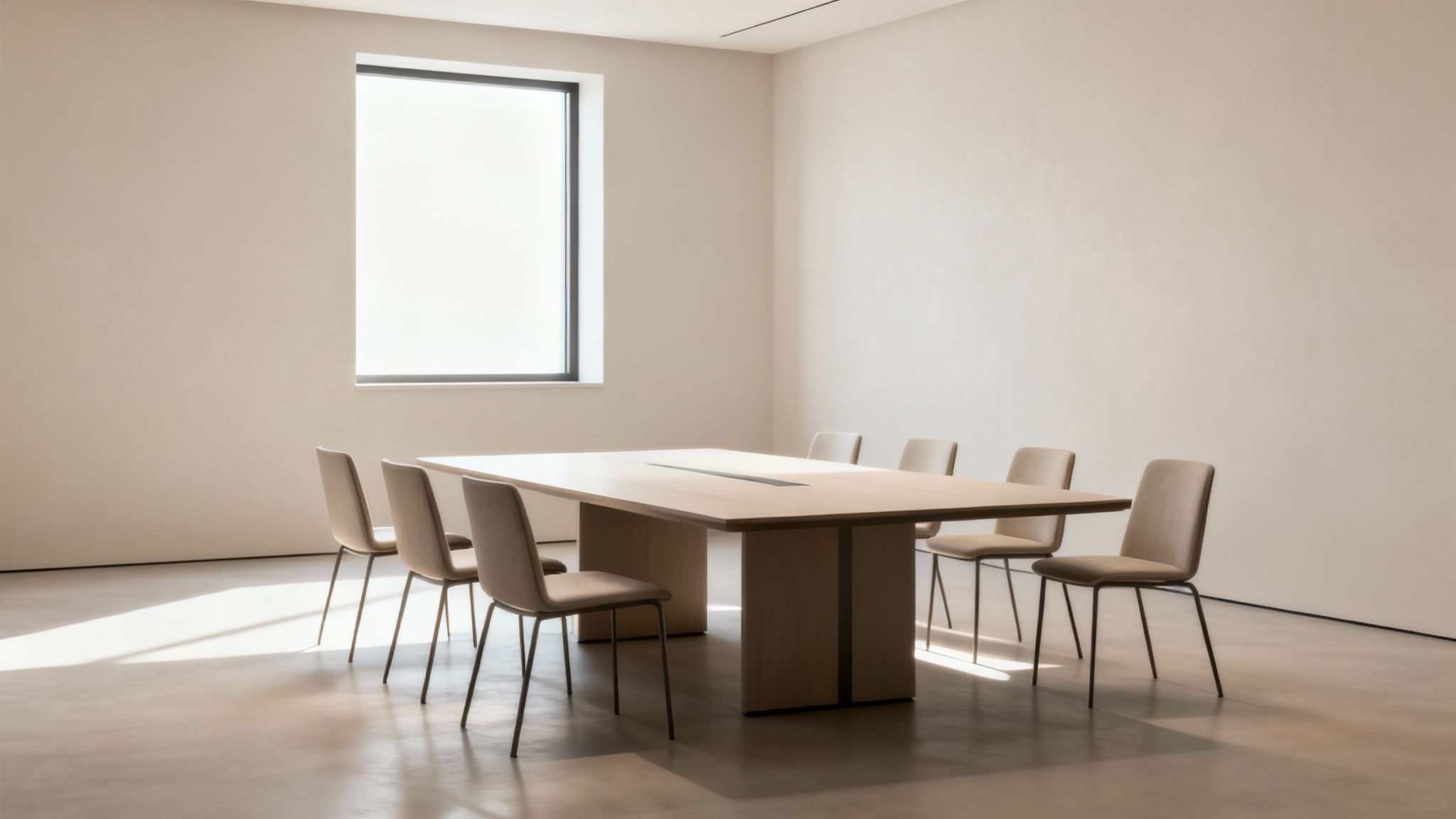
Beyond just the footprint, the materials you choose have a huge impact on the room's vibe. Exploring options like different wood finishes, laminates, or even specialty glass styles can completely elevate the design. The right material should echo your company's brand and the atmosphere you're trying to create.
For a bit of context, a standard conference table built for 10 people usually measures around 120 inches long by 48 inches wide. This size gives everyone enough elbow room. It's this popular sizing that has really pushed manufacturers to offer more customizable tables with built-in power and data ports, a trend that’s become almost a necessity in today's tech-driven offices.
Matching Table Shape to Your Meeting Style
The shape of your conference table does more than just fill a room; it’s the silent moderator in every meeting, directing the flow of conversation and collaboration. Getting the shape right is just as important as figuring out the correct conference room table size because it sets the psychological stage for every interaction.
A table's geometry can create a formal sense of hierarchy or foster an atmosphere where everyone participates equally. This choice should directly reflect what you actually do in your meeting space.
The Classic Rectangular Table
When most people picture a conference room, they picture a rectangular table. Its long, straight lines create a clear structure, which is perfect for formal presentations, board meetings, and any situation where there’s a distinct head of the table. This shape is a real workhorse, especially for maximizing seating in long, narrow rooms.
The downside? Its formal nature can sometimes feel a bit rigid. People at opposite ends might struggle to see and hear each other, which can stifle the open dialogue you want in more collaborative sessions. A typical boardroom table for 8-10 executives usually runs between 96 to 120 inches long and 42-48 inches wide.
Recent numbers show that 60% of new office furniture installations still lean towards rectangular shapes. Their popularity is boosted by how well they support modern AV tech, a critical feature now that an estimated 70% of meetings involve video conferencing.
The Collaborative Boat-Shaped Table
A boat-shaped table is a subtle but powerful twist on the classic rectangle. It’s wider in the middle and gently tapers toward the ends—a simple design tweak that dramatically improves sightlines for everyone at the table.
That gentle curve makes a huge difference in fostering a more collaborative vibe. By bringing the edges inward, this shape ensures no one feels too far removed from the conversation. It's an excellent choice for teams that need to have dynamic discussions and review presentations together, striking a great balance between formal structure and inclusive dialogue.
Round and Square Tables for Equal Footing
When every voice needs to be heard equally, round and square tables are the undisputed champs. With no designated "head," these shapes are a physical representation of a flat hierarchy, naturally encouraging open conversation and teamwork. They are absolutely perfect for smaller, agile teams and brainstorming sessions.
These tables are ideal for:
- Small team huddles: Fostering quick, informal check-ins and creative problem-solving.
- Intimate client meetings: Creating a less intimidating, more personal atmosphere.
- Breakout groups: Helping small groups focus during a larger workshop or training session.
Because they excel at promoting face-to-face interaction, round tables are particularly effective at building rapport and making sure everyone feels included. To see how different table shapes can anchor your broader office layout, you can explore our full range of office furniture designs.
Key Takeaway: No matter the shape, the fundamental rule for seating capacity is to allow 24 to 30 inches of personal space per person along the table's edge. This is the magic number that ensures attendees have enough elbow room to comfortably take notes, use a laptop, and engage without feeling squeezed. It's the simple principle you can use as a starting point, whether you're seating six people for a creative session or twenty for a formal board review.
Planning Your Room Layout for Flow and Function
You can pick the most beautiful, perfectly sized conference table in the world, but if you drop it into a poorly planned room, it’s going to fail. The real secret to a functional meeting space isn’t just the furniture—it’s the negative space around it. This clearance is what allows people to move naturally, ensures accessibility, and creates a feeling of comfortable productivity instead of frustrating confinement.
Think of the walkways in your conference room like arteries; they have to stay clear to keep the room’s energy alive and flowing. When pathways are too narrow or blocked, a meeting can feel stagnant. It becomes a hassle for people to get up, present at a whiteboard, or even just shift in their seats without bumping into everyone else. Good planning gets rid of these bottlenecks before they ever become a problem.
The shape of your table plays a big role in this, as different shapes encourage different kinds of meetings and, therefore, different kinds of movement.
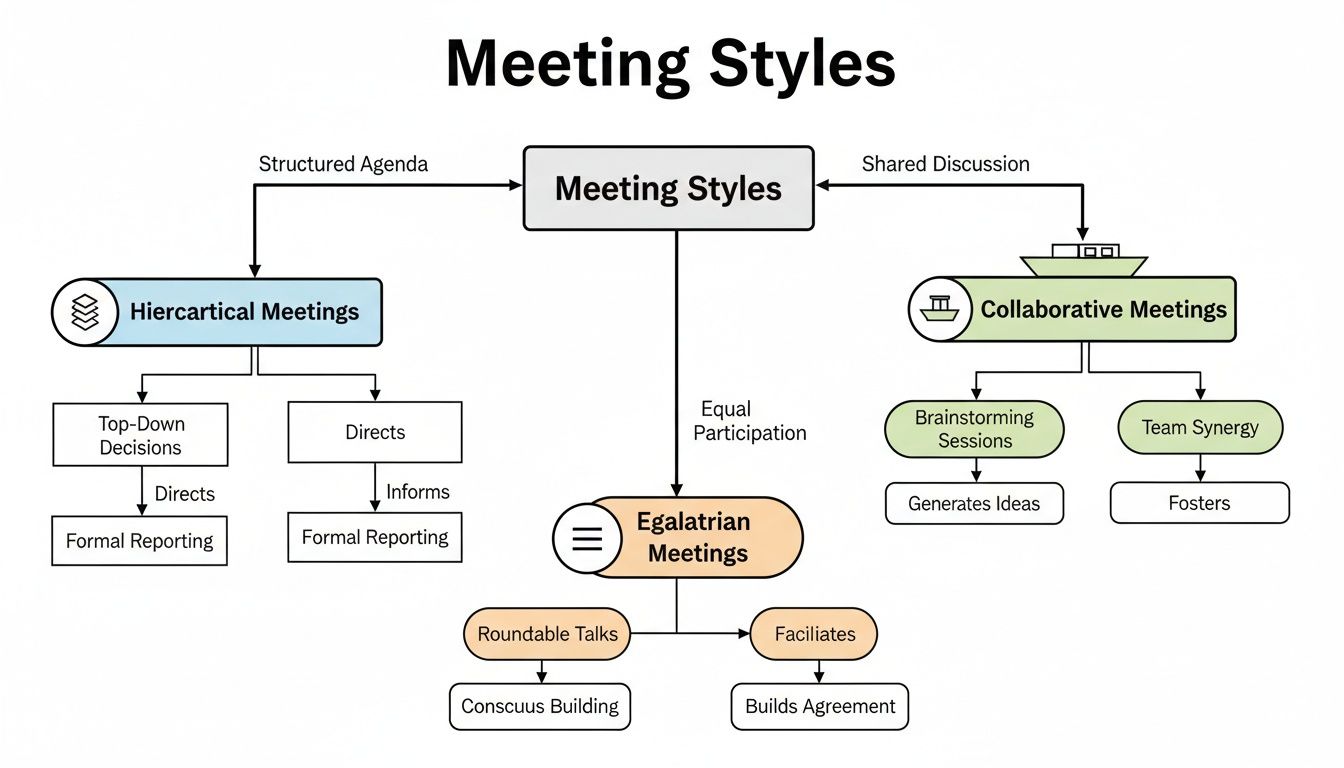
As you can see, a long rectangular table works well for top-down, hierarchical meetings, while a round table promotes a more egalitarian discussion. Each one demands a unique approach to the surrounding space.
The Gold Standard for Clearance
When you start mapping out the room, there's a magic number to keep in your head: 48 inches. This is the gold standard for clearance in your main traffic paths—the space between the edge of the table and the walls or other big items like credenzas.
Why 48 inches? It’s wide enough for two people to pass by each other without doing that awkward sideways shuffle. It also gives someone enough room to pull their chair out and stand up while another person walks behind them without issue. That generous spacing is what makes a room feel professional and accommodating.
For spots with less foot traffic, like the space between the table and a wall that isn't a primary walkway, you can shrink that clearance down to a minimum of 36 inches. It’s functional, but this tighter spacing is best kept to low-traffic zones to avoid creating pinch points in your layout.
Mapping Your Entire Room Footprint
A great layout goes way beyond just the conference table. Before you lock in that table size, you need to account for every other piece of the puzzle that will live in that room.
Start by measuring and mapping out the location of things like:
- Credenzas and Cabinets: These are staples in most conference rooms, but they eat up a surprising amount of floor space.
- Whiteboards or Presentation Screens: You need to leave enough room for someone to stand at the screen and present without feeling crammed against the table or chairs.
- Door Swings: Don't forget about the arc of the door opening into the room! A classic mistake is putting a chair right where the door needs to swing open.
- Structural Elements: Beams, support columns, radiators, or any other permanent fixtures have to be included in your clearance math.
If you want to see how all these pieces come together in the real world, check out some of our finished spaces in our office design project gallery.
Pro Tip: Grab a roll of painter's tape and mark the dimensions of your future table and other furniture directly on the floor. This simple trick lets you physically walk around the "furniture" and get a true feel for the flow before you spend a dime.
Ensuring ADA Accessibility
Beyond just comfort and flow, your room layout is a matter of compliance and inclusivity. The Americans with Disabilities Act (ADA) has specific standards to make sure workspaces are accessible for everyone.
For conference rooms, that means providing clear, unobstructed pathways wide enough for a wheelchair to navigate easily. The 36-inch minimum clearance is often cited in ADA guidelines for accessible routes, but honestly, providing more generous pathways—closer to that 48-inch ideal—is always the better move. A thoughtfully designed room allows every single team member, regardless of their mobility, to navigate the space with dignity and ease. Good planning makes your meeting space not just functional, but truly welcoming to all.
Integrating Technology, Power, and Cabling
These days, a conference table is more than just a place to set down notepads and coffee cups—it's the command center for your entire meeting. If you don't plan for technology, you'll end up with a tangled mess of wires, creating trip hazards and an unprofessional vibe. The trick is to think about power and data right from the start, making sure your table is sized not just for people, but for their devices too.
Thinking about cabling isn't just an IT problem; it's a core part of the room's design. When tech is woven in seamlessly, it makes hybrid meetings a breeze, keeps everyone's laptops charged, and lets your team focus on the discussion—not on hunting for an open outlet.
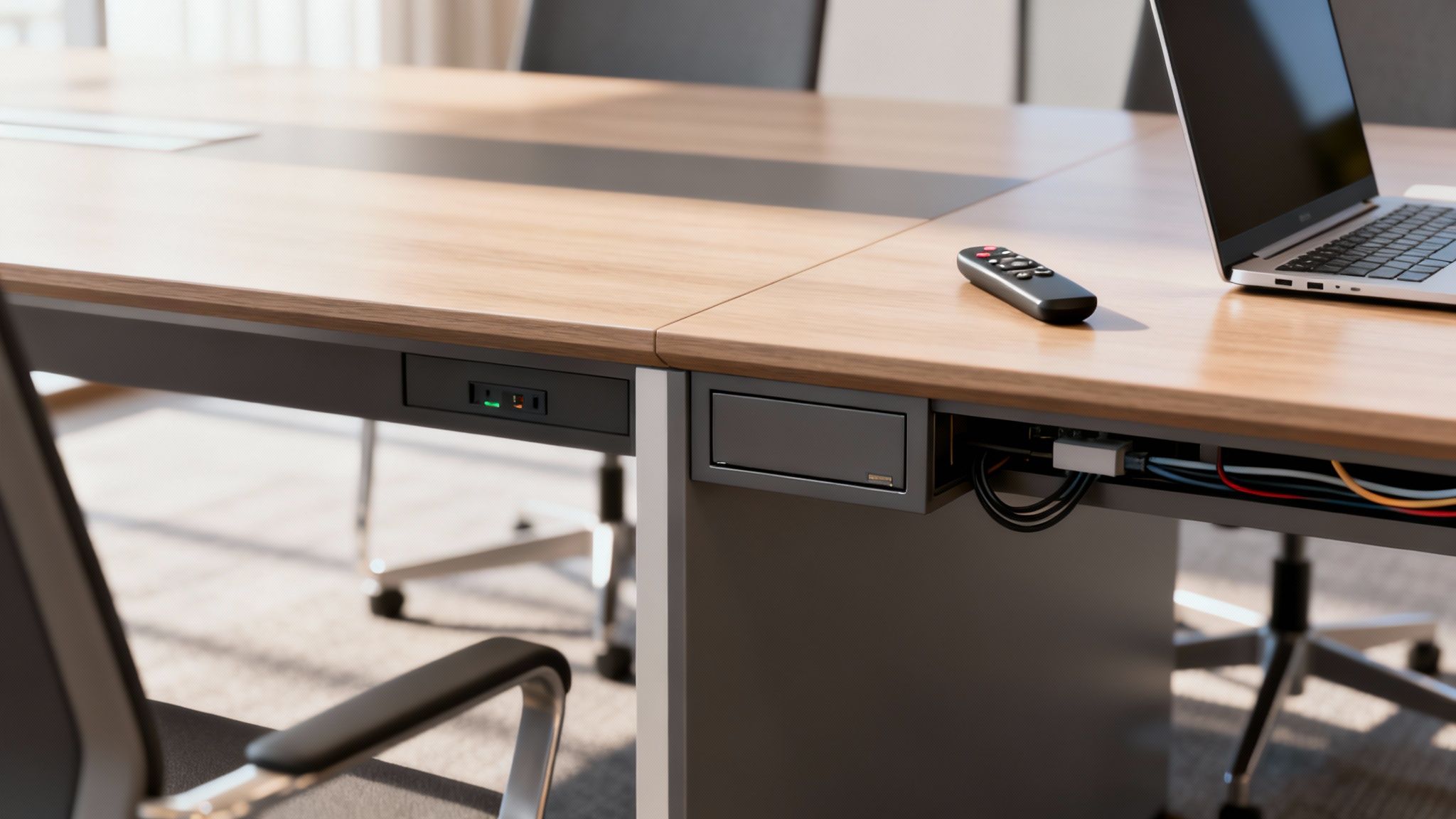
Smart Cable Management Solutions
The goal here is to make power and data access totally effortless without cluttering up the beautiful table you just picked out. Thankfully, modern tables come with some slick built-in solutions that hide the mess while keeping connectivity right at your fingertips.
A few popular options include:
- Built-in Power Modules: These are set right into the tabletop, often with a mix of standard outlets, USB-A and USB-C ports, and maybe an HDMI hookup. Many pop up when you need them and retract back down for a clean, flush look.
- Under-Table Cable Trays: A simple but brilliant solution. These are basically nets or trays mounted underneath the tabletop to wrangle power strips and extra cords, keeping them neatly tucked away and off the floor.
- Hollow Legs or Pedestals: Some of the savviest designs use hollow legs or a central base to run cables discreetly from the floor straight up to the power modules on the surface.
The right choice really depends on how you meet. For quick team huddles, a few USB ports might be all you need. But for those all-day workshops or big presentations, a full suite of power, data, and AV connections is a must-have. For a deeper dive, check out our guide on the essentials of a safe and efficient cubicle electrical setup.
Planning Your Power and Data Pathways
Once you’ve picked your in-table tech, you need a solid plan to get power and data from the wall to the table. This is where a little foresight saves a ton of headaches later, because trying to add this stuff after the fact can be expensive and disruptive.
Your table's fancy tech is only as good as its connection to the building's wiring. Think through the entire journey—from the wall socket to the tabletop port—to avoid last-minute scrambles and ugly extension cords snaking across the floor.
It’s no surprise that high-tech tables with built-in charging are catching on, grabbing 15% of the market share in 2023. They’re a productivity booster, making sure no one’s device dies mid-meeting. For a truly professional setup, looking into structured cabling systems is a smart move to keep things neat, efficient, and ready for whatever tech comes next.
Here are a few common ways to route those cables:
- Floor-Mounted Outlets: This is the cleanest look. A floor box, or "poke-thru," is installed directly under the table, allowing power and data to connect out of sight. It's the gold standard, especially for new builds or major renovations.
- Cable Covers and Raceways: If you’re working with an existing room that doesn’t have floor outlets, low-profile cable covers can run from the wall to the table base. They’re not quite as invisible as a floor box, but they manage the wires safely and keep people from tripping.
- Power Poles: A power pole is a vertical channel that drops from the ceiling down to the conference table, hiding all the wiring inside. It's a fantastic solution for open-plan offices where the table is nowhere near a wall.
A Step-By-Step Checklist for Measuring Your Room
Accurate measurements are the absolute bedrock of good room design. Before you even think about choosing the perfect conference room table size, you need a precise blueprint of the space you’re working with. This goes way beyond just jotting down the length and width; it's about capturing every little detail that could throw a wrench in your final layout.
Getting this right from the very beginning saves you from the headache (and cost) of ordering a beautiful table that simply won’t fit. Think of this checklist as your treasure map—follow it, and 'X' will mark the spot for your ideal table.
1. Measure the Core Dimensions
First things first, let's get the basics down to understand the room's total footprint. Grab a reliable tape measure and a notepad, or your tablet, and let's get to it.
- Length: Measure the longest wall from one corner clean to the other.
- Width: Now do the same for the shorter wall, corner to corner.
- Ceiling Height: Measure straight up from the floor to the ceiling. Most standard ceilings are around 8 feet, but if you have higher ceilings, that can make the room feel much more open and might influence your lighting or even acoustic panel choices.
2. Identify and Map All Obstructions
Okay, now for the tricky part. It's time to account for everything that isn't empty floor space. These are the permanent fixtures that will directly impact where your table can (and can't) go.
- Doors: Measure the width of the door, sure, but more importantly, you need to map its swing arc. Make a note of which way the door opens and exactly how far it swings into the room.
- Windows: Jot down the location and width of every window. Don't forget to measure their height from the floor (the sill height), as this will determine where you can place things like credenzas or whiteboards.
- Columns and Pillars: If you have any structural columns, measure their dimensions and their exact distance from the nearest walls. You have to work around these.
- Built-in Features: Document the location and size of anything else that's fixed to the walls or floor—radiators, built-in cabinets, thermostats, light switches, you name it.
3. Locate Power and Data Ports
In any modern meeting room, technology is king. Knowing precisely where your power and data sources are is absolutely crucial for planning a space that’s actually functional.
A table's final position is often dictated by connectivity. Mapping out your outlets early on prevents a situation where ugly extension cords become a permanent part of your room's decor.
On a quick sketch of your room, mark the exact location of every single one of these:
- Electrical outlet
- Ethernet/data port
- AV connection point (like wall-mounted HDMI ports)
This info is what will help you decide if you need a table with built-in power modules or if you need to think about floor-based cable management solutions.
Once you've picked out the perfect table, having professional teams handle the final placement is a game-changer. You can learn more about office furniture installation and disposal to see how the pros ensure a smooth, perfect setup from start to finish.
Tying It All Together with Cubicle By Design
Your conference table is a huge piece of the puzzle, but it doesn't exist in a vacuum. A truly great meeting space flows naturally with the rest of your office, creating a workspace that just works. This is where we need to stop thinking about just one room and start planning for a cohesive, professional environment that feels unified from the moment someone walks in.
At Cubicle By Design, this is our specialty. We don't just sell furniture; we help build connected, harmonious workplaces. Your new conference room should feel like it belongs, complementing the function and feel of your entire office, from the reception desk right down to individual workstations.
Defining Spaces with Modern Solutions
One of the trickiest parts of office design today is creating separate, functional zones without building a bunch of walls that kill the open, airy vibe. Our Series 7 Glass Walls are the perfect answer. They let you carve out a sleek, modern conference area that feels private but still very much a part of the larger space.
These modular glass walls are fantastic for acoustic separation—keeping confidential meetings private—while letting all that great natural light flow through. No more stuffy, claustrophobic meeting rooms. They look incredible paired with our flexible cubicle systems, creating a consistent design language. Imagine a well-placed conference room right near your collaborative workstation cubicles, making it easy for teams to pop in for a quick huddle.
See Your Whole Office Come to Life
It's a lot easier to nail down the perfect conference room table size when you can actually see how it fits with everything else. That's exactly why we built the Custom Cubicle Designer tool. It lets you map out your entire office, not just a single room.
You can play around with different setups, dropping your new conference room next to various arrangements of our versatile cubicles. This bird's-eye view is a game-changer. It helps you make sure walkways are clear, sightlines are good, and the overall office flow feels natural, not forced.
This big-picture approach is becoming essential. As businesses adapt, we're seeing a 40% rise in multi-purpose rooms that need to be flexible. For our clients, that means having modular designs that can scale from an 84-inch table for a small huddle to a 144-inch table for an all-hands meeting. To see how market trends are shaping office furniture, you can read the full research from HTF Market Insights.
Creating a Unified Design Language
A cohesive workspace isn't just about the layout; it's about the look and feel. Your conference room should be a natural extension of your company's brand and culture. By pairing our modular solutions, you can create that seamless aesthetic.
Think about how these combinations could work:
- Executive Hubs: Pair a large, formal conference room enclosed by our Series 7 Glass Walls with nearby private office cubicles. The result is a sophisticated, high-end executive wing.
- Collaborative Zones: Drop smaller, open-plan meeting areas with round tables near clusters of low-walled workstations. This setup encourages teamwork and spontaneous brainstorming.
When you think of your workspace as a complete system, choosing a conference table becomes much simpler. You can pick a size that not only fits the room but also perfectly supports its role in the productivity and design of your entire office. At Cubicle By Design, we give you the tools and solutions to strike that perfect balance.
Common Questions About Conference Room Tables
Picking out the right conference room table can feel surprisingly complicated, but it really just boils down to a few key principles. To wrap things up and make sure the core ideas from this guide stick, we’ve put together some straightforward answers to the questions we hear most often from our clients.
Think of this as a final gut check. Getting these details right—from clearance and height to whether a table will actually fit—is what separates a functional, inviting meeting space from one that's just frustrating to be in.
How Much Space Do You Need Around a Conference Table?
This is probably the most important question, and here’s the rule of thumb: aim for at least 48 inches (4 feet) of clearance between the edge of your table and the walls or any other furniture. That might sound like a lot, but it creates a comfortable walkway that allows two people to pass by each other easily, even when chairs are pulled out.
If a particular side of the table isn't a main traffic path, you can sometimes get away with a minimum of 36 inches. But honestly, sticking to the 48-inch rule is your best bet for a room that feels open and accessible, not cramped.
What Is the Standard Height of a Conference Table?
You’ll find that nearly every standard conference table is between 29 and 30 inches high. There's a good reason for this specific range—it's ergonomically designed to work perfectly with standard office chairs, which usually have a seat height between 16 and 21 inches.
This consistency ensures everyone at the table can sit with good posture, which makes a big difference in comfort during those longer strategy sessions.
Will a 10-Person Table Fit in a 12'x16' Foot Room?
Putting a 10-person table in a 12'x16' room is a classic mistake. It's technically possible, but it will be so tight that it’s completely impractical. A typical rectangular table for 10 people is about 10 feet long. In a 16-foot room, you’re left with only 3 feet (36 inches) of clearance on each end, which is already below the minimum we’d recommend for comfortable movement.
And that's before you even consider the 12-foot width, which would feel even more squeezed. For a room this size, an 8-person table is a much smarter choice. It will give you the breathing room you need for a functional, professional space.
Should I Choose a Rectangular or Boat-Shaped Table?
The right shape really depends on the kind of meetings you have. Neither is better than the other, they just serve different purposes.
-
Rectangular Tables: This is the traditional, go-to choice for formal boardrooms. They’re great for maximizing seating, especially in long, narrow rooms, and they establish a very clear head of the table for a more hierarchical feel.
-
Boat-Shaped Tables: These tables are a fantastic alternative, with a design that's wider in the middle and tapers at the ends. That subtle curve dramatically improves sightlines, making it easier for everyone to see the person speaking or view a presentation. It naturally creates a more collaborative, less formal atmosphere.
Ready to design a workspace that perfectly balances form and function? The team at Cubicle By Design provides end-to-end support to help you plan, procure, and install a workspace that enhances productivity and collaboration. Explore our solutions and see how our modular systems can create a cohesive, professional environment for your entire office. https://cubiclebydesign.com/