


A great office floor plan is much more than just a blueprint for where to put the desks. Think of it as a strategic asset, one that perfectly balances how your teams actually work with your company’s bigger, long-term goals. It’s about consciously creating an environment that sparks collaboration, protects focused work, and can pivot right along with you as your business evolves.
Defining Your Workspace Goals and Needs
Before you even think about sketching a layout or browsing furniture, you have to nail down the most critical step: defining what you need your office to accomplish. A truly effective floor plan is built on a foundation of clear goals and a real-world understanding of your team’s day-to-day grind.
If you skip this initial discovery phase, you risk ending up with a space that looks sharp but functions poorly. That’s a recipe for bottlenecks, constant distractions, and expensive re-dos down the line.
The whole process starts by making sure the physical space aligns with your company culture and strategic direction. Is your main goal to get different departments talking and sparking new ideas? Or is it to carve out quiet, distraction-free zones for deep, concentrated work? Answering that one question will shape every single decision you make from here on out.
Analyzing Workflows and Team Proximity
First, get a feel for the daily rhythm of your office. Watch how your teams move and interact. You need to identify which departments genuinely benefit from being shoulder-to-shoulder.
Your marketing and sales teams, for instance, probably need to be close enough for quick huddles and strategy sessions. On the flip side, putting the finance department right next to a loud, high-energy sales floor could make it impossible for them to concentrate. It’s about creating an internal ecosystem where every part supports the others—not just for convenience, but to cut down on friction and boost efficiency all day long.
Engaging Stakeholders for Essential Feedback
You simply can’t design a functional office in a vacuum. Your next move is to get direct feedback from department heads and, just as importantly, their teams. They’re the ones on the ground, and they know exactly what’s working and what’s driving them crazy about the current setup.
A successful floor plan isn’t designed for people; it’s designed with them. Engaging your team in the planning process uncovers critical insights that a top-down approach will almost always miss, ensuring the final layout meets real-world needs.
A simple survey or checklist can get the ball rolling. Ask pointed questions like:
- What are your team’s biggest daily frustrations with the current layout? It could be anything from a chronic lack of meeting rooms to not enough storage space.
- Which other teams do you interact with most frequently? Knowing these key relationships is crucial for “zoning” your departments effectively.
- What is the ideal balance of collaborative vs. quiet space for your team? A group of software engineers will have vastly different needs than a creative agency’s design team.
- Are there any specific equipment or technology needs that require dedicated space? Think about shared printers, servers, or other specialized hardware.
Gathering this information is a foundational step we detail in our complete office space planning guide, which can help you structure these crucial conversations.
Planning for Modern Work Patterns
Let’s be honest, the way we use offices has fundamentally changed. With hybrid work now the norm, designing for 100% capacity every single day just doesn’t make sense anymore.
Modern office design is smarter. It relies on utilization data, recognizing that even on the busiest days, you might only hit 50-60% occupancy. In fact, major real estate studies from firms like JLL show that global workplace utilization hovers near 40%, a number that’s pushing companies to completely rethink traditional layouts.
Instead of endless grids of assigned desks that sit empty half the week, successful floor plans now mix it up. They incorporate reservable touchdown stations, flexible collaboration zones, and multi-purpose rooms that actually match how people are using the office. This data-driven approach ensures your investment in square footage is efficient, supporting peak collaboration days without wasting money on empty desks. When you focus on how your space is actually used, you create a far more dynamic and cost-effective environment.
Designing a Floor Plan for People and Productivity
A great office is more than just a place to work; it’s an environment that genuinely helps people do their best work. Once you’ve got your basic goals down, the human side of the design is where a good floor plan of the office becomes a great one. This is all about creating a layout that supports different work styles, promotes well-being, and makes employees actually want to come in.
It really boils down to balance. You need vibrant, open areas that spark teamwork and those spontaneous “aha!” moments, but you also need quiet, distraction-free zones for deep concentration. Get that balance wrong, and you end up with a space where nobody can work effectively.
Creating Zones for Different Work Styles
Let’s be honest: not all work is the same. A developer coding a new feature needs a totally different setup than a sales team brainstorming a campaign. This is where the idea of “neighborhoods” or “zones” becomes so powerful. By grouping teams with similar workflows, you can create distinct areas perfectly suited to their specific tasks.
For instance, you could set up a high-energy zone for your collaborative teams, complete with whiteboards, flexible seating, and easy access to meeting rooms. Then, in another part of the office, you establish a dedicated quiet zone. This area is a sanctuary for tasks that demand intense focus. It’s the perfect place for solutions like our sound-dampening Private Office Cubicles, which essentially act as low-stimulus pods for concentration.
When you intentionally design for different modes of work, you’re giving your employees the power to choose the space that best fits what they need to do at that moment. This autonomy is a game-changer for job satisfaction and productivity because people feel trusted to manage their own focus and energy.
This data shows just how critical getting space utilization right has become for modern offices.
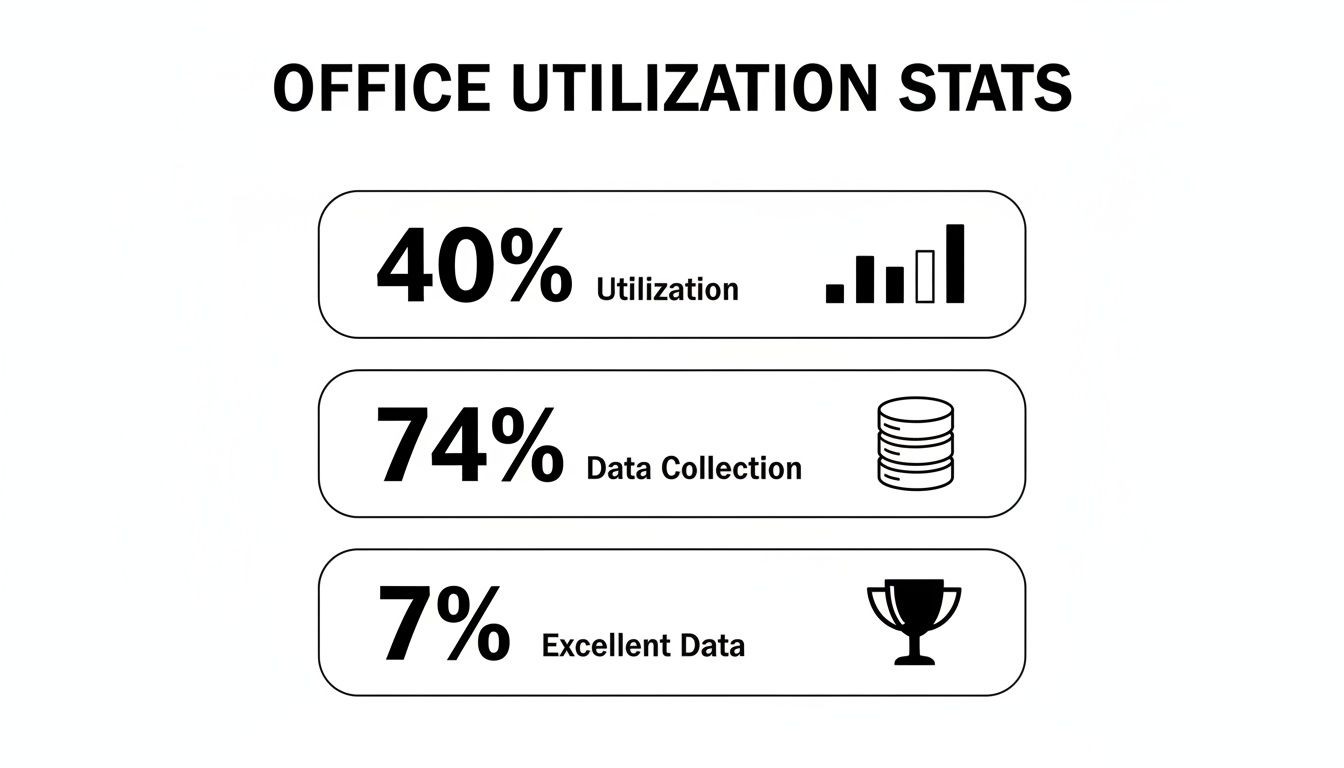
As you can see, there’s a big gap: while 74% of companies are collecting data on how their space is used, only 7% have what’s considered “excellent” data. This leads directly to underutilized, inefficient offices—a problem a well-zoned floor plan helps solve.
Balancing Collaboration and Focus
Nailing the right mix of collaborative and private space is one of the most common challenges we see. It’s not just a gut feeling; workplace studies consistently tie this balance to real results. Data from thousands of office workers shows a clear preference for workplaces that offer both.
Many companies are now aiming for a mix of roughly 30–40% collaboration space and 60–70% individual or focus settings. A foundational step in achieving this is deeply understanding the nuts and bolts of commercial floor plans and how different layouts can serve these ratios.
Our online Cubicle Designer tool is a huge help here, allowing you to experiment with layouts and find that perfect balance before committing to anything. You can play around with different arrangements of Workstation Cubicles and other furniture with a simple drag-and-drop interface. And if you need a spark of creativity, check out some of our other office cubicle design ideas for more inspiration.
Encouraging Movement and Interaction
A static office can feel pretty stale. A thoughtfully designed floor plan encourages people to move around and interact throughout the day. I’m not talking about constant interruptions, but creating opportunities for those valuable, unplanned conversations that often spark the best ideas.
Here are a few ways to get people moving:
- Centralize Amenities: Put the high-traffic spots—the kitchen, coffee stations, printers—in a central location. It’s a simple trick that encourages people from different departments to cross paths naturally.
- Create “Third Spaces”: These are the comfortable, informal areas away from desks. Think lounge chairs, small café-style nooks, or even an outdoor patio. They give employees a place to recharge, have a casual chat, or work in a more relaxed setting.
- Design Clear Pathways: Make sure walkways are wide, intuitive, and don’t create bottlenecks. A clear circulation path makes the office feel more open and accessible, which subtly encourages people to move around.
By weaving these elements into your design, you transform the office from a collection of desks into a living, breathing environment. The goal is to build a space that doesn’t just accommodate the work being done, but actively makes it better.
Building for Agility with Modular Office Systems
Let’s be honest: your business is always evolving. So why is your office floor plan stuck in the past? In today’s world, static, drywall-heavy layouts are more of a liability than an asset. The real key to a future-proof workspace is agility, and that starts with modular office systems from a trusted provider like Cubicle By Design.
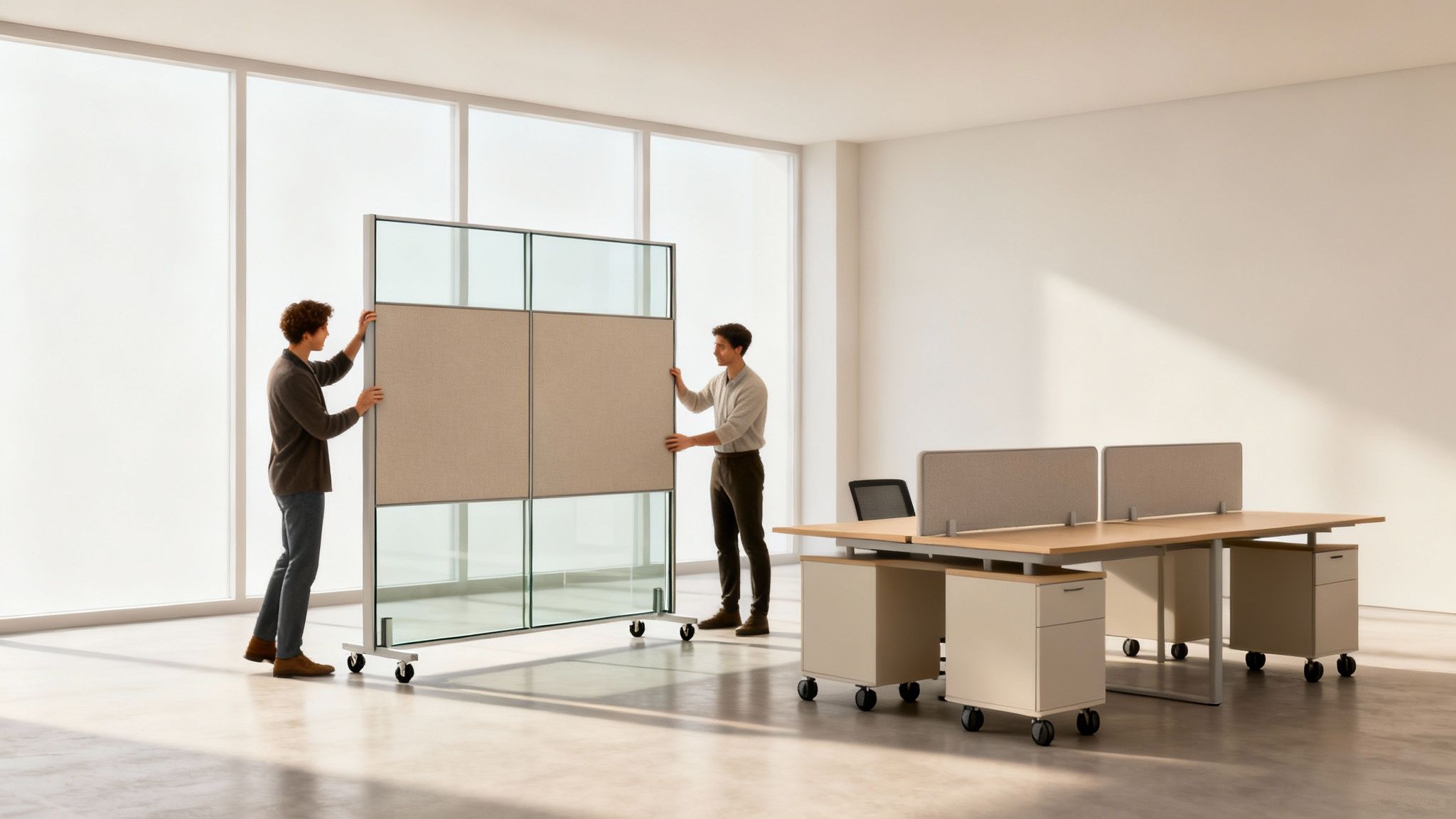
Think of your office furniture and walls less like permanent fixtures and more like a versatile ‘kit of parts’ you can adapt whenever you need to. Imagine reconfiguring a team area overnight for a new project sprint or adding a private office in an afternoon—all without the dust, disruption, and cost of a construction crew. This isn’t a luxury anymore; it’s a strategic necessity.
The Power of a Reconfigurable Workspace
Traditional office renovations are a massive headache. They’re expensive, disruptive, and take forever. When your needs shift—maybe your team grows, you adopt a hybrid model, or a new department forms—a fixed layout forces you right back into another costly construction cycle. Modular systems flip that script entirely.
With solutions from Cubicle By Design, you can create a space that actually grows with you. Our versatile cubicles can be rearranged, expanded, or even downsized with minimal fuss. This gives you the power to tweak your floor plan of the office to meet new challenges without the huge capital expense and downtime that comes with conventional construction.
A modular office is more than just movable furniture—it’s a completely different mindset. It’s about seeing your physical workspace as a dynamic tool you can reshape to solve business problems, improve collaboration, and support your team as their needs change.
This adaptability is exactly what modern workplaces need. As companies figure out the rhythm of hybrid work, being able to quickly scale up collaborative zones or dial up quiet focus areas is crucial. A modular framework gives you the freedom to test new layouts and discover what truly makes your team productive.
Real-World Scenarios, Adaptable Solutions
So, how does this actually play out in a real office? Let’s look at a few examples I’ve seen firsthand.
- The Growing Startup: A tech company lands a huge new client and needs to hire five developers, fast. Instead of a frantic search for more office space, they use their existing modular workstation cubicles. In just a few hours, they transform an underused open area into a dedicated, semi-private pod for the new team. Problem solved.
- The Project-Based Agency: A marketing firm needs a “war room” for a three-month campaign. Using movable glass partitions, they section off part of their open-plan space to create a secure, focused hub. Once the project wraps, the walls come down just as easily, and the space returns to its original configuration. We see this all the time with our modular office walls.
- The Hybrid Workforce: A company notices that Tuesdays and Wednesdays are packed, but the office is a ghost town the rest of the week. They use our Custom Cubicle Designer to plan a layout with fewer assigned desks and more shared, reservable workstations and collaborative lounges. They end up optimizing every square foot.
Slashing Future Costs and Embracing Long-Term Value
The financial argument for going modular is pretty compelling. It’s not just a trend; it’s a smart business move. Industry data shows that 55% of global occupiers are now using flexible office solutions, driven by a desire to lower long-term costs and avoid expensive refits.
As office vacancy rates in the U.S. have stabilized, the focus has shifted to modernizing existing spaces for maximum efficiency. Companies that adopt modular systems drastically reduce construction waste and shorten the time it takes to reconfigure their space. This makes their real estate dollars work a whole lot smarter, which is critical as the demand for well-designed, adaptable offices continues to grow.
By investing in a flexible foundation, you’re not just buying furniture—you’re investing in your company’s ability to pivot and adapt for years to come.
Navigating Power, Data, and Building Compliance
A brilliant floor plan can look perfect on paper but fall apart in the real world without a solid technical foundation. This is where we get into the nuts and bolts—tackling the critical infrastructure that actually brings an office to life: power, data, and building compliance. I’ve seen it happen time and again: overlooking these details early on is one of the most common and costly mistakes you can make.
It’s easy to get caught up in furniture placement and aesthetics, but a truly successful floor plan of the office weaves in technical requirements right from the start. When you plan your electrical and network layout alongside your furniture, you ensure every employee has the connectivity they need from day one. No one wants to see a jungle of hazardous extension cords ruining a brand-new space.
Integrating Power and Data Seamlessly
Let’s face it, modern offices are power-hungry. Every single workstation needs outlets for monitors, laptops, and phone chargers, not to mention reliable network ports for high-speed internet. The trick is to map these needs directly onto your floor plan before a single cubicle is ordered.
Loop in your IT team and an electrician to plot out exactly where power and data drops are needed. Think about high-demand areas, like conference rooms that need beefy connectivity for presentations and video calls. For open-plan layouts, power poles or integrated raceways within modular cubicle systems are your best friend. These solutions cleanly deliver electricity and data from the ceiling or floor, keeping wires safely tucked away and out of sight. You can dive deeper into the specifics with this detailed guide on cubicle electrical setup.
Planning for power and data isn’t just an IT problem—it’s a core design function. Integrating connectivity into the floor plan from the start prevents expensive retrofitting, improves safety, and creates a cleaner, more professional look.
Smart Cable Management Strategies
A clean office is a safe and productive one, and nothing torpedoes a great design faster than a mess of tangled cables. Beyond just looking sloppy, poor cable management is a serious tripping hazard and can lead to damaged equipment or network outages.
Here are a few practical tips I always recommend for keeping wiring under control:
- Use Integrated Raceways: Many modern cubicle systems have built-in channels designed specifically to hide and organize cables. This is hands-down the cleanest and most efficient way to manage wiring at the desk level.
- Leverage Cable Trays: For rows or pods of desks, under-desk cable trays or baskets are perfect for keeping power strips and adapters off the floor.
- Plan for Both Wi-Fi and Hardwired Connections: While great Wi-Fi is a must, don’t forget about hardwired Ethernet ports. They offer more stable and secure connections for desktops and other critical equipment that isn’t moving around.
Demystifying Building Codes and Accessibility
Compliance isn’t just a good idea—it’s the law. Every office floor plan must follow local building codes and federal regulations like the Americans with Disabilities Act (ADA). These rules exist for a very important reason: to ensure your workspace is safe and accessible for every single person.
The ADA, for example, has specific requirements for things like hallway width and door clearance. Main circulation paths generally must be at least 36 inches wide to allow for wheelchair access. You have to factor this into your layout from the beginning to avoid creating pinch points or dead ends. There needs to be enough room around desks and in common areas for everyone to navigate comfortably and safely.
Fire codes are just as critical, dictating everything from the number and location of exits to how far someone has to travel to reach one. It is absolutely crucial to have a professional—like an architect or a contractor who knows local commercial codes—review your plan. Getting this wrong can lead to failed inspections, fines, and expensive, last-minute fixes.
To help keep these critical points top-of-mind, here is a quick checklist to review during your planning process.
Office Planning Compliance Checklist
This table summarizes key compliance areas to review during the floor plan design phase. It’s a great starting point for conversations with your architect or contractor to ensure your new office is safe, accessible, and up to code.
| Compliance Area | Key Consideration | Action Item |
|---|---|---|
| ADA Accessibility | Are all pathways, doorways, and common areas at least 36 inches wide? | Measure and mark all circulation paths on the floor plan to confirm clearance. |
| Fire Safety | Are all exit routes clearly marked and unobstructed? | Review local fire code for maximum travel distance to an exit and verify your plan. |
| Electrical Code | Is the number of planned outlets sufficient to avoid overloading circuits? | Consult an electrician to validate the power distribution plan. |
| Ergonomics | Do workstations allow for proper posture and movement? | Ensure adequate desk depth and clearance for ergonomic chairs. |
| Egress Pathways | Can every employee reach two separate exits from their primary workspace? | Trace primary and secondary exit paths for all zones on the floor plan. |
| Restroom Access | Do restrooms meet ADA requirements for stalls, sinks, and turning radius? | Confirm all restroom dimensions and fixture placements with an ADA expert. |
Taking the time to check these boxes ensures your beautiful new office is also a safe, compliant, and inclusive one for everyone on your team.
Bringing Your New Office Plan to Life
You’ve got the final design in hand, and this is where things get really exciting. It’s time to take that detailed floor plan of the office off the page and turn it into the functional, physical workspace you envisioned. The secret to getting this right is a well-orchestrated execution plan that minimizes headaches and gets your team settled and productive from day one.

This final phase isn’t just about moving desks around. It’s a logistical puzzle involving vendors, timelines, and most importantly, your people. A smooth transition is absolutely essential for keeping morale high and business moving forward.
Creating a Phased Installation Plan
Trying to overhaul an entire office at once is a recipe for chaos and downtime. I’ve seen it happen, and it’s not pretty. A phased approach is almost always the smarter strategy. This just means breaking the project down into smaller, more manageable chunks.
You could start by setting up a currently vacant section of the office or maybe tackle one department’s area over a weekend. This lets the rest of your team keep working with minimal interruption. A phased rollout also gives you a chance to spot and fix any small issues in one area before you replicate them across the entire floor.
The whole point of a phased installation is to control the chaos. By systematically building out your new office, you prevent operational downtime and ensure each stage meets your standards before you move on to the next.
Getting everyone on the same page is crucial. To really help your team and the installers grasp the final vision, using tools like rendered floor plans can make a world of difference. When people can see what you’re building, the process goes much more smoothly.
Coordinating Vendors and Managing Logistics
The installation phase is a busy time, bringing together everyone from furniture dealers like us at Cubicle By Design to electricians and IT technicians. Having one person act as the central point of contact is non-negotiable for keeping things on track.
A simple shared calendar can do wonders for scheduling. And before a single box of furniture arrives, you need to do a thorough pre-installation site check. Trust me, this saves so many headaches later.
- Confirm Measurements: Double-check that doorways, elevators, and stairwells are actually wide enough for the furniture to get through.
- Verify Site Conditions: Make sure the installation area is clean, clear, and totally ready for the crew to get to work.
- Check Power and Data: Confirm that electrical outlets and data ports are active and exactly where your plan says they should be.
These simple checks prevent costly surprises and delays on the big day. Working with an experienced partner makes this much easier. For instance, our team provides a full rundown on what to expect during a professional office furniture installation, taking a huge logistical weight off your shoulders.
The Human Side of the Transition
Never, ever underestimate the importance of communication during an office move. Your team is going to have questions. Keeping them in the loop is the best way to build excitement and calm any anxieties about the change.
Start by sharing the new floor plan well ahead of time. But don’t just show them the layout—explain the why behind it. Talk about how it’s designed to improve collaboration, provide better focus areas, or support hybrid work.
Once the space is ready, a simple welcome guide or a quick orientation can go a long way. Point out the new amenities, explain how to book meeting rooms, or show off the different work zones.
Finally, make it clear you’re open to feedback. There will always be small adjustments needed in the first few weeks. Gathering that input shows your team that their comfort and productivity are what this was all about in the first place.
Questions We Hear All the Time About Office Floor Plans
When you’re staring at an empty office space, the questions start piling up fast. It’s a big job, and getting the layout right from the start is absolutely critical. Over the years, we’ve helped countless businesses navigate this process, and a few key questions always seem to come up.
Let’s walk through the most common ones we hear and get you some clear, practical answers.
How Do I Strike the Right Balance Between Open and Private Spaces?
This is probably the number one question, and the honest answer is: it depends entirely on how your team actually works. There’s no magic formula, but a 60/40 or 70/30 split—leaning toward individual focus space—is a solid starting point for most companies.
The best way to figure this out is to simply ask your people. Talk to them about their day-to-day.
If you’ve got teams of developers or financial analysts who need long, quiet stretches to concentrate, you’ll want to lean into solutions like our sound-dampening Private Office Cubicles. On the other hand, if your office buzzes with creative brainstorms and constant team huddles, then dedicating more real estate to open, flexible collaboration zones just makes sense.
The real goal here isn’t just about walls and desks; it’s about empowerment. When you give people a variety of spaces to choose from, they can pick the right environment for the task at hand. That trust does wonders for morale and, you guessed it, productivity.
What Are the Biggest Mistakes to Avoid When Planning a Layout?
We’ve seen a few common missteps that can quickly turn a beautiful new office into a daily frustration. One of the biggest is completely ignoring how people need to move through the space. If you don’t plan for workflow and clear circulation paths, you end up with a cramped, awkward office where people are constantly bumping into each other.
Another huge one is acoustics. An office that’s an echo chamber makes it impossible for anyone to get deep work done. It’s a productivity killer. Similarly, forgetting to map out power and data access from day one is a recipe for a tangled mess of extension cords and spotty Wi-Fi later on.
And finally, don’t design yourself into a corner. Your business will grow and change. Choosing a rigid, inflexible layout is a massive mistake. Opting for adaptable, modular furniture ensures your workspace can evolve with you, saving you from a costly and disruptive overhaul every couple of years.
How Can I Design a Floor Plan That Actually Works for a Hybrid Team?
Designing for a hybrid team boils down to two key things: flexibility and choice. The old model of one desk per person just doesn’t work anymore. Instead, you’ll want to embrace reservable “hot desks” or modular Workstation Cubicles that can be booked on demand. This approach frees up valuable square footage for spaces people actually need.
You’ll also want to seriously ramp up the number and variety of your meeting rooms. Make sure every single one is outfitted with top-notch video conferencing gear so your remote and in-office folks can connect without a hitch.
Think about creating comfortable “touchdown” spots with soft seating and easy-to-reach outlets for employees who are just popping in for a few hours. The modern office isn’t just a sea of desks; it’s a destination. It should be the absolute best place for the things people can’t do well from their kitchen table: collaborating face-to-face, building camaraderie, and sparking new ideas together.
Ready to turn these ideas into a concrete plan? The Cubicle By Design team is here to help. Explore our full range of cubicles or start creating your perfect layout instantly with our free Custom Cubicle Designer tool.