


You're usually not searching for furniture rental in San Antonio because things are calm. You're searching because a lease started early, a project team landed fast, a renovation displaced people, or leadership wants a functioning office before the rest of the details are settled.
That's where most online advice falls short. A lot of local content is written for apartment renters, not office managers who need workstations, install coordination, building access approvals, and a clean sign-off at the end. If you're handling furniture rental San Antonio for a workplace, the main job isn't picking desks. It's controlling risk, timeline, and total cost while keeping the office usable on day one.
Furniture Rental San Antonio Office Manager’s Guide 2026
Assessing Your Office Needs and Project Timeline
The expensive mistakes happen before the first quote arrives. If you ask vendors for “50 desks and chairs,” you'll get pricing. You probably won't get the right setup.
The first step is defining the use case. That matters because office furniture rental doesn't behave like home furniture rental. IBISWorld notes that the most defensible operating model is to segment demand by use case first, and that a key pitfall is assuming furniture rental is one uniform category when office demand has different turnover and utilization economics than home rental in the U.S. home furniture rental industry overview.
Start with work patterns, not just headcount
A 30-person office can need very different furniture depending on how people work.
- Sales floor needs density: Teams making calls all day usually need tighter planning, clearer aisle paths, and more repetition. That's where call center cubicles make more sense than mixed individual desks.
- Creative or hybrid teams need flexibility: They may need fewer assigned seats, more touchdown areas, and easier reconfiguration.
- Client-facing teams need finish consistency: Reception, conference rooms, and manager offices often need a more polished visual standard than back-office seating.
- Short project teams need speed: If the office exists for a defined contract period, standard workstation kits are often easier to deploy than highly customized combinations.
If you're still shaping the plan, an office space planning guide helps organize workstation counts, circulation, and support spaces before you request pricing.
Build a project brief vendors can actually quote
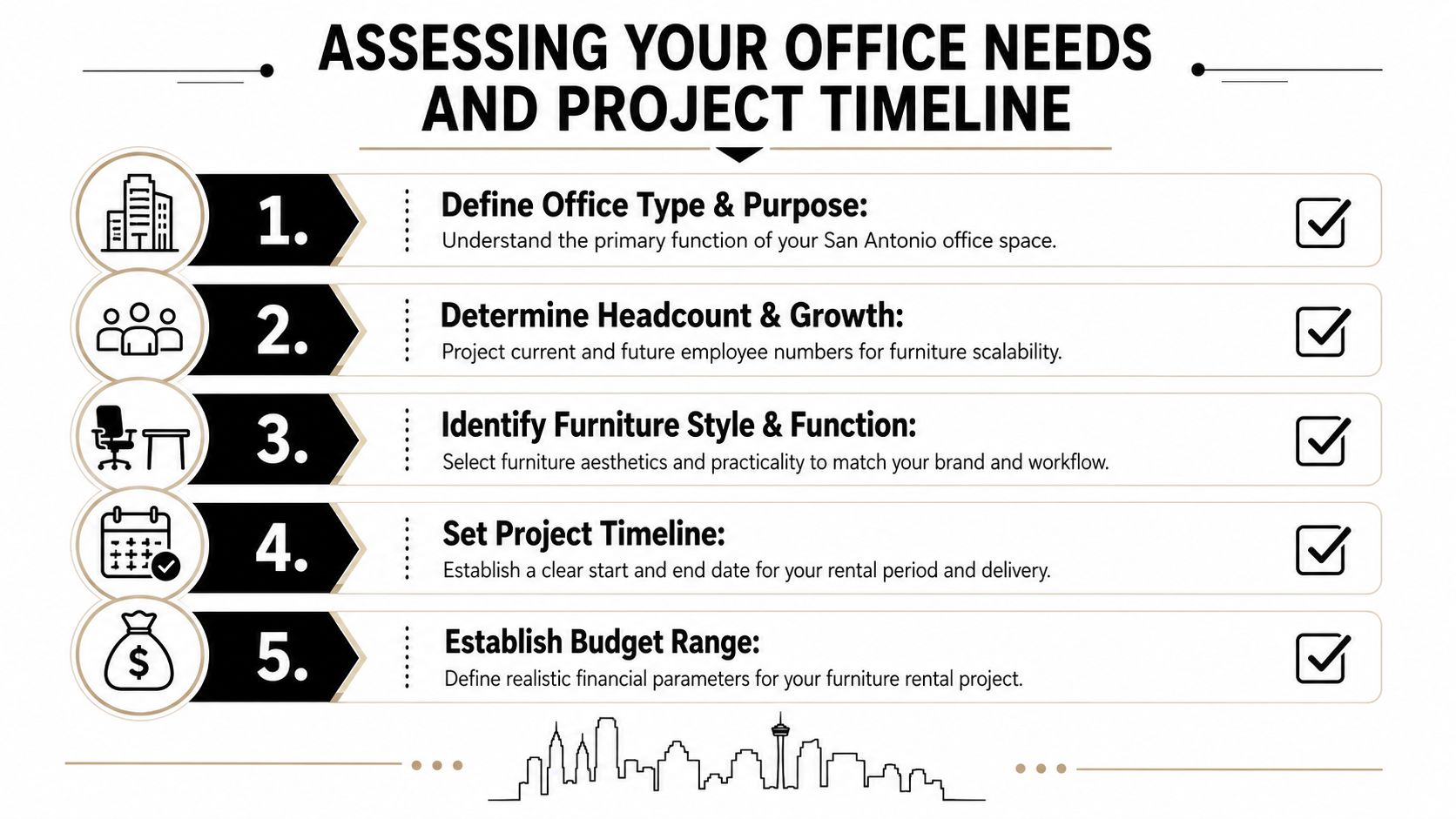
A good brief should answer five practical questions:
- How many seats are live on day one
- Which teams need assigned seating versus shared seating
- What power and data conditions already exist
- Which rooms must be included beyond open office seating
- How likely the layout is to change during the rental term
Use a planning tool if the space is still fluid. Something like Room Sketch 3D furniture fitting is useful when you need to test whether a workstation footprint, meeting table, or storage run will fit before you commit.
Practical rule: If your floor plan doesn't show power locations, entry points, and exact workstation counts, your quote is still provisional whether the vendor says so or not.
Put the timeline on paper
Rental projects slip when nobody owns the sequence. Lock down your target occupancy date, then work backward through approvals, building access, delivery windows, and install time.
A simple way to pressure-test the schedule is to ask:
| Project item | What to confirm internally |
|---|---|
| Building access | Freight elevator rules, loading dock hours, COI requirements |
| Layout approval | Who signs off on final seat counts and room uses |
| IT readiness | Power drops, data runs, monitor arms, cable paths |
| Team moves | Which departments move first and which can wait |
| Change control | Who approves additions after the order is placed |
If you want fewer change orders, get visual before you get contractual. The Cubicle Designer is one practical way to test dimensions, privacy levels, and storage options while the plan is still flexible.
Budgeting Beyond the Monthly Rental Rate
The monthly number is rarely the full number. That's the trap.
A low advertised rate can still produce a costly project once delivery, installation, pickup, and service charges show up on later pages of the quote. That problem is especially common in local search, where many San Antonio rental pages are written for apartments, not offices. Fashion Furniture's San Antonio page highlights a recurring gap in total-cost transparency and advises renters to ask whether setup, deposit, delivery, service charges, insurance, pickup, and cleaning fees are included in the price on its San Antonio rental guidance.

What belongs in the real budget
When I review a rental quote, I want the vendor to separate every cost that touches the project. If they bundle everything into one vague monthly figure, comparison gets harder.
Look for these line items:
- Delivery charges: Especially important if your site has limited dock access or time-restricted receiving.
- Installation labor: Assembly, placement, and any after-hours or multi-floor work.
- Pickup and removal: Often forgotten until the end of the term.
- Damage waiver or insurance: Sometimes mandatory, sometimes optional.
- Cleaning or refurbishment fees: Important if the contract sets condition standards for return.
- Deposit terms: Not just the amount, but what triggers deductions.
A quote review gets much easier when you benchmark each option against expected workstation scope. If you need help thinking through cost ranges by workstation style, the workspace price guide is a useful reference point.
Compare landed cost, not rent alone
The cleanest method is to convert every proposal into landed cost per usable workstation. That means taking all expected charges and dividing them by the number of seats that are operational.
A cheap monthly rate can become the most expensive option if the vendor adds freight, install labor, and end-of-term fees outside the base quote.
Use this short checklist before signing:
- Ask what's excluded: If something isn't listed, ask whether it can still appear later.
- Check access assumptions: Loading dock limits, security check-ins, and elevator reservations often change labor cost.
- Define damage standards: “Normal wear” should not be left vague.
- Review extension pricing: Short initial terms with unclear extension rates can get expensive fast.
What works and what doesn't
What works is a quote with separate categories, clear service assumptions, and return conditions in writing. What doesn't work is a one-page proposal that looks simple but leaves operational details unresolved.
If the vendor can't explain exactly what happens on delivery day, pickup day, and invoice day, the monthly number doesn't mean much.
The Rent Versus Buy Decision Framework
Your lease renewal is still in legal review, headcount is shifting by quarter, and leadership wants the new San Antonio office live in 30 days. That is the kind of situation where the rent versus buy decision gets expensive if you treat it like a simple pricing exercise.
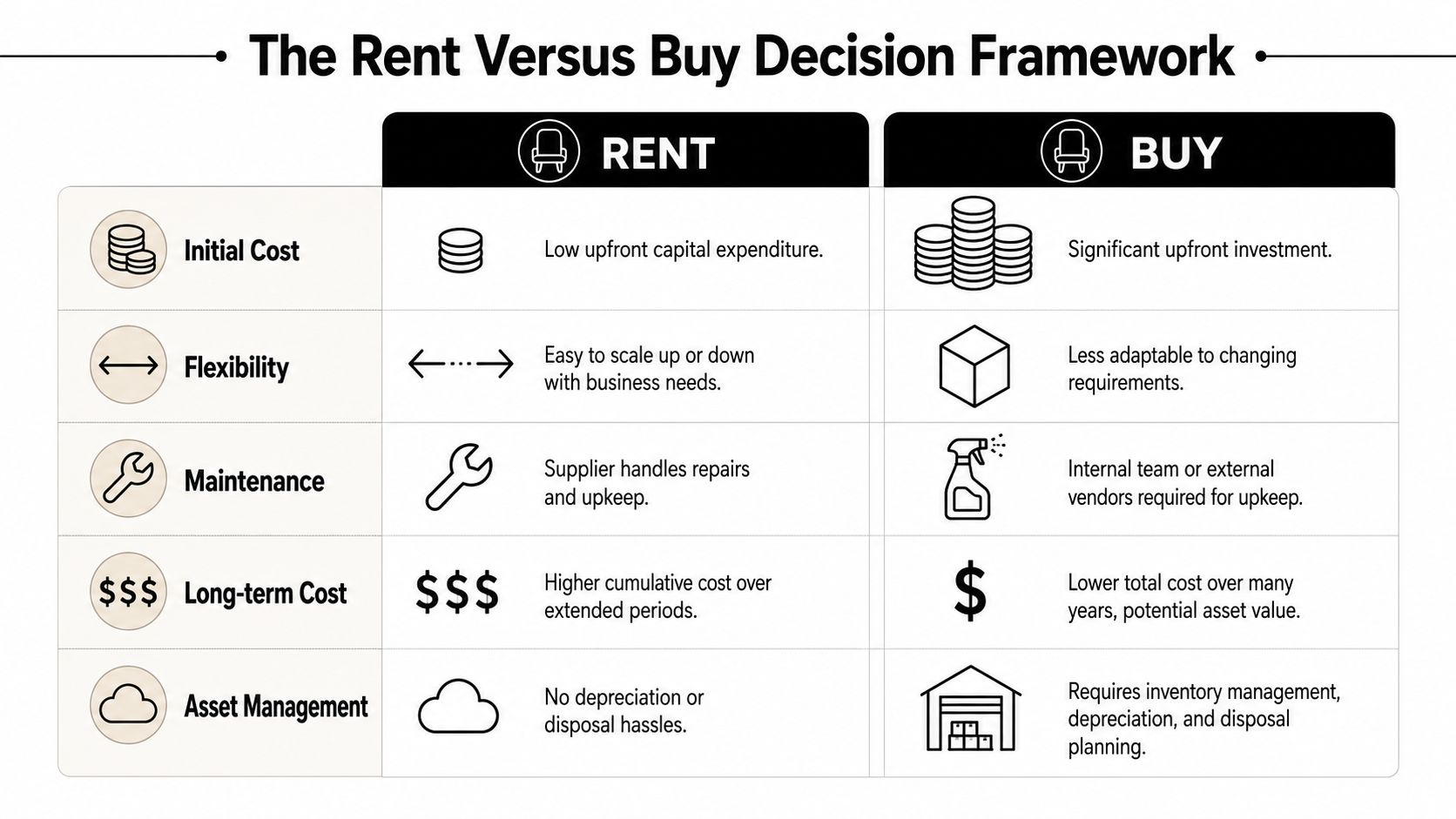
Renting covers uncertainty. Buying makes more sense when the floor plan, headcount, and occupancy period are settled enough to justify ownership. The mistake I see most often is teams comparing monthly rent to purchase price without pricing the cost of change.
Draper and Kramer makes a fair point in its article on whether you should rent your furniture. A lot of advice stops too early and never answers when rental stops being economical for larger teams or longer terms. For office and facilities managers, that missing piece matters more than the basic pros and cons.
Start with the break-even point
Use a simple decision screen before you look at aesthetics or finish options:
| Decision factor | Renting tends to fit when | Buying tends to fit when |
|---|---|---|
| Timeline | Occupancy is temporary, phased, or still under review | The team expects to stay put for years |
| Scale volatility | Hiring plans could rise or fall | Seat count is predictable |
| Capital versus operating budget | Upfront cash needs to stay low | CapEx approval is available |
| Reconfiguration risk | Departments may shift or consolidate | Layout standards are unlikely to change |
That framework works well in San Antonio because many office projects here sit in the middle. A branch office may start with 25 seats, then add 15 after a contract award. A medical admin team may need temporary swing space during a renovation. In those cases, flexibility has a cash value.
The office furniture buying guide is useful for pressure-testing the ownership side if your occupancy plan is stable and your standards are already defined.
What usually tips the decision
Rental keeps its edge when the cost of being wrong is high. If you buy 60 stations and then restack the office six months later, you own the mismatch. If you rent, you usually have a cleaner path to add, remove, or swap product, though that flexibility still needs to be written into the agreement.
Buying usually wins when three things are true at the same time. The team will stay in place long enough to amortize the purchase. The furniture specification is stable. The business can handle storage, repairs, and eventual disposal without creating a side project for facilities.
Hybrid plans often produce the best result.
- Rent open-area workstations for teams with uncertain headcount.
- Buy task chairs for employees with strict ergonomic requirements.
- Purchase conference room pieces if branding and finish consistency matter.
- Keep architectural products separate. For example, glass office partitions often belong in a facilities or tenant improvement discussion, not a short-term furniture rental decision.
Match ownership to stability. Match rental to uncertainty.
One more practical point. If your project involves furniture transfers between locations, review a guide to licensed and insured movers before you assume your rental vendor handles every relocation risk. In multi-site office projects, that gap shows up late and usually adds cost.
Here's a useful explainer if you want another visual on weighing rental against ownership:
The strongest decision is rarely ideological. It is operational. If the business is buying certainty, purchase the furniture. If the business is buying time, flexibility, or room to change, rent the pieces that are most likely to move first.
How to Vet San Antonio Furniture Rental Vendors
San Antonio has options, but not every option is built for office work. According to Yelp data referenced in the verified research, San Antonio has at least 10 top-rated furniture rental businesses, while the national Home Furniture Rental sector includes 375 businesses in 2026 and excludes office furniture, which is why vendor screening matters so much for commercial projects in the San Antonio furniture rental listings.
That distinction matters because a vendor can look strong in residential search results and still be weak at supplying uniform workstation runs, office install crews, or commercial-grade reconfiguration support.
Ask capability questions, not just price questions
A serious vendor conversation should sound more like procurement than shopping. Start with operational questions:
- Inventory depth: Can they supply matching stations in the quantity you need, or are they brokering from multiple sources?
- Commercial experience: Have they worked in multi-tenant office buildings with loading dock rules and building management approvals?
- Replacement process: If a pedestal arrives damaged, what happens next and how fast?
- Reconfiguration support: Can they add seats, remove seats, or swap layouts mid-term?
- End-of-term process: How much notice do they need for pickup, and who documents condition?
If you're comparing local and regional providers, this is also where dealer networks matter. A directory like office furniture dealers near me can help frame the commercial side of the market before you narrow the shortlist.
Test the move and handling side
A lot of rental failures are really logistics failures. Furniture can be available and still arrive late, damaged, or incomplete because the delivery chain wasn't built for office conditions.
That's why I ask vendors whether they use trained crews, what insurance documentation they carry, and how they handle claims. If you want a practical checklist for evaluating that side of the process, this guide to licensed and insured movers is useful background reading before vendor calls.
Don't assume “delivery included” means commercial install competence. It may only mean curb-to-door transport.
What a strong vendor answer looks like
Strong vendors answer in specifics. They can tell you whether they stock consistent finishes, how they handle punch-list issues, and what lead time they need once a layout is final.
One practical example is Cubicle By Design, which offers office furniture planning and installation support in addition to modular workplace products. That kind of scope can be useful when the project needs more than simple furniture drop-off.
Weak vendors stay general. They talk about flexibility, style, and affordability, but not staging plans, crew structure, or reconfiguration procedure. For office rentals in San Antonio, that usually means more surprises later.
Managing Logistics Installation and Compliance
Monday, 7:00 a.m. The crew is in the lobby, the freight elevator is tied up by another tenant, security does not have the certificate of insurance, and half the workstations cannot be placed because the final plan never made it from project team to installer. That is how a simple rental turns into overtime, change orders, and a delayed occupancy.
In San Antonio offices, install day is an access and coordination job as much as a furniture job. Facilities managers usually pay for mistakes long before anyone sits in the chairs.
Lock down building access and field conditions early
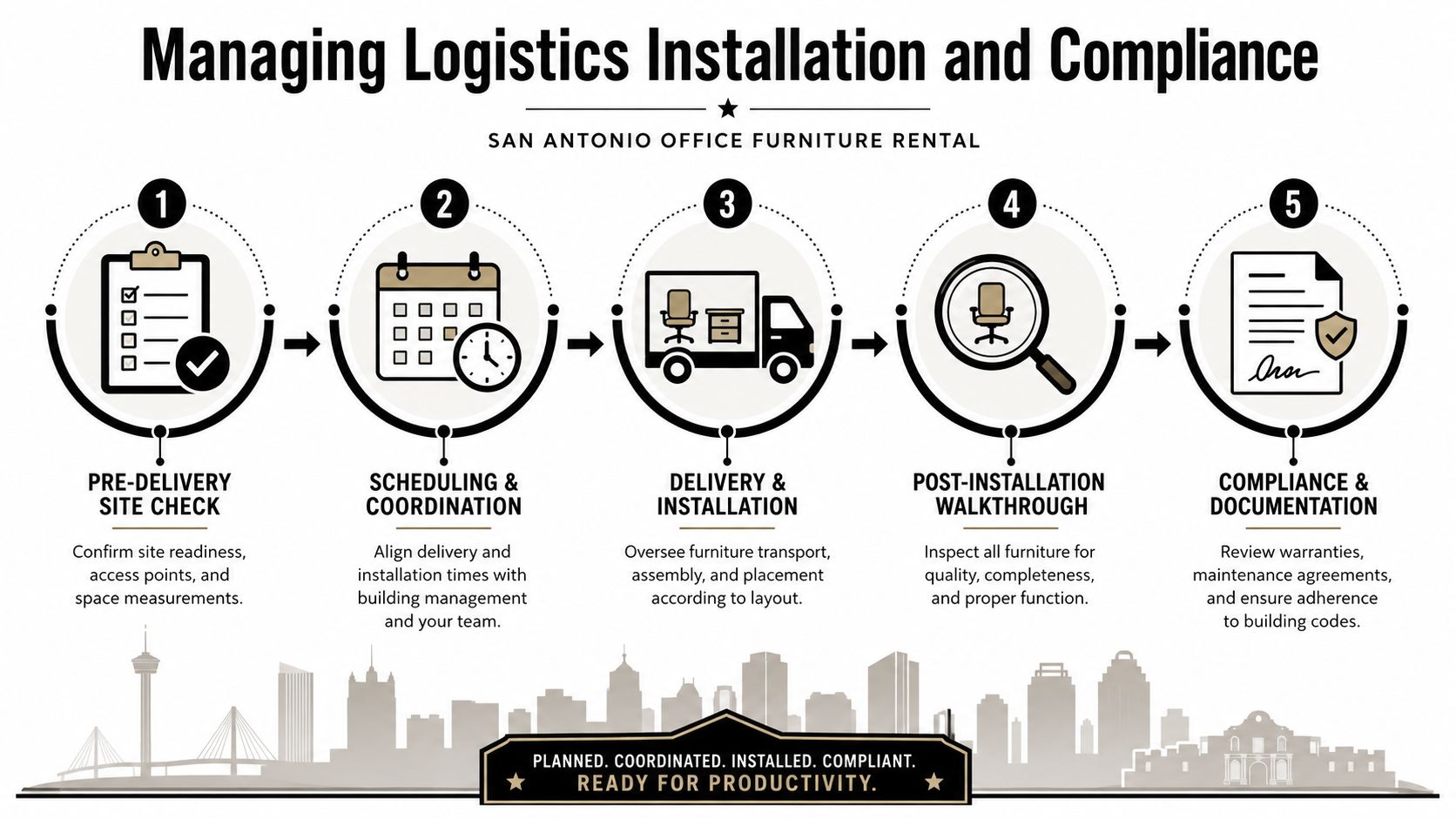
By the time the truck rolls up, decisions should already be finished. Install crews need one approved floor plan, one site contact, and clear instructions on what gets set first if your team is opening in phases.
Use a pre-delivery checklist that covers the items that slow commercial jobs:
- Dock and elevator access: Reservation times, loading route, after-hours rules, and whether another vendor has the dock
- Security requirements: COI submission, badge procedures, approved crew list, and contact names at the building
- Staging location: A space for wrapped product that does not block exits, corridors, or other trades
- Final install drawing: The issued layout, seat assignments if needed, and any priority zones for first-day use
- Power and data readiness: Floor boxes, outlet alignment, monitor arm needs, and cable routing constraints
- Protection and disposal rules: Wall protection, debris removal, pallet handling, and landfill or recycling requirements
If the scope includes stations, conference rooms, and phased occupancy, review office furniture installation services before you finalize the schedule. Installation scope changes labor hours, sign-off procedure, and the number of return trips you may end up paying for.
Measure vendor logistics by recovery speed
Rental volume is growing, as noted earlier in the article. That does not help your project unless the vendor can recover fast when something goes wrong.
Ask plain operational questions. How quickly can they replace a damaged top or missing pedestal in San Antonio. Do they keep matching inventory nearby or ship from another market. Who owns punch-list tracking, and when do they close it. A vendor with polished sales language but vague replacement timing usually becomes expensive during occupancy week.
I look for three service habits: documented delivery counts, a named field supervisor, and a written process for shortages and damage claims. Without those, the monthly rental rate stops mattering because your internal team starts paying in delays.
A good rental install ends with a signed punch list, final counts, and a clear owner for every open item.
Treat compliance as part of layout, not a last walkthrough
Furniture that fits on paper can still create problems in the field. The usual issues are narrowed egress paths, storage crowding door swings, panels blocking usable power access, and conference layouts that technically fit but work poorly once people are in the room.
San Antonio facilities teams also have to account for building-specific rules, especially in multi-tenant properties downtown and in medical or government-adjacent spaces where access windows are tighter. That is one reason office rental projects need a B2B process. Consumer-style delivery standards are not enough when a landlord, security desk, installer, IT team, and department leads all have approval points.
If your rental install overlaps with a larger move, these corporate office move strategies are useful because they address the same handoff risks between relocation crews, installers, and internal stakeholders.
The final walkthrough should be methodical. Check counts, finishes, keys, hardware, drawer operation, panel alignment, and any layout drift from the approved plan. Photograph damage the same day and send the punch list before staff starts using the space. Once employees move in, it gets harder to separate install defects from normal wear.
Frequently Asked Questions About Office Furniture Rental
Small questions create big delays when nobody answers them clearly. The issues below come up often in furniture rental San Antonio projects for offices, especially when the timeline is compressed or the team size may change.
If you need a starting point for rental-oriented workplace options, office furniture on rent is a useful page to review before requesting quotes.
Common questions that affect execution
| Question | Answer |
|---|---|
| How early should I contact vendors for an office rental project? | Earlier than you think. Contact vendors once you have a draft floor plan, rough seat count, and target occupancy date. Waiting for every detail to be perfect usually slows the job because delivery, building coordination, and install planning all need lead time. |
| Can I change quantities after the rental starts? | Sometimes, but only if the vendor has matching inventory and reconfiguration capacity. Ask this before signing. Mid-term additions are much easier when finish standards, workstation sizes, and storage types were standardized from the start. |
| What should I document on install day? | Document counts, visible damage, missing parts, finish mismatches, and any layout deviations from the approved plan. Take photos and send a written punch list the same day. If you wait until after staff moves in, it gets harder to separate delivery issues from normal use. |
The questions I'd ask before approving any contract
Some issues don't look urgent until they become expensive.
- What happens if the lease changes: Can the rental term be extended, shortened, or transferred?
- Who owns the punch list: Is there one point of contact for damaged or incomplete items?
- What condition is required at pickup: You need written standards, not broad language.
A simple rule for office managers
If a vendor answer sounds flexible but not specific, keep asking.
Office furniture rentals work well when the vendor can define inventory, timing, handling, and closeout in plain terms. They become difficult when the arrangement is casual, undocumented, or built from residential assumptions that don't fit a workplace.
If you're planning a temporary office, phased expansion, or fast workplace reset, Cubicle By Design is one option to review for modular workstations, planning tools, and installation support that fit commercial office requirements.