

The old way of thinking about office layouts—static, heavy, and built to last in one spot forever—just doesn't work anymore. Modern businesses need to be able to pivot, and that means their physical space has to be just as agile. This is where modular office desk systems come in.
Think of them less like traditional furniture and more like a set of building blocks for your office. They are a collection of interchangeable parts that you can arrange, and then rearrange, as your company’s needs change. For a comprehensive overview, visit our main page at Cubicle By Design.
Why Modern Workspaces Are Going Modular
Let's face it, the way we work is always changing. Team sizes fluctuate, new projects demand different kinds of collaboration, and hybrid schedules are now the norm. You need an office that can keep up. That’s why modular desks have gone from a nice-to-have to a core part of smart business strategy.
Unlike that massive oak desk that takes four people to move, modular systems are built for adaptation. Imagine being able to expand a department's footprint overnight. Or what if you could create a temporary, focused "war room" for a critical project in just a few hours? That's the real power of modular design—you can transform your space without calling in a construction crew.
The Rise of the Flexible Office
With the move to more flexible work arrangements, adaptable furniture has become a flat-out necessity. Companies are quickly learning that a static office can kill productivity and lead to a lot of expensive, unused space. Modular systems tackle these problems head-on, letting you:
- Scale up or down easily: Add, remove, or reconfigure components to accommodate a growing team or a smaller on-site crew.
- Support different work styles: Quickly shift from open, collaborative zones to semi-private workstations for focused tasks.
- Improve employee well-being: Giving people some control over their immediate environment is a proven way to boost job satisfaction.
You can see this shift reflected in the market numbers. The U.S. office furniture market is expected to grow from USD 17.43 billion to USD 18.25 billion by 2026, with much of that driven by the adoption of hybrid work. More telling, modular systems are projected to grow at a CAGR of 5.6% from 2026 to 2033, a faster pace than other furniture types as businesses put a premium on flexibility. If you're new to the concept, we have a great primer on what is modular furniture.
Beyond Layouts to Long-Term Value
The benefits here go way beyond just being able to move things around. Because these systems are designed to adapt over the long haul, they offer a much better return on your investment. Instead of a complete (and expensive) overhaul every few years, you can simply reconfigure your setup to meet new challenges. This is not only smarter financially, but it’s a more sustainable approach, too.
Thinking sustainably goes beyond just reusing furniture. It's also about responsibly managing the lifecycle of your office technology. For any company looking to be more eco-conscious, understanding the Benefits of E-Waste Recycling for Modern Businesses is a critical piece of the puzzle.
This forward-thinking mindset is exactly why so many companies choose a partner like Cubicle By Design. We help you create a workspace that doesn't just work for you today—it's ready for whatever comes next.
Understanding the Components of a Modular System
To really get what makes modular office desks so powerful, you have to stop thinking of them as a single piece of furniture. Instead, picture a high-end, commercial-grade toolkit where every individual part is designed to work together in almost endless combinations.
Think of it like a set of sophisticated building blocks. The magic isn’t in any single piece, but in how you can connect them to build exactly what your team needs. This is how you can create anything from a wide-open benching system for your collaborative teams to fully private office cubicles for heads-down, focused work.
It all boils down to a few key ideas that feed into each other: adaptability, cost, and employee well-being are all tied together.
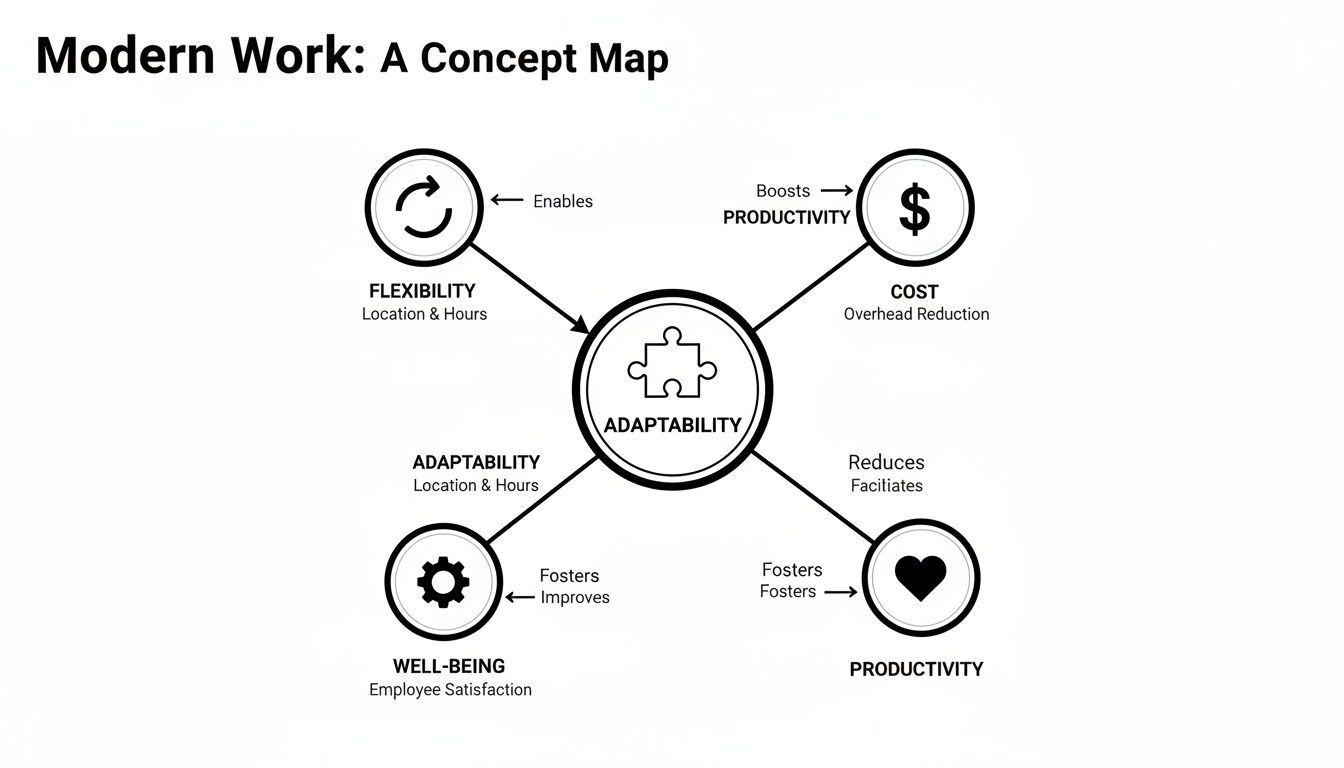
As you can see, making your space adaptable isn't just a design choice—it's a business strategy that gives you better cost control and a more flexible, productive environment for your people.
The Core Building Blocks
At the heart of any modular system are a few fundamental components. Once you know what they are and how they click together, you're on your way to designing a truly functional office. Let's break down the essential pieces you'll be working with.
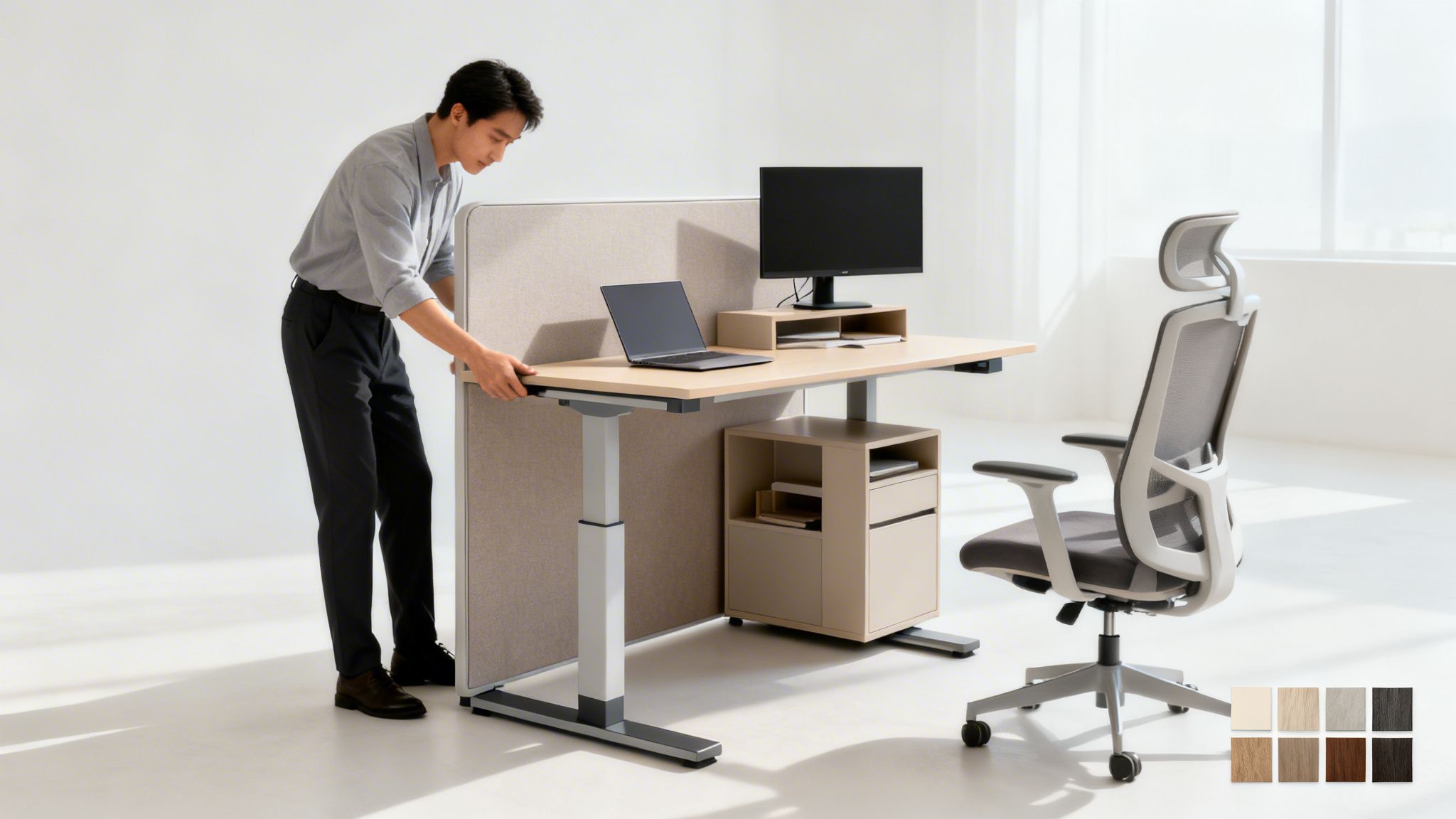
- Work Surfaces: This is the desktop itself—where the work gets done. They’re the foundation of each station and come in a huge variety of shapes (rectangular, L-shaped, curved), sizes, and finishes to match your look.
- Support Structures: These are the legs, bases, and frames holding everything up. They’re engineered for stability but also for quick connection and disconnection, which is the secret sauce for easy reconfigurations down the road.
- Privacy Panels: These are the walls that give each workstation its footprint and sense of place. They can be low dividers that keep the office feeling open or full-height panels that create enclosed cubicles with excellent sound control.
Storage and Power Integration
A well-designed modular system does more than just give your team a place to sit. It has to organize their gear and power their tech, which is where integrated storage and power solutions come in. These aren't just add-ons; they are designed right into the system from the start.
Think of it as building organization directly into the workstation. Common options include:
- Pedestals: These are the classic drawer units, either mobile or fixed, that slide right under the work surface.
- Overhead Bins: Flipper-door cabinets that mount directly onto the privacy panels, making great use of vertical space.
- Shelving and Wardrobes: Taller units that can be built into a cubicle’s structure for more substantial storage needs.
Power and data management are the central nervous system of a modern office. In modular systems, this is handled through raceways—discreet channels built into the base or beltline of the panels that hide all the wiring, keeping the workspace clean, organized, and safe from trip hazards.
The Power to Connect
Those raceways are what make modular setups so perfect for today’s tech-heavy offices. They create a clean, hidden pathway for all your electrical and data cables, running them from the building’s main source to each individual desk. Everything stays out of sight but remains easy to access when you need to make a change.
With options for multi-circuit power, you can ensure every workstation has plenty of juice for computers, multiple monitors, and chargers without tripping a breaker. For a closer look at your options, check out our guide to under-desk power strips to see how these components fit into the bigger picture. This integrated approach ensures your office can handle the technology you have now and whatever comes next.
Designing a Workspace for Productivity and Comfort
Okay, we’ve covered the individual parts. Now for the fun stuff—putting it all together. This is where you move from theory to practice and start creating a workspace that’s built specifically for your team. Every decision from here on out directly impacts your people's comfort, their productivity, and even your company culture.
It’s a bit like getting a custom-tailored suit. You start with great fabric (the modular components), but the real magic is in the fit. It’s the precise measurements and functional details that make it uniquely yours. The same goes for modular office desk systems.
The Panel Height Question: Privacy vs. Collaboration
One of the first big decisions you’ll make is choosing the right panel height. This one choice really sets the tone for your office, striking a balance between heads-down focus and open collaboration. It’s less about aesthetics and more about engineering the right vibe for different roles.
Here’s how we typically see panel heights used:
- Low Panels (32"- 42"): Perfect for open, collaborative zones where teams need to talk frequently. They give a sense of personal space without boxing anyone in.
- Mid-Height Panels (48"- 54"): This is a very popular middle ground. It gives employees privacy while seated, cutting down on visual distractions, but they can still pop their heads up to chat with a neighbor.
- Tall Panels (65" and up): When you need serious acoustic control and privacy, this is the way to go. We often use these to create semi-private offices or quiet zones for roles that demand deep concentration.
There's a reason the market for these systems is growing so fast. Starting 2025 at USD 628 million, it's on track for a 5.4% CAGR because businesses see the value in flexibility. Studies show that good ergonomic design in these systems can cut the risk of musculoskeletal issues by up to 20-30%. Plus, facilities managers can save 15-25% on reconfiguration costs compared to tearing out fixed walls and desks. You can see more on the market's direction and financial upsides of modular furniture.
Getting the Look and Feel Just Right
Beyond the physical layout, this is your chance to really inject your brand’s personality into the space. The colors you choose for panel fabrics, the finish on the work surfaces—these details bring the office to life and create a look that feels polished and intentional.
At the same time, this is where you can make a huge impact on employee well-being by choosing ergonomic solutions. This isn’t just a nice-to-have; it's a direct investment in your team's health and daily performance.
A height-adjustable desk is a fantastic place to start. Building sit-stand desks into your modular plan empowers employees to switch up their posture throughout the day. It’s proven to reduce physical strain and keep energy levels up. It's a simple, powerful way to support a healthier work style. For a deeper dive, check out our guide to ergonomic office equipment.
Bringing Your Vision to Life
Let’s walk through a real-world example. A growing marketing agency needed to reconfigure their space to support both team collaboration and individual client work. Using a tool like our online Custom Cubicle Designer, they were able to play with different layouts in real-time.
They created a central "hub" using low panels and shared surfaces for their creative team. For the account managers who spend all day on the phone, they designed clusters of mid-height stations to provide seated privacy. They even planned out all the power and data needs to make sure every desk could handle dual monitors and other tech.
This is exactly how you can use these tools to solve your own challenges—turning a basic floor plan into a strategic asset for your business.
How to Plan Your Office Layout Strategically
Great office design is about so much more than just filling a room with furniture. It’s really about mapping out the flow of work and energy. Planning your layout with modular office desk systems is a bit like being a city planner for your company. You get to lay down the highways for foot traffic, create quiet residential zones for focused work, and build bustling downtown districts for collaboration.
A well-thought-out layout can be the difference between a chaotic, distracting office and a productive, streamlined one. The real goal is to build a space that just feels intuitive, where your team can easily find the right spot for whatever they're working on—whether that's a quiet call, a team huddle, or a deep-focus project.
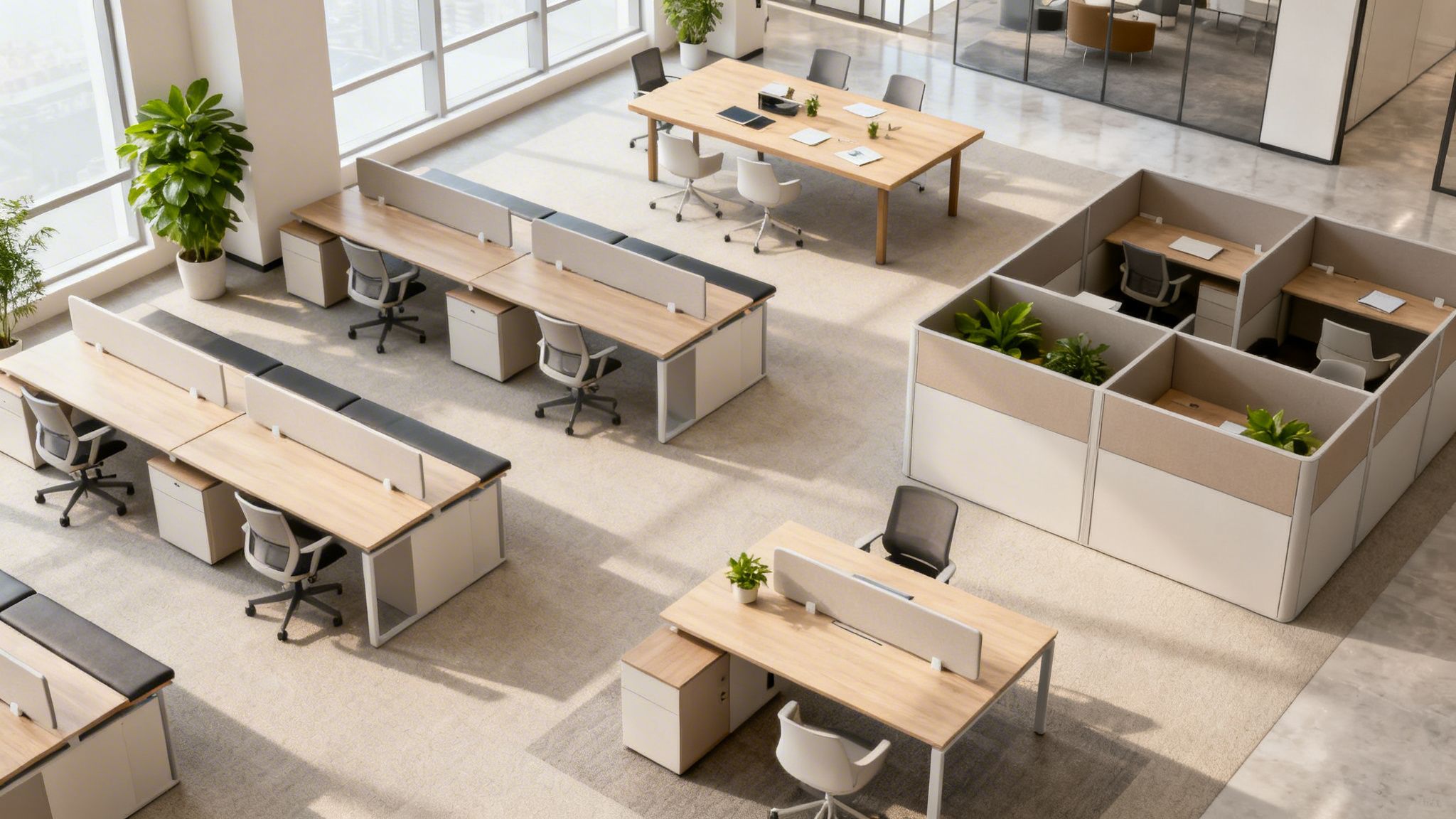
Creating Purposeful Zones
One of the most powerful strategies you can use is zoning. This just means carving out distinct areas in your floor plan, each with its own specific purpose. Think of it as creating different "neighborhoods" in your office. This simple approach helps manage noise, cut down on distractions, and guide employees to the space that best supports their task.
An effective zoning plan usually includes a mix of these:
- Focus Zones: These are your quiet spots for heads-down, individual work. Taller panels and sound-absorbing materials are your friends here. This is the perfect place for Private Office Cubicles to give people the seclusion they need to really concentrate.
- Collaborative Zones: Think open, energetic spaces designed for teamwork. Benching systems or clusters of desks with low panels are great for encouraging those spontaneous conversations and brainstorming sessions.
- Social Zones: This is the heart of your office culture—the break rooms, coffee bars, and lounge areas. These spaces are vital for giving people a place to recharge and connect on a human level.
When you start thinking in terms of zones, you move beyond just assigning desks and begin designing for how work actually happens.
Mapping Traffic Flow and Accessibility
Once you have your zones figured out, it's time to map out the "streets" of your office. Traffic flow is absolutely critical for an efficient and safe workspace. You have to make sure there are clear, easy-to-navigate pathways between different zones, desks, and key areas like exits, restrooms, and meeting rooms. Bad traffic flow creates frustrating bottlenecks, constant interruptions, and a cramped feeling.
A huge piece of this puzzle is ADA (Americans with Disabilities Act) compliance. Walkways must have a clear width of at least 36 inches to accommodate wheelchairs. This isn't just about following the law; it's about building an inclusive and accessible workplace for every single person.
When you're planning your layout, try to physically walk the path an employee would take. Can they get from their desk to the printer without running an obstacle course? Is the path to the fire exit completely clear? Getting these practical details right is what makes a layout work in the real world. You can see more on how we approach this in our guide to office space planning and design.
Using Modular Solutions for Different Environments
Here's where the magic of modular office desk systems really shines: they can support any layout strategy you come up with. Different departments have different needs, and your furniture should be able to adapt right along with them.
For instance:
- High-Density Call Centers: In this kind of environment, you need to maximize your square footage but still provide some acoustic privacy. Rows of mid-height Workstation Cubicles strike this balance perfectly, offering seated privacy and noise reduction without making the space feel boxed in.
- Collaborative Hubs: For a creative team in marketing or design, you might set up a "pod" configuration. This just means grouping four or six workstations together with low panels, creating a little team neighborhood that makes communication effortless.
- Hybrid Workspaces: If your team splits their time between the office and home, you can create flexible "hoteling" stations or unassigned desks that anyone can use when they're in.
At the end of the day, strategic layout planning is about making deliberate choices to build an environment that actively supports your business goals and company culture. It's your chance to create a workspace that works as hard as your team does.
Calculating the True Cost and ROI
It’s tempting to just look at the upfront price when you're planning a new office. But with modular office desk systems, that initial number is just the beginning of the story. To really understand the value, you have to look at the total cost of ownership (TCO) and the long-term return on investment (ROI).
Think of it like buying a car. One model might have a lower sticker price, but if it’s a gas-guzzler that’s always in the shop, it's going to cost you a lot more over five years. It’s the same with office furniture. A modular system might have an initial cost similar to fixed furniture, but the real savings show up down the road.
Factors That Influence Initial Cost
So, what goes into that initial price tag? Just like building a custom home, the choices you make will shape the final budget.
Here are the key cost drivers:
- Materials and Finishes: Of course, high-end laminates, premium fabrics, and glass panels will cost more than the standard, workhorse options.
- Component Complexity: A simple, straightforward workstation is always going to be more budget-friendly than one loaded up with L-shaped surfaces, height-adjustable bases, and tons of storage.
- Technology Integration: The amount of power outlets and data ports you need at each station plays a big role. The more connections, the higher the cost.
- Panel Height and Type: Taller panels, especially acoustic ones designed to absorb sound, are a bigger investment than low, simple dividers.
Knowing these factors helps you make smart trade-offs. You can get the functionality your teams need without blowing the budget, just by being strategic about where you invest.
The Hidden Savings and Long-Term ROI
This is where modular systems really start to shine. The true financial power comes from the savings they create after installation. These aren't always obvious line items on an invoice, but they have a huge impact on your bottom line.
This is where the business case for modular systems becomes undeniable. The U.S. office furniture market is projected to reach USD 26 billion by 2034, and the shift towards flexibility is a huge reason why. For example, organizations often reduce their required office space by up to 30%, and firms report 15% higher satisfaction with modular setups versus traditional furniture. Get more insights into the office furniture market's growth.
Here’s where that ROI really comes from:
- Reduced Reconfiguration Costs: When a team grows or a department moves, you don’t need a demolition crew. A small team can reconfigure modular workstations in just a few hours. That saves you thousands in labor and material costs compared to tearing down and rebuilding fixed offices.
- Better Space Utilization: As your headcount goes up or down, you can adjust your layouts to fit more people comfortably without having to lease more square footage. You end up paying for the space you actually use, not for empty, fixed offices.
- Increased Productivity: Studies have shown that height-adjustable desks—a very common feature in modular systems—can lift employee output by 10-12%. When people have more control over their own workspace, they’re more focused and engaged.
Let’s picture a startup over its first five years. With fixed furniture, every time a team expands, it means buying all-new desks and paying for costly, disruptive renovations. But with a modular system from a partner like Cubicle By Design, they simply rearrange their existing components and maybe buy a few extra parts. They save a ton of money and avoid massive downtime. That agility is the very core of a strong ROI.
Your Step-by-Step Procurement and Installation Plan
Getting from the decision to buy new modular desks to the final walkthrough can feel like a huge undertaking. But it doesn't have to be a chaotic free-for-all. Think of it less like a massive construction project and more like a well-executed game plan, moving your office from where it is now to where it needs to be.
We want to pull back the curtain on the whole process. With a solid checklist and the right team on your side, you can steer your project with confidence and end up with a space that’s on-budget and perfectly suited to your team.
Phase 1: Define Your Needs and Find a Partner
The first, and most important, step is to look inward. Before you even think about browsing products, you need a crystal-clear picture of what you're trying to accomplish.
Start by asking your team the tough questions:
- What are our biggest goals here? Are we chasing more privacy, trying to foster better collaboration, or just looking for a modern facelift?
- What are the loudest complaints about our current setup? Is it the noise, the lack of storage, or desks that are just plain uncomfortable?
- How many workstations do we need right now? And what does our growth look like over the next few years?
Once you have those answers in hand, it’s time to bring in a full-service partner like Cubicle By Design. A great partner doesn’t just sell furniture; they act as a translator, turning your company’s needs into a functional, real-world plan.
Phase 2: Finalize Your Design and Specifications
This is where your ideas start to look like a real office. Using powerful visualization tools, you’ll go from abstract concepts to a concrete blueprint for your new modular office desk systems.
A huge part of this phase is getting hands-on with a tool like our Custom Cubicle Designer. It lets you play with different layouts, pick panel heights, test out finishes, and see how storage and power options fit into the big picture—all in a simple, visual way.
Getting this step right is critical for an accurate quote and ensuring there are no surprises on installation day. You’ll nail down every last detail, from the fabric on the panels to the number of outlets at each desk, making sure the system is ready to go from day one.
Phase 3: Coordinate Logistics and Installation
With your design locked in and approved, the project shifts from planning to pure logistics. Your partner will handle the nitty-gritty of ordering and scheduling, but your job is to get your physical space prepped and ready for the new arrivals.
This phase breaks down into three key parts:
- Site Preparation: Make sure the installation area is clean, clear, and completely ready for the assembly crew to get to work.
- Scheduling Delivery: Work with your partner to find a delivery window that causes the least amount of disruption to your team's workday.
- Overseeing Installation: A professional crew will handle the actual assembly. While they’re the experts, it’s always smart to have someone from your team on-site as a point person to answer any questions that pop up.
A smooth installation is the key to a successful project. For a deeper dive, check out our guide on planning for a hassle-free office furniture installation. By sticking to a clear plan, you can make sure your new office comes together perfectly.
Frequently Asked Questions About Modular Desk Systems
When you're planning a new office layout, a lot of questions come up. It's a big investment, and you want to get it right. We get it. Here are the answers to some of the most common questions we hear about modular office desk systems to help you move forward with confidence.
How Hard Is It to Reconfigure a Modular Desk System?
It’s much easier—and less expensive—than you probably think. Forget the idea of calling in a demolition crew. Quality modular systems are designed from the ground up to be changed.
Most of these systems use what are called non-progressive connections. In plain English, that means you can change one single workstation without having to disassemble the entire row. A small, trained crew can often reconfigure a whole section in just a few hours, keeping disruption to your business at an absolute minimum.
Can Modular Systems Actually Support All Our Office Tech?
Absolutely. Any modern modular system worth its salt is built for today's technology needs. They come with built-in channels, called raceways, that hide all your power and data cables right inside the desk panels.
This keeps your office looking clean and, more importantly, eliminates dangerous trip hazards from messy cords. Every employee gets the power and data they need for their computers, multiple monitors, and other gadgets, all neatly managed.
One of the biggest advantages is durability. High-quality modular systems are built for demanding commercial use with steel frames and resilient surfaces. If a single component gets damaged, you can replace just that part instead of the entire desk, extending the life of your furniture and protecting your investment.
How Do Modular Desks Help with Employee Wellness?
This is a big one. Modular systems give you the tools to create a healthier and more comfortable workplace. By choosing height-adjustable desks for your setup, you give employees the power to switch between sitting and standing throughout the day, a practice proven to reduce physical strain and keep energy levels up.
You can also fine-tune panel heights and materials to create better acoustics. This cuts down on distracting noise, helping your team stay focused and reducing the overall stress of a busy office. Giving people this kind of control over their personal space is a major factor in job satisfaction and well-being. At Cubicle By Design, we help you design a space that supports your team from day one.
Ready to build a workspace that works for you? Explore our flexible cubicle solutions or start designing your own layout today with the free Cubicle By Design Custom Cubicle Designer.