

Modular Office Walls For Flexible Workspaces
Imagine being able to completely overhaul your office layout over a single weekend. No dust, no demolition crews, no week-long disruption. That’s the reality of modular office walls—a high-end, adaptable solution that lets you assemble, reconfigure, and even relocate your workspace with surprising ease.
Think of them as sophisticated LEGOs for office design. They aren’t just walls; they’re a strategic investment in your company’s agility.
Your Workspace Reimagined With Modular Office Walls
Traditional construction with drywall is permanent. Once a wall goes up, any change means a messy, expensive, and time-consuming project. Modular office walls completely flip that script. They are pre-engineered partition systems built for flexibility, allowing your business to adapt its physical space as fast as your needs change.
This modern approach ditches the “one-and-done” mindset of permanent construction. Instead, it treats your office layout as a dynamic asset that can evolve right alongside your company—a critical advantage as businesses navigate new team structures and hybrid work models.
From Fixed Floor Plans To Fluid Environments
The concept behind modularity is powerful. These systems use factory-built panels and components that are simply assembled on-site. When you need a new private office, want to expand a conference room, or decide to build a collaborative pod, the walls can be quickly taken down and put back up in a new layout.
The entire process is clean, fast, and generates almost no waste compared to tearing down drywall.
A few key advantages make this possible:
- Pre-Engineered Precision: Every component is manufactured to exact specifications, guaranteeing a perfect fit and a clean, professional finish every time.
- Rapid Installation: With no taping, mudding, or painting required, installation times are cut dramatically. This means less operational downtime for your business.
- Sustainable Design: Because the components are reusable, modular walls are an environmentally responsible choice, saving tons of construction debris from ending up in landfills.
This built-in flexibility is driving a major shift in the market. Valued at around $4.16 billion in 2025, the global modular partition wall market is projected to hit $6.17 billion by 2034. This growth shows a clear trend: businesses across all industries are moving toward more adaptable workspace solutions.
Here’s a great example of a modern office using these flexible wall systems.
This photo perfectly illustrates how glass and solid panels can be combined to create functional zones that feel both open and private. For businesses looking to strike that balance, understanding the details of a glass architectural wall installation can offer deeper insight.
Ultimately, these systems are much more than just partitions; they’re a practical tool for future-proofing your office.
Choosing Your Perfect Modular Wall System
Not all modular office walls are created equal. Walking into this world can feel like stepping into a massive showroom full of possibilities, with each system designed for a very specific purpose. The trick is to match the right wall system to your office’s unique function, look, and even its culture.
First things first, you need to know the difference between demountable walls and relocatable walls. Think of demountable systems as being engineered for reuse; you can take them apart piece by piece, which is perfect for companies that know their layout will probably change down the line. Relocatable walls, on the other hand, are often moved as whole units, built for lightning-fast disassembly and redeployment in a new spot.
With that foundation, let’s dig into the most common types you’ll come across.
Frameless Glass Partitions
Picture an office flooded with natural light, where sightlines stay open and teams feel connected even when they’re in separate spaces. That’s the magic of frameless glass partitions. These systems use minimal framing to create a sleek, modern look that champions transparency and a collaborative vibe.
Their main draw is pure aesthetics. They make spaces feel bigger and more inviting. This makes them ideal for:
- Open-plan areas that need designated zones without sacrificing an ounce of light.
- Conference rooms that need to feel like part of the main office, not a separate box.
- Showcasing a modern, forward-thinking company culture.
But while they’re beautiful, they don’t offer the same level of acoustic privacy as solid walls. That makes them a better fit for collaborative hubs rather than spaces where people need deep, uninterrupted focus.
This image shows how you can combine different wall types in a single office to get the best of both worlds.
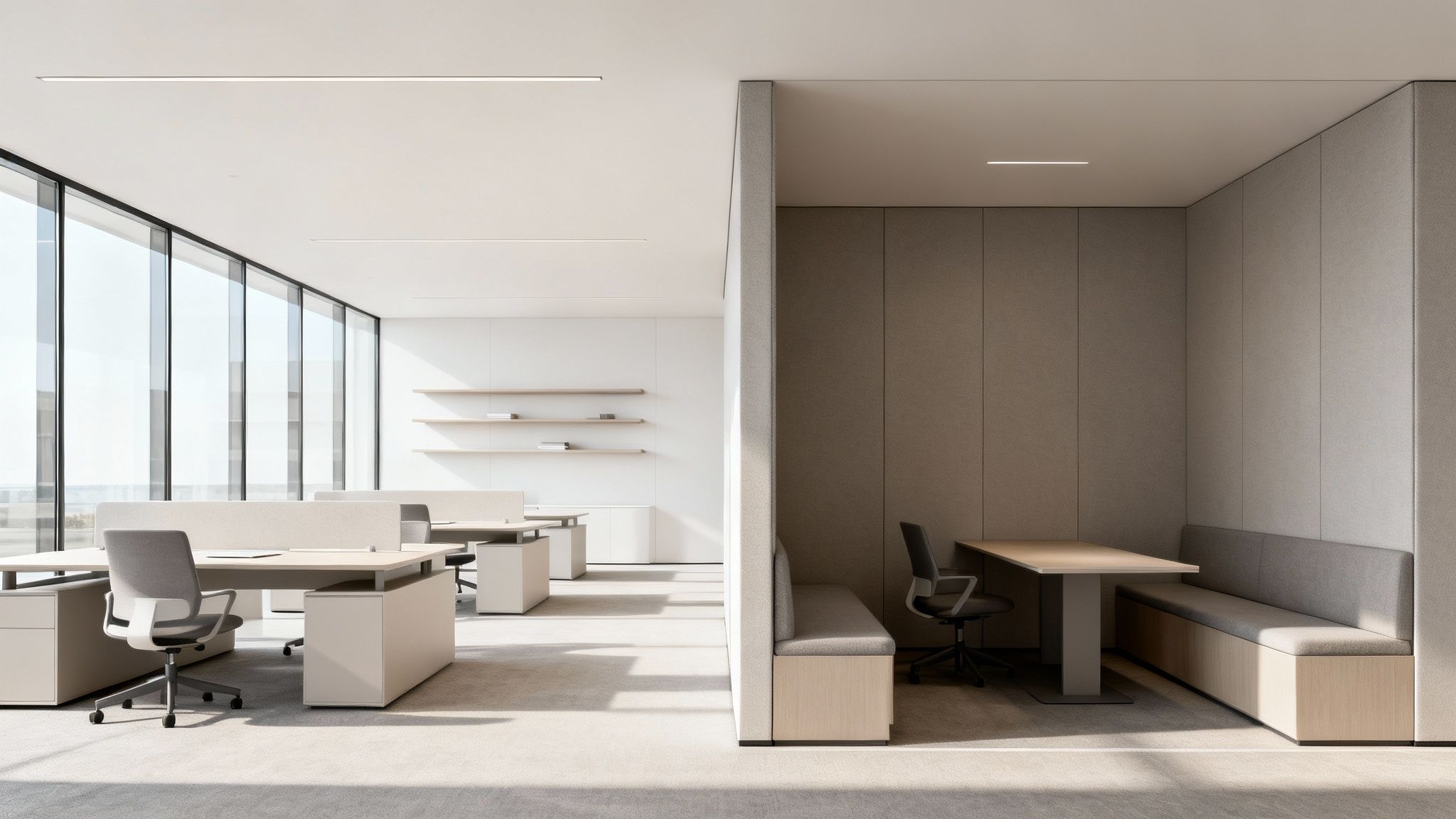
You can see how the strategic use of both glass and solid panels creates a balanced environment that supports different work styles all at once.
Framed Aluminum Systems
If you’re looking for a solution that blends the openness of glass with a bit more structure and acoustic control, framed aluminum systems are an incredibly popular choice. These modular office walls feature glass or solid panels set inside sturdy aluminum frames, giving them a more defined and substantial appearance.
That frame isn’t just for looks—it adds real functional benefits. It seriously improves sound insulation and durability, making these systems a versatile workhorse for almost any office. They’re perfect for private offices, meeting rooms, and any area where you need to strike that delicate balance between visibility and privacy.
Solid Panel Walls
When acoustic privacy and visual separation are completely non-negotiable, solid panel walls are the answer. These systems are basically the modular version of traditional walls but with all the added perks of flexibility and reusability. They deliver the highest level of soundproofing you can get, which makes them absolutely essential for certain jobs.
A well-designed solid panel modular wall can achieve a Sound Transmission Class (STC) rating that meets or even beats standard drywall construction. This ensures confidential conversations stay exactly that—confidential.
You’ll want to consider solid panel walls for:
- Executive offices where privacy is paramount.
- Human Resources departments that handle sensitive information daily.
- Quiet “focus rooms” or libraries where employees can escape the hustle.
- Dividing large floors into distinct, sound-isolated departments.
The materials for these panels can range from vinyl-covered gypsum and fabric-wrapped boards to laminates that mimic wood or other high-end finishes. This variety ensures you can get the right look without sacrificing function.
To give you a clearer picture, here’s a quick breakdown of how these systems stack up against each other.
Comparison Of Modular Office Wall Types
| Wall Type | Key Feature | Best For | Common Materials |
|---|---|---|---|
| Frameless Glass | Maximum light, sleek modern look | Open-plan zones, collaborative hubs, modern aesthetics | Tempered or laminated glass, minimal hardware |
| Framed Aluminum | Balanced privacy and openness | Private offices, meeting rooms, structured layouts | Glass, solid panels (laminate, fabric), aluminum frame |
| Solid Panel | Superior acoustic & visual privacy | Executive offices, HR, focus rooms, sound-sensitive areas | Gypsum, fabric, vinyl, wood veneer, laminate |
Ultimately, choosing the right system comes down to weighing these options against what your team actually does every day. For a deeper dive into different office solutions, check out our comprehensive office furniture buying guide. Once you understand the strengths of each type of modular wall, you can start designing a workspace that truly works for everyone.
The Real-World Benefits Of Going Modular
Choosing modular office walls over traditional drywall isn’t just a design choice; it’s a strategic move that pays off in flexibility, cost savings, and a healthier planet. Forward-thinking companies are catching on because modularity just makes sense for the fast-paced nature of modern business. It’s an investment in an office that can grow and pivot right alongside you.
The most immediate win is incredible adaptability. Imagine your company lands a major new project. You need to create a dedicated space for a ten-person team, and you need it now. With traditional construction, you’re looking at a loud, dusty, and disruptive renovation that halts productivity. Modular walls, on the other hand, let you build out a new, fully-functional department over a weekend with almost no interruption.
That ability to reconfigure your space on demand is a serious competitive advantage.
Driving Down Costs And Maximizing ROI
While the upfront material cost for modular systems can sometimes be higher than drywall, the real financial picture becomes clear when you look at the total cost of ownership. The installation is dramatically faster and cleaner, which means significantly lower labor costs and less operational downtime. There’s no taping, no mudding, no sanding, or painting—all of which condenses a project timeline from weeks to just a few days.
But the financial perks don’t stop at installation. Modular office walls are classified as tangible personal property, not permanent structural additions. This often lets businesses depreciate them on a much faster schedule—typically over 7 years compared to 39 years for conventional construction.
This accelerated depreciation can lead to substantial tax savings, improving your company’s cash flow and turning a necessary office expense into a smart financial asset.
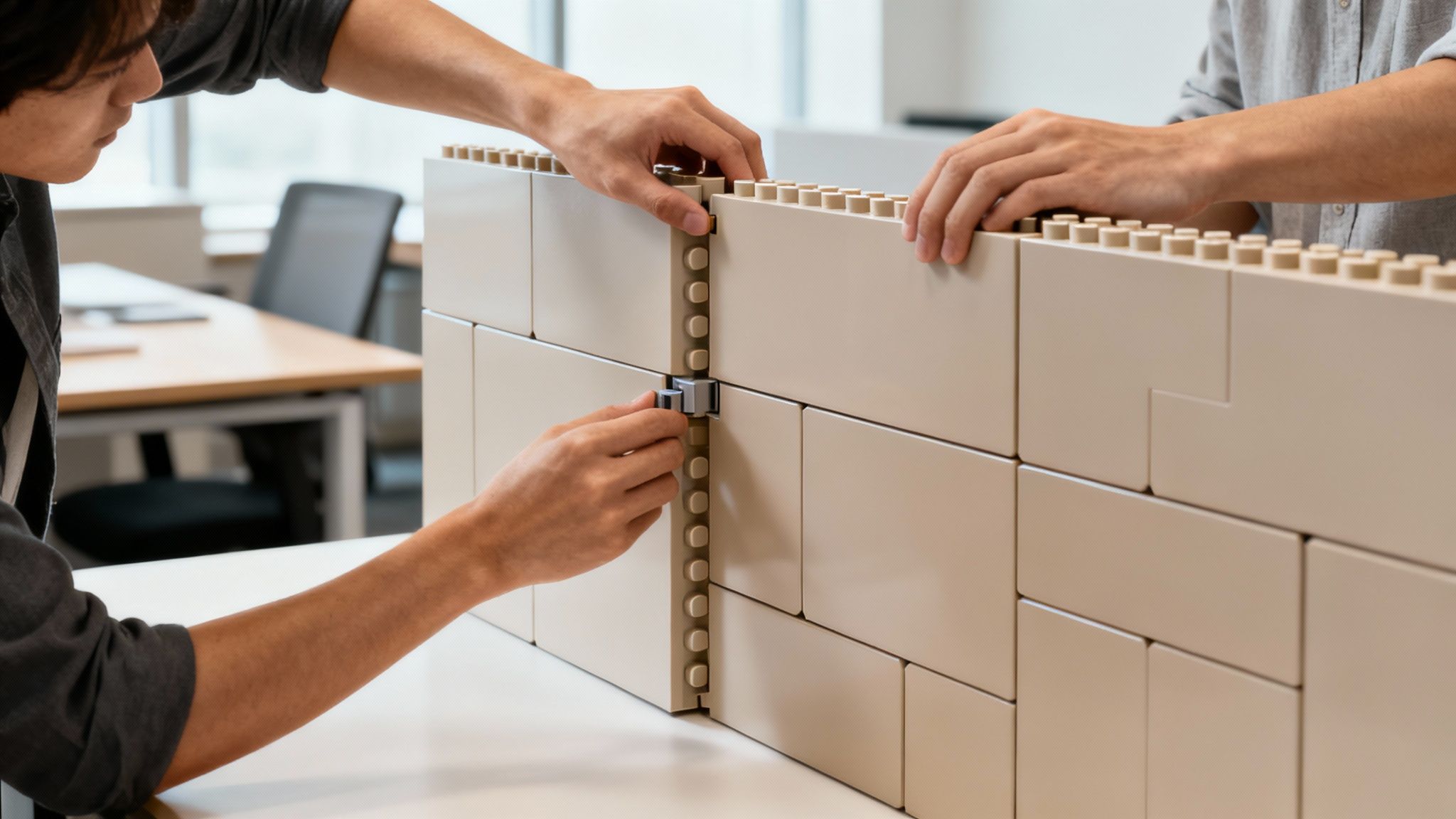
Here’s a look at a modular wall installation in progress. You can really see how clean and efficient the assembly process is.
The image shows how pre-made panels can be quickly set into place without the mess you get with traditional construction. That translates directly to less disruption and getting your team back to work faster.
Embracing Sustainability And A Greener Footprint
In an era where corporate responsibility matters, sustainability is another huge benefit. Traditional demolition sends tons of drywall, wood studs, and other materials straight to the landfill with every single office renovation. In fact, construction and demolition debris is one of the largest sources of waste in the country.
Modular office walls are sustainable by their very nature because they’re designed for reuse. When your needs change, you don’t throw the walls away; you simply take them down and put them back up in a new layout. This circular approach drastically cuts down on construction waste.
This commitment to eco-friendly design resonates with modern employees and clients. It’s a tangible way to show your company is invested in a sustainable future, standing in stark contrast to the throwaway nature of fixed walls.
The growing demand for this kind of adaptable workspace is a key reason the office modular partition walls market, which hit $901 million in 2025, is projected to expand at a compound annual growth rate of about 5.4% through 2033. You can learn more about the market trends for modular partitions and see how flexibility is shaping the future of office design. The advantages of modern layouts also extend to individual workstations; to learn more, check out the benefits of a modern office cubicle in our related guide.
Your Modular Wall Project Blueprint
Bringing modular office walls into your space is a whole lot less disruptive than a full-blown construction project, but that doesn’t mean you can just wing it. A successful outcome always starts with a solid plan. Think of it as a blueprint for your new workspace—a roadmap that keeps your project on schedule, on budget, and delivering exactly what your team needs to do their best work.
The first step is figuring out what you actually need. Go deeper than just “dividing up the room.” Ask yourself how your team really works. Are you trying to create more private offices for heads-down focus? Do you need collaborative pods for project teams? Or maybe you just need a few quiet zones away from the hustle and bustle. Answering these questions first will guide every single decision you make from here on out.
Defining Your Project Requirements
Before you get caught up in layouts and finishes, you have to nail down your core requirements. This is where you translate your business goals into concrete specs for the new space. Getting this right from the start prevents expensive changes later and ensures the final layout actually supports how your company operates.
Start by thinking through a few key areas:
- Acoustic Needs: How much sound privacy do you need? An HR office discussing sensitive information has completely different needs than a casual breakout area. You’ll want to look at the Sound Transmission Class (STC) rating for the walls.
- Space Allocation: How many private offices, meeting rooms, or focus pods are you adding? Figure out the ideal square footage for each to make sure people aren’t crammed into a space that’s too small to be functional.
- Workflow and Adjacency: Think about who needs to be near whom. A good layout should feel natural and support the way your teams already communicate and collaborate, not fight against it.
A classic mistake we see is people planning only for today. Always plan for at least 10-15% growth in your layout. The beauty of modular office walls is that you can adapt down the road, but starting with a forward-thinking plan saves a ton of time and hassle.
Planning Your Design And Layout
With your requirements locked in, it’s time for the fun part: translating them into a floor plan. This is where the vision starts to feel real. You can use simple layout software or even just grab some graph paper and start sketching out how the modular walls will configure the office. The goal is to create a natural flow for foot traffic and make sure every new zone serves its purpose.
This is where the advantages of modular really shine. As the infographic shows, these systems are fundamentally faster, more cost-effective, and more sustainable than building with drywall.
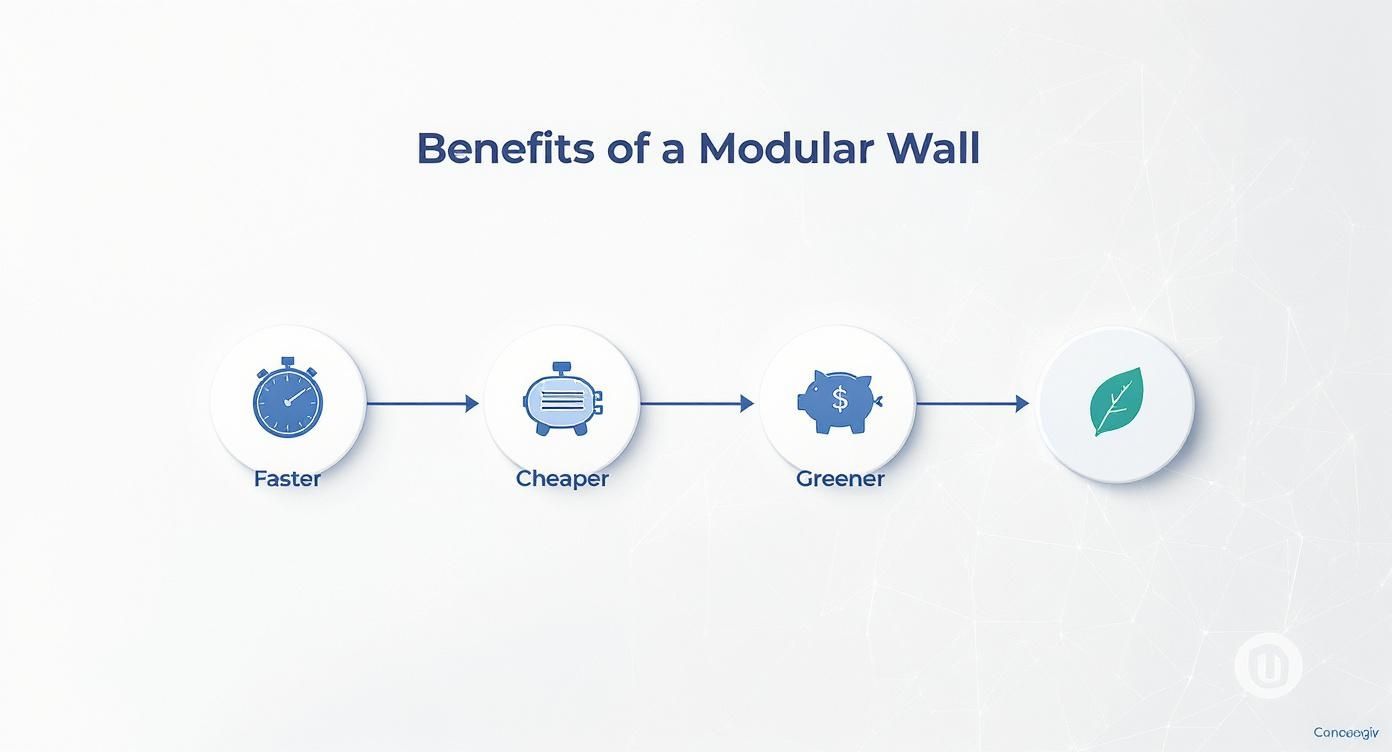
These three benefits—speed, savings, and sustainability—are what make modular construction such a smart business decision, from cutting down on installation time to minimizing your environmental footprint.
During this stage, you also have to sweat the small stuff. Overlooking these technical details can cause major headaches during the installation.
Your Essential Pre-Installation Checklist:
- Power and Data Integration: Where do you need outlets, light switches, and network jacks? Map these out and make sure your wall system has built-in channels (raceways) to hide all the wiring.
- HVAC and Lighting: How will the new walls affect airflow from existing vents or block overhead lights? You might need to adjust your layout to ensure every new space is comfortable and well-lit.
- Fire Safety Compliance: Check your local building codes. You need to be sure your plan doesn’t mess with sprinkler head coverage or block emergency exits. Safety is non-negotiable.
- ADA Accessibility: Make sure all your new doorways and corridors meet the Americans with Disabilities Act (ADA) standards for width and clearance. It’s about creating a space that works for everyone.
Vetting Vendors And Setting Timelines
The final piece of your blueprint is picking the right partner and setting a realistic schedule. Not all vendors are created equal. Look for a company with a proven track record, good client reviews, and transparent pricing. A proper quote should break everything down—materials, labor, shipping, and any other potential fees.
Once you’ve found your vendor, work with them to map out a project timeline. A modular wall installation is way faster than drywall, but it still requires coordination. Good office renovation project management is the key to making sure everything shows up on time and the installation happens smoothly without bringing your business to a halt. This structured approach is your best bet for a project that goes off without a hitch.
Decoding The Cost Of Modular Office Walls
When you’re budgeting for an office refresh, it’s all too easy to get tunnel vision on the upfront price tag. Traditional drywall often looks like the cheaper option at first glance, but that’s rarely the full story. The real cost shows up over time.
Think of modular office walls less as an expense and more as a long-term investment in your company’s future. Getting a handle on what drives the price is the first step to seeing just how smart that investment can be.
The initial cost per linear foot for any modular system comes down to a few key variables, with your choice of materials leading the charge. It makes sense, right? A sleek, full-height frameless glass wall is naturally going to have a different price point than a solid, vinyl-covered panel.
Key Factors That Influence Price
Once you’ve settled on the basic materials, a few other elements will shape the final quote. It’s really important to think through these features to build a budget that lines up with what you actually need, so you don’t get hit with surprises later.
Here’s a look at the main cost drivers:
- Acoustic Ratings: Need serious soundproofing? Walls engineered with higher Sound Transmission Class (STC) ratings require extra materials and more specialized construction, which bumps up the cost.
- Integrated Technology: If you need walls with built-in channels for power and data cables, or ones designed to hold smart boards and monitors, expect a higher price.
- Doors and Hardware: The type of door you choose—like a sliding glass door versus a solid wood one—and the quality of the handles and locks can significantly impact the overall project cost.
- Finishes and Customization: This is where you can really make the space your own. Custom colors, unique finishes like a rich wood veneer, or even adding your company logo will add to the budget compared to the standard, out-of-the-box options.
The table below breaks down these primary cost factors.
Cost Factor Breakdown For Modular Walls
This table outlines the primary factors that influence the total cost of a modular office wall project.
| Cost Factor | Description | Impact on Price (Low/Medium/High) |
|---|---|---|
| Material Type | The core material of the wall panel (e.g., vinyl, fabric, glass, wood). | High |
| Acoustic Rating (STC) | The level of soundproofing built into the wall. | Medium |
| Doors & Hardware | The style, material, and mechanism of integrated doors. | Medium |
| Custom Finishes | Non-standard colors, textures, or branded elements. | Medium |
| Integrated Technology | Built-in electrical, data, or AV mounting capabilities. | Low to Medium |
| Wall Height & Size | Full-height walls or larger panels require more material and labor. | Low to Medium |
Understanding how these pieces fit together helps you tailor a solution that meets both your functional needs and your budget.
This chart provides a great visual breakdown of how modular walls stack up against drywall when you look at the bigger picture.
As you can see, even if the initial material cost for modular systems feels a bit higher, the savings you get from faster installation, easy reconfiguration, and even tax benefits quickly start to close that gap. Over time, it often becomes the more cost-effective solution.
Beyond The Sticker Price: The True ROI
The real financial magic of modular office walls happens when you look past day one. A traditional drywall build is what you’d call a sunk cost. The minute you realize your layout isn’t working anymore, you’re paying to tear it down and then paying all over again to rebuild.
With modular systems, your initial investment holds its value. Think about this: reconfiguring a modular wall system can cost as little as $20 to $60 per linear foot. Compare that to new drywall construction, which can easily shoot past $100 per linear foot once you factor in demolition, framing, finishing, and painting.
This incredible cost-efficiency is a huge reason why modern offices are the biggest users of these systems, especially with today’s focus on collaborative and open-plan work environments. The demand for flexible solutions in co-working spaces and temporary offices has only poured fuel on that fire. You can dig deeper into the growth of the modular wall systems market to see the trend for yourself.
This long-term value is the core of the modular ROI. You’re not just buying walls; you’re buying the ability to adapt your workspace on the fly, quickly and affordably, for years to come.
For a more detailed look at office furnishing costs, check out our complete cubicle price guide; it offers more context on budgeting for a truly flexible workspace. When you factor in the savings on labor, the minimal disruption to your business, and the power to change your layout whenever you need to, modular walls prove they’re a strategic asset that pays for itself.
Answering Your Modular Wall Questions
As you start exploring how modular walls could fit into your workspace, it’s totally normal for a few questions to pop up. This section tackles the most common things we hear from facility managers, designers, and business owners who are right where you are now. We want to give you clear, straightforward answers so you can feel confident in your decisions.
Think of this as your practical guide to the nuts and bolts. We’re moving past the big-picture benefits and getting into the details that really matter for your day-to-day operations and long-term investment.
Are Modular Walls As Soundproof As Traditional Walls?
This is usually the first thing people ask, and the answer is a solid yes. In fact, a high-quality modular wall system can often provide better sound control than standard drywall construction. The big difference is that they are engineered systems, designed from the ground up with acoustics in mind.
Unlike drywall, where performance hinges on the quality of the on-site work, modular systems are built with precision in a factory. They come with specific Sound Transmission Class (STC) ratings, which is just a technical way of measuring how well a wall blocks sound.
You can pick a system that’s fine-tuned to exactly what you need. Common options include:
- Enhanced Acoustic Insulation: Panels filled with sound-absorbing materials like mineral wool.
- Double-Paned Glass: Just like the windows on a house, two layers of glass with an air gap between them do a fantastic job of cutting down noise.
- Acoustic Seals: Special seals are fitted at the top, bottom, and between panels to stop sound from sneaking through any tiny gaps.
This level of engineering means you can create genuinely private spaces for confidential meetings, executive offices, or quiet heads-down work—often with better results than you’d get from a typical stud-and-drywall build.
How Long Does Installation Take Compared To Drywall?
The speed of installation is one of the biggest wins for modular office walls. A typical modular install can be wrapped up in a fraction of the time it takes for traditional construction. We’re talking days, not weeks.
Because every piece is manufactured and finished in a factory, the on-site process is more like assembly than construction. There’s no taping, no mudding, no sanding, and no painting. This doesn’t just cut out the time for those messy jobs; it eliminates the dust, fumes, and general chaos that can bring an office to a grinding halt.
The bottom line is that a faster installation means less operational downtime. Your team can get into the new space and back to work much sooner, which translates directly into cost savings and a much smoother project.
This clean, quick process makes modular solutions a perfect fit for offices that are already occupied, where keeping disruption to a minimum is a huge priority.
The image highlights the core questions businesses have, emphasizing the need for clear, reliable information before making an investment.
Can Modular Walls Integrate With Existing Building Systems?
Absolutely. Modern modular wall systems are specifically designed to work seamlessly with a building’s existing infrastructure. This “plug-and-play” capability is what makes them so practical for today’s offices, where technology is everywhere.
The systems have pre-engineered channels, often called raceways, that run both horizontally and vertically inside the wall panels. These hidden channels are made to house everything from electrical wiring and data cables to low-voltage lines for AV gear.
This integrated design makes it incredibly easy to:
- Add power outlets exactly where you need them.
- Install light switches and thermostats.
- Run network ports for computers and phones.
- Mount monitors or smart boards directly onto the wall.
Just as importantly, this flexibility extends to future needs. If you decide to move a desk and need an outlet in a different spot, an electrician can easily get into the raceways to adjust the wiring without having to cut open a wall. This makes changing your power and data layout just as simple as reconfiguring the walls themselves.
What Is The Long-Term Maintenance Required?
Modular walls are known for being incredibly low-maintenance, especially when you compare them to painted drywall. They come with durable, factory-applied finishes that are built to handle the daily scuffs and bumps of a busy office.
Think about a traditional wall for a moment. It gets dinged and marked up, and every few years, it needs a fresh coat of paint to look good again. That means more disruption, more cost, and more hassle.
On the other hand, modular panels with finishes like high-pressure laminate, vinyl, or tempered glass are simple to clean and tough against scratches. If a panel somehow gets badly damaged, the fix is clean and easy—you just swap out that one panel for a new one. No patching, no sanding, and no trying to match old paint. This simplicity and durability make the long-term upkeep minimal and very cost-effective.
Ready to design a better workplace with the flexibility of modular office walls? The team at Cubicle By Design provides end-to-end support, from space planning to professional installation. Explore our modular solutions and start building your custom office today.