

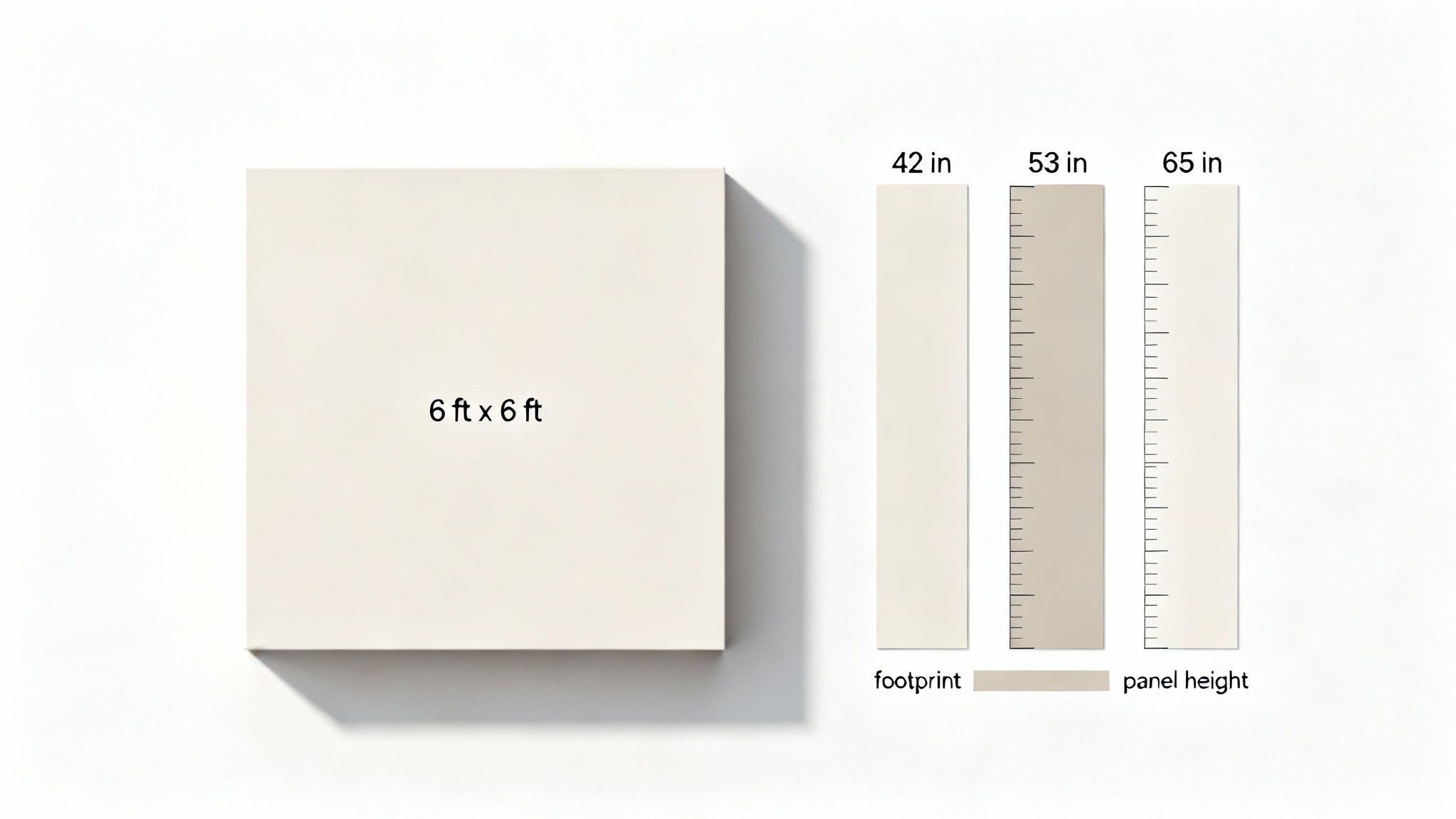
Think about office cubicles, and one size probably comes to mind: the classic 6'x6' workstation. It's the industry workhorse for a reason, offering a respectable 36 square feet of personal space. But that's only half the story.
The true "standard" isn't just about the floor space a cubicle takes up. It's a careful balance between that footprint and the height of its walls.
Your Quick Guide to Standard Cubicle Dimensions
Choosing the right cubicle size feels a lot like designing a house. You don’t just look at the foundation's square footage; you also have to decide how high the walls should be. A sprawling one-story home and a compact two-story house might sit on the same-sized foundation, but they offer completely different living experiences.
It's the same with cubicles. The footprint sets the stage for the desk and gear, but the panel height dictates everything else—privacy, acoustics, and how easily teammates can collaborate.
Finding that perfect balance is critical. Get it right, and you’ll boost employee comfort and focus. Get it wrong, and you could end up with a noisy, distracting environment. A floor plan of tall private office cubicles feels worlds apart from an open-concept layout of low-walled workstation cubicles, even if their footprints are identical.
Common Office Cubicle Sizes and Their Best Uses
To get you started, here’s a quick breakdown of the most common cubicle footprints and where they shine. This table will help you start matching your team’s roles with the right amount of real estate.
| Footprint (Width x Depth) | Square Footage | Primary Use Case | Best For |
|---|---|---|---|
| 5' x 5' | 25 sq ft | High-density and short-duration tasks | Call centers, telemarketing, shared hybrid "touchdown" stations |
| 6' x 6' | 36 sq ft | General all-purpose individual workspace | The versatile industry standard for most administrative roles |
| 6' x 8' | 48 sq ft | Roles requiring additional surface or gear | Engineers, designers, or staff with dual monitors |
| 8' x 8' | 64 sq ft | Supervisory roles or semi-private workspaces | Managers and team leads who need space for guest seating |
Think of this as your starting point. As we dig deeper, you’ll see how these basic sizes can be configured to create a workspace that’s perfectly suited to your company’s needs.
Ready to explore your options? You can browse our full cubicles category at Cubicle By Design. Or, if you want to jump right in and see what’s possible, our Custom Cubicle Designer lets you build and visualize your ideal layout right now.
How We Got Here: The Evolution of the Modern Cubicle
Ever wondered why a 6'x6' cubicle became the go-to standard? It definitely wasn’t a random choice. The dimensions we almost take for granted today are the result of decades of trial and error, massive shifts in technology, and a constant search for that sweet spot between personal space and office efficiency.
To really get why today's sizes make sense, you have to look back. The original cubicles were a lot more generous with space than what most of us picture. It wasn't uncommon to see sprawling 8'x8' or even 10'x10' workstations, designed to house the boat-anchor CRT monitors and literal mountains of paperwork that defined office life. Those huge footprints were a necessity for the tools of the time.
The Great Shrink: How Technology Changed Everything
The real game-changer was technology. You can think of it like the evolution of the mobile phone—what started as a hefty brick that needed its own bag is now a sleek device that fits in your pocket. A nearly identical transformation happened on our desks.
Those clunky, desk-hogging monitors were replaced by slim, flat screens. Towering stacks of paper gave way to digital files quietly stored in the cloud. As the physical tools of our jobs got smaller and more efficient, the need for all that extra desk space just evaporated.
This opened the door for a new wave of smaller, more modular, and cost-effective workstations. Suddenly, offices could fit more people comfortably into the same square footage without anyone feeling like they were giving up the tools they needed to be productive.
The modern cubicle has been shaped by more than 50 years of workplace evolution, tracing its roots back to Robert Propst’s “Action Office” in the mid-1960s. Throughout the 1980s and early 1990s, large footprints like 8' x 8' were standard for white-collar staff, reflecting paper-heavy workflows and bulky technology.
From Idealism to Practicality
This journey wasn't just about shrinking gadgets; it was also about hard economics. The original vision for modular offices was pretty idealistic, aiming to give employees flexible, human-centric spaces. But as the cost of commercial real estate began to skyrocket, companies needed practical solutions that squeezed the most out of every single square foot.
That economic pressure is really what cemented the move toward standardized, compact footprints. The 6'x6' cubicle emerged as the perfect compromise—it was large enough for an individual to focus and feel comfortable, yet small enough to allow for efficient office layouts that didn't break the bank. If you want to dive deeper into this fascinating history, you might be interested in the evolution of the office cubicle and how it shaped the modern workplace.
Understanding this backstory is incredibly helpful when you're planning your own office. It shows you that today’s modular systems from Cubicle By Design aren’t just furniture; they are flexible tools designed for how we work now. It also helps explain why your old, oversized cubicles might be holding your office back, hogging valuable real estate that could be used much more effectively.
Ultimately, choosing the right office cubicle standard sizes is about more than just filling a floor plan. It's about adapting to how your team works today and giving them an environment that supports modern productivity, not the workflows of the past.
Choosing the Right Footprint From Call Centers to Corner Offices
When you’re outfitting an office, it’s tempting to think one-size-fits-all. But a call center agent has wildly different needs than a senior manager who holds frequent one-on-ones. The key to a truly productive office is matching the cubicle’s footprint—its length and width—to the specific demands of each job.
Think of it this way: you wouldn't give a graphic designer and a data entry clerk the exact same toolkit. The same logic applies to their workspace. By thoughtfully allocating space based on daily tasks, you’re not just filling a floor plan; you’re investing in workstations that actively help your team succeed.
We've come a long way from the days of bulky monitors and towers of paperwork dictating desk size. As work has become more streamlined and cloud-based, cubicle footprints have become more flexible and purpose-driven.
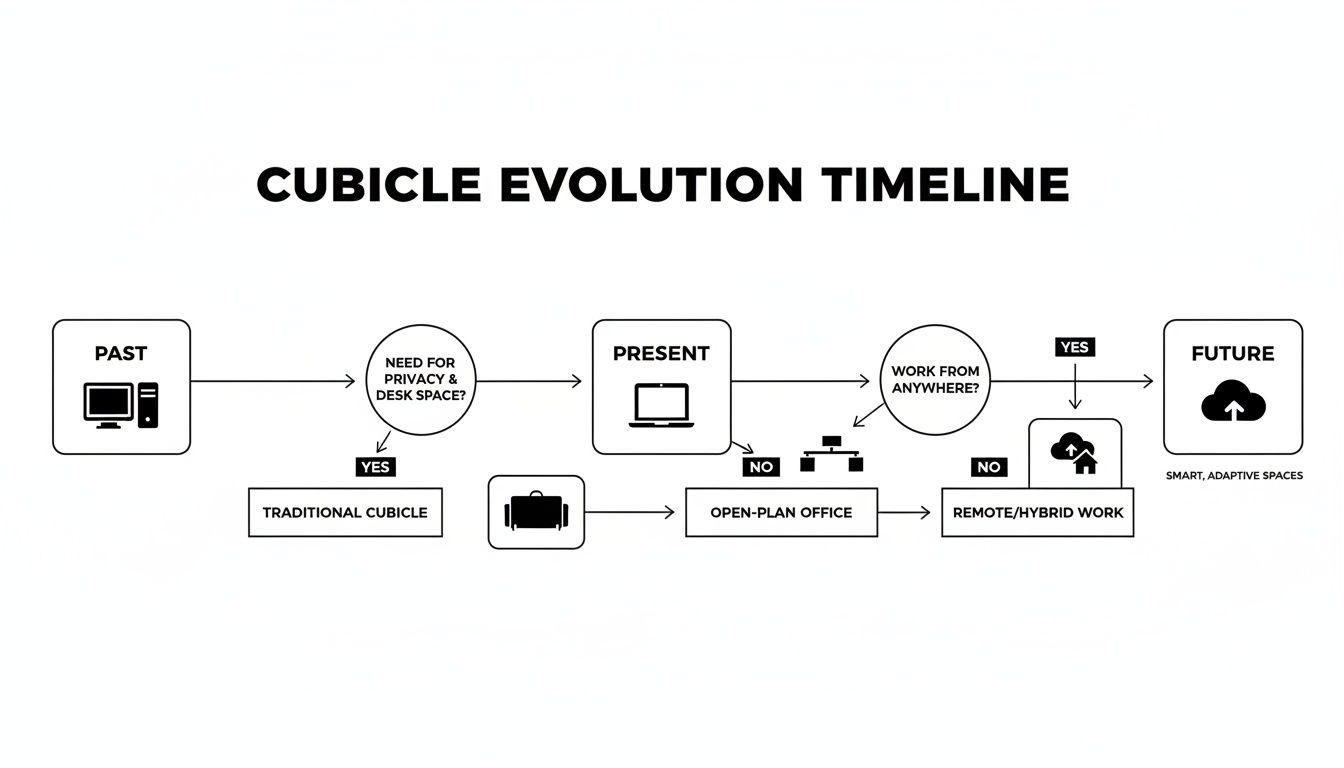
This shift away from needing massive physical space for equipment means modern cubicles can be adapted with incredible precision to the job at hand.
The High-Density Hero: The 5×5 Footprint
The 5'x5' cubicle is the undisputed champion of space efficiency. Packing a focused 25 square feet of workspace into a tight package, it’s the go-to solution for high-volume roles where the work is almost entirely digital and doesn't require much physical storage.
These compact stations are perfect for:
- Call Centers: Where agents need just enough acoustic separation for clear calls, without a sprawling surface area.
- Telemarketing Teams: Providing a dedicated, distraction-free zone for heads-down, phone-based work.
- "Touchdown" Spots: Creating unassigned seating for hybrid or visiting team members who just need a place to plug in for the day.
This footprint lets you maximize your real estate, creating high-density layouts without making everyone feel like they’re working on top of each other.
The Versatile Workhorse: 6×6 and 6×8 Footprints
For most typical office roles, the 6'x6' and 6'x8' footprints hit that sweet spot between personal space and smart layout efficiency. For a long time, the 6'x6' cubicle was the de facto standard for general office staff, and it’s still incredibly popular.
The slightly larger 6'x8' footprint, offering a comfortable 48 square feet, is a fantastic upgrade for roles that need a bit more breathing room. You're not just adding a few feet; you're adding flexibility.
This mid-range size is a great fit for:
- Developers and Engineers: Who often run dual-monitor setups and need space for technical drawings or reference materials.
- Accountants: Requiring secure, lockable storage for sensitive documents right next to their primary work surface.
- Designers: Who need to spread out sketches, material samples, or prototypes while also working on their computers.
These sizes are the real backbone of most modern offices, simply because they support such a wide variety of tasks so effectively.
By aligning the cubicle footprint with job requirements, you're doing more than just improving individual productivity—you're creating a smarter, more efficient office layout. This task-oriented thinking ensures every square foot has a purpose.
The Semi-Private Office: The 8×8 Footprint
Sometimes, a role demands more than just a workstation. That's where 8'x8' cubicles come in. With a generous 64 square feet, these larger footprints create a true semi-private office, perfect for managers, team leads, or senior specialists who need more privacy and function.
This spacious setup isn't just about a bigger desk; it allows for:
- Guest Seating: A small chair can easily fit for private one-on-one meetings or performance reviews.
- Additional Equipment: There's plenty of room for a personal printer, larger filing cabinets, or specialized gear without cluttering the main workspace.
- Enhanced Privacy: When paired with taller panels, this footprint provides the seclusion needed for confidential conversations and deep, uninterrupted work.
Cubicle Footprint Decision Matrix
Choosing the right size can feel overwhelming. This quick comparison table breaks down the best uses for each standard footprint to help you match the space to the role.
| Footprint Size | Typical Role | Space per Person | Pros | Cons |
|---|---|---|---|---|
| 5'x5' | Call Center Agent, Telemarketer, "Touchdown" User | 25 sq. ft. | Maximizes office density; cost-effective; promotes focus | Limited storage and surface area; can feel cramped for some |
| 6'x6' | General Admin, HR, Marketing, Most Office Staff | 36 sq. ft. | Balanced space; versatile; supports most standard office tasks | Might be tight for roles with lots of physical materials |
| 6'x8' | Engineer, Accountant, Designer, Specialist Roles | 48 sq. ft. | Ample room for dual monitors and storage; good for varied tasks | Takes up more floor space; may not be needed for simpler roles |
| 8'x8' | Manager, Team Lead, Senior Staff | 64 sq. ft. | Allows for guest seating; high privacy; feels like a small office | Lowest density; higher cost per station; requires more space |
Ultimately, picking a footprint is a strategic decision that directly impacts your team’s workflow and satisfaction. From compact stations for focused tasks to expansive setups for managers, the right size empowers each person to do their best work. You can explore a variety of workstation cubicles that fit any office layout to find the perfect match for every role on your team.
Finding the Perfect Panel Height for Your Office Culture
Choosing a cubicle’s footprint is only half the battle. The real game-changer for your employee experience—that delicate balance between privacy and collaboration, focus and conversation—is the height of the walls. While length and width give you square footage, panel height dictates the entire feel of your office.
Think of it like choosing a fence for a neighborhood. A low picket fence clearly marks a boundary but welcomes conversation with neighbors passing by. A tall privacy fence, on the other hand, creates a secluded, personal sanctuary. This same idea applies directly to office cubicles, and the height you pick sends a clear message about your company culture.
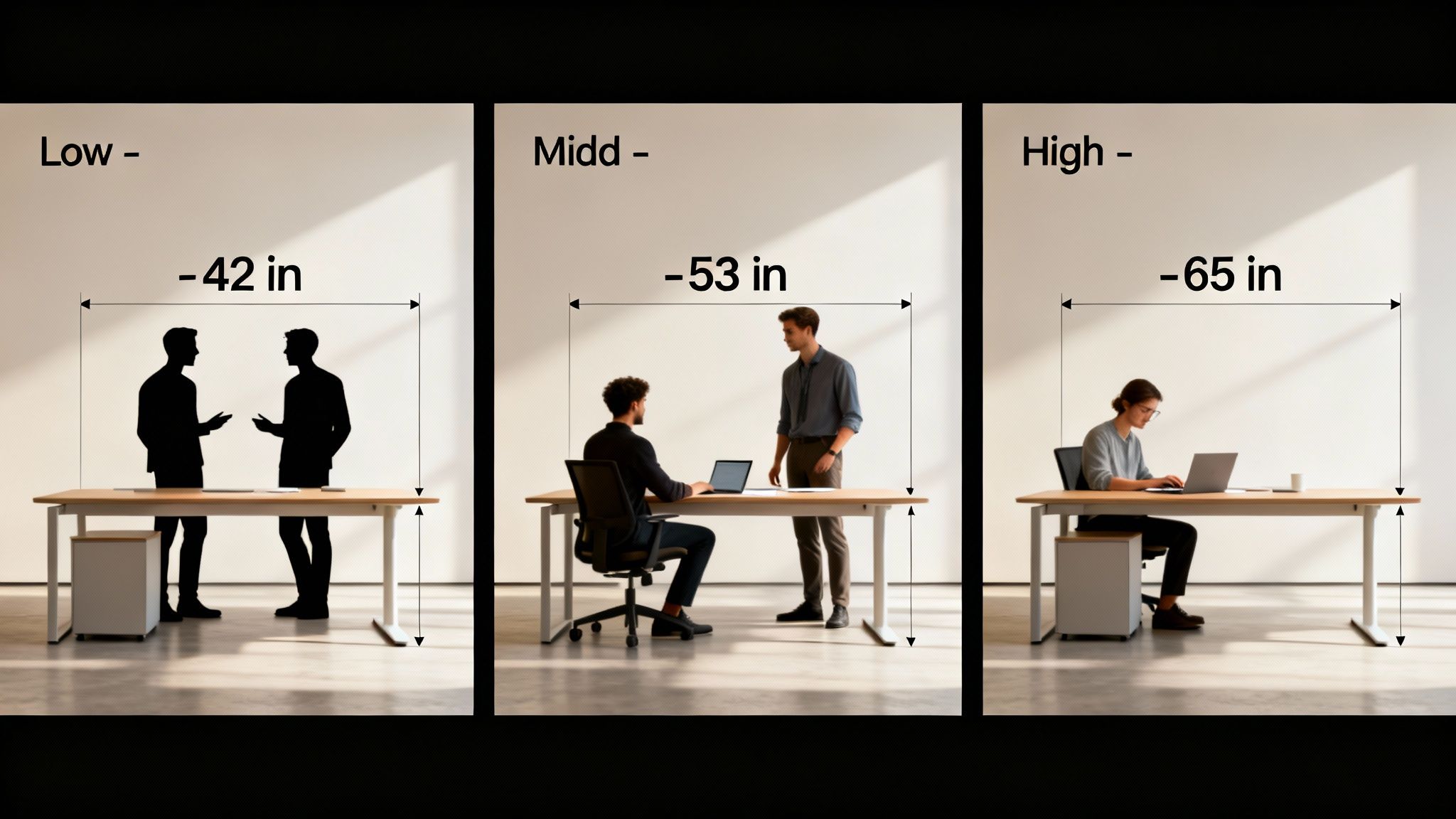
Low Panels for Open Communication
Low panels, typically around 42 inches high, are the office equivalent of that friendly picket fence. They’re built to encourage an atmosphere of open communication and easy collaboration.
At this height, team members have clear sightlines across the office while seated. This makes it effortless to ask a quick question, share an idea, or just feel connected to the team's energy. It’s the perfect setup for dynamic, fast-paced teams that thrive on constant interaction.
- Best for: Sales teams, creative departments, and collaborative project groups.
- Effect: Promotes transparency and teamwork.
- Downside: Offers minimal acoustic or visual privacy, which can be a real distraction during heads-down work.
This open-plan feel creates a lively, buzzing atmosphere where information flows freely.
Mid-Height Panels for Balanced Workflows
Mid-height panels, usually around 53 inches, are the most popular and versatile option for a reason. They hit the sweet spot, offering what's known as "seated privacy."
What does that mean? When an employee is sitting down, the panels are high enough to block most visual distractions, letting them focus. The moment they stand up, though, they can easily see and speak with colleagues. It’s a fantastic middle ground that supports both individual concentration and spontaneous teamwork.
This height strikes a crucial balance. It acknowledges the need for focused work without completely isolating employees, making it the workhorse of modern office design for its flexibility.
This adaptability makes it a safe and effective choice for a wide range of general office roles where the day is a mix of independent tasks and team huddles.
High Panels for Privacy and Focus
When a role demands confidentiality and deep concentration, high panels of 65 inches or more are the only way to go. These taller walls essentially create semi-private offices, drastically cutting down on both visual and auditory distractions from the surrounding office.
They are a non-negotiable for departments where sensitive information is part of the daily routine. The acoustic dampening from these taller panels helps contain conversations and muffle ambient noise, creating a quiet sanctuary for focused work. If you're looking to learn more about creating these zones, our detailed guide on office cubicle privacy is a great resource.
High panels are the best choice for:
- Human Resources: For conducting confidential interviews and employee discussions.
- Finance and Accounting: Where privacy is essential for handling sensitive financial data.
- Legal Departments: To ensure attorney-client privilege and confidential case work.
- Quiet Zones: For any employee who needs an escape from the open office buzz to perform deep work.
Choosing this option sends a clear signal that your company values and protects the need for uninterrupted performance. It’s an investment in productivity for roles where mistakes are costly and concentration is everything. By matching panel height to your culture, you can build an environment that truly supports how your team works best.
Smart Space Planning Beyond the Cubicle Itself
Once you've landed on the right footprint and panel height, the real work begins: arranging everything into a functional office. This is where the theory behind office cubicle standard sizes crashes into the reality of your floor plan. Think of it like city planning for your workspace—you're laying down main roads for traffic, building quiet neighborhoods for focus, and making sure everyone has access to utilities.
Good planning is so much more than a game of office Tetris. It's about designing a space that feels safe, efficient, and intuitive for everyone who walks through the door. Getting the details right—like walkway widths, where to put power and data, and how many people you can comfortably fit—can make or break your new layout.
Mastering Walkways and Circulation
The space between the cubicles is just as critical as the workstations themselves. If you don't plan your walkways well, you end up with frustrating bottlenecks, a cramped atmosphere, and even potential safety hazards. Following the Americans with Disabilities Act (ADA) guidelines isn't optional; it's essential for making your office accessible to all.
Here are the key measurements to burn into your brain:
- Main Aisles: These are the highways of your office. They need to be at least 48-60 inches wide to let people pass each other comfortably.
- Secondary Aisles: Think of these as the smaller streets leading to individual desks. A minimum width of 36 inches is an absolute must for accessibility.
- Clearance Behind Chairs: Always leave at least 3 feet of breathing room between the back of a seated employee's chair and whatever is behind them. This gives them space to push back and stand up without causing a traffic jam.
A well-designed layout just flows, letting people move around without bumping into each other or disrupting colleagues deep in concentration.
Calculating Employee Density
One of the first questions we always get is, "How many people can we actually fit in here?" It's a great question, but you can't just divide your total square footage by 36 because you have a bunch of 6'x6' cubicles. You have to account for all the shared spaces that make an office actually work.
A good rule of thumb is to budget between 125 to 225 square feet of total office space per employee.
A denser, more open layout might land closer to the 125 sq ft mark. A more spacious plan with wider walkways and more private offices will push you toward 225 sq ft per person. That number covers everything—the workstation, hallways, meeting rooms, break areas, and reception.
This simple calculation helps you sidestep the misery of an overcrowded office and ensures your team has the space they need to thrive.
Powering Up Your Workspace
Let's be honest: in today's world, a cubicle without power and data is just a fancy box. You absolutely have to plan for electrical and network access from day one. If you don't, you're signing yourself up for a tangled nightmare of extension cords and a logistical headache on move-in day.
Work with your facilities team or an electrician to map this out early:
- Power Poles or Base Feeds: Figure out how you’ll get power from the ceiling or floor into each cluster of cubicles.
- Data Drops: Make sure every single workstation has easy access to Ethernet ports for a solid, reliable connection.
- Outlet Placement: Plan for enough outlets inside each cubicle to handle computers, monitors, phone chargers, and anything else your team needs to plug in.
Properly integrated power and data are the invisible foundation of a productive office. For a deeper dive into creating a truly cohesive and functional layout, our guide to office space planning and design is packed with expert insights.
When thinking about smart space planning, it’s also wise to consider factors beyond the physical layout, like the air your team breathes. Improving indoor air quality with solutions such as air purification systems contributes to a healthier, more productive environment. Taking the time to plan these essential details is what transforms a simple collection of cubicles into a high-functioning, compliant, and comfortable workplace.
Bring Your Vision to Life with Our Custom Cubicle Designer
All this talk about office cubicle sizes—from footprints to panel heights—is great, but at some point, you have to see how it all fits together. Theory is one thing, but a real, visual plan is something else entirely. This is where you move from abstract ideas to concrete action, and we’ve built the perfect tool to help you make that leap.
Our free online Custom Cubicle Designer is your personal sandbox for building the perfect workspace. It’s designed to turn all the decisions you’ve been mulling over into a clear, 3D model, taking the guesswork out of the process and preventing expensive mistakes down the road.
From Blueprint to Reality
The designer tool lets you apply everything you’ve learned in a simple, hands-on environment. You get to see exactly how your choices will look and function long before you commit to placing an order.
- Select Your Footprint: Kick things off by choosing a standard size like 6'x6' or 8'x8' to anchor your design.
- Experiment with Panel Heights: Instantly visualize the difference between low, collaborative walls and tall, private ones.
- Choose Your Finishes: Play around with different fabrics and surface colors to make sure they match your company’s vibe.
- Add Essential Storage: Just drag and drop shelving, pedestals, and overhead bins to finish out your workstation.
This tool is the bridge between imagination and reality. It empowers you to visualize, tweak, and perfect your office layout, guaranteeing the final result is exactly what your team needs.
To help visualize and nail down your custom layouts, using space planner software can be a huge help for exploring different arrangements. By creating a digital model first, you make the quoting process a breeze and ensure there are no surprises on installation day.
Ready to take the next step and translate your ideas into a solid plan? You'll see how you can transform your office with our interactive cubicle designer; it's the most powerful way to bring your vision to life. Start designing your ideal office today with the Cubicle By Design platform.
A Few Final Questions on Cubicle Sizes
Even with a great plan in hand, a few practical questions always pop up just before you pull the trigger on an office furniture order. Getting these last details ironed out is key to moving forward with confidence and making sure your new workspace is a hit from day one.
What's the Most Common Office Cubicle Size?
Without a doubt, the industry workhorse is the 6'x6' cubicle. This footprint gives you a comfortable 36 square feet of personal workspace, which really hits the sweet spot between giving employees enough room and making smart use of your floor plan.
Of course, you’ll see compact 5'x5' setups for call centers or sprawling 8'x8' stations for managers, but the 6'x6' is the versatile go-to for most general office roles.
How Much Total Space Do I Need Per Employee?
It's tempting to just multiply the number of employees by 36 square feet, but don't forget the walkways! As a solid rule of thumb, you should budget for 125 to 225 square feet of total office space per employee. This number accounts for their actual workstation cubicle plus all the shared space—the hallways, break rooms, and conference areas that make an office functional.
A buzzing, open-concept office with lots of collaborative zones might lean closer to the 125 sq. ft. mark. An office with more spacious, private office cubicles will naturally push you toward the 225 sq. ft. end of the spectrum.
What Panel Height Is Best for Killing Noise?
If you're serious about cutting down on chatter and creating acoustic privacy, you need to go with high panels—anything 65 inches or taller. These walls extend well above a person's head when they're seated, making them far more effective at soaking up ambient sound and creating a focused atmosphere.
Mid-height panels (around 53 inches) are great for visual privacy, but they won't do much to block conversations. For teams like HR or finance where confidentiality is non-negotiable, tall, sound-absorbing fabric panels are the only way to go.
Can I Change My Cubicle Layout Later?
Absolutely. This is one of the biggest wins of a modern modular system. The furniture from Cubicle By Design is engineered for this exact purpose. As your company grows or teams get shuffled around, you can easily change layouts, adjust footprints, and add or remove panels.
This built-in flexibility makes modular cubicles a smart long-term investment. Your office can evolve right alongside your business, saving you from a complete—and costly—overhaul every time things change.
Ready to build a workspace that’s a perfect fit for your team? At Cubicle By Design, we specialize in creating functional, stylish office layouts that don't break the bank. Explore your options and bring your vision to life with our Custom Cubicle Designer.