


Typing "office furniture dealers near me" into a search bar is the easy part. The real work starts when you have to figure out who on that list can actually bring your vision to life.
Finding a true partner means looking past the simple retailers to identify specialists like Cubicle By Design—folks who offer the whole package, from initial design concepts to the final installation. This guide will help you turn that overwhelming list of names into a curated shortlist of qualified experts ready to build your ideal workspace.
Starting Your Search for Local Furniture Partners
Kicking off the hunt for the right office furniture dealer is a huge first step. You’re not just buying desks and chairs; you're making a serious investment in your company's culture and your team's daily well-being. A great local partner doesn't just sell you stuff—they act as a consultant, helping you sidestep expensive mistakes and ensuring your new layout works for you today and for your future growth.
The market definitely reflects this shift. The global office furniture market has been valued anywhere from USD 57.51 billion to USD 107.26 billion in recent years. And with projections showing it could climb as high as USD 180.20 billion by 2032, it's clear that companies are putting more stock in their physical environments than ever before.
Moving Beyond a Basic Google Search
A simple search will spit out a list of businesses, but it won’t tell you the most important thing: who can actually deliver on your specific vision? To build a solid list of potential partners, you’ve got to dig a little deeper.
Start by getting more specific with your search terms. Instead of something generic, try queries like:
- "Modular cubicle installers in [Your City]"
- "Commercial office space planners near me"
- "Ergonomic office chair showrooms in [Your Area]"
These targeted searches help cut through the noise, pushing general retailers down the list and highlighting dealers with the specialized skills you really need. Once you have a handful of names, the real vetting begins.
Evaluating a Dealer's Digital Footprint
Think of a dealer's website as their digital showroom. It’s your first real peek into what they're capable of. A professional, easy-to-use site is a good start, but you need to look closer.
Dive into their project galleries or case studies. Do their completed projects have the same look and feel you're going for?
A robust project gallery is so much more than a collection of pretty pictures. It's proof of concept. It shows you the dealer's real-world ability to handle projects of different sizes and complexities, not just their sales pitch.
Look for dealers who showcase a wide range of work, from small office refreshes to massive corporate installations. For instance, seeing a map of recent jobs gives you tangible proof of their experience right in your area. That kind of transparency says they're proud of their work and confident you’ll be happy with the results.
Here's a quick checklist to help you size up potential dealers right from the start.
Initial Dealer Vetting Checklist
| Evaluation Criteria | What to Look For | Red Flags to Avoid |
|---|---|---|
| Project Gallery | Diverse projects, clear before/after photos, relevant industry examples. | Stock photos only, very few projects shown, or work that looks dated. |
| Services Offered | In-house space planning, design, installation, and project management. | Just "sales" or "delivery." A lack of comprehensive services is a big warning. |
| About Us/Team Page | Details on their history, expertise, and the actual people you'll work with. | Vague, generic mission statements with no personal touch or team info. |
| Website Quality | Modern, mobile-friendly design that's easy to navigate and professional. | Broken links, outdated information, or a site that's hard to use. |
Checking these basics online helps you quickly weed out the duds.
Another critical spot to check is their "About Us" or "Services" page. You're looking for a partner, not just a supplier. A true partner will offer services that go way beyond the sale, including:
- Space Planning and Design: Do they have designers on staff? A dealer who helps you map out the space from the get-go is invested in making it a success.
- Installation and Project Management: You want to see mentions of in-house or dedicated installation crews. This signals accountability and a smoother process.
- Customization Options: The ability to tailor solutions, maybe with something like a Custom Cubicle Designer, shows they can adapt to your unique needs instead of pushing a one-size-fits-all product.
This initial digital vetting is crucial. It saves you a ton of time by eliminating unqualified candidates early on, letting you focus your energy on the local dealers who can genuinely deliver.
Evaluating Showrooms and Product Quality Firsthand
Alright, you’ve done your online homework and have a shortlist of local dealers. Now for the fun part: getting hands-on with the furniture. Online galleries and slick marketing photos are a great starting point, but you can’t truly judge quality through a screen. You need to see it, touch it, and sit in it.
A showroom visit is where the rubber meets the road. It’s your chance to see past the sales pitch and feel the difference between furniture that just looks good and furniture that’s built to last. This is a critical step in making sure your investment pays off for years to come.
What to Look for in Build Quality
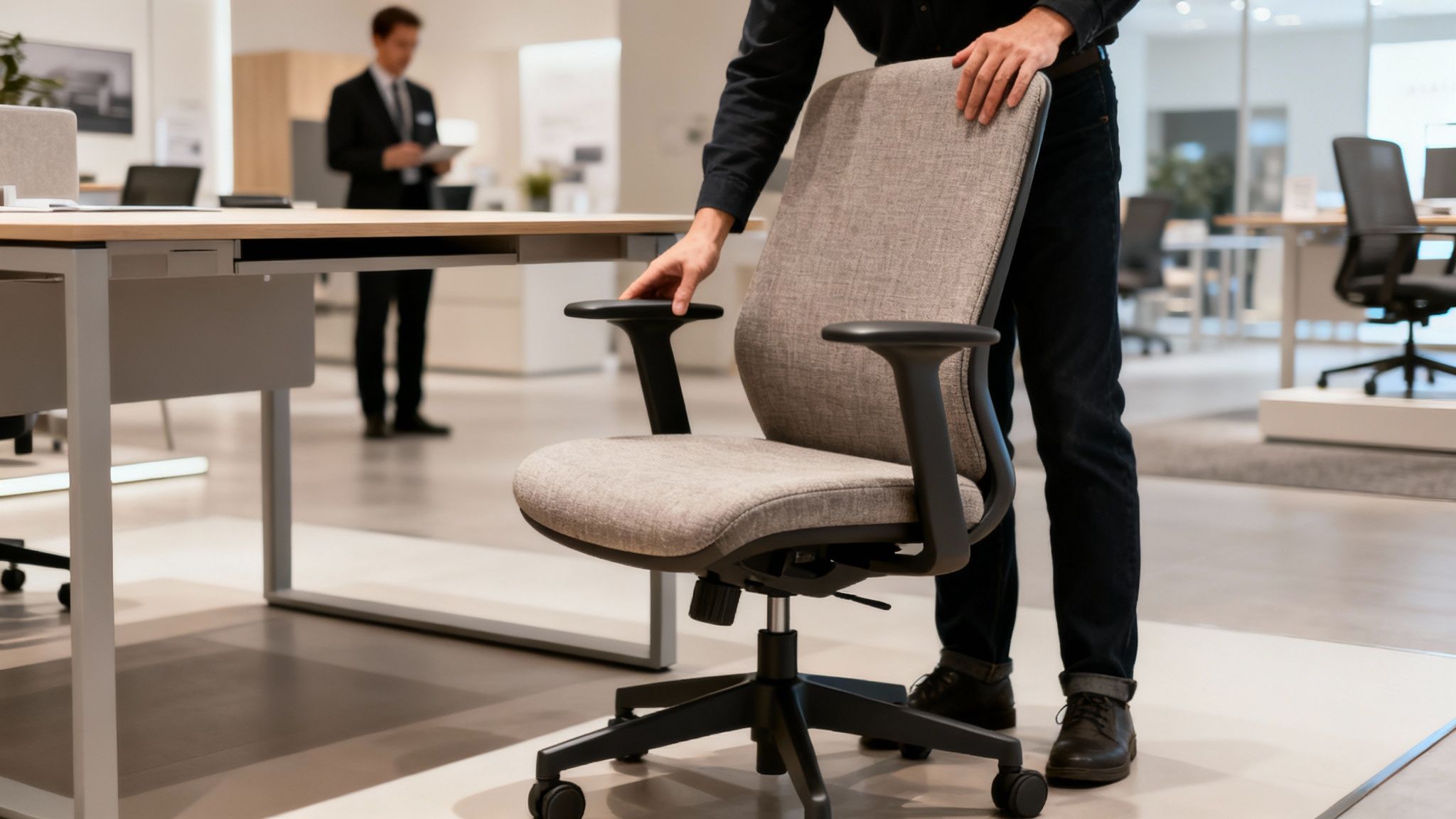
Let’s be clear: commercial-grade office furniture is a different beast entirely from what you’d buy for your home office. It’s engineered to withstand 8-10 hours of daily use, day in and day out. When you're in the showroom, put on your detective hat and look for the details that signal real quality.
Start with the desks and tables. Give them a gentle shake. Do they wobble or feel flimsy? Look closely at the joints and where the legs connect—everything should be tight and seamless. Run your hand over the laminate or wood veneer. A quality surface feels solid and should be finished to resist the inevitable scratches and coffee cup rings.
Next, find the chairs and start testing. Sit down, lean back, and play with every lever and knob you can find. The adjustments for height, tilt, and armrests should feel smooth and secure, not clunky or loose. Check the base—a five-point base is the standard for stability—and give the casters a roll. They should glide effortlessly.
Pay close attention to the fabric and upholstery. High-quality commercial fabrics are designed for durability and cleanability. Ask about the "double rub" count—a rating that measures a fabric's abrasion resistance. For a typical office, a rating of 30,000 double rubs is a good benchmark for longevity.
Finally, give the workstation cubicles and private office cubicles a once-over. Are the panels stable? Do the connectors that hold them together look and feel robust? Open and close every drawer and cabinet door. They should move smoothly on their tracks and feel solid, not tinny. These are the little things your team will notice every single day.
Engaging With the Sales Team
Your interaction with the showroom staff is as telling as the furniture itself. You’re not looking for a pushy salesperson; you’re looking for a knowledgeable consultant. A great one will ask you questions first—about your company culture, how your teams work, and what problems you’re trying to solve.
Use this time to pick their brain. A true expert can explain why one laminate is better than another for a high-traffic area, or how the ergonomics of a specific chair can reduce back strain. They should be guiding you to the right solutions for your needs and budget, not just the most expensive items on the floor.
Key Questions to Ask During Your Visit
To make sure you get all the info you need for an apples-to-apples comparison later, go in with a list of questions. It keeps the conversation focused and ensures you don't forget anything important.
Here are a few essentials to have on your list:
- Warranty Details: What exactly does the warranty cover on chairs versus desks? How long is it for, and what’s the process if we need to make a claim?
- Lead Times: What are the real-world lead times for the items we’re interested in? Do you have any "quick ship" programs if we’re in a time crunch?
- Customization Options: How much can we customize? Can we specify fabrics, finishes, or even dimensions?
- Delivery and Installation: Is your installation team in-house or subcontracted? What does the whole delivery and setup process look like from start to finish?
Walking out of the showroom with solid answers to these questions means you're ready to confidently compare your options and make a final decision.
How to Nail Your Office Space Planning
Finding beautiful, high-quality furniture is one thing. Making sure it actually fits your space and supports how your team works? That’s an entirely different challenge. This is where the search for "office furniture dealers near me" moves beyond picking out chairs and becomes about finding a strategic partner like Cubicle By Design.
Let's be honest, even the most amazing desks will be a disaster if they block a fire exit or don't fit the flow of your office. Getting the space plan right from the start is what prevents those costly, headache-inducing mistakes and ensures your investment pays off.
Measuring Your Space with Precision
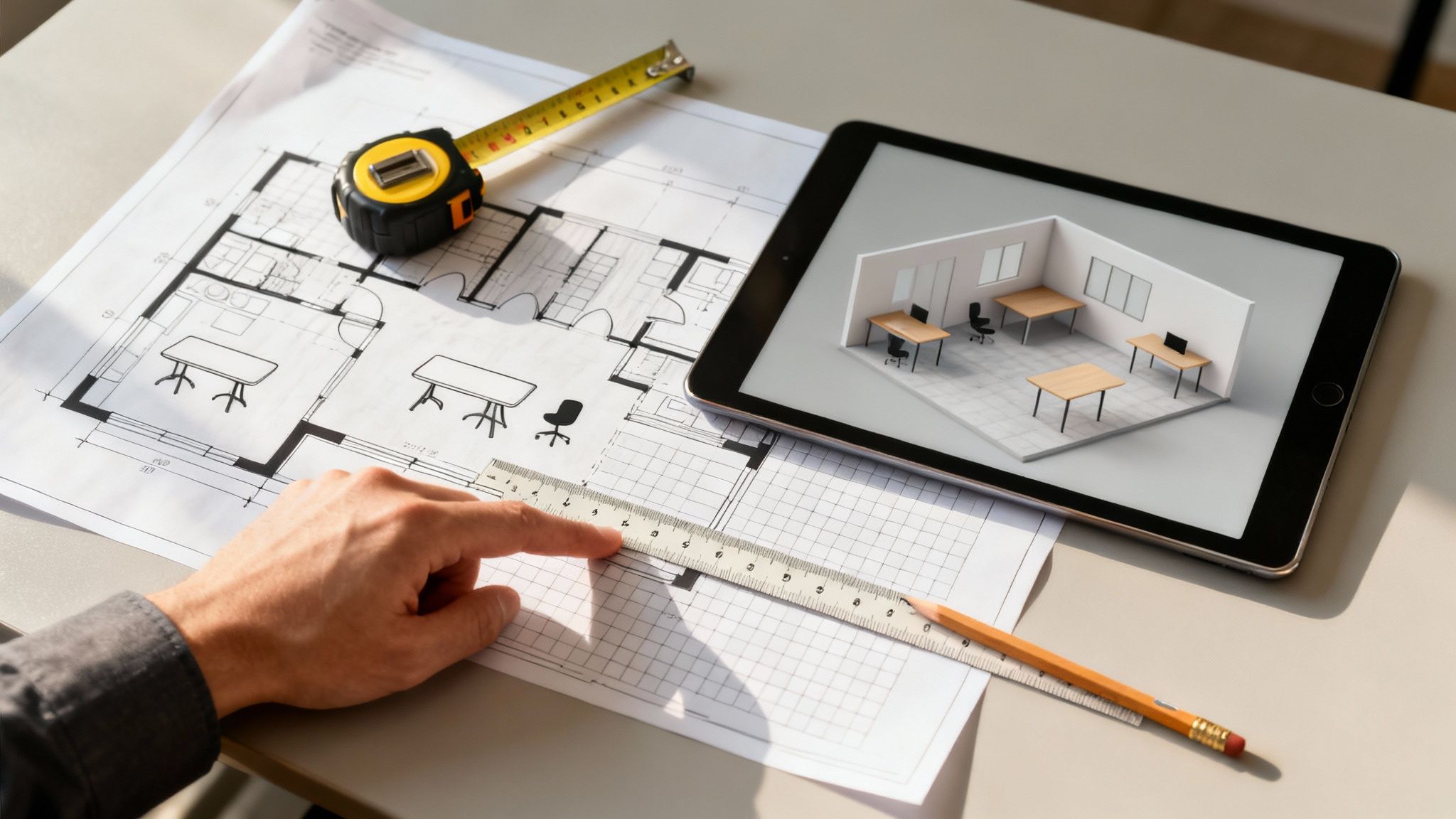
Before you can plan a single thing, you need good data. And I don’t just mean the basic length and width of the room. A truly functional layout is built on the details—the little quirks and features of your physical space.
So, grab a measuring tape, a notepad, and your phone's camera. Your mission is to create a detailed map that accounts for every potential obstacle and opportunity.
Be sure to document the exact location and dimensions of:
- Structural Elements: Note every single support pillar, column, or permanent fixture that isn't going anywhere.
- Access and Egress: Measure all doorways, windows, and hallways. You'll also want to note which way the doors swing and how far windows open.
- Utility Access: Mark the location of all power outlets, data ports, and light switches. This is a big one—it dictates where your tech-heavy workstations can realistically go.
- Vertical Space: Don't forget about ceiling height! This becomes critical if you're looking at taller partitions or certain storage solutions.
This isn’t busywork. This detailed map is the foundation for everything that comes next. It prevents the nightmare scenario of furniture arriving on-site only to discover it blocks a key doorway or can't reach a power source.
Translating Measurements into a Functional Layout
With your measurements in hand, the real design work can begin. This is where a skilled dealer proves their worth, helping translate those raw numbers into a layout that considers how people actually move and work throughout the day.
A true space planning expert will dig into a few key areas:
- Workflow and Adjacency: They'll ask which teams collaborate the most and then arrange their spaces to make that seamless, cutting down on disruptions.
- Traffic Flow: A good layout has clear, logical pathways. It prevents those awkward bottlenecks and ensures everyone can move around easily and safely.
- Compliance and Accessibility: Every plan must adhere to ADA (Americans with Disabilities Act) requirements, ensuring proper clearance in walkways and around desks.
A professional layout isn't just about cramming in as many desks as possible. It's a strategic plan that balances individual focus areas with collaborative zones and the natural flow of a busy workday. It's about creating an environment that just works.
For a deeper dive, our comprehensive office space planning guide offers more detailed insights to help you prepare for those initial conversations with a dealer.
The Power of Visualization with 2D and 3D Renderings
All this planning comes together in one of the most valuable tools a dealer can offer: professional renderings. It's one thing to look at a floor plan, but it’s nearly impossible to truly imagine the finished space from a simple drawing. This is where visualizations change the game.
A 2D rendering gives you that top-down, blueprint-style view. It’s perfect for confirming clearances, seeing traffic patterns, and getting the overall spatial arrangement just right.
A 3D rendering is where the magic happens. It provides a realistic, photo-like preview of your future office. You can see how different fabrics and finishes will actually look together, understand the sightlines from various desks, and get a genuine feel for the room's atmosphere.
These visualizations are your best defense against buyer's remorse. They allow you to make confident decisions and request changes before a single piece of furniture is ordered, saving you time, money, and a whole lot of stress.
You’ve done the legwork, talked to a few dealers, and now the proposals are rolling in. This is where the real work begins. Getting quotes from different office furniture dealers is one thing, but figuring out what they actually mean is another. The goal isn't just to find the lowest number—it's to find the best partner.
A great proposal is clear, comprehensive, and leaves no room for doubt. It's on you to make sure you're comparing apples to apples.
Let's be honest: the cheapest quote is almost never the best deal. That super-low price can look tempting, but it’s often a red flag. It probably means critical services like delivery, installation, or project management have been left out. Those are costs you'll end up paying for later, and they always come as a nasty surprise. A real pro gives you the full picture upfront.
Breaking Down the Bid
To get a true comparison, you have to dissect each proposal, line by line. Don't even consider a dealer who just gives you a single lump-sum number. A professional bid will itemize everything.
When you're comparing quotes, you need to be a detective. Look for these key details:
- Product Specifications: Are the quotes for the exact same products? Check the model numbers, the dimensions, and especially the finishes and fabric grades. A dealer might substitute a "similar" chair, but a lower-grade fabric won't last as long. Those small details make a big difference in both price and durability.
- Service Inclusions: Is delivery included? What about professional installation and trash removal? These are essential services, not optional add-ons. If they aren't listed, assume they'll cost you extra.
- Project Management: A dedicated project manager is your lifeline. They coordinate every moving part and make sure the entire process runs smoothly. Make sure this service is included in the package, not billed as an afterthought.
If a quote is vague or missing this information, push back. Ask for a revised, fully itemized version before you move forward. Any dealer worth their salt will be happy to provide it.
Office Furniture Bid Comparison Checklist
To make this easier, we've put together a checklist. Use this to line up the bids side-by-side and see how they really stack up. It’s the only way to get a true, unbiased view of what you're being offered.
| Checklist Item | Dealer A Details | Dealer B Details | Dealer C Details |
|---|---|---|---|
| Product Match (Model, Size, Finish) | |||
| Delivery & Freight Costs | |||
| Professional Installation Fees | |||
| Debris & Trash Removal | |||
| Dedicated Project Manager | |||
| State & Local Taxes | |||
| Payment Terms & Schedule | |||
| Proposed Project Timeline | |||
| Installation Crew (In-House vs. Sub) | |||
| Product Warranty Details | |||
| Post-Installation Support Plan |
Once you’ve filled this out, the right choice often becomes much clearer. The proposal with the most "included" or "in-house" checkmarks is usually the one that offers the most long-term value.
Identifying Hidden Costs and Understanding Terms
Beyond the big items, you have to sweat the small stuff. The fine print is where hidden fees love to hide, and they can completely blow up your budget.
The most transparent quotes clearly outline every potential charge, from delivery fees to taxes. A dealer who hides costs in the fine print is not a partner you can trust for a long-term relationship.
Always check the payment terms. What’s the deposit requirement? When are the other payments due? A clear schedule for delivery and installation shows the dealer has a real plan. It's not just a guess. And while you're thinking about the financials, it's worth exploring all your options. For some companies, understanding the financial implications of leasing versus buying can be a smart move for managing cash flow.
Weighing the Non-Monetary Factors
Finally, value is about more than just money. The intangibles often tell you the most about the kind of experience you’re going to have. And if you want to get a better feel for what specific furniture systems should cost, our cubicle price guide is a great place to start.
Look at the dealer’s proposed timeline. Is it realistic? Does it work with your own deadlines? Dig into their installation process, too. Do they use their own experienced, in-house team, or do they just subcontract it out to the lowest bidder? An in-house crew almost always means more accountability and better quality work.
Don't forget to review the warranty and support details. A strong warranty shows that a dealer stands behind their products. And what happens after the project is done? The best partners are there for you down the road, ready to help with reconfigurations, repairs, or additions. That’s where the true value is.
What to Expect During Installation and Beyond
You’ve vetted the dealers, toured the showrooms, and finally signed on the dotted line. It feels like a huge accomplishment, but the real work is just beginning. The installation is where all that planning becomes a physical reality, and a smooth, professional install is every bit as important as the quality of the furniture itself.
Knowing what’s coming can turn a potentially chaotic day into an exciting one. A top-notch dealer doesn’t just dump boxes on your curb; they orchestrate the entire process to bring your new office to life with as little disruption as possible. This is the final, make-or-break step.
The Pre-Installation Checklist
A successful install day starts long before the trucks ever pull up. Any professional dealer worth their salt will work with you to nail down the pre-arrival logistics so everything is ready to go.
Your dealer’s project manager should be in touch to coordinate a few key things:
- Site Access and Logistics: This means confirming building hours, figuring out loading dock access, and navigating any specific rules for using the elevator.
- Insurance and Permits: They should handle providing your building management with a Certificate of Insurance (COI) and securing any necessary work permits on their end.
- Site Protection: This is a big one. They should have a plan to protect your space, like laying down floor coverings and using corner guards to prevent scuffs and dings.
This kind of proactive communication is the sign of a team that’s done this a thousand times. It heads off last-minute headaches and lets the crew work efficiently from the moment they walk in the door.

This process just gets you to the starting line—the installation phase is where the real race begins.
During the Installation Process
When the big day arrives, you should see a uniformed, professional crew led by an on-site supervisor. This person is your go-to, the single point of contact for updates and any questions that pop up. Beyond just getting the furniture in the door, it’s worth using experienced crews for professional furniture assembly services to ensure everything is built correctly and safely.
The team will usually start by staging all the components according to the approved floor plan. Then, the assembly begins. You can get a detailed look at what a streamlined process looks like by exploring Cubicle By Design's office furniture installation process.
Once everything is built, the crew should wipe down every surface, haul away all the cardboard and packaging, and leave your new space truly move-in ready.
The final step before the crew packs up is the walkthrough. This is your chance to walk the entire space with the project manager, point out any issues, and create a "punch list" of anything that needs a tweak or correction.
This punch list ensures every detail is perfect, whether it's a misaligned drawer or a tiny scratch on a desk. A reputable dealer will jump on these items and fix them right away, no questions asked.
After the Work Is Done
A great furniture dealer doesn't disappear the second the last screw is tightened. Real long-term support is what separates a true partner from a one-time vendor.
This ongoing relationship should include:
- Warranty Management: If a product fails or has a defect down the line, your dealer should handle the warranty claim for you, coordinating repairs or replacements directly with the manufacturer.
- Day-Two Services: Once your team moves in, you might notice small things that need adjusting. A good partner will be available to help with ergonomic tweaks or minor reconfigurations.
- Future Growth Planning: The best dealers, like Cubicle By Design, stick with you. When it's time to grow, they can help you reconfigure your existing furniture or add new pieces that perfectly match what you already have.
This kind of long-term partnership ensures your office can evolve right alongside your business, making your initial investment that much smarter for years to come.
Common Questions About Choosing a Furniture Dealer
Navigating the world of commercial furniture can bring up a lot of questions, especially if it’s your first major office project. When you start searching for "office furniture dealers near me," knowing what to ask can save you a world of time, money, and stress down the line.
These are the real-world concerns we hear from business owners and office managers every day. Getting clear answers to these questions is the first step in finding a true partner, not just another vendor.
How Far in Advance Should I Start Looking for an Office Furniture Dealer?
The sweet spot is 3-6 months before you absolutely need everything in place. I know, that probably sounds like a ton of time, but building in that buffer is one of the smartest moves you can make.
This timeframe gives you the breathing room to do things right. You'll have enough time for proper research, a few showroom visits, detailed space planning, and making thoughtful product selections. Most importantly, it accounts for manufacturing lead times, which can sometimes stretch for several weeks on custom orders.
Rushing the process is the fastest way to make compromises you'll regret later. Starting early gives you the leverage to negotiate better, evaluate all your options, and make sure every last detail aligns with what your company actually needs.
What Is the Difference Between a Dealer and a Retail Store?
This is a critical distinction that trips a lot of people up. A retail store is where you go to buy a pre-made desk or chair off the floor. The products are usually residential-grade, the services are limited, and the relationship pretty much ends when you walk out the door.
An office furniture dealer, on the other hand, is a full-service business partner. Dealers like Cubicle By Design offer durable, commercial-grade products built to handle the wear and tear of a busy office for years. But the furniture is just one piece of the puzzle. The real value is in the complete solution they provide.
A good dealer brings a whole team to the table:
- Expert Space Planning: They'll take your floor plans and create a layout that’s efficient, compliant with codes, and actually works for your team.
- Professional Design Services: They help you pick finishes, fabrics, and styles that build a cohesive, professional environment that reflects your brand.
- Project Management: A dedicated person coordinates everything, from placing the order to scheduling the final installation.
- Professional Installation: Experienced crews—not just delivery guys—assemble and install everything correctly and safely.
- Ongoing Support: Need to file a warranty claim, reconfigure a department, or add more workstations next year? Your dealer is who you call.
Simply put, a dealer understands workplace dynamics, ergonomics, and building codes in a way a typical retailer just doesn't.
Can I Mix and Match Furniture From Different Brands?
Absolutely! In fact, it's a fantastic way to get a custom look and make your budget go further. A skilled dealer is your best guide for pulling this off successfully.
When it comes to systems furniture like cubicles, it’s almost always best to stick with one manufacturer. This ensures all the panels, connectors, and surfaces are compatible. But for things like task chairs, lounge seating, or conference tables, you can easily pull from other brands to add personality and visual interest.
An experienced designer will be your secret weapon here. They know how to match styles, scale, and finishes across different product lines so the final space looks intentionally curated, not like it was pieced together from a catalog.
What Are the Most Common Mistakes to Avoid?
Knowing where others have gone wrong is the best way to get it right. From our years of experience, we've seen a few common missteps that can derail a project:
- Choosing a dealer on price alone. The lowest bid often comes with hidden costs for essential services like project management, installation, or even trash removal.
- Skipping the showroom visit. You just can't judge the true quality, comfort, and feel of furniture from a picture on a website. You have to sit in the chair.
- Forgetting to check references. Talking to past clients is the single best way to learn about a dealer's real-world performance and follow-through.
- Underestimating the power of space planning. A bad layout can make even the most beautiful furniture a daily frustration, tanking productivity and morale.
Steering clear of these traps is half the battle. When you partner with a knowledgeable dealer who has your back, you can create a workspace that truly supports your team and your business for years to come.
Ready to turn your office vision into a reality with a partner you can trust? The team at Cubicle By Design is here to guide you through every step, from initial space planning with our Custom Cubicle Designer to professional installation and beyond.