


You’re usually shopping for office partitions with door systems when something in the workplace has already stopped working.
Maybe private calls are spilling into the open floor. Maybe managers need enclosed rooms, but drywall feels too slow and too permanent. Maybe your team is back in the office on a hybrid schedule, and the old layout no longer fits how people work. In most projects, the question isn’t whether to divide space. It’s how to do it without creating a budget problem, a code problem, or a circulation problem.
That’s where modular partition systems earn their keep. A good system can create enclosed offices, focus rooms, meeting spaces, or call areas while still keeping the floor adaptable. The wrong one can leave you with noisy doors, exposed cords, bad traffic flow, and a room that looks finished but doesn’t function well.
Choosing the Best Office Partitions With Door in 2026
Beyond Drywall How Modern Office Partitions Create Flexible Space
Drywall still has a place. If you need permanent construction, rated assemblies, or a full architectural buildout, it may be the right move. But most office reconfiguration projects don’t fail because teams lacked walls. They fail because the walls they built couldn’t adapt once headcount changed, departments shifted, or hybrid schedules reset space needs.
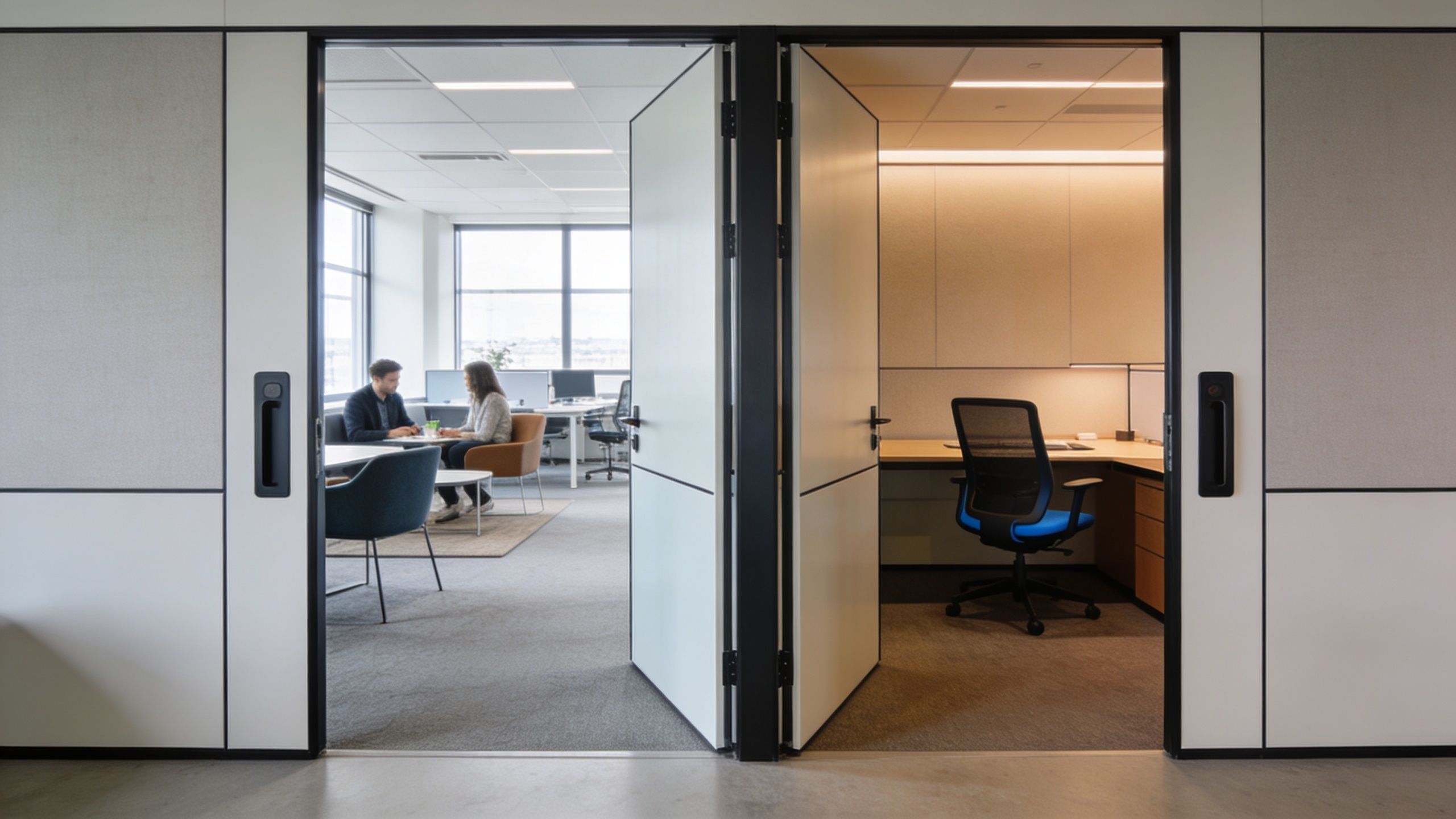
Modern office partitions with door systems solve a different problem. They let you shape private space inside an existing footprint without committing to a full demolition-and-rebuild cycle. Glass fronts, framed systems, demountable walls, and mixed-material partitions all make it possible to carve out enclosed rooms while keeping the layout reworkable.
Why more teams are moving away from fixed construction
The market direction reflects what facilities teams already know from experience. The global glass partition market is projected to reach USD 4.8 billion in 2025 and grow to USD 6.46 billion by 2035, driven by modular systems that balance collaboration and seclusion without permanent construction, according to Cubicle By Design’s overview of office glass wall partitions.
That projection matters because it matches what happens on the ground. Companies want enclosed space, but they also want options. They want room for private meetings, heads-down work, HR conversations, and video calls without locking the entire floor plan into one long-term decision.
Three practical advantages usually drive the choice:
- Faster adaptation: A modular wall system is easier to revise than conventional framing and drywall.
- Cleaner visual continuity: Glass and mixed-panel systems preserve openness better than solid built walls.
- Lower disruption risk: Reconfigurable layouts are easier to update when departments expand, contract, or relocate.
If you’re comparing approaches, it helps to review how modular office walls are used in active workplaces rather than thinking of them as a design accessory. They’re an operational tool.
Practical rule: If you already know the layout will change again, build for the second move, not just the first one.
Where office partitions with door work best
These systems do their best work in offices that need a mix of openness and enclosure. That includes hybrid workplaces, startups that expect growth, call-intensive environments, and departments that need private rooms inside a larger shared floor.
They also work well when a company wants to preserve natural light. Full solid walls can visually shrink a floor plate fast. Glass partitions, especially when paired with doors and selective privacy film, let you create enclosed rooms without turning the center of the office into a dark corridor.
That balance shows up outside corporate headquarters too. Small business owners often wrestle with the same trade-offs at a different scale, and a practical guide on how to set up your home office is useful because the core issues are similar: privacy, light, circulation, and furniture placement all have to work together.
What modular walls do better than people expect
Most buyers first notice the look. Experienced planners focus on the downstream effects.
A well-designed partition system can support:
- Private offices without major reconstruction
- Meeting rooms inside open-plan space
- Doors, blinds, and privacy treatments where needed
- A future reconfiguration path instead of a dead-end build
That last point is the one people miss. A partition project shouldn’t just solve today’s seating chart. It should make the next change less painful.
Choosing Your System Partition Materials and Door Types
Material and door choices decide whether the finished room feels calm, flimsy, bright, claustrophobic, private, or expensive. Because of these, many projects go sideways. Buyers focus on appearance first, then discover later that the wrong door swing blocks circulation, the wrong panel material exposes every conversation, or the nice-looking glass spec doesn’t perform the way they assumed.
The decision gets easier when you separate two issues. First, choose the panel material based on privacy, light, and maintenance. Then choose the door type based on traffic pattern, available clearance, and how often the room will be used.
Glass versus solid and composite panels
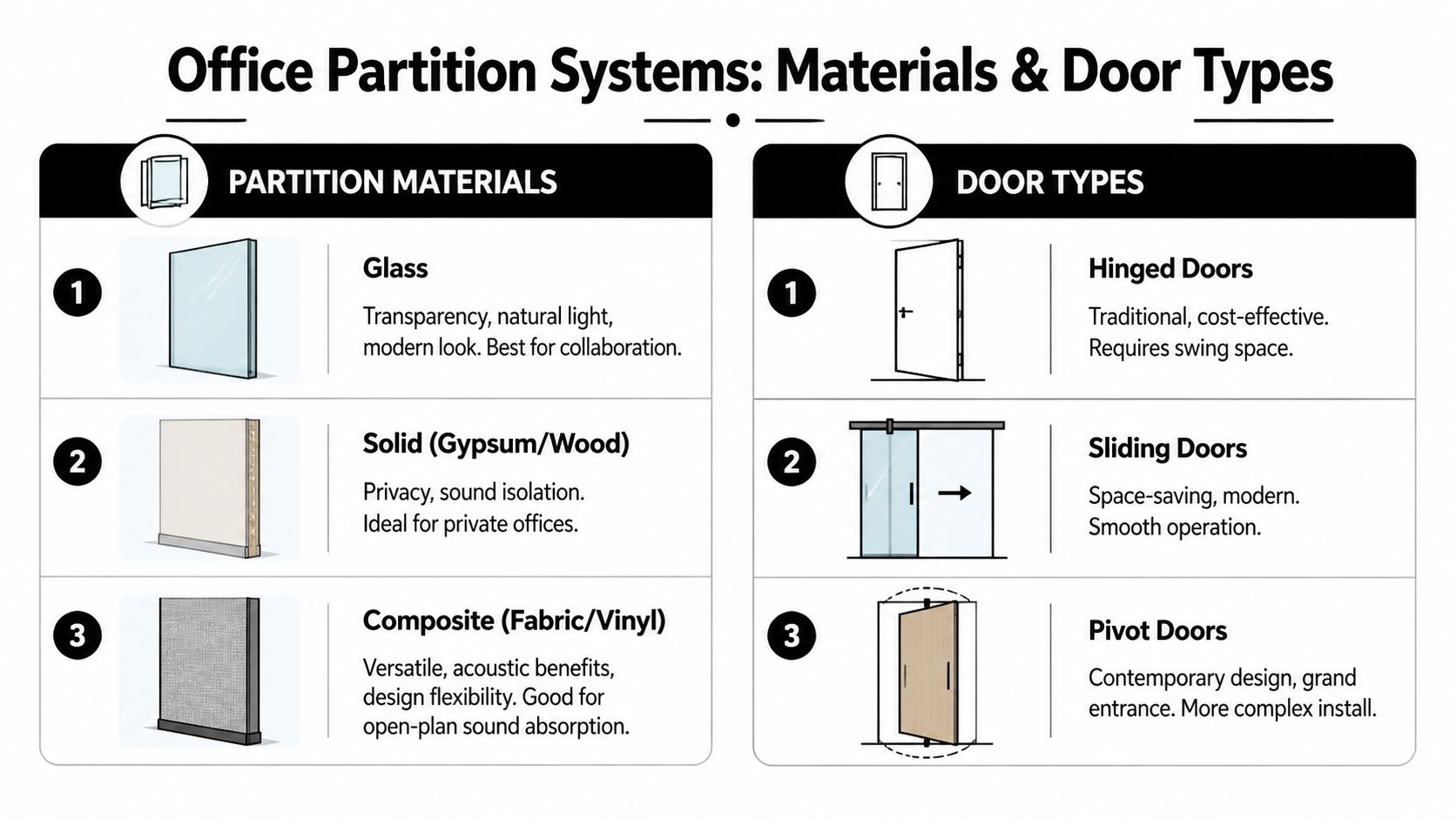
Glass remains the default choice when a client wants openness, visibility, and daylight. It works especially well for front offices, conference rooms, and private offices where visual connection matters. But glass isn’t one thing. Thickness matters, framing matters, and door detailing matters.
Modern partition systems support infill thicknesses from 2-25 mm, with 8, 10, and 12 mm tempered glass commonly used for fixed walls and door leaves. Thicker glass improves sound insulation, with benchmarked systems reaching up to 47-64 dB reduction, according to Aluprof’s partition system documentation.
Solid panels, including laminate-faced or gypsum-style components, trade transparency for stronger privacy. They’re useful when a room handles confidential conversations or when occupants don’t want to feel visible all day. Composite options, such as fabric-faced acoustic panels paired with glass, can be a smart middle ground when noise control matters more than a fully transparent look.
Here’s the practical trade-off:
- Glass: Best for light, openness, and a modern look. Less forgiving if acoustic detailing is weak.
- Solid panels: Better for privacy and visual separation. Heavier visual footprint.
- Composite assemblies: Good when you need a custom mix of openness and acoustic absorption.
Door type changes how the room actually functions
A beautiful partition line can still fail if the door type doesn’t suit the room.
Swing doors are the most familiar and often the easiest for users. They’re a strong choice for private offices and meeting rooms where there’s enough clearance for the leaf to open cleanly. Sliding doors save floor area, but they can be less forgiving acoustically unless the system is engineered and sealed properly. Pivot doors create a sharp modern look, though they typically require more planning and cleaner installation tolerances.
For buyers evaluating framed and frameless assemblies, a dedicated look at a door in glass wall system helps clarify how door hardware, stiles, and frame conditions affect the final result.
| Component | Option | Best For | Considerations |
|---|---|---|---|
| Partition | Glass | Open offices, conference rooms, daylight sharing | Needs careful acoustic detailing for speech privacy |
| Partition | Solid laminate or similar | HR rooms, admin offices, confidential work | Reduces openness and borrowed light |
| Partition | Fabric or composite mix | Team areas needing softer acoustics | Finish coordination matters |
| Door | Hinged | Private offices, regular daily use | Requires swing clearance |
| Door | Sliding | Tight layouts, space-saving needs | Acoustic sealing can be harder |
| Door | Pivot | Design-led offices, statement entries | More complex hardware and alignment |
Good-looking glass doesn’t guarantee a good-performing room. The spec on paper and the behavior in use are not always the same thing.
What works and what doesn’t
What works is matching the room to the activity. A manager office used for one-on-ones may benefit from framed glass with a properly sealed hinged door. A touchdown huddle space may function well with more visual openness and less acoustic demand. A call-intensive room usually needs stronger control than buyers expect.
What doesn’t work is forcing one material across every use case to simplify purchasing. Uniformity can look tidy, but function suffers if every room gets the same panel and the same door regardless of purpose.
Planning Your Layout and Configuration
Space planning is where office partitions with door either become useful infrastructure or expensive obstacles. Most layout mistakes come from chasing seat count first and circulation second. That creates pinched aisles, awkward door conflicts, and enclosed rooms that look right on a plan but feel cramped in daily use.
Start with movement. People need to pass through the office without cutting through work zones or waiting for doors to clear.
The pathing numbers that matter
A practical layout should preserve 48-inch primary circulation paths and 36-inch secondary paths. Those dimensions support ergonomic movement and help keep the plan usable when chairs are occupied, doors are opening, and people are carrying materials through the space.
If you violate those clearances, the office starts fighting the user. Someone opens a door and blocks an aisle. A rolling chair backs into traffic. A printer alcove becomes a choke point. Those aren’t styling issues. They’re layout failures.
A workable planning sequence looks like this:
- Mark primary routes first: Main circulation should stay obvious and unobstructed.
- Place enclosed rooms second: Offices, focus rooms, and meeting rooms should sit off those routes without pinching them.
- Fill in workstation areas last: Desks and panels should respond to the circulation plan, not the other way around.
Choosing partition height by task
Height changes the feel of the office more than most buyers expect. Lower panels preserve sightlines and support team awareness. Taller assemblies provide stronger separation but can make a small suite feel segmented if they’re overused.
The following height ranges are useful planning benchmarks from the verified project guidance:
- 50-inch panels: Seated privacy with visual connection
- 66-inch panels: More standing privacy
- 80-inch and higher: Maximum isolation without disrupting HVAC when properly planned
Those height choices should match the work being done. A sales floor may benefit from lower divisions around benching or workstations. A finance office handling confidential calls may need taller enclosures and doors. Private offices along the perimeter can often use more glass to borrow light into interior zones.
For teams mapping these relationships before purchase, office space planning and design is the part to get right early. It’s much cheaper to solve a clearance problem on a plan than after hardware and panels are ordered.
Rooms don’t feel private because they’re enclosed. They feel private when people can use them without interruption, glare, traffic conflict, or constant visual exposure.
Common configurations that hold up well
Some layouts consistently perform better than others.
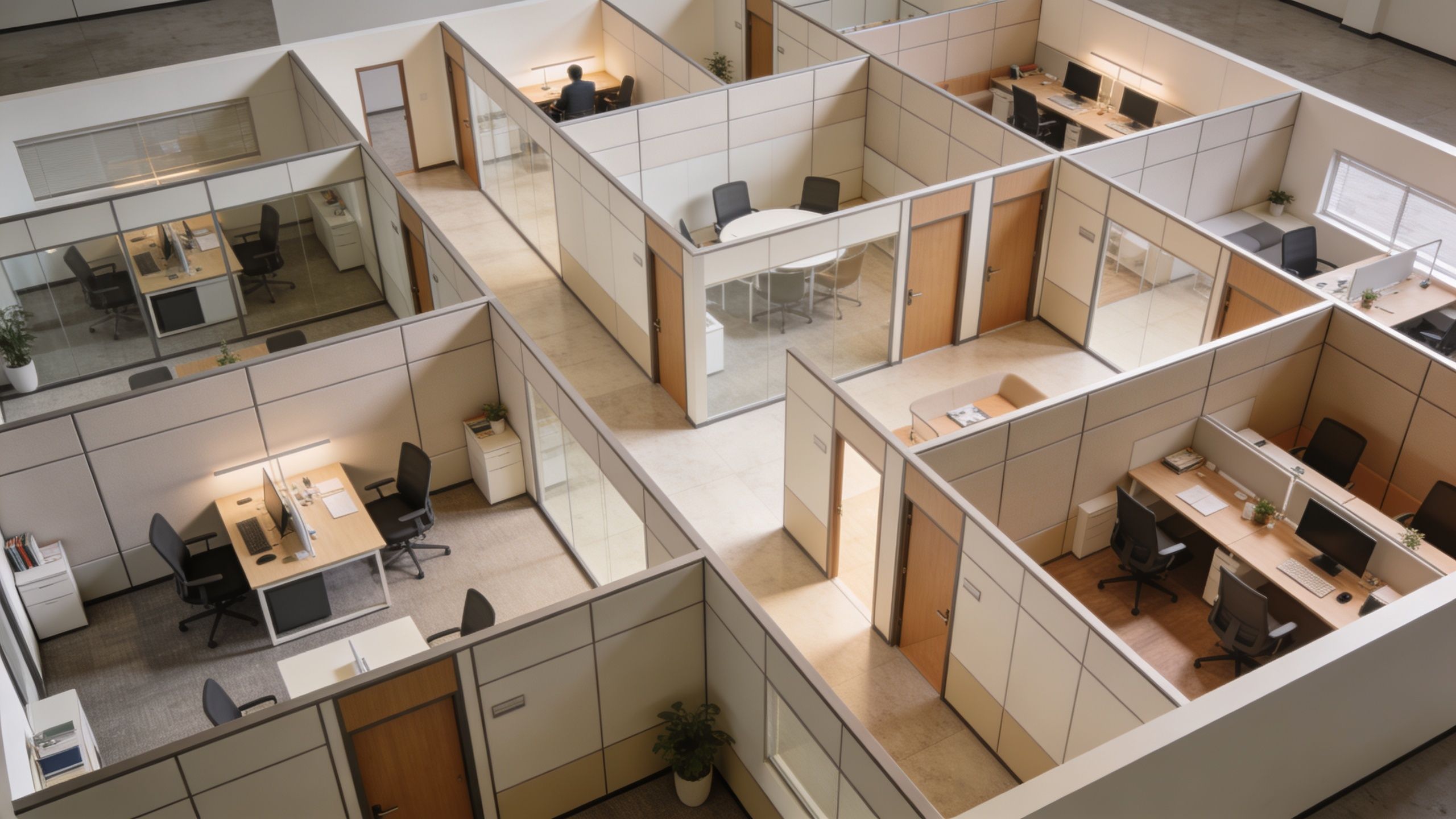
A row of private offices along one side of the floor works well when leadership, HR, or client-facing staff need enclosed rooms. Glass fronts keep the corridor from feeling boxed in. A huddle room inserted into open plan space is useful for quick meetings and video calls, especially when the room sits near shared team zones. A call center support room can also be built inside a larger operations floor, giving supervisors or escalation staff an enclosed area without separating them from the department.
Here’s a useful visual reference before finalizing dimensions and adjacencies:
A real-world planning example
One verified new build project used Series 7 framed partitions to outfit 25 workstations while maintaining 100% visibility and acoustic separation. That example is useful because it shows what many offices are really trying to achieve: visual openness without giving up structure.
The strongest plans do exactly that. They give people enough enclosure to focus, enough transparency to keep the floor open, and enough circulation room that the office doesn’t feel overbuilt.
Understanding Acoustics Fire Codes and Egress
Most disappointment with office partitions with door starts here. Buyers assume a closed glass room will sound private because it looks enclosed. That assumption causes trouble. Acoustic performance depends less on appearance and more on system detailing.
If speech privacy matters, you have to evaluate the wall, the door, the perimeter seals, the gap conditions, and the room around it. One weak point can undo an otherwise solid specification.
What true acoustic performance depends on
The first practical rule is simple. The door is usually the weak link. You can specify good glass and still lose privacy if the door doesn’t seal properly.
Verified technical guidance for demountable glass partitions emphasizes that strong sound control requires full perimeter gasketing on door frames, drop seals, and closers. Without those details, sound leaks around the edges and reduces effective performance. That’s why an ordinary off-the-shelf door often disappoints when installed next to heavier acoustic glass.
A few field-tested observations hold up across projects:
- Framing helps control leakage: Framed systems often make it easier to manage seals and alignment.
- Door hardware matters: Closers and seal packages are functional components, not cosmetic add-ons.
- Glass thickness isn’t enough by itself: Heavier glass helps, but leakage at the perimeter still defeats privacy.
If acoustic control is a priority, review options built around office acoustics solutions rather than treating acoustics as an afterthought after the layout is done.
Field note: If you can see daylight around the door edge, sound is moving through it too.
Why code conversations should happen early
Fire codes and egress aren’t optional cleanup items at the end of the project. They shape the plan from the beginning. Door location, direction of travel, corridor width, and exit access all have to work with the partition layout.
Even when a demountable wall feels more like furniture than construction, the installed result still affects how occupants move through the space. Facilities managers should verify local code requirements for:
- Egress paths
- Door clearances
- Exit access
- Any material or glazing requirements that apply to the occupancy
The right process is to coordinate with the building team, installer, and code authority before final approval. That avoids the common mistake of approving a clean-looking floor plan that later needs revisions because a corridor is compromised or a door interrupts the means of egress.
Fire safety and realistic expectations
Not every office partition project requires the same type of fire-rated solution. That depends on the building, occupancy, and where the partitions sit in the overall plan. What matters is that buyers don’t assume all modular systems can be dropped anywhere without review.
In practice, the safest approach is to ask three questions early:
- Is this room part of a required path of travel?
- Does the door interfere with emergency movement when open?
- Do local requirements trigger any special assembly or glazing rules?
When those questions are answered early, the rest of the project gets easier. When they’re ignored, code corrections usually show up late and cost more to fix.
Integrating Power Data and Hardware
A partition line that looks clean but leaves cords draped across the floor hasn’t solved the problem. It has moved the problem. Power and data integration is one of the clearest differences between a well-planned installation and a rushed one.
This issue has become more visible as offices reconfigure more often. A 2025 JLL Global Workplace Trends report indicates that 68% of office managers cite cabling complexity as a top barrier to reconfiguring office layouts, as noted in Porta-King’s discussion of modular office wall partitions. That rings true in the field. Cabling is rarely glamorous, but it drives whether a room is usable on day one.
What integrated raceways actually solve
Integrated raceways and concealed channels reduce three recurring problems at once. They clean up the visual field, reduce trip hazards, and make future changes easier. If a room is meant for hybrid meetings, focused office work, or a bank of workstations, users need outlets and data access where the activity happens, not wherever the base building happened to leave them.
Good planning usually covers:
- Outlet locations near actual work points
- Data routing for enclosed offices and shared rooms
- Separation of visible technology from public-facing finishes
- A path for future changes without opening finished walls
This is where a product-level detail matters. Some modular systems include built-in electrical pathways and coordinated power options. For example, office cubicle power pole components are used to bring power into panel-based layouts where clean vertical distribution is needed.
Hardware choices affect more than appearance
Hardware selection is often treated like a finish decision, but it’s also a use decision. Handles, locks, closers, thresholds, and latching hardware all shape how a room performs.
A few practical examples:
- Locking hardware: Useful for HR rooms, admin offices, and spaces where records or equipment need controlled access.
- Lever handles: Easier for broad user access than more decorative but less practical hardware.
- Closers: Help maintain consistent door behavior and support acoustic sealing.
- Privacy films and blinds: Add selective screening without turning the entire room opaque.
Security planning sometimes overlaps with building-wide access control, especially in shared facilities or multi-tenant properties. For readers managing those broader building concerns, this overview of access control for property managers is a helpful companion resource because it frames access decisions at the property level, not just at the individual office door.
A private office isn’t fully functional until the user can power devices, connect to data, close the door properly, and secure the room when needed.
One place where planning tools help
This is also the one part of a project where digital configuration tools save time. During early planning, teams can test outlet locations, panel runs, and door positions before anything is ordered. One example is the Custom Cubicle Designer, which lets buyers work through dimensions, privacy levels, finishes, storage, and electrical options in a more structured way than passing sketches back and forth.
That kind of planning discipline matters because power, data, and hardware are the details that users notice after move-in. If they’re right, nobody talks about them. If they’re wrong, the room never quite works.
Budgeting Installation and Your Next Steps
Budgeting gets easier when you stop asking for a single price per room and start pricing the variables that change the outcome. For office partitions with door systems, the main cost drivers are material choice, door type, height, acoustic detailing, and whether power and data are integrated into the assembly.
Installation planning should be just as disciplined. Verify dimensions, confirm field conditions, review building rules, and coordinate trades before materials arrive. If electrical work, access control, or specialty hardware are involved, make sure those scopes are aligned before install day. That’s also why it helps to understand what contractor credentials mean in practice. This breakdown from Jolt Electric on contractor verification gives a clear explanation of the difference between licensed, bonded, and insured.
A simple decision framework
Use this sequence when moving the project forward:
- Define the room purpose first: A manager office, call room, meeting room, and touchdown space shouldn’t be specified the same way.
- Choose the system around function: Don’t let the finish sample decide the room.
- Confirm layout and code conditions early: Clearance and egress issues are cheaper to solve before procurement.
- Plan maintenance upfront: Glass needs routine cleaning, hardware needs periodic adjustment, and seals should be inspected if privacy matters.
For buyers comparing product paths, it helps to review cubicles, private office cubicles, and workstation cubicles side by side. Different teams need different levels of enclosure, and not every project needs full-height walls.
The best next step is to turn your needs into an actual plan. That means identifying who needs privacy, where circulation has to stay open, what must be powered, and which rooms need stronger acoustic treatment. Once that’s clear, the specification becomes much easier.
If you’re ready to move from ideas to a working layout, Cubicle By Design can help you map the space, compare modular options, and build a practical plan around privacy, power, circulation, and budget.