


Meta Title: Office Storage Credenza Expert Buying Guide | Cubicle By Design
Meta Description: Learn how to choose the right office storage credenza for size, layout, security, and modular integration. Expert buying guidance from Cubicle By Design.
Office Storage Credenza Expert Buying Guide
You usually know it’s time for an office storage credenza before anyone says it out loud.
The printer has claimed a side table. Extra toner is stuffed into a lateral file that was never meant to hold supplies. Project binders migrate from desk to desk. Someone runs a charging cable across a walkway because there isn’t a better route. The office still functions, but it doesn’t feel settled.
That’s the point where a credenza stops being a decorative add-on and becomes a planning decision. In a well-run workplace, storage has a job. It should hide visual noise, support daily work, protect sensitive items, and free the primary desk for core work instead of overflow.
A lot of first-time buyers make the same mistake. They shop by finish first, then width, then price. The better order is workflow, placement, capacity, and only then appearance. If you get the first three right, the credenza earns its footprint. If you get them wrong, it becomes another flat surface that collects clutter.
The End of Office Clutter Starts Here
A familiar office scenario goes like this. The front-facing areas look decent enough, but the working surfaces tell the truth. Stacks of folders sit beside monitors, supply boxes live under guest chairs, and every shared device seems to bring one more visible cord into the room.
The problem is that piecemeal storage rarely supports how people move through the day. It spreads items around the room instead of giving them a home.
The office storage credenza fixes that when it’s chosen for function first. It creates concealed storage close to the point of use. It also gives you a low, stable surface for printers, devices, intake trays, or staged materials without crowding the main workstation.
There’s also a useful bit of context behind the piece itself. The credenza evolved from a medieval European furniture piece originally designed as a security measure for food and drink to protect nobles from poisoning, before becoming the decorative and functional storage furniture used in offices today, as noted in this history of the credenza.
Where clutter usually starts
Most clutter problems in offices fall into a few categories:
- Paper drift: Active files stay out because enclosed storage is too far away or too hard to use.
- Supply creep: Everyday items get stored wherever there’s open space.
- Tech sprawl: Printers, chargers, and spare cables land on whatever surface is available.
- No ownership: Shared items have no assigned storage zone.
A quick reset helps. This office declutter checklist is a practical starting point if you need to identify what should stay visible, what should be concealed, and what can leave the room entirely.
Practical rule: If staff use an item weekly but don’t need it on the desktop, the credenza is often the right home for it.
Good storage also depends on good habits. If you’re tightening both physical and digital organization, this article on how good file management impacts your office is worth reviewing before you finalize a layout.
What Exactly Is an Office Credenza
An office credenza is a long, low storage unit that typically sits at desk height or near it. In practical terms, it works as a secondary work surface plus concealed storage. That combination is what separates it from furniture that looks similar but behaves differently in daily use.
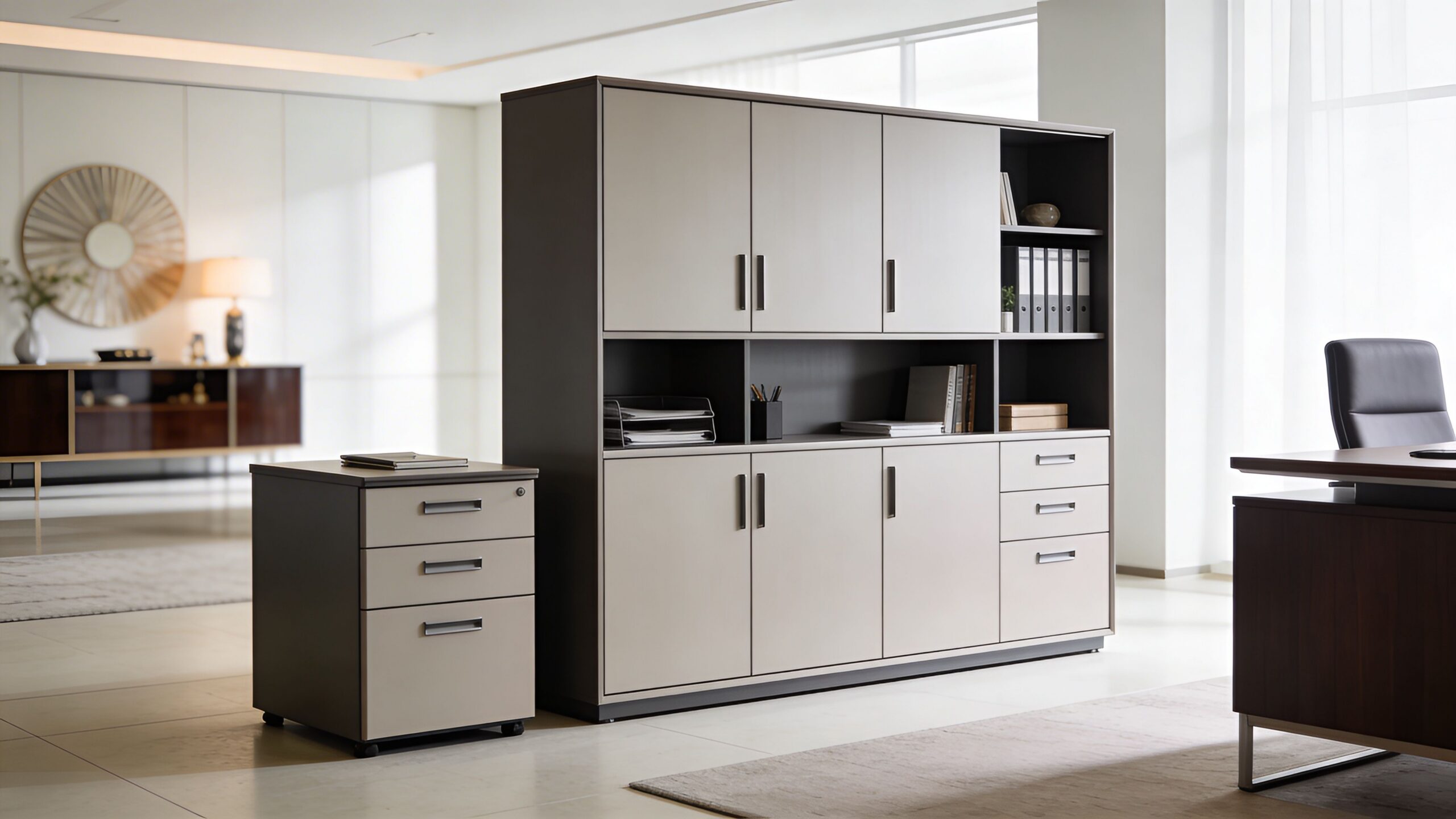
A sideboard or buffet may look close in shape, but those pieces are usually chosen for residential or hospitality settings first. A standard filing cabinet is more specialized. It stores paper well, but it doesn’t give you much usable top surface, and it rarely integrates gracefully into a modern office footprint.
Why this furniture category exists
The office credenza is the product of a long shift in workplace storage. The precursor was the vertical filing cabinet, which was invented between 1891 and 1898 and became ubiquitous in offices worldwide by 1920 according to this history of the filing cabinet. That adoption happened because offices needed faster access to information.
That same need still drives storage purchases now. The difference is that modern work requires more than paper retrieval. Offices need space for devices, shared tools, personal storage, presentation materials, and the visual calm that comes from hiding operational clutter.
How it works in real offices
A credenza usually supports one of these setups:
- Behind a desk: Common in private offices where the main desk faces visitors.
- Beside a workstation: Useful when the user needs quick access to files, supplies, or a printer.
- At the edge of a shared area: Good for team storage without adding tall visual barriers.
- As part of a desk suite: Often paired with bridges, hutches, or return surfaces.
The best way to think about it is this. A desk handles the active task in front of you. A credenza handles the tools and materials that support that task.
What it is not
It’s not just “extra storage.” That framing leads buyers to oversimplify the purchase.
A real office storage credenza should do at least three things well:
- Conceal disorder so the room reads clean and professional.
- Support workflow by placing tools close to where work happens.
- Add useful surface area without making the room feel crowded.
In well-planned offices, the credenza becomes the quiet command center. It holds the messy parts of work so the workstation can stay focused.
If a unit can’t do those jobs, it may still be a cabinet. It just isn’t the right credenza.
Choosing Your Credenza Type and Materials
Effective buying decisions are made at this stage. The right office storage credenza isn’t only about style. It’s about whether the type and material match your office conditions, your users, and the amount of abuse the unit will take over time.
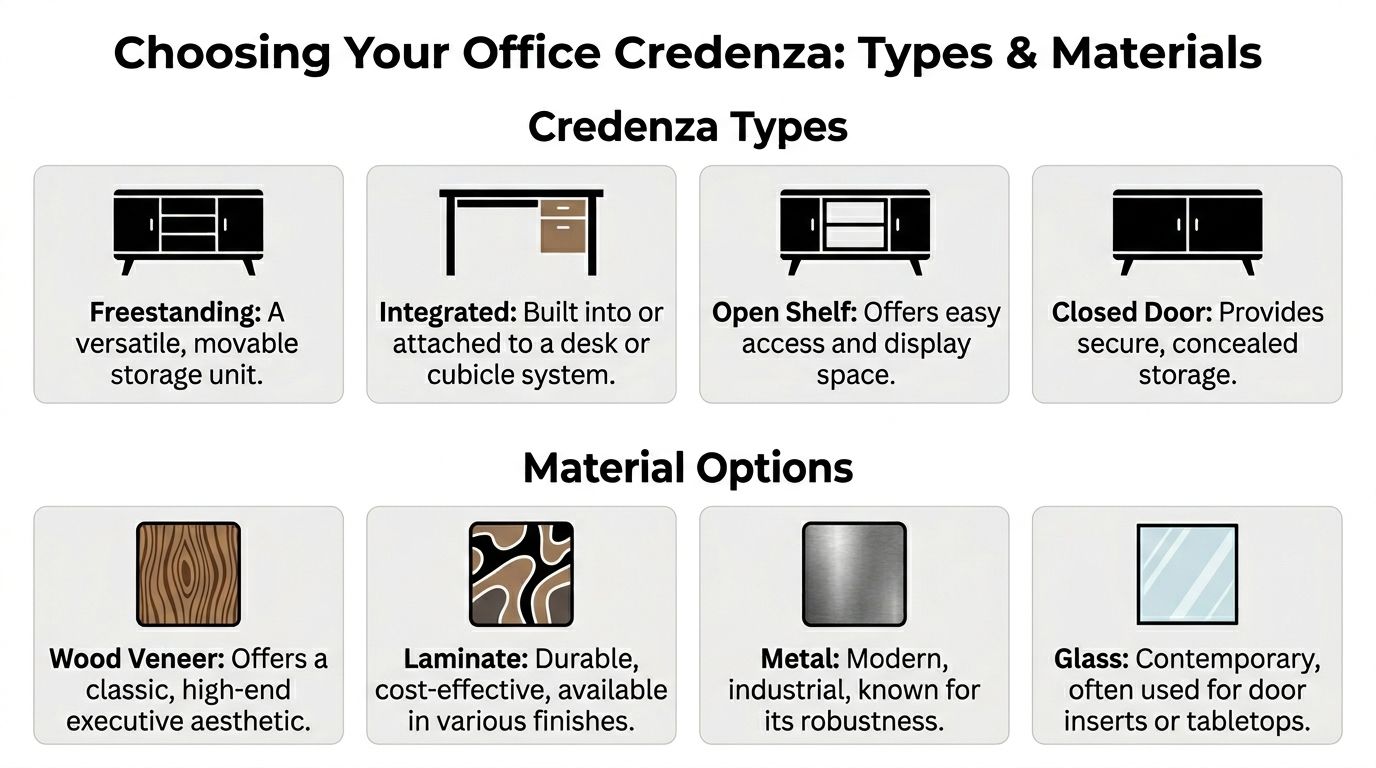
Commercial-grade credenzas are typically 70 to 72 inches wide and weigh 205 to 250 pounds, with interior shelves often rated for 75 to 100 pounds. Laminate tops are commonly engineered to resist heat and spills, as shown in these commercial credenza specifications. Those details matter because they tell you the piece is built for office use, not occasional home use.
Start with type, not finish
The first choice is how the credenza will live in the room.
Freestanding credenzas
These are the easiest to place and replace. If you expect reconfiguration, departmental moves, or lease changes, freestanding is often the safest bet.
They work well when:
- Teams change often: You can move the unit without rebuilding a workstation.
- The room serves multiple purposes: It can support storage one year and devices the next.
- You’re testing a layout: A freestanding piece lets you correct course more easily.
The trade-off is that freestanding units can look disconnected if the rest of the office uses coordinated systems furniture.
Integrated or knee-space credenzas
These act as part of a workstation rather than a separate cabinet. They’re strong choices for private offices, manager stations, and support roles that need desk space plus nearby storage.
They usually work best when:
- The user handles both focused computer work and frequent paperwork.
- You want an L-shaped or U-shaped layout without adding bulky vertical storage.
- The office uses modular planning and matched finishes.
Open-shelf and closed-door variants
Open shelves give quick access, but they also display everything. Closed doors keep the room calmer and more professional.
In most workplaces, closed-door credenzas win because they hide the items that make offices feel chaotic. Open storage works best for reference materials, display pieces, or carefully managed team zones.
Material affects maintenance more than buyers expect
Material changes how the credenza looks on day one, but it also changes how it ages.
| Material | Pros | Cons | Best For |
|---|---|---|---|
| Laminate | Durable, easy to clean, resists everyday wear, practical for multi-user environments | Less warmth than real wood veneer | High-traffic offices, shared workstations, budget-conscious projects |
| Wood veneer | Executive appearance, richer finish, strong fit for client-facing spaces | Can show wear more easily, often needs more careful maintenance | Private offices, leadership spaces, board-facing environments |
| Metal | Sturdy feel, strong security impression, works in industrial or technical spaces | Colder visual effect, can feel too utilitarian in polished offices | Back-office operations, records rooms, technical teams |
| Glass accents | Light, contemporary look, breaks up heavy cabinetry visually | Shows fingerprints, reveals contents if too transparent | Design-led offices, selective display storage |
For teams comparing panel construction and door durability in more detail, this primer on MDF vs. wood cabinet doors gives useful background. It’s residential in framing, but the material logic still helps buyers ask better questions.
What tends to work best
Laminate is the safest all-around choice for most offices. It’s durable, easier to maintain, and usually better suited to shared environments where surfaces take daily abuse from bags, mugs, boxes, and devices.
Wood veneer earns its place when appearance carries weight. That’s common in executive offices, conference-adjacent spaces, and any room where clients spend time.
Metal works when security or toughness outranks warmth. It’s rarely the best aesthetic choice for the whole office, but it can be right in operational settings.
What buyers often get wrong
A few patterns show up over and over:
- They buy residential furniture for commercial use. It looks fine at delivery and ages badly.
- They choose open shelving because it looks lighter. Then the shelves fill with unattractive office overflow.
- They overvalue the finish and undervalue the hardware. Doors, hinges, and shelf strength determine whether the piece still works years later.
- They ignore how the credenza relates to surrounding systems furniture. That’s where visual mismatch starts.
If the office needs to scale, move, or reconfigure, flexible planning usually beats a beautiful one-off piece.
For a broader look at compact storage strategy in tighter layouts, this guide to storage cabinets for small spaces is a useful companion when you’re building a shortlist.
Planning for Size Capacity and Placement
Most credenza mistakes happen before the order is placed. Buyers either choose a unit that fits the wall but not the workflow, or they buy enough storage on paper that still doesn’t hold what the user needs in practice.
The fix is simple. Measure the room, audit the contents, and trace the daily path of work.
Measure the room like an installer would
Don’t stop at the wall width. A credenza has to arrive, clear nearby furniture, allow door swing, and still leave the user enough space to move comfortably.
Check these first:
- Overall wall space: Measure the full span, then subtract trim, outlets, returns, and adjacent furniture.
- Usable depth: A credenza that projects too far can tighten circulation quickly.
- Door and drawer swing: Open doors need clearance from chairs, side walls, and passing traffic.
- Access path: Elevators, hallways, and office entry points can all become delivery problems.
- Floor condition: Uneven floors affect stability and alignment.
Audit what goes inside
A buyer may say they need “file storage,” but that can mean very different things. It might mean banker boxes, binders, reams of paper, locked HR records, spare peripherals, or a desktop printer that should no longer sit on the main desk.
List the contents by category:
- Paper storage such as active files, archive folders, binders, and forms.
- Supplies like toner, stationery, batteries, headsets, and packaging materials.
- Technology including printers, docking devices, chargers, and power bricks.
- Personal or restricted items that should stay concealed or locked.
This inventory tells you whether you need shelves, file capability, lockable compartments, or a top surface dedicated to equipment.
Map where work happens
A credenza should remove friction, not create it. If the user has to stand, pivot, or cross a walkway every time they need a file or device, placement is off.
Look at the rhythm of the role:
- Administrative staff often need the credenza within immediate reach.
- Managers may prefer it behind the desk for clean visitor-facing presentation.
- Shared team areas usually need central placement without blocking sightlines.
- Hybrid touchdown spaces benefit from storage that supports quick resets between users.
A credenza earns its floor space when it shortens reach, reduces visual clutter, and keeps support tools off the main desktop.
For larger moves, professional office space planning and design becomes valuable in this context. It helps prevent one storage decision from creating three circulation problems elsewhere.
A placement test that works
Before you buy, tape the footprint on the floor.
Then add a chair, open an imaginary door swing, and walk the path a user takes from entry to desk to printer to guest seating. This low-tech test catches a surprising number of layout errors.
If the footprint feels intrusive before the credenza even arrives, it won’t feel better after installation.
Integrating Credenzas with Modular Cubicles
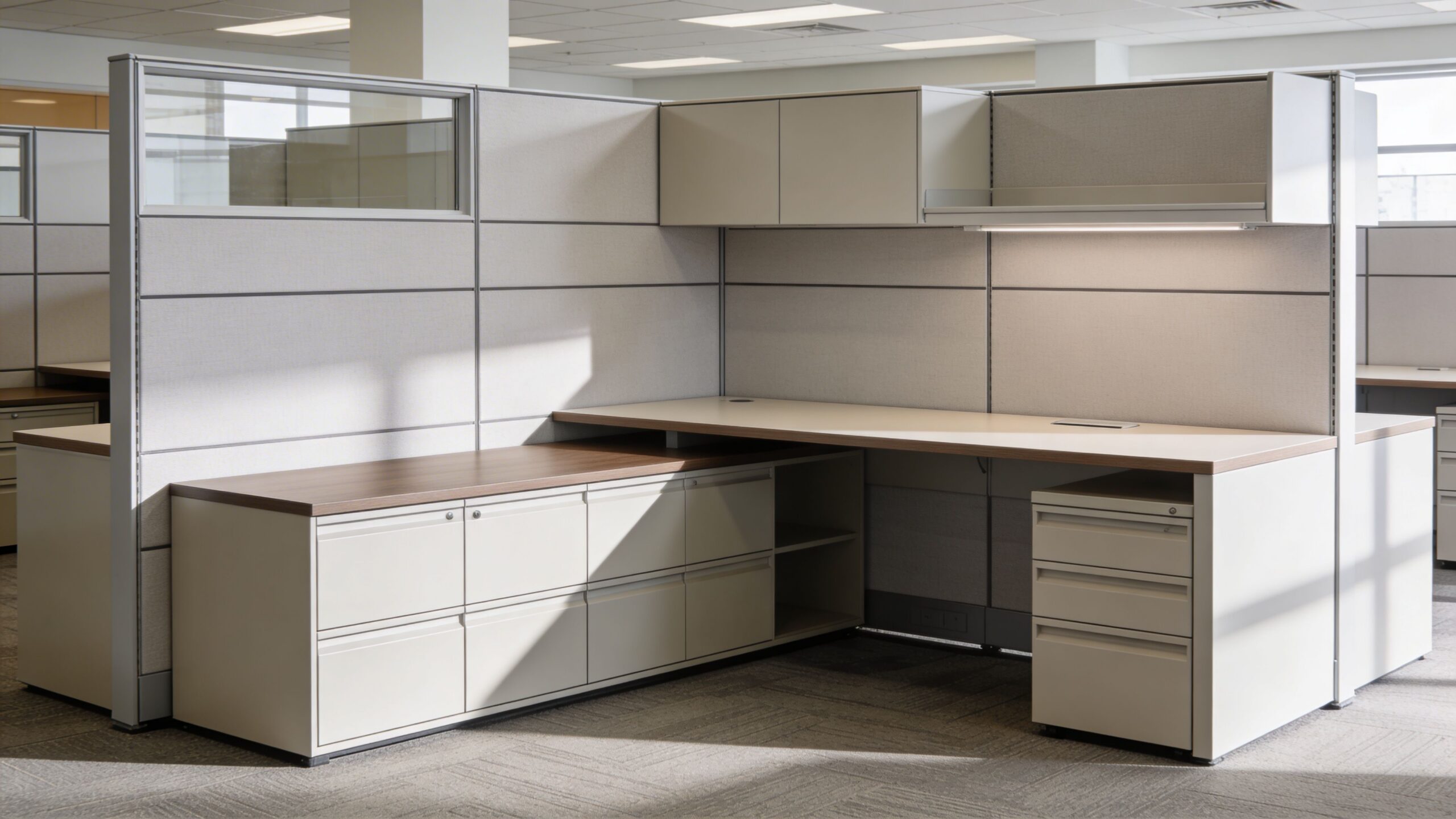
A credenza gets more useful when you stop treating it as a standalone box and start treating it as part of a system. That’s especially true in modular offices, where storage, worksurfaces, privacy panels, and power all compete for the same footprint.
The best layouts don’t bolt on storage at the end. They build it into the workstation logic from the beginning.
Why integration changes the purchase
In a modular setting, a credenza can do more than hold supplies. It can help define the shape of the workstation.
That often means:
- creating an L-shaped work zone without adding another desk,
- extending usable surface area for printers or active project materials,
- preserving a cleaner visual line than multiple small storage pieces,
- matching surrounding finishes so the office reads as a coordinated whole.
Integrated credenzas outperform random add-ons in such scenarios. They support the user and the floor plan at the same time.
Where they fit best
A credenza tends to work particularly well in these modular applications.
Manager and lead stations
These roles often need a workstation that handles computer work, paperwork, and short in-person conversations. A credenza placed perpendicular or behind the main desk gives them a second surface and concealed storage without making the station feel heavy.
Team-based workstation clusters
In clustered layouts, low-profile credenzas can support shared devices or localized storage while preserving openness better than tall cabinets.
Private office systems
Even enclosed modular offices benefit from credenzas because they create a more complete furniture suite. The room feels planned rather than assembled.
Using a configurator the right way
When you’re working with modular furniture, visualization tools save time only if you use them with real inputs. The mistake is treating the configurator like a style picker.
Use it as a planning tool instead:
- Set true dimensions first: Don’t estimate the room. Enter real constraints.
- Choose privacy intentionally: Panel heights affect how visible the credenza remains and how open the station feels.
- Match finishes across elements: The credenza should belong to the workstation, not look imported from another project.
- Think through storage hierarchy: Decide what stays at desk level, what moves into the credenza, and what should live overhead or elsewhere.
- Account for power early: A printer credenza with no sensible cable route becomes a surface problem again.
For buyers planning broader system layouts, this overview of modular office cubicles helps frame how storage pieces should support the larger workstation strategy.
The practical advantage of systems thinking
What works in real offices is consistency. If every station follows a similar storage logic, staff learn where things belong, reconfiguration gets easier, and the office remains coherent as teams grow.
That’s one reason modular systems with compatible credenzas make sense for phased projects. You can add capacity later without making the second phase look unrelated to the first.
A few linked planning tools are especially useful during early layout work:
- Cubicle By Design for overall workstation planning
- cubicles to review system options
- Cubicle Designer tool for visual configuration
- private office cubicles for enclosed office applications
- workstation cubicles for open-plan team layouts
The smartest credenza purchase is rarely a single-furniture decision. It’s a workstation decision.
When that shift happens, buyers stop asking only, “Where can this cabinet fit?” They start asking, “How should this station work?” That’s the better question.
Security Cable Management and Code Compliance
A credenza may look simple from the outside, but the professional-grade difference is usually in the technical details. Security, cable routing, and stability features determine whether the unit supports a real office or just occupies floor space.
That matters most in shared, regulated, or high-traffic environments.
Security is not optional in many offices
If the credenza will hold personnel files, financial records, medical paperwork, devices, or backup media, locking storage is part of the specification, not an upgrade.
Good questions to ask:
- What exactly is being secured? Paper files, electronics, or both?
- Who needs access? One person, one department, or facilities staff?
- Does the room already provide security? If not, the credenza may need to do more of the protective work.
- Will keys create an admin problem? Even a solid lock is only useful if access control remains manageable.
For many buyers, the right answer is simple locked concealed storage. The mistake is assuming any cabinet door provides meaningful protection.
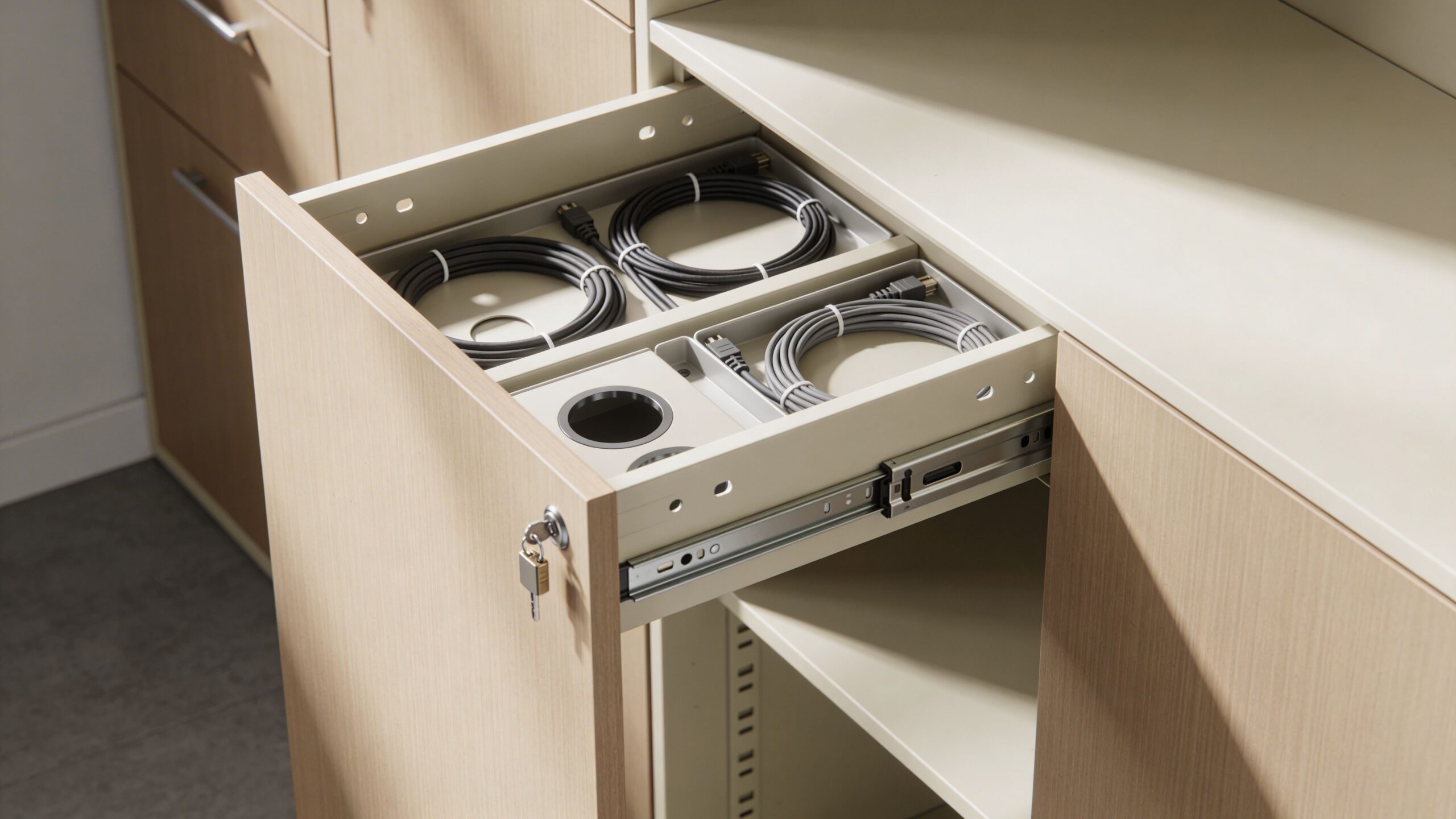
Cable management affects safety and appearance
A printer credenza without cable planning usually becomes a mess within days. Wires drape behind the unit, adapters pile inside the compartment, and staff route charging cables through the nearest gap.
Integrated wire management is one of the most practical features to insist on. According to this credenza buying guide with safety details, wire management grommets measuring 1.5 to 2 inches in diameter can reduce office trip hazards by up to 40%. That’s a strong operational reason to choose a credenza built for electronics, not just storage.
Look for:
- Grommets or pass-throughs that let cables enter and exit cleanly
- Interior space for power bricks and adapters
- Ventilation awareness if the credenza will house active equipment
- A clean route to wall or floor power so cords don’t cross circulation paths
If the workstation system also needs vertical cable routing, planning that with a cubicle power pole keeps the whole setup cleaner and safer.
Stability and accessibility matter too
A credenza has to sit level, especially on imperfect commercial floors. The same K-Log guide notes that adjustable leveling glides are essential for counteracting floor imperfections and preventing tipping under ANSI/BIFMA X5.5 safety standards. That’s one of those details buyers don’t notice until doors won’t align or the unit rocks under load.
Accessibility also deserves attention. In shared offices, make sure placement, top height, and surrounding clearance support the users. A credenza that blocks approach or creates a tight maneuvering zone may look fine on paper and fail in use.
A practical specification checklist
Before approving a unit, confirm these points:
- Locking function: Appropriate for the level of document or device security needed
- Cable routing: Built into the unit, not improvised after install
- Leveling glides: Required for real-world floor conditions
- Commercial hardware: Hinges and pulls suited to repeated office use
- Clear access: Doors and placement won’t create pinch points or circulation issues
The common thread is simple. A credenza should reduce risk, not create new points of failure.
Budgeting for Your Office Storage Credenza
Most buyers ask, “What does an office storage credenza cost?” The better question is, “What will this piece cost us over time if we buy the wrong one?”
That shift matters because a credenza is rarely just a line item. It affects storage capacity, office appearance, staff efficiency, and how often you’ll need to replace or repair the unit.
Stop looking at price in isolation
A cheaper credenza can become expensive fast if it wears poorly, can’t handle the load, or doesn’t fit the office well enough to solve the original problem. In practice, low initial pricing often hides compromise in materials, shelf strength, hardware, or integration.
The more useful budget conversation includes:
- Expected lifespan
- Maintenance and cleaning demands
- Whether the unit can adapt to future layout changes
- How much clutter or workspace pressure it removes
- Whether it protects equipment and sensitive materials appropriately
That’s why Total Cost of Ownership matters so much here. As this credenza category overview focused on ROI gaps points out, many guides emphasize appearance but miss lifespan, maintenance cost, and ROI in terms of space efficiency and productivity.
What usually drives the budget up
Some upgrades are cosmetic. Others are worth paying for.
The features that usually justify additional spend are:
- Commercial-grade construction instead of residential build quality
- Better hardware for doors and locks
- Integrated cable management for tech-heavy setups
- Finish coordination with surrounding office systems
- Modular compatibility if the office may reconfigure later
By contrast, highly decorative detailing often increases price without improving performance.
A simple decision framework
When comparing options, sort them into three buckets.
Buy now and keep long term
This is the right bucket for commercial laminate or well-specified veneer credenzas that match the rest of the office and solve a durable need.
Acceptable for temporary use
This may fit short leases, swing spaces, or transitional departments, but it shouldn’t be mistaken for a long-term standards solution.
False economy
This includes underbuilt cabinets, poor fit for the room, missing cable management, or furniture that looks better than it functions.
Budget discipline doesn’t mean buying the least expensive credenza. It means buying the least expensive credenza that won’t need to be corrected later.
Facilities teams usually feel the difference six months after installation, not on ordering day.
Frequently Asked Questions About Office Credenzas
Should a credenza replace filing cabinets entirely
Not always. If the office still handles a large volume of active paper records, dedicated filing may still be necessary. A credenza works best when you need a mix of concealed storage and usable top surface.
Is laminate good enough for professional offices
Yes, in many offices it’s the most practical choice. Commercial-grade laminate is durable, easier to maintain, and well suited to shared or high-traffic settings.
Do I need locking doors
If the unit will hold sensitive files, devices, or anything that shouldn’t be openly accessible, yes. Even in lower-risk offices, locks can help control casual access.
What size office storage credenza is most common
Commercial units often land in the larger-width range discussed earlier in this guide, but the right size depends on placement, circulation, and what the user needs to store. The room should determine the dimensions, not the catalog page alone.
Can a credenza hold a printer
Often, yes. But verify shelf capacity, top durability, cable routing, and whether the unit has enough interior space for supplies and power components.
Is a credenza better behind the desk or beside it
Both can work. Behind the desk is common in private offices and gives a cleaner visitor-facing presentation. Beside the desk is better when the user needs fast access throughout the day.
What’s the biggest buying mistake
Choosing based on appearance before workflow. A credenza should solve a storage and layout problem first. Finish comes after that.
If you're planning a new office, reworking an existing footprint, or trying to integrate storage into a cleaner modular layout, Cubicle By Design is a strong place to start. Their team can help you think beyond a standalone office storage credenza and build a workstation plan that fits your space, storage needs, privacy requirements, and timeline.