
A Complete Guide to Office Sliding Doors for Modern Workplaces | Cubicle By Design

Walk into any modern office today, and you'll notice something's different. The rigid, walled-off layouts of the past are disappearing. In their place, you’ll find office sliding doors are becoming a go-to solution for creating workplaces that can actually keep up with how we work. They're the secret sauce for solving the biggest problem with open-plan offices: how to get people to collaborate while still giving them a quiet place to focus.

Why Office Sliding Doors Are a Modern Workplace Essential

The modern office is a constant balancing act. You need open sightlines for teamwork, but you also need private nooks for deep work. This is where office sliding doors stop being just doors and start becoming a strategic part of your office design, turning a fixed floor plan into an environment that can change on a dime. Instead of building permanent walls, you can use sliding systems to completely redefine a room in seconds.

Modern office interior with a glass meeting room, blurred figures, open workspaces, and large windows.

Don't just think of them as hardware. Think of them as a key ingredient for a productive, employee-friendly space. They offer an answer that's both stylish and incredibly practical, tackling several major headaches in today's workspaces.

The Strategic Value of Sliding Systems

Office sliding doors do more than just close off a room; they give you a real advantage in how you manage your space. By getting rid of the swing space a traditional door needs, they instantly give you back valuable floor area—often as much as 30 square feet per door. That recovered space can become another workstation, a small breakout area, or just create a more open, uncluttered feeling.

This space-saving feature is a huge reason they’re popping up everywhere. The market is showing it, too, with a projected growth rate of 5.5% a year through 2033. When businesses are reporting productivity jumps of 20-30% just from better traffic flow, it’s clear the right doors do a lot more than just open and close—they change how work gets done.

By bringing in office sliding doors, facility managers can build a flexible backbone for the office that adapts to whatever the business needs, whether that’s growing teams or supporting a hybrid work schedule. They’re a true investment in adaptability.

Enhancing Both Looks and Function

Beyond just saving space, sliding doors can completely elevate the look and feel of an office. A glass sliding door, for instance, keeps the space feeling connected and lets natural light pour in, which makes the whole office feel bigger and more welcoming. This lines up perfectly with the big workplace design trends that focus on employee well-being.

But good looks don't mean you have to sacrifice function. Modern sliding systems come with fantastic acoustic seals, making sure a private meeting actually stays private. In an open office where noise is the number one complaint, being able to create privacy on demand is a game-changer.

At Cubicle By Design, we're experts at making these solutions fit seamlessly into a bigger plan. We often pair office sliding doors with our modular systems, like our private office cubicles and flexible workstation cubicles, to build truly adaptive environments. Whether you’re starting from scratch or updating an existing space, our team can help you use our Custom Cubicle Designer to map out a layout that’s as smart as it is beautiful.

Choosing the Right Type of Office Sliding Door

Not every sliding door is built the same, and picking the right one is less about looks and more about how you need your office to actually work. The door you choose will define the space, affecting everything from acoustics and privacy to the overall vibe of the room.

Think of it like this: a sleek, frameless glass door is like a sharply tailored suit—it’s all about modern professionalism. A rustic barn door, though, is more like a comfortable blazer; it’s stylish, but it also adds a ton of character and warmth. Each has its place, and knowing their strengths is the key to getting it right.

Frameless and Framed Glass Doors

When people think of modern office doors, glass is usually the first thing that comes to mind. But the real decision comes down to choosing between a framed or frameless system.

  • Frameless Glass Doors: These are the definition of minimalist cool. Made from a single, solid pane of tempered or laminated glass, they use very little hardware. This creates a wide-open feeling and lets natural light flood your space. They’re a perfect fit for an executive office that needs to feel connected to the main floor while still having some sound separation.
  • Framed Glass Doors: With these, the glass panels are set inside a sturdy aluminum or steel frame. That frame adds a lot of structural integrity and, more importantly, a huge boost in acoustic performance thanks to better seals. These are the workhorses you want for busy conference rooms or team pods where keeping conversations contained is non-negotiable.

And if you’re concerned about people seeing sensitive information on screens, you can add specialized solutions like Casper Cloaking film to reduce visual hacking. This clever film makes screens look black from an angle, so you get the open feel of glass without the security risk.

Barn-Style Sliding Doors

Barn doors have officially moved out of the farmhouse and into the modern office. They’ve become a seriously trendy and practical choice, mounted on a track above the doorway so the door itself becomes a design element.

These are fantastic for adding personality to break rooms, creative studios, or common areas. Because they come in so many materials—from reclaimed wood to industrial metal—you can make them fit just about any design. A great barn door can be a real statement piece while closing off a noisy kitchen or collaboration hub.

The one big thing to remember with barn doors is the wall space. You need a clear section of wall right next to the opening that’s at least as wide as the door itself. That's where the door will "stack" when it's open.

Pocket and Telescoping Doors

When you’re fighting for every last square inch of floor space, pocket and telescoping doors are your secret weapons. They are the ultimate space-savers, practically vanishing when you don't need them.

  • Pocket Doors: These are masters of disguise. The door panel slides directly into a hidden cavity, or “pocket,” inside the wall. This makes them ideal for narrow hallways, small private offices, or any spot where a swinging door would just get in the way.
  • Telescoping Doors: Imagine a sliding door with multiple panels that stack behind each other on parallel tracks. That’s a telescoping door. They let you open up a much wider space than a single door ever could, making them a great option for dividing large training rooms or creating flexible meeting areas.

Getting these systems to work with fixed partitions requires some smart planning. For ideas on how to pair these doors with other glass elements, you can see how our glass partition walls for offices help create bright and dynamic spaces. By understanding how each door type works and where it shines, you can make a choice that elevates both the look and the function of your office for years to come.

A Balanced Look at the Pros and Cons

Every choice you make in an office design comes with its own set of trade-offs. When it comes to office sliding doors, you need a clear-eyed view of both the good and the bad to make a smart decision. It's about looking past the sleek photos and really understanding how they'll work in your space day in and day out.

The biggest win with sliding doors is, without a doubt, their incredible space-saving ability. A classic swing door needs a wide, clear arc to open, eating up valuable square footage that could be put to better use. Sliding doors get rid of that "dead zone" completely, often reclaiming an average of 30 square feet per door.

Think about it—in a packed office, finding that much extra space for every private office or meeting room can be a game-changer. It might mean the difference between a floor plan that feels cramped and one that feels comfortable and efficient.

This simple diagram can help you decide when a sliding door is the obvious winner over a swing door.

A sliding door decision tree diagram, showing how to choose between a sliding door and a swing door based on available space.

As you can see, the decision often comes down to pure square footage. But beyond that, sliding doors also help smooth out traffic flow in busy hallways and make it easier to meet ADA compliance standards.

Addressing Common Concerns Head-On

While the benefits are strong, it's just as important to tackle the potential drawbacks. The number one concern we hear from facilities managers is about acoustic performance. Will a sliding glass door really keep a sensitive conversation private?

The short answer is yes, but only if you choose the right specs. The secret is in the door’s Sound Transmission Class (STC) rating and making sure it's installed with high-quality acoustic seals. For a deeper dive, you can check out our complete guide on office acoustics solutions.

Cost is another point to consider. The upfront price for a quality sliding door system, especially for complex types like pocket or telescoping doors, can be higher than a standard swing door.

But if you look at it from a long-term value perspective, the story changes. The gains in usable floor space, better workflow, and a more flexible office often deliver a major return on your investment. A good system is a lasting asset, not just a one-time cost.

Mitigating Challenges with Smart Choices

Making sliding doors work for you is all about planning ahead and working with people who know what they're doing. Here’s how you can turn potential headaches into non-issues:

  • Structural Integrity: Heavy glass or barn doors need solid support. Always start with a structural check to ensure the wall and header can handle the weight. This will save you from major maintenance problems down the road.
  • Hardware Quality: The track, rollers, and handles do all the heavy lifting. Don't skimp here. Paying for premium, durable hardware means you'll get smooth, quiet operation for years with minimal upkeep.
  • Professional Installation: This is non-negotiable. An experienced installer will make sure the door is perfectly aligned, the seals are tight, and everything works correctly from day one.

By thinking about these things from the get-go, you can confidently install office sliding doors that give you all the benefits without any of the drawbacks. It’s all about making informed choices with a partner who sees the whole picture.

Understanding the Technical Specifications That Matter

Stepping into the world of office sliding doors means looking past the sleek aesthetics and getting into the technical details. These are the specs that make sure your investment is sound, secure, and actually works for your team. Getting them right from the start is the difference between a door that’s just a pretty partition and one that genuinely improves your office.

This is where the real planning begins.

Close-up of components for a glass sliding door system, including an aluminum profile, rollers, and glass panels.

Cracking the Code on Acoustics and Privacy

Without a doubt, the number one technical question we get about any office door is about sound. To measure this, the industry uses the Sound Transmission Class (STC) rating. Think of it like the SPF rating on sunscreen—the higher the number, the more sound it blocks. A standard interior wall lands somewhere around STC 33, which means you can still clearly hear loud speech from the other side.

For different parts of your office, you'll want to aim for different levels of sound control:

  • Huddle Rooms (STC 35-40): These spaces need to block out normal conversation so teams can brainstorm without disturbing the whole floor.
  • Private Offices (STC 40-45): For any discussion that needs a bit of confidentiality, you'll want a higher rating to ensure speech privacy is a given.
  • Executive Suites & HR Offices (STC 45+): In these critical areas, the goal is to make sure sensitive conversations are completely unintelligible from the outside.

Hitting a high STC rating isn’t just about picking thick glass. It’s a complete system. The frame, high-quality acoustic seals around the entire door, and a drop-down seal at the bottom all have to work together to create a tight barrier against noise.

Choosing Your Hardware and Track System

The hardware is the engine of your sliding door. It dictates how smoothly it operates day-to-day and how long it’s going to last. You really have two main choices here: top-hung and bottom-rolling systems, and they each have their place.

Top-Hung Systems

With this setup, the door panel hangs from rollers that glide along a track hidden above the opening. This is the go-to for a clean, high-end look because there’s no floor track to trip over or get gunked up with dirt. It gives you an incredibly smooth and quiet glide, making it a perfect fit for executive offices and premium conference rooms. The catch? It needs strong structural support in the ceiling or header to carry the full weight of the door.

Bottom-Rolling Systems

Here, the door's weight rests on wheels that roll along a track right on the floor. This system is generally easier to install and doesn't need as much heavy-duty support overhead, making it a flexible choice for retrofits. While it works well, that floor track can become a maintenance point. It needs regular cleaning to keep debris from building up and jamming the works.

Integrating Power and Data Seamlessly

In any modern office, a wall is rarely just a wall. It’s usually a hub for power and data. When you’re installing office sliding doors, especially near workstations, you absolutely have to plan for cabling. This is where combining your door system with modular walls becomes a massive advantage.

For facility managers and architects, the rise of modular construction is directly linked to the growing popularity of sliding systems. The global market for sliding door systems is projected to hit USD 15.6 billion by 2034, partly because they offer incredible scalability and acoustic benefits, with some systems reducing noise by up to 35dB.

At Cubicle By Design, we look at furniture and partitions as a single, complete ecosystem. We help you plan for integrated power and data from day one, making sure your new sliding doors work in harmony with your team’s workstation cubicles. Nailing these technical details is a core part of our comprehensive office furniture installation service, where we guide you toward a space that’s not just functional today, but ready for tomorrow.

Planning Your Installation or Office Retrofit

Picking out a great-looking sliding door is the fun part. But for the project to go smoothly, whether you're building out a new office or upgrading your current one, the real work starts with a hard look at your space. A solid plan is what separates a seamless installation from a costly headache.

This whole process kicks off not with a design catalog, but with a tape measure and a healthy respect for physics.

An installer in work clothes measures a sliding door frame with a tape measure while referencing a floor plan on a tablet.

Think of it like this: you wouldn’t hang a heavy piece of art without finding a stud first. Heavy glass barn doors or massive telescoping systems put a ton of stress on the header above the opening. A structural assessment is your first, non-negotiable step to make sure the wall and ceiling can actually handle that load day in and day out. For pocket doors, you’ll need to confirm the wall cavity is truly empty—no surprise plumbing or electrical wiring in the way.

Navigating Compliance and Safety Codes

Once you know the structure can handle it, your next hurdle is compliance. Commercial buildings have a rulebook thick with codes for fire safety and accessibility, and you have to play by those rules.

  • Fire Ratings and Egress: Some walls in your building are designated fire barriers. Any door you put there has to have a matching fire rating to keep that barrier intact. Egress codes also define clear escape routes, which will impact everything from your door’s width to the type of hardware you can use.
  • ADA Compliance: The Americans with Disabilities Act (ADA) has very specific requirements to make sure everyone can get through the door. This means a minimum clear opening width, a maximum opening force (usually under 5 lbs), and specific handles like levers or pulls, not round knobs.

This is where having an expert team in your corner is a game-changer. At Cubicle By Design, our project managers sweat these details from day one. We ensure your new doors aren't just stunning but are 100% compliant and safe.

Keeping the Office Running During a Retrofit

Putting new doors in an active office is a bit like performing surgery while the patient is awake. The big challenge is getting the job done without bringing business to a standstill. Before you start, it’s always a good idea to review some essential office renovation tips to see the bigger picture of your upgrade.

A phased installation is usually the best approach. This could mean scheduling work for evenings and weekends or tackling one department at a time. The key is to keep your team in the loop so the process feels like a planned upgrade, not a chaotic mess.

This planning also has to account for the move toward automated systems. Automatic sliding doors are quickly becoming the norm, with the market expected to hit USD 4.542 billion by 2035. They're a huge win for accessibility, but they also offer serious perks for hygiene—touchless entry can slash germ transmission by up to 99%. For facilities managers, the efficiency gains are just as attractive, with some systems speeding up employee entry by 25% during busy morning rushes.

From the first structural check to the final install, our team handles every detail, transforming your space with as little friction as possible.

Budgeting for Office Sliding Doors and Lifecycle Costs

Let’s talk numbers. When you're planning for office sliding doors, it's easy to get fixated on the initial price tag. But to make a truly smart financial decision, you have to look at the whole picture. The total investment isn't just the doors—it's the hardware, the installation labor, and any potential structural work your space might need.

A realistic budget accounts for all of this right from the start. Yes, high-quality hardware and a professional installation will add to your upfront cost. But they're absolutely critical for smooth, reliable operation and long-term durability, saving you from a world of expensive repair headaches down the line.

Thinking in Terms of Total Cost of Ownership

It’s tempting to just grab the cheapest option off the shelf, but a much savvier approach is to evaluate the Total Cost of Ownership (TCO). This means looking beyond the initial bill and considering how the doors will deliver value over their entire lifespan. Often, a higher initial investment pays for itself many times over through a strong Return on Investment (ROI).

Think about these long-term wins:

  • Space Efficiency: Every single square foot you reclaim by getting rid of a traditional door swing is valuable real estate. For a growing company, that extra space can mean delaying a costly office expansion or move.
  • Flexibility: Your team is going to change. The ability to easily reconfigure a space with sliding partitions is far more cost-effective than tearing down walls for a full renovation every few years.
  • Durability: Quality systems are built to handle daily use with minimal upkeep. That means fewer maintenance calls and lower expenses over the years.

The real value of office sliding doors lies in their ability to make your workspace more efficient and adaptable. The TCO proves that a well-chosen system is a long-term asset, not just a short-term expense.

Understanding Key Price Influencers

So, what actually determines your final cost? Several key factors come into play. It's no surprise that larger or custom-sized doors will cost more than standard, off-the-shelf sizes. Your material choices make a big difference, too—a solid wood barn door and a sleek frameless glass system will have very different price points.

Don't forget the extras. Adding features like automation for a high-tech feel or specialized hardware for better security or acoustics will also affect the budget. Planning for these elements early on is the best way to prevent surprise costs later. For a more detailed breakdown of office furniture expenses, our comprehensive cubicle price guide offers fantastic insights that can help you shape your budget.

One of the best financial perks of a quality system is how little maintenance it needs. With a proper installation, routine upkeep is usually as simple as keeping the tracks clean and checking the hardware every now and then. This low-maintenance design ensures your doors remain a functional and beautiful asset for years, solidifying their long-term value.

Common Questions About Office Sliding Doors

Even after you've weighed the pros and cons, bringing a new feature like sliding doors into your office design usually comes with a few last-minute questions. Let's clear up some of the most common ones so you can move forward with your project.

Can Glass Sliding Doors Really Be Soundproof?

Let's be clear: no door is ever 100% "soundproof." But can a glass sliding door provide the speech privacy you need for a confidential meeting? Absolutely. The magic isn't in the glass alone, but in the entire system.

A high-quality sliding door with a solid Sound Transmission Class (STC) rating and professional acoustic seals can give you the same level of sound isolation you’d expect from a traditionally built office. It's all about the specs.

Think of it like this: the right combination of laminated glass, snug frames, and automatic drop-down seals at the bottom creates a barrier. Conversations stay in, and distractions stay out, all without making the office feel closed off.

How Do Sliding Doors Fit with Cubicle Systems?

They fit together perfectly, especially in modern, modular office plans. You can use a sleek office sliding door as the entryway for a private office made from glass walls, or you can integrate them with clusters of workstations to create focus pods. This approach gives you a workspace that looks cohesive and just plain works better.

Picture a row of private office cubicles, each with its own smooth-gliding door. It’s the best of both worlds—your team gets the quiet, private space they need for deep work, but the office keeps that bright, collaborative feel. You can see how these systems come together by browsing our different cubicles.

What Kind of Maintenance Do They Need?

Here’s one of the best parts about a well-made sliding door system: they're incredibly low-maintenance. Keeping them in top shape is simple and doesn't take much time at all.

  • Keep the Tracks Clean: Every so often, just wipe down the tracks to get rid of dust or debris. That's usually all it takes to keep them gliding smoothly.
  • Check the Hardware: Give the handles and rollers a quick check periodically to make sure everything is still tight and secure.
  • Lubricate (Only If Needed): If you notice any friction, a light spray of a silicone-based lubricant is all you need. Just be sure to avoid oil-based products, which can attract more dirt.

Honestly, the best way to avoid maintenance headaches is to get the installation right from the start. When an experienced professional installs your doors, every single component is perfectly aligned and calibrated for years of trouble-free use. At Cubicle By Design, our team is obsessed with getting every installation just right.


Ready to see how a solution that’s both beautiful and practical can change your workspace? The team at Cubicle By Design can help you map out the perfect layout with our Cubicle Designer tool.


Read More
Office Cubicle Privacy

Office Cubicle Privacy: Tips for Better Focus

Achieving real privacy in an office isn’t just about putting up walls; it’s about creating a space where people can actually focus, handle sensitive information confidently, and simply feel comfortable. It’s a careful balance between blocking visual clutter, like constant foot traffic, and quieting the acoustic chatter from nearby calls and conversations. Getting it right means looking beyond panel height to think about layout, materials, and even your workplace culture.

Why Office Privacy Is More Than Just High Walls

Let’s be honest, the standard cubicle often fails at its main job: giving someone a space for focused work. We’ve all been there—trying to dive into a complex report while a loud phone call happens just a few feet away, or getting distracted by constant movement in our peripheral vision. This isn’t just a small annoyance; it’s a huge drain on productivity, morale, and even data security.

Modern office cubicles with glass panels designed for privacy.

Creating effective office cubicle privacy is a strategic business decision, not just an employee perk. It starts with understanding the two very different kinds of distractions that plague most offices.

The Two Faces of Office Distraction

First, you have visual privacy. This is all about controlling what an employee sees. The constant parade of people walking by, colleagues waving, or just general movement can repeatedly break concentration. This is a massive issue for roles that demand intense visual focus, like data analysis, coding, or graphic design.

Second, and often the bigger culprit, is acoustic privacy. This is about controlling what an employee hears. Overheard conversations, ringing phones, and even loud typing can make deep work feel impossible. Study after study confirms that human speech is the single most distracting office sound, causing a significant drop in performance.

A distracting environment doesn’t just slow people down; it forces them to work harder to achieve the same results, leading to increased stress and burnout. Solving for privacy is solving for employee well-being and operational efficiency.

Different Teams Have Different Needs

One of the biggest mistakes I see is a one-size-fits-all approach to privacy. It’s crucial to recognize that every team has unique requirements.

For instance:

  • A finance or HR department handling sensitive data needs the highest level of both visual and acoustic separation to maintain confidentiality.
  • A customer service or sales team absolutely needs strong acoustic barriers to prevent calls from bleeding over and to keep conversations professional.
  • An engineering or writing team might benefit most from reducing visual motion, which helps them stay in a state of deep, uninterrupted focus for longer stretches.

The fact that high-partitioned cubicles are the single most popular office setup, making up 37.7% of all surveyed configurations, shows that businesses know personal space is important. The problem is, many of these setups fail because they don’t solve the specific acoustic and visual problems for the teams using them.

By figuring out your office’s unique pain points, you can move beyond generic solutions. That’s where specialists like Cubicle By Design come in, helping you transform a distracting space into one that’s built for success. Once you understand the real-world impact of these interruptions, you can start building a workspace that truly works. A great next step is to explore the key features that make a difference by reading our guide on the benefits of a modern office cubicle. This background will set you up perfectly for the practical solutions we’ll cover next.

Diagnosing Your Office’s Privacy Pain Points

Before you even think about pricing out new panels or shifting desks around, you’ve got to take a step back and figure out what’s really going on. I’ve seen it time and time again: companies make assumptions about what their employees need, and it turns into one of the most common—and costly—mistakes in office planning. The goal isn’t just to throw up barriers; it’s to solve the right problems.

A team collaborates in a modern office space, highlighting the need for balanced privacy and teamwork.

Jumping straight to a solution without a clear diagnosis often leads to a wasted budget and the original issues festering. A smart strategy always starts with asking the right questions to map out the specific pain points hitting your team.

Moving Beyond Assumptions

Every department works differently, which means they all have different privacy needs. Your sales team, for example, is probably struggling with call confidentiality. When they’re discussing pricing and contracts, the last thing they need is for those details to be overheard. For them, strong acoustic separation is a must-have to do their jobs right.

Meanwhile, your engineering team might be completely derailed by something else: visual motion. The constant parade of people walking past their desks can completely shatter the deep focus needed for complex coding. In their case, visual privacy is the top priority. If you don’t ask, you’d never know which problem is doing more damage to productivity.

A Practical Diagnostic Checklist

To get real answers, you have to collect direct feedback. You don’t need anything complicated—a simple survey or a few quick, informal interviews can uncover everything you need to know. The key is to ask questions that get to the root of the distractions and frustrations.

Here are a few questions you can adapt for your team:

  • What are the top three distractions you face on a typical day? (This helps you figure out if the problem is noise, visuals, or both.)
  • Where in the office do you feel most productive, and why? (Their answer might point to a quiet corner or a less-trafficked spot.)
  • Are there times you feel conversations—yours or others’—are too public? (This one gets right to the heart of acoustic privacy concerns.)
  • Does movement or activity in your line of sight disrupt your focus? (This hones in specifically on visual distractions.)

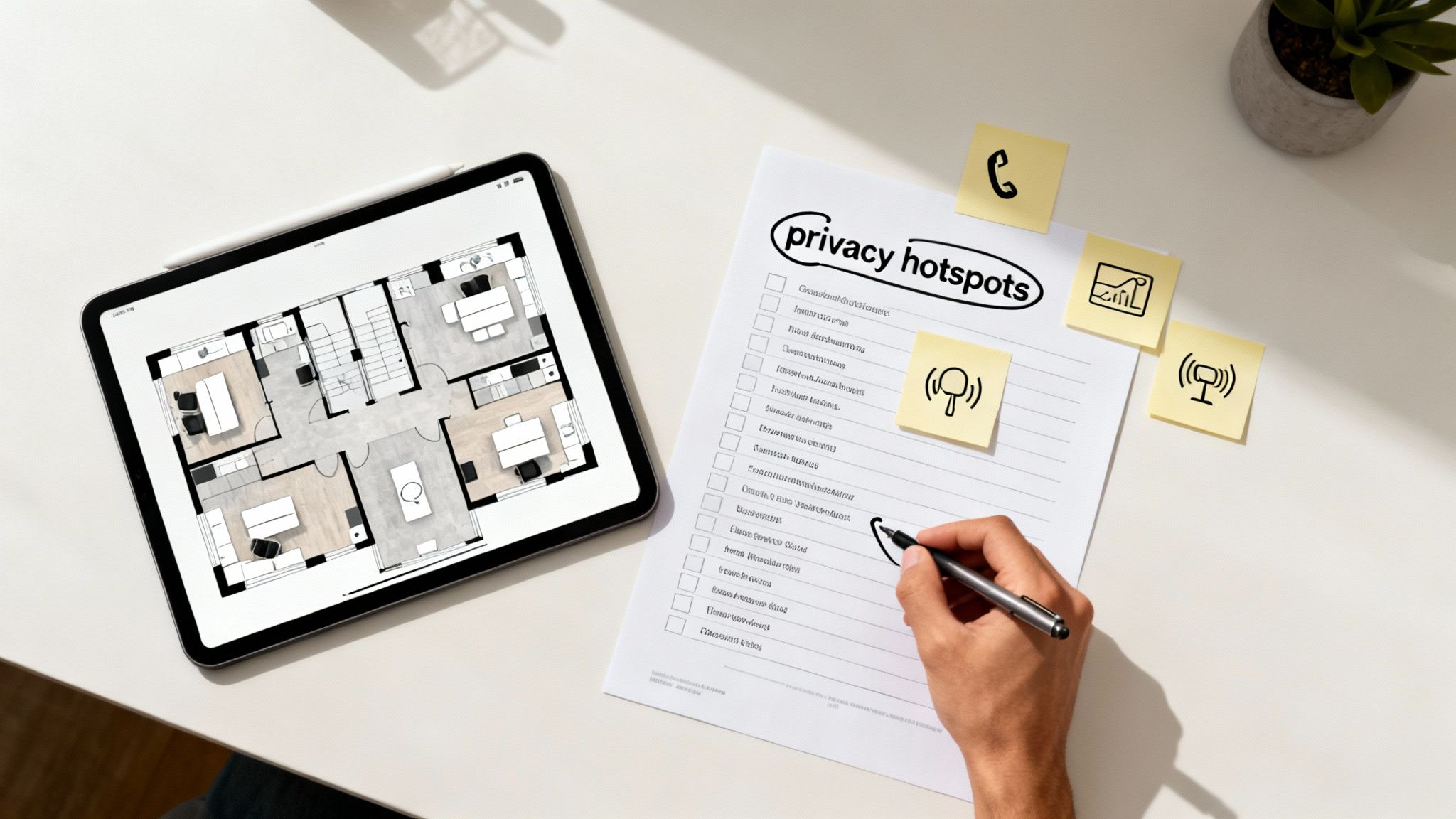
The answers will quickly help you identify “privacy hotspots”—specific areas or departments where the lack of office cubicle privacy is hitting hardest. These are the places you need to tackle first.

By focusing on your team’s actual feedback, you shift from guessing what they need to knowing what will make a tangible difference. This data-driven approach ensures your investment directly addresses the biggest obstacles to their productivity and well-being.

This whole diagnostic phase is about understanding that delicate balance between collaboration and concentration. Getting this information first helps you avoid the common pitfalls many companies fall into. To learn more about what to watch out for, check out our guide on the common mistakes in office planning and how to avoid them.

Ultimately, this process gives you a clear, evidence-based roadmap. You’ll know precisely where higher panels are needed, which areas could benefit from sound-dampening materials, and how a smarter layout could support different work styles. With this diagnosis in hand, you’re ready to find real solutions for your actual problems.

Choosing the Right Cubicle Panels and Materials

Alright, you’ve done the hard work of diagnosing your office’s privacy weak spots. Now for the fun part: translating that insight into real, physical solutions. This is where we move from strategy to structure, picking the actual walls and panels that will shape your team’s workspace and, ultimately, their productivity.

Getting this right is about more than just aesthetics. It’s about matching the physical environment to the work being done. A one-size-fits-all approach is a fast track to wasted money and frustrated employees.

A modern office featuring Series 7 cubicles with fabric panels and glass toppers to enhance privacy and light.

Why Panel Height Matters More Than You Think

Panel height is your number one tool for creating privacy. It can be the single biggest factor between a team that’s locked in and one that’s constantly pulled off task.

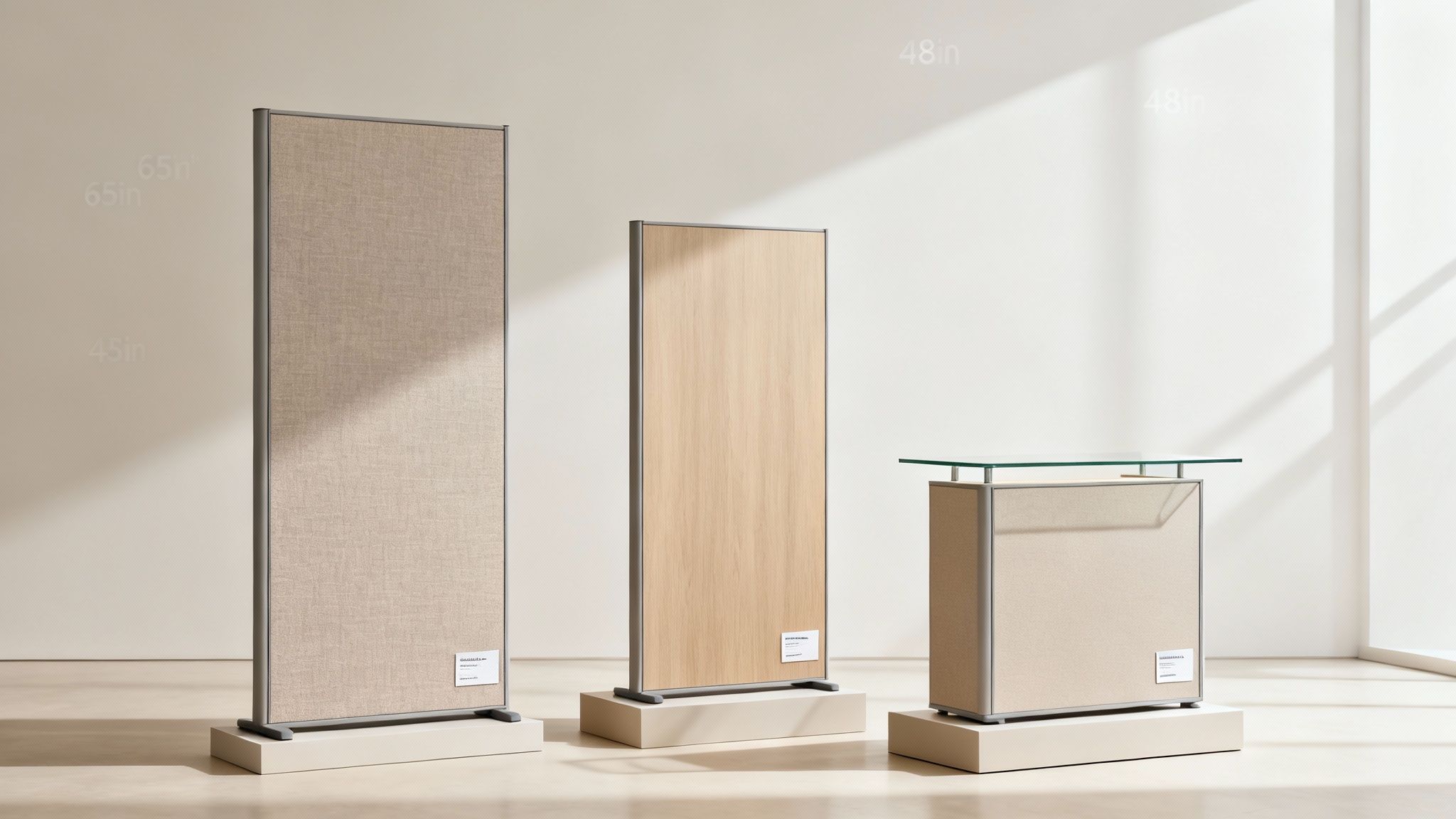
For a sales or customer service team that lives on the phone, a 65-inch or taller panel isn’t a luxury; it’s a necessity. These high walls are fantastic at containing sound, stopping conversations from bleeding over and protecting client confidentiality. They also create total visual separation, which is crucial for any role that requires deep, uninterrupted focus.

On the other hand, a collaborative team in marketing or design might find that suffocating. For them, 48-inch to 54-inch panels often hit the sweet spot. This height provides privacy when seated—blocking distracting sightlines and dampening some noise—but still makes it easy to pop your head up and ask a quick question. It’s the perfect balance between individual focus and spontaneous teamwork.

The big push toward open-plan offices really brought this issue to light. We’ve seen studies showing that over half of employees are unhappy with their sound privacy. We’re talking 59% in offices with high partitions and 58% in those with low ones. The lesson? Just having a wall isn’t enough. It has to be the right wall for the job.

Selecting Materials for Acoustic and Visual Control

Once you’ve got your height figured out, the panel material itself is your next big decision. Each one brings something different to the table.

  • Sound-Absorbing Fabric Panels: When noise is your main enemy, these are your best friend. The fabric is porous by design, trapping sound waves and cutting down on that ambient office chatter. They’re essential for call centers, HR departments, or anywhere conversations need to stay contained.
  • Durable Laminate Panels: Laminate won’t absorb sound like fabric, but it’s incredibly durable and a breeze to clean. It’s a smart, practical choice for high-traffic zones and provides a solid visual block, making it a great base for any cubicle setup.
  • Glass Panel Toppers: Glass is my favorite trick for adding privacy without making the office feel like a cave. You can add clear, frosted, or patterned glass toppers to your panels—like the ones in our Series 7 line—to block sound while still letting all that valuable natural light flow through the space.

I’ve found that the most successful layouts almost always mix materials. Think about a fabric panel at desk level to soak up the most noise, with a sleek glass topper above it to keep things feeling bright and open. It’s a win-win.

Below is a quick cheat sheet I put together to help clients compare their options at a glance.

Comparing Cubicle Panel Options for Privacy and Purpose

This table breaks down how different panel heights and materials stack up against common office needs, helping you make a more informed choice.

Panel Option (Height & Material) Visual Privacy Rating (1-5) Acoustic Privacy Rating (1-5) Best For Example Product
48″ Fabric Panel 3 3 Collaborative teams needing seated privacy and moderate noise reduction. Series 7 Cubicles
54″ Laminate Panel 4 2 High-traffic areas needing strong visual separation and durability. Series 7 Cubicles
65″ Fabric Panel 5 5 Call centers, sales teams, HR—any role requiring high focus and sound containment. Series 7 Cubicles
65″ Fabric + Glass Topper 5 4 Executive areas or focus-heavy roles where natural light is also a priority. Series 7 Cubicles

As you can see, the “best” option really depends on the specific job function. There’s no single right answer, only the right answer for your team.

Visualizing Your Privacy Solutions

Trying to imagine all of this can be tough. That’s why tools like a Custom Cubicle Designer are so valuable. You can play around with different heights, materials, and layouts in real-time. See exactly how a row of 65-inch stations will feel, or how adding glass toppers can completely change the vibe of a department.

This step is a game-changer for getting everyone on board and making sure the final product is exactly what you envisioned. It also helps you manage your budget by comparing costs. And on that note, many people are surprised to learn that custom-fit cubicles are more affordable than you think. They deliver a much better ROI than off-the-shelf solutions that don’t quite solve your core problems.

Ultimately, choosing the right panels is all about matching form to function. When you align your choices with the real-world needs of your team, you’re not just buying furniture—you’re building an environment designed for success.

Thinking Beyond the Wall for Total Privacy

Getting office cubicle privacy right means looking past the panels themselves. While the right walls are your foundation, a truly private and productive workspace is built by layering smart, complementary strategies. It’s about shaping the whole environment—what people see, what they hear, and even how they move through the space.

Great privacy isn’t just about what you build up; it’s also about what you tune out. This is where clever acoustic and layout solutions come in, transforming a collection of cubicles into a cohesive, focused work environment.

Mastering the Office Soundscape

One of the most powerful tools for acoustic privacy isn’t a physical wall at all. Sound masking systems, sometimes called white noise machines, work by introducing a soft, unobtrusive background sound that’s similar to airflow.

This engineered sound is specifically designed to match the frequencies of human speech. It doesn’t actually eliminate conversations, but it gently blurs them, making them much harder to understand and, therefore, far less distracting. The key is subtlety. When done right, the sound should be barely noticeable, just blending into the background without an annoying hum.

Think of it like this: In a dead-silent library, a single whisper can travel all the way across the room. But in a busy coffee shop, that same whisper gets lost in the ambient noise. Sound masking creates a consistent, controlled “coffee shop effect” for your office.

This simple addition can dramatically cut down on how far conversations travel, giving employees the confidence to take calls without feeling like the whole office is listening in. It’s a potent layer of acoustic defense that makes your cubicle panels work even harder.

Designing a Smarter Office Layout

How you arrange your cubicles is just as critical as what they’re made of. A strategic layout can passively guide foot traffic, break up sightlines, and create natural zones for different kinds of work. Instead of lining up cubicles in long, straight rows that create a “bowling alley” effect, you can get a lot smarter with the configuration.

Here are a few layout tips I’ve seen work wonders:

  • Stagger the Entrances: By simply offsetting cubicle openings, you immediately eliminate those long, direct lines of sight. This small change prevents people from getting distracted by every single person who walks down the main corridor.
  • Create Dedicated Zones: Group teams with similar work styles together. For example, put a high-energy, phone-heavy sales team on the opposite side of the office from a detail-oriented accounting department that needs deep concentration. This minimizes cross-departmental disruption before it even starts.
  • Use Natural Barriers: Don’t underestimate the power of strategically placed furniture and decor. Large potted plants, bookcases, or freestanding acoustic screens can act as soft visual and sound buffers, breaking up open spaces and adding a much-needed layer of perceived privacy.

A thoughtful layout anticipates workflow and potential distractions, solving a lot of privacy issues from the get-go. For a deeper dive into how different setups compare, check out our guide on the open-plan offices vs. cubicles and their pros and cons.

Layering Small Solutions for Big Impact

Finally, giving employees some personal control over their space can complete your privacy strategy. The most effective workspaces I’ve designed combine the big-picture solutions with smaller, individual ones.

Consider adding these elements to the mix:

  • Desktop Acoustic Dividers: These smaller, portable panels can be added to existing desks. They provide an extra boost of sound absorption and visual focus right where it’s needed most.
  • Headset Policies: For teams that are constantly on calls or listening to audio, establishing a clear headset policy can drastically cut down on the ambient noise pollution for their neighbors.

Here’s how this plays out in the real world. Imagine a sales team placed next to an accounting department. The solution isn’t just taller walls. It’s a combination of 65-inch fabric panels to block the initial sound, a sound masking system to blur any remaining chatter, a layout that directs foot traffic away from the accountants, and a clear headset policy for the sales team.

By layering these architectural, acoustic, and behavioral solutions, you create a genuinely private workspace. Each element supports the others, delivering a result that’s far more effective than any single solution could ever be on its own.

Your Practical Privacy Implementation Checklist

Okay, you’ve diagnosed your privacy issues and sketched out some great ideas. Now for the hard part: turning those plans into a real, functioning workspace without derailing everyone’s day-to-day. A successful rollout is about much more than just scheduling an installation date. It’s a dance of budgeting, logistics, and most importantly, communication.

Let’s walk through a practical checklist to help you manage your office cubicle privacy project like a pro and sidestep those last-minute disasters we’ve all seen happen.

Budgeting and Calculating Your Return

Before a single panel is ordered, you need to get the budget locked down and make a clear case for the investment. Let’s be honest, a well-planned office overhaul isn’t cheap. It’s a serious corporate investment—so serious, in fact, that the global market for cubicles and partitions hit $6.3 billion in 2022 and is still climbing. That tells you businesses are taking this seriously. If you want to dive deeper into the market trends, there’s some interesting research on the resurgence of cubicle design on room.com.

To get that budget approved, you have to talk about the return on investment (ROI). It’s all about productivity.

  • Estimate Lost Productivity: Just ask your team. Find out how much time they feel they lose to noise and distractions every day. Even 30 minutes of lost focus per person adds up to a staggering amount of lost time and money across the entire company.
  • Project Error Reduction: Think about your detail-oriented teams—finance, data entry, legal. A quieter, more private space directly translates to fewer costly mistakes. Try to put a number on what those errors cost you now.
  • Factor in Employee Retention: Don’t underestimate this one. An office that respects focus and well-being is a massive perk. It’s a powerful tool for keeping your best people from looking elsewhere.

Mapping Out Technical and Logistical Needs

Here’s a step I’ve seen people skip, and they always regret it: planning for power and data. Your slick new layout is almost guaranteed to require changes to your existing infrastructure. Finding that out on installation day is a recipe for major delays and budget overruns.

Grab your facilities manager or a professional planner and physically walk the space.

  • Electrical Outlets: Does every single new workstation have easy access to power? Don’t assume.
  • Data Ports: Is there a network drop planned for every station that needs one?
  • Code Compliance: Double-check that the new layout meets all local fire and accessibility codes. This is non-negotiable.

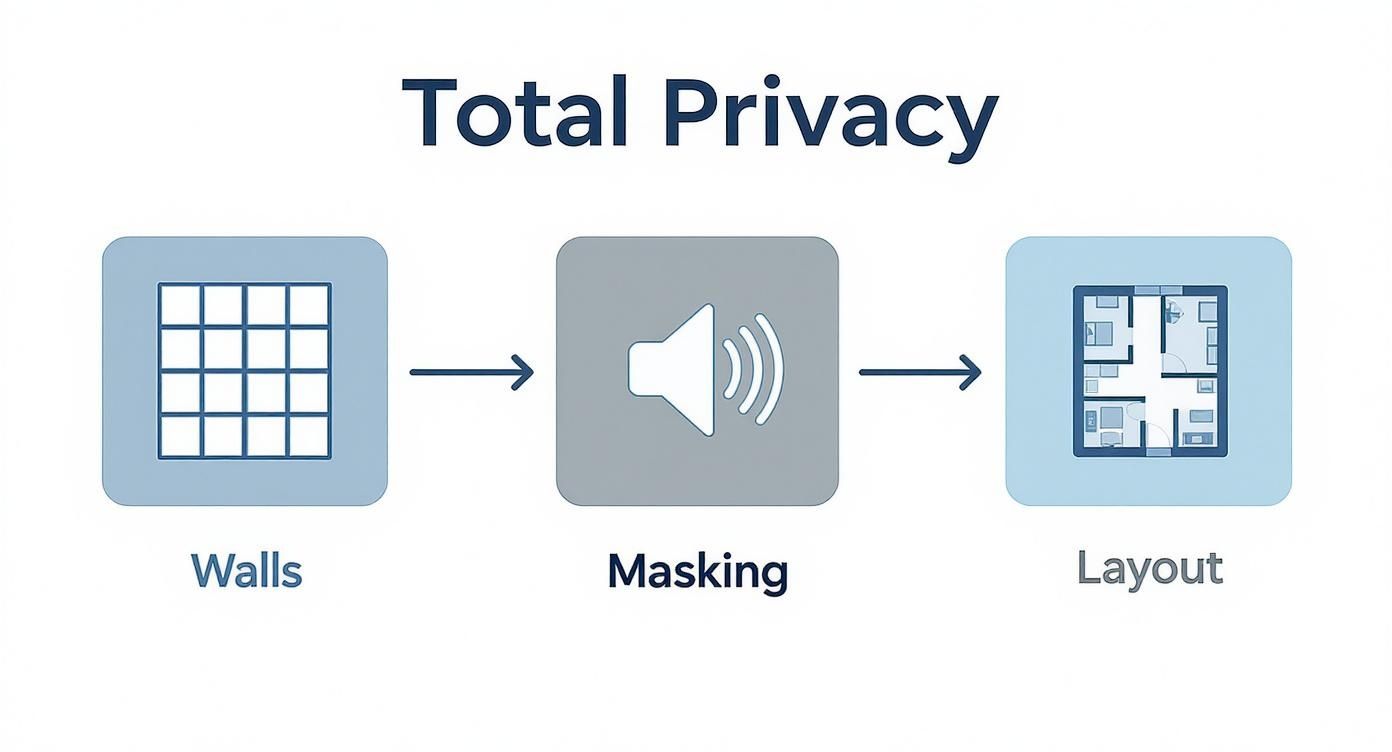
This whole process is about layering solutions. You’re combining physical walls, maybe some acoustic masking, and a smarter layout to get the job done.

An infographic showing the process flow for achieving total office cubicle privacy, with icons for walls, sound masking, and layout.

As you can see, it takes more than just one element to create a truly private and productive environment.

A project’s success is often determined by how well you manage the small, technical details. A thorough walkthrough of your electrical and data plan before you order a single panel will save you from major headaches down the road.

Communication and Team Buy-In

Finally, you can have the perfect plan, but it will fall flat without clear communication. Any change, even a good one, can make employees anxious if they don’t understand what’s happening and why.

Put together a simple communication plan to get your team on board and even excited about the new space.

  1. Announce the ‘Why’: Don’t just say, “we’re getting new cubicles.” Explain how the new layout is designed to slash distractions and help them focus. Frame it as what it is: an investment in their comfort and productivity.
  2. Share the Timeline: Give everyone the key dates. When does installation start? When will it be done? No one likes surprises.
  3. Provide a Floor Plan: Show them what the new space will look like and where their new workstation will be. It helps people visualize the change and reduces a ton of uncertainty. If you need some inspiration, browsing a gallery of popular cubicle configurations can give you great ideas for how to organize the space.
  4. Conduct a Final Walkthrough: Once the dust settles, walk through the new layout with team leads. This is your chance to catch any small issues and make final adjustments before everyone moves in.

Follow these steps, and you’ll do more than just install some new furniture. You’ll execute a smooth, successful project that genuinely improves your office and shows your team you’ve got their back.

Answering Your Top Office Privacy Questions

Even with the best plans, a few questions always seem to pop up right before you pull the trigger. Designing a private, productive office involves a lot of moving parts, from panel heights to materials and flow. To help you sort through the final details, here are our answers to the questions we hear most often from business owners tackling this exact challenge.

What’s the Magic Number for Cubicle Height?

This is the classic question, and if I’m being honest, there’s no single “magic” height. The right choice is all about what your teams actually do all day. You’re matching the barrier to the task at hand.

For departments that need to buckle down and focus—think HR, finance, or your legal team—you’ll want to look at panels 65 inches or higher. This is the gold standard for creating a true zone of focus. It provides serious acoustic dampening and complete visual separation, effectively cutting out disruptions from conversations and foot traffic.

But for teams that feed on quick, spontaneous collaboration, like marketing or creative groups, those tall walls can feel like a cage. For them, a height between 48 and 54 inches is often the sweet spot. It’s high enough to block sightlines and muffle sound when people are seated, but low enough that they can easily pop their head up to ask a teammate a quick question. The best office designs we see almost always mix and match, tailoring the privacy level to each department.

The goal isn’t just privacy; it’s purposeful privacy. A 65-inch wall is a tool for focus, while a 48-inch wall is a tool for balanced interaction. Choosing the right tool for the job is what makes the investment pay off.

How Can I Boost Privacy Without Breaking the Bank?

Improving privacy doesn’t have to mean a massive, expensive overhaul. If you’re working with a tight budget, you can get a lot of bang for your buck by focusing on a few strategic, high-impact changes first.

If noise is the main problem, start with sound-dampening fabric panels that you can add to your existing cubicle walls. Even smaller desktop dividers can absorb a surprising amount of chatter right at the source. Sometimes, a simple white noise machine can work wonders in masking background conversations and giving people their speech privacy back.

For visual privacy, some of the most effective solutions are completely free. Try rearranging your layout to stagger cubicle entrances or face desks away from busy hallways. It can dramatically cut down on distractions. Adding a few tall plants or freestanding screens also creates effective and affordable visual barriers. The key is to focus your limited budget on the teams with the most critical privacy needs first—that’s where you’ll see the biggest return.

Are Glass Panels a Good Idea for Privacy?

Glass panels are a fantastic option, especially when you want to achieve acoustic separation without sacrificing that open, airy feel. Solid materials block sound waves, and glass is no exception. It lets you create quiet zones while keeping the natural light and brightness that modern offices are known for.

Of course, clear glass on its own doesn’t do much for visual privacy. That’s where frosted or patterned glass comes into play. These options obscure distracting movement and details while still letting all that valuable light pass through.

A design we recommend all the time is using glass panels as “toppers” on fabric or laminate panels. For example, a 54-inch solid panel with a 12-inch glass topper gives you a total height of 66 inches. This design blocks sound where it matters most—at voice level—but keeps the upper part of the office feeling visually connected. It’s a modern approach that really delivers the best of both worlds.

Will Taller Walls Make My Office Feel Claustrophobic?

This is probably the number one concern we hear, and it’s a totally valid one. Nobody wants their team to feel like they’re working in a maze of dark corridors. The good news is, this is easily avoided with a few smart design choices.

The trick is to use panels that are tall enough for privacy but still stop well below the ceiling. That simple gap at the top allows for proper air circulation and lets your overhead lighting reach every single workspace. It makes all the difference in preventing that closed-in feeling.

And as I mentioned, incorporating panels with glass toppers is another great strategy. This gives you the acoustic blocking you need at seated and standing height, but keeps the upper space feeling light and open. Don’t underestimate the power of color, either. Lighter fabrics and finishes can make the entire office feel bigger and more expansive. You’re not trying to build a fortress; you’re just creating distinct “zones of privacy” that feel both secure and inviting.


Ready to stop guessing and start designing a more private, productive workspace? The experts at Cubicle By Design can help you navigate every decision, from layout planning to material selection. Explore our solutions and start building a better workplace today.

https://cubiclebydesign.com

Read More