

Glass Partition Walls for Offices Your Complete Guide
Think for a moment about the traditional office. What comes to mind? For many, it’s a maze of high-walled cubicles that block out light and create a feeling of being boxed in. Now, imagine a different kind of workspace—one that’s open, filled with natural light, and humming with collaborative energy.
Glass partition walls for offices aren’t just a fleeting design trend; they’re a powerful tool for building a more productive and dynamic work environment. They break down barriers, both physical and communicative, which can do wonders for team morale and project a modern, forward-thinking brand image.
Reimagining the Modern Office with Glass Partitions
Today’s office is much more than just a place to clock in and out. It’s an ecosystem that needs to support focused work, spontaneous collaboration, and employee well-being. The old way of doing things with drywall and bulky cubicles often leads to a siloed culture, cutting people off and casting half the office in shadow. Glass partitions are the solution, transforming dim, sectioned-off areas into bright, connected spaces.
This isn’t just a gut feeling; the market reflects this shift. The global office partitions market was valued at around $8 billion and is expected to keep growing. Why? Because businesses are demanding flexible workspace solutions that give them the best of both worlds: the community feel of an open plan with the privacy people actually need to get work done.
Why Glass Is Gaining Ground
The pull towards glass walls is about much more than just looks. They are a genuinely functional piece of smart workplace design that solves several key business problems at once. When you swap out opaque walls for transparent ones, you create a visual connection that helps foster a real sense of unity and shared purpose.
Here’s why so many companies are making the switch:
- More Natural Light: Glass lets sunlight reach deep into the building. This isn’t just a “nice-to-have”; studies have shown it can significantly cut down on employee eyestrain and headaches.
- Better Collaboration: When team members can see each other, it encourages those quick, impromptu conversations that often lead to the best ideas. People simply feel more approachable.
- Real Flexibility: Modular glass wall systems are worlds easier to reconfigure than traditional construction. As your business grows and changes, your office can adapt right along with it.
- A Modern Brand Image: A sleek, glass-filled office sends a clear message. It says you’re a transparent, innovative company that cares about its people.
The secret to a great workspace is using glass partitions to create an environment that feels both expansive and intimate. It’s about crafting a place where ideas can flow as freely as the light.
This move toward brighter, more adaptable layouts is a cornerstone of good workspace strategy. A well-designed floor plan does more than just cram in desks; it actively improves how people work and helps you hit your company goals. Integrating glass walls is a huge part of our approach to expert office space planning and design, and this guide will walk you through everything you need to know to do it right.
Choosing Between Framed and Frameless Glass Walls
So, you’ve decided that glass partition walls are the way to go for your office. Great choice. Now comes the next big decision: what style fits your vision? You’re basically looking at two main options—framed or frameless systems. Each one brings a totally different look and feel to the table.
Getting this right is all about balancing your company’s aesthetic, your team’s day-to-day needs, and where you see the business heading. Think of it like choosing between a classic painting in an ornate frame and a modern, gallery-mounted canvas. The framed option is bold and defined, drawing your eye with its structure. The frameless one, on the other hand, goes for that seamless, “barely there” look, letting the space itself do all the talking.
The Bold Structure of Framed Glass Walls
Framed glass walls are exactly what they sound like. They have a visible architectural frame, usually made of aluminum, that outlines each glass panel. This creates a kind of grid pattern that can be anything from sleek and subtle to powerfully industrial. It’s a go-to choice for offices that want to make a strong visual statement.
The biggest upside here is structural strength. That frame provides rock-solid support, which is a huge plus in high-traffic hallways or when you’re building out larger, more complex layouts. That extra support also makes it a breeze to integrate features like sliding or pivot doors.
Framed systems, like our Series 700 and 800 glass walls, are real workhorses in a variety of settings.
- Aesthetic Versatility: The frames come in tons of colors—black, silver, white—so you can easily match your office decor or brand palette.
- Enhanced Durability: That metal framework adds an extra layer of protection around the glass edges, making them incredibly resilient to daily wear and tear.
- Superior Acoustics: The seals tucked inside the frame do wonders for sound insulation. This is a game-changer for private offices and meeting rooms where conversations need to stay confidential.
This quick visual shows how different office goals can point directly to a glass wall solution.
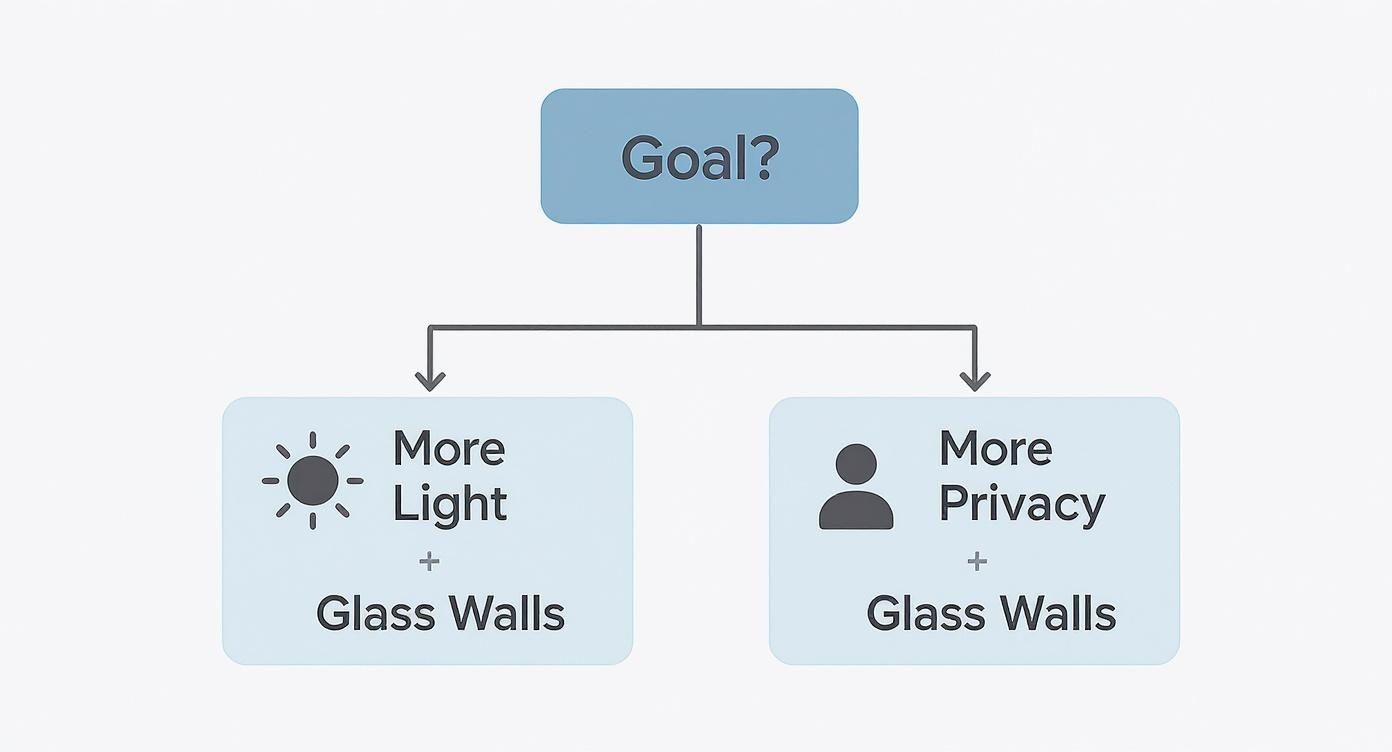
The bottom line? Whether you’re trying to create an open, sun-drenched atmosphere or carve out focused, private workspaces, glass partitions are an incredibly flexible answer.
The Minimalist Appeal of Frameless Glass Walls
If a clean, modern, and almost invisible look is what you’re after, frameless glass walls are your best bet. These systems use very little hardware. The polished glass edges butt right up against each other, held in place by discreet channels along the floor and ceiling. What you get is an all-glass appearance that lets natural light flow completely uninterrupted.
Frameless partitions, such as our Series 500, are designed to create an illusion of wide-open space. By getting rid of the visual break of a frame, they make even smaller offices feel larger and more connected. This minimalist style is perfect for companies that want to project a sophisticated, forward-thinking image.
The real beauty of a frameless system is its simplicity. It’s about creating division without building a visual barrier, letting light and ideas move freely through the workspace.
They might look more delicate, but don’t be fooled. Frameless walls are built from thick, tempered safety glass that provides exceptional strength. They’re an amazing choice for executive offices, high-stakes conference rooms, and reception areas where making a clean, elegant first impression is everything.
To help you weigh the options, here’s a quick side-by-side comparison.
Framed vs. Frameless Glass Walls at a Glance
| Feature | Framed Glass Partitions | Frameless Glass Partitions |
|---|---|---|
| Aesthetics | Defined, structured, industrial or classic look. | Minimalist, seamless, “all-glass” modern look. |
| Structure | Highly durable with visible aluminum frames. | Appears seamless with minimal top/bottom channels. |
| Best For | High-traffic areas, large configurations, superior acoustics. | Maximizing light, creating an open feel, modern offices. |
| Cost | Generally more cost-effective. | Typically a higher-end investment. |
| Doors | Easily integrates sliding and pivot door systems. | Requires specific hardware for doors; very sleek result. |
Ultimately, whether you lean toward the bold definition of framed walls or the clean minimalism of frameless ones, the decision comes down to the story you want your office design to tell. To see how these systems fit into a bigger picture, you can explore our guide to modular office walls and learn about their long-term flexibility.
Solving for Acoustics and Privacy in Glass Offices
An open, light-filled office sounds great on paper, but it immediately brings up two huge questions: What about noise? And how can anyone get any privacy?
These aren’t minor issues. The very transparency that makes glass partition walls so appealing can feel like you’re trading away both acoustic and visual privacy. The good news is, modern glass systems are engineered with some pretty sophisticated solutions that tackle both problems head-on.
It all comes down to finding the right balance between that open, airy atmosphere and the quiet, confidential spaces every business needs to actually get work done. A bustling sales floor needs a totally different acoustic setup than a boardroom where a sensitive deal is being hammered out. In the same way, an HR manager’s office demands a level of visual privacy that a collaborative project area just doesn’t.
Demystifying Acoustic Performance
When we talk about how well a wall blocks sound, the industry metric is its Sound Transmission Class (STC) rating. Think of it like an SPF number for sunscreen—the higher the STC rating, the more sound it blocks out. For reference, a typical drywall office wall usually lands somewhere between an STC of 35 and 40. That’s enough to muffle loud speech, making it audible but not really understandable.
A lot of people just assume glass is terrible for blocking noise, but that’s a common misconception. Sure, a single pane of standard tempered glass might only have an STC rating in the low 30s. But specialized glass partition systems can perform just as well as, or even better than, traditional walls.
Here’s how we dial up the sound control:
- Double-Glazed Glass: This is a fantastic middle ground. It uses two panes of glass separated by an air gap, which acts as an insulating buffer that disrupts sound waves before they can pass through. This simple design can boost the STC rating well into the 40s.
- Laminated Acoustic Glass: This is the heavy hitter. It’s made of two sheets of glass bonded together with a clear, sound-dampening interlayer. This special layer is engineered to absorb vibrations, pushing STC ratings to 50 or even higher—perfect for creating truly soundproof spaces.
Creating Visual Privacy on Demand
Tackling noise is only half the battle. Visual privacy is just as crucial for many roles and meetings. Glass walls offer a surprising amount of flexibility here, letting you control who sees what without having to kill all the natural light.
The goal isn’t to hide everything, but to provide privacy precisely where and when it’s needed. Modern glass solutions make this possible without reverting to dark, closed-off rooms.
These privacy options can be applied during the initial installation or even added on later, which gives you a ton of flexibility. A few of the most popular solutions include:
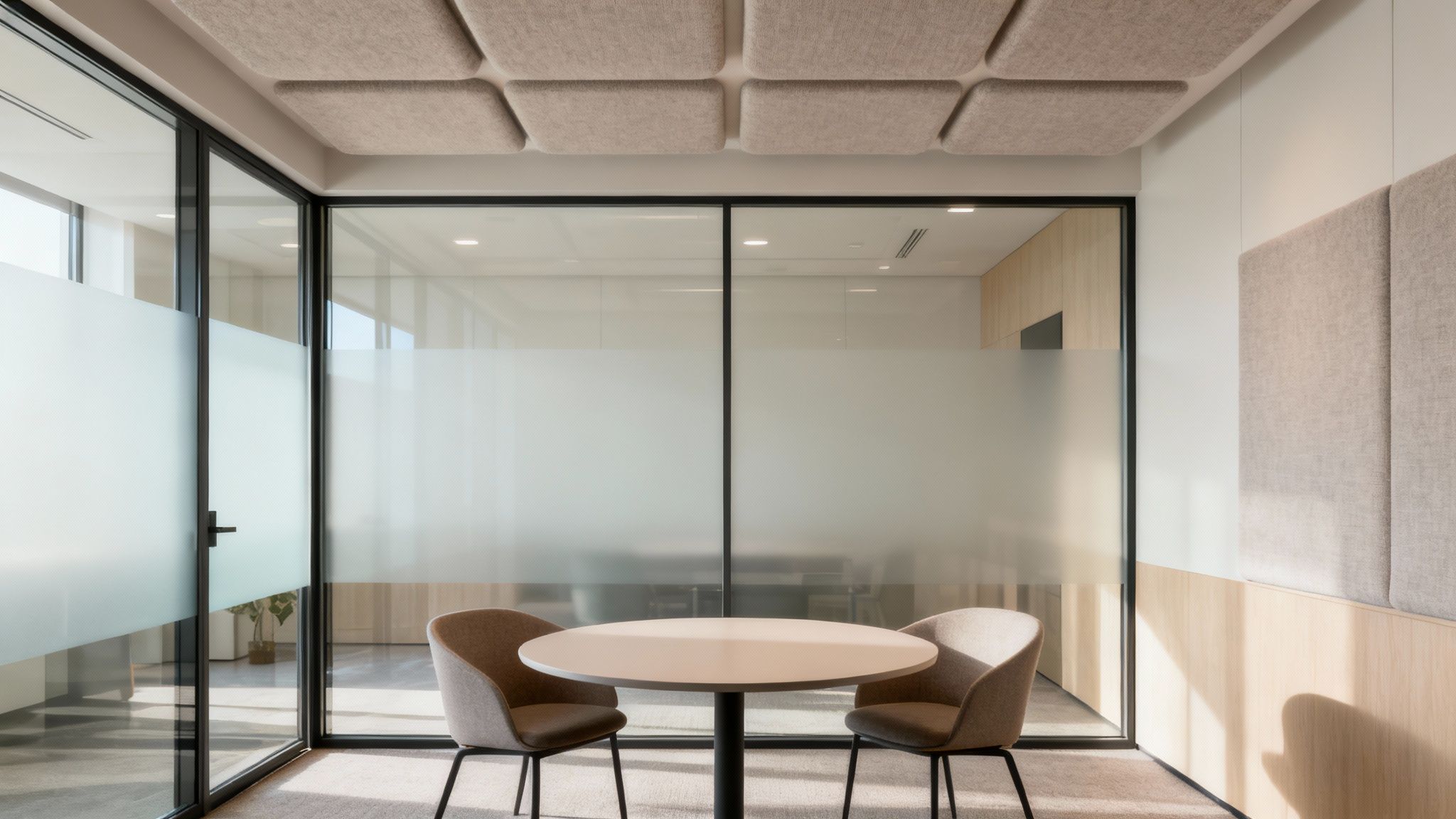
- Frosted and Etched Glass: This treatment diffuses light to blur visibility while keeping the space feeling bright and open. It’s an ideal choice for private offices or conference rooms where confidentiality is key, but you don’t want to feel boxed in.
- Decorative and Banded Films: Applying vinyl film is a cost-effective and highly customizable route. You can add simple frosted bands at eye level, create intricate patterns, or even weave in company branding for a unique look that provides targeted privacy right where you need it.
- Switchable Smart Glass: For the ultimate in control, smart glass (sometimes called privacy glass) is a real game-changer. At the flip of a switch, it can go from perfectly clear to completely opaque. This technology is perfect for boardrooms or executive offices that need to shift from open collaboration to a private meeting in an instant.
It’s no surprise the demand for these solutions is climbing. The global glass partition wall market was valued at around $922 million and is on track to hit approximately $1.29 billion. The growing popularity of smart glass is a big driver behind this, as more companies look for dynamic control over their spaces.
Ultimately, getting both sound and visual privacy right is fundamental to a successful workplace. For more on these core principles, you can explore our detailed guide on achieving effective office cubicle privacy.
Understanding the Costs and ROI of Glass Walls
Whenever an office upgrade is on the table, the conversation always finds its way to the numbers. Investing in glass partition walls for offices is about much more than an upfront expense; it’s a strategic move that pays you back long after the installation crew has packed up. To make a confident choice, you need to understand what shapes the cost and what kind of real returns you can expect.
The final price tag for a glass wall system isn’t a simple, off-the-shelf number. Think of it as a sum of several custom choices you make to get the perfect fit for your space and your team’s needs. Every decision, from the type of glass to the handle on a door, plays a part in the final investment.
Breaking Down the Budget Factors
To get a clear financial picture, it helps to look at the main things that influence the price. It’s a lot like building a custom car—the base model has a price, but every feature you add, from a more powerful engine to custom interior trim, adjusts the final cost. The same principle applies here.
The key cost drivers typically include:
- Glass Type and Thickness: Standard tempered glass is the baseline. If you need better sound control, upgrading to double-glazed or laminated acoustic glass will increase the price. The same goes for specialty options like frosted or low-iron (ultra-clear) glass.
- Framing System: Frameless systems often demand thicker, more robust glass and specialized hardware to pull off that seamless look. This can sometimes place them at a higher initial price point than many standard framed options.
- Hardware and Finishes: The little details matter. Door handles, hinges, and frame finishes (like a sleek powder-coated black versus standard brushed aluminum) all contribute to the final tally.
- Doors and Mechanisms: A simple pivot door is going to be more budget-friendly than a large sliding door or a more complex telescoping system that tucks neatly away.
There’s a reason this market is growing. The global glass partition market was estimated at around $4.66 billion and is expected to climb to over $6.09 billion in the coming years. That growth is being driven by businesses recognizing the long-term value these systems bring, including serious energy savings from maximizing natural light. You can explore the full research on the glass partition industry to learn more.
Calculating Your Return on Investment
The true value of glass walls really shines when you look beyond the initial invoice and consider the long-term Return on Investment (ROI). This is where that initial expense starts paying for itself, both through direct cost savings and big gains in productivity.
The smartest office investments aren’t just about what they cost today, but about how much value they create tomorrow. Glass walls deliver returns by making your space more efficient, flexible, and human-centric.
The ROI from glass partition walls for offices is multi-faceted. It touches everything from your utility bills to your team’s performance.
The Tangible Financial Benefits
The financial payback from installing glass walls is clear and easy to measure in several key areas. These benefits add up over time, steadily chipping away at the initial cost.
Here are three major ways glass walls provide a tangible return:
- Lower Energy Bills: By letting natural light flood deep into your floor plan, glass walls dramatically cut down on the need for artificial lighting during the day. This can lead to a very noticeable drop in your electricity bill. Some studies have shown that maximizing daylight can result in significant energy savings.
- Increased Employee Productivity: A well-lit, visually open environment has a direct, positive impact on employee well-being and focus. Plenty of research has linked natural light to reduced eyestrain, fewer headaches, and better alertness—which translates directly to higher productivity and better quality of work.
- Future-Proof Flexibility: This might just be the most significant long-term financial win. Demountable glass walls can be reconfigured or moved with minimal cost and disruption. Compare that to demolishing and rebuilding traditional drywall—a messy, expensive, and time-consuming headache. The adaptability of modular glass systems saves a huge amount of money over the life of your office lease.
When you weigh these costs against a traditional build-out, the advantages become crystal clear. To get a better sense of how different office solutions stack up, take a look at our comprehensive cubicle price guide for a broader perspective on workspace investments.
Your Glass Partition Installation Roadmap
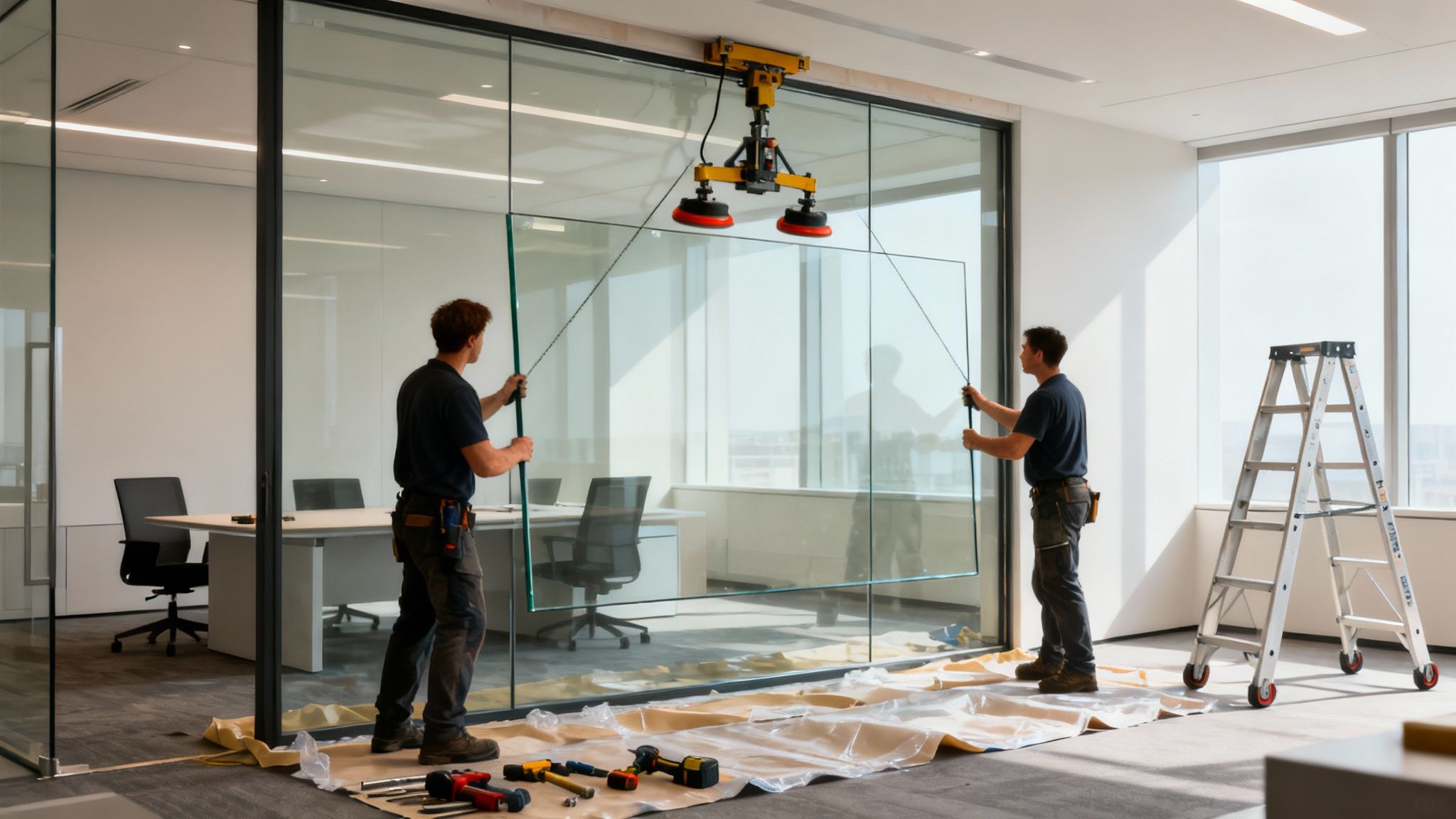
The idea of any office renovation can be stressful. Visions of dust, constant noise, and general chaos are enough to make anyone pause. But installing glass partition walls for offices is a completely different ballgame. When you’ve got an experienced crew on the job, the whole process is remarkably clean, efficient, and designed to cause as little disruption to your daily grind as possible.
Let’s walk through the roadmap from start to finish. Knowing what to expect takes the guesswork out of the equation and gives you confidence that everything will run smoothly. Think of it as a well-planned trip with clear milestones, not a frantic last-minute scramble.
Phase 1: Initial Consultation and Site Measurement
It all starts with a simple conversation. This first step is where we dig into your goals—what are you really trying to accomplish with this new layout? We’ll talk through your needs for privacy, sound control, workflow, and the overall look and feel you’re aiming for.
Once we have a clear vision, a professional team heads to your site to take meticulous measurements. This is way more than just checking wall lengths. They’re assessing floor and ceiling levels, scouting for potential obstacles like support columns or HVAC vents, and confirming structural support points. Getting this data right is the foundation for a perfect fit.
Phase 2: Design and Approval
With those precise measurements in hand, the design work begins. This is the fun part where your vision starts coming to life in detailed drawings and 3D renderings. You’ll see exactly how the glass partition walls for offices will look in your space, right down to the door locations, frame finishes, and any extras like frosted film for privacy.
This is a true collaboration. You get to review the designs, give feedback, and tweak things until they’re just right. We don’t move forward until you are 100% confident that the final plans meet every one of your needs. No surprises later on—that’s the goal.
A successful installation is built on a foundation of precise planning. The time spent refining the design and confirming every detail upfront is what guarantees a smooth, predictable on-site assembly with minimal disruption.
Phase 3: Fabrication and Logistics
After you give the final thumbs-up, we kick off the custom fabrication. Every single component—from the glass panels cut to exact dimensions to the aluminum frames finished in your chosen color—is manufactured off-site in a controlled factory setting. This method has some serious advantages:
- Higher Quality: A factory environment allows for a level of precision and consistency that’s just not possible to achieve on-site.
- Minimal On-Site Mess: Since all the cutting and finishing happens elsewhere, your office stays clean and free of construction dust and debris.
- Faster Installation: With every piece pre-made and ready to go, the on-site team can focus purely on assembly, which dramatically shortens the project timeline.
While that’s happening, our project managers are handling all the logistics. They’re coordinating delivery schedules, making sure everything is up to building code, and syncing up with any other contractors you might have on-site, like electricians or painters. For a deeper dive into how we manage this, you can learn more about our professional glass architectural wall installation services.
Phase 4: On-Site Assembly
This is the home stretch, and it’s often the fastest part of the whole process. The pre-fabricated components arrive at your office, ready for assembly. Our expert installation team works efficiently to put up the framework, set the glass panels, and install the doors and hardware. Because the system is modular and engineered for a perfect fit, the assembly is clean, quiet, and surprisingly quick—often finished with very little interruption to your team’s workday.
Bringing Your Glass Wall Project to Life with Cubicle By Design
Picking out the right glass partition system is a great start, but it’s really just the beginning. The real success of your office transformation—from a simple idea on a floor plan to a flawless, finished space—comes down to the partner you choose to guide you there. This is where experience makes all the difference, turning what could be a headache into a smooth, predictable process.
At Cubicle By Design, we don’t just sell high-quality glass wall systems. We’re your hands-on partner for the entire project, from the first conversation to the final walkthrough. We know that redesigning an office is a big investment, and our job is to make sure you see a real return in how your space works, looks, and feels for years to come.
A Partnership, Not Just a Purchase
Trying to manage a commercial build-out on your own can be a real handful. You’re juggling building codes, coordinating with electricians and painters, and trying to keep everything on schedule. Our team is here to take that weight off your shoulders. We’ve specialized in modular office design for years, so we know how to spot potential problems before they happen, keeping your project on time and on budget.
Our whole approach is built around making your life easier:
- Real Consultation: We kick things off by listening. Our designers want to understand your team’s workflow, your privacy needs, and your company’s vibe. That’s how we find the perfect glass wall system for you.
- See It Before You Build It: We take your floor plan and create detailed 2D and 3D mockups. This lets you visualize exactly how your new layout will function, so you can make confident decisions before a single panel is ordered.
- One Point of Contact: You’ll get a dedicated project manager who handles everything. They coordinate manufacturing, delivery, and on-site assembly, ensuring the installation is completely stress-free for you.
Choosing a partner isn’t just about the product; it’s about the people and the process behind it. A truly great workspace is built together, through a collaborative relationship focused on making your office better.
Quality and Customization are Standard
Every office has its own personality, and we think your glass partitions should, too. Cubicle By Design offers a huge range of options, from different frame finishes and glass types to door hardware and custom privacy films. This means the final installation doesn’t just work well—it looks like it was made for your space. We only use top-tier, commercial-grade materials built to stand up to the daily hustle of a busy office.
Whether you’re drawn to the clean, modern look of our Series 500 frameless walls or need the versatile strength of our Series 700 and 800 framed systems, our products are all designed to create spaces where people can do their best work. This is more than just selling partitions; it’s about helping you build a better office environment.
Ready to see what glass walls can do for your office? Contact the Cubicle By Design team today for a personalized consultation and let’s get started.
Common Questions About Glass Partitions
When you’re diving into the specifics of a new office design, a lot of practical questions pop up. It’s one thing to love the look of glass partition walls for offices, but it’s another to know how they’ll hold up day-to-day. Let’s tackle some of the most common things people ask about durability, flexibility, and upkeep.
These are the details that often come to mind after you’ve settled on the big picture, and they’re crucial for understanding the long-term value of your investment.
How Durable Are Glass Partition Walls in a Busy Office?
This is usually the first question people ask, and for good reason. The answer is simple: they’re incredibly tough. Office glass partitions aren’t made from ordinary window pane glass. They’re built with commercial-grade tempered or laminated safety glass.
Tempered glass is four to five times stronger than standard glass and is engineered to crumble into small, dull-edged pieces if it ever shatters, which drastically reduces the risk of injury. Laminated glass adds another layer of security by sandwiching a clear film between two sheets of glass. If it breaks, the film holds everything together. These systems are designed to handle the daily bumps and knocks of a busy corporate office, making them a safe and surprisingly rugged choice.
The strength of modern glass partition systems often surprises people. They are not delicate installations but robust architectural elements designed for the rigors of daily business life.
Can Glass Walls Be Relocated If We Redesign Our Office Layout?
Absolutely. In fact, this is one of their biggest selling points. Modular glass partition walls for offices are designed from the ground up to be demountable. That means they can be uninstalled, moved, and reassembled in a new spot with very little mess or disruption.
This adaptability is a game-changer for growing companies that know their floor plan will likely need to change in the future. It offers a massive long-term cost saving compared to the alternative—demolishing and rebuilding traditional drywall, which is a dusty, expensive, and time-consuming headache. When you invest in a movable system, your office can evolve right alongside your business.
What Maintenance Is Required for Glass Partition Walls?
Glass partitions are remarkably easy to care for, which keeps their total cost of ownership low. For the most part, all you’ll ever need is a standard glass cleaner and a microfiber cloth to keep them looking sharp and professional.
Unlike painted drywall that gets scuffed and needs a fresh coat every few years, glass holds up beautifully. For framed systems, a quick wipe-down of the aluminum tracks every now and then is all it takes. This simplicity frees up your facility team to focus on bigger priorities, saving you both time and labor costs.
Ready to transform your workspace with a solution that’s as flexible as it is beautiful? The team at Cubicle By Design offers expert guidance and a full range of customizable glass wall systems to fit your needs. Explore your options and start planning your project by visiting us at https://cubiclebydesign.com.