
A Practical Guide to Finding the Right Privacy Screen for Cubicle Setups

A privacy screen for a cubicle is so much more than a simple divider. Think of it as a tool for carving out a focused, productive, and comfortable personal workspace right in the middle of a busy office. It's essential for cutting down on visual distractions, dampening ambient noise, and giving employees that much-needed sense of personal territory—something that’s absolutely critical for deep work and overall job satisfaction.

Why Privacy Screens Are Crucial in Modern Offices

In any modern workplace, the constant hum of activity can be a double-edged sword. Collaboration is great, but the non-stop visual and auditory interruptions often get in the way of the very focus needed for high-quality work. Picture a bustling sales floor where every movement catches your eye, or a tech space where developers need total concentration to code. When personal space isn't clearly defined, productivity is the first thing to suffer.

This is where a well-chosen privacy screen for cubicle setups becomes a strategic business tool, not just another piece of furniture. At Cubicle By Design, we see them as fundamental components for building a balanced work environment. The right screen can transform an open-plan area into a series of productive zones, fostering both individual focus and easy team collaboration when it's needed.

The Psychological Impact of Personal Space

It’s been shown time and again: employees who feel they have some control over their immediate environment report higher job satisfaction and lower stress levels. A simple privacy screen delivers this by creating a clear, physical boundary. This small change brings some significant psychological benefits:

  • Reduces "On-Display" Anxiety: It gets rid of that feeling of being constantly watched, allowing people to concentrate on their work without feeling self-conscious.
  • Minimizes Task-Switching: By blocking peripheral motion, screens help the brain stay locked on a single task, avoiding the mental drain of constantly re-focusing.
  • Fosters a Sense of Ownership: Having a defined space, even a small one, gives employees a sense of belonging and personal ownership over their work.

The demand for these solutions is growing, and fast. The global market for cubicle privacy screen fabric was valued between $1.8 and $2.34 billion and is projected to expand significantly. It's clear that more and more businesses are recognizing their value.

A thoughtfully designed workspace respects the individual's need for concentration just as much as it supports group collaboration. Privacy screens are the simplest, most effective way to strike that essential balance.

To get a better handle on the variety of solutions out there, exploring options like Blind Screens can offer some valuable insight into what might work for your office. Ultimately, investing in privacy isn't about building walls between people. It's about building a more effective, less stressful, and more productive workplace for everyone on your team.

Choosing the Right Material for Your Workspace

Picking the right material for your privacy screen for cubicle setups is about way more than just looks. It’s a strategic choice that defines how your office feels and functions, directly impacting everything from noise levels to the flow of natural light.

Think about it this way: a high-energy call center needs something totally different from a collaborative design studio. For the call center, you'd want acoustic fabric panels that soak up sound, keeping conversations from bleeding over and creating a more focused atmosphere. The design studio, on the other hand, might go for frosted acrylic to keep the space bright and airy while still giving each person their own defined zone.

Fabric and Acoustic Felt

Fabric screens are the go-to for a reason. They give off a classic, professional vibe and come in just about any color you can imagine, making it easy to match your company's branding. Standard fabric does a decent job of providing visual privacy, but if noise is the real enemy, you'll want to upgrade to acoustic felt.

Made from dense, compressed fibers, acoustic felt is a superstar at sound absorption. It really cuts down on the chatter and keyboard clatter between workstations, which is a lifesaver for:

  • Sales Teams: So one person's pitch doesn't become everyone's distraction.
  • HR Departments: Where confidential conversations are a daily reality.
  • High-Density Work Areas: To dial down the collective hum of a busy office.

You'll also see a lot of modern offices using decorative films on glass partitions for a similar effect. When you're weighing your options, checking out a guide on the best window film for privacy can spark some great ideas, especially if you're leaning toward frosted or opaque looks for glass screens.

Frosted Acrylic and Clear Glass

If your goal is a modern, light-filled workspace, acrylic and glass are fantastic options. They create that necessary separation without boxing everyone in or making the office feel cramped.

Frosted acrylic—what most people call plexiglass—really offers the best of both worlds. It blurs out shapes and details for solid visual privacy, but it also diffuses light beautifully. This keeps things bright and open, preventing harsh shadows and making it perfect for teams that need to feel connected but still require their own space.

Clear glass panels are less about privacy and more about defining space and adding a layer of safety. They work great as sneeze guards and physical barriers while keeping sightlines completely open. You’ll often find them in reception areas or roles where total visibility is a must. For a better sense of how different dividers can function, take a look at our full lineup of desk divider panels.

Privacy Screen Material Comparison

To make the decision a bit easier, it helps to see how the most common materials stack up against each other. Each one has its own strengths, so it's all about matching the material to your specific workplace needs.

Material Type Visual Privacy Level Acoustic Properties Best For Compatibility
Acoustic Fabric High (Opaque) Excellent Open offices, call centers, HR departments Most cubicle systems, including Series 7
Standard Fabric High (Opaque) Good General office use, branding with colors Most cubicle systems, including Series 7
Frosted Acrylic Medium (Translucent) Poor Collaborative spaces, modern aesthetics Most cubicle systems, glass walls
Clear Glass Low (Transparent) Poor Reception areas, sneeze guards Most cubicle systems, glass walls

This table should give you a clear starting point for figuring out what will work best for your team and your space.

The right material doesn't just divide space; it enhances it. The goal is to choose a material that solves your specific workplace challenges, whether that's too much noise, a lack of light, or constant visual distraction.

Ultimately, your decision comes down to what your office truly needs. Are you trying to quiet a loud floor, or do you just need to create personal boundaries while keeping the vibe open and collaborative? Nail down that answer, and you're well on your way to choosing the perfect material for your cubicles.

How to Measure Your Cubicle for a Perfect Fit

Let's be honest, a privacy screen that doesn't fit right just looks sloppy. It can sag, look unprofessional, and ultimately fail to do its job. Nailing the measurements is the single most important thing you can do to make sure your new screens look like they were always part of the office design. It sounds technical, but it’s actually pretty straightforward.

All it really takes is a tape measure and a few minutes of your time. You’re focusing on three key numbers: the width of the panel where the screen will sit, how high you want the screen to go, and how thick the panel is. That's it.

This quick visual breaks it down. By focusing on just these three dimensions—height, width, and depth—you’ll have everything you need for a perfect fit.

Mastering the Key Dimensions

First up is the width. Simply measure the length along the top of your cubicle panel, from one end to the other. If you're outfitting multiple sides of a cubicle, make sure to measure each panel individually. You'd be surprised how often they can vary slightly.

Next, think about the height. How much privacy are your people looking for? If you just want to create some visual separation while seated, a screen that extends 12 to 18 inches above the desktop usually does the trick. But for roles that demand more focus or handle sensitive information, going with 24 inches or more is a much better bet.

Last, and this one is critical, measure the thickness of the cubicle panel itself. This is the measurement that dictates which mounting clamps will work. Use your tape measure to get the exact thickness of the wall right where the clamp will attach.

Pro Tip: Measure twice. Always. It’s a simple habit that has saved our clients from countless headaches and costly reorders. A screen that's off by even half an inch can throw off the entire look and feel of a workstation.

Avoiding Common Measurement Pitfalls

A few small details can derail your measurements if you aren't paying attention. One of the biggest mistakes we see is people forgetting to account for hardware that's already on the panel.

Take a quick look for any pre-existing brackets, cable management clips, or decorative caps along the top of the panel. You need to measure the clear, unobstructed length available for the screen. Also, think about the path of any monitor arms or phone cords. You want to ensure your new screen won’t get in their way. You can learn more about typical layouts by checking out these standard cubicle dimensions.

Choosing the Right Mounting Option

That panel thickness measurement you took directly informs your mounting hardware choice. Generally, you’ll be choosing between two common types: top-mount clamps and side-mount brackets.

  • Top-Mount Clamps: These are the most popular for a reason—they're incredibly versatile. They slide right over the top of the panel and are tightened from below, creating a solid grip without any drilling. They’re perfect for standard, flat-topped cubicle walls.

  • Side-Mount Brackets: These are your go-to when a top clamp just won't work. They attach to the side of the work surface or panel, providing a different type of stability for unique setups.

When you place your order, just double-check that the clamp’s adjustable range matches your panel’s thickness. Our high-quality workstation cubicles are specifically designed for easy integration with all sorts of mounting hardware, ensuring a secure and professional finish every time.

Designing Your Ideal Workspace with Our Customization Tool

Bringing a vision to life is about more than just picking out parts; it’s about seeing how they all fit and function together. This is exactly where our interactive design tools make a world of difference. You can stop imagining and start building a virtual model of your future workspace, integrating your chosen privacy screens right into the design from the get-go. With our cubicle designer tool, you can design a workstation as a core component, not an afterthought.

Instead of tacking on a privacy screen as an afterthought, our approach lets you design it as a core component of the complete workstation. This guarantees the final product is cohesive, functional, and perfectly dialed in to what your team actually needs.

A Real-World Design Scenario

Let's get practical. Imagine you're an HR manager tasked with creating a new, confidential onboarding area. The goal is to design a space that feels welcoming but also provides the necessary discretion for sensitive conversations about payroll and benefits. A generic, off-the-shelf setup just isn't going to cut it.

With our online design tool, you can tackle this challenge head-on by building the entire workstation from the ground up. You could select a taller, 24-inch fabric panel to ensure conversations remain private and pair it with specific storage options and surface finishes that match your office aesthetic.

Here's a glimpse of the interface where you can start mapping out your own custom layout.

This tool lets you visually experiment with different heights and materials, making it easy to see exactly how your choices impact the overall vibe—from privacy levels to openness.

From Concept to Visualization

The true power here is in the visualization. You aren't just ticking boxes on a list; you're actively building and seeing the results in real-time. It’s a hands-on process that simplifies what could otherwise be a series of complicated decisions.

  • Specify Exact Dimensions: Punch in the height, width, and depth you need to guarantee a perfect fit for your floor plan.
  • Explore Finishes: Click through different fabric colors and material textures until you find the perfect match for your company's look and feel.
  • Integrate Components: Drag and drop in storage, electrical outlets, and other features to build out a fully functional workstation.

This process is invaluable for creating specialized areas. You can design low-walled workstation cubicles with minimal screens for a collaborative sales team, then switch gears to design fully enclosed private office cubicles for your finance department, all in the same session.

By visualizing the entire setup before you place an order, you completely eliminate the guesswork. You gain the confidence that the privacy screens and cubicles you design will not only fit the space but will also function exactly as you intended.

This integrated design method ensures that every single element, especially the crucial privacy screen for cubicle selection, contributes to a more productive and comfortable work environment. For more ideas on how this technology can reshape your office, learn more about transforming your office with our interactive cubicle designer. It’s the most effective way to make sure your investment perfectly meets your team's needs.

Installation and Long-Term Care Tips

Your custom-designed privacy screens have arrived—now for the fun part. Proper installation is what brings your vision to life, making sure your new screens are secure, level, and perfectly integrated into the workspace. With just a few basic tools and a little attention to detail, this whole process is usually pretty straightforward.

The essentials are simple: you'll probably just need a tape measure, a level, and whatever Allen wrench or screwdriver came with your mounting hardware. It’s always a good idea to lay a soft cloth down on the desk surface before you get started to prevent any accidental scratches.

For that truly professional finish, take the time to ensure each privacy screen for cubicle setups is perfectly level and tightened down. A wobbly screen doesn't just look sloppy; it can be a real distraction. Double-checking that all the clamps are snug will pay off in the long run. Don't forget about cable management, either—a few clips or ties to route wires neatly along the base of the screen will create a clean, hazard-free workstation.

Of course, if you're tackling a larger project, bringing in the pros might be the way to go. You can find more information about our office furniture installation services to see how we can handle the heavy lifting for you.

Keeping Your Screens in Top Condition

Once everything is installed, a little bit of routine maintenance is all it takes to keep your screens looking brand new for years. How you clean them depends entirely on the material you chose, and using the wrong products can cause some serious, irreversible damage.

Proper care isn't just about looks; it protects your investment and ensures your office continues to feel professional and well-maintained. A clean workspace has a direct impact on employee morale and focus.

Here are a few simple guidelines for each material type:

  • Fabric and Acoustic Panels: The best approach here is regular dusting with a soft brush attachment on a vacuum. If a small spill happens, blot it immediately with a clean, dry cloth. You can then use a mild, water-based cleaner, but always test it on a hidden spot first.
  • Acrylic or Glass Screens: Steer clear of ammonia-based cleaners like Windex. They can cause acrylic to look cloudy over time. Instead, stick with a soft microfiber cloth and a simple mix of mild soap and water to prevent scratches and keep them crystal clear.
  • Hardware and Mounts: Every so often, wipe down the metal clamps and brackets with a dry cloth to get rid of dust. It's also a good idea to check that all the connections are still tight, especially in high-traffic parts of the office.

A consistent, gentle cleaning routine is always more effective than an occasional deep scrub. It stops dirt from building up and protects the material's finish, extending the life and look of your privacy screens.

By following these simple installation and care tips, you’re making sure your new screens not only deliver the privacy you need but also remain a durable, attractive part of your office for a long, long time.

Common Questions About Cubicle Privacy Screens

When you start thinking about upgrading your office with a privacy screen for cubicle setups, some practical questions always pop up. We hear them all the time from facilities managers and office leaders weighing their options. I've gathered the most common ones here to give you clear, straightforward answers and help you feel confident in your decision.

Can I Add Privacy Screens to My Existing Cubicles?

Yes, absolutely. In fact, retrofitting privacy screens onto existing cubicles is one of the most common projects we help with. Modern screens are designed specifically for this kind of versatility.

The single most important detail is ensuring compatibility. Our screens at Cubicle By Design come with a variety of mounting options, including adjustable clamps designed to fit different panel thicknesses. Before you order, just take a quick measurement of your cubicle walls. This simple step guarantees you get the right hardware for a secure, seamless fit.

How High Should a Cubicle Privacy Screen Be?

The perfect height really comes down to balancing privacy with the work being done. There's no one-size-fits-all answer, but here are some guidelines from what we've seen work best:

  • For Collaborative Teams: A screen that extends 12-18 inches above the desk surface usually hits the sweet spot. It's high enough to block direct sightlines when people are seated and focused but low enough for easy conversation when they stand up.
  • For High-Concentration Roles: Think finance, HR, or any job that requires deep focus. For these teams, a screen extending 24 inches or more is far more effective at creating a true bubble of concentration.

Take a look at the primary tasks for each department. The goal is to match the screen height to the specific work happening there, creating an environment where everyone can be productive.

Will Acoustic Screens Make My Office Silent?

While they won't create a soundproof vault, you shouldn't underestimate the impact of high-quality acoustic screens. They make a very noticeable difference by dampening the ambient buzz of a busy office—background chatter, keyboard clicks, and ringing phones.

These panels are engineered with sound-absorbing materials. Their main job is to cut down on noise bleeding from one workstation to the next, which significantly improves speech privacy. It becomes much harder for neighbors to overhear sensitive or distracting conversations, making them a powerful tool for a more focused and confidential workspace.

We often hear "privacy screen" and "cubicle extender" used interchangeably, but they can have slightly different jobs. A screen typically adds privacy to a desk or low wall, while an extender is all about adding height to existing cubicle panels. The good news is our solutions are versatile enough to function as both.

Ultimately, a well-chosen privacy screen for cubicle setups is a practical investment in your team's focus and comfort. For more details on our full range of solutions, explore our selection of cubicles to find the perfect match for your office.


Ready to create a more focused and productive workspace? At Cubicle By Design, our team can help you select and customize the perfect privacy solutions for your office. https://cubiclebydesign.com/
Read More

A Complete Guide to Privacy Screens for Office Cubicles | Cubicle By Design

Privacy screens are more than just simple partitions you attach to a cubicle wall. Think of them as a frontline defense against the constant "visual noise" that plagues so many modern offices. In any space with an open floor plan or low-walled cubicles, the constant motion can kill concentration. These screens are a straightforward, effective way to reclaim focus and boost employee comfort.

Your Guide to Modern Office Privacy Screens

Welcome to the definitive guide for choosing the right privacy screens for your workspace. If you're running an open or hybrid office, you know that managing distractions is one of the biggest hurdles to keeping your team focused. It's a real problem—in fact, a staggering 60% of office workers say they struggle to concentrate because of all the interruptions, both seen and heard.

This guide is your playbook for creating a workspace where your team can actually get deep work done. We’ll walk you through everything, from picking the right materials to understanding how these simple additions can transform your office into a more focused and secure environment.

Why Privacy Screens Matter More Than Ever

The big push toward open layouts was meant to spark collaboration, but it came with a major downside: it became nearly impossible for people to concentrate on their own. Privacy screens for office cubicles tackle this issue head-on by giving each person a small bubble of personal space.

The benefits become obvious pretty quickly:

  • Fewer Visual Distractions: When you block the sightlines, you stop people from getting sidetracked by every little movement in their peripheral vision.
  • Better Confidentiality: For teams that handle sensitive information, screens add a crucial layer of visual security.
  • Improved Employee Well-being: Having a sense of personal space is a huge stress reducer. It gives employees a feeling of control over their immediate environment.
  • A Real Productivity Boost: Less interruption means deeper focus. That translates directly to higher quality work and better efficiency.

"Workspaces are supposed to be areas of deep work and concentration, but constant visual and auditory noise makes that nearly impossible. Privacy screens restore a crucial element of control to the individual, directly impacting their ability to perform."

At Cubicle By Design, we see every day how a thoughtfully designed space can make a world of difference. Whether you're setting up brand-new cubicles or just looking to upgrade what you already have, knowing your options is the first step.

The right screen can complete any design, from basic workstation cubicles to more enclosed private office cubicles. You can even play around with different setups using our interactive cubicle designer tool to see for yourself how different heights and materials can strike the perfect balance between privacy and collaboration for your team.

Choosing The Right Materials For Your Privacy Screens

Picking the right material for your privacy screens is a lot like choosing the right tool for a job. Each option brings a unique set of benefits to the table, and your choice will shape everything from the office's soundscape to its visual style. The decision you make has a real impact on your team's focus, comfort, and the overall vibe of your workspace.

The first step is to get clear on why you need them. Are you trying to quiet the buzz from a busy sales floor? Or are you just looking to give people their own defined space without boxing everyone in? Nailing down your primary goal will point you directly to the perfect material.

The right privacy screens aren't just a piece of furniture; they're a strategic investment that boosts focus, security, and productivity all at once.

As you can see, this one solution connects to a whole host of critical business outcomes, which is why getting the material right is so important.

Acoustic Fabric For Sound Absorption

Think of acoustic fabric panels as a noise-dampening blanket for your cubicles. These screens are built with special sound-absorbing materials that soak up ambient noise. This makes them a lifesaver in loud environments like call centers or open-plan areas where conversations are constant. They literally trap sound waves, cutting down on echo and stopping noise from bouncing all over the office.

This is your best bet if your main goal is creating zones for deep, focused work. By turning down the volume on auditory distractions, you give your employees the quiet they need to concentrate, which leads to better work and less stress. Our guide to panel privacy screens dives deeper into how these can completely change a noisy office.

Modern Laminates For Durability And Style

Laminate screens are the workhorses of the privacy world—sleek, durable, and a breeze to clean. They provide solid visual privacy and come in a massive range of finishes, from realistic wood grains to bold, solid colors, so you can easily match your office's existing look. While they won't absorb sound like fabric, their real strength is in their longevity and low maintenance.

Laminates are a great call for high-traffic areas or when you just want a clean, uniform look across the entire workspace. Their rigid structure creates a clear, crisp division of space, helping define individual workstations and keep visual clutter under control.

Elegant Glass And Polycarbonate For Openness

What if you need privacy but don't want to kill the natural light or that open-concept feel you've worked so hard to create? This is exactly where translucent materials like frosted glass or polycarbonate panels come in. They create a visual buffer, blurring sightlines to cut down on distractions while still letting light pass through, keeping the office feeling bright and airy.

This balance is key to modern office design. Frosted or etched glass provides necessary seclusion for individual tasks without creating the feeling of isolation that can sometimes come with completely opaque partitions.

These materials are perfect when you're going for a sophisticated, contemporary look. They elegantly divide space in offices where maintaining a sense of community is just as important as providing personal space. When you're looking into these options, understanding the different window screen material types can give you a good sense of what to expect in terms of durability and appearance.

Comparing Your Material Options

To make the decision a bit easier, let's lay out the key features of each material side-by-side. The right choice for you will come down to balancing your specific needs for sound control, aesthetics, durability, and budget.

Comparing Privacy Screen Materials

This table breaks down how each material stacks up in the areas that matter most.

Material Type Key Benefit Best For Acoustic Rating
Acoustic Fabric Superior noise reduction Call centers, open-plan offices, and focus-intensive roles High
Laminate High durability and style versatility High-traffic areas and creating a uniform, modern look Low
Frosted Glass Balances privacy with natural light Environments aiming for a sophisticated, open-concept feel Low to Medium
Polycarbonate Lightweight, durable, and cost-effective Budget-conscious projects needing visual privacy and light Low

By taking a moment to think about how each of these materials fits with your company culture and the day-to-day needs of your team, you can confidently choose privacy screens that not only look fantastic but also help create a more productive and comfortable place to work.

How to Select the Perfect Privacy Screen Height

Choosing the right height for your privacy screens for office cubicles is one of those decisions that seems small but has a huge impact on your office's daily rhythm. It's not just about looks; it's about finding that sweet spot between focus and collaboration. Think of it as tuning an instrument—a few inches can completely change the vibe from a collaborative hum to quiet, heads-down work.

Getting this right isn't a guessing game. It's about being strategic. The perfect height isn't a one-size-fits-all number; it depends entirely on the kind of work a team does day in and day out.

Finding the Balance with Seated Privacy

For a lot of teams, the goal is simple: cut down on distractions without killing conversation. This is where "seated privacy" really shines. Lower screens, typically around 12 to 18 inches high from the desktop, are the ideal tool for the job.

When an employee is sitting, these screens are just high enough to block their line of sight to the surrounding hustle and bustle, eliminating the peripheral movement that constantly pulls focus. But the second they stand up or lean over, they can easily chat with a colleague. It's a perfect setup for:

  • Collaborative Teams: Think marketing or creative departments where people need to bounce ideas off each other. They get their focus time but still feel like part of the group.
  • Open-Concept Zones: In more open areas, these screens define personal space without putting up towering walls that make the room feel closed off.

This approach creates a dynamic where focus is the default, but collaboration is just a glance away. It gives people control over their day, letting them adapt to whatever task is at hand.

By giving people this basic level of visual separation, you create a more comfortable, less chaotic space. It's a simple change that makes a big difference in employee productivity and well-being.

Creating Deep Focus Zones with Taller Screens

On the flip side, some jobs demand long stretches of pure, uninterrupted concentration. For these roles, taller privacy screens for office cubicles—usually 24 inches or higher from the desktop—are non-negotiable. These screens create a much more enclosed, private workstation that acts as a real shield against distractions.

This level of privacy is essential in certain environments. Think about call centers, where agents need to focus intently on a customer while protecting sensitive information, or accounting departments where confidentiality is everything.

Taller screens are the best bet for:

  • Heads-Down Work: For programmers, analysts, or writers, deep focus is the name of the game. A taller barrier is a clear "do not disturb" sign.
  • High-Noise Environments: While they aren't true acoustic panels, the extra height definitely helps block and absorb more background chatter, making a personal workspace quieter.
  • Confidential Tasks: Any job that involves private data is better off with the added visual security that taller screens provide.

By using taller screens in specific areas, you can design dedicated "deep focus" zones in your office, giving employees a place to tackle their most demanding work without interruptions.

How to Measure for a Perfect Fit

Ordering the wrong size screen is an expensive, frustrating headache. To get it right the first time, you just need a few quick, accurate measurements. Before you start looking at options, follow these simple steps for your existing desks.

  1. Measure the Width: Grab a tape measure and get the width of the desk surface where you plan to mount the screen. Most screens come in standard widths designed to match common desk sizes.
  2. Determine Your Desired Height: Decide if you're aiming for seated privacy (12-18 inches) or a deep focus zone (24+ inches). Measure up from the desktop to see exactly how high the screen will sit.
  3. Check for Obstructions: Look around for anything that could get in the way, like overhead storage bins, shelves, or monitors. Make sure you have enough clearance to install the screen without any trouble.

Taking a couple of minutes to get these numbers will save you a world of trouble and ensure your new privacy screens fit perfectly. To see how these measurements play into the bigger picture of office layout, check out our guide on standard cubicle dimensions.

Balancing Openness and Privacy with Glass Solutions

How do you get that modern, light-filled office vibe without turning the whole place into a distracting free-for-all? It’s a common puzzle. You want the collaborative buzz of an open plan, but you also know that real, heads-down work requires focus. This is exactly where glass privacy screens for office cubicles come in, offering a solution that’s both beautiful and practical.

Instead of putting up solid, opaque walls that chop up the floor plan and block all the light, glass panels create defined workspaces while letting sunlight stream through. It’s the perfect compromise. You get a sense of separation that cuts down on distractions, but you don’t make your team feel like they’re stuck in isolated boxes. It's a sharp, professional look that instantly signals a modern company culture.

The Power of Translucent Barriers

Think of frosted or partially-etched glass as a visual filter. It blurs sightlines just enough to stop the constant peripheral motion that kills concentration, but it doesn't create a hard, unfriendly barrier. The result is a workspace that feels both private and connected, fostering an atmosphere of calm focus.

This is a fantastic option for anyone trying to achieve a high-end look while actually helping people get more done. Glass just works with modern office design, making any area feel more spacious and sophisticated.

Here's why glass panels are such a game-changer:

  • Maximizes Natural Light: Glass allows sunlight to reach deeper into the office, and plenty of studies show this boosts employee mood and energy levels.
  • Reduces Visual Noise: A frosted or etched finish obscures direct lines of sight, cutting down on the random movements that pull you out of deep work.
  • Creates an Open Feel: Unlike solid partitions, glass keeps that sense of openness alive, so workstations don't feel cramped or claustrophobic.
  • Enhances Aesthetics: Let's be honest—glass panels just look clean and contemporary. They elevate the whole feel of the office.

Bringing the Concept to Life

You can see this mix of style and function in premium systems like our Private Office Cubicles. These setups often use full or partial glass panels to build out executive-level spaces that feel private but still part of the broader office. It gives leaders the confidentiality they need for sensitive calls without walling them off from their team.

By using materials that manage sightlines without blocking light, you can build an environment that supports different work styles. It gives employees the focused space they need for individual tasks and the open, airy atmosphere that encourages collaboration when it's time to connect.

This approach isn't just for high-walled private offices, either. Even standard workstation cubicles can be fitted with glass toppers to get a similar effect on a smaller scale. You can play around with different setups and see how they’d look in your own space with our interactive cubicle designer tool.

And if you're thinking bigger, you can learn more about how glass cubicle walls can completely transform an entire floor plan. Ultimately, adding glass is a smart move that proves privacy and openness don't have to be enemies. You really can have the best of both worlds.

Thinking About Installation Costs and Maintenance

So, you've picked out the perfect privacy screens for office cubicles. Now it's time to think about the practical side of things: getting them installed and keeping them looking good for the long haul. It’s tempting to just look at the purchase price, but the smart move is to consider the total cost of ownership. This covers the initial setup, any tweaks needed, and the simple upkeep that keeps your investment in top shape for years.

Think of it as a long-term play. The money you spend on a proper installation pays for itself quickly when you see the real-world returns in employee productivity and well-being. A smooth setup process gets those benefits rolling from day one, turning your office into a more focused, efficient space almost immediately.

Professional Installation vs. a DIY Approach

One of the first calls you'll have to make is whether to bring in the pros or try to tackle the installation yourself. Going the DIY route might seem like a good way to trim the budget, especially if you're just dealing with a few simple clamp-on screens. But for bigger projects or more complex systems, hiring a professional team is almost always the more cost-effective choice when you look at the bigger picture.

Professional installers have seen it all. They know how to handle unexpected curveballs, like desks that aren't perfectly level or the best way to weave in power and data cables without creating a mess. They make sure every screen is secure, straight, and perfectly aligned, avoiding those small, nagging mistakes that can make an office look sloppy. If you want a full rundown of what’s involved, you can check out the details on our professional office furniture installation services.

The real value of a professional installation isn't just about getting it done fast; it’s about getting it done right the first time. You avoid the risk of damaging the product, ensure everything is safe, and let your own team keep doing what they do best without interruption.

This decision is becoming even more critical as offices demand more flexible solutions. In fact, the market for privacy screens is booming—it's projected to jump from USD 250 million in 2025 to USD 443.5 million by 2035. This huge growth is all about the need for adaptable office layouts and stricter data security rules, which makes a proper, secure installation more important than ever.

The Long-Term Return on Your Investment

Figuring out the return on investment (ROI) for privacy screens isn't just about crunching numbers. The real payoff is in your people. When employees can actually concentrate without constant visual noise, their quality of work goes up and they get tasks done faster. Fewer interruptions lead to deeper focus, which has a direct line to better output.

On top of that, giving people a sense of their own personal space does wonders for morale and retention. An office that respects the need for individual focus is simply a better place to work. As you budget for these kinds of office upgrades, it's useful to see how they fit into the broader context of tenant improvement costs per square foot for commercial spaces.

Simple Maintenance for a Lasting Impression

The good news is that keeping your privacy screens in great condition is incredibly easy. A little bit of regular, gentle cleaning is all it takes to maintain their appearance and extend their lifespan, protecting your investment.

Here are a few quick tips for different materials:

  • Fabric Screens: A vacuum with a brush attachment is perfect for day-to-day dusting. If a small spill happens, blot it right away with a clean, dry cloth. You can then use a mild fabric cleaner, but always test it on a hidden spot first.
  • Laminate and Polycarbonate: Just wipe them down with a soft cloth and a gentle, non-abrasive cleaner. Steer clear of harsh chemicals that could mess up the surface finish.
  • Glass Screens: Your standard glass cleaner and a microfiber cloth will do the trick. This combo is the best way to avoid streaks and keep the glass sparkling clear.

Here at Cubicle By Design, we're with you for the entire lifecycle of your office furniture. From the first sketch to the final installation and beyond, we make sure our versatile Workstation Cubicles and their privacy screens are installed correctly and are a breeze for you to maintain for lasting value.

Solving Noise Challenges in High-Volume Workspaces

In a high-energy environment like a call center, controlling the constant buzz isn't just a nice-to-have—it's absolutely essential. The non-stop chatter, ringing phones, and keyboard clicks create a wall of sound that can demolish focus and lead to serious employee burnout. For these high-volume workspaces, acoustic privacy screens for office cubicles are a direct and powerful solution.

These aren't just simple visual barriers; they're engineered specifically to absorb sound. High-performance acoustic fabrics use a porous, multi-layered construction that literally traps and dampens sound waves, stopping them from bouncing all over the office. This immediately brings down the overall decibel level, creating a calmer atmosphere where people can actually concentrate on their own conversations without getting derailed by their neighbors.

From Chaos to Clarity: A Call Center Example

Picture a bustling call center where agents are handling sensitive customer information. Without any acoustic management, private details can easily be overheard, which is a huge compliance risk. By installing acoustic privacy screens, you solve two critical problems at once:

  • Improved Concentration: Agents can hear their customers more clearly, which means fewer mistakes and better service.
  • Enhanced Confidentiality: The screens create a sound-dampening bubble around each station, protecting those private conversations.

This has become even more important as open-plan offices have taken over. With 68% of U.S. corporate offices now built on open layouts, the "visual noise" and auditory distractions are a massive problem. In fact, a staggering 82% of employees report being distracted by it.

When you invest in good acoustic management, you're not just buying furniture—you're investing in performance, employee satisfaction, and regulatory peace of mind. The improvement in focus and reduction in errors deliver a return you can actually measure.

Connecting Solutions to Real-World Needs

The need for effective noise control goes way beyond call centers. It applies to any department that requires deep focus, from accounting teams to software developers. Strategically placing acoustic panels can transform a chaotic open floor into a series of productive, focused zones. Solutions like specialized desk divider panels offer a flexible way to add this acoustic control right where you need it most.

Ultimately, tackling your office noise problem is just a smart business decision. By giving your team the right tools—like high-performance acoustic privacy screens—you empower them to do their best work, free from the constant strain of a noisy environment. That leads directly to a happier, more efficient team and a healthier bottom line.

Your Questions About Cubicle Privacy Screens, Answered

As you get closer to finalizing your office plans, a few common questions always seem to pop up. I hear these all the time from facility managers and office planners, so let's tackle them head-on. Getting these last few details straight will help you pick the right privacy screens for office cubicles with total confidence.

Think of this as a quick way to clear up those final practical questions before you move forward.

Can I Add Privacy Screens To My Existing Cubicles?

Absolutely. In most cases, you can retrofit new privacy screens onto your current cubicles. The most important thing is to ensure compatibility.

You’ll want to measure your existing panel thickness and height to guarantee a secure, stable fit. For modular systems like the ones we offer at Cubicle By Design, this process is usually a breeze.

My best advice? Have a design expert take a look at your current setup. They can pinpoint the best options for a seamless upgrade, making sure your investment looks great and enhances what you already have—no guesswork required.

What Is The Difference Between Acoustic And Standard Screens?

Think of it this way: a standard screen is for your eyes, while an acoustic screen is for your ears.

Standard fabric screens are fantastic for creating visual privacy and defining personal space. They do an excellent job of blocking sightlines and cutting down on the visual clutter that can make an open space feel chaotic.

Acoustic screens do all of that, too, but they’re built with special sound-absorbing materials inside. They’re engineered to dampen ambient noise, reduce echo, and muffle distracting conversations.

The right choice really just depends on what problem you're trying to solve. If you simply need to stop people from looking over each other's shoulders, a standard screen is perfect. But if the real challenge is office noise killing concentration, acoustic screens are the clear winner for creating more productive cubicles.

How Do Privacy Screens Affect Office Lighting?

The material you choose has a huge impact on your office lighting, and you can really use this to your advantage.

Solid, opaque materials like laminate or heavy acoustic fabrics will block light. This creates cozy, focused work zones that might need their own task lighting. It’s an ideal setup for roles that demand deep concentration with zero distractions.

On the other hand, if you want to maintain that open, airy feel, translucent materials like frosted glass or polycarbonate are a game-changer. They obscure visibility for privacy but still let natural and ambient light flow through, keeping the whole workspace feeling bright and energized.

This choice lets you shape the environment, whether you're outfitting flexible workstation cubicles or more traditional private office cubicles. You can even play around with different options in our cubicle designer tool to find that perfect balance.


Ready to create a more focused and productive workspace? At Cubicle By Design, our experts are here to help you select the perfect privacy screens for your needs. Contact us today to get started!

Read More

A Practical Guide to Cubicle Privacy Screens

Cubicle privacy screens are a must-have for creating focused, secure "micro-environments" inside a busy, collaborative office. They do more than just divide up space; they actively help slash distractions and protect sensitive information in today's popular open-plan layouts. Think of them as the physical "do not disturb" sign for the modern office, giving employees back their ability to concentrate. From our extensive experience at Cubicle By Design, we've seen firsthand how these simple additions can transform a workplace.

Reclaiming Focus in the Modern Office

The modern office is a bit of a paradox. It’s designed to get people talking and collaborating, yet individual focus is what really drives productivity. This massive shift to open-plan designs, while great for teamwork, accidentally created a major "privacy deficit." When you're dealing with constant visual and auditory interruptions, it’s nearly impossible to get into a state of deep work, which hurts everything from project timelines to employee morale.

This is where smart design choices make all the difference.

Instead of seeing them as just barriers, you should think of cubicle privacy screens as architectural tools. They give office managers the power to carve out distinct zones for different kinds of work—whether it’s heads-down focus time or a quiet chat between a couple of team members. This simple act of separation helps bring back that crucial sense of personal space and control.

The Growing Demand for Privacy Solutions

This isn't just a hunch; the market data backs it up. The global cubicle and partition market is expected to balloon to nearly USD 12.79 billion by 2034. Why? Because businesses are finally realizing that the sweet spot for a productive office lies in a healthy mix of privacy and collaboration.

This trend highlights a major shift in how we think about workplace design. Companies now get that giving people tools to focus is just as important as creating spaces for them to interact. Of course, physical barriers are just one piece of the puzzle. It's also helpful to explore other strategies, like these 9 ways to limit distraction and get work done, to create a truly focused environment.

By creating these thoughtfully designed micro-environments, companies can tackle the privacy deficit head-on. The result is a workplace that feels connected but still allows for the deep, concentrated work that moves the needle. As a bonus, it also boosts data security by shielding screens and documents from wandering eyes.

At Cubicle By Design, we specialize in helping businesses find that perfect balance. We provide practical, effective solutions that lead to a more focused and secure workplace. You can learn more about the core principles of office cubicle privacy.

Exploring Different Types of Privacy Screens

Picking out the right cubicle privacy screens is a lot like choosing the right tool for a job—you have to match the solution to the specific task at hand. You wouldn't use a hammer to turn a screw, and similarly, different screens are built for different purposes in the office. They generally fall into three main categories, each designed to tackle a unique set of workplace challenges.

The trick is to figure out exactly how much flexibility, privacy, and permanence you need for various parts of your office. By breaking down the options, you can put together a workspace that truly supports every kind of task your team gets into. Explore our full range of cubicles to see these options in action.

Freestanding Screens For Ultimate Flexibility

Think of freestanding screens as portable room dividers for your office. They are by far the most flexible option because they don't require any installation or attachment to your existing furniture. You can pop them up in minutes to create a temporary quiet zone for a project, section off a high-traffic hallway, or completely reconfigure a team space on the fly.

This kind of adaptability makes them perfect for dynamic, hybrid offices where the floor plan might need to shift from one week to the next. For instance, a marketing team could use them to set up a temporary "war room" for a campaign launch, then just as easily move them aside to open the space back up for daily collaboration.

Desk-Mounted Panels For Individual Focus

Desk-mounted panels are basically the modern equivalent of a personal library carrel. They attach right onto the edges of a desk, carving out a defined, personal workspace that cuts down on visual distractions from the sides and front. This type is ideal for employees who need to concentrate on detailed tasks without feeling completely boxed in.

These panels are also a really smart, cost-effective way to retrofit existing desks in an open-plan office. They add a serious layer of privacy without you having to kick off a major renovation. They're especially helpful for roles that demand deep focus, like programming, writing, or data analysis. You can learn more about how panel privacy screens can be worked into your current setup.

Full-Height Cubicle Walls For Maximum Separation

When you need the highest level of privacy and sound control, full-height cubicle walls are the definitive answer. These are the classic, modular walls that create complete or partial enclosures, such as private office cubicles, offering the greatest degree of visual and sound separation. They’re a perfect fit for departments like HR or finance that handle sensitive information, or for establishing dedicated quiet zones.

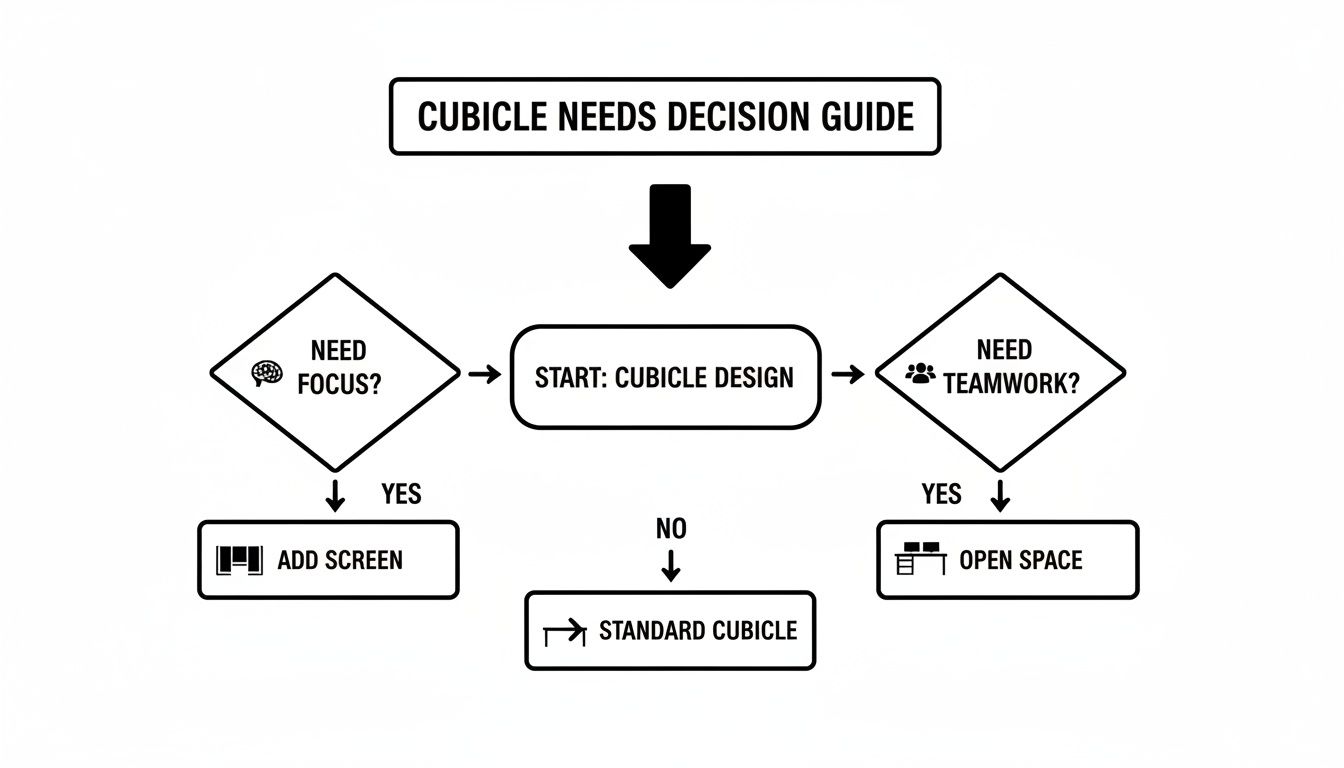
This flowchart can help you visualize the decision-making process, depending on whether your team's biggest need is individual focus or collaborative teamwork.

A decision guide flowchart for cubicle design, considering focus needs for cubicle privacy screens or teamwork for open space.

As the visual shows, the path to a productive workspace starts with identifying the core work style. This simple first step guides you toward either focused enclosures or more open, collaborative areas.

Choosing Materials for Aesthetics and Acoustics

The material you choose for your cubicle screens does a lot more than just set the office's visual style; it actively shapes how the space feels and functions. This isn't just about picking a finish. It's about solving real-world problems, whether that’s finally getting a handle on distracting noise or brightening up a dark corner of the floor plan.

Think of it this way: the material dictates whether your screen will be a sound sponge, a light filter, or a classic, professional backdrop. That one decision is fundamental to creating an office where people can actually get work done.

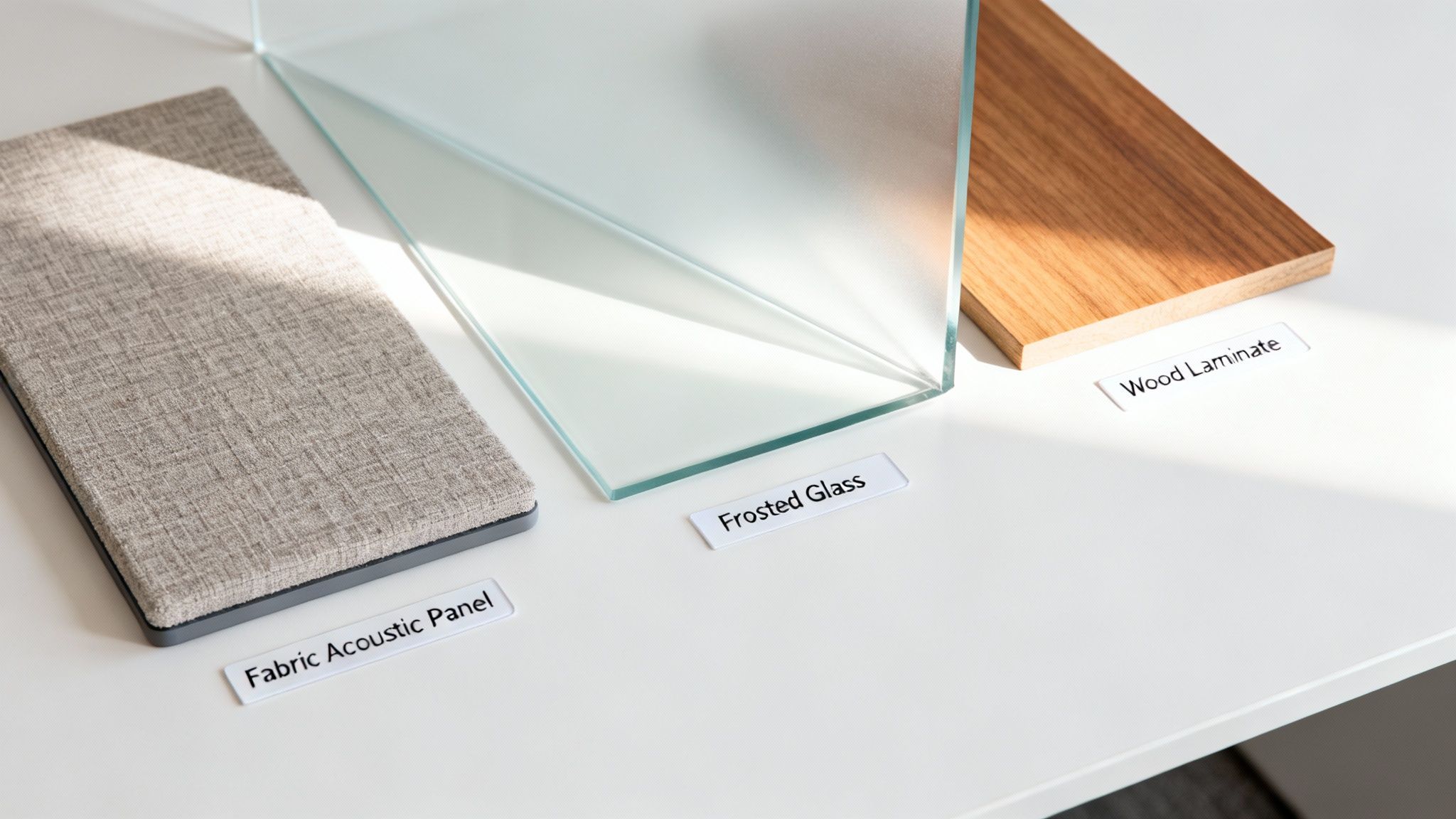
Three material samples for office partitions: a fabric acoustic panel, frosted glass, and wood laminate, showing options for cubicle privacy screens.

Fabric Panels: The Sound Sponges

If your office is dealing with noise pollution—and most are—fabric-wrapped acoustic panels are the gold standard. These things act like 'sound sponges,' soaking up all that ambient chatter, ringing phones, and keyboard clatter instead of letting it bounce off hard surfaces. Their porous cores are engineered specifically to kill echo and dial down the overall volume.

This makes fabric the go-to choice for:

  • Call Centers: Where you have dozens of conversations happening at once, creating a wall of sound.
  • Quiet Zones: For those designated areas where people need to put their heads down and concentrate without constant interruptions.
  • Collaborative Hubs: To keep the noise from one team's brainstorming session from derailing another team's focus next door.

Glass and Polycarbonate: The Light Filters

On the flip side, you have materials like frosted glass or polycarbonate that act as 'light filters.' They’re perfect when you want to create visual separation without losing that bright, open feel of a modern office. These translucent screens obscure direct sightlines for privacy, but they still let natural and artificial light pour through the space.

This approach helps you maintain a sense of openness and connection, avoiding that closed-in, claustrophobic feeling you can get with solid, opaque dividers. You can see how this concept works on a larger scale with full glass partition walls for offices.

Laminate and Wood: The Classic Finish

For a timeless, buttoned-up look, you can't go wrong with laminate and wood finishes. These materials bring a sophisticated, professional vibe that can easily match your existing desks and architectural details, creating a cohesive, high-end feel. They’re also incredibly durable, easy to wipe down, and resistant to scratches, which makes them a smart, practical choice for busy areas.

Privacy isn't just a corporate buzzword; it's a fundamental need across industries. Just look at healthcare—their investment in privacy solutions shows how critical it is. The global market for privacy cubicle curtains is expected to hit USD 632.8 million by 2032, all driven by the need for patient confidentiality. You can read more about this trend in the Grand Research Store report.

Selecting the Right Size and Mounting Options

Choosing the right material is only half the battle. Getting the dimensions perfect is what makes a privacy screen truly effective.

Think about it: a screen that’s too short won’t actually block sightlines, while one that’s too tall can make a space feel cramped and isolated. It's a game of inches, but getting it right ensures your investment pays off in productivity and comfort.

The key is to start with a clear goal. Are you trying to give employees quiet focus while they're at their desks, or do you need to block views along a busy walkway? Answering this question will guide every decision you make about height and placement.

Deciding Between Seated and Standing Privacy

Your first big decision is the level of privacy your team actually needs. This usually falls into two categories, and each one serves a very different purpose in the office.

  • Seated Privacy: This is achieved with screens typically between 42 to 53 inches high. This height is perfect for blocking distractions and creating a focused personal workspace for employees when they are sitting down. It keeps coworkers from seeing directly onto screens from across the room, yet it’s low enough to allow for easy collaboration when someone stands up to chat.

  • Standing Privacy: This requires taller screens, usually 60 inches or higher. This is your best bet for high-traffic areas or for departments like HR and finance that handle sensitive information. It effectively blocks the view of both seated employees and those walking by, offering a much higher degree of visual security.

To get a better sense of how these heights fit into a larger floor plan, check out our guide on standard cubicle dimensions.

Choosing the Best Mounting Option

How a screen attaches to your workspace is just as important as its size. The mounting style affects stability, flexibility, and even the furniture itself.

The genius of today's systems is modularity. You can start with a basic configuration and easily reconfigure or expand as your needs evolve, ensuring your office can adapt without requiring a complete overhaul.

There are two main ways to go:

  1. Clamp-On Mounts: These are the most flexible and non-permanent solution. Clamps attach directly to the edge of a desk without any drilling, protecting your furniture from damage. This makes them a fantastic choice for retrofitting existing desks, especially in leased office spaces where you can't make permanent changes.
  2. Permanent Mounts: For a more integrated and stable setup, screens can be screwed directly into the desk or be part of a full cubicle panel system. This method is best for long-term office layouts where you don’t expect to be making frequent changes.

Enhancing Visual Privacy and Data Security

In today's workplace, privacy isn't just about keeping noise down—it’s about actively protecting sensitive information. The big shift toward open-plan offices has, without meaning to, opened the door to a major vulnerability: "visual hacking." This is where confidential data on a computer screen is just a glance away for anyone walking by.

This isn't some far-off, theoretical risk; it's a real problem with serious consequences. Just think about an HR manager reviewing employee salaries, a finance team member looking at confidential client accounts, or a lawyer reading a privileged document. All it takes is a casual glance from a passerby—a sneaky practice known as shoulder surfing—to cause a major data breach.

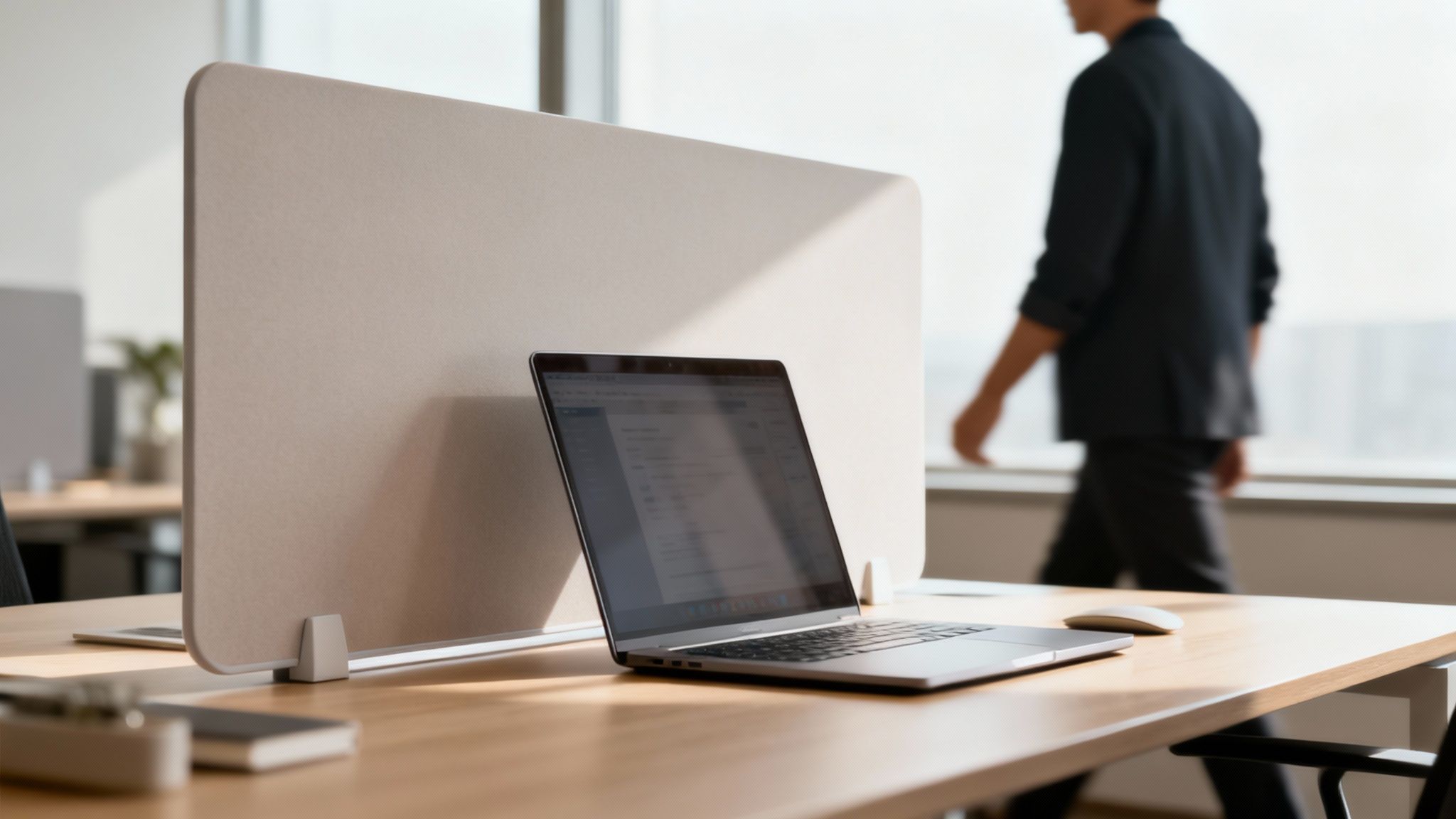
A laptop computer sits on a modern wooden desk next to a cubicle privacy screen in a sunlit office, illustrating data security.

From Accessory to Security Essential

This is exactly why strategically placed cubicle privacy screens are so important. They serve as your first and most effective line of defense against visual hacking by physically blocking screens from prying eyes. When you put them in place, you’re turning a simple office accessory into a core part of your company's data security plan. They're a smart investment in protecting your most valuable information.

Visual privacy is no longer a "nice-to-have." It is a fundamental part of a comprehensive security strategy, protecting intellectual property, client trust, and employee confidentiality.

You can see how seriously businesses are taking this just by looking at the market. The privacy screen filter market alone was valued at USD 1.2 billion in 2024 and is expected to more than double to USD 2.5 billion by 2033. This surge is a direct response to the fact that 68% of U.S. corporate offices now have open-plan designs, which naturally leads to more visual distractions and security risks.

For offices with a lot of glass walls, companies are also looking into high-tech solutions like Casper Cloaking technology to prevent visual hacking, which makes screens appear black to anyone looking in from the outside. By combining physical barriers like cubicle screens with advanced tech, you can build a strong, multi-layered defense against data exposure.

Design Your Ideal Workspace in Minutes

Okay, you've got the theory down. You know the different types, materials, and sizes of cubicle privacy screens. Now for the fun part: putting it all into practice.

Figuring out how different setups will actually look and feel in your office can be tough. It's one thing to read about a 66-inch panel, and another thing entirely to see how it divides a space. Luckily, you don't have to rely on guesswork or complicated floor plans anymore.

Instead of just imagining it, you can become your own office architect. This hands-on approach lets you see exactly how your choices will impact privacy, aesthetics, and workflow before you commit to anything.

Become Your Own Office Architect

The best way to know if a layout will work is to build it yourself—virtually, of course. We created the Cubicle Designer for exactly this reason. It's the perfect next step to take your office from a rough idea to a solid plan.

Think of it as a sandbox for your office. Our interactive platform lets you play around with different elements in real-time. You can drag and drop layouts, test various panel heights for seated or standing privacy, and cycle through a huge range of materials and finishes. It’s a pressure-free way to build, tweak, and perfect your ideal workspace. For a deeper dive, you can transform your office with our interactive cubicle designer.

The ability to configure and visualize your workspace before purchasing is a game-changer. It ensures the final product aligns perfectly with your team’s functional needs and the company’s aesthetic vision, preventing costly mistakes.

This is where you can directly apply everything you've learned. See for yourself how a tall fabric panel creates a quiet zone for heads-down work, or how a 42-inch glass-topped screen keeps the space feeling open and connected. You can build out everything from standard workstation cubicles to fully enclosed private office cubicles with just a few clicks. It’s the most direct path to a more productive, private, and well-designed office built specifically for your team.

A Few Common Questions About Cubicle Privacy Screens

When you're planning an office refresh, a few questions about cubicle privacy screens always seem to come up. Getting clear, straightforward answers is the best way to make sure you're investing in something that actually solves your team's challenges. This quick guide tackles the most frequent questions we hear from office managers.

Think of this as the final checklist for navigating the details of selecting, installing, and maintaining the perfect privacy setup for your people.

What Is the Best Height for a Cubicle Privacy Screen?

The perfect height really comes down to what you're trying to achieve. It’s all about the goal.

  • For "seated privacy," which is just enough to shield an employee's monitor and immediate workspace while they're sitting down, panels between 42-48 inches high work great.
  • But if you want true "standing privacy" to stop people from peering over the top in busy walkways, you’ll need to go higher—think 60 inches or taller.

The best approach is to look at each department's unique needs. For instance, lower screens can be perfect for creative teams who need to talk and pass ideas back and forth easily. Taller screens, on the other hand, are a much better fit for departments like HR or finance that handle sensitive information.

Are Acoustic Screens Really Effective at Reducing Noise?

Yes, they absolutely are. Acoustic screens made with real sound-dampening materials like high-density fabric or felt are extremely effective. They work by absorbing sound waves instead of letting them bounce all over the office, which leads to a noticeable drop in echo and ambient chatter.

Now, they won't make a bustling office completely silent—that's not the point. But they will significantly dial down distracting background noise. This makes it so much easier for employees to focus on their work without getting sidetracked by every conversation happening nearby.

How Difficult Is It to Install or Reconfigure Cubicle Screens?

This really depends on the type of screen you go with. Freestanding screens, for example, are the easiest—they require zero installation and can be moved around at a moment's notice. Desk-mounted screens are also surprisingly simple, often using tool-free clamps that you can attach in just a few minutes.

Full-height modular walls are a bit more involved and might require a pro for the initial setup. But even then, modern systems from Cubicle By Design are specifically engineered to be reconfigured without a major headache. That kind of modularity means your office can adapt as your business grows, without you having to start from scratch.

Retrofitting your existing furniture is a popular and really smart strategy. Both desk-mounted and freestanding screens are designed for this exact purpose, letting you add privacy without having to replace all your desks and chairs.

Can I Add Privacy Screens to My Existing Desks?

Absolutely. In fact, adding screens to the desks you already have is one of the most budget-friendly ways to improve privacy. Both freestanding and desk-mounted cubicle privacy screens were made for exactly this scenario.

Just be sure to measure your desk's thickness before ordering to make sure the clamps will be compatible. And if you're looking at freestanding models, take a quick measurement of the available floor space to ensure a good fit.


Ready to create a more focused and productive workspace? At Cubicle By Design, we make it simple to find the perfect privacy solutions for your office. Explore our wide range of options today.

Find your ideal cubicle solution at Cubicle By Design

Read More

Desk Dividers Panels: Boost Focus and Privacy at Work | Cubicle By Design

In a world of open-plan offices, desk divider panels are your secret weapon for turning chaos into focused, productive sanctuaries. They offer both visual and acoustic separation, slashing distractions and giving your team the personal space they desperately need to concentrate. Think of them as a flexible, budget-friendly way to create privacy without calling in the construction crew.

Reclaiming Focus in the Modern Office

Let's be honest: the open-plan office was supposed to be a hub of collaboration, but it often backfires, creating a non-stop parade of noise and visual clutter. Every phone call, passing chat, and bit of movement can yank an employee right out of their workflow, leading to serious frustration and a nosedive in productivity. This is exactly where desk dividers prove their worth.

By adding a simple physical barrier, you instantly give definition back to personal workspaces. These panels act like shields, blocking out that distracting peripheral motion and muffling the ambient chatter. It’s not about building walls; it's about carving out intentional zones for deep work right within your shared space.

The Growing Demand for Focused Workspaces

This isn't just a hunch; it's a major market trend. The office dividers market, which was valued at USD 1,375.56 million, is on track to hit a massive USD 2,650.78 million by 2032. That’s a powerful compound annual growth rate of 8.14%. This surge shows a clear shift in how businesses think about office design, putting employee focus and well-being front and center. You can see more on the office dividers market growth at futuremarketreport.com.

This trend really drives home the value companies are placing on creating environments where people can actually do their best work. When you strategically add desk dividers, you're making a direct investment in your team's output and their overall happiness at work.

Key Benefits of Implementing Desk Dividers

Beyond just cutting down the noise, desk dividers bring a surprising number of benefits that make for a healthier, more efficient office. They're a fantastic tool for any manager looking to get more out of their floor plan.

  • Enhanced Privacy: Panels create a much-needed sense of personal territory. This lets employees handle sensitive tasks or take important calls with more confidence.
  • Improved Organization: Dividers help outline each person's workstation, which gives the whole office floor a more structured, tidy, and professional look.
  • Increased Employee Well-being: The constant overstimulation of an open office can be draining. By toning that down, these panels can lower stress levels and foster a more positive atmosphere.
  • Cost-Effective Flexibility: Compared to putting up permanent walls, desk divider panels are a modular, adaptable solution. You can reconfigure your space on the fly as your team's needs evolve. For more inspiration, check out our guide on office cubicle design ideas.

Ultimately, integrating desk dividers panels from a trusted provider like Cubicle By Design is a smart move. It helps you strike the perfect balance between the collaborative energy of an open office and the non-negotiable need for individual focus.

Choosing the Right Materials and Styles

Picking the right desk divider panels is a lot like choosing the right tool for a job—you have to match the material and style to the specific challenges you're facing in your workspace. It's a balancing act between function, aesthetics, and of course, budget. The decision you land on will have a real, direct impact on your office's noise levels, visual appeal, and the overall vibe.

The first step is getting a handle on what each material actually does. Are you trying to soak up sound in a high-energy call center, or do you want to keep that bright, open feel in a collaborative design studio? Every option comes with its own set of strengths and trade-offs.

Fabric and Acoustic Panels for Sound Control

For most offices, the number one enemy is noise. This is exactly where fabric-covered and acoustic PET felt panels really shine. Think of them as the sound-dampening specialists in the world of dividers.

Standard fabric-covered panels give you that classic, professional look and a solid baseline of sound absorption. They're incredibly versatile, come in just about any color you can imagine, and fit right into most office decors without a fuss.

But for spaces that need to take noise control to the next level, high-performance acoustic PET felt panels are the clear winner. Made from compressed recycled materials, they're literally engineered to trap sound waves. This makes them the perfect solution for areas where deep focus is non-negotiable.

This diagram shows how solving common workspace problems—like constant distractions—with the right tools naturally leads to better focus and higher productivity.

As you can see, creating focused environments is directly connected to the outcomes every business wants: better concentration and improved work output.

Glass and Acrylic for Openness and Light

Sometimes, the goal isn't to block out the world but to define personal space without putting up solid walls. This is where glass and acrylic panels are the perfect fit. They’re brilliant for keeping that open-plan feel while still giving everyone their own workstation.

These transparent or frosted options let natural light pour through the office, which is a proven mood-booster and can even help cut down on the need for artificial lighting.

Clear panels are fantastic for setting up boundaries that discourage interruptions without making employees feel boxed in. They strike that perfect balance, promoting a sense of team connection while providing just enough personal space.

While they won't give you the acoustic punch of a fabric panel, their sleek, modern look can instantly upgrade a workspace's design. Plus, they are incredibly easy to clean and maintain—a huge win in any busy office.

Comparing Desk Divider Panel Materials

To make the best call, it helps to see how the options stack up side-by-side. Use this quick reference table to compare the key features of common desk divider panel materials and find the best fit for your office environment.

Material Type Primary Benefit Best For Acoustic Performance
Fabric Good sound absorption, classic look General office use, moderate noise Good
Acoustic PET Felt Superior sound dampening, modern feel Call centers, focus-intensive areas Excellent
Acrylic/Glass Maintains light and openness Collaborative spaces, design studios Minimal

This breakdown makes it clear that your choice isn't just about looks—it’s a strategic decision that shapes how your team works. The right panel can turn a distracting area into a hub of productivity. When you're weighing your options, you might also want to look into the specific benefits of privacy screens for desks.

Ultimately, the right material is the one that supports your company culture and helps your people do their best work.

Understanding Acoustics and Privacy in Panel Selection

When you're picking out desk divider panels, you're making a choice that goes way beyond color or style. You're actually making a strategic decision about the entire soundscape of your office. The right panels can tame a chaotic, noisy space and turn it into a hub of focus and calm. But to get there, you need to understand a little bit about the science of sound control.

Don't worry, you don't need an engineering degree to get this right. Effectively managing office noise really boils down to two simple actions: soaking up all that ambient noise and blocking direct sound from getting from point A to point B.

NRC vs. STC: The Sponge and the Door

To get a handle on the two main acoustic ratings, let’s use an easy analogy. Think of NRC (Noise Reduction Coefficient) as a sponge and STC (Sound Transmission Class) as a solid door.

  • NRC (The Sponge): This number tells you how well a material absorbs sound inside a room. Just like a sponge soaks up a spill, a panel with a high NRC rating soaks up ambient chatter, the clatter of keyboards, and general background hum. It cuts down on echo and just makes the whole place feel quieter. This is your go-to for taming the general buzz of an open office.

  • STC (The Door): This rating is all about how well a material blocks sound from passing straight through it. Think of a closed door that keeps a private conversation from being overheard. A panel with a high STC rating is what you need to create true speech privacy, making it absolutely essential for any space where confidentiality is key.

Once you know the difference, you can choose panels that solve your actual problem. Are you trying to lower the overall volume in the office, or do you need to carve out pockets of privacy for focused work? The answer points you directly to the right solution.

How Panel Design Creates Privacy

Great acoustics isn't just about picking the right material; the physical design of the divider itself is a huge part of the equation. Things like panel height, density, and a proper installation all work together to create both the sound and visual privacy your team needs. It's common sense, but taller panels are just better at blocking sightlines and keeping sound contained.

For example, a 48-inch-high panel gives a seated person visual privacy, but stepping up to a 65-inch-high panel does a much better job of blocking sound and creating that private office cubicle feel.

The density of the panel material is another major player. Heavier, more solid panels will naturally have a higher STC rating, making them more effective sound blockers. Lastly, you have to make sure there are no gaps between panels or at the floor. Sound is like water—it will find any crack to leak through.

This move toward better, more private workspaces is part of a much bigger picture. The global home office furniture market was valued at USD 15.5 billion and is expected to grow at a 4.4% clip through 2034. It's clear that people are demanding more effective and comfortable places to work, wherever that may be. You can dive deeper into the home office furniture market trends with this report from GMI Insights.

By combining the right materials with a smart design, you can build a workspace that strikes the perfect balance between collaboration and concentration. For even more practical tips, check out our in-depth guide on achieving office cubicle privacy.

Integrating Power and Data Management

In today's office, a desk isn't just a surface for a coffee mug and a notepad—it's a high-tech command center. Laptops, multiple monitors, phones, and chargers all have a constant thirst for power and data. If you don't have a smart system to manage it all, that need for connectivity quickly turns into a chaotic mess of tangled cords, creating trip hazards and a cluttered, unprofessional look.

This is where thoughtfully designed desk divider panels become an essential part of your office infrastructure. The best modern systems are built with integrated solutions that tame the cable monster and create a streamlined, efficient setup.

The Secret Weapon: Raceways and Cable Management

The key to a clean and functional workstation is getting a handle on all those cables. High-quality desk divider panels solve this problem with built-in channels known as raceways.

Think of a raceway as a hidden highway just for your wires. These channels usually run along the base of the panel, but sometimes you'll find them at desk height, providing a protected pathway for all your electrical wiring and data cables. This clever design keeps every cord neatly tucked away and completely out of sight.

By containing cables within the panel’s structure, raceways get rid of that "cable spaghetti" lurking under desks. This doesn’t just look better—it makes the office safer by removing trip hazards and makes life much easier for the cleaning crew.

This organized approach means every employee gets easy access to the connections they need, without ever having to sacrifice a clean, professional-looking workspace.

Tapping into Your Building's Power Grid

Powering up dozens of desks across a large office requires a real strategy. Desk divider panel systems give you a few professional ways to connect entire clusters of workstations to your building’s main power supply.

Two of the most common and effective solutions are base feeds and power poles.

  • Base Feeds: This method is perfect for desks along a wall. Power and data conduits are run from a wall or floor outlet directly into the base of the first panel in a row. From there, the wiring "jumps" from one panel to the next through the internal raceways, energizing the entire line of desks. It’s a clean and discreet option.
  • Power Poles: What about workstations floating in the middle of a room? That’s where a power pole comes in. It’s a vertical conduit that drops down from the ceiling to the top of a cubicle panel, feeding power and data directly into the system's raceway. This keeps all the wiring safely overhead and out of walkways.

Both of these methods provide a safe, code-compliant way to energize your entire floor plan without ever having to rely on messy and dangerous extension cords.

And if you're looking for even more ways to organize your setup, our guide on selecting an under desk power strip offers some great tips. For those looking to simplify even further, understanding technologies like Power over Ethernet (PoE) can be a game-changer, as it can deliver both power and data to certain devices over a single ethernet cable.

Designing Your Ideal Workspace Configuration

Turning the idea of a perfect office into a reality all starts with a solid plan. With the right tools, you can go way beyond a simple floor plan and start crafting a workspace that’s truly engineered to support how your team actually works. It's about building a space that isn't just functional, but genuinely yours.

This is where you get to dive into the details. You can specify the exact dimensions, pick the right panel heights for the privacy you need, and select finishes that line up perfectly with your company's brand. It’s the point where your operational needs meet your design vision.

Step-by-Step Customization with a Digital Designer

The most powerful way to bring your layout to life is with a digital design tool. This completely takes the guesswork out of the equation, helping you visualize the final result with incredible accuracy before you commit to anything.

The Cubicle By Design Custom Cubicle Designer makes this process surprisingly straightforward. You start by laying out the core elements of your workspace:

  1. Define Your Footprint: First things first, you'll enter the precise length and width of each workstation. This simple step ensures every cubicle is going to fit perfectly within your floor space, making the most of every square foot.
  2. Set Your Privacy Level: Next, pick the panel height that matches your goals. Lower panels, around 42" to 48", are fantastic for encouraging collaboration. Taller panels, 65" or higher, create the kind of quiet seclusion needed for deep focus and confidential work.
  3. Choose Your Finishes: This is the fun part—where you really get to inject your brand's personality into the space. You can pick from a huge array of fabric colors, surface laminates, and trim paints to create a look that's cohesive and professional.

This level of control ensures your desk dividers panels line up perfectly with both your functional needs and your aesthetic vision.

Adding Essential Components for Full Functionality

Let's be honest, a great workstation is more than just a desk and some panels. Real productivity happens when an employee has everything they need right at their fingertips. A good design tool makes it easy to integrate these crucial components.

You can add in essentials like pedestals for personal storage, overhead shelves for quick access to binders and supplies, and even tackboards for pinning up important notes. Each addition is designed to optimize the individual workspace, making it more organized and easier to use. Exploring different home office organization ideas can also spark inspiration for creating an even more productive setup.

The real power of customization is its ability to transform a generic floor plan into a high-performance environment. You can design specific zones for different teams, making sure each group has the exact resources and level of privacy they need to do their best work.

The demand for these kinds of adaptable solutions is absolutely booming. The global commercial room divider market was valued at USD 789.19 million in 2022 and is projected to hit USD 1,308.62 million by 2031, growing at a strong clip of 5.78% each year. This trend just highlights how important flexible office design has become in the modern workplace.

At the end of the day, a thoughtfully designed configuration is a direct investment in your team's success. For those thinking about even larger-scale solutions, you might also want to check out our guide on modular office walls for flexible workspaces.

Frequently Asked Questions About Desk Divider Panels

Even with all the options laid out, you probably still have a few practical questions kicking around. It’s completely normal. This section tackles the most common things we get asked, giving you clear, straightforward answers to help you feel confident before you invest in a more focused workspace.

How Do I Choose the Right Height for My Desk Dividers?

The perfect height for your desk dividers really comes down to what you’re trying to accomplish.

  • For Visual Privacy: If you just want to block sightlines so your team can focus without distractions, panels that extend 18-24 inches above the desk surface are usually perfect. This puts the total height right around 48-54 inches.
  • For Acoustic Control: But if noise is the real enemy and you're aiming for a quieter, more private feel, you need to go taller. Panels that are 65 inches or higher are much better at soaking up sound and creating that focused, private office cubicle atmosphere.

Can Desk Divider Panels Be Installed on Existing Desks?

Absolutely. In fact, many divider panels are specifically designed to be retrofitted onto the desks you already own. The most popular mounting options use adjustable clamps that grab the edge of the desk—no drilling required. This makes installation a breeze and won't damage your furniture.

The key is to measure the thickness of your current desks to make sure the mounting hardware is a match. Here at Cubicle By Design, we offer versatile solutions that fit a huge range of office furniture, from simple standalone desks to more complex workstation cubicles.

The ability to add panels to existing desks is a game-changer for cost-effective upgrades. You can dramatically improve privacy and quiet down the office without the massive expense and headache of replacing all your furniture.

What Is the Best Way to Clean and Maintain Panels?

Keeping your panels looking sharp is pretty simple, but the "how-to" depends on the material.

  • Fabric Panels: For routine dusting, a quick once-over with a vacuum's brush attachment does the trick. If a spill happens, spot-clean it with a gentle, water-based fabric cleaner, but try not to soak the material.
  • Acoustic PET Panels: These are tough. A simple wipe-down with a damp cloth is usually all they need.
  • Glass or Acrylic Panels: Stick with a standard, ammonia-free glass cleaner and a microfiber cloth. That’s the secret to avoiding streaks and scratches.

No matter the material, always test your cleaning solution on a small, hidden spot first. A little bit of regular cleaning will keep your desk dividers looking professional and make them last for years. If you're planning a more complex setup, our custom cubicle designer can help you pick materials that align with how much (or how little) maintenance you want to do.


Ready to create a more focused and productive workspace? At Cubicle By Design, we specialize in providing high-quality, customizable cubicles and desk divider solutions.

Read More