


So, what exactly is a temporary office wall? Think of it as a non-permanent, movable partition system designed to slice up big, open office spaces into smaller, more functional areas. Whether you need a few private offices, a new meeting room, or a quiet zone for focused work, these walls get the job done. Unlike traditional drywall construction, these flexible solutions can be put up, moved around, and taken down with almost no disruption. This makes them a perfect fit for growing businesses that need to change their layout without the headaches and high costs of a full-blown renovation.
The Modern Answer to an Evolving Office
In a business world that seems to change by the minute, a static office layout can seriously hold your team back. Gone are the days of being locked into a single floor plan for years on end. Today’s workplaces have to be flexible—able to scale up for a new project team, create quiet nooks for deep work, or build a private meeting space on the fly. This is exactly where a temporary office wall becomes an essential tool for any company that’s thinking ahead.
Instead of tearing your hair out over disruptive and expensive construction projects, businesses are wising up and turning to modular solutions. These systems offer a genuinely practical way to shape your environment to fit what you need right now, not what you needed five years ago. Think of them as high-end building blocks for your office, letting you create a dynamic workspace that actually helps people be productive and work together.
Why Flexibility Is the New Standard
The need for adaptable space isn’t just a fleeting trend; it’s a direct response to how modern teams actually get work done. A growing startup might need to add five new workstation cubicles one month and then carve out a collaborative project area the next. With temporary walls, making these kinds of changes is surprisingly simple.
- Cost-Effective Growth: You get to sidestep the huge expense of traditional construction. Adding a new office or reconfiguring a whole department can be done for a fraction of the cost.
- Minimal Disruption: Installation is quick and clean. We’re talking hours or days, not weeks. This means your team can keep right on working without missing a beat.
- A Future-Proof Space: As your company changes, your office can change right along with it. Temporary walls can be easily moved or reconfigured to support new team structures and workflows.
At the end of the day, embracing solutions like temporary walls means you’re investing in an agile infrastructure. It gives you the power to build an office that not only looks great but also functions as a strategic asset, ready to adapt to whatever comes your way. Here at Cubicle By Design, we help businesses discover the power of flexible office design, from individual cubicles to entire floor plans.
Exploring the Different Types of Temporary Office Walls
When you hear “temporary office wall,” it’s easy to picture a flimsy, simple screen. But the reality is a whole world of smart, flexible solutions, each designed to tackle specific challenges in the modern workplace. Figuring out which type is right for you is the first step toward creating an office that truly works for your team, your budget, and your style.
The options run the gamut, from basic dividers all the way to sophisticated systems that genuinely rival the look and feel of traditional drywall. This versatility is a huge reason why the entire movable walls market is booming right now. Valued at $4.5 billion, the industry is on track to nearly double to $8.3 billion by 2033. This growth is directly tied to the fact that 70% of global firms are now making reconfigurable layouts a priority. As businesses need to stay nimble, these walls are providing the answer. You can actually explore the full market research to see more on this industry-wide shift.
This diagram breaks down the core benefits that are driving so many companies to adopt temporary walls: adaptability, productivity, and pure versatility.
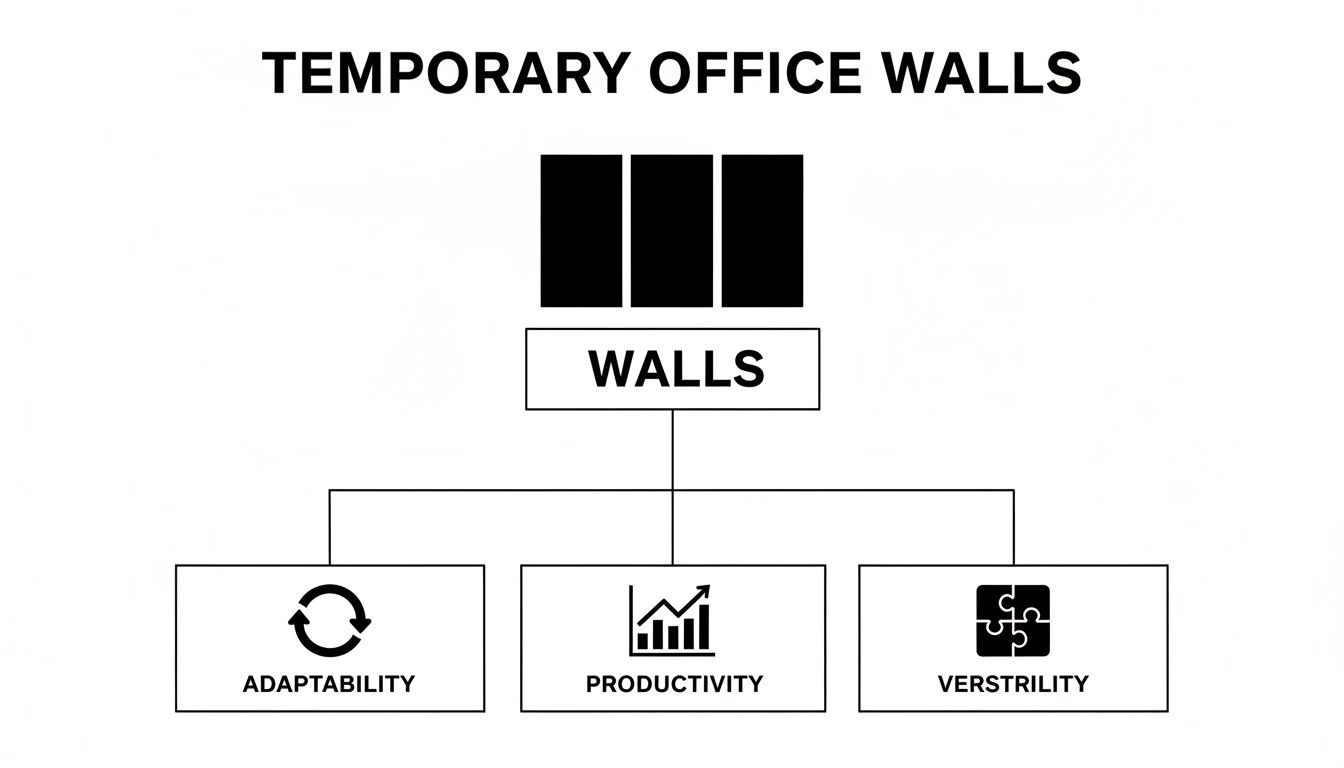
As you can see, these systems are about so much more than just dividing a room. They’re practical tools for creating work environments that can adapt on the fly. Let’s break down the most popular types you’ll come across.
Modular Panel Systems
Think of modular panel systems as the ultimate office LEGOs. They’re made up of interlocking panels, usually covered in fabric or a clean laminate finish, that you can click together in countless different ways. They are perfect for quickly creating clusters of workstations or sectioning off an entire department.
Because they’re so incredibly versatile, modular systems are a go-to for growing businesses. You can start with just a few panels to carve out a small team area, and then simply add more as you hire. They also play nicely with existing furniture, which makes them a really practical choice for offices that are constantly evolving.
Glass Wall Systems
If you’re going for a modern, high-end look that promotes transparency and lets natural light flow, glass wall systems are the premier choice. These systems use sleek tempered glass panels set in minimal frames—or sometimes no frames at all—to define spaces like conference rooms or private offices without making the area feel closed off and cramped.
Glass is the ideal way to strike that perfect balance between an open-plan vibe and the very real need for designated, quiet areas. While you get that great visual connection to the rest of the office, you still get a solid degree of acoustic separation. If you’re leaning toward this sleek option, you can learn more by checking out our guide on glass partition walls for offices.
The real magic of glass walls is their ability to maintain an open, light-filled atmosphere. They divide space physically without dividing it visually, which is a huge deal for fostering a collaborative and connected company culture.
Demountable Walls
When real privacy and serious sound control are at the top of your list, demountable walls are the heavy-duty solution you need. These are substantial, floor-to-ceiling systems that give you the acoustic performance and solid feel of traditional drywall. The key difference? Unlike permanent construction, they can be taken down and reinstalled somewhere else.
Demountable walls are perfect for creating private office cubicles or boardrooms where confidential conversations are the norm. They’re a bigger investment upfront, but they provide unparalleled soundproofing and a sense of permanence—all while keeping the flexibility to move when your office layout needs a refresh.
Freestanding Partitions and Room Dividers
For the ultimate in speed and simplicity, nothing beats freestanding partitions. These are lightweight screens that can be set up in minutes to create instant privacy nooks, visually separate different teams, or just guide foot traffic through a big open space.
They won’t give you the same level of acoustic privacy as a full, floor-to-ceiling system, but they are fantastic at cutting down on visual distractions. They’re a cost-effective and highly mobile solution for businesses that need to make quick, temporary tweaks to their floor plan without any real installation.
Comparing Temporary Office Wall Solutions
Choosing the right type of temporary wall really comes down to your specific needs—from acoustics and aesthetics to your budget and how often you plan to reconfigure your space. To make the decision a bit easier, this table breaks down the key features of the most common solutions.
| Wall Type | Best For | Acoustic Rating | Flexibility | Typical Cost |
|---|---|---|---|---|
| Modular Panel Systems | Creating cubicles and workstations, scaling with growth | Low to Medium | High | $$ |
| Glass Wall Systems | Conference rooms, private offices, maximizing light | Medium | Medium | $$$$ |
| Demountable Walls | High-privacy offices, boardrooms, soundproofing | High | Medium | $$$ |
| Freestanding Partitions | Quick visual separation, temporary privacy nooks | Low | Very High | $ |
As you can see, a simple freestanding partition is great for a quick fix, while a demountable or glass wall system is more of a long-term investment in a truly flexible infrastructure. Consider what problem you’re trying to solve today, but also think about what your team might need a year from now.
Making the Right Choice for Your Space
Moving past the different styles of temporary walls, we get into the nitty-gritty of picking the right one for your actual workspace. A successful project is about so much more than looks. You have to think about how these walls will function day-to-day. Things like acoustics, power integration, and even local building codes can make or break how well your new space actually works.
When you get these details right, your investment doesn’t just divide a room—it genuinely makes the office more productive and comfortable. The goal is to create an environment where the new walls feel like they were always meant to be there, not like a quick fix. With our free cubicle designer tool, you can visualize your layout and plan these details in advance.
Mastering Acoustics and Privacy
In any office, controlling sound is absolutely essential for focus and keeping conversations confidential. When you’re looking at temporary office walls, the Sound Transmission Class (STC) rating is the most important number to know. It tells you exactly how well a partition blocks airborne sound. The rule is simple: the higher the STC rating, the more sound it stops.
A low STC rating might be fine if you just need a visual barrier between teams, but it won’t do much to muffle a sales call. If you’re building a private office or a quiet meeting room, you’ll need a system with a much beefier rating.
A normal office conversation clocks in around 50-60 decibels (dB). A wall with an STC rating of 40 will make loud speech audible but garbled, while a rating of 50 or higher means you’ll barely hear it at all.
The wall’s material is a huge factor here. Fabric-covered panels are fantastic for absorbing ambient chatter and cutting down on echo, which can make open areas feel less chaotic. On the other hand, solid-core demountable walls offer the best performance for blocking sound, making them the go-to choice for spaces where privacy is the top priority.
Integrating with Existing Infrastructure
A temporary wall doesn’t just appear out of thin air; it has to play nicely with your building’s existing systems. Before you sign on the dotted line, you need a plan for power, data, and even airflow. The good news is that modern modular systems often come with built-in raceways to cleanly hide all your wiring and cables, keeping the space looking sharp and functioning smoothly.
Here are a few key things to map out:
- Power and Data Access: Figure out exactly where you’ll need outlets, USB ports, and network jacks. Planning this from the start with a system that has integrated cabling is a world away from tripping over extension cords later.
- HVAC and Airflow: Make sure your new walls won’t block air vents or mess with the heating and cooling. Floor-to-ceiling walls, in particular, might require some tweaks to your HVAC system to keep both sides of the wall comfortable.
- Lighting and Sprinklers: Double-check that your new layout won’t create dark, gloomy corners or, more importantly, get in the way of your fire suppression system. Local building codes are incredibly strict about sprinkler coverage, and you have to follow them.
Navigating Building Codes and Permits
While many temporary wall systems are considered furniture and don’t need a permit, that’s not a universal rule. The regulations can change quite a bit depending on your city and the specifics of your installation.
As a general rule, any wall that’s hard-wired into the building’s electrical system or goes all the way to the ceiling deck (which can interfere with HVAC and fire sprinklers) is much more likely to require a permit. The smartest move is to always check with your local building authority or your property manager before you start. It’s a simple step that can save you from big fines and the headache of having to tear down your work.
Aligning Aesthetics with Your Brand
Finally, don’t forget that the look and feel of your temporary walls should match your company’s culture. They’re a big visual part of your office, so design matters. Choose finishes, colors, and materials that work with your existing decor to create the atmosphere you’re going for.
Whether you want a sleek, modern look with glass and aluminum or a warmer, more collaborative vibe with fabric panels, the right choice will make your space feel deliberate and welcoming. You can explore our full guide to modular office walls to see just how different styles can be tailored to fit your brand.
Navigating the Costs of Renting vs. Buying
When it comes to temporary office walls, one of the first big decisions you’ll face is whether to rent or buy. This choice goes way beyond the initial price tag—it’s about matching your financial strategy to your company’s real-world needs. Think about your project timelines, your growth plans, and how much flexibility you really need.
The whole rent-versus-buy question often boils down to one thing: how long do you need the walls? If it’s a short-term gig, renting gets you what you need without a big capital spend. But if you’re playing the long game, buying is an investment that can pay off through ownership, tax benefits, and the freedom to change things up whenever you want.
The Case for Buying Your Walls
Purchasing a temporary office wall is definitely an upfront investment, but it’s often the smartest move for the long haul. When you buy, those walls become a company asset. That means you can depreciate them over time, which can create some nice tax advantages and ease the overall financial hit.
This is the perfect route for businesses with a clear, steady growth plan. If you know you’ll need a flexible office layout for the next few years, buying is almost always the more cost-effective choice. You get total control over your space, letting you reconfigure layouts for new teams or projects without ever having to think about rental fees.
The Advantages of Renting
For businesses dealing with short-term projects or a bit of uncertainty, renting is a lifesaver. It keeps your initial investment low, freeing up cash for other critical parts of your business. It’s a fantastic option for temporary project teams, seasonal hiring pushes, or even just to test-drive a new floor plan before you commit to it permanently.
Renting gives you maximum flexibility. If a project ends sooner than expected or your needs suddenly change, you’re not stuck with walls you don’t need anymore. Most rental agreements even bundle in the installation and removal, making the whole process incredibly simple from start to finish. For any need that’s less than a year, renting is usually the most practical and financially sound path.
A huge plus for both options is how much more efficient they are than traditional construction. Temporary walls are key to scaling your space cost-effectively. Many systems go up in under an hour, which can slash renovation costs by 30-40% compared to building fixed walls. It’s no wonder that over 2.5 million flexible workspaces worldwide are jumping on this trend. You can discover more insights about this trend on Archive Market Research.
A Practical Scenario-Based Guide
To make the decision a little easier, let’s look at a few common business scenarios. Seeing how it plays out in the real world can help you figure out which path is right for you.
- Rent If You Are:
- Hosting a short-term project: Need to create a dedicated space for a team for the next 3-6 months? Renting is the perfect plug-and-play solution.
- Testing a new layout: Not sure if an open plan or a more divided office is right for your team? Rent some walls and try out a few setups with very little risk.
- Managing a tight budget: If you’re short on upfront capital, renting lets you get the workspace you need right now without a huge financial commitment.
- Buy If You Are:
- Planning for long-term growth: If you expect your team to expand and your layout to change over the next several years, buying is the smarter long-term investment.
- Frequently reconfiguring your space: For dynamic businesses that are constantly adapting their environment, owning the walls gives you total freedom to change things up.
- Seeking to build company assets: Buying adds a depreciable asset to your books, which can offer some significant tax benefits down the road.
To get a better handle on the numbers, you can also explore our complete cubicle price guide. It will give you a much more detailed financial picture to help you make an informed decision.
Installation, Reconfiguration, and Long-Term Care
Picking out the right temporary office walls is a great start, but their real value comes to life over the entire time you use them. We’re talking about everything from a smooth, quiet installation to just how easy it is to shuffle your layout around and keep things looking sharp with minimal maintenance. The whole point is to keep your business nimble without creating headaches.
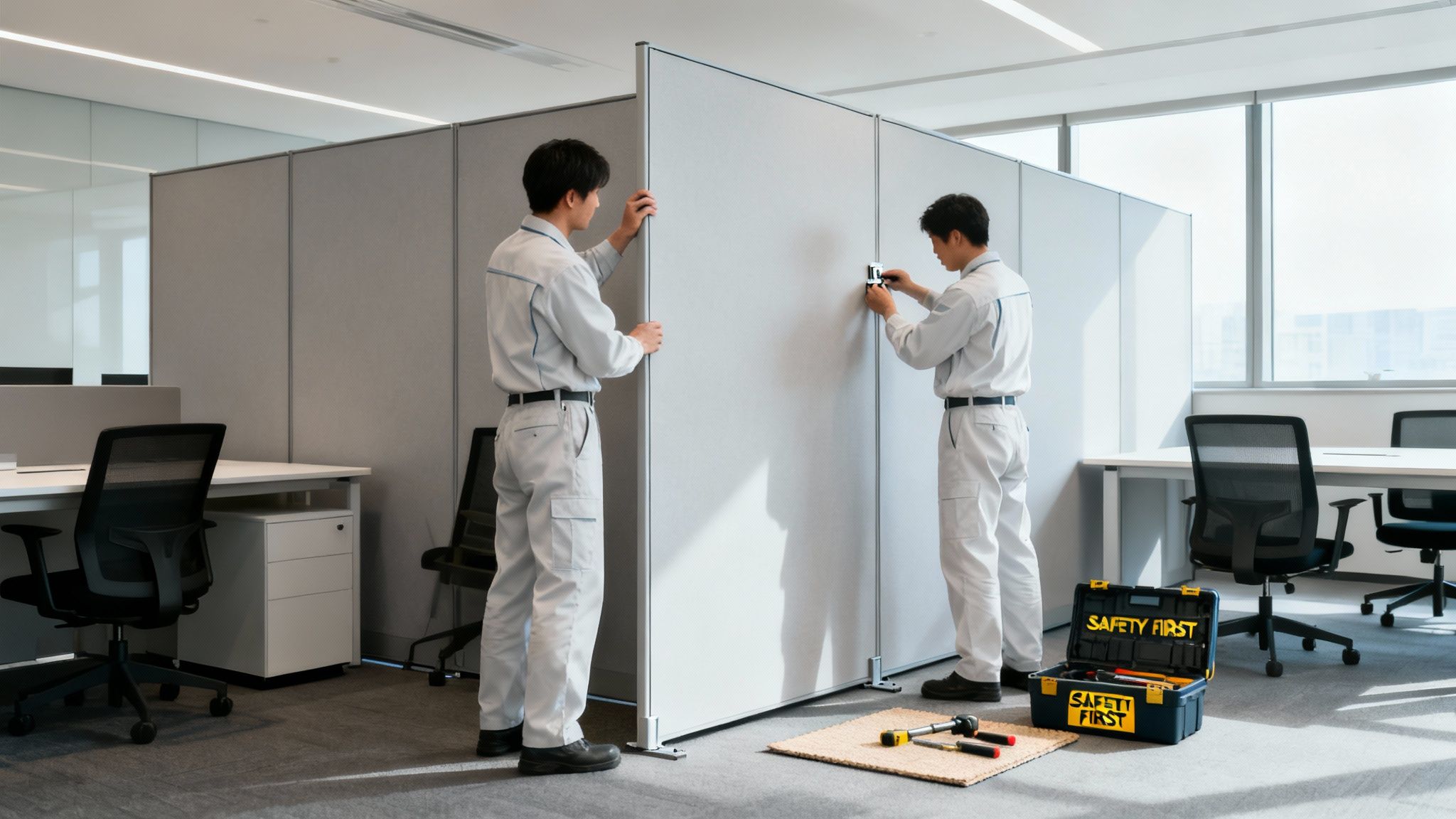
The initial setup is a breeze. It starts with a professional site visit to make sure the game plan fits your existing space perfectly. From there, trained technicians handle the assembly with as little disruption to your team’s day as possible.
This efficiency is a huge reason why the modular wall systems market hit $10.5 billion and is expected to nearly double to $20.8 billion by 2032. Businesses are jumping on board because they can slash setup time by up to 70% compared to old-school construction.
The Magic of Reconfiguration
Here’s where temporary office walls really shine: their adaptability. Your business changes, so why should your office be stuck in one configuration? When you need to spin up a new project team, add another private office, or carve out a new collaboration zone, rearranging your walls is surprisingly simple.
Unlike drywall—which means dust, noise, and a whole lot of mess—modular walls are built to be moved. The process is clean and straightforward:
- Systematic Disassembly: Panels are carefully unlocked and taken apart without creating a construction zone in your office. No dust, no debris.
- Easy Relocation: The parts are lightweight enough to be moved to their new spot without a major production.
- Quick Reassembly: The system is put back together in the new layout, often in just a few hours.
This power to constantly reinvent your floor plan is what turns a temporary wall from a one-time purchase into a long-term asset. You can get a better sense of what a professional crew can do by checking out our guide on office furniture installation.
Simple Long-Term Care and Maintenance
Keeping your temporary walls looking great for years doesn’t take much work. The care instructions depend on the material, but it’s all pretty simple stuff.
- Fabric Panels: A quick pass with a vacuum’s brush attachment handles the dust. For small spots, a gentle fabric cleaner does the trick.
- Laminate Surfaces: These are tough. Just wipe them down with a soft cloth and a mild cleaner to get rid of smudges and fingerprints.
- Glass Walls: Nothing fancy here. Standard glass cleaner and a microfiber cloth will keep your glass partitions crystal clear and streak-free.
If you’re looking for a deeper, chemical-free clean, methods for steam cleaning walls can be a great option for many surfaces. On top of that, any reputable manufacturer will offer a solid warranty covering material and workmanship defects, so you can have peace of mind that your investment is protected.
Designing a Truly Agile Office Layout
It’s time to move beyond the static floor plan. Let’s talk about how to transform your space into a living, breathing ecosystem that actually helps your team get work done. A temporary office wall isn’t just a divider; think of it as a strategic tool for building a truly agile workplace. This is all about ditching rigid layouts for a more fluid, responsive approach to office design.
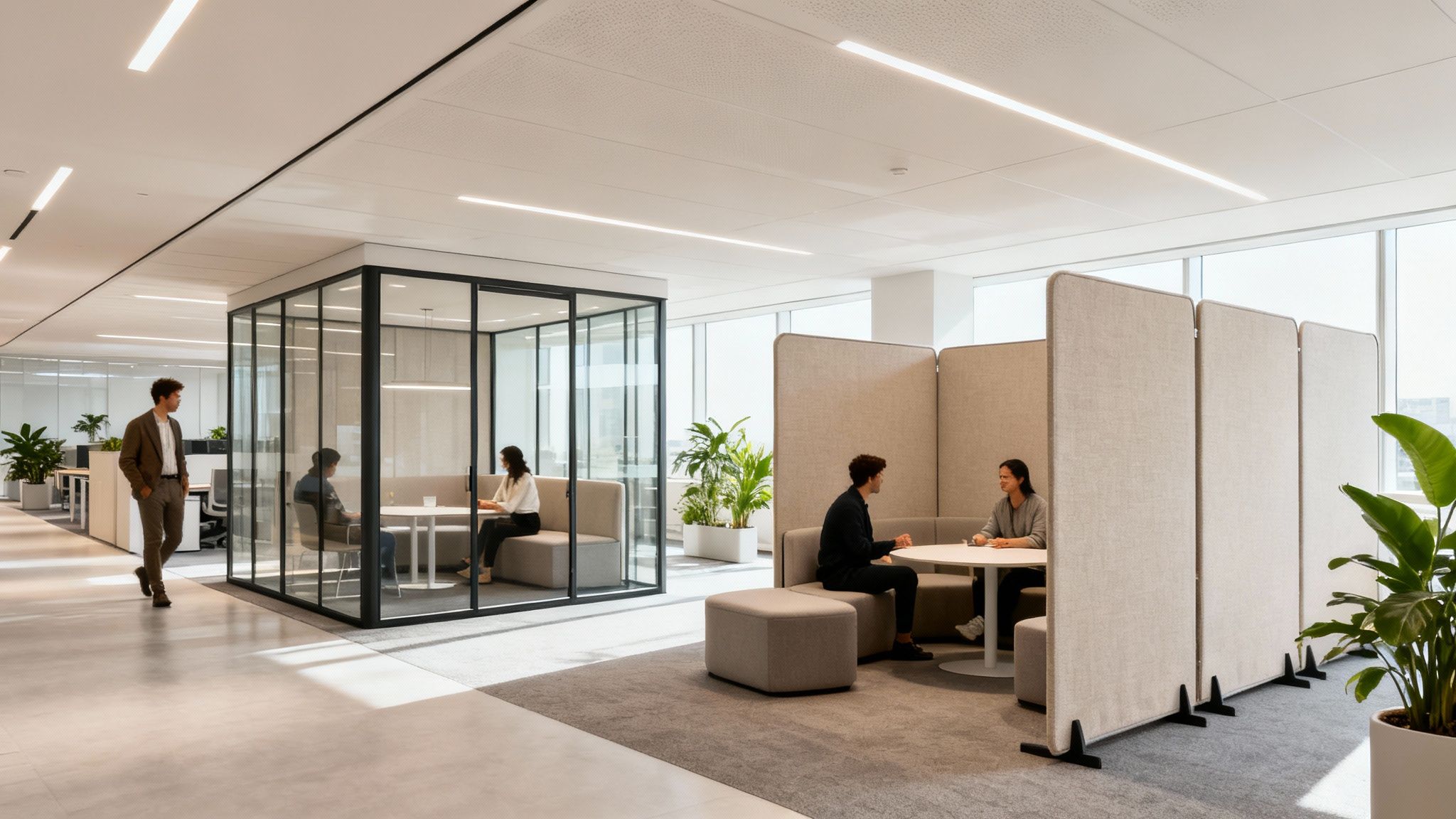
When you place these walls thoughtfully, you can carve out specialized zones that cater to different kinds of work. Suddenly, your office goes from a one-size-fits-all box to a versatile environment that supports every task your team tackles.
Creating Purpose-Built Zones
An agile office is really just a collection of intentional spaces. With modular and demountable walls, you can build out these critical areas without the headache and dust of a traditional construction project.
- Quiet Zones: Use demountable walls with a high-STC rating or fabric-covered panels to create library-like nooks for deep, focused work. These spots are gold for anyone needing to concentrate, shielding them from the unavoidable chatter of a busy office.
- Collaborative Hubs: Carve out open, energetic areas perfect for brainstorming and team huddles. Low-height partitions or sleek glass walls can define these hubs without completely sealing them off, which helps maintain a sense of connection to the rest of the office.
- Team Neighborhoods: Group project teams or entire departments into their own zones. This gives teams a home base and a sense of ownership over their space while still keeping them accessible to others.
This whole concept is the backbone of Activity-Based Working (ABW). It’s a design philosophy where employees aren’t chained to a single desk. Instead, they choose the best space for the task at hand, moving between quiet zones, collaborative hubs, and their team neighborhood as their day unfolds.
The Key to Modern Design Philosophies
Trying to implement something like ABW is nearly impossible with a fixed floor plan. Temporary office walls are the key that unlocks this level of flexibility, letting you create a workspace that responds directly to what your team needs, when they need it.
Just look at the high demand for flexible co-working office solutions—it shows how much businesses value adaptable layouts. Temporary walls let you build that same highly functional environment right inside your own dedicated space, giving your team the freedom to do their best work.
It’s time to stop thinking of walls as permanent barriers and start seeing them as powerful tools for growth. Our office space planning and design services can help you figure out exactly how to apply these concepts to your unique workplace.
Common Questions About Temporary Office Walls
Even when you think you have a solid plan, a few practical questions always pop up before pulling the trigger on a new office setup. Investing in temporary office walls is a big move toward making your space more flexible, so it’s smart to clear up any last-minute doubts. This section tackles the real-world questions we hear most often from office managers and business owners, so you can move forward with confidence.
We’ll get into the nitty-gritty of soundproofing, how these systems play with the furniture you already have, and what you can expect in terms of long-term durability. Getting these details right is the key to making sure your new walls work exactly the way you need them to.
How Good Are Temporary Walls at Soundproofing an Office
The short answer? It really depends on the type of wall you choose. The effectiveness varies quite a bit, so you have to match the wall system to the level of privacy you’re trying to achieve.
- For Maximum Privacy: If you need a space for confidential meetings or focused executive work, floor-to-ceiling demountable walls with solid cores are your best bet. These are the champs of sound control and can achieve high Sound Transmission Class (STC) ratings, effectively blocking conversations.
- For Reducing Ambient Noise: In a lively open office, fabric-covered modular panels work wonders. They are fantastic at absorbing that background hum and chatter, cutting down on echo and making it easier for everyone to concentrate. They won’t give you a silent room, but the improvement is significant.
- For Visual Separation: Glass walls look sharp and modern, but standard versions don’t do much for sound privacy. If you love the look but need more quiet, you can upgrade to specialized acoustic glass, which has a sound-dampening layer built right in.
For true, library-level quiet, nothing beats a full-height system with proper seals at the floor and ceiling.
Can I Use These Walls with My Existing Office Furniture
Absolutely. In fact, that’s one of their biggest selling points. Temporary walls are designed from the ground up to integrate with the desks, filing cabinets, and especially the workstation cubicles you already own. This compatibility is what allows you to reconfigure your space without having to buy all new furniture.
You can use them to carve out a few private offices right next to your open-plan area or build new perimeters around a cluster of existing desks. For a truly seamless look, it’s a good idea to measure the height of your current furniture and pick a wall style that complements it. Companies like Cubicle By Design offer a huge selection of cubicles and wall systems that are designed to fit together perfectly.
Think of temporary walls as a modular extension of your current office. They don’t replace what you have; they enhance it, allowing you to add layers of privacy and structure exactly where they’re needed most.
Are Temporary Office Walls Durable Enough for Daily Use
Yes, without a doubt. We’re not talking about flimsy room dividers here. Commercial-grade temporary walls are built to handle the daily grind of a busy office. Reputable manufacturers use tough, high-quality materials like heavy-duty aluminum frames, scratch-resistant laminates, and tempered safety glass that can stand up to years of wear and tear.
The key to longevity, however, is using the right tool for the job. A lightweight freestanding screen is perfect for a low-traffic corner, but it’s not the right choice for a main corridor. For high-use areas like hallways or meeting rooms, you’ll want a more robust modular or demountable system. When you choose the right product and have it installed correctly, these walls become a lasting part of your office infrastructure.
Ready to create a more agile and productive workspace? The experts at Cubicle By Design can help you find the perfect temporary wall solution for your needs. Explore our options and start your office transformation today at https://cubiclebydesign.com/.