

What if the secret to a more productive, efficient office has been hiding in plain sight for decades? When it comes to laying out an office, the go-to starting point is almost always the 6-foot by 6-foot cubicle. It's become the industry standard for a reason, striking that perfect balance between personal workspace and a smart floor plan.
But don't think of this 36-square-foot footprint as a rigid rule. It's more like a versatile foundation you can build on.
The Standard Cubicle Footprint
Think of the 6'x6' cubicle as the most fundamental piece in your office design toolkit—it's flexible, efficient, and surprisingly adaptable. This size didn't just appear out of thin air; it evolved from a real need to give people their own focus zones without putting up expensive, permanent walls.
Its popularity really boils down to providing just enough room for a desk, a chair, and some basic storage. This makes it a super practical choice for all sorts of different roles.
The real genius of this standard is its modularity. A 6'x6' footprint can handle different desk setups, from a simple straight surface to a more spacious L-shaped desk, all within that neat, contained area. That's why it's such a great solution for businesses trying to get the most out of every square foot. If you're looking for more general information on dimensions for various products, that resource can be a helpful starting point. At the end of the day, the goal is to create a functional workspace that supports your team without wasting valuable space.
Why Did 6×6 Become the Standard?
The 6'x6' cubicle has been the gold standard for a long time. You can trace its roots all the way back to the Action Office II system from 1968, which was all about boosting productivity with flexible designs. Then, as companies got more cost-conscious in the 1980s, this size really took over. It was the perfect compromise between those dense "cube farms" and roomy private offices.
Today, it’s still a popular choice because it fits so well into common layouts while giving employees enough personal space to actually focus—a huge factor in any good office design.
Here’s a quick breakdown of the most common sizes you'll encounter and what they're best used for.
Quick Guide to Common Cubicle Footprints
| Cubicle Size (ft) | Total Area (sq ft) | Best For | Configuration Type |
|---|---|---|---|
| 5' x 5' | 25 | Call centers, data entry, high-density areas. | Compact, Benching |
| 6' x 6' | 36 | Standard individual workstations, all roles. | L-Shape, U-Shape |
| 6' x 8' | 48 | Mid-level staff needing more storage space. | L-Shape, U-Shape |
| 8' x 8' | 64 | Managers, staff needing meeting space. | U-Shape |
| 8' x 12' | 96 | Executive offices, collaborative pods. | Private Office |
As you can see, there's a footprint for just about every need, from the most compact setups to something more expansive.
A well-planned office layout is more than just arranging furniture; it’s about creating an environment that fosters productivity, collaboration, and employee well-being. The typical cubicle size serves as the cornerstone of this strategic process.
Ultimately, picking the right cubicle size is just the first step in a much bigger puzzle. The real work involves mapping out your entire floor plan, thinking about how people will move through the space, and making sure everything is up to code.
This whole process is what we call space planning. You can check out our guide on what is space planning to get a better handle on how all these pieces fit together to create an office that actually works. With this foundational knowledge, you can confidently move toward creating a space that your team will love.
Matching Cubicle Dimensions to Workplace Roles
Sure, the 6'x6' cubicle is a solid, reliable starting point, but it's far from your only option. Honestly, picking the right cubicle size isn't about chasing some universal standard. It’s about matching the workspace to what the job actually demands. You wouldn't use a smart car for a construction job, right? Same logic applies here—you don't cram an employee who needs to spread out blueprints or focus on complex projects into a tiny box.
When you start thinking this way, you move past the "one-size-fits-all" trap and start building an office that genuinely works. By aligning each workstation's footprint with the daily grind of the employee using it, you can seriously boost productivity, improve comfort, and get the most out of every square foot. It's the kind of strategic thinking that lies at the heart of smart office design.
This little balancing act between efficiency, comfort, and your overall goals is everything.
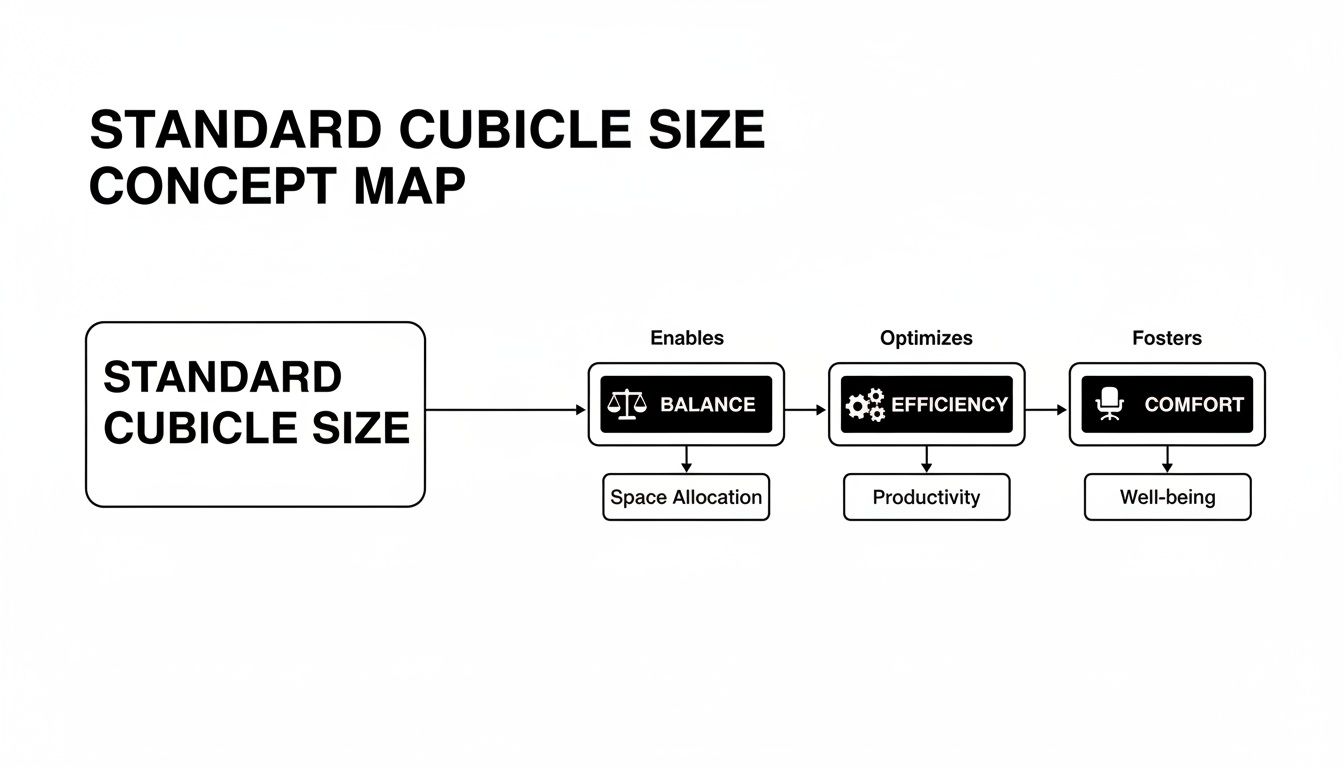
As you can see, the dimensions you choose have a direct impact on your team's day-to-day productivity and well-being.
Compact Cubicles for High-Density Roles
For jobs that are heavy on phone calls or repetitive computer tasks, a smaller footprint is almost always the most practical way to go. Think call centers or data entry departments—environments where density and efficiency are the names of the game.
-
4'x4' or 5'x5' Cubicles: These compact stations give you just enough room for a computer, a phone, and a few personal items. Their small size is perfect for maximizing the number of employees you can fit into one area, which is a must-have for large teams working in close quarters.
-
Benching Systems: Another go-to for these roles is a benching system. Imagine long, shared tables with low (or no) dividers. They're incredibly space-efficient and tend to foster a high-energy, collaborative vibe.
These smaller setups are all about function. They provide a no-frills workspace that gets the job done. If you're looking to optimize this kind of space, you can learn more about upgrading your workspace with call center cubicles.
Standard Workstations for Everyday Tasks
Now let's talk about the backbone of most offices: the administrative staff, marketing coordinators, and all the other roles that need a balanced environment. This is where the standard 6'x6' and the slightly roomier 6'x8' workstation cubicles really shine.
These sizes typically feature a versatile L-shaped work surface, giving employees plenty of room for a multi-monitor setup, paperwork, and personal touches without feeling hemmed in. That extra space in a 6'x8' layout is a great fit for people who need a bit more surface area or extra storage like pedestal files and overhead bins. It's the perfect middle ground between personal space and an efficient floor plan.
For these roles, the goal is to create a "home base" that feels both functional and personal. A well-proportioned standard cubicle gives employees a sense of ownership, which can lead to better focus and higher job satisfaction.
Spacious Layouts for Management and Focus Work
Finally, some roles just demand more. More space, more privacy, and more room for those little impromptu meetings. We're talking about managers, executives, designers, and engineers—people whose workflow requires a bigger footprint.
Spacious options like 8'x8' or 8'x12' configurations are ideal here. These dimensions can easily accommodate a U-shaped desk, guest chairs, and plenty of storage. The larger area creates a clear sense of separation and provides the privacy needed for confidential conversations or deep, uninterrupted concentration.
These bigger setups essentially act as private office cubicles without the cost and hassle of building permanent walls. Throw in some taller panels, and you've created a secluded environment that supports leadership and high-focus work. At Cubicle By Design, we help you find the perfect match for every single role on your team.
How Cubicle Layouts Shape Your Office Environment
A cubicle's dimensions are only half the story. The real magic happens when you start arranging them together to create a functional, flowing office. Think of it less like placing a single piece of furniture and more like city planning for your workspace. The way you cluster workstations—in tight-knit pods or long, orderly rows—has a huge impact on everything from foot traffic to team dynamics and even your company culture.
A smart layout does more than just cram people into a room. It can intentionally build bridges between collaborators or carve out quiet zones for deep, focused work. By understanding the most common configurations, you can turn a basic floor plan into a genuine productivity tool.
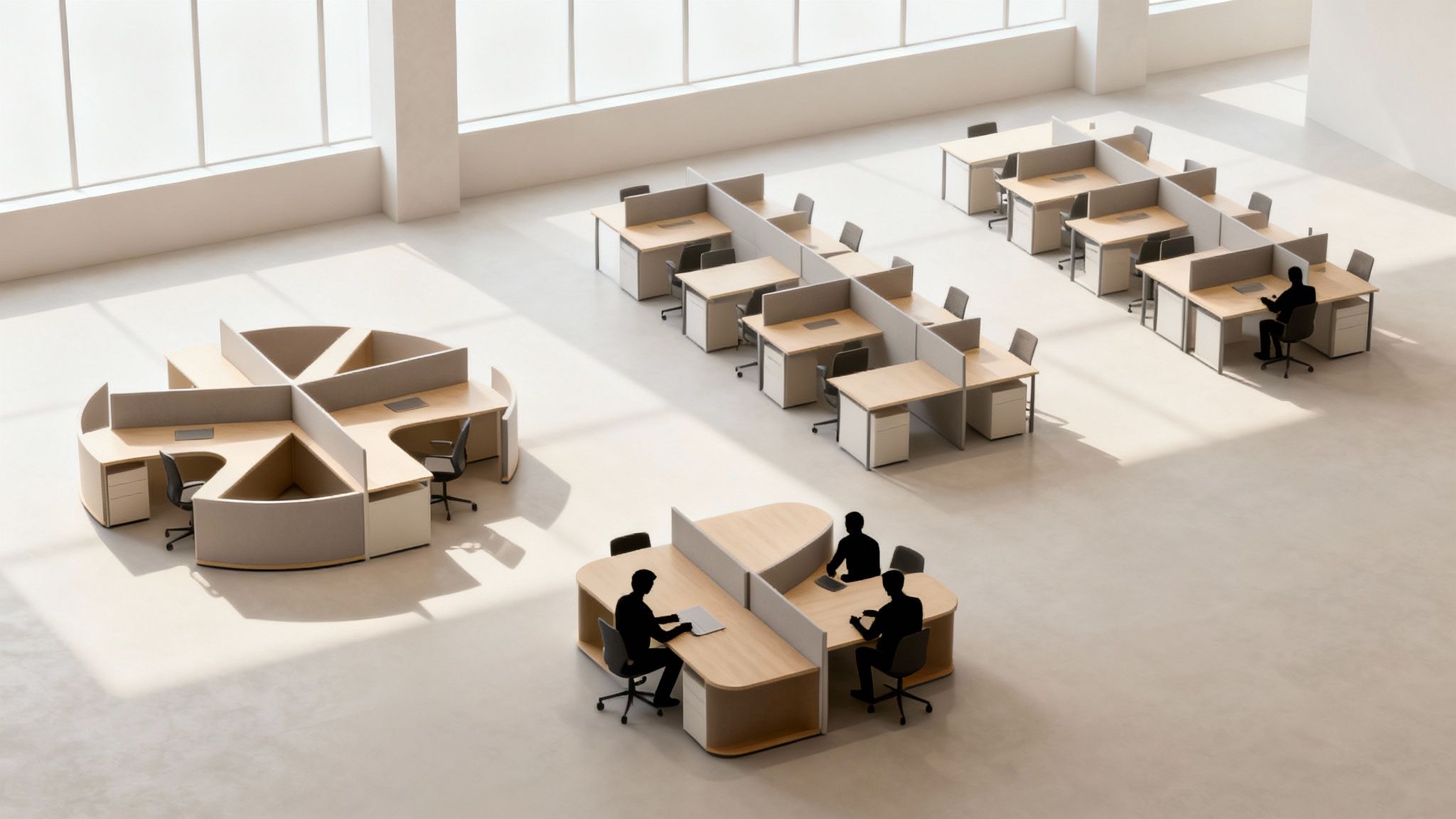
The right arrangement can make all the difference in how your teams connect and perform every single day.
Fostering Teamwork with Collaborative Pods
When the goal is to get specific teams talking, arranging cubicles into pods or clusters is a fantastic strategy. This setup groups employees who need to work together into a shared zone, making those quick, spontaneous problem-solving chats completely effortless.
- Pinwheel Layouts: Picture four L-shaped desks joined at the corners. From above, it looks just like a pinwheel. This gives each person their own defined area while keeping them just an arm's length away from their three closest teammates.
- 4-Pod Clusters: This is a classic for a reason. It places four cubicles together in a simple square, which helps build a strong team identity and makes sharing resources feel natural and intuitive.
These clustered designs are ideal for departments like marketing, engineering, or project management, where constant communication is the name of the game. They transform a set of individual workstations into a team's unified command center.
Maximizing Efficiency with Linear Configurations
For roles that require more independent focus—or in offices where you just need to maximize your headcount—linear layouts offer a clean and highly efficient solution. These configurations line up cubicles in straight rows, creating obvious traffic paths and a structured, orderly environment.
The most popular linear style is the back-to-back row. This setup has employees facing away from each other, which cuts down on visual distractions while keeping shared aisles clear and accessible. It’s particularly effective for roles in accounting, administration, or any job where individual concentration is key.
Another option is a benching system, which is basically a long, shared desk with low or no dividers. You sacrifice some privacy, but the space-saving design is unbeatable for high-density offices. For a closer look at these and other layouts, check out our overview of common cubicle configurations.
Designing for Specific Workflows
Ultimately, the best layout is one that supports how your team actually works. A sales or telemarketing team, for instance, might thrive in a specialized "telemarketing pod." This design typically uses higher panels and a smaller footprint to create better acoustic separation, cutting down on background noise so they can hear clients on the phone.
For a more tailored approach, don't be afraid to mix and match. You could build collaborative pods for your creative teams, set up back-to-back rows for the finance department, and drop in a few standalone private office cubicles for managers who need them. This kind of hybrid model lets you fine-tune the environment for each department's unique needs.
Planning Your Aisles for Safety and ADA Compliance
Choosing the right cubicle size is a huge step, but the job isn't done until you've thought about the space between them. The pathways, aisles, and walkways are the arteries of your office, guiding traffic, ensuring safety in an emergency, and making sure every single employee can get around easily.
If you don't plan your aisles well, you're not just creating an inefficient office; you're creating a potentially dangerous one that could be a legal liability. A bad layout leads to frustrating bottlenecks, creates a fire hazard, and can fail to meet critical accessibility laws. A well-thought-out floor plan, on the other hand, makes for a safe, inclusive, and productive environment for everyone on your team.
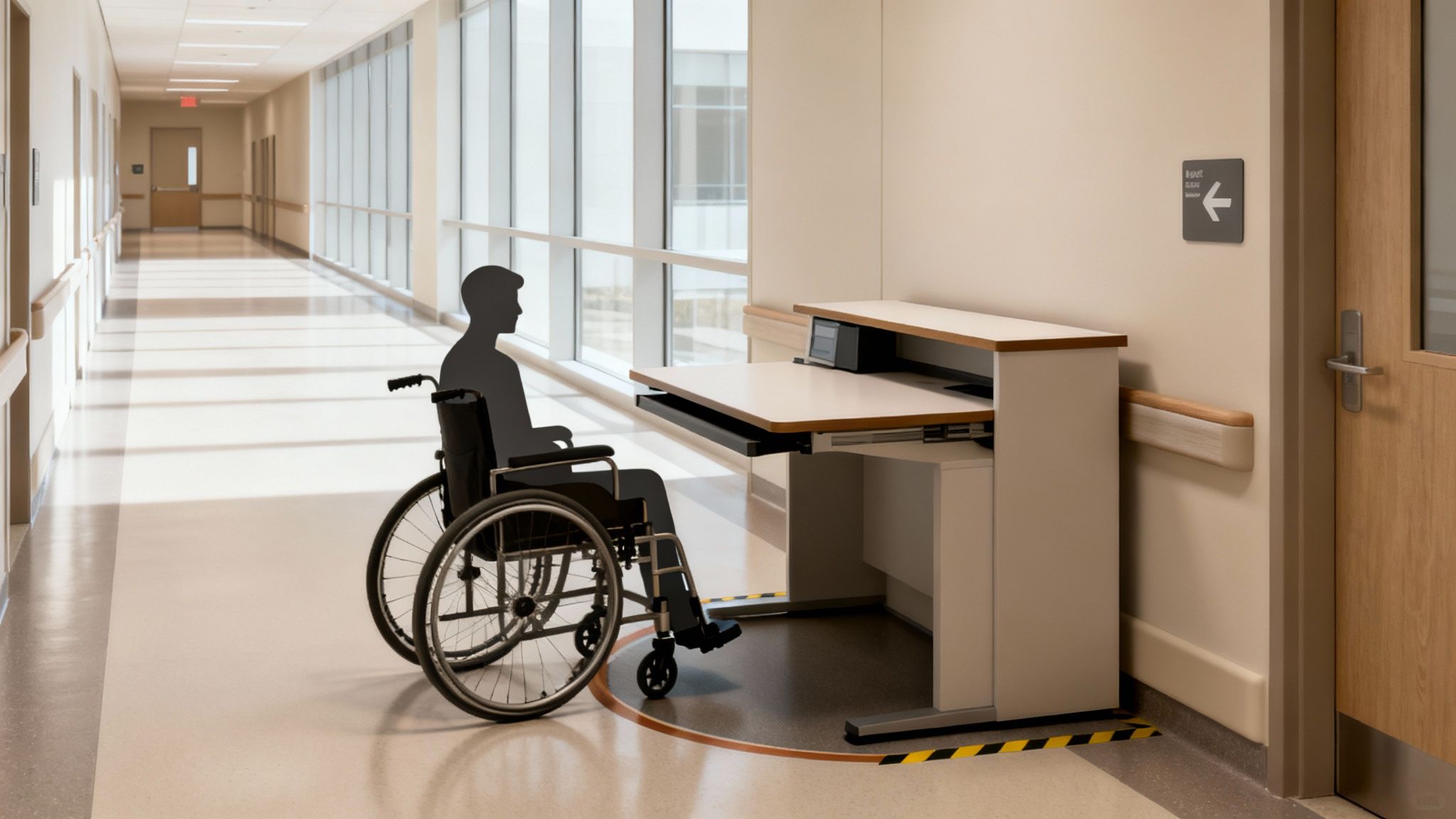
This commitment to smart design is fundamental to creating a workplace that truly works for all employees.
Aisle Widths for Fire Safety and Flow
The first rule of thumb for aisle planning is making sure there's a clear path out. Local fire codes are very specific about the minimum width for walkways to allow for a quick, orderly evacuation. While the exact rules can vary by location, a few general standards are a great place to start.
- Main Aisles: Think of these as the highways of your office—they connect major areas like entrances, exits, and break rooms. They need to be at least 44 inches wide to handle heavy foot traffic and emergency crews.
- Secondary Aisles: These are the smaller side streets that lead to individual cubicles. A minimum width of 36 inches is usually required, which is enough for one person to walk through comfortably.
It’s just like planning roads in a town. You need wide main streets for lots of cars and smaller side streets to get to individual houses. And, of course, keeping these paths clear of obstructions like boxes, chairs, or equipment is absolutely non-negotiable for safety.
Understanding ADA Requirements for an Inclusive Office
Beyond basic safety, your office layout must comply with the Americans with Disabilities Act (ADA). These federal guidelines are in place to ensure people with disabilities can access and navigate the workplace just like everyone else. For office layouts, that often boils down to providing enough clearance for wheelchair users.
"An accessible route must provide a clear width of at least 36 inches for a single wheelchair and 60 inches for two wheelchairs to pass. A T-shaped or 60-inch diameter circle is needed for a 180-degree turn."
This is one of the most critical ADA rules to remember. You absolutely have to provide a 60-inch (5-foot) diameter turning circle or a T-shaped intersection within your cubicle clusters so a wheelchair user can turn around. This space is mandatory and needs to be baked into your layout from day one.
The ADA guidelines also apply to the workstations themselves.
- Desk Height: Surfaces need to provide at least 27 inches of knee clearance from the floor.
- Reach Ranges: Controls, outlets, and storage have to be within easy reach from a seated position.
Building an ADA-compliant office isn't just about following the rules; it's about creating a space where every employee feels valued and can do their best work. As you map out your floor plan, carefully consider every detail, from door widths to desk heights. For a deeper look at these factors, our comprehensive office space planning guide offers valuable insights to help you get it right. At Cubicle By Design, we help you create a layout that’s efficient, safe, and welcoming for every member of your team.
Customizing the Perfect Workstation for Your Team
Knowing the standard cubicle sizes is a great starting point, but the real magic happens when you start tailoring workstations to how your team actually works. Moving beyond the pre-set dimensions is how you create an environment that actively helps your people succeed, rather than just giving them a place to sit. It’s like the difference between a suit off the rack and one that’s been custom-fitted; they both do the job, but one is a whole lot more comfortable and effective.
This is where you stop thinking about generic setups and start designing a truly high-functioning workspace. By focusing on the elements you can actually change—from panel heights that control privacy to built-in storage that keeps essentials close by—you can build a workstation from the ground up that becomes a real asset.
Key Elements of Customization
To build the perfect workstation, you need to think beyond its footprint. A few key components come together to define how a cubicle actually looks, feels, and functions for the person using it. Getting these details right is what turns a standard space into a powerhouse of productivity.
Here are the main dials you can turn:
- Panel Height: This is your number one tool for managing privacy and noise. Low panels, around 42 inches, keep things open and make it easy for team members to collaborate. Mid-height panels, from 53 to 65 inches, give you seated privacy, which is perfect for focused work. For roles that demand deep concentration, full-height panels at 65+ inches create the quietest, most secluded spaces.
- Storage Solutions: You can’t have an efficient workspace without good, integrated storage. Options run the gamut from mobile pedestal files that slide neatly under a desk to overhead bins that keep less-used items out of the way. Picking the right mix ensures an employee has everything they need without their desk becoming a mess.
- Power and Data Integration: Let's face it, a modern workstation runs on power and data. Customizable cubicles let you build in electrical raceways to keep all those cords and cables organized and hidden. Not only does it look a whole lot better, but it also gets rid of dangerous tripping hazards.
Bring Your Vision to Life with Our Custom Designer
The idea of designing a whole office layout might sound intimidating, but today's tools make it surprisingly simple. You don't need to be an architect to map out a workspace that actually works for your team. You just need a tool that lets you see what you’re doing.
The best office designs come from a real understanding of daily workflows. When you customize, you can build workstations that solve the actual problems your team faces, whether it's not enough storage or too many distractions.
At Cubicle By Design, we want to empower you to create that ideal office. Our online Cubicle Designer tool is a powerful but straightforward platform that puts you in the driver's seat. You can play around with every aspect of your workstation, from the basic dimensions to the final touches.
With just a few clicks, you can:
- Pick a starting layout, whether you need a compact station or a spacious private office cubicle.
- Adjust panel heights to find that sweet spot between privacy and teamwork.
- Try out different fabrics and finishes to match your company’s vibe.
- Add the right storage and power options to build a complete workstation cubicle.
Once you have a design you love, you can send it right to our team for a detailed quote. This takes your plan from an idea to a real, tangible project you can move forward with. Stop settling for a one-size-fits-all solution and start building the exact workspace your team deserves with Cubicle By Design.
Start Your Office Transformation with Cubicle By Design
So, feeling ready to build a smarter, more productive workspace? You've journeyed through the essentials—from picking the right cubicle size to designing layouts that are efficient, safe, and up to code. Now, it’s time to turn all that great knowledge into action.
At Cubicle By Design, we're more than just a furniture company. Think of us as your partner in creating a better office, from that first spark of an idea all the way to a fully realized, functional workspace that just works.
Your Partner from Planning to Completion
Our expert team is here to jump in at any stage of your project. We can help with the initial space planning to make the most of every square foot, guide you in selecting the perfect workstation cubicles, and stick with you until the project is wrapped up successfully. We sweat the details so you can focus on running your business.
Ready to see what's possible? Take a look through our full range of cubicles to get some inspiration flowing.
The best workspaces are born from a clear vision and the right tools. We're here to provide the expertise and resources to bridge that gap between your concept and a finished, productive office.
If you're the hands-on type, you can start building your ideal setup right now. Learn how to transform your office with our interactive cubicle designer and begin tweaking every detail to fit your team's unique needs.
Whether you need a single private office cubicle or an entire floor of workstations, our goal is simple: to help you create a workplace that truly supports your team. Let's build a better office, together.
Got Questions About Cubicle Sizes? We've Got Answers.
Even after you’ve spent hours planning your office layout, a few specific questions always seem to pop up right when you think you're done. It's completely normal. We hear the same great questions from clients all the time, so we’ve put together some straightforward answers to help you lock in those final details with confidence.
What's the Smallest Cubicle Size That Actually Works?
You might see some ultra-compact stations out there, some as small as 4'x2', but for most day-to-day roles, the smallest you want to go is 5'x5'. This gives you a 25-square-foot space, which is just enough room for a desk, a proper office chair, and a bit of personal storage without making your team feel like they're working in a closet.
A 5'x5' footprint is a go-to choice for high-density setups where the main goal is fitting in as many people as possible. Think call centers, data entry departments, or even temporary "touchdown" spots for visiting employees—anywhere efficiency and a repeatable layout are key.
How Much Does Panel Height Really Matter for Privacy?
Panel height is a bigger deal than most people think. It’s one of the most critical levers you can pull to control the entire vibe of your office, dictating both visual privacy and how much noise bounces around the room.
- Low Panels (around 42 inches): These are great for keeping things open and encouraging chatter. They create an airy, collaborative feel but don’t do much to block sound or sightlines.
- Mid-Height Panels (53-65 inches): This is the sweet spot for a lot of companies. They offer "seated privacy," so when an employee is sitting down, they can focus without visual distractions. This height also does a decent job of soaking up ambient office noise.
- High Panels (65+ inches): When you need to create quiet, heads-down workstations, this is the way to go. Tall panels provide maximum visual privacy and the best sound absorption, perfect for roles that require deep, uninterrupted concentration.
Ultimately, picking the right height comes down to balancing your company's culture with the need for individual focus.
What's the Best Way to Measure a Room for Cubicles?
Getting your measurements right is the foundation of a good layout. Don't rush this part—a small mistake here can turn into a huge headache (and a costly one) when the furniture arrives and doesn't fit.
First, get the big picture by measuring the total length and width of the room to calculate your overall square footage. Then, grab a notepad or tablet and sketch a basic floor plan. Walk the room and carefully mark the exact locations of every permanent fixture: columns, support beams, doors (and which way they swing!), windows, and, of course, where your power and data outlets are.
With this master plan in hand, you can start sketching out different cubicle runs and aisle placements. This forces you to think about traffic flow and ADA-compliant clearances long before you even think about placing an order.
Taking the time to be precise upfront is the surest way to guarantee your final layout is functional, compliant, and looks fantastic.
At Cubicle By Design, our team lives and breathes these details so you don't have to. We offer expert space planning to make sure your new workstations fit your office and your workflow perfectly. Take a look at our complete range of customizable cubicles or jump right in and start building your own layout with our online Cubicle Designer tool.