


Choose the Best 10 Gallon Trash Can for Your Office
A crowded office makes waste management feel harder than it should. A bin that looks fine in a product photo can block a chair, stop a cabinet door from opening, or force your team to wrestle with liners that never fit quite right. That's why a 10 gallon trash can deserves more attention than most buying guides give it, especially in offices where every inch matters.
Cubicle By Design has been helping businesses of all sizes plan and furnish efficient, code-compliant workspaces for more than 25 years (Cubicle By Design). That kind of office planning experience matters here because trash can selection isn't just about volume, it's about how a bin lives inside a real floor plan. If you're mapping waste stations into a new layout, office space planning and design should be part of the decision from the start.
Introduction
A 10 gallon bin often gets chosen as a quick fix, then becomes a daily annoyance because no one checked the space around it. Under a desk, beside a printer, or at the edge of a breakroom, the wrong shape or lid style can create friction every single day. The better approach is to treat the can as part of the workspace layout, not as an afterthought.
That's especially true in offices with cubicles, shared desks, and tight circulation paths. A bin that works in a catalog may still fail if a chair rolls into it, a cabinet door swings into it, or a lid needs more clearance than the installer expected. The safest buying habit is simple, measure the spot first, then match the can to the space.
Practical rule: In office settings, the bin has to fit the room first and the trash second.
For teams planning whole-floor rollouts, consistency is the key benefit. One standard can size, one liner type, one restocking pattern, and one cleaning routine usually beat a patchwork of different containers. That makes maintenance easier, keeps ordering cleaner, and reduces the chance of placing the wrong product in the wrong zone.
Understanding 10 Gallon Trash Can Specifications
A 10 gallon trash can usually sits in the small to medium range of workplace and household bins. It is often chosen for 1 to 2 people or for light-use areas such as a small kitchen or home office, and it sits below the more common 13 gallon residential kitchen size (Trash Cans Unlimited). For office managers, that makes it a practical option for desks, private offices, and other low-volume disposal points where every inch of floor space matters.
The number on the label only tells part of the story. Outside dimensions matter just as much, because a can that sounds compact on paper can still clash with cabinet doors, chair movement, or a narrow aisle.
What the size really means
A typical 10 gallon can is usually about 20 to 26 inches tall with a diameter or width around 12 to 16 inches, depending on whether it is round or rectangular (Global Industrial). While those are standard dimensions, clearance is the critical factor. A 16-inch wide can may need more functional space than its footprint suggests, or it can scuff walls, block a lower cabinet, or get in the way when a chair rolls back.
The capacity also translates to about 40 liters, which helps when you are comparing products from different suppliers or writing purchasing specs (Global Industrial). In an office setting, that volume is usually enough for point-of-use disposal without taking over the floor like a full-size commercial bin.
Liner selection follows the can size, not guesswork. Bag-size guidance recommends a liner with capacity at least equal to the bin, plus roughly 3 to 6 inches of extra height so the bag can fold over the rim (Tenaquip). That is why a 13 gallon bag often fits a 10 gallon can well.
| Dimension Type | Round Can | Rectangular Can | Recommended Liner |
|---|---|---|---|
| Height | 20 to 26 inches | 20 to 26 inches | 13 gallon |
| Width or Diameter | 12 to 16 inches | 12 to 16 inches | 13 gallon |
| Best fit note | Check for lid swing clearance | Check for corner clearance | Allow overhang for folding |
Office layout adds another layer. A bin that matches the numbers can still fail beside a drawer pedestal, under a workstation, or near a traffic path. If you are comparing bin footprints with furniture modules, the logic used in standard cubicle dimensions helps keep the space workable instead of crowded.
For buyers sourcing multiple units, Find quality bins for your business is a useful retail reference point, especially when you need a compact container class that behaves well in shared offices and is simple to standardize across several rooms.
Materials and Lid Types Comparison
A 10 gallon can can look simple and still perform very differently depending on the shell and lid. In offices, the biggest decision is usually whether you want a lightweight, easy-to-move bin or a more polished container that blends into the room. The answer depends on traffic, cleaning routines, and how visible the bin is to clients or employees.
Material choices that actually matter
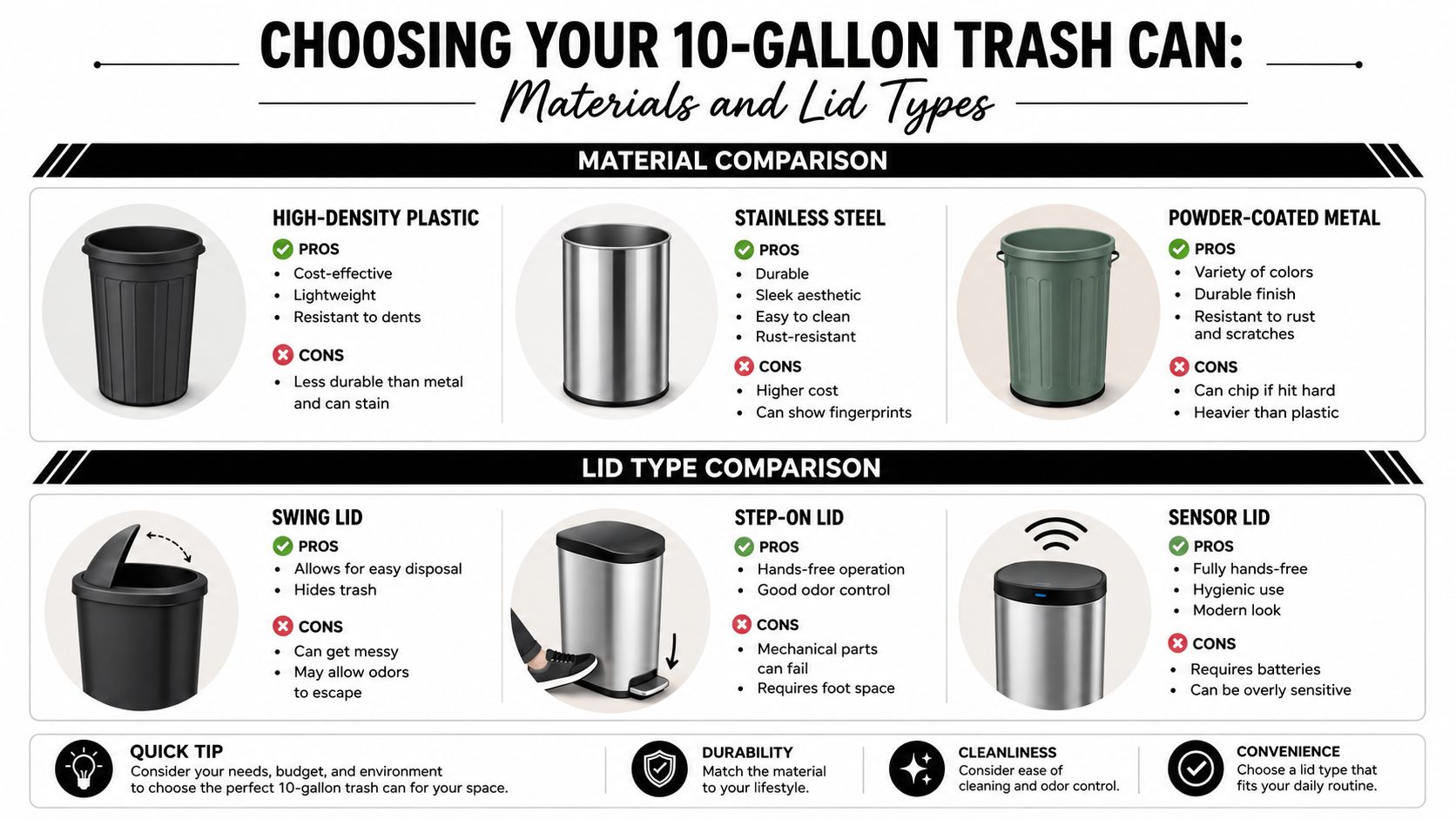
High-density plastic is usually the most forgiving choice for back-of-house or high-turnover areas. It's lightweight, easy to move during cleaning, and less likely to dent if it gets bumped by a chair or cart. The trade-off is appearance and long-term wear, since it can stain and usually doesn't feel as refined in a front-office setting.
Stainless steel fits better in reception areas, executive suites, and conference rooms where appearance matters as much as function. It's easy to wipe down, resistant to rust, and visually cleaner than many plastic models. The downside is that fingerprints can show, so it works best where staff can keep up with regular wipe-downs.
Powder-coated metal sits between the two. It gives you more finish options than bare steel and can handle office use well, but it's heavier and can chip if it's hit hard. In a predictable, well-maintained environment, that's often a reasonable trade.
Good office rule: Use the most durable material where people bump the bin, and the most polished material where people see it.
Lid styles and what they solve
A swing lid is the easiest to drop waste into quickly, but it offers weaker odor control and can get dirty around the flap. It's fine for dry office waste, especially when the bin is emptied often.
A step-on lid is better for hands-free use and tends to help with odor control. It does require floor space for the pedal and enough room for the lid to open without hitting a wall or chair.
A sensor lid makes sense where hygiene is a priority and staff want a modern look. It also needs extra vertical room and power or batteries, so it's not the simplest choice for every under-desk or cabinet placement.
An open-top bin works in low-odor, low-touch spaces, especially for paper-only disposal. It's the fastest option, but it offers the least control over smell and visual clutter.
For offices thinking about material selection in the broader context of furniture finishes and sustainability, sustainable office materials is a useful lens to keep in mind. The best bin isn't just functional, it should fit the room's overall maintenance and design logic.
Ideal Office Use Cases
A 10 gallon trash can is a practical fit for a small desk area, a private office, or a light-use support space where waste stays relatively predictable. That may sound straightforward, but office trash is rarely uniform. A bin that handles paper and the occasional cup beside a desk can fall short in a breakroom where wrappers, napkins, and food scraps build up quickly.
Desk side and private office use
At a desk, the usual load is paper, envelopes, and a few coffee cups. In that setting, a 10 gallon bin often gives enough capacity without crowding the room visually. A slim rectangular shape usually fits better beside pedestal drawers or under a workstation return, where every inch matters.
A private office can also work well with an open-top or swing-lid model if the user empties it regularly. The key question is not only how much trash it holds. It is also whether the bin interferes with chair movement, knee space, or the path someone takes when standing up from the desk.
Breakrooms and pantry zones
Breakrooms call for more caution. Food waste, wrappers, and mixed debris fill a bin faster and make odor control part of the decision. A 10 gallon can can still be the right choice for a small team with frequent cleaning, but it is a weaker default once the room becomes a main disposal point. In offices that need to fit compact stations into tight shared areas, office design ideas for small spaces can help you place the bin where it supports traffic flow instead of blocking it.
Conference rooms sit in the middle. They usually collect mixed trash, but they also stay empty for part of the day, so a neatly styled lidded bin often makes sense there. Restrooms usually follow a different service pattern and placement logic, so they need to be judged separately from desk-side bins.
A bin can match the capacity on paper and still miss the needs of the room.
That distinction matters in office planning, especially for bulk ordering. A procurement team may buy the right size for one zone, then discover that the underlying problem is clearance near cabinet doors, chair legs, or a narrow entry path. The hidden space around the bin often decides whether it feels convenient or constantly in the way.
How to Select the Right 10 Gallon Trash Can
The smartest selection process starts with the installation site, not the product page. Office managers often ask whether a 10 gallon can is “big enough,” but the more useful question is whether it will function in the exact spot it's meant to occupy. That means measuring the opening, the surrounding furniture, and the lid movement before the order is placed.
Start with the footprint
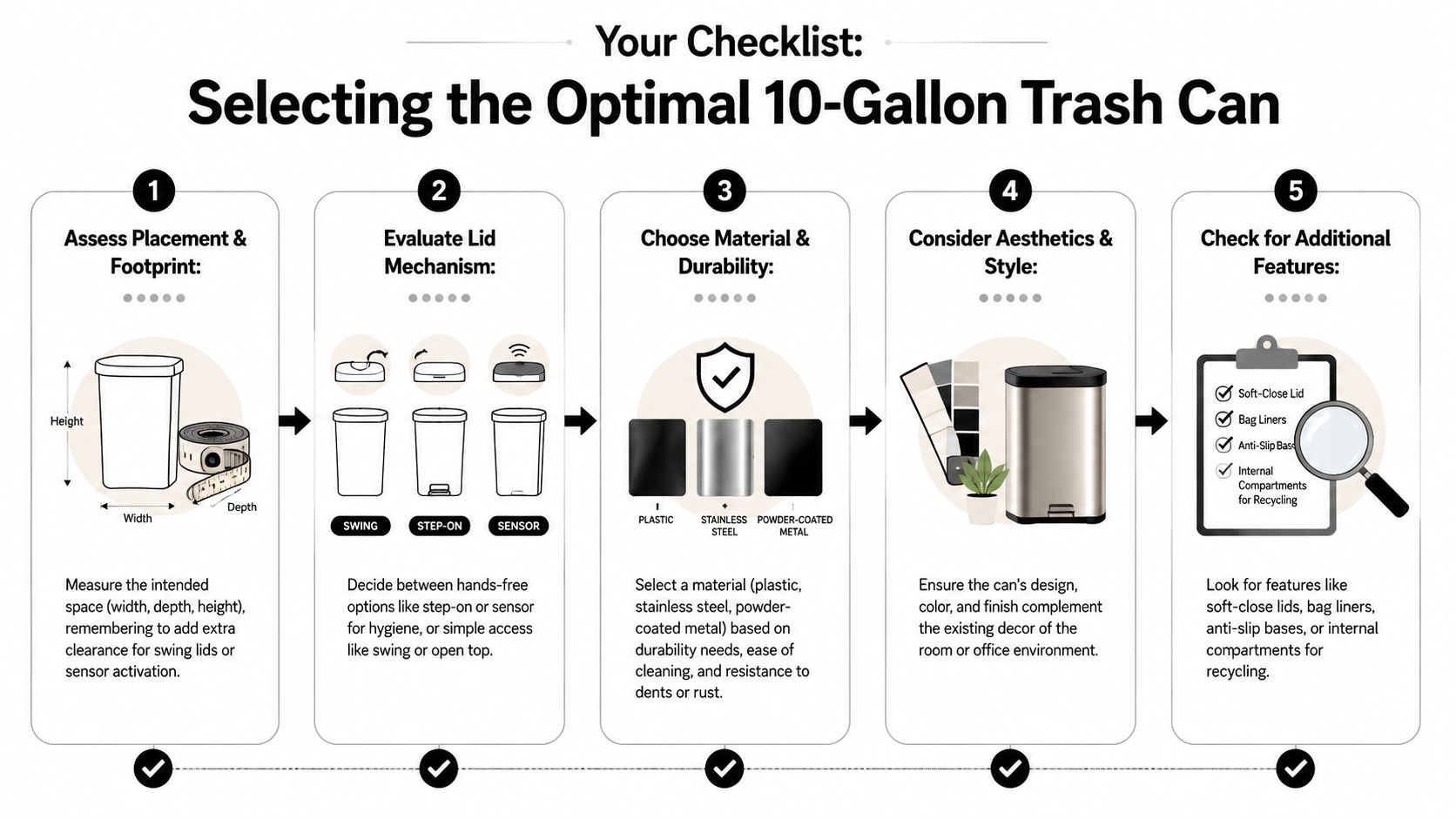
Measure the intended width, depth, and height. Then add room for the can to open, clear the wall, and avoid contacting chair legs or cabinet hardware. The most common mistake is choosing a can that fits on paper but not in the actual opening.
The same caution applies to under-cabinet and under-desk placements. Buying guides often skip this part, but lid swing and sensor activation need extra clearance to work properly, especially where the can sits under furniture or near a hinge line (iTouchless). If the lid can't open fully, the bin becomes frustrating no matter how good the capacity looks.
Match the mechanism to the room
Hands-free lids make sense where people want to avoid contact, such as shared kitchens, restrooms, or higher-touch common areas. Step-on and sensor options improve convenience, but they also introduce moving parts and clearance demands. Simpler lids win when the placement is tight and the waste stream is dry.
Balance appearance with maintenance
A polished bin in a client-facing area should still be easy for the cleaning crew to service. That means no awkward corners, no difficult-to-remove lid assemblies, and no finish that shows every scuff in a high-traffic zone. A durable model that's easy to wipe down usually beats a fancier bin that complicates the janitorial routine.
Use a short decision checklist
- Measure the spot first: Check width, depth, and height before you compare products.
- Leave room for the lid: Add extra clearance for swing, pedal, or sensor motion.
- Match the room's waste stream: Dry paper, food scraps, and mixed trash need different upkeep.
- Choose the material by visibility: Use plastic where the bin is hidden, and steel where it's seen.
- Confirm the cleaning plan: If staff can't service it easily, it's the wrong bin.
For office-wide furniture decisions, the same discipline that goes into office furniture buying guide helps prevent small purchases from creating large layout headaches later.
Liners Maintenance and Bulk Ordering Tips
A 10 gallon bin only works well when the liner fits the way the office uses it. A can that holds dry paper waste can follow a looser maintenance rhythm than one that collects food scraps or heavier mixed trash, and that difference should guide both liner orders and cleaning schedules. The useful rule is simple. Match the maintenance plan to the trash stream, not just the bin size.
Choose liners by fit, not by habit
A 10 gallon can often works best with a 13 gallon liner, because the extra material gives staff room to fold the bag over the rim and remove it cleanly. In office settings, that extra room matters more than many buyers expect. A liner that is too small can slip, sag, or tear when someone lifts it out, which creates extra cleanup and wasted time.
For bulk purchasing, it helps to standardize on one liner size for all similar bins across the floor. That keeps storage simpler and makes restocking easier for facilities staff. If your building has both desk-side bins and breakroom bins, group them by waste stream first, then decide which liner size should become the default. For teams that need dependable replenishment, quality hospitality bin liners are often chosen because they support repeat service and routine turnover.
Set the cleaning rhythm by room
Dry office paper can usually stay in service longer than food waste. A bin beside printers or in private offices may remain acceptable for a longer interval, while a breakroom bin needs closer attention because odor builds faster and mixed waste fills faster. That difference is one reason a 10 gallon can is not the same answer for every room.
A practical maintenance routine should cover emptying, liner replacement, and a quick wipe of the rim and lid. If the can uses a pedal or sensor, the cleaning crew should inspect the moving parts at the same time so buildup does not turn into a mechanical problem later. Good maintenance is like keeping a copier stocked with the right paper, the job goes smoothly when the supply matches the daily load.
Buy for the floor plan, not one bin at a time
Bulk ordering works best when office managers think in clusters, not single purchases. A row of matching bins near workstations can share the same liner type, while a separate breakroom cluster may need a different supply pattern because the waste stream is heavier. That approach prevents scattered purchases that leave half-used cases in storage and the wrong liners at the wrong station.
It also helps with space planning. Bulk cases need somewhere dry and out of the traffic path, and that storage spot should be close enough for housekeeping staff to restock without crossing busy work areas. If the supply closet is awkward, the maintenance plan becomes awkward too.
Placement and Space Planning for Office Environments
A bin that fits the room can still fail if it sits in the wrong path. In offices, trash placement competes with chair clearance, cable runs, foot traffic, and cleaning access, so the right location is just as important as the right product. That's why placement should be planned with the same care you'd give to cubicles, filing, or power access.
Map the can to the workstation
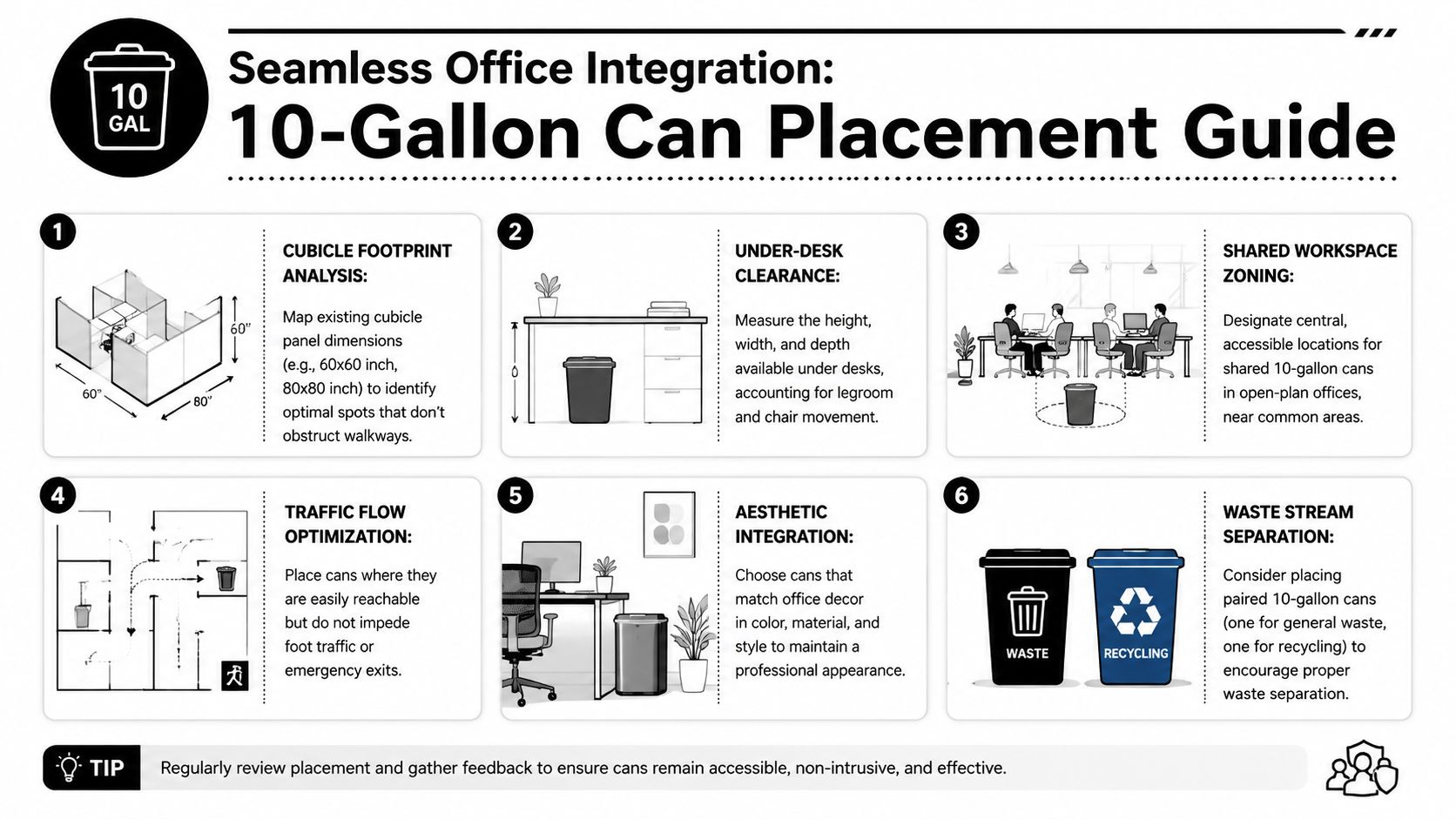
In cubicle areas, the safest approach is to place the bin where it won't interfere with chair movement or panel access. Under-desk placement works when there's enough room for both the container and the user's feet, but the opening height and door swing need to be checked first. If a trash can sits too close to a pedestal or return, it becomes an obstacle instead of a convenience.
Keep shared areas clear
In open offices and breakrooms, a shared 10 gallon bin should stay accessible without forcing someone to step into another person's path. The bin should be easy to reach from nearby seats, but not positioned where a door, cabinet, or traffic lane will constantly bump it. That balance matters even more near emergency routes and equipment zones.
When companies are restructuring their workspaces or clearing out old furniture, ITAD for office relocation planning is a useful planning lens because trash, surplus furniture, and layout changes often happen together. A clean relocation plan should account for disposal points as carefully as it accounts for desks and screens.
Use pairing when waste streams differ
A single bin is fine for simple setups, but paired bins can make sense when recycling and trash need to stay separate. That's especially helpful in conference rooms and collaboration areas where people generate a mix of paper, cups, and packaging. The best placement is the one that gets used naturally, not the one that looks good only on paper.
Conclusion
A good 10 gallon trash can is small enough to fit office spaces and large enough to support everyday disposal when the waste stream is light. The difference comes from clearance, lid choice, liner fit, and maintenance planning, not from capacity alone. If you measure the space first and standardize the rest, your office gets a cleaner layout and a simpler service routine.
If you're ready to plan bins alongside desks, partitions, and room layouts, use Cubicle By Design and its Custom Cubicle Designer to build a workspace that fits the way your team works. You can also explore custom office cubicles, glass office partitions, call center cubicles, and workstation cubicles as you finalize your office setup.
A CTA for Cubicle By Design.