



A sustainability brief often lands on a facilities manager's desk with almost no translation. The leadership team wants the next renovation to be greener. Procurement wants clean specs. Finance wants no surprises. Staff wants a workplace that feels healthier and easier to work in. Those goals can line up, but only if you define the materials correctly from the start.
Too many office projects stall because “sustainable” gets treated like a style preference instead of a buying standard. One vendor points to recycled content. Another talks about low emissions. A third says their product is reusable, but can't explain what happens when a panel, frame, or desk reaches end of life. That's where sustainable office materials stop being a branding exercise and become a specification exercise.
The practical way to approach this is to judge materials by how they perform across the whole life of the product, especially in systems you'll live with for years, like panels, workstations, storage, and partitions. In day-to-day operations, that means durability, maintenance, indoor conditions, reconfiguration potential, and disposal all matter. If your project also includes HVAC changes, it helps to understand how material choices interact with home air quality principles such as pollutant control and healthier indoor environments.
Office planning decisions also get easier when layout and material selection happen together. A thoughtful office space planning and design approach helps you avoid the common mistake of buying “green” products that don't fit the way your teams work.
Designing a Better Workplace with Sustainable Office Materials
The best sustainable offices don't feel fragile, experimental, or compromised. They feel well built. Surfaces hold up. Air feels cleaner. Furniture adapts when teams shift. Maintenance doesn't turn into a constant stream of patchwork fixes.
That's the standard. Sustainable office materials should help you create a workplace that performs better, not one that just sounds better in a meeting.
Practical rule: If a product's sustainability story falls apart the moment you ask about maintenance, repair, reconfiguration, or disposal, it probably wasn't specified well enough.
In office environments, the strongest outcomes usually come from a handful of disciplined decisions. Buy materials that last. Ask for clear ingredient and composition information. Favor products that can be repaired, reused, or reconfigured. Avoid finishes and adhesives that create unnecessary indoor air concerns. Treat short-lived, hard-to-separate assemblies with caution, even if the brochure looks polished.
That mindset matters most in modular systems. Cubicles, workstations, and demountable partitions aren't one-time decorative purchases. They're operating assets. If your company grows, restructures, or changes seating density, those systems need to move with you. A product that can adapt without being ripped out and discarded usually does more good than one with a nice environmental claim and no second life.
The point isn't perfection. It's making disciplined choices that reduce waste, support healthier interiors, and protect your budget over time.
What Exactly Defines a Sustainable Office Material
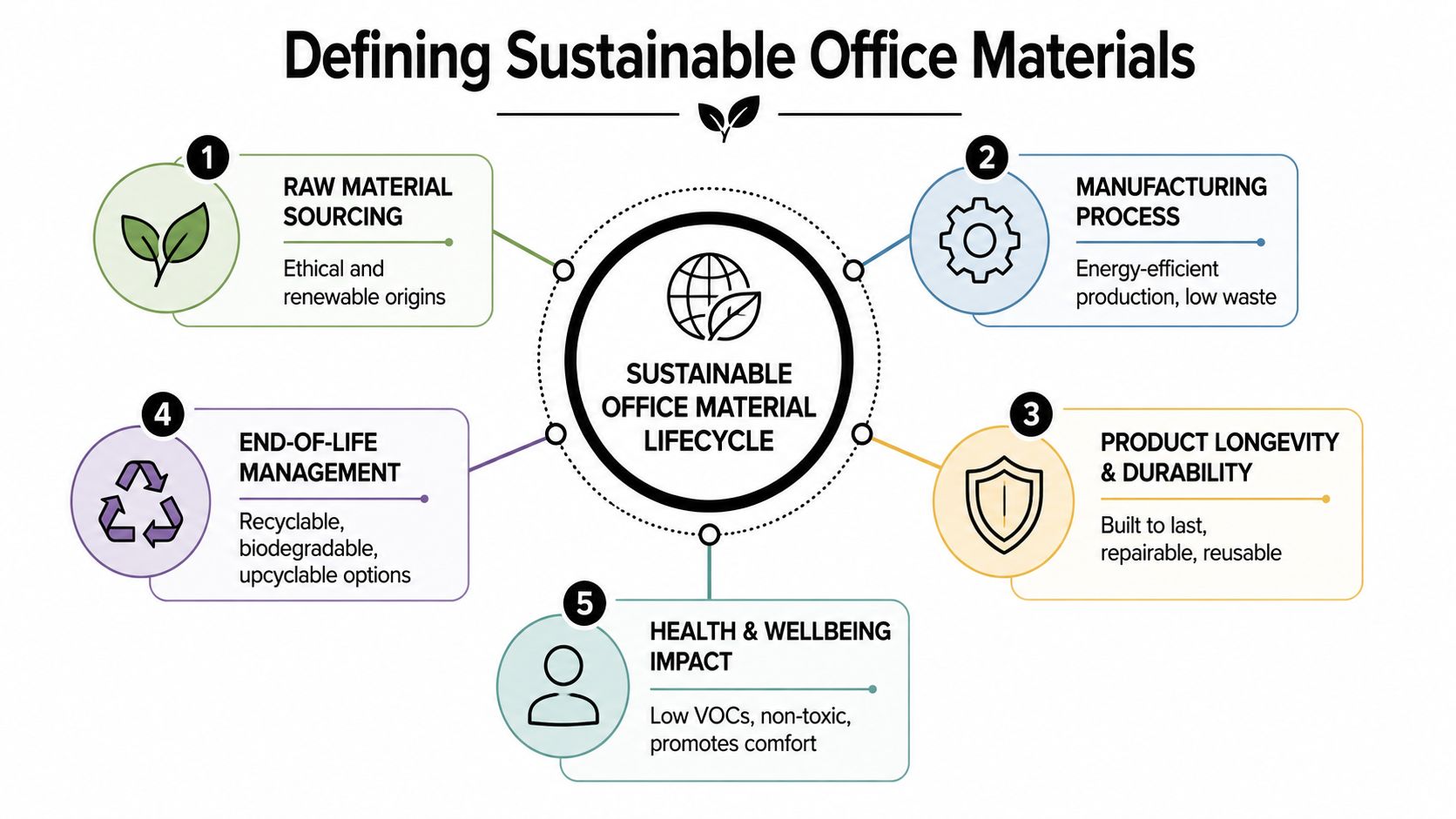
A sustainable office material isn't defined by one sticker, one recycled component, or one marketing phrase. It's defined by its full lifecycle. This is comparable to judging a book by the whole story, not just the cover.
A desktop might look responsible because it uses wood veneer. That says very little on its own. You still need to know where the substrate came from, what binders were used, how the surface was finished, how long it will last, whether it can be repaired, and what happens when it leaves service.
Look past the visible finish
The market has moved beyond simple “green” purchasing. Contemporary office-interior guidance describes a shift toward circular office fit-outs, where reuse and recycled content are treated as standard design criteria, with recurring strategies that include reused or repurposed furniture, recycled materials, certified timber such as FSC, and recycled fabrics and upholstery, as outlined in this circular office fit-out guidance.
That shift is important because many poor material decisions hide beneath attractive finishes. Laminate can be practical or problematic depending on the substrate and adhesive system. Upholstery can look premium but be difficult to replace or recycle. A glass partition can be a durable, recyclable choice, but the framing, sealants, and hardware still matter.
A useful plain-English test is this:
- Sourcing: Was the raw material responsibly selected?
- Manufacturing: Did the product avoid unnecessary waste or harmful chemistry?
- Use phase: Will it hold up in a working office without constant replacement?
- Wellbeing: Does it support a healthier indoor environment?
- End of life: Can the material be reused, disassembled, or recycled with reasonable effort?
Terms that matter in real projects
You don't need academic language to make strong buying decisions, but a few terms help.
- Embodied carbon: The impact tied to making and moving a product before your team even uses it.
- Circularity: Whether a product can stay in use through repair, reuse, reconfiguration, or recovery instead of heading straight to disposal.
- Low-VOC: Materials and finishes designed to limit chemical emissions that can affect indoor comfort and air quality.
For many buyers, the easiest way to understand circular thinking is to compare it to everyday waste reduction habits. Fillaree's guide for eco-conscious households explains the mindset well. Reduce what you don't need, reuse what still has value, and avoid products designed for one short life.
For office projects, that same logic applies to panels, desks, storage, and glazing systems. If you're evaluating transparency and daylighting products, it also helps to compare glass for office applications alongside frame materials, sealants, and hardware, not just the glass itself.
A sustainable material earns that label over time. It doesn't get it from appearance alone.
Key Sustainable Materials for Your Next Office Project
Walk through a well-planned office and you can usually spot the strongest material decisions right away. The workstation frames feel rigid. The desktops don't chip after routine use. The partition system still works after a department shuffle. Fabrics look clean without feeling disposable. The room gets daylight without giving up separation.
That performance usually comes from a short list of materials chosen for the right reasons, not because they're trendy.

Metals, wood, glass, and textiles in the real office
For office furniture and workstations, strong sustainability signals come from material circularity across the full product life cycle. Research on green office desk furniture recommends evaluating materials from raw material preparation through manufacturing, use, recycling, and waste disposal, while selecting structural, decorative, and auxiliary materials based on service life, recyclability, and reusability, as discussed in this research on green office desk furniture.
In practical terms, that often leads buyers toward these material categories:
- Recycled steel and aluminum: Good choices for workstation legs, cubicle frames, brackets, and storage structures. They deliver strength and long service life. In modular systems, metal framing also tends to support repeated reconfiguration better than flimsy composite assemblies.
- Certified or reclaimed wood: Useful for desktops, credenzas, shelves, and feature surfaces when buyers also verify substrate quality and finish chemistry. A wood top that can be refinished or reused usually performs better than a disposable top that looks good for one cycle.
- Glass: A durable, highly recyclable material that supports daylight and visual openness. It's especially effective in enclosed offices, front-of-house areas, and partition systems where teams want a brighter feel without a full drywall build-out.
- Recycled and replaceable textiles: Valuable on panels, acoustic elements, and seating, especially when covers or tiles can be swapped without replacing the entire product.
- Low-emission paints, coatings, and adhesives: These don't always get attention in early budgeting, but they affect the daily experience of the finished office more than many buyers expect.
A broader look at eco-friendly building materials can also help when your office project overlaps with wall treatments, flooring, or architectural upgrades beyond furniture.
What works and what usually disappoints
The most reliable material choices tend to share one trait. They stay useful through change.
A metal-framed workstation with replaceable surfaces usually ages better than an all-in-one bonded unit. A demountable glass partition typically creates less disruption during future reconfiguration than a permanent framed wall. A panel fabric that can be replaced independently beats a system that forces you to scrap the whole assembly because one section wears out.
What doesn't work as well is superficial sustainability. That includes products that advertise recycled content but can't be repaired, products with attractive wood claims but vague adhesive disclosure, and lightweight imported assemblies that won't survive a move.
If you're selecting individual work surfaces or private-office desking to complement a modular layout, a grey wooden desk can be a useful reference point for comparing finish durability, substrate quality, and design compatibility with the rest of the office.
This short video offers a useful visual reference for how material choices shape office environments over time.
The best office material is often the one you won't have to replace when the org chart changes.
Decoding Sustainability Certifications You Should Know
Certifications help when they answer a specific buying question. They're less useful when they're treated like decoration.
A facilities manager usually needs to know three things. Will this material affect indoor conditions? Was the raw material sourced responsibly? Will this support a broader building or corporate sustainability target? That's a better filter than collecting logos.
Match the label to the question
GREENGUARD is commonly used to address indoor emissions. If you're concerned about what a workstation, panel, adhesive, or finish might release into occupied space, this is the kind of certification buyers look for.
FSC speaks to responsible forestry and wood sourcing. It matters when you're purchasing wood furniture, veneer components, millwork, or products that rely on timber-based inputs.
LEED works differently. It isn't a product label in the same narrow sense. It's a building-level framework, and material choices can contribute to broader project goals around responsible sourcing, emissions, and environmental performance.
Common sustainability certifications at a glance
| Certification | What It Verifies | Primary Benefit |
|---|---|---|
| GREENGUARD | Low chemical emissions from products used indoors | Helps buyers screen for healthier indoor environments |
| FSC | Responsible sourcing of forest-based materials | Gives confidence in timber and wood-based product sourcing |
| LEED | Building-level sustainability framework | Helps teams align furniture and finish choices with larger project goals |
Buyers often encounter a common pitfall. A certification doesn't replace product review. It narrows the risk.
For example, an FSC label on a wood component doesn't tell you whether the finish is easy to maintain. A low-emission certification doesn't tell you whether a desk is repairable. A LEED-oriented spec doesn't guarantee the furniture will survive a reconfiguration. Those are still procurement questions.
Ask each certification to do one job. Don't ask it to prove everything about the product.
A Smart Buyer's Guide to Sustainable Procurement
Sustainable procurement gets easier once you stop treating it as a premium line item and start treating it as a total cost of ownership decision.
Cheap products usually reveal their real cost later. Edges fail. Panel fabrics stain and can't be replaced. Desks wobble after one move. Hardware goes out of production. Then the company pays again in downtime, labor, replacements, and disposal.
Buy the service life, not just the item
A technically sound way to specify sustainable office materials is to treat them as a life-cycle procurement problem, not a single product feature. The University of Michigan's purchasing guide recommends requiring supplier disclosure of recycled content, recyclability, and chemical safety at the SKU level instead of relying on generic environmental claims, as outlined in this sustainable office supply purchasing guide.
That SKU-level discipline matters because “eco-friendly” is too vague to compare products. Procurement teams need specifics tied to the actual item being ordered.
A good supplier conversation should cover:
- Composition details: What's in the substrate, finish, adhesive, and upholstery?
- Maintenance burden: What cleaners are required, and how often do components need attention?
- Repair path: Can damaged parts be replaced without replacing the full unit?
- Disassembly: Can the product come apart cleanly for reuse or recycling?
- End-of-life support: Is there a take-back, recycling, or documented disposal pathway?
Where buyers often overspend
The biggest budget mistakes usually come from false economy.
One example is choosing a lower-grade workstation because the upfront quote looks attractive, then discovering the system can't be expanded when headcount changes. Another is buying built-ins where modular furniture would have handled future moves with less waste and labor. A third is ignoring finish and fabric maintenance, then replacing worn elements years earlier than expected.
If you want a practical framework for comparing long-term value, this office furniture buying guide is a useful reference for balancing price, durability, and operational fit.
The strongest procurement teams write specs that force clarity. They don't ask vendors whether a product is green. They ask what it's made of, how it's maintained, how it's repaired, and what happens when the company no longer needs it.
Putting Sustainability into Practice with Modular Systems
Modular office systems are where sustainability becomes concrete. It's one thing to agree with the idea of reuse. It's another to buy a system that can be moved, resized, repaired, and redeployed when your floor plan changes.
That's why modular design has an advantage in active workplaces. It turns adaptability into a material strategy.
What to specify in cubicles and partitions
A common gap in the market is verifying whether “sustainable” products are lower impact across their full lifecycle. Buyers often struggle to compare a recycled-material desk, reclaimed wood panel, or modular partition once shipping, replacement frequency, and disposal are considered, a gap noted in this discussion of sustainable office design verification.
For modular systems, that means you should ask very direct questions:
- Panel construction: Are fabrics replaceable? Is the core low-emission? Can damaged sections be swapped independently?
- Frame material: Is the metal durable enough for repeated moves and reconfigurations?
- Connection hardware: Will the system support expansion, downsizing, and part replacement later?
- Glass wall assembly: Are the aluminum framing and hardware strong, serviceable, and recyclable?
- Power access: Can electrical components be updated without dismantling the whole installation?

Why modular often beats fixed construction
A fixed wall solves one layout. A modular wall can solve several over its service life.
The same is true for workstations. A well-designed benching or cubicle system can shift from individual focus work to team neighborhoods, support departmental growth, or adapt to hybrid attendance without forcing a rip-and-replace cycle. That's where sustainable office materials deliver operational value, not just environmental value.
If your project team is weighing flexibility against permanence, this explanation of what modular furniture is is a useful starting point for aligning layout strategy with long-term procurement.
Reconfiguration is one of the most practical forms of waste prevention in an office.
Your Sustainable Office Action Checklist
A sustainable office project usually succeeds or fails before the purchase order goes out. The teams that get it right ask sharper questions early, narrow the spec to materials that can survive real use, and avoid products that create waste the first time the layout changes.
The category is also growing fast. The global sustainable office supplies market was valued at $3.6 billion in 2024 and is projected to reach $8.1 billion by 2033, implying a 9.4% CAGR, according to Market Intelo's sustainable office supplies market report. That matters because buyers now have more supply-chain depth and more product choice than they did when sustainable purchasing sat on the fringe.
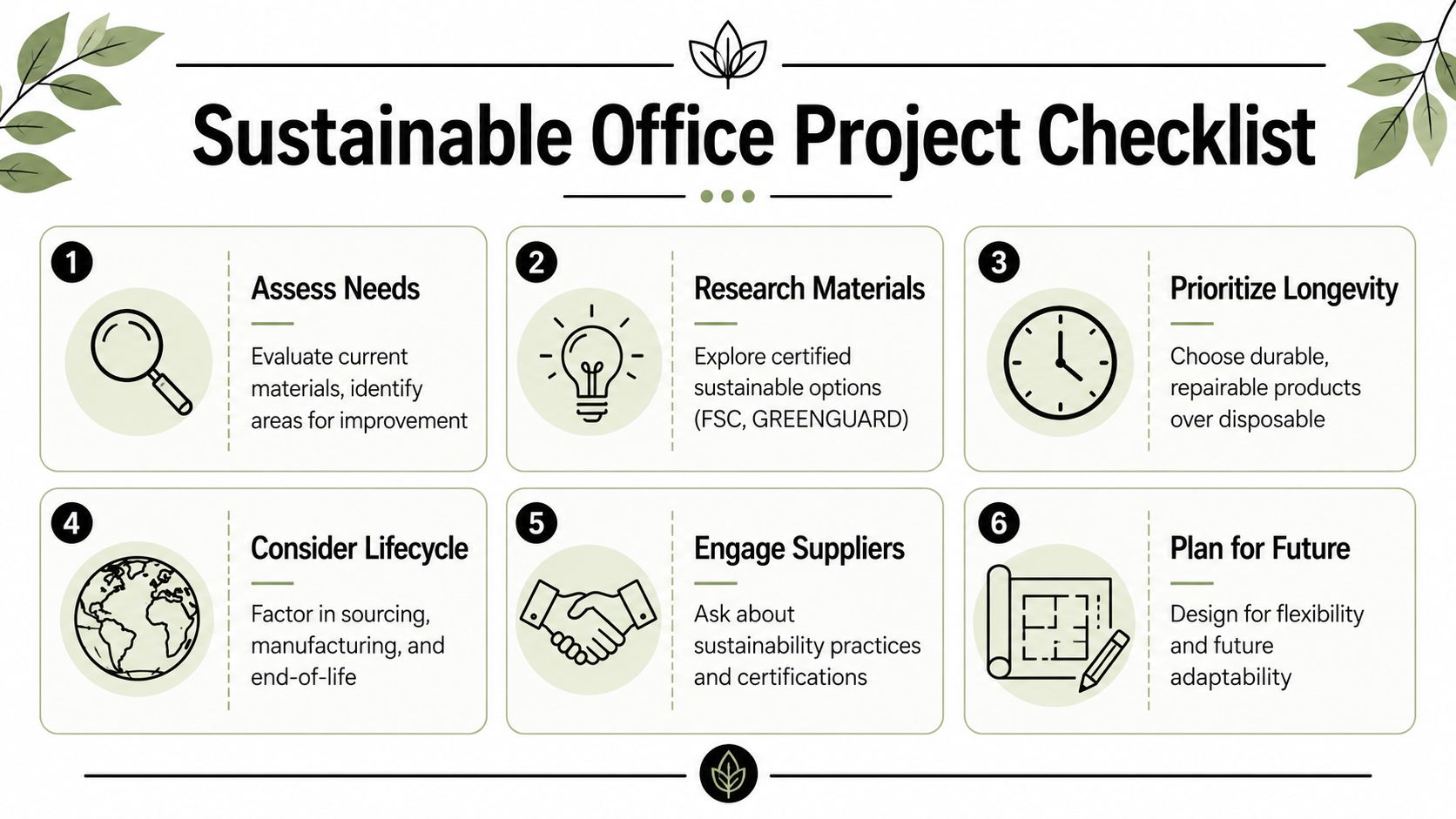
Use this checklist on your next project:
- Define function first: Match materials to how people work, not to a mood board.
- Ask for SKU-level disclosure: Require clear information on recycled content, recyclability, and chemical safety.
- Prioritize long service life: Favor repairable, modular systems over bonded, disposable assemblies.
- Review maintenance thoroughly: Some finishes look strong in a sample but fail under cleaning and daily use.
- Plan the second life now: Reuse, reconfiguration, resale, and recycling should be discussed before installation.
- Coordinate layout with procurement: The right material in the wrong system still creates waste.
When you approach sustainable office materials this way, the result isn't just a greener office. It's a workplace that's easier to maintain, healthier to occupy, and less expensive to keep useful over time.
If you're planning a new layout or upgrading an existing office, Cubicle By Design can help you turn these principles into a practical workstation plan. You can test configurations with the Cubicle Designer, explore custom office cubicles, compare glass office partitions, review options for call center cubicles, and browse workstation cubicles for flexible layouts that support long-term use.