


Choosing the right ones makes all the difference. It's the gap between a drawer that glides open silently for years and one that sticks, groans, and eventually fails under the weight of daily use.
Why the Right Drawer Slides Matter in Your Office
In any busy workplace, the smallest details can have the biggest impact on daily workflow. Drawer slides might seem like a minor piece of hardware, but they're absolutely essential to the usability and longevity of your office furniture.
High-quality slides ensure that your team can access files, supplies, and personal items without a second thought. It's a small thing that removes a point of friction, contributing to a smoother and more productive environment.
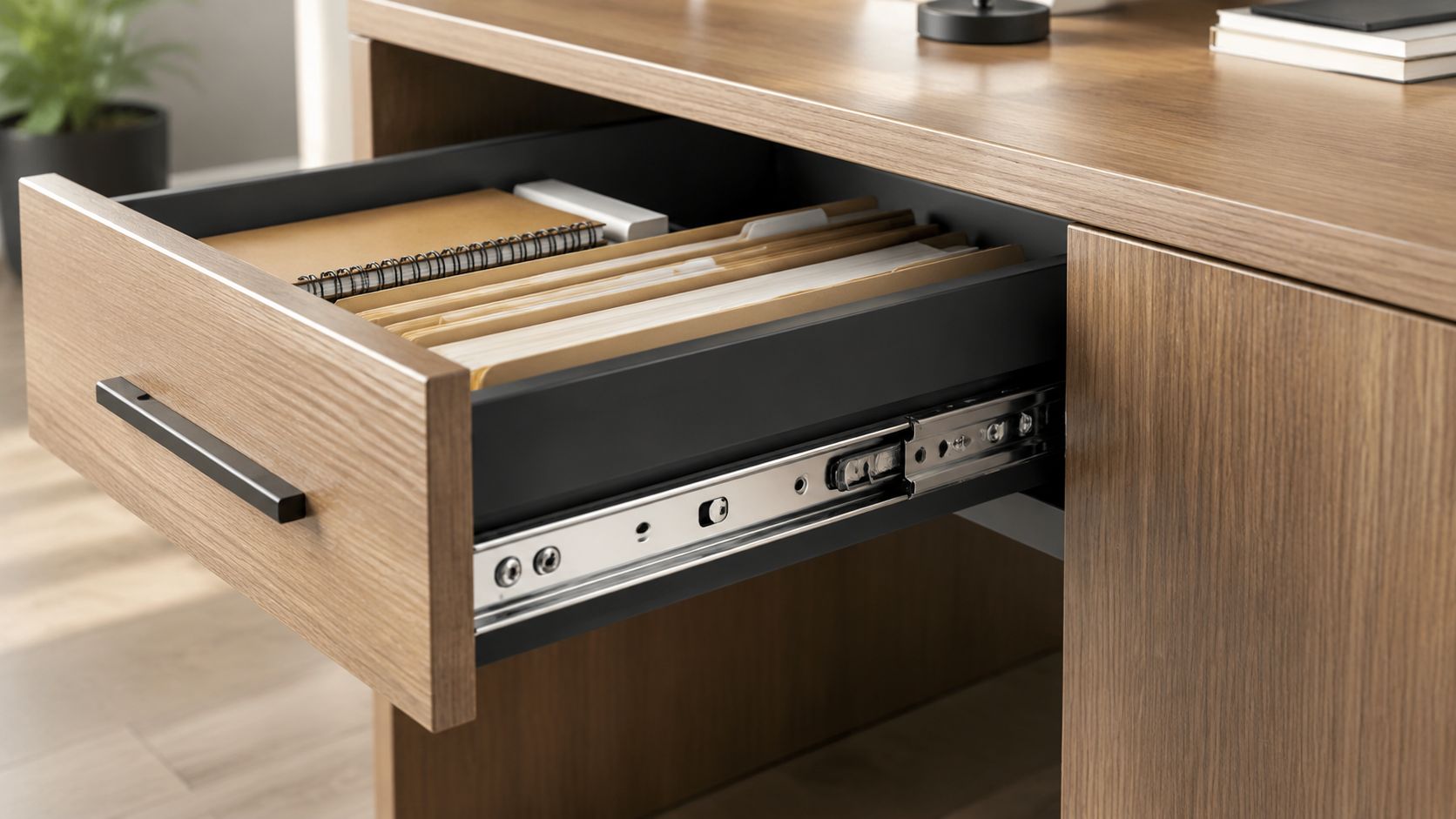
When you're outfitting an office, hardware choice should never be an afterthought. It’s a key component in creating durable and reliable workstation solutions that can stand up to constant use. A drawer that constantly jams or a slide that breaks isn't just an annoyance—it disrupts work and leads to costly repairs or replacements.
The Baseline for Compact Office Storage
The 10-inch drawer slide is the smallest standard size in a global market that hit USD 6.45 billion in 2024. This industry is projected to grow to over USD 10 billion by 2033, which tells you just how vital this hardware is.
Manufacturers typically standardize slides in 2-inch increments, making the 10-inch variant the go-to baseline for compact storage. You'll find them in everything from pencil drawers in executive desks to small supply cabinets in call center cubicles.
Selecting the right 10-inch drawer slides enhances not just the function but also the lifespan of your office furniture. It’s a small investment that pays off daily in convenience and reliability.
This guide will walk you through everything you need to know about these essential components, whether you are designing custom office cubicles from scratch or just upgrading your existing furniture. Getting the hardware right is the first step toward building a better, more functional workplace. If you're looking for solutions for your space, you might also find our guide on selecting a drawer unit for under desk storage helpful.
Choosing the Right Type of 10 Inch Drawer Slide
When you're outfitting an office, the small details make a huge difference, and that includes the drawer slides. The hardware holding your drawers in place isn't just a minor component; it dictates how the furniture feels and performs every single day. The right 10-inch drawer slides need to handle the daily grind, look good, and function flawlessly.
Your main decision will come down to the slide's mechanism and how it mounts to the furniture. Let's break down what that really means for your office.
Ball-Bearings vs. Rollers: What's Under the Hood
The two mechanisms you’ll see most often are ball-bearing and roller slides, and they offer very different experiences. Think of ball-bearing slides as the industry standard for high-quality office furniture. The secret is in the name—tiny steel ball bearings roll within the track, drastically reducing friction. This is what creates that satisfying, whisper-quiet glide you expect from a premium desk. Because they're so durable, they are the go-to choice for drawers that see constant use.
Roller slides are the more budget-friendly alternative. They use simple plastic or nylon wheels that roll along a track. While they don't have the same buttery-smooth feel as ball-bearing models, they are perfectly reliable for light-duty jobs like pull-out keyboard trays or drawers for small supplies. For those exploring more advanced options for high-density storage, it's worth looking into specialized solutions like the ones found in Material Handling USA's inventory systems.
Which Mounting Style Is Right for You?
Once you've settled on a mechanism, the next step is choosing a mounting style. This decision affects both the final look of the furniture and how complex the installation will be.
Side-Mount Slides: This is what you'll find in most office furniture, and for good reason. They attach to the sides of the drawer box and the cabinet interior, providing fantastic stability and the strength to handle heavy loads. Their straightforward installation makes them a workhorse for everything from standard file drawers to the heavy-duty storage in a desk double pedestal.
Undermount Slides: If a clean, high-end aesthetic is your top priority, undermount slides are the answer. They are mounted to the cabinet and connect to the underside of the drawer, making the hardware completely invisible. It’s a sleek choice that's perfect for modern executive desks and minimalist office designs where every detail counts.
Center-Mount Slides: You won’t see these as often in today's office furniture. A single rail mounts under the center of the drawer. They're really only suited for very lightweight drawers and aren't recommended for anything that needs to hold a significant amount of weight.
To help you visualize the differences, here's a quick comparison of the most common options for office applications.
Comparison of 10 Inch Drawer Slide Types
| Slide Type | Mounting Style | Typical Load Capacity (10") | Best For | Pros | Cons |
|---|---|---|---|---|---|
| Ball-Bearing | Side-Mount | 75-100 lbs | File drawers, heavy supply storage, high-use pedestal drawers | Extremely smooth, quiet, durable, high load capacity | More expensive, less forgiving on installation |
| Undermount | Undermount | 75-90 lbs | Executive desks, modern cabinets, reception furniture | Hardware is completely hidden, smooth action, often has soft-close | Highest cost, more complex installation, requires specific drawer construction |
| Roller | Side-Mount | 35-50 lbs | Keyboard trays, light supply drawers, occasional-use storage | Very affordable, simple to install | Can be noisy, less smooth, lower weight capacity |
| Center-Mount | Center-Mount | 25-35 lbs | Small pencil drawers, very light-duty applications | Economical, single-rail installation | Low weight capacity, can be unstable, not for heavy use |
Ultimately, choosing the right slide comes down to thinking through how the drawer will be used.
By matching the drawer's purpose with the right weight capacity and aesthetic, you can confidently pick the perfect 10-inch drawer slide that delivers lasting performance and keeps your workspace functioning smoothly.
How to Measure for a Perfect Drawer Slide Fit
There's nothing worse than installing a new drawer only to find it sticks, wobbles, or doesn't close properly. Getting that perfect, smooth glide isn't magic—it all comes down to precise measurements.
Trust me, taking a few moments to measure correctly will save you a massive headache later. It's the classic "measure twice, install once" rule, and it's the key to making sure your 10-inch drawer slides work flawlessly, whether you're outfitting new custom office cubicles or just upgrading a desk drawer.
Key Measurements for Drawer Slides
Getting this right means you can stop guessing and avoid that frustrating moment when a drawer is just too tight or loose. Grab a tape measure, and let’s walk through the three simple measurements you'll need.
Drawer Box Length: First, measure the outside of the drawer box from front to back. The key here is to exclude the drawer front panel from your measurement. If your drawer box is 10 inches long, you need a 10-inch slide. Simple as that.
Cabinet Interior Depth: Now, measure the inside of the cabinet opening, from the very front edge of the frame to the back wall. For a 10-inch slide to fit, you need at least 10 inches of clear depth inside the cabinet.
Side Clearance: This is where most mistakes happen. You need to measure the gap between the side of the drawer box and the inside wall of the cabinet. Most side-mount ball-bearing slides require exactly 1/2 inch of clearance on each side, which adds up to a total of one full inch.
This quick infographic helps visualize the main things to consider when picking out your hardware.
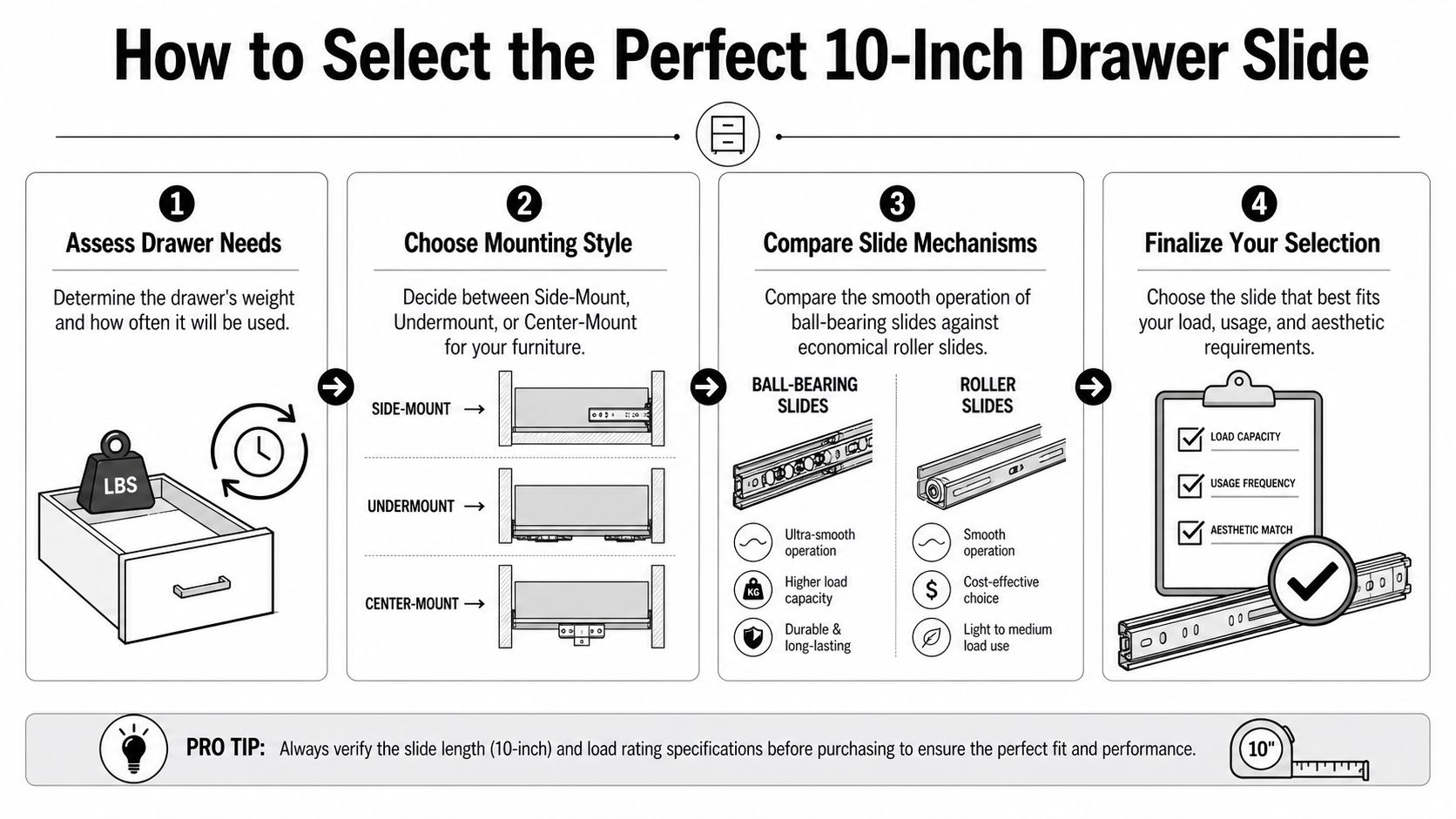
As you can see, it really comes down to understanding your specific needs, picking the right mounting style, and then comparing the slide mechanisms.
Getting these measurements right is foundational. Without accurate dimensions, even the highest-quality drawer slide will fail to perform as expected.
This is especially critical for office furniture like filing cabinets, where drawers have to withstand constant use. If you need more details on common sizes, check out our guide to standard file cabinet measurements. With these numbers in hand, you’re all set to pick hardware that fits like it was made for the job.
Understanding Load Ratings for Office Durability
When you're choosing 10-inch drawer slides, the load rating is more than just a number on a spec sheet—it's a promise of how well your furniture will hold up over time. This rating tells you the maximum weight a pair of slides can safely handle day in and day out. In a busy office where drawers are in constant motion, getting this right is key to protecting your investment.
Think of it like choosing tires for a truck. You wouldn't put standard car tires on a vehicle meant for heavy hauling. In the same way, a lightweight slide designed for a small keyboard tray will quickly fail if it's installed in a file drawer packed with paper. Overloading a slide is a fast track to sagging drawers, frustrating jams, and eventual breakage.
Matching Slide Strength to Office Tasks
The secret to long-lasting office furniture is simple: match the slide's strength to its job. A small pedestal drawer for pens and sticky notes has completely different demands than a deep drawer in an office storage credenza filled with heavy binders.
Generally, a standard 10-inch drawer slide can support anywhere from 50 to 100 pounds per pair, which is perfect for light-to-medium use. If you need something tougher, heavy-duty ball-bearing slides can handle well over 100 pounds. As a best practice, always choose a slide with a load rating about 10–20 pounds higher than the heaviest load you expect. This creates a buffer that ensures smooth, reliable performance for years.
This little bit of extra capacity accounts for the reality of daily use—the quick yanks, the firm pushes, and the occasional overstuffing that happens in every busy workspace.
Why Over-Specifying Is a Smart Investment
It might seem practical to pick a slide rated for the exact weight you need, but giving yourself a little extra capacity is a smart, forward-thinking move.
A drawer slide's load rating is its core performance guarantee. Choosing a rating that slightly exceeds the expected weight is the single best way to ensure safety, smooth function, and long-term reliability in high-use workstation cubicles.
This proactive approach builds in a margin of safety, preventing the hardware from being pushed to its absolute limit. It reduces strain on the ball bearings and tracks, leading to a much longer and trouble-free service life. By investing in the right strength from the start, you avoid the headache of future repairs and ensure your office furniture remains a dependable asset.
Step-by-Step Drawer Slide Installation Guide
Putting in a new set of 10-inch drawer slides doesn't have to be a headache. While it might look technical, it's actually a pretty straightforward process when you know the steps. Side-mount slides, which are the go-to standard for most office desks and cabinets, are especially easy to work with. We'll walk you through it, so your drawers glide perfectly from the get-go.
Before you start, grab a few basic tools. You won’t need anything fancy, just a tape measure, a pencil, a drill (with a small bit for pilot holes), a Phillips head screwdriver, and a level. Having these ready will make the job much quicker and more precise.
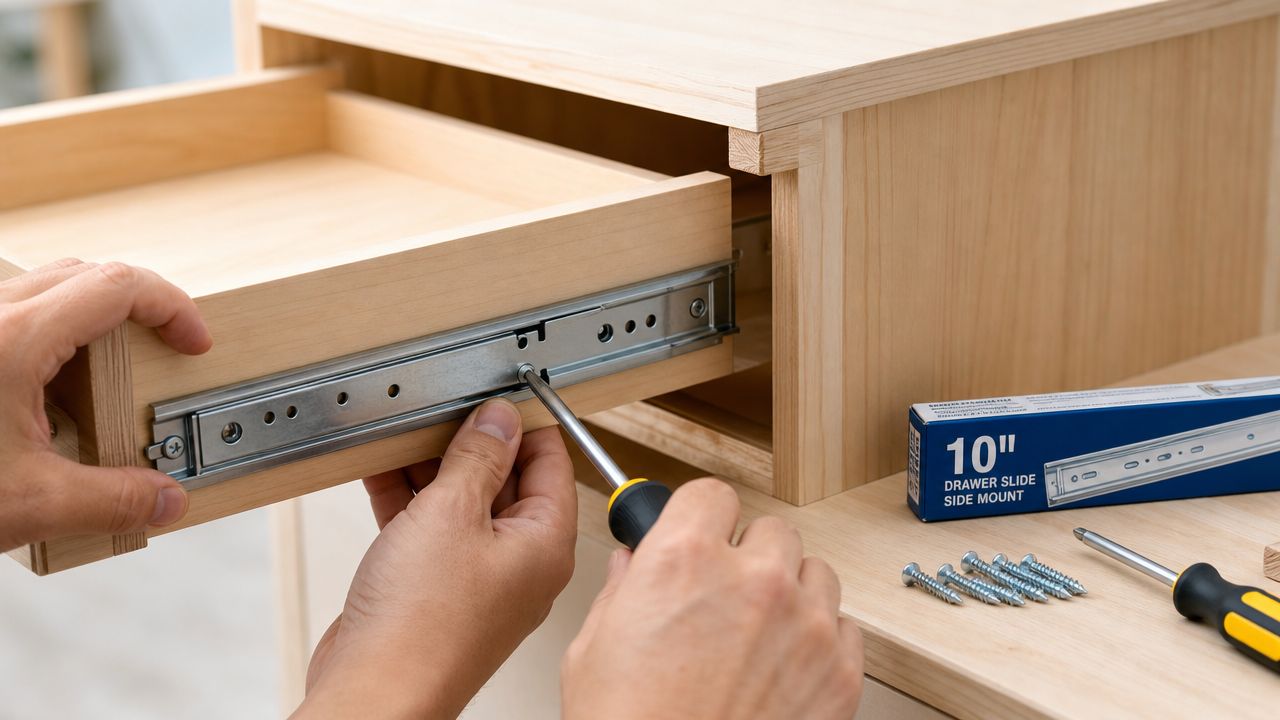
Preparing and Mounting the Slides
First things first, you'll need to separate the two parts of each slide. A typical side-mount slide is made of a wider cabinet member and a slimmer drawer member that fits inside it. Most slides have a small release lever—just press it, and the drawer member will slide right out. Put the drawer members aside for a moment.
With those separated, it's time to focus on installing the cabinet members inside the cabinet, one on the left and one on the right.
- Mark Your Lines: Grab your pencil and tape measure to draw a perfectly level line where the bottom of the slide will go. Using a level here is critical; if the slides aren't even, the drawer will sag or stick.
- Position the Slide: Line up the bottom edge of the cabinet member right on your pencil line. You'll also want to make sure the front of the slide is perfectly flush with the front edge of the cabinet.
- Drill Pilot Holes: Hold the slide steady and mark where the screws will go. It’s always a good idea to drill small pilot holes first, as this keeps the wood from splitting when you drive the screws in.
- Attach the Slide: Now, screw the cabinet member securely into place. Just repeat this process on the other side, making sure both slides are perfectly level with one another.
Attaching the Drawer Members and Final Assembly
Once the cabinet pieces are in, you're ready to tackle the drawer box itself. This part is just as easy, but that same attention to detail will ensure you get a smooth, professional-feeling result.
A successful drawer slide installation depends on perfect alignment. Taking the time to ensure both the cabinet and drawer members are level and parallel is the single most important factor for a professional result.
Attach the drawer members you set aside earlier to the sides of the drawer box. Check that they're flush with the front and bottom of the drawer. Once again, use your level to make sure they are perfectly horizontal before you drill your pilot holes and secure them. After both drawer members are attached, you're on the home stretch.
Simply line up the drawer with the tracks inside the cabinet and gently push it in until you hear a "click." That's the sound of the locking mechanism engaging. Pull the drawer open and closed a few times to make sure everything is moving smoothly.
For anyone diving deeper into custom casework, Labs USA's Blum hinge guide is a fantastic resource with insights that apply to all kinds of cabinet hardware. And if you're tackling a major office upgrade, you can learn more about how the pros handle complex jobs by reading about professional office furniture installations.
Troubleshooting and Maintaining Your Drawer Slides
Nothing disrupts a productive workday quite like a stubborn, sticky drawer. Keeping your office furniture in top condition is about more than just appearances; it's about ensuring a smooth, frustration-free environment for your team.
Proper care is simple, and it ensures your drawers glide open and closed for years. Whether you're managing a bustling office from Cubicle By Design or just looking to fix a single desk, this advice will help keep your 10-inch drawer slides working like new.
Common Drawer Slide Problems and Fixes
Even the best hardware can hit a snag now and then, but thankfully, most issues have straightforward solutions. Figuring out the root cause is half the battle.
The Drawer Is Sticking or Hard to Open: More often than not, the culprit is simply dirt and gunk building up in the ball-bearing tracks. A quick, thorough cleaning is usually all it takes. If that doesn't solve it, the slide itself might be slightly bent or out of alignment.
The Drawer Won't Close All the Way: First, do a quick check for any papers, pens, or other items that might be blocking the back of the cabinet. If the path is clear, the slide has likely shifted. You can typically fix this by loosening the mounting screws, nudging the slide back into place, and tightening everything back up.
The Drawer Sags or Tilts When Opened: This is a classic sign of either an overloaded drawer or loose mounting screws. Before you do anything else, check the contents against the slide’s load rating. If the weight is fine, grab a screwdriver and tighten all the screws on both the drawer and cabinet.
A Simple Maintenance Routine
A little proactive care goes a long way. Just a few minutes of attention every six months or so can prevent nearly every common drawer slide problem from ever starting.
Regular cleaning and proper lubrication are the secret to a long life for your drawer slides. A well-maintained slide will operate smoothly and silently for years, whether it's in a standard desk or a high-use call center cubicle.
Start by extending the drawer completely. Wipe down the slide members with a clean, dry cloth to get rid of any dust. If you find some stubborn grime, a cloth lightly dampened with a mild degreaser will do the trick.
Once the tracks are clean and dry, apply a small amount of white lithium grease or a silicone spray directly onto the ball bearings. Slide the drawer open and closed a few times to spread the lubricant evenly. That's it! This simple routine ensures your furniture remains an asset, not an annoyance.
Frequently Asked Questions About Drawer Slides
When you're getting down to the final details of an office furniture project, a few key questions always seem to pop up. To help you finalize your choices with confidence, we’ve put together some quick, straightforward answers to the most common queries we get about 10-inch drawer slides.
Upgrading and Feature Availability
Can I replace old roller slides with modern ball-bearing slides?
You absolutely can. Swapping out older, clunky roller slides for the smooth action of modern ball-bearing slides is one of the most common and impactful upgrades you can make. The only critical detail to check is the side clearance. Most ball-bearing slides need a 1/2-inch space on each side of the drawer, so be sure to measure that gap before you buy.
Are soft-close features available for 10-inch slides?
Yes, and it’s a feature we highly recommend for professional environments. Many leading manufacturers offer 10-inch drawer slides with an integrated soft-close mechanism. This simple addition prevents drawers from slamming shut, which not only cuts down on noise but also reduces long-term wear and tear on your custom office cubicles and desks.
The ability to upgrade existing furniture with modern hardware like full-extension or soft-close slides allows you to enhance functionality without a complete overhaul, making it a cost-effective solution for any workspace.
Understanding Slide Terminology
What does 'full extension' mean for a 10-inch slide?
"Full extension" means the drawer can slide out its entire length—in this case, a full 10 inches—so the back of the drawer completely clears the cabinet. This gives you unobstructed access to everything inside, which is a must-have for file drawers in workstation cubicles.
For comparison, a 3/4 extension slide would only travel about 7.5 inches, leaving the last few inches of the drawer tucked away and hard to reach. For true accessibility in any office, from individual desks to integrated glass office partitions, full-extension slides are the superior choice.
At Cubicle By Design, we believe the right hardware is essential for a functional and durable workplace. Whether you're designing a single office or outfitting an entire floor with call center cubicles, our team is here to help. Explore our full range of solutions and start building your ideal workspace with our online cubicle designer today.