


A standard 4-drawer letter-width vertical file cabinet is typically 15 inches wide and about 52 to 53 inches tall, while a standard 2-drawer lateral file cabinet is often 36 inches wide and about 28 to 30 inches tall. Those two sizes cover a large share of everyday office planning needs, especially when you're deciding between a narrow storage tower and a lower cabinet that can sit under or beside a desk.
If you're staring at a floor plan and the desks are placed but storage still feels unresolved, that's usually where file cabinets become a problem. They look simple on a product page, but in a real office they affect circulation, sightlines, reach, drawer clearance, and how people work around a station all day. Good planning starts with knowing the standard file cabinet measurements that manufacturers have built around for years, then using those standards in a way that supports the room instead of crowding it.
Standard File Cabinet Measurements A Planner's Guide
Planning Your Office Storage The Right Way
Office layouts often stall when it is time to place storage. A workstation plan can look clean on paper until file cabinets start taking wall space, blocking drawer swing, or narrowing the path behind seated employees.
The best results come from treating storage as part of the layout from the beginning, not as a final add-on. Cabinet dimensions are driven by the records your team keeps, the way those files are accessed, and the amount of clearance the surrounding furniture needs to function properly. In practice, that means storage decisions affect circulation, reach, and how well a workstation supports daily work.
Start by assigning each cabinet a job before you assign it a location.
Start with the three cabinet roles
Most workplaces are choosing between three practical storage types:
- Vertical cabinets work well where wall width is limited and storage needs to build upward.
- Lateral cabinets use more horizontal space and usually give teams easier front access to shared files.
- Mobile pedestals keep frequently used items at the desk and make more sense in flexible workstation setups.
Each type supports a different pattern of use. Shared records usually belong in a central zone. Department files should sit close to the people who open them often. Personal documents and small supplies belong at the individual workstation.
Practical rule: If a cabinet does not have a defined storage role before it is placed on the plan, it often ends up in the wrong location or the wrong size gets ordered.
Storage planning improves when it is coordinated with panels, desks, and traffic paths at the same time. That is why many facilities teams start with a broader office space planning and design strategy before they finalize cabinet quantities and placement.
Standard Vertical File Cabinet Measurements
A vertical file cabinet solves one planning problem well. It stores a high volume of paper without taking much wall width. That is why it still shows up in private offices, records rooms, and at the ends of workstation runs where every additional inch along the wall affects desk layout.
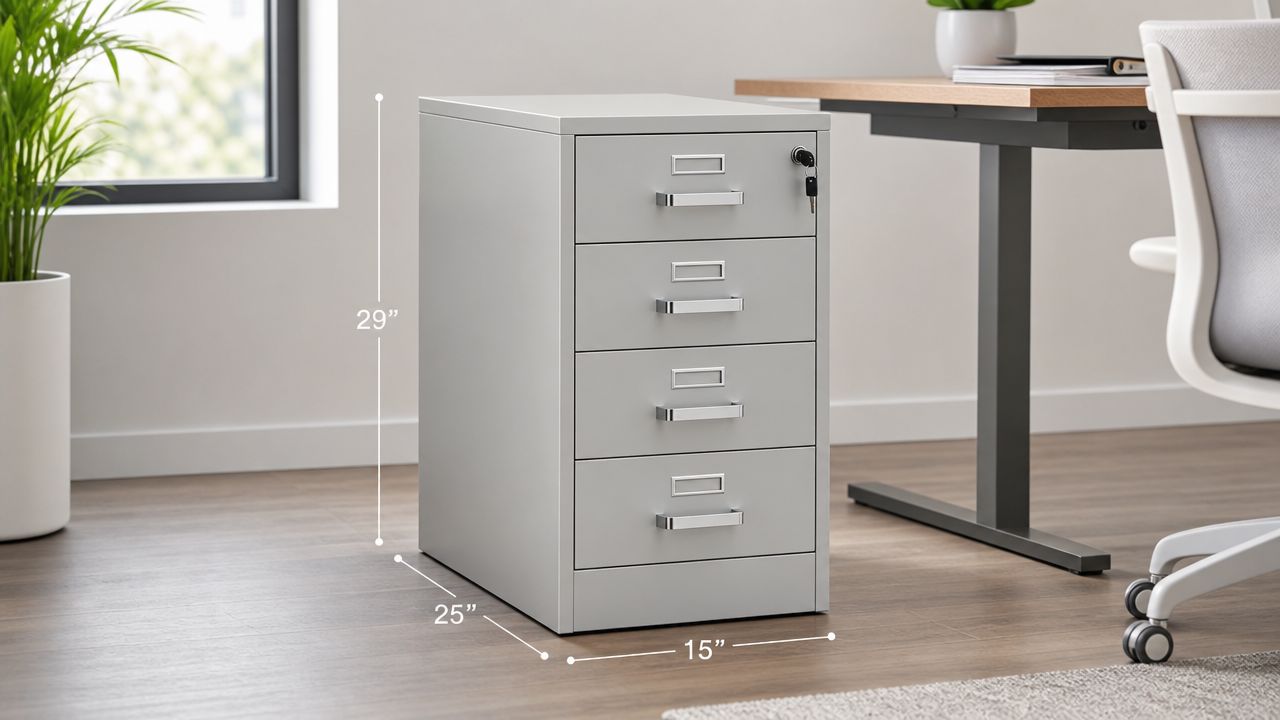
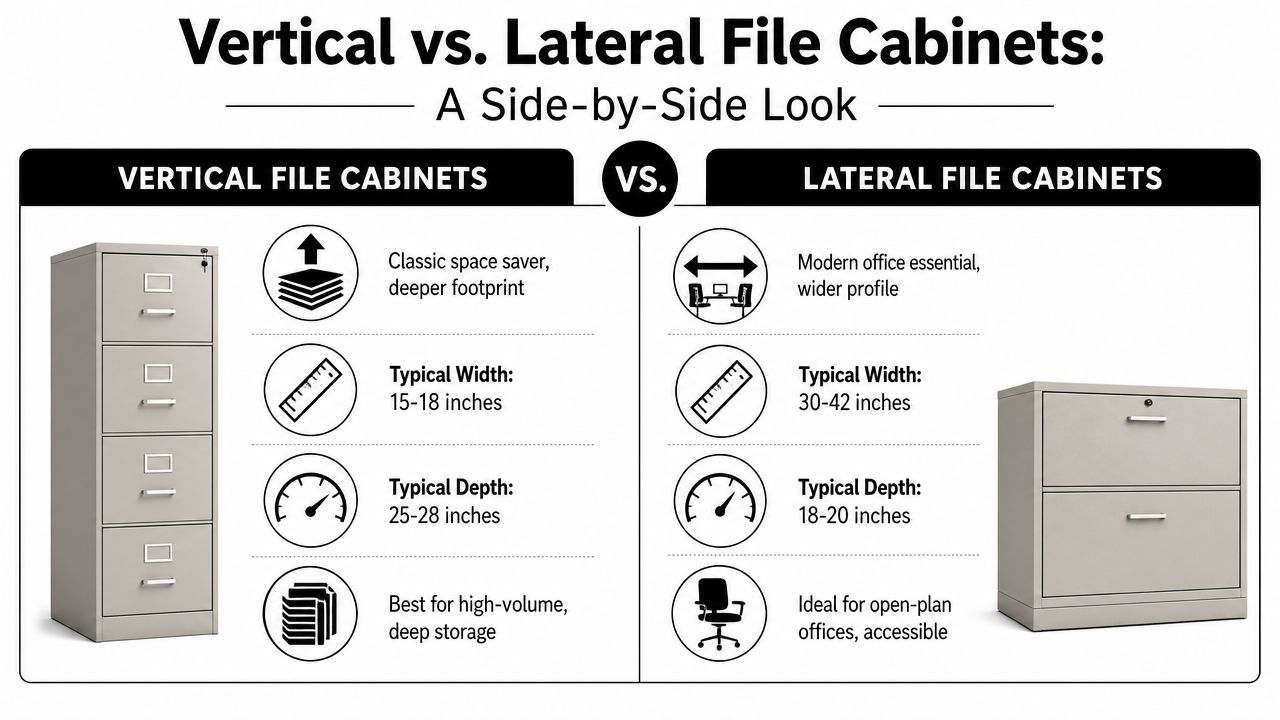
Standard widths are typically 15 inches for letter-size cabinets and 18¼ inches for legal-size cabinets. Standard depths usually fall in the 25 to 28½ inch range for commercial units. That narrow face is what sells the cabinet. The depth is what affects the floor plan.
Heights by drawer count
Vertical cabinets are commonly specified in 2-, 3-, 4-, and 5-drawer models. Typical overall heights are:
- 29 inches for 2-drawer units
- 40 inches for 3-drawer units
- 52 to 53 inches for 4-drawer units
- 64 to 66 inches for 5-drawer units
The trade-off is straightforward. As drawer count increases, storage capacity rises without using more wall width, but the cabinet becomes less convenient as a shared surface and more demanding in front-access space. A 2-drawer unit can work beside a desk and still feel reasonably low-profile. A 5-drawer unit is better treated as dedicated records storage.
Where vertical cabinets make sense
Vertical cabinets fit best where the plan is tight side to side but can tolerate more front-to-back depth.
That usually includes:
- Private offices where a cabinet needs to fit beside a desk or in a corner
- Administrative areas where one user or a small team accesses active files regularly
- Small file rooms where capacity needs to build upward instead of across the wall
I usually recommend a vertical cabinet when width is the limiting factor, not when daily file retrieval speed is the top priority. If a team is opening drawers all day, the narrow footprint helps less than people expect once clearance and user movement are taken into account.
For tighter layouts, the same planning logic used in storage cabinet solutions for small office footprints applies here. Cabinet width is only one number. Depth, drawer swing, and adjacent workstation access decide whether the cabinet fits the room.
Common planning mistakes
The biggest mistake is sizing a vertical cabinet by width alone. On paper, 15 inches or 18¼ inches sounds compact. In the field, a cabinet that projects 25 to 28½ inches into the room can crowd a path, pinch a workstation entry, or interfere with drawer access at a nearby desk.
The second mistake is choosing a tall model for a space that needs touchdown surface area. A 4-drawer or 5-drawer vertical gives you storage density, but it does not give you the broad usable top that many teams want from lower storage pieces. If that surface matters, a lateral unit or even a furniture-style option such as the Giorgi Bros. Aspen file cabinet may align better with the room's function and finish standards.
Standard Lateral File Cabinet Measurements
Lateral cabinets became popular for a reason. They trade a narrow footprint for a broader, shallower profile that often fits the wall better and makes files easier to reach.
Common lateral widths are 30, 36, 42, or 44 inches, and the standard depth is about 20 inches, according to the lateral filing cabinet size guide. Typical heights range from about 28 to 30 inches for 2-drawer models and 32 to 36 inches for 4-drawer models.
Why laterals fit modern layouts better
A lateral cabinet asks for more wall span, but less front-to-back intrusion. In practice, that's often a better trade in open offices, circulation corridors, and shared team zones.
The main advantages are easy to see:
- Shallower depth: At about 20 inches, a lateral cabinet sits tighter to the wall than many vertical units.
- Lower profile options: A 2-drawer lateral at roughly 28 to 30 inches high can function as storage plus a usable surface.
- Front-facing access: Users can see and retrieve a wider file section without dealing with a tall stack of drawers.
A useful visual reference can help when you're comparing these forms in a live project review.
Where laterals make the most sense
Lateral cabinets are usually the better choice when people need frequent access and the room has enough wall width to support them. They also make more sense when the cabinet top needs to work as part of the office, not just as dead surface.
That could mean using the cabinet top for a printer, shared trays, or a touchdown surface near a team cluster. If you want to see how this format appears in residential-style office furniture, the Giorgi Bros. Aspen file cabinet is a useful example of the lateral profile in a finished furniture context.
For teams that need secure shared storage, a setup similar to lateral filing cabinets with lock often fits better than stacking multiple vertical units along the same wall.
Mobile File Cabinets and Pedestal Dimensions
Mobile file cabinets are the most flexible option, but they only work if they fit the workstation correctly. In real planning, that means focusing less on raw storage volume and more on under-desk compatibility, user reach, and whether the cabinet can move without becoming a nuisance.
A pedestal is usually the answer when a user needs personal storage at arm's reach. These units are commonly placed under desks or just outside the worksurface zone, and the best ones support daily habits without crowding knees, bags, or task chairs.
What matters more than the label
Two common pedestal formats show up over and over:
- File/file configurations support users who still handle a meaningful amount of paper.
- Box/box/file configurations balance office supplies with one file drawer for active documents.
The exact dimensions vary by manufacturer, so it's better to verify fit directly with the desk and return you're using than to assume every pedestal is interchangeable. The planning question is simple. Can the user sit comfortably, open the drawers without blocking movement, and still access the cabinet from a normal seated position?
Low mobile storage works best when it behaves like part of the workstation instead of extra furniture squeezed underneath it.
Best use cases for mobile storage
Pedestals tend to work especially well in offices with:
- Flexible seating arrangements
- Shared workstations
- Compact benching systems
- Users who need personal lockable storage close at hand
If you're furnishing desk-level storage, a drawer unit for under desk setups is usually the right category to review before you finalize workstation depth and legroom.
What doesn't work is trying to make a pedestal carry the burden of departmental records. Once files become shared, high-volume, or archive-oriented, the storage belongs in a vertical or lateral cabinet, not under someone's desk.
How to Choose the Right File Cabinet For Your Space
The right cabinet isn't the one with the biggest drawer count. It's the one that supports the way people move and work in the room you have.
Industry guides note that while vertical cabinets can be 52 to 54 inches tall, the top drawer on some 4-drawer units can be too high for comfortable use as a work surface. The same guidance notes that lateral cabinets, often 30 to 42 inches wide, support more storage horizontally and are better suited as task-adjacent surfaces in modern offices, as discussed in this file cabinet sizing guide.
Choose based on the room, not the catalog
Start with how the cabinet will live in the office:
- Tight width available: Vertical usually wins.
- Long wall available: Lateral usually wins.
- Need a secondary top surface: Lateral is often the stronger choice.
- Need personal storage at the desk: Mobile pedestal is the practical answer.
That sounds basic, but it prevents a common mistake. Teams often choose a vertical cabinet because the width looks efficient, then discover the height and depth make the station awkward in everyday use.
Match the cabinet to the workflow
Think about access patterns before capacity.
A records room can tolerate a taller cabinet because users aren't opening drawers all day. A shared admin area usually benefits from lower, broader storage because several people may need to access files in sequence. In hybrid offices, lower cabinets often do more work because they support both storage and nearby task activity.
A useful decision filter looks like this:
| Priority | Best Fit |
|---|---|
| Narrow footprint | Vertical cabinet |
| Frequent shared access | Lateral cabinet |
| Personal workstation storage | Mobile pedestal |
| Usable top surface | Lower lateral cabinet |
Decision point: If people will touch the cabinet all day, usability matters more than squeezing in one more drawer.
When teams are also dividing open space into quieter zones or support areas, glass office partitions often pair well with lower-profile storage because they preserve visibility while helping define where filing belongs.
Essential Clearance and Space Planning Metrics
Most file cabinet mistakes happen after the cabinet arrives. The footprint looked fine on the plan, but once the drawers open, the aisle disappears.
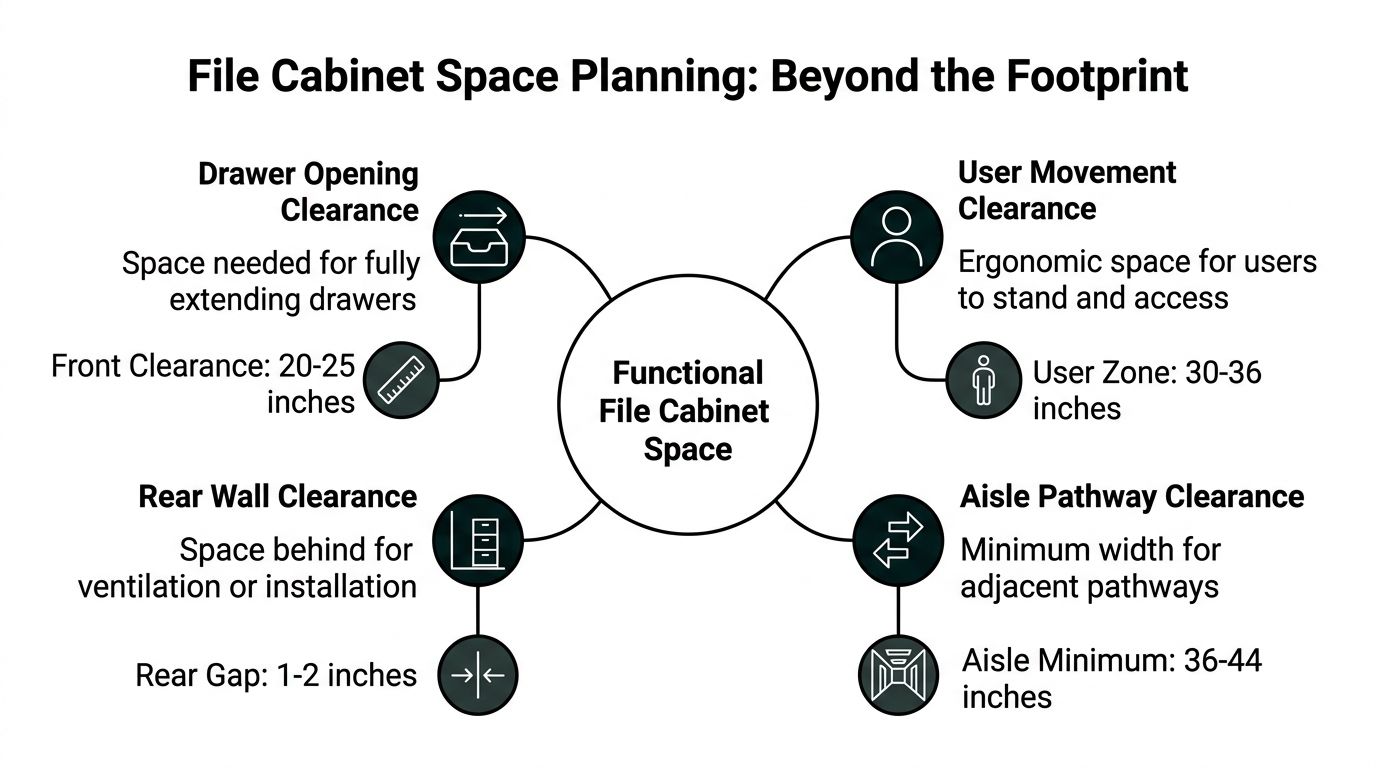
For commercial U.S. ranges, vertical file cabinets are typically specified at about 25 to 28 inches deep, while compact versions are around 22 to 24 inches. A planner must account for that depth again as clearance space in front of the cabinet so the drawer can fully extend and a user can reach files at the back, according to this commercial file cabinet specification guide.
The hidden space a cabinet needs
This is the part many floor plans miss. The cabinet depth is only the parked dimension. The operating dimension is bigger because the drawer has to open fully.
For a vertical cabinet, that means planning for:
- Cabinet depth at rest: roughly 25 to 28 inches in many commercial models
- Drawer extension zone: another depth allowance in front so the drawer can open fully
- User access area: enough room for someone to stand, sort, and remove files without backing into circulation
If any of those zones collide with a chair path, doorway swing, or primary aisle, the cabinet is technically installed but functionally wrong.
Common layout conflicts
These problems show up often in real offices:
- Cabinet behind a guest chair: The file opens into occupied space.
- Cabinet near a workstation entry: One open drawer blocks normal access.
- Cabinet at the end of a bench run: The drawer extension conflicts with walking traffic.
- Cabinet under a low shelf or wall feature: The top may fit, but use becomes cramped.
Don't measure only to the cabinet face. Measure to the cabinet face, then measure the open-drawer condition, then stand where the user will stand.
A good plan also checks adjacent functions. If a cabinet sits near print equipment, coat storage, or a corridor turn, the conflict multiplies fast because all those uses peak at the same time.
A practical planning sequence
When placing file cabinets, use this order:
- Confirm document type so the cabinet format matches letter or legal storage.
- Place the cabinet footprint in the most logical wall or station zone.
- Add the full drawer extension space in front of the cabinet.
- Test the human use position with someone standing at the open drawer.
- Check neighboring furniture movement such as task chairs and adjacent doors.
That sequence catches most problems before procurement.
Integrating File Cabinets with Your Office Furniture System
A file cabinet works better when it behaves like part of the furniture system instead of an isolated piece dropped into leftover space. That matters even more in modular offices, where every inch of alignment affects circulation and sightlines.
A low cabinet can support the edge of a workstation neighborhood. A taller one can terminate a run and create a visual stop. The key is to coordinate height, reach, and placement with the surrounding desks and panels rather than treating storage as an afterthought.
Use storage to shape the workspace
A few integration patterns consistently work well:
- End-of-run storage: Taller cabinets can anchor the end of a workstation row and keep shared records out of the primary seated zone.
- Low boundary storage: Lower cabinets help define team areas without fully closing them off.
- Task-adjacent support: A cabinet placed near a printer or admin support point reduces unnecessary walking.
If you're laying out modular stations, reviewing standard cubicle dimensions alongside storage placement helps prevent mismatched heights and awkward entries.
Measure furniture as a system
Cabinets don't fail because the cabinet is wrong. They fail because nobody measured the relationship between the cabinet, the desk, the return, the chair path, and the wall.
For teams that need a simple refresher on process, this guide on how to measure your furniture is a useful companion to office layout work. It reinforces a habit every planner needs. Measure the object, then measure the route, then measure the operating space.
That same thinking carries into broader furniture planning, whether you're working with custom office cubicles, denser call center cubicles, or flexible workstation cubicles that need storage without losing seat count.
Quick Reference Specification Table
When you need a fast check, a simple dimension table saves time. The measurements below consolidate the standard ranges cited earlier and keep the common cabinet types in one place.
Standard file cabinet dimensions at a glance
| Cabinet Type | Drawer Count | Typical Height (in) | Typical Width (in) | Typical Depth (in) |
|---|---|---|---|---|
| Vertical, letter-size | 2 | 29 | 15 | 25 to 28½ |
| Vertical, legal-size | 2 | 29 | 18¼ | 25 to 28½ |
| Vertical, letter-size | 3 | 40 | 15 | 25 to 28½ |
| Vertical, legal-size | 3 | 40 | 18¼ | 25 to 28½ |
| Vertical, letter-size | 4 | 52 to 53 | 15 | 25 to 28½ |
| Vertical, legal-size | 4 | 52 to 53 | 18¼ | 25 to 28½ |
| Vertical, letter-size | 5 | 64 to 66 | 15 | 25 to 28½ |
| Vertical, legal-size | 5 | 64 to 66 | 18¼ | 25 to 28½ |
| Lateral | 2 | 28 to 30 | 30, 36, 42, or 44 | 20 |
| Lateral | 4 | 32 to 36 | 30, 36, 42, or 44 | 20 |
| Mobile pedestal | 2-drawer or 3-drawer | Varies by manufacturer | Varies by manufacturer | Varies by manufacturer |
How to use the table correctly
Use this table as a planning baseline, not as a substitute for product cut sheets. Standard file cabinet measurements help you narrow the right category quickly, but final approval should still be based on the exact model, drawer behavior, and how the cabinet interacts with the surrounding furniture.
If the office is dense, test the open-drawer condition before you order. That's where good-looking plans either hold up or fall apart.
If you're planning a new layout, expanding a team area, or trying to fit storage into a tighter footprint without losing function, Cubicle By Design can help you coordinate cabinets, workstations, partitions, and circulation as one complete workplace system. For configurable layouts, the Cubicle Designer is a practical starting point for matching storage and workstation dimensions before anything gets ordered.