
A few strands of greenery clipped to the wrong panel can make a clean workstation look crowded fast. In a modern office, the better approach is to decorate with the furniture system in mind. Glass screens, slim partitions, shared benching, and movable storage all change what looks good and what stays in place through the season.
Holiday decor in a cubicle should add warmth without blocking sightlines, damaging finishes, or interfering with cables, monitor arms, and daily work. I usually advise people to treat Christmas decorating the same way they treat workplace styling in general. Keep the footprint tight, use removable materials, and match the scale of the decor to the size of the workstation.
That matters even more in offices built around modular office desk systems. Decorations that worked on older, fabric-heavy cubicles often fail on glass dividers or low-profile partitions. Magnets may not grip, tape can leave marks, and oversized pieces can look awkward when every line in the office is clean and intentional.
The ideas below focus on office-friendly Christmas decor that fits modern modular layouts. The goal is simple: festive desks, safer installs, and a polished look that still feels professional in January.
1. Minimalist Desk Garland with Modular Workspace Integration
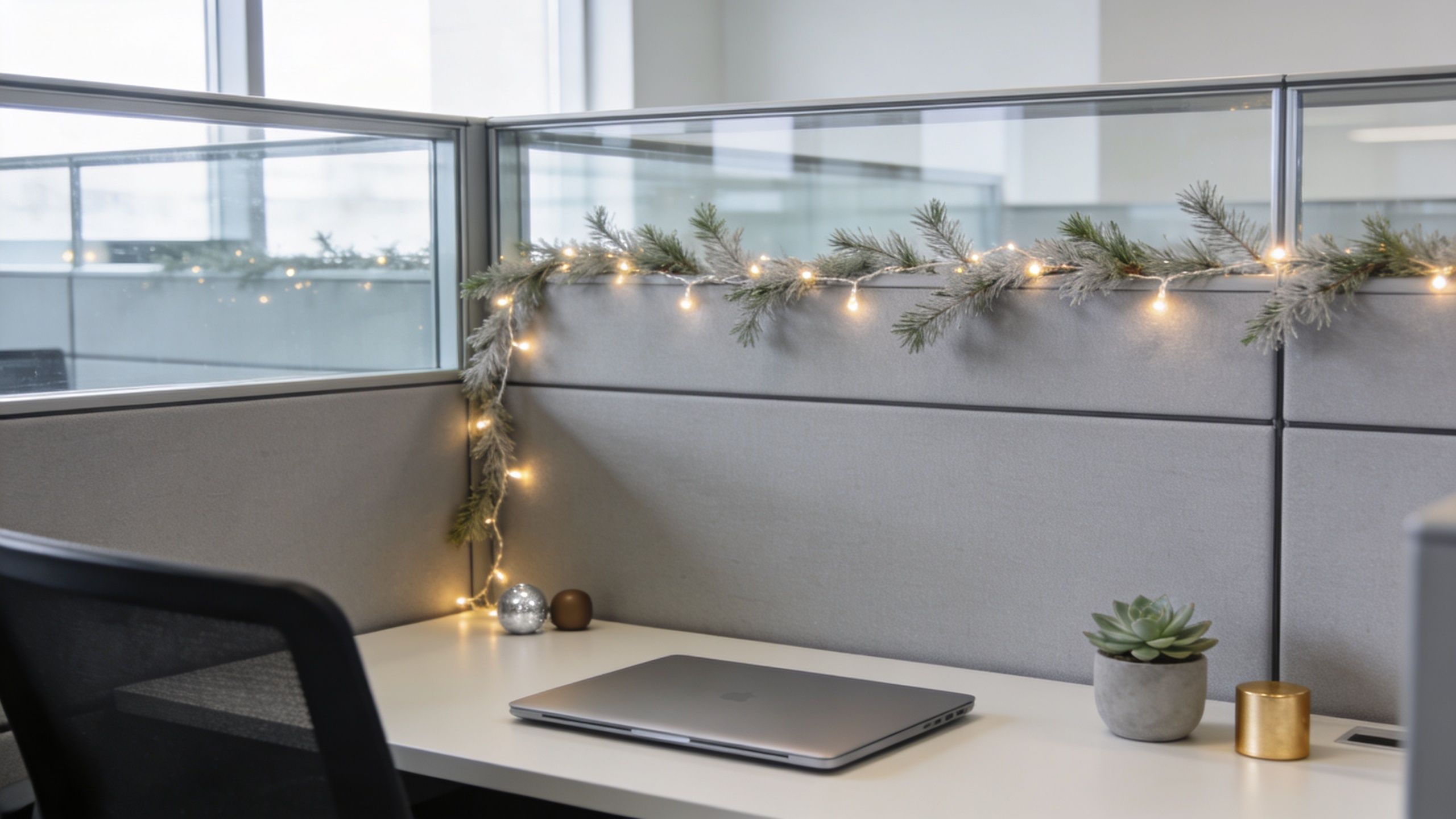
You walk into a clean benching setup on Monday morning. Glass screens are clear, monitor arms are lined up, and one workstation has a narrow cedar garland tracing the desk return. It reads festive right away, but it still respects the architecture of the office. That is the standard to aim for.
A minimalist garland works because it adds texture without fighting the furniture. In modular environments, every line is visible. A bulky strand can crowd a compact footprint, catch on task seating, or look awkward against low partitions and glass. A slimmer profile with controlled spacing usually performs better.
How to make it look intentional
Place the garland on one clear line only. The front desk edge, a credenza return, or the top rail of a partition usually works best. Once greenery wraps every surface, the workstation stops looking designed and starts looking temporary.
For offices built around modern modular office desk systems, keep the decoration aligned with the kit of parts. Follow the desk geometry, respect reveals and seams, and leave shared surfaces untouched. That approach looks sharper, and it avoids the common problem of decor interfering with reconfigurable components.
Practical rule: If the garland blocks daylight, covers acoustic material, or hangs into a neighbor’s line of sight, it’s too much.
What works and what doesn’t
A few choices decide whether this looks polished or improvised:
- Use battery-operated LED strands: They avoid cord runs across shared aisles and reduce conflicts with power access, sit-stand bases, and cable trays.
- Choose a narrow garland profile: Slim faux cedar, eucalyptus, or mixed winter greens suit low panels and glass better than dense, oversized pine.
- Keep the palette disciplined: Matte white, brushed metallics, soft green, and natural wood fit most commercial interiors without clashing with brand colors.
- Use removable mounting hardware: Low-tack hooks and reusable fastening tabs are safer for laminate, metal frames, and finished panel systems than pins or standard tape.
- Skip large bows and dangling ornaments: They add visual weight quickly and tend to swing into monitors, bags, and passing traffic.
I usually recommend testing the install from seated height and from the main aisle before calling it done. A garland can look balanced from inside the cubicle and still feel visually heavy from the outside. The best office holiday styling holds up from both views, especially in open plans where every workstation is part of a larger composition.
2. Modular Vertical Wall Garden Decorations
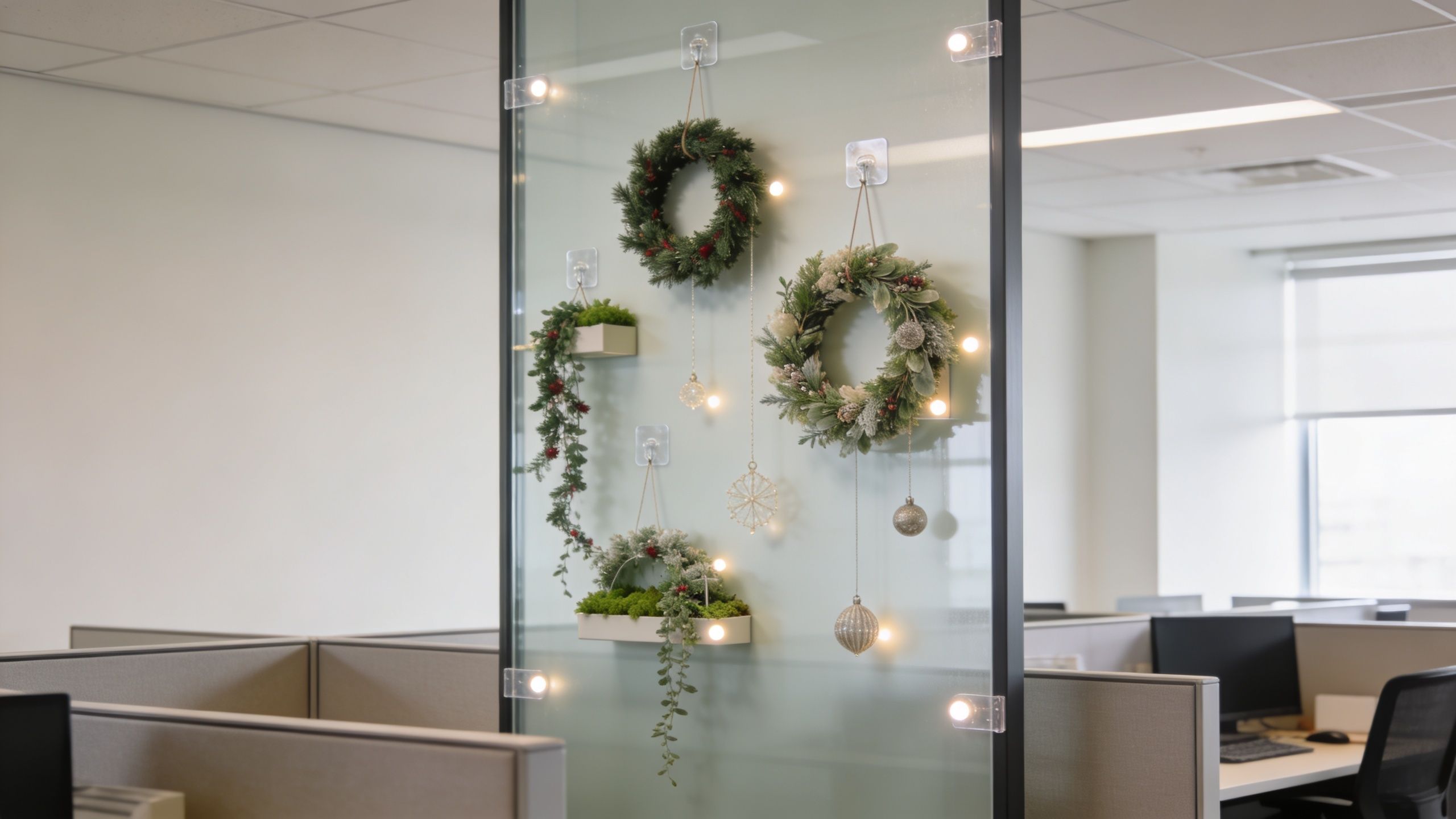
A narrow glass panel at eye level can carry more holiday style than a crowded desktop. In modular offices, that matters. The best vertical displays add seasonal color without interfering with shared surfaces, movable components, or the clean sightlines that make newer workstation systems feel open.
A holiday wall garden works well here because it reads as intentional decor instead of overflow. Use one restrained composition. A slim wreath, a vertical run of faux winter greenery, or a small grid of lightweight ornaments usually fits the scale better than a wide, home-style arrangement.
Best surfaces for this approach
Surface compatibility decides whether this idea looks polished or turns into a maintenance problem. Glass partitions handle suction cups, clear hooks, and static-cling accents well. Metal frame sections can support magnets if the pieces are light and the contact point is stable. Fabric panels are less predictable, so I keep the load low and use removable fasteners rated for finished office surfaces.
This approach suits modular layouts because it leaves the worksurface open and respects systems that may be reconfigured after the holidays. If you also want greenery that can transition beyond December, these plants for office spaces offer a good starting point for mixing permanent biophilic elements with seasonal decor.
Keep the composition light
Vertical cubicle decor fails when the piece is too large for the panel or too heavy for the mounting method. Scale first. Material second.
A few guidelines keep it under control:
- Measure the visible panel area: Leave margin around the decoration so the panel still looks like part of the workstation, not a backdrop.
- Choose low-mass materials: Faux cedar, felt shapes, paper ornaments, and thin wire frames mount more reliably than dense greenery or glass ornaments.
- Anchor one focal point: One centered piece with a small supporting accent usually looks cleaner than several competing items.
- Protect the finish: Skip strong adhesives, staples, and pins that can mark glass, laminate, or acoustic surfaces.
- Check both sides of the partition: In glass-fronted systems, the back view matters almost as much as the front.
I also recommend treating vertical holiday decor as temporary layer, not a permanent build-out. Offices with flexible furniture need decorations that come down quickly, store flat, and leave no residue behind. That practical standard lines up with guidance from Arnold’s Office Furniture on cubicle winter decorating, which emphasizes removable options over messy DIY installs.
3. Cubicle Corner Tree and Accent Lighting Strategy
A slim corner tree works when you want one statement piece instead of lots of small ones. In the right cubicle, it adds instant holiday presence without covering your desk in mini decorations.
This works best in private or semi-private setups where you have an unused corner near a return, storage unit, or side chair. A narrow artificial tree usually looks better than a wide tabletop tree because it creates height and keeps the main work surface open.
Placement matters more than tree style
Before buying anything, check how you move through the workstation. If the tree blocks file access, crowds a guest chair, or catches your coat every time you sit down, it’s in the wrong spot. The best corner trees feel tucked in, not wedged in.
For enclosed or semi-enclosed setups, private office cubicles give you more freedom to use a slightly taller focal piece while still preserving privacy and order.
Lighting without the mess
The lighting should support the tree, not create a wiring problem. Pre-lit trees are usually the cleanest option in offices because they reduce extra cords and keep the whole display contained.
If you add supplemental light, keep it subtle:
- Choose warm LED lighting: It feels softer in office environments than saturated color-changing strands.
- Route cords along fixed edges: Never run them across chair paths or underfoot areas.
- Secure the base if needed: A slim tree in a busy walkway zone may need discreet stabilization.
- Decorate lightly: Small ornaments, ribbon, and one topper are often enough.
In office cubicles, scale beats detail. A simple tree with good proportion looks more polished than an overdecorated one.
If your cubicle already suffers from poor brightness in winter, decor lighting can also help soften the space. Cubicle By Design’s guidance on office cube lighting is useful when you’re trying to avoid glare, shadows, and awkward lamp placement while layering in seasonal lights.
4. Coordinated Team Decoration Themes Across Cubicle Clusters
Monday morning is when cluster decorating usually gets tested. If one pod is covered in bright tinsel, another has tabletop figurines, and a third adds flashing lights to glass panels, the whole floor starts to feel visually fragmented. A coordinated theme prevents that. It gives each team enough room for personality while keeping the larger workplace consistent.
This matters even more in modular offices. Benching systems, shared runs of panels, and glass-fronted enclosures put multiple workstations in view at once, so decoration choices read as one composition rather than a series of isolated desks.
Good themes for professional offices
The strongest team themes are easy to repeat and easy to control. Winter white, evergreen with brushed metallics, muted company colors, Scandinavian minimal, or a soft red-and-wood palette all work well across connected stations because they stay disciplined on color and scale.
In clustered work areas, consistency matters more than novelty. One repeated element, such as matching chair-back ribbon, a small wreath on every panel, or identical desktop accents, usually does more for the overall look than asking each person to invent a different holiday display. If your department is setting up or reconfiguring a pod, this guide on how to plan office layout is useful for understanding circulation, sightlines, and shared boundaries before decor goes up.
Teams that want a softer holiday look can also blend decor with biophilic elements. A few low-maintenance plants repeated across the cluster can bridge seasonal styling and everyday office design. The Jungle Story low light plant guide is a practical reference for offices that do not get much natural light.
Set boundaries before decorating starts
Cluster decorating works best with a short set of rules. Without that, one person decorates the panel tops, another tapes items to glass, and someone else adds floor pieces that narrow the aisle.
Use a simple framework:
- Choose one palette: Two or three colors are enough for a clean, professional result.
- Assign one shared element: Repeat one item across the cluster so the area reads as a unit.
- Set a height limit: Keep decorations below panel tops or within an agreed band, especially near glass and open sightlines.
- Respect circulation: Leave entries, chair movement, and shared walkways fully clear.
- Approve attachment methods: Use clips, hooks, or non-marking fasteners that suit modular surfaces and can be removed cleanly.
I usually recommend assigning one person to review the full cluster before anyone starts hanging decor. That catches the practical issues early, especially in offices with mixed panel heights, movable storage, and transparent dividers. The best coordinated setups feel intentional from ten feet away and unobtrusive when someone is trying to work.
5. Desk-Based Sustainable and Eco-Friendly Decorations
Not every office wants plastic garlands and glitter-covered everything. For a lot of teams, a quieter and more sustainable approach feels more current anyway.
Desk-based natural decor works because it stays within personal boundaries. A small bowl of pinecones, a paper chain in a muted palette, dried citrus in a clear jar, or a potted evergreen on the corner of the desk can all add warmth without looking wasteful.
Materials worth using
The strongest sustainable setups use materials that can be reused, composted, stored flat, or repurposed after the season. That usually means paper, wood, fabric ribbon, ceramic containers, and living plants.
If you want to add greenery that lasts beyond December, low-maintenance plants are often the best bridge between holiday styling and year-round workspace wellness. For plant options that tolerate dim interiors, this guide to low light houseplants is a practical reference.
Keep the look refined
Eco-friendly doesn’t have to mean rustic in a messy way. The best versions are edited and intentional.
A few reliable combinations:
- Kraft paper ornaments with white twine: Clean, inexpensive, and easy to recycle.
- Mini potted evergreen in a neutral planter: Festive now, useful later.
- Dried orange slices with cedar sprigs: Best in small doses, not scattered everywhere.
- Reusable cloth ribbon: Softer and less disposable than plastic bows.
What usually doesn’t work is the overcrafted look. Too many handmade pieces in too many textures can make a workstation feel cluttered. In an office, sustainability succeeds when it still respects visual order.
6. Interactive Photo Display and Memory Walls
Some holiday decor looks nice for a week and then fades into the background. Photo displays don’t. People keep looking at them because they carry actual meaning.
A memory wall works well in shared cubicle clusters, on a common pinboard, or on one designated panel near a team area. Instead of focusing only on ornaments and lights, it turns the holiday setup into a small culture piece. That’s especially useful in hybrid offices where not everyone sees each other every day.
What belongs on the display
Keep the content warm but structured. Team lunch snapshots, volunteer photos, pet pictures in holiday accessories, end-of-year wins, and simple gratitude notes usually land well. Random uploads with no curation don’t.
A dedicated cork board or magnetic board makes this much easier because items can be swapped out without damaging partitions. Magnetic accessories are especially useful in offices that need quick updates and clean removal.
Use one curator. Shared displays get better when one person handles layout, spacing, and visual consistency.
Make it festive without losing privacy
The frame around the display can be seasonal. Add a thin garland border, a few paper snowflakes, or a narrow string of battery lights. Keep the decoration secondary to the photos.
A good office version also needs guardrails:
- Get permission for photos: Don’t assume everyone wants their picture displayed.
- Avoid confidential content: Screens, whiteboards, and paperwork in the background can create problems.
- Refresh it once or twice: New images keep the display active during the season.
- Limit visual noise: Too many tiny photos with too many captions make people stop engaging.
This idea works particularly well for teams trying to make seasonal decorating feel communal instead of purely decorative.
7. Professional Desktop Miniature Scenes and Tabletop Displays
Miniature scenes are the most personality-driven option on this list. Done well, they look charming and polished. Done badly, they look like a gift shop exploded next to your keyboard.
The trick is restraint. One compact village, one winter scene under a clear cover, or one small tabletop diorama can add a lot of character without dominating the desk.

Make the display office-appropriate
Place the scene toward the back corner of the desk or on a credenza, not in the main typing zone. Clear acrylic covers help with dust and make the setup look more intentional. They also reduce the risk of pieces getting bumped during normal work.
A miniature scene usually works best when the rest of the cubicle stays simple. If you already have garland, stockings, signs, mugs, and themed mousepads everywhere, a village display becomes one element too many.
One source discussing office holiday decor highlights a major gap around policy and safety, noting that holiday decorations contribute to about 860 structure fires annually in the U.S., with 40% involving electrical issues, according to the summary in Square Signs’ office holiday decorating ideas. That’s exactly why miniature scenes should use low-heat LEDs or battery-operated lighting, and why cords need careful routing in cubicle environments.
Best themes for a professional desk
Choose scenes with a clear style. Traditional snowy village, monochrome winter city, woodland cabin, or modern Scandinavian houses all translate well. Novelty scenes can be fun, but in shared offices they date faster and can distract more.
A few practical rules help:
- Keep the footprint compact: The display should feel contained, not sprawling.
- Use integrated light only: Loose add-on strands create clutter fast.
- Store it as one unit if possible: Trays and display boxes make setup and takedown easier.
- Avoid loose glitter or faux snow: It spreads everywhere.
For inspiration on seasonal display details and niche decor accessories, some people also like browsing gift-focused posts such as where to find Pooh bear Christmas stockings, especially when they want a softer, nostalgic accent for a personal desk.
If you’re considering a more elaborate desktop scene, this video shows how layered miniature holiday displays can come together without taking over the entire workspace.
7-Way Cubicle Christmas Decor Comparison
| Item | Implementation Complexity 🔄 | Resource Requirements ⚡ | Expected Outcomes 📊 | Ideal Use Cases 💡 | Key Advantages ⭐ |
|---|---|---|---|---|---|
| Minimalist Desk Garland with Modular Workspace Integration | Low, simple install; cord planning needed | Low, LED string lights, neutral garlands, hooks | Subtle, cohesive festive accent that preserves aesthetic | Modern open-plan & Series 7 cubicles; glass partitions | Preserves clean design; reusable and sustainable |
| Modular Vertical Wall Garden Decorations | Medium, mounting considerations for glass | Medium, lightweight wreaths, adhesives, ornaments | Adds vertical depth without using floor space | Frameless or framed glass walls; compact cubicles | Space-efficient, scalable across teams |
| Cubicle Corner Tree and Accent Lighting Strategy | Low–Medium, placement and cord management | Medium, compact tree, integrated LEDs, stable base | High visual impact in personal workspace; morale boost | Private cubicles with corner space (6×6–8×8) | High-impact focal point; reusable year-to-year |
| Coordinated Team Decoration Themes Across Cubicle Clusters | High, planning, buy-in, and coordination required | Medium, team sets, guidelines, centralized purchasing | Strong unified aesthetic and strengthened team identity | Department clusters, facilities-managed office zones | Scalable, improves visitor perception and team cohesion |
| Desk-Based Sustainable and Eco-Friendly Decorations | Low–Medium, sourcing and disposal guidelines | Low, natural/repurposed materials, potted plants | Reduced waste; improved wellness and ESG alignment | Sustainability-focused organizations and wellness programs | Environmentally aligned; cost-effective with lasting benefits |
| Interactive Photo Display and Memory Walls | Medium–High, privacy, consent, and curation needs | Low–Medium, frames, cork/magnetic boards, digital displays | Increased engagement, belonging, and documented culture | Hybrid teams, culture-driven workplaces, shared clusters | Builds community and morale; relatively low cost |
| Professional Desktop Miniature Scenes and Tabletop Displays | Medium, assembly, protection, and maintenance | Medium–High, miniatures, lighting, display covers | Artistic, professional focal point; conversation starter | Creative teams, client-facing desks, design studios | Elegant contained displays; supports creative expression |
Deck the Halls Safely A Guide to Office-Friendly Decorating
A string of lights goes up at 9 a.m. By lunch, the cord crosses a chair path, an adhesive hook has pulled at the laminate, and facilities has asked for half the display to come down. That pattern is common in modular offices because the furniture is doing more work than it appears to. Panels manage acoustics, glass maintains sightlines, and shared power has limited capacity.
Start with approval. HR, operations, or facilities should confirm what can attach to panels, glass fronts, storage towers, and shared walls. In flexible workplaces, the answer often depends on the furniture system, not just company culture. A magnetic clip may be fine on one surface and completely wrong on another.
Safety rules should shape the design, not just limit it. Keep decorations clear of sprinklers, extinguishers, exit routes, return air grilles, and badge readers. Maintain the original walking width around desks and shared aisles. If a guest has to turn sideways to pass a corner tree or floor display, the piece is too large for that footprint.
Power deserves special attention.
Use listed LED lights, keep cords inside the workstation boundary, and skip daisy-chained strips or overloaded outlets. I treat holiday lighting as an accent only, never as something that should compete with monitors, task lighting, docking stations, or sit-stand desk power. In benching systems and panel-based workstations, that trade-off matters because one overloaded circuit can affect multiple seats.
Installation method affects both appearance and cleanup. Choose removable clips, low-residue hooks rated for the surface, magnetic accessories where the system allows them, and freestanding decor for glass-heavy layouts. Avoid pins, aggressive tape, and anything that can chip powder-coated metal or leave marks on acoustic tiles and laminate. The cleanest holiday setups are usually the ones designed for fast removal on day one.
Style matters too. Offices with client traffic, shared neighborhoods, or mixed holiday preferences usually benefit from winter-forward decor, restrained color palettes, and opt-in team displays. That approach keeps the workspace festive without turning every station into a competing theme. It also works better in modern offices where visual clutter carries farther across glass and open sightlines.
The best cubicle Christmas decor fits the workstation instead of fighting it. It stays inside the assigned footprint, preserves privacy where needed, respects transparent partitions, and comes down without repair work in January. If you are reviewing broader workspace changes as part of that process, the earlier planning resources in this article are the right place to revisit.