


A lot of waiting room projects start the same way. The office is being refreshed, leadership wants the front area to look more polished, and someone walks into reception and realizes the current setup isn’t doing the company any favors. The chairs look mismatched. The traffic flow feels awkward. Visitors either stand too long or spread out in a space that feels cold and unfinished.
That first room matters more than often realized. It’s where a client forms an opinion before the meeting starts, where a job candidate decides what kind of company they’re walking into, and where a vendor or partner gets a quick read on how the business operates. A strong office furniture waiting room doesn’t need to be flashy, but it does need to feel intentional.
That’s one reason this category gets real attention in commercial furniture planning. The U.S. office furniture market reached USD 17.43 billion in 2025, and seating products accounted for 27.68% of total revenue, according to Grand View Research’s U.S. office furniture market analysis. Reception seating isn’t an afterthought. Buyers treat it as a visible, business-critical investment.
Most of the mistakes I see come from treating the waiting room like a short shopping list. Pick a few chairs, add a table, move on. The better approach is to treat it as a small but strategic project. You’re balancing visitor comfort, brand fit, cleaning needs, layout efficiency, and long-term replacement cost at the same time.
That’s the standard worth using if you want the room to hold up, look right, and make sense financially.
Office Furniture Waiting Room Design: A Complete Guide
An office manager usually doesn’t get handed a clean, simple waiting room assignment. More often, the request comes with constraints. The room is smaller than it should be. The budget is tight. Leadership wants a more upscale look. Facilities wants materials that clean quickly. Reception staff wants better visibility to the entrance.
Those competing priorities are normal. A waiting room sits at the intersection of design, operations, and visitor experience. It has to welcome people, support the staff working nearby, and hold up under repeat use without looking tired six months later. That’s why the right plan starts with function first, then finishes and styling second.
The phrase office furniture waiting room sounds straightforward, but it covers a broad set of decisions. You’re not only choosing seats. You’re deciding how people enter, where they pause, what they see first, and whether the room feels calm, crowded, formal, or casual. The most effective spaces do three things well. They support the flow of people, create visual order, and make waiting feel shorter than it is.
A polished reception area also needs to connect to the rest of the office. If the front room feels thoughtful but the workplace behind it feels disconnected, visitors notice. That’s why many teams review waiting room furniture alongside workstations, private offices, and front-desk elements rather than treating each purchase separately. For broader workplace planning, Cubicle By Design offers office furniture resources around modular layouts and front-of-house coordination.
A waiting room is the company’s physical handshake. If it feels improvised, the brand feels improvised.
The strongest projects don’t start with a chair catalog. They start with a practical question. What should a visitor feel when they walk in, and what does the room need to endure every day after that?
The Foundation of a Great Waiting Room Experience
A waiting room works a lot like a home’s entryway. It introduces the space, signals what kind of environment lies beyond it, and tells people how to behave without saying a word. The furniture carries much of that message.
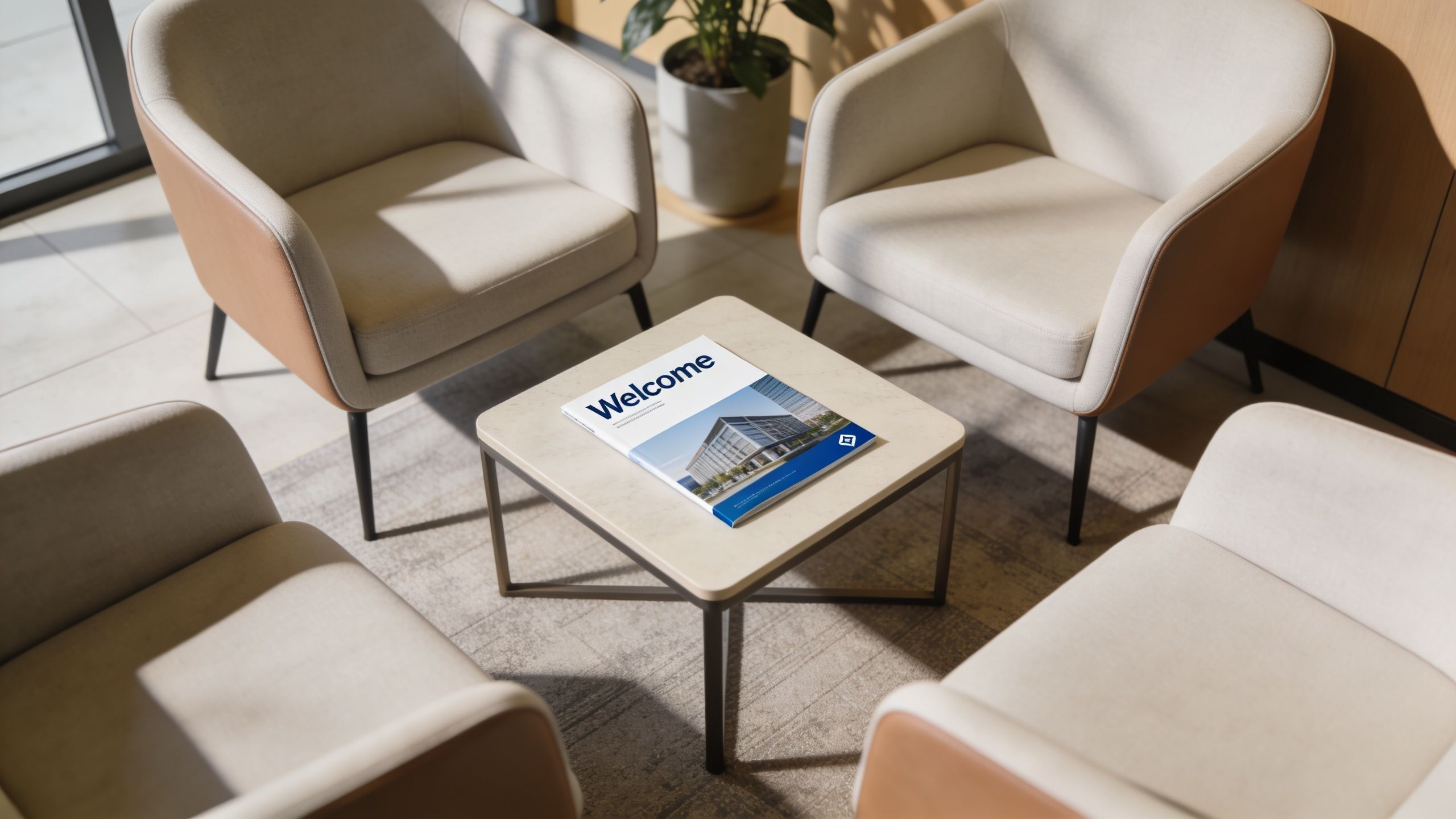
A great waiting room experience usually rests on three layers. Comfort is the first. Visitors need seating that feels supportive, easy to enter and exit, and appropriate for the expected wait. Brand expression is the second. Materials, forms, and colors should align with the business rather than feeling copied from a generic lobby. Practical function is the third. Staff need clear sightlines, guests need obvious cues, and the room has to stay organized under pressure.
Comfort is more than softness
The wrong seat often looks fine in a product photo. It fails in use. A chair can be heavily padded and still feel uncomfortable if the seat is too low, the angle is awkward, or the arm placement makes standing up harder for older visitors.
That’s why “comfortable” should be defined in practical terms:
- Easy entry and exit: Seats shouldn’t trap people in a low lounging posture unless that’s a deliberate hospitality choice.
- Stable support: Chairs should feel planted, not lightweight or wobbly.
- Appropriate scale: Oversized lounge pieces can make a compact reception area feel clogged fast.
- Predictable maintenance: Upholstery should still look orderly after repeated use.
The room should match the business
A law office, a medical practice, and a software firm can all create a good visitor experience, but they shouldn’t all do it the same way. A traditional office may lean into structured seating, wood accents, and a calm palette. A more contemporary company may use modular forms, lighter finishes, and a less formal arrangement.
Reception desks play a major role in that visual signal, too. If you’re trying to align seating with a more classic front-of-house look, reviewing traditional reception desks can help clarify what style language the waiting area should support.
Practical rule: Define the feeling before you define the furniture. “Trustworthy,” “calm,” “creative,” and “high-touch” lead to very different buying decisions.
Function quietly shapes perception
Visitors rarely comment on circulation paths, spacing, or line of sight. They do notice when those things are wrong. If they don’t know where to sit, where to check in, or how to move through the room without crossing traffic, the space feels off even if the furniture is attractive.
What works is simple. Make the reception point obvious. Keep movement intuitive. Use furniture to support the room’s purpose, not compete with it. That’s the difference between a waiting room that merely looks furnished and one that feels professionally designed.
Choosing Your Waiting Room Furniture Types
Not every waiting room needs the same mix. The right furniture depends on traffic volume, visit length, privacy expectations, cleaning requirements, and the image the business wants to project. Most projects combine several furniture types rather than relying on one.
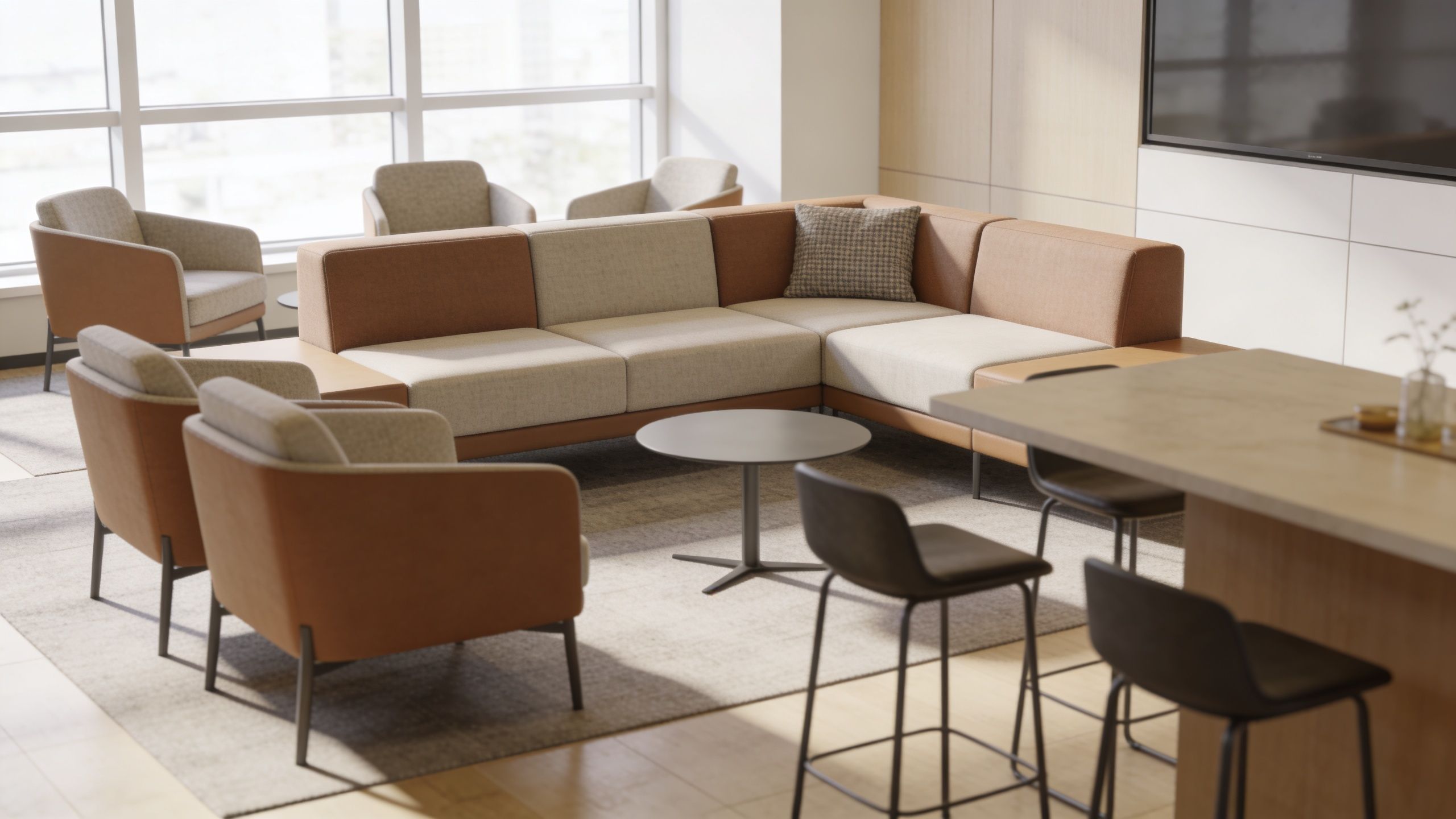
Early in the selection process, it helps to look at examples of mixed seating zones and how they balance posture, density, and visual weight.
Individual guest chairs
These are the workhorse option for many offices. Individual guest chairs are flexible, easier to rearrange than fixed systems, and usually the safest choice when you need a straightforward professional look.
They work well in smaller offices, professional service firms, and any reception area where visitor count changes throughout the day. They also let you mix in a few wider or higher-capacity chairs without making the room feel visibly specialized.
Their downside is efficiency. If the room is busy, a collection of individual chairs can drift out of alignment and create a cluttered look unless staff reset the space regularly.
Beam seating and tandem seating
Beam seating is common where volume and order matter more than a residential feel. It keeps the room visually controlled, makes seat counts predictable, and reduces the problem of chairs shifting all over the floor.
This type often works best in clinics, service centers, and high-turnover reception areas. It’s less inviting in a boutique office, and it can make a client-facing environment feel transactional if used in the wrong setting.
If you’re comparing categories and trying to understand posture, comfort, and maintenance trade-offs, this guide to office seating options that aren’t a pain in the neck is a helpful companion.
Lounge chairs and sofas
Lounge seating changes the tone immediately. It signals that the office wants guests to settle in rather than pass through quickly. That can be useful in executive receptions, creative firms, and high-touch client environments.
It also introduces risk. Low lounge furniture often consumes more floor area, makes accessibility harder if chosen poorly, and can wear unevenly because people favor the same “best” seat every time. In compact waiting rooms, one sofa can dominate the room and reduce flexibility.
A quick visual can help as you compare these setups in real environments:
Benches and modular seating
Benches are efficient and clean-looking. They fit narrow rooms, support quick turnover, and often work well when the goal is simple, durable seating without a lot of visual bulk.
Modular seating is different. It gives you the ability to build zones, change layouts, and adapt as the business grows or the space gets reconfigured. That flexibility is useful, but only if someone intends to use it. Buying modular pieces for a room that will never change can add complexity without delivering much value.
The supporting pieces matter
Waiting room projects often go wrong because the main seating gets attention and everything else is treated as filler. That usually leads to tables that are too large, too small, or placed where they block movement.
Useful supporting pieces include:
- Coffee tables: Best for central lounge groupings, literature, or a visual anchor.
- End tables: Better for distributed seating clusters and personal-item convenience.
- Power surfaces: Helpful when visitors may wait with phones or laptops.
- Accent pieces: Use sparingly so the room stays clear and maintainable.
A smart office furniture waiting room mix usually includes one dominant seating type, one secondary type, and only the accessory pieces the room can support.
Planning Your Layout and Seating Capacity
A waiting room usually fails at 8:45 a.m., not at 2:00 p.m. The chairs fit on the floor plan, but the entry door collides with the first seat, late arrivals stand in the check-in path, and one stroller or laptop bag turns a passable aisle into a bottleneck. Good layout work prevents that. It also protects your furniture budget, because a room that functions well for years delivers a better return than one that needs an early rework.
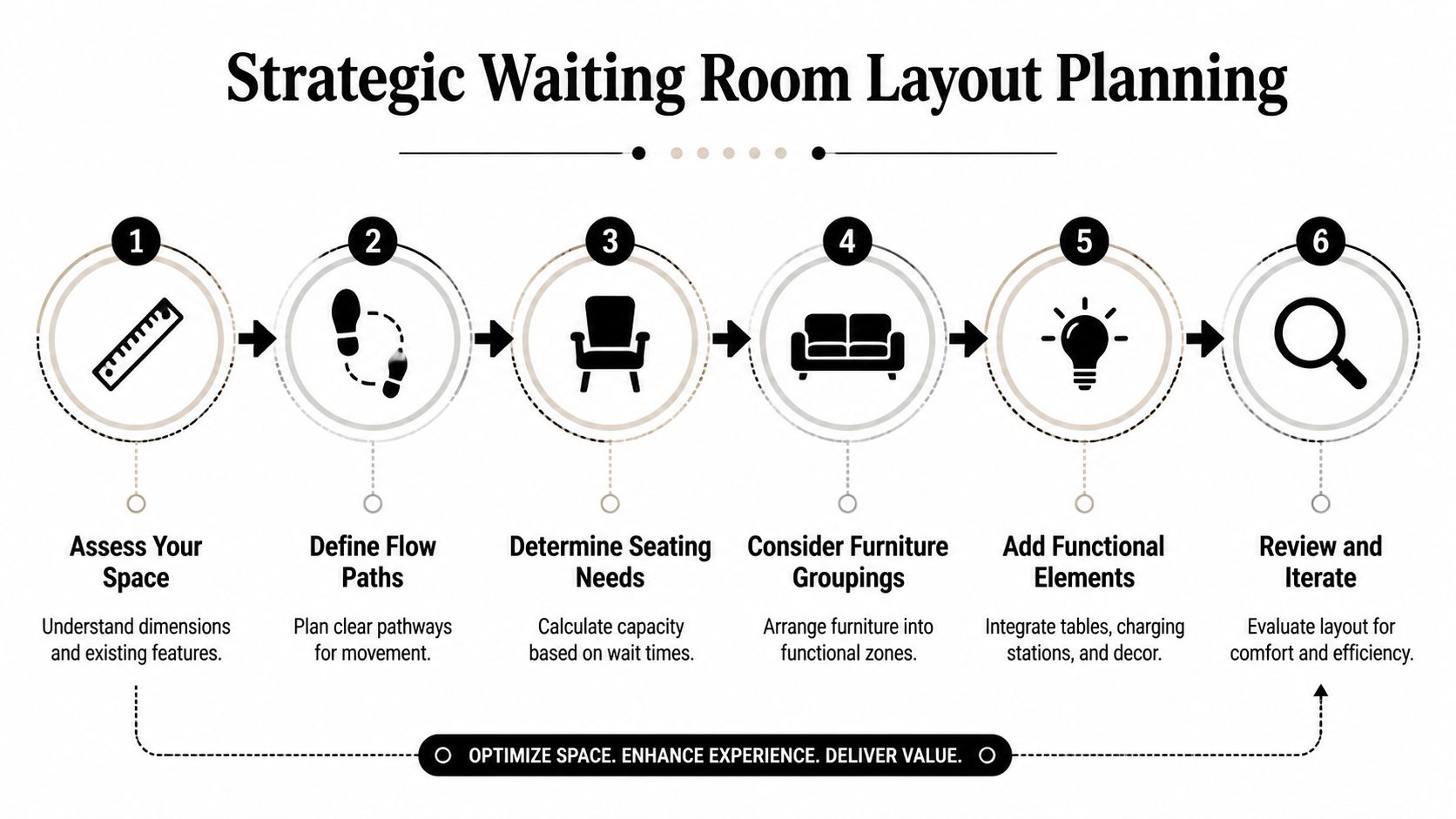
Start with peak demand and usable space, then build the layout around circulation. Reception areas always feel larger before furniture, side tables, door swings, and queue space are drawn in. Analysts at National Business Furniture note in their waiting room planning and measurement guide that compact seating and lounge seating need different space allowances, and that seat counts should reflect peak occupancy rather than average daily traffic. That point matters for TCO. Under-sizing forces a faster redesign. Over-sizing ties up capital in seats that stay empty and make the room harder to maintain.
Plan for the busiest 30 minutes
Average traffic is a weak planning metric. Waiting rooms succeed or fail during the short window when arrivals overlap, delays stack up, or several visitors show up with personal items at once.
Use this sequence:
- Count peak seated visitors: Measure the highest number waiting at one time, not total visitors per day.
- Reserve space for non-seating functions: Check-in, door clearance, accessibility, and queueing get space before decorative pieces do.
- Test the seating mix against actual behavior: Short-stay guest chairs support turnover. Lounge groupings support longer visits but reduce capacity.
- Add a buffer: A small reserve protects the room from looking full the moment one schedule slips.
One bad rush period can shape a visitor’s impression more than months of quiet operation.
Choose a layout pattern based on room behavior
Layout style should follow traffic, supervision needs, and expected wait time.
Perimeter layout
Perimeter seating keeps the center open and usually gives you the cleanest circulation path. It works well in smaller lobbies, healthcare-adjacent offices, and reception areas with frequent arrivals and departures. The trade-off is feel. If every chair is pushed to the wall with no focal point, the room can read as sparse and transactional.
Clustered layout
Grouped seating creates a more relaxed, hospitality-driven room. It suits clients who may wait longer, families arriving together, or offices that want a less formal first impression. It costs space. You lose some seat density, and cleaning staff need better access around tables and chair legs.
Back-to-back layout
Back-to-back rows increase capacity in deeper rooms without forcing every visitor to stare at reception. This pattern often works in legal offices, larger clinics, and multi-tenant lobbies where occupancy fluctuates. It takes discipline to detail well. If spacing is tight, the room starts to feel crowded fast.
Draw the obstacles before you approve the furniture
Projects go off track when teams place seats first and solve the rest later. Doors, columns, ADA clearances, stroller parking, bag placement, and line formation need to be visible on the plan before a furniture order is finalized.
A measured, tool-driven office planning process helps teams test those conditions early. For teams that also need to visualize footprints and adjacent workstation planning, the Custom Cubicle Designer can help compare options before installation.
Customization affects layout economics too. A custom bench that fits an odd wall may cost more upfront but save floor area and add seats you would not get from standard retail dimensions. For teams comparing that decision, this guide for discerning homeowners is useful because the same basic trade-off applies in commercial projects. Higher initial cost can be justified when the fit, durability, and space efficiency improve the long-term result.
Review the plan like an operations manager
Before sign-off, test the room on paper and on site.
- Arrival is obvious: Visitors should know where to go within a few steps.
- Reception has clear sightlines: Staff should see arrivals without standing up or leaning around furniture.
- Aisles stay open in real use: A person sitting down, setting down a bag, or helping a child should not block circulation.
- Overflow has a plan: If attendance spikes, identify where standing visitors can wait without crowding the desk.
- Cleaning is practical: Staff need enough space to vacuum, wipe arms, and move around tables without shifting half the room.
The best waiting room layouts usually look simple. They are rarely simple to plan. They work because every square foot has a job, and the furniture supports that job over the full life of the space.
Selecting for Durability Materials and Ergonomics
Most waiting room furniture failures aren’t dramatic. The room just starts aging badly. Fabric pills. Arms loosen. Seats sag. Finishes become hard to clean. The whole area begins to look tired before anyone is ready to replace it.
That’s why durability should be specified, not assumed. In an office furniture waiting room, materials and construction decide whether the room still looks credible after years of daily use.
Upholstery should match maintenance reality
There’s no universal “best” upholstery. The right choice depends on who uses the room, how often it’s cleaned, and what kind of appearance the business wants to preserve.
| Material | Durability | Cleanability | Initial Cost | Best For |
|---|---|---|---|---|
| Fabric | Good in commercial grades, but appearance depends on weave and use pattern | Moderate, usually needs more care than non-porous surfaces | Moderate | Corporate offices, professional reception areas, lower-risk spill environments |
| Vinyl | Strong for heavy-use settings when cleanability is a priority | High | Moderate | Healthcare, high-turnover waiting rooms, spaces with frequent disinfection |
| Polyurethane faux leather | Good visual polish, but performance depends on grade | High | Moderate to higher | Executive reception areas, polished front-of-house spaces |
| Genuine leather | Can age well in the right setting, but requires proper care | Moderate | Higher | Low-volume executive offices, premium client-facing areas |
Fabric often works well in professional offices where comfort and acoustics matter. Vinyl makes more sense where staff clean surfaces frequently and need a non-porous option. Faux leather can deliver a cleaner, sleek look, but lower-grade versions can fail early at seams and corners. Genuine leather looks strong in the right reception area, but it doesn’t fit every budget or maintenance program.
Frame quality matters more than finish color
A chair’s finish is what buyers notice first. The frame is what determines whether the purchase lasts. Commercial seating takes repeated stress at the arms, legs, and back junctions. Those are the failure points worth asking about.
Standard guest chairs typically support 250 to 300 lbs, while specialized bariatric models are rated for 400 to 750 lbs, according to Worthington Direct’s guide to lobby and reception seating. That same guide notes that reinforced higher-capacity chairs can extend replacement cycles from 7 to 10 years to 12 to 15 years.
Those numbers matter even if your visitors don’t specifically request bariatric seating. Higher-capacity construction usually means stronger joinery, better support systems, and lower stress during normal use.
Better weight capacity isn’t only an accommodation feature. It’s often a durability strategy.
Ergonomics should include inclusivity
Reception seating doesn’t need to perform like task seating, but it does need to accommodate a broad range of bodies comfortably. That means avoiding furniture that is too low, too deep, too soft, or too narrow for easy use.
A practical mix often includes:
- Standard guest chairs for most seats
- A few wider or higher-capacity chairs integrated into the room
- Arm support on at least part of the seating mix
- Seat heights that help visitors stand up easily
That’s one reason it helps to review broader ergonomic office equipment principles even when selecting guest furniture. The body mechanics don’t stop mattering because the person is only seated for a short time.
What works and what usually doesn’t
What works is durable upholstery that fits the cleaning routine, reinforced construction in high-use seats, and a seating mix that doesn’t force every visitor into the same posture.
What usually doesn’t work is buying purely on showroom appearance. The chair that feels plush and residential at first often becomes the fastest-looking failure in a busy reception area. Commercial waiting room furniture should feel intentional, stable, and maintainable. That’s the standard that protects both your image and your budget.
Aligning Furniture with Your Brand and Budget
Brand and budget often get treated as competing priorities. In practice, they work better together when you make decisions through a total cost of ownership lens.
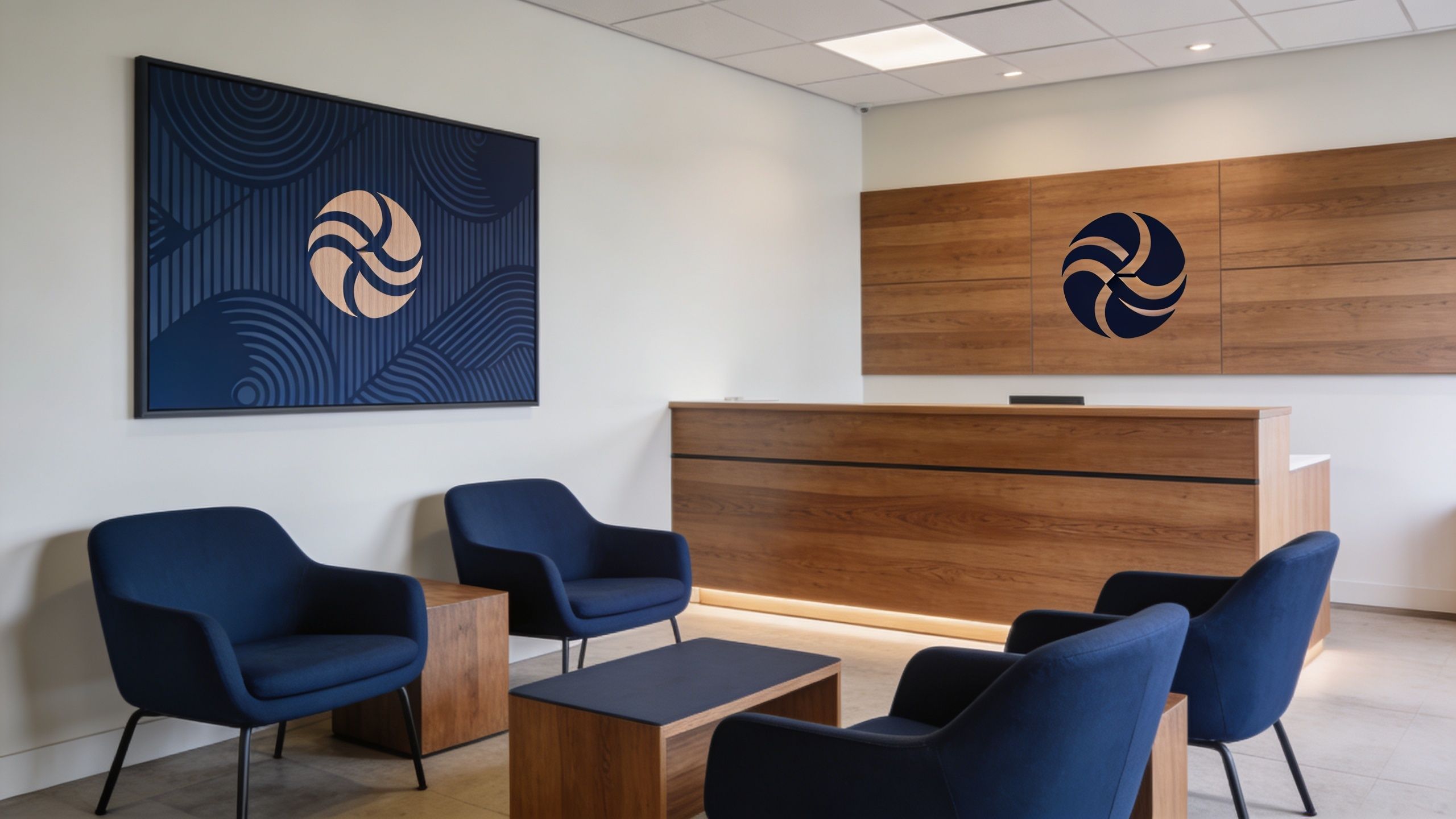
A waiting room tells visitors what kind of business they’re entering before anyone speaks. Color, silhouette, finish, spacing, and reception-desk style all carry signals. Warm woods and fitted seating suggest stability. Minimal lines and modular forms suggest adaptability. Saturated accent colors can feel energetic in one business and distracting in another.
Let the brand guide the specification
A good brand fit doesn’t mean putting the logo colors on every chair. It means making choices that feel consistent with the company’s tone.
Use these cues carefully:
- Color: Accent color works best in controlled doses, usually on upholstery, pillows, or art rather than every major surface.
- Material: Wood feels warmer. Metal and glass feel sharper. Upholstery texture can make a room feel either formal or relaxed.
- Form: Boxy seating reads differently from curved lounge forms. Traditional exposed-leg chairs don’t send the same message as low modular pieces.
- Desk relationship: The waiting room and reception desk should look like they belong to the same office.
If the broader workplace is being planned at the same time, consistency matters beyond the front room. For example, teams often want the visual language of the reception area to carry into workstation cubicles and adjacent work areas rather than feeling like a separate design project.
Use total cost of ownership, not just purchase price
Many buying decisions improve by considering factors beyond initial cost. The least expensive chair on the quote isn’t automatically the least expensive chair over the life of the room. You have to account for how long it holds its shape, how often it needs repair, how hard it is to clean, and whether it will force a partial replacement that leaves the room looking mismatched.
Because there’s a clear data gap in published ROI metrics for waiting room furniture, the most reliable way to make the case internally is with a simple TCO worksheet based on your own conditions. Compare options using the same categories each time:
- Initial purchase cost
- Expected maintenance burden
- Likelihood of early cosmetic wear
- Replacement timing
- Impact of partial replacements on room consistency
That method works especially well when leadership wants a lower sticker price but facilities will own the consequences later.
Cheap seating often costs more when you count disruption, patchwork replacements, and the visual decline that starts long before the chair fully fails.
Budget discipline that actually helps
The strongest budget conversations are specific. Instead of asking whether a chair is “worth it,” ask what problem the higher-priced option solves. Does it clean faster? Hold shape better? Match the brand more accurately? Reduce replacement risk?
A few practical buying habits help:
- Standardize where possible: Too many unique pieces make future replacements harder.
- Spend where wear is concentrated: Entrance-adjacent and most-used seats need stronger specifications.
- Avoid overfurnishing: Extra pieces increase cost and often hurt flow.
- Quote whole-room cohesion: A waiting room should be priced as a system, not as disconnected items.
For teams building that business case, an office furniture buying guide can help frame procurement questions more clearly.
One practical route is working with a dealer that can coordinate reception seating with the rest of the workspace. Cubicle By Design, for example, provides modular planning tools and office furniture coordination that can be useful when the waiting room is part of a larger office reconfiguration rather than a standalone furniture order.
Your Waiting Room Furniture Specification Checklist
A waiting room project gets easier when you turn preferences into specifications. Vendors quote more accurately, facilities can compare options more cleanly, and internal stakeholders stop debating vague ideas like “modern” or “comfortable.”
Space and capacity
Start with the facts of the room itself.
- Room dimensions: Include usable floor area, not just wall-to-wall measurement.
- Entry and exit points: Note door swings, sidelights, and adjacent circulation.
- Peak waiting volume: Define actual busy-period demand.
- Reception relationship: Mark sightlines and check-in orientation.
Furniture list and room function
Write down the actual furniture categories required.
- Primary seating type: Guest chair, beam seating, bench, lounge, or modular.
- Secondary seating type: If needed for flexibility or a different visitor profile.
- Tables and accessories: Only include pieces that support use without blocking movement.
- Technology needs: Power access, charging surfaces, or integrated lighting if relevant.
Materials and construction
Projects protect long-term value.
- Upholstery type: Based on cleaning routine and appearance goals.
- Frame construction: Specify commercial-grade expectations.
- Finish requirements: Choose materials that match traffic and maintenance conditions.
- Weight-capacity mix: Include any stronger-capacity seating the room should contain.
Accessibility and visitor comfort
A well-specified waiting room serves more people well.
- Accessible clearances: Allow for easy movement and approach.
- Supportive seating mix: Include options with arms and easier egress.
- Inclusive seating variety: Don’t make every seat identical if your visitors aren’t.
- Placement logic: Put the easiest-access seats where they are simplest to reach.
Style and procurement notes
End with the visual and buying details.
- Desired look: Modern, traditional, transitional, healthcare, hospitality-inspired, or another clear style direction.
- Color palette: Define primary neutrals and any accent colors.
- Replacement strategy: Ask how easily individual pieces can be reordered later.
- Installation scope: Clarify delivery, assembly, placement, and punch-list expectations.
If your waiting room project connects to larger workplace planning, it helps to review adjacent furniture systems too. You can browse broader office configurations through cubicle collections when the front room is part of a wider office update.
Frequently Asked Questions About Waiting Room Furniture
Should a waiting room include power and charging access
If visitors regularly arrive with phones, tablets, or laptops, yes. Power access is most useful in longer-wait environments, executive reception areas, and offices where guests may complete forms or work while they wait. The cleanest approach is usually a table or integrated surface solution rather than loose floor cords.
Is modular seating worth it for a growing office
It can be, especially if the room may serve multiple functions over time or if the business is still refining traffic patterns. Modular seating earns its keep when you expect change. If the layout is fixed and visitor patterns are stable, simpler standalone pieces may be easier to maintain.
The same thinking applies elsewhere in the workplace. Teams considering adaptable enclosed spaces often look at private office cubicles when they want flexibility beyond the reception area.
How many furniture styles should be mixed in one waiting room
Usually fewer than people think. One primary seating family, one secondary element, and restrained accessory choices create a cleaner result than mixing many unrelated shapes and finishes. Too much variety often makes the room feel like leftovers from other projects.
What’s the easiest waiting room upholstery to maintain
In heavy-use settings, non-porous surfaces are usually easier to wipe down consistently. In lower-intensity corporate settings, commercial-grade fabric can still perform well if the cleaning plan is realistic. The right choice depends on how the room is used and who will maintain it.
What’s the most common planning mistake
Buying furniture before confirming the layout. Teams often fall in love with a chair or sofa, then discover it blocks circulation, reduces seat count, or creates a maintenance problem. Space planning should lead. Product selection should follow.
If you’re planning a reception update, expanding into a new office, or trying to make the waiting room fit a larger workplace redesign, Cubicle By Design is one place to review modular office furniture options, layout tools, and front-of-house planning resources before you finalize your specification.