
8 Smart Small Office Layout Ideas to Maximize Your Space | Cubicle By Design

In today's dynamic work environment, a small office footprint doesn't have to mean small potential. The right layout can transform a compact space into a hub of productivity, collaboration, and employee well-being. But with limited square footage, every decision counts, and generic solutions often lead to cramped quarters, high noise levels, and frustrated teams. This guide moves beyond the obvious, offering eight distinct, actionable small office layout ideas tailored to different work styles and business goals.

Whether you're supporting a hybrid team, fostering deep focus, or encouraging agile collaboration, the key is intentional design. A well-planned space, like those we create at Cubicle By Design, isn't just about fitting in desks; it's about building a foundation for success. We'll explore how modular systems like our cubicles, strategic zoning, and flexible furniture can help you unlock your office's true potential. To fully maximize your small office, exploring essential office renovation tips can also help boost functionality and efficiency from the start.

This article provides the practical details you need, from space dimensions and pros and cons to furniture suggestions and implementation checklists. We will cover a range of options, from agile sprint setups and quiet focus zones to hybrid models that blend private office cubicles with open-plan areas. Let's dive into the layouts that can make your compact workspace work smarter for you.

1. The Dynamic Hub: Open Plan with Activity-Based Working (ABW)

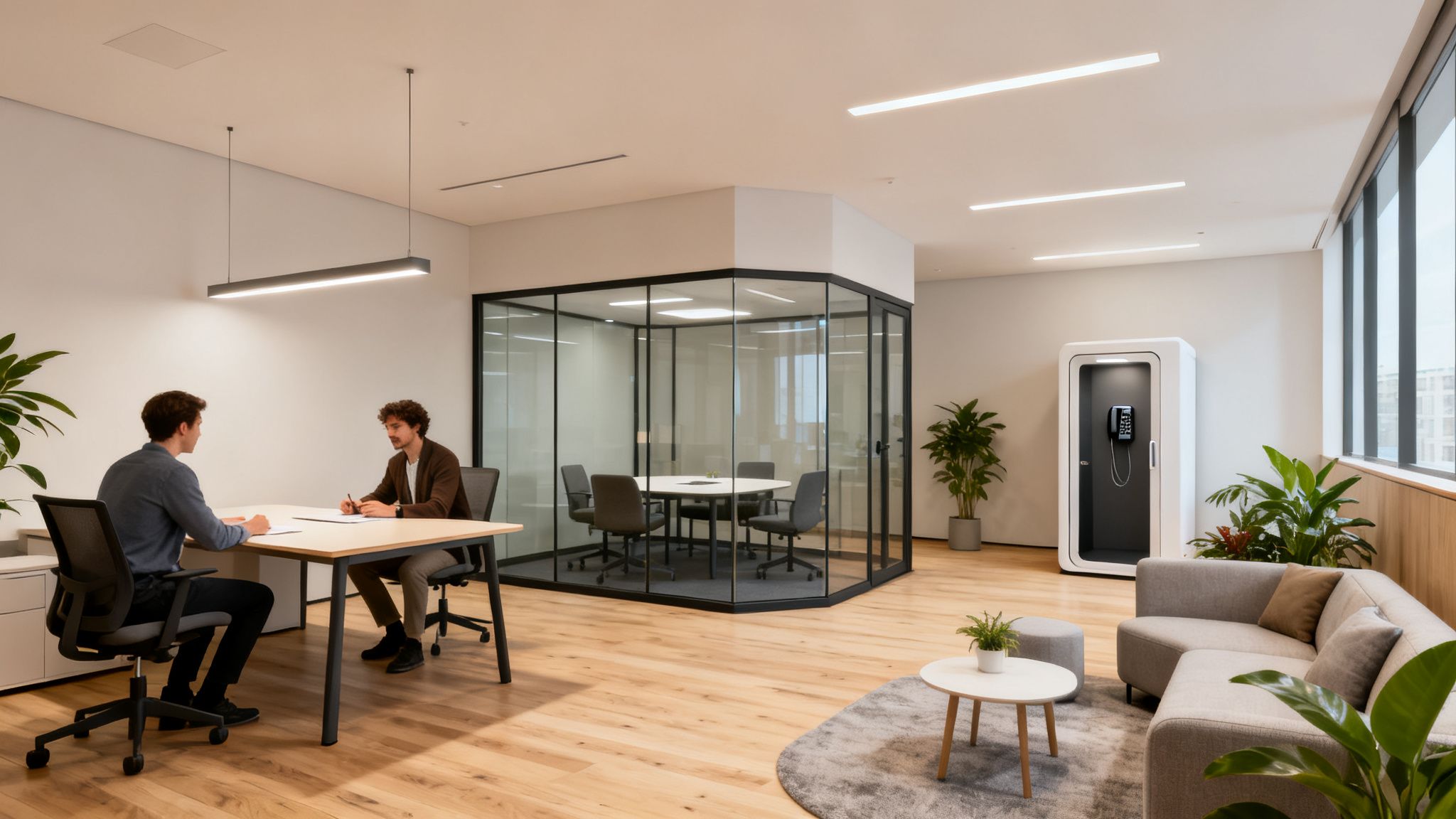
Forget the traditional sea of identical desks. Activity-Based Working (ABW) transforms a small open office into a versatile, high-functioning ecosystem. This approach creates distinct zones tailored to different tasks, such as shared collaborative tables, quiet focus nooks, casual lounge areas, and private phone booths. Instead of being assigned to a single spot, employees choose the environment that best supports their work at any given moment.

A modern small office layout idea featuring an open-plan design with designated zones for collaboration and focused work.

This fluidity is one of the most effective small office layout ideas because it maximizes every square foot and supports modern hybrid work models. The office becomes a destination for specific activities like brainstorming or client meetings, not just a daily requirement. Major companies like Google and Microsoft have successfully implemented ABW principles to boost innovation and employee satisfaction.

How to Implement an ABW Layout

  • Zone Definition: Survey your team to understand their work patterns. Use this data to create a balanced mix of zones, aiming for a 60/40 ratio of open-to-enclosed spaces.
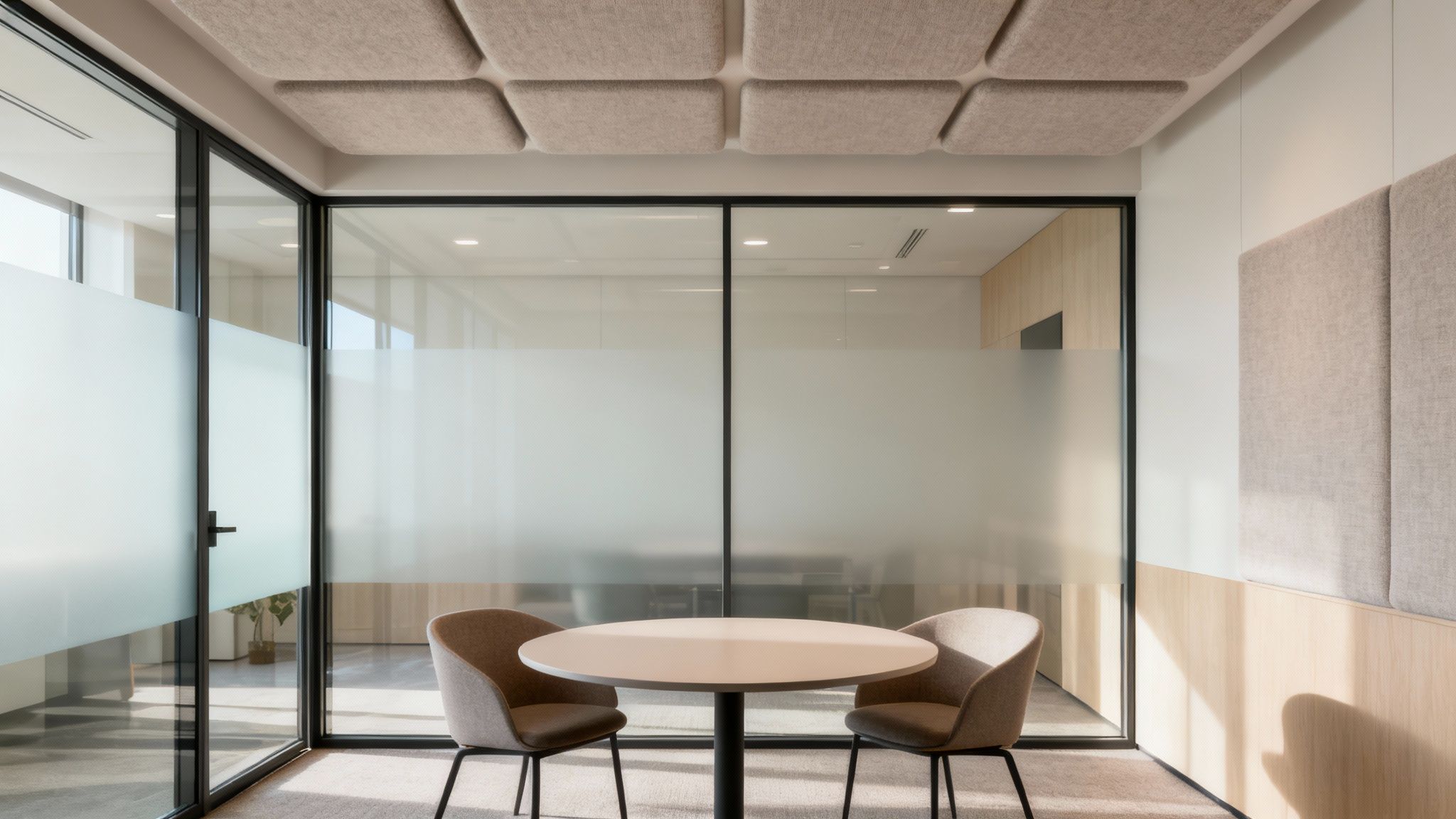
  • Acoustic Management: Invest in quality acoustic panels and glass partitions to minimize noise transfer between zones. To create semi-private focus areas without sacrificing natural light, consider using modular glass walls.
  • Flexible Infrastructure: Ensure power outlets and data ports are widely available throughout the space to allow employees to work from anywhere.
  • Clear Wayfinding: Use clear signage, color-coded zones, and a digital booking system to help staff easily navigate the space and find available work areas.
  • Furniture Selection: Choose adaptable furniture like movable whiteboards, modular seating, and height-adjustable desks. Consider adding a few of our private office cubicles to serve as dedicated focus pods.

ABW is a strategic layout that fosters autonomy and empowers teams to work smarter. By giving employees control over their environment, you can enhance productivity, collaboration, and overall job satisfaction. For a deeper look at how this compares to traditional setups, you can explore the differences between an open office vs. a cubicle environment.

2. Modular Cubicle Layout with Privacy Panels

The modern cubicle offers a structured, cost-effective solution that brilliantly balances individual focus with team accessibility. This approach uses modular systems arranged in pods or grid patterns, featuring adjustable privacy panels to create a dedicated workspace for each employee. Unlike the monolithic cubicle farms of the past, today’s systems provide personalization, acoustic control, and a clear organizational framework perfect for small offices.

This setup is one of the most practical small office layout ideas for roles requiring deep concentration, such as in accounting, legal, and IT departments. The defined personal space minimizes distractions and allows for customization, which can significantly boost productivity and employee morale. Companies like Steelcase and Herman Miller pioneered these systems, making them a staple in Fortune 500 back-office operations and government agencies.

How to Implement a Modular Cubicle Layout

  • Customize Panel Heights by Role: Use taller panels (around 67 inches) for roles handling sensitive information, such as HR or finance. Opt for lower panels (42–48 inches) for collaborative teams to maintain an open feel while still providing a defined personal area.
  • Integrate Infrastructure: Plan for electrical and data needs from the start. Modern workstation cubicles often include built-in power solutions, ensuring a clean, cable-free setup that supports future tech upgrades.
  • Maximize Limited Desk Space: In a compact cubicle, every inch counts. Install monitor arms to lift screens off the desk surface and invest in high-quality ergonomic seating to support employee comfort and well-being.
  • Visualize Before You Buy: Use our free Cubicle Designer to map out your layout. This helps you optimize traffic flow and ensure the configuration fits your space perfectly before you purchase.
  • Balance with Collaborative Zones: Combine cubicle pods with small, centrally located touchdown tables. This encourages team members to step away from their desks for quick meetings or brainstorming sessions without disrupting others.

Modular cubicles provide a reliable and scalable framework for any small office. They offer a sense of ownership and privacy that is often lost in fully open plans. To further enhance this, you can explore the benefits of adding privacy screens for cubicles to boost acoustic and visual separation.

3. The Collaborative Hub: Bench Seating & Shared Tables

Popularized by the tech industry and fast-paced startups, the bench seating layout replaces individual desks with long, shared tables. This highly efficient model places team members side-by-side, creating an energetic and collaborative environment perfect for teams that thrive on constant communication and real-time problem-solving. It’s a design that strips away physical barriers to foster a strong sense of community and shared purpose.

This setup is one of the most cost-effective small office layout ideas because it maximizes headcount per square foot. It’s ideal for functions like software development, creative agencies, and newsrooms where rapid iteration and teamwork are paramount. Major innovators like Apple and Facebook utilized this approach in their early stages to fuel a culture of open innovation and agility.

How to Implement a Bench Seating Layout

  • Balance Openness with Privacy: While the core is open, you must provide alternatives. Designate small, quiet zones or install a few private phone booths for confidential calls and deep-focus work.
  • Prioritize Ergonomics: Employees will spend their entire day at these tables, so invest in high-quality ergonomic chairs and individual task lighting. Monitor arms are essential for reducing desk clutter and allowing for flexible screen positioning.
  • Provide Personal Storage: Since personal desk space is limited, provide secure lockers or personal cubbies where employees can store valuables, bags, and other belongings.
  • Establish Clear Etiquette: Create and communicate clear policies for shared workspace cleanliness, noise levels, and personal item placement to prevent clutter and minimize friction between colleagues.
  • Offer Posture Variety: Consider integrating standing-height tables or café-style seating areas nearby to encourage employees to change their posture and move throughout the day.

Bench seating excels at creating a dynamic, unified team atmosphere. To ensure it works for everyone, it must be supported by accessible quiet spaces. You can easily supplement this layout with our versatile workstation cubicles to create the necessary balance between collaboration and concentration.

4. Hybrid Cubicle and Open Space Mix

For the office that needs the best of both worlds, a hybrid layout blends the focused privacy of cubicles with the dynamic energy of open collaborative zones. This balanced approach creates defined “neighborhoods” where small teams have dedicated individual workstations alongside shared resources like tables, lounge areas, or meeting pods. It directly addresses the needs of a diverse workforce, supporting deep concentration and spontaneous teamwork in equal measure.

This model is one of the most practical small office layout ideas because it offers structure without sacrificing flexibility. Companies like IBM and Microsoft have adopted similar neighborhood-based principles to support evolving hybrid work demands. The layout empowers teams by giving them a home base for both individual tasks and group projects, making the office a highly functional and adaptable environment.

How to Implement a Hybrid Layout

  • Create Neighborhoods: Arrange clusters of 4-6 cubicles around a central collaborative hub, such as a 48-60 inch round table. This gives teams a dedicated space for quick touchpoints and brainstorming sessions.
  • Vary Panel Heights: Use higher panels for roles requiring intense concentration and lower panels for team members who collaborate frequently, fostering both privacy and interaction.
  • Define Boundaries Smartly: Use modular glass walls to separate neighborhoods. This provides visual and acoustic separation while allowing natural light to flow through the entire office.
  • Provide Meeting Space: Aim to include one 8-10 person meeting room or a few smaller pods per neighborhood to support team meetings and private client calls.
  • Maximize Personal Space: Equip each cubicle with task lighting and monitor arms to free up desk surface area and improve ergonomics in compact spaces. Our workstation cubicles are designed to maximize efficiency in these setups.

A hybrid layout acknowledges that no single work style fits all. By providing a mix of environments, you can boost productivity and cater to the diverse needs of your employees. You can explore how office trends boost employee productivity to see how this model fits into the modern workplace.

5. Quiet Focus / NoiseControl Zone Layout

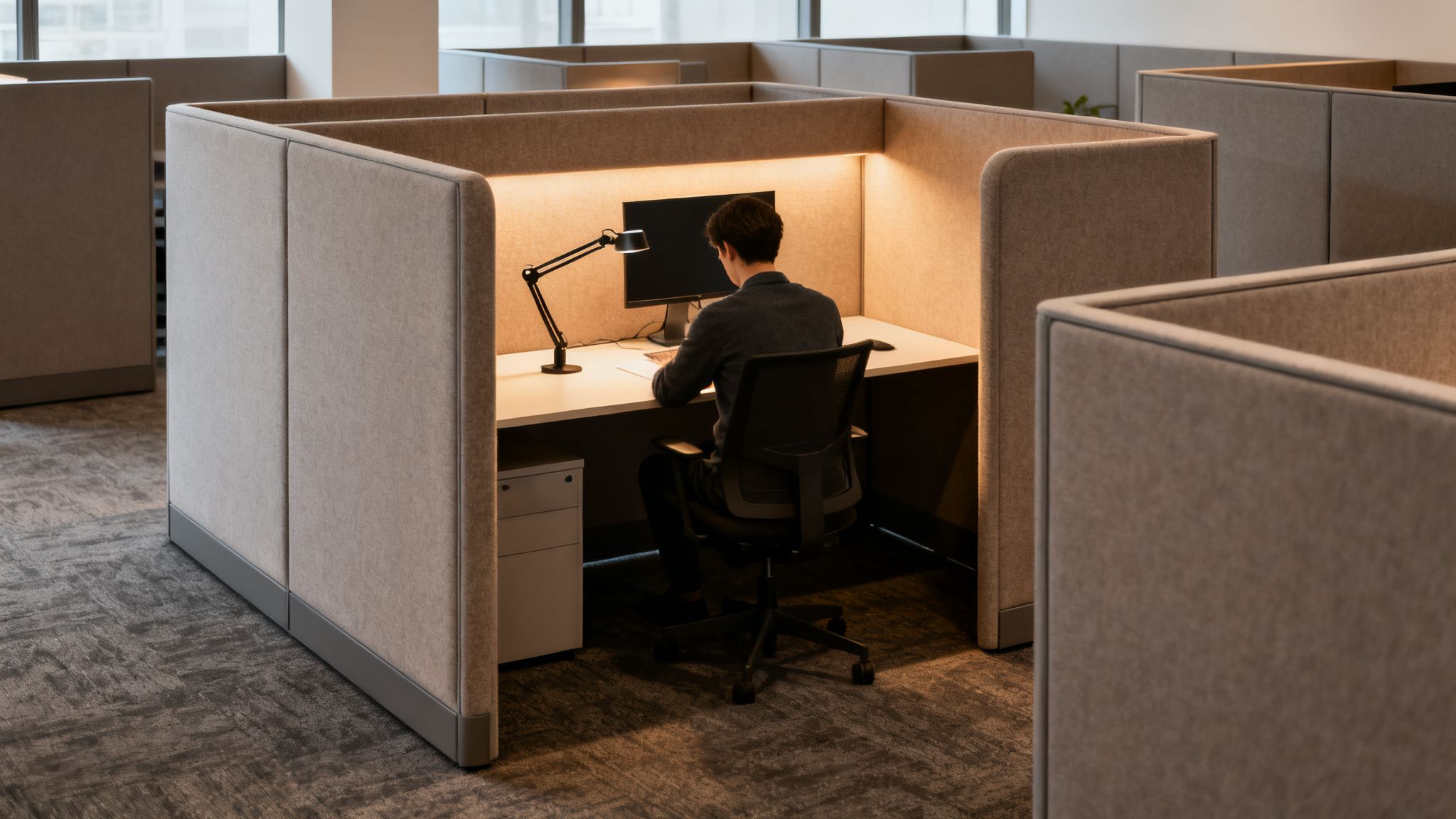
In an era dominated by open-plan collaboration, the value of deep, uninterrupted work is often overlooked. A Quiet Focus or NoiseControl Zone layout directly addresses this by creating a sanctuary for tasks demanding concentration, such as coding, writing, or financial analysis. This approach carves out dedicated areas shielded from the noise and foot traffic of the main office, using acoustic isolation and individual workstations to minimize distractions.

A person works at a computer in a modern, private office cubicle with warm lighting.

This intentional separation is one of the most crucial small office layout ideas for teams with diverse roles. It acknowledges that not all work is collaborative and provides the necessary environment for high-stakes, focused output. This concept, championed by figures like Susan Cain and implemented by tech giants like Google, recognizes that providing quiet spaces directly correlates with enhanced productivity and reduced employee stress.

How to Implement a Quiet Focus Zone

  • Acoustic Cubicles: Utilize cubicles with high panels, such as our Series 7 models at their maximum 67-inch height, made from acoustic-rated materials to absorb sound. This creates a strong first line of defense against office chatter.
  • Sound Dampening: Install acoustic ceiling tiles and carpeting to absorb ambient noise and reduce sound reverberation from hard surfaces. White noise machines can also be used to mask disruptive external sounds effectively.
  • Strategic Placement: Position the quiet zone away from high-traffic areas like kitchens, entrances, and main collaborative spaces. Establish clear entry and exit paths to prevent people from cutting through the zone.
  • Visual Boundaries: Use clear signage to designate the area as a quiet zone. For a more modern and less isolating feel, you can learn more about how office glass partition walls can create visual separation while containing sound.
  • Establish Protocols: Set clear guidelines for the space, such as prohibiting phone calls and conversations. Consider a booking system or rotating access schedule if dedicated quiet desks are limited, ensuring everyone gets a chance for focused time.

By creating a dedicated area for concentration, you empower employees to perform their best work without interruption. This layout is a powerful way to support neurodiversity and varied work styles within a single, cohesive office environment.

6. Agile / Scrum Sprint Layout

Designed for high-speed, collaborative teams, the Agile / Scrum Sprint Layout turns a small office into a high-visibility project command center. This layout organizes the space into co-located team pods, each with dedicated areas for daily stand-ups and large visual management walls for Kanban boards or burndown charts. The focus is on minimizing physical barriers to foster rapid communication and complete transparency of the team’s workflow.

This model is one of the most effective small office layout ideas for tech, product development, and creative teams because it physically reinforces agile ceremonies like sprint planning and retrospectives. The environment itself becomes a tool for productivity. Tech giants like Atlassian and teams within Amazon have famously used this pod-based structure to accelerate development cycles and enhance team cohesion.

How to Implement an Agile / Scrum Layout

  • Create Team Pods: Group teams of 6–10 members into defined zones. Use open-plan desks or low-height workstation cubicles (42–48 inch panels) to maintain sightlines while creating a sense of team identity.
  • Dedicate Collaboration Space: Allocate 15–20% of each pod’s area for daily stand-ups and impromptu meetings. This can be an open space marked on the floor or a small cluster of mobile tables.
  • Install Visual Walls: Dedicate at least one large wall per pod for physical or digital Kanban boards. Large mobile whiteboards are a flexible alternative that can be reconfigured for different sprint activities.
  • Prioritize Flexible Furniture: Use modular furniture like rolling tables, stackable chairs, and movable whiteboards to quickly adapt the space for sprint planning, reviews, or retrospectives.
  • Provide Quiet Zones: While collaboration is key, deep focus is essential for sprint execution. Ensure there is at least one nearby quiet area or a private focus pod for every team to use for complex tasks.
  • Support Hybrid Teams: Equip pods with large monitors and quality video conferencing equipment to seamlessly integrate remote team members into daily stand-ups and planning sessions.

The Agile Sprint Layout is a purpose-built environment that empowers teams to self-organize and communicate fluidly. By aligning the physical space with the team’s workflow, you can significantly boost project velocity and innovation.

7. Assigned Individual Offices / Private Office Layout

The traditional private office layout dedicates an enclosed, individual space to each employee or a small team. This approach prioritizes privacy, minimizes distractions, and provides a clear sense of personal territory. While more space-intensive than open concepts, it remains one of the most effective small office layout ideas for professions where confidentiality, deep concentration, and frequent one-on-one meetings are paramount.

This layout is a cornerstone in industries like law, finance, and healthcare, where sensitive information is handled daily. The acoustic and visual separation allows for focused work and private client consultations without interruption, establishing a professional and secure atmosphere. It supports roles that demand uninterrupted cognitive effort, such as those in research, human resources, or executive leadership.

How to Implement a Private Office Layout

  • Strategic Allocation: Reserve fully enclosed offices for roles requiring absolute client confidentiality or handling sensitive HR and financial data. For other staff, consider semi-private spaces using partial walls to maintain a degree of privacy without complete isolation.
  • Balance Privacy and Light: Incorporate glass partition walls and doors to maintain visual connectivity and allow natural light to flow through the office. This prevents a feeling of confinement while still offering acoustic separation.
  • Optimize Space: To maximize floor space outside of the offices, centralize shared resources like printers, supply closets, and break areas. Designate a shared conference room for larger team meetings rather than equipping each office for group work.
  • Smart Furnishings: Ensure each office has adequate storage, such as filing cabinets and shelving, to keep work surfaces clear and organized. Integrated cable management systems are crucial for maintaining a tidy and functional tech setup.
  • Consider Hybrid Solutions: For a modern take, you can blend private offices with open workstations. For example, a cubicle office with a door provides a lockable, private space within a more modular and cost-effective footprint than traditional construction.

By carefully planning the allocation and design of individual offices, you can create a highly functional environment that supports focused work and reinforces a professional image. This layout is ideal for teams that value autonomy, privacy, and a quiet, controlled workspace.

8. Touchdown / Hot-Desking Layout with Remote Support

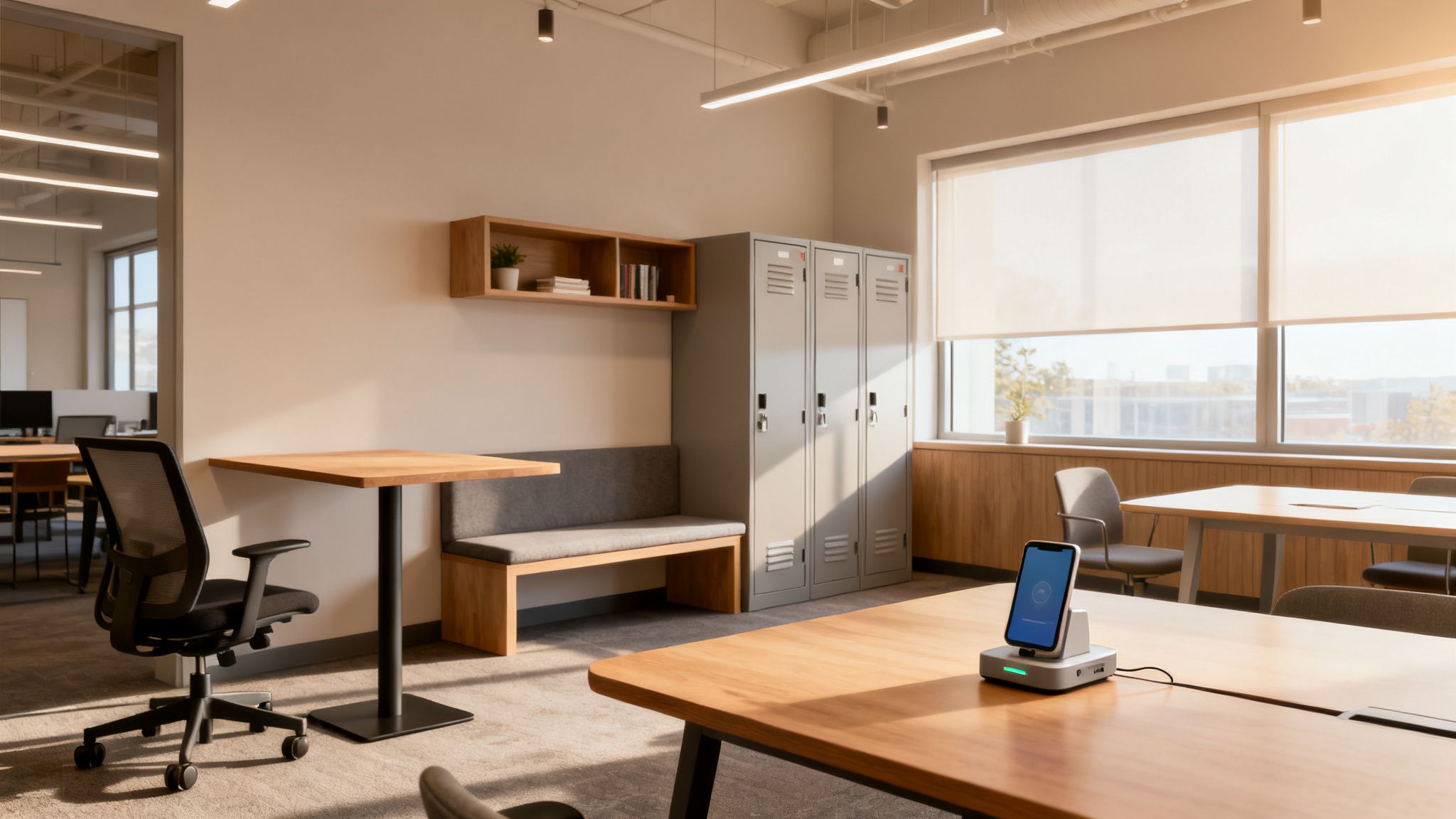
Embrace the ultimate in flexibility by transforming your small office into a dynamic hub for a mobile workforce. The touchdown, or hot-desking, layout eliminates assigned seating. Instead, remote employees, field staff, and hybrid team members use available desks on a first-come, first-served or reserved basis when they come into the office. This model is one of the most efficient small office layout ideas for companies with a remote-first or hybrid culture.

A modern hot-desking office with unassigned desks, ergonomic chairs, personal lockers, and charging stations.

The office transitions from a daily requirement to a destination for intentional collaboration, client meetings, and focused individual work. This approach is famously used by remote-first pioneers like GitLab and Automattic, as well as major consulting firms, to maximize real estate and support modern work styles. It significantly reduces the need for a 1:1 desk-to-employee ratio, freeing up space and budget.

How to Implement a Touchdown/Hot-Desking Layout

  • Provide Sufficient Space: Plan to have enough touchdown stations to accommodate 70-80% of your remote workforce on peak in-office days. This ensures everyone who comes in has a place to work comfortably.
  • Invest in Universal Tech: Equip desks with universal docking stations, ample power outlets, and high-speed Wi-Fi to ensure a seamless plug-and-play experience for every user. For truly agile hubs, consider integrating modern Wi-Fi VoIP phones to free desks from cables and allow employees to work from anywhere in the office.
  • Offer Personal Storage: Since desks are unassigned, install secure lockers or cubbies where employees can store personal belongings and work equipment overnight.
  • Use a Booking System: Implement a digital desk reservation system to manage high-traffic days and allow employees to book a desk, meeting room, or private pod in advance.
  • Create Diverse Work Zones: Supplement standard desks with a variety of work environments. Include lounge areas for casual work, collaboration tables for team projects, and a few of our workstation cubicles to serve as quiet focus areas.

A hot-desking layout is a forward-thinking solution that optimizes space while empowering a flexible workforce. By providing a well-equipped and inviting hub, you encourage meaningful in-person connection and support the autonomy your modern team needs.

8 Small Office Layouts: Side-by-Side Comparison

Layout Implementation Complexity 🔄 Resource Requirements ⚡ Expected Outcomes 📊 Ideal Use Cases 💡 Key Advantage ⭐
Open Plan Layout with Activity-Based Working (ABW) Medium–High — requires change management and zoning Moderate–High — varied furniture, acoustic treatments, power/data Flexible space use, increased collaboration, reduced real estate cost; noise risk Startups, hybrid-first companies, innovation teams ⭐ High flexibility and space efficiency; fosters spontaneous collaboration
Modular Cubicle Layout with Privacy Panels Low–Medium — modular install and straightforward reconfiguration Moderate — cubicle systems, panels, integrated cabling Strong focus and acoustic isolation; clear ownership Call centers, legal, finance, enterprise back-office ⭐ Proven privacy and productivity with scalable reconfiguration
Bench Seating / Shared Table Layout Low — simple furniture layout, minimal partitioning Low — long tables, seating; limited personal storage Maximum collaboration and space efficiency; low privacy Small startups, creative agencies, flat engineering teams ⭐ Maximizes team cohesion and cost-effectiveness
Hybrid Cubicle and Open Space Mix High — careful neighborhood planning and zoning High — mix of cubicles, pods, acoustic solutions Balanced privacy and collaboration; adaptable to hybrid models Mid-sized firms, professional services, mixed work styles ⭐ Best balance between focused work and teamwork
Quiet Focus / NoiseControl Zone Layout Medium — requires zoning, protocols, enforcement High — acoustic-rated panels, enclosed pods, specialized materials Significantly improved deep-work quality and reduced errors Engineering, data science, research, neurodiverse staff ⭐ Maximizes concentration and output quality
Agile / Scrum Sprint Layout Medium — pod clustering and visual-management setup Moderate — mobile furniture, large boards, AV for remote Faster decisions, improved team velocity, visible workflows Agile software teams, product development squads ⭐ Optimizes Agile ceremonies and rapid iteration
Assigned Individual Offices / Private Office Layout Medium — partitioning/fit-out, HVAC and electrical planning Very High — per-seat square footage, doors, furniture, construction Maximum privacy and professionalism; highest per-seat cost Executives, legal, HR, confidential client work ⭐ Best for confidentiality, focus, and client-facing roles
Touchdown / Hot-Desking Layout with Remote Support Medium — booking systems, wayfinding, policy rollout Moderate — lockers, docking stations, robust IT/booking tools High space utilization and flexibility; risk of dissatisfaction without rules Remote-first orgs, consultants, field teams, startups ⭐ Maximizes real estate efficiency for hybrid and mobile workforces

Design Your Perfect Workspace Today

The journey to an optimized small office is not about finding more square footage; it's about making every square foot work smarter. Throughout this guide, we've explored a diverse range of small office layout ideas, from the collaborative energy of an Open Plan with Activity-Based Working to the focused sanctuary of a Quiet Zone. We've seen how modular cubicles can offer unparalleled flexibility, how Agile layouts can supercharge project sprints, and how a Hybrid model can provide the best of both worlds for a dynamic workforce.

The central lesson is clear: the most effective layout is a direct reflection of your team's unique needs, culture, and daily workflow. There is no universal "best" design, only the one that is best for your organization. A startup prioritizing rapid collaboration might thrive with a Bench Seating arrangement, while a law firm requiring confidentiality would benefit immensely from partitioned, private office cubicles. The power lies in moving beyond generic templates and strategically aligning your physical space with your business objectives.

Key Takeaways for Your Office Transformation

As you move forward, keep these core principles at the forefront of your planning process:

  • Function Over Form: A beautiful office that hinders productivity is a failed design. Prioritize layouts that directly support your team’s primary tasks, whether that’s deep concentration, team brainstorming, or client-facing meetings.
  • Flexibility is Future-Proof: The modern workplace is in constant flux. Opt for adaptable furniture and modular systems, such as versatile workstation cubicles, that can be reconfigured as your team grows or its needs evolve.
  • Empower Your People: The best small office layout ideas provide choice. Incorporating a mix of spaces like focus pods, collaboration nooks, and touchdown stations empowers employees to select the environment best suited for their immediate task, boosting both satisfaction and output.
  • Plan for Technology: A successful layout seamlessly integrates technology. Ensure you have adequate power access, strong Wi-Fi coverage, and dedicated areas for video conferencing to support both in-office and remote team members.

Your office is more than just a place to work; it's the physical embodiment of your company's culture and a critical tool for achieving your goals. By thoughtfully selecting and implementing the right layout, you're not just arranging furniture, you are architecting an environment for success. The right design can break down communication barriers, foster innovation, and send a powerful message to your team that their well-being and productivity are valued.


Ready to turn these ideas into reality? The expert team at Cubicle By Design specializes in transforming compact spaces into powerful, productive work environments. Explore our extensive collection of cubicles or bring your vision to life with our free Custom Cubicle Designer tool today.
Read More

A Guide to Glass Cubicle Walls for Modern Offices | Cubicle by Design

Glass cubicle walls are exactly what they sound like: semi-permanent partitions made from glass panels, often set within sleek metal frames. They’re a brilliant way to carve out individual offices or team zones within a larger, open-plan space.

Think of them as the perfect middle ground. You get the privacy and quiet needed to focus, but you don't lose the natural light and visual connection that makes an office feel alive. It's truly the best of both open and private office worlds. At Cubicle by Design, we help businesses achieve this perfect balance.

The Big Shift to Brighter, More Open Workspaces

For years, the typical office was a sea of high-walled, fabric-covered cubicles. While they were decent at blocking out noise, they also created dim, isolating little boxes that killed any chance of collaboration and left much of the office feeling dark and disconnected.

Thankfully, we're seeing a major shift away from that old-school model. The push is toward workspaces that feel brighter and more energetic.

It’s all about finding the right balance. Companies want to build a sense of community and make teamwork easy, but a completely open floor plan often backfires with constant noise and interruptions that tank productivity. This is precisely where glass cubicle walls come in as an elegant fix, creating defined work areas without putting up visual barriers.

Letting the Light and Connection In

Modern office design is all about employee well-being and productivity, and nothing contributes more to that than natural light. Swapping out solid, traditional walls for transparent or frosted glass can completely change the feel of your workplace.

  • Flooding the Space with Natural Light: Glass partitions let sunlight travel deep into the office, cutting down on the need for harsh artificial lighting and creating a much more pleasant place to work.
  • Building Visual Connection: Employees can see their colleagues, which helps build a sense of team unity and transparency without forcing them into constant, distracting conversations.
  • Creating a Modern, Dynamic Vibe: The clear, reflective quality of glass instantly makes a space feel bigger, more modern, and more energetic than old-school drywall or fabric.

This isn't just about aesthetics; it's a smart business move. The global market for glass partition walls was valued at an impressive USD 13,500.75 million and is expected to skyrocket to USD 26,500.40 million by 2032. That kind of growth sends a clear message: businesses are all-in on creating flexible, light-filled offices.

We're at the forefront of this movement, helping businesses build inspiring workplaces with versatile cubicle systems that incorporate glass beautifully. By understanding the latest workplace design trends, companies can create offices that not only look fantastic but also support a healthier, more collaborative, and more productive team. It’s a single design choice that has the power to redefine your entire office culture.

Choosing Your Style: Framed vs Frameless Glass Walls

When you’re planning glass cubicle walls, one of the first big calls is choosing between framed and frameless systems. That choice goes beyond looks—it shapes acoustics, workflow, and the overall vibe of your space.

Think of it like picking windows for your home. A framed window brings structure and crisp lines, while a frameless picture window erases barriers between inside and out. Understanding these nuances helps you design an office that works just as beautifully as it looks.

The Classic Structure Of Framed Glass Walls

Framed glass wall systems wrap each panel in a sturdy aluminum or steel frame. That frame isn’t just decoration—it boosts structural stability and tightens up sound control.

For areas where privacy and focus are non-negotiable, framed walls shine. They seal each glass panel, cutting through office chatter and blocking noise transfer.

Consider where framed systems excel:

  • Private Offices: Executives and managers get a quiet zone for strategy sessions.
  • Conference Rooms: Every word stays inside, free from hallway intrusions.
  • HR Or Legal Departments: Confidential talks and document reviews remain under wraps.

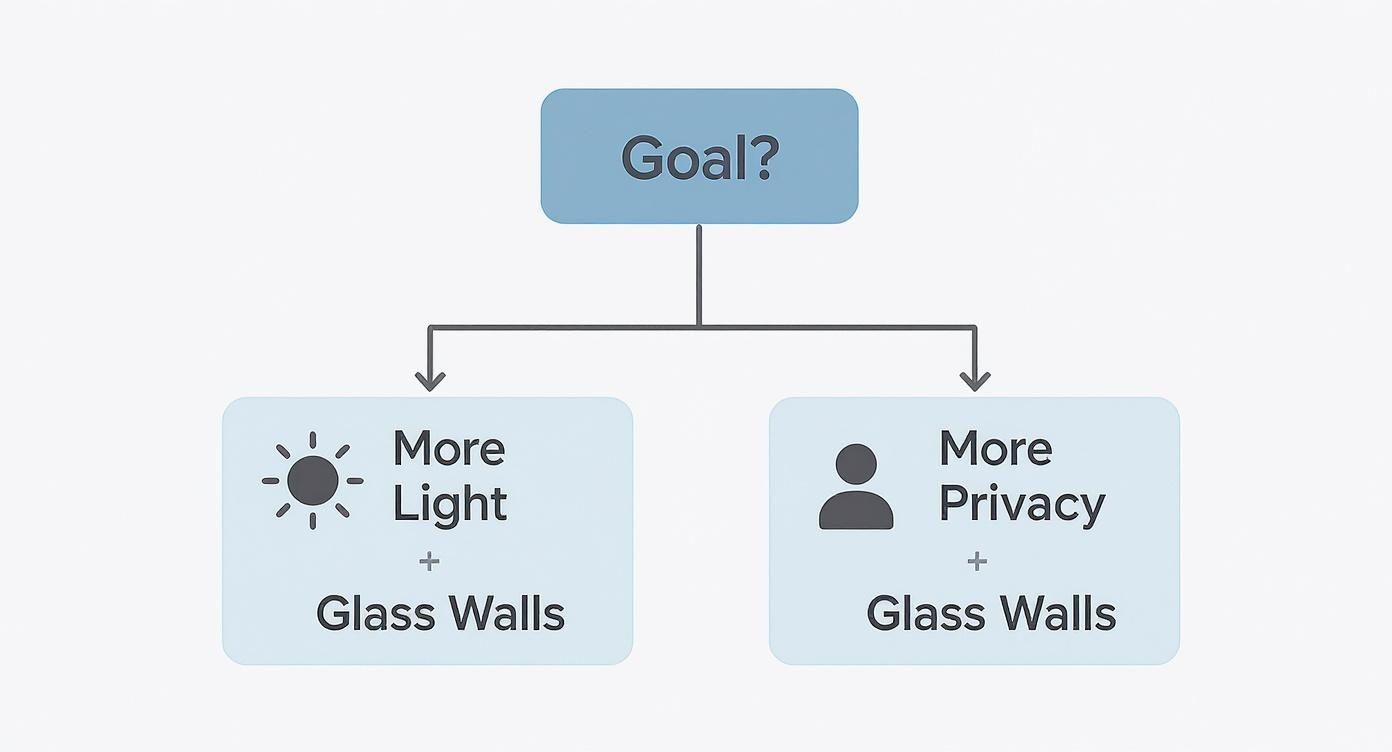
This decision tree visualizes the choice between clinging to old, isolating cubicles and embracing a balanced, light-filled environment.

The Seamless Appeal Of Frameless Glass Walls

Frameless glass wall systems rely on minimal hardware—just discreet clips or slender channels at the top and bottom. The result is an almost invisible barrier that lets natural light flood uninterrupted.

It’s like an infinity pool for your office: unbroken glass panes blur edges, making the space feel airy and expansive.

By stripping away vertical and horizontal lines, frameless glass walls foster a culture of openness and collaboration among team members.

This style is a favorite in creative agencies and tech startups chasing a minimalist vibe. They won’t match framed walls for acoustic insulation, but they excel at carving out zones without erecting visual walls.

For details on specific options, explore our glass wall systems for offices.

Comparing Framed And Frameless Glass Wall Systems

Here’s a quick rundown to spot the differences at a glance.

Feature Framed Glass Walls Frameless Glass Walls
Sound Control Excellent acoustic separation Moderate noise dampening
Visual Impact Defined lines and structure Seamless, transparent sightlines
Hardware Heavy-duty frames around each panel Minimal clips or channels
Installation Speed Standard timeline; moderate installation effort Faster install; fewer components
Maintenance Frames may need regular cleaning and upkeep Easier wipes, but glass edges require care
Aesthetic Style Professional, structured look Modern, minimalist design

Use this comparison to match features with your workspace priorities—whether you’re after soundproof privacy or a gallery-like openness.

Your final choice boils down to balancing acoustic needs with visual flair. Framed walls bring robust sound control and a polished structure. Frameless walls deliver boundless light and an airy, modern feel.

Unlocking the Real-World Benefits of Glass Partitions

Sure, they look fantastic, but glass cubicle walls deliver some powerful, practical advantages that can genuinely change your company's culture and even its bottom line. Moving past pure aesthetics, these systems bring tangible benefits that reshape how your team works, feels, and collaborates. Let's break down the three core advantages that make them such a smart long-term investment.

First, bringing in more natural light does more than just brighten a room—it creates a healthier, more cost-effective environment. Second, the visual link between teams helps build a culture of transparency and approachability. And finally, their modular nature gives you incredible flexibility for future growth.

Maximize Natural Light and Well-Being

One of the first things you'll notice after installing glass cubicle walls is the dramatic increase in natural light. Traditional high-walled cubicles have a bad habit of creating dark, isolated pockets that lean heavily on artificial lighting. That kind of environment can lead to eye strain, headaches, and that general afternoon sluggishness we all know.

Glass partitions act like a conduit, letting sunlight pour deep into the office. Studies have actually shown that employees with access to natural light report a 63% reduction in headaches and a 56% drop in drowsiness. This isn't just a minor perk; it's a direct boost to your team's well-being and their ability to stay focused all day.

This simple change has a financial upside, too. By cutting down on the need for constant overhead lighting, businesses can see a real drop in their energy bills. It’s a win-win that lifts employee morale and helps your operational budget.

Foster a Culture of Visual Connection

While completely open offices can be a recipe for constant distraction, old-school cubicles often create silos that make it hard for teams to connect. Glass cubicle walls hit that perfect sweet spot, encouraging a visual connection without taking away personal workspace. This transparency is a huge step toward building a more open and collaborative company culture.

When employees can actually see their colleagues, it sparks more of that spontaneous, impromptu collaboration. It also makes managers seem much more approachable. This subtle shift can break down hierarchical barriers and speed up communication, since a quick question is often just a glance away.

This sense of shared space—without the shared noise—is key. It tells your team that collaboration is valued, but it also respects their need for focused, individual work time, a critical factor for maintaining high productivity. You can explore how different layouts impact team dynamics and learn more about achieving office cubicle privacy without total isolation.

Embrace Long-Term Flexibility and Value

Maybe the most underrated benefit of glass cubicle walls is just how adaptable they are. A traditional drywall build-out is permanent and a pain to change. When your company grows or your teams restructure, you're often stuck with a layout that just doesn't work anymore, staring down the barrel of a disruptive and expensive renovation.

Modular glass partitions, on the other hand, are designed for change. They can be easily demounted, moved, and reconfigured to create new offices, expand team pods, or adapt to new workflows with almost no disruption. This built-in flexibility saves you from future construction headaches and costs.

This adaptability is a major reason why over 70% of modern commercial buildings now integrate glass partitions. The global market is booming, expected to hit USD 36.81 billion by 2033, driven by businesses looking for smart, scalable solutions. This makes glass walls not just a design choice, but a strategic investment in your company's future.

Tailoring Your Space With Custom Glass Walls

Your office shouldn’t feel like a rigid box—and your partitions shouldn’t either. Glass cubicle walls invite you to treat each panel as a chance to weave your brand story into the very fabric of your workspace.

It goes beyond choosing a height or color. You’re making strategic design decisions that impact how people work and interact. Need a hush-hush corner for private calls? Or an open enclave for brainstorming? Customization makes it happen.

Choosing The Right Glass For Form And Function

Glass choices shape both mood and utility. They dictate how much light floods in, how much privacy you enjoy, and even how people move through the space. Here’s a quick look at the most popular options:

  • Clear Glass: Floods the room with daylight and fosters an open vibe—ideal for team areas where communication matters.
  • Frosted Glass: Blurs outlines but keeps spaces bright. Perfect for HR offices, executive suites, or any spot where discretion is key.
  • Tinted Glass: Comes in warm bronze or cool gray tones. Cuts glare and offers soft privacy without sealing you off entirely.
  • Banded or Patterned Glass: Add horizontal frosted bands or custom vinyl logos. It’s a smart way to guide sightlines and reinforce branding.

Mixing clear and frosted panels isn’t just decorative. It’s a way to channel focus, guard confidential discussions, and choreograph a visual rhythm across your floor plan.

Aligning Finishes With Your Brand Identity

Once you’ve picked the glass, the frame finish becomes your accent color. It can blend in or boldly punctuate the design. These finishes often tie into furniture, door frames, or company colors for a cohesive look:

  • Satin Anodized Aluminum: A classic silver that feels clean and professional.
  • Powder-Coated Black: Sharp, modern lines that command attention.
  • Powder-Coated White: Brightens the room and enhances a minimalist aesthetic.

When these frames echo your existing palette, the result feels intentional. For more on harmonizing small details with big-picture design, check out our guide on creating personalized workspaces with custom cubicles.

Integrating Power And Data For A Clean Look

Tech power is at the heart of every workstation—but tangled cords can wreck a pristine design. The solution? Raceways built right into the base of your glass wall frames. They tuck away power and data cables, delivering outlets exactly where you need them.

This discreet wiring system:

  • Cuts down on extension cords and messy power strips
  • Removes trip hazards and visual clutter
  • Makes each desk a plug-and-play zone for every employee

To see how these components come together, try the interactive Custom Cubicle Designer. Experiment with layouts, finishes, and glass styles until your vision aligns with reality—before you ever place an order.

Planning Your Glass Wall Installation Project

Bringing your vision for a bright, modern office to life is an exciting process, but it all hinges on a solid, practical plan. Making the switch to glass cubicle walls is worlds easier than traditional construction, but it still demands careful coordination to get you from concept to final walkthrough without a hitch. Getting a handle on these key stages demystifies the whole thing and helps you sidestep common headaches.

The journey starts with professional space planning, where we translate your ideas into a layout that actually works. This is about more than just drawing lines on a blueprint; it’s about making sure the workflow makes sense, everything is up to code, and every square foot pulls its weight. From there, we nail down the logistics, pick out materials, and schedule an installation that doesn’t bring your business to a screeching halt. This is where partnering with a full-service expert really pays off.

Mapping Out The Project Timeline

A clear timeline is everything for managing expectations and keeping the project on track. The installation for glass cubicle walls breaks down into a few distinct phases, each with its own checklist. Think of it as a roadmap that takes you from our initial chat to the finished space.

A structured approach makes sure no detail gets missed:

  1. Initial Consultation and Space Planning: We’ll sit down with you to understand your goals, take detailed measurements of your space, and sketch out a layout that gets the balance between looks and function just right.
  2. Design Finalization and Material Selection: This is the fun part. You’ll choose your glass types, frame finishes, and any cool integrations like power and data. Once you sign off, we’re ready for production.
  3. Production and Lead Time: Your custom glass wall components are manufactured to the exact specs from the design phase. Lead times can vary, so planning ahead is always a good idea.
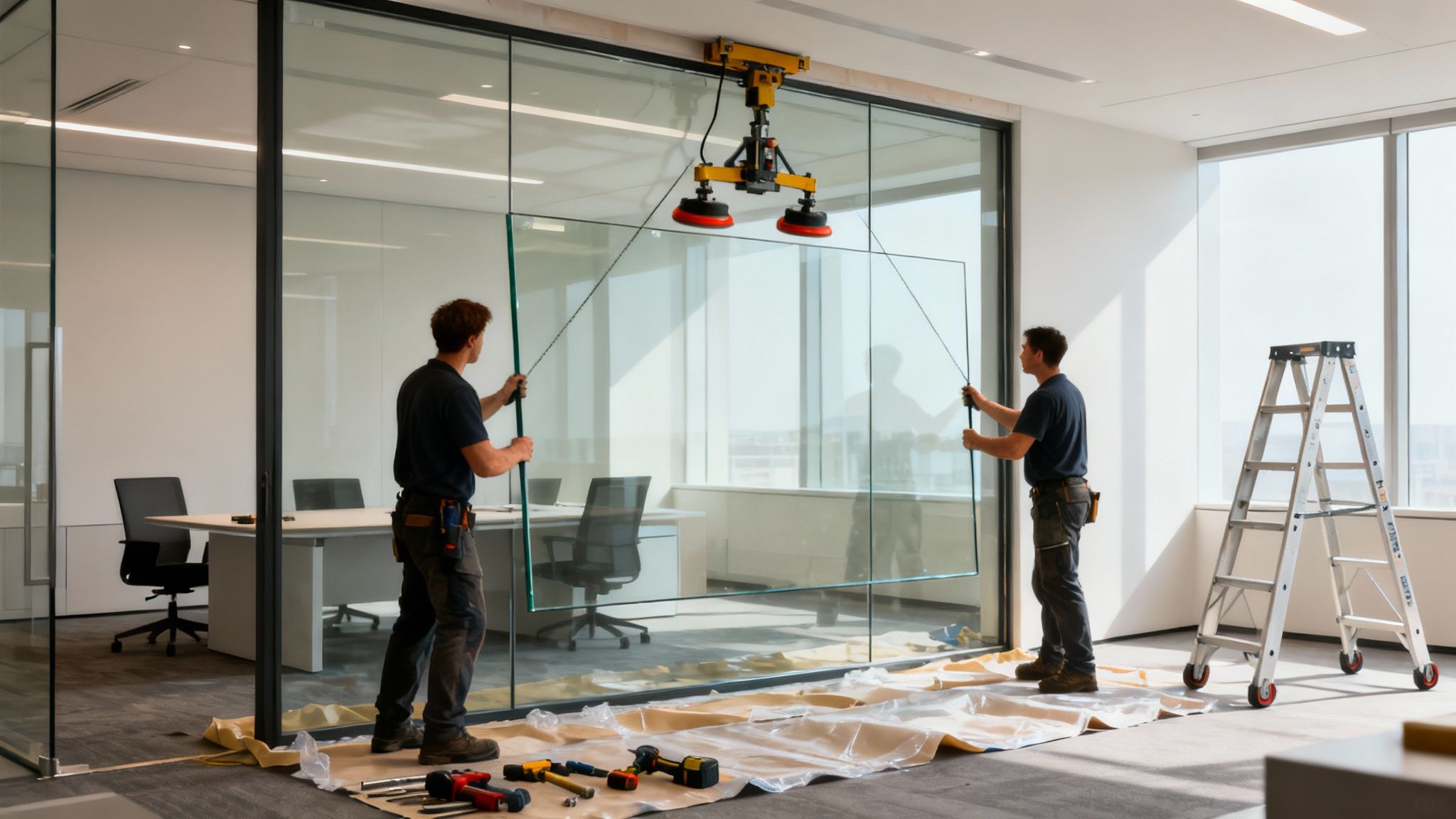
  4. Site Preparation and Installation: Our installation crew preps the site and puts the system together. You’ll be amazed at how quickly it happens, with far less noise and dust than putting up drywall.
  5. Final Walkthrough and Approval: We’ll walk through the finished space with you, making sure every last component is installed perfectly and looks exactly how you envisioned it.

Navigating Building Codes and Logistics

One of the most critical—and often overlooked—parts of any office renovation is sticking to local building codes. These rules cover everything from fire safety and clear emergency exits to electrical wiring and structural stability. It can feel like a maze of regulations, but it’s a non-negotiable step to ensure your workspace is safe and legal.

An experienced partner handles all these details for you, making sure your new glass cubicle walls meet every standard. This means verifying that all glass is properly tempered for safety and that the new layout doesn’t block sprinkler systems or fire escape routes. For getting precise material and labor estimates, pros often use specialized glazing takeoff software to keep the project plan accurate from the start.

By getting a handle on the practicalities of code compliance and installation logistics upfront, you can avoid costly delays and rework down the line. A proactive approach is the hallmark of a well-managed project.

The industry as a whole is moving in this direction. The glass partition wall market, which includes these cubicle walls, ballooned from roughly USD 2,650 million globally in 2019 to USD 6.99 billion after the pandemic. Projections show it hitting USD 9.27 billion by 2030. This boom is fueled by businesses that need flexible, code-compliant solutions for the modern workplace.

To see how a professional team handles every step from start to finish, you can read more about our complete office furniture installation services.

Real-World Applications Where Glass Cubicles Excel

It’s one thing to talk about features, but to really get a feel for the impact of glass cubicle walls, you need to see how they solve everyday challenges in a real office. These systems are so much more than simple dividers; they're a powerful tool for shaping workflow, guiding company culture, and getting the most out of your floor plan.

Let’s walk through a few practical scenarios to get the ideas flowing for your own space.

From sophisticated executive suites to high-energy team pods, the beauty of glass is its adaptability. You can fine-tune each area for its specific purpose, boosting productivity and making the office a place people genuinely want to be.

The Connected Executive Office

Picture a leadership row built with full-height, framed glass walls. This approach creates impressive private office cubicles that feel both professional and approachable. The executives get the quiet they need for sensitive calls or deep strategic thinking, but the glass keeps them visually connected to their teams.

This simple design choice subtly reinforces an open-door policy, tearing down the walls of the intimidating corner office. It makes leaders feel like part of the daily pulse of the company, not separated from it.

The Collaborative Team Hub

Now, let's think about a marketing or creative department. These teams run on quick conversations and spontaneous brainstorming. Instead of sticking them in isolating cubicles or a loud, messy open floor, you can use half-height glass partitions to give them their own zone.

These lower walls carve out a team "neighborhood" without killing the open, airy vibe. People can easily talk over the glass and share screens, but they still have a defined personal space. It’s the perfect setup for agile teams who need to switch between individual tasks and group huddles on a dime.

By defining collaborative zones with glass, you give teams a home base that encourages interaction while minimizing disruptions to neighboring departments. This balanced approach is key to a productive open-plan environment.

The High-Focus Work Zone

Of course, not every department thrives on constant interaction. Your finance, legal, or HR teams handle confidential information and need serious concentration. For these groups, full-height glass cubicle walls with frosted or banded glazing are the answer.

Here’s how this setup nails the "heads-down" work environment:

  • Acoustic Separation: A well-sealed framed system dramatically cuts down on chatter and background noise, letting employees focus on complex work.
  • Visual Privacy: Frosted glass keeps sensitive documents or on-screen data private from anyone walking by. Crucially, it does this without blocking light, so the space never feels dark or claustrophobic.
  • Defined Boundaries: It sends a clear signal that this is a quiet zone, naturally discouraging interruptions.

These examples just scratch the surface. They show how glass walls can be tailored to any workflow, creating specialized environments that help every team perform at its best. Whether you're designing individual workstation cubicles or planning entire departments, the right glass system delivers both function and style.

Frequently Asked Questions About Glass Cubicle Walls

Switching over to glass cubicle walls is a big move in office design, so it's only natural to have a few questions. We get a lot of inquiries about these modern partitions, so we've put together some straightforward answers to help you feel confident about your decision.

Are Glass Walls Good For Soundproofing And Privacy?

You'd be surprised. While everyone loves glass cubicle walls for the visual openness they bring, today's systems are actually engineered with acoustics as a top priority. Framed systems, in particular, do a fantastic job of creating seals that really dampen the typical office chatter.

If you need even more sound control, you can always opt for thicker or laminated acoustic glass. And for privacy? Options like frosted, tinted, or even custom-banded glass give you that visual separation without killing the natural light. This makes them a perfect fit for meeting rooms, HR offices, or anywhere confidentiality is key.

How Durable And Safe Are Glass Office Walls?

In any office, safety and durability are non-negotiable. Our glass partitions are built using commercial-grade tempered or laminated safety glass, which is a solid four to five times stronger than the standard stuff. Tempered glass is designed so that if it ever does break, it crumbles into small, dull pieces, drastically cutting down the risk of injury. For those curious about the specifics, there are great guides on the different types of safety glass that break down the technical details.

The aluminum frames are just as tough, engineered for stability in a high-traffic workplace. Once they're professionally installed, these systems are incredibly sturdy and ready to handle the daily grind of a busy office.

What Is The Cost Compared To Traditional Drywall?

Looking at the initial price tag, glass cubicle walls can seem like a bigger investment than traditional drywall. But that's not the whole story—you have to look at the total cost of ownership. Over the long haul, glass walls deliver a much stronger return.

Because they are modular and demountable, glass partitions can be reconfigured as your business grows. This adaptability saves you from expensive and disruptive demolition and construction projects in the future.

On top of that, glass walls are often classified as furniture, which can open up some potential tax advantages. When you factor in the energy savings from all that natural light and the positive bump in employee productivity, glass partitions often end up being the smarter financial choice over time. Think of it as an investment in your company's future flexibility.


Ready to design a brighter, more flexible workplace? The team at Cubicle by Design can help you plan the perfect layout with our versatile glass wall systems. Explore your options at https://cubiclebydesign.com/ and start building your ideal office today.

Read More

Finding the Best Ergonomic Office Chairs for Your Team with Cubicle By Design

When you start searching for the best ergonomic office chairs, you’ll quickly notice one thing that sets the great ones apart: adjustability. It's no accident that brands like Herman Miller, Steelcase, and Haworth consistently top the charts. Their chairs are engineered to adapt to the human body, not force the body to adapt to the chair.

This guide is all about helping you make a smart, long-term investment in your team’s well-being and, by extension, their productivity. At Cubicle By Design, we believe the right chair is the foundation of a productive workspace.

Why Ergonomic Chairs Are a Smart Business Investment

It’s time to stop thinking of office chairs as just another furniture purchase and start seeing them for what they are: a critical business decision. It's easy to look at a chair and see only a place to sit, but if you frame it as an essential tool for focus and wellness, its real value becomes crystal clear.

A high-quality ergonomic chair isn't just an expense; it's a direct investment in your company's most valuable asset—your people. The hidden costs of poor posture from sitting in a non-supportive chair add up fast. Musculoskeletal problems are a major reason for missed workdays, and that cheap chair in the corner is often the main culprit.

Think about it: when someone is constantly fidgeting to get comfortable or trying to work through nagging back pain, their focus is shattered. Productivity tanks. The link between physical comfort and professional output is impossible to ignore.

The Financial Impact of Workplace Wellness

The numbers tell a compelling story. The global market for ergonomic chairs is projected to grow by USD 9.14 billion between 2025 and 2029. This isn't a trend; it's a fundamental shift in how smart businesses operate.

Companies that get it right and invest in proper ergonomics often report a 15% increase in productivity and a 20% drop in sick days. Beyond the hard numbers, providing a genuinely comfortable workspace is one of the most powerful ways to enhance employee experience. It sends a clear message: we value your health.

This kind of proactive thinking doesn't just boost morale; it delivers a tangible return by cutting down on absenteeism and health-related costs. For a deeper dive into the numbers, check out our guide on how good ergonomics can save you money.

A better workplace starts with the right foundation. By connecting the dots between your team's health and your company's bottom line, prioritizing high-quality seating becomes a non-negotiable strategy for sustainable success.

Ultimately, choosing the right seating is about building an environment where people can do their best work. Whether you’re outfitting a new set of workstation cubicles or upgrading your current setup, the chair is the centerpiece of individual performance. It’s an investment that pays for itself every single day.

What Really Makes an Ergonomic Chair Ergonomic?

What’s the real difference between a top-tier ergonomic chair and a standard one you might grab off a shelf? It’s not about flashy materials or a hefty price tag. The secret lies in dynamic, personalized adjustability. A genuinely ergonomic chair is a sophisticated piece of equipment designed to mold to an individual's body, giving support exactly where it's needed most.

Once you understand these features, you're making an informed investment. When you can see the purpose behind each lever and knob, you move from just buying a chair to choosing a tool that actively boosts your team's health and focus. Let’s break down the critical components that deliver real, tangible benefits.

The Foundation of Support: Lumbar and Back Adjustments

If there's one make-or-break feature, it's the lumbar support. Your lower spine has a natural inward curve, and keeping that curve supported is essential for preventing strain and chronic back pain. A chair with a flat back forces the spine into an unnatural slouch, which is a fast track to fatigue and discomfort.

A great ergonomic chair offers dynamic lumbar support. This isn't just a static pillow wedged in the back; it's an adjustable mechanism. You should be able to move it up and down, and sometimes in and out, to perfectly match the user's spinal curve. This customized fit ensures the lower back is always supported, taking pressure off the spinal discs and surrounding muscles. When you're testing chairs, the support should feel present but not pushy.

To help you zero in on what truly matters, here's a quick breakdown of the most critical ergonomic features and the direct impact they have on well-being and productivity.

Key Ergonomic Features and Their Impact on Wellness

Ergonomic Feature What It Does Primary Benefit
Dynamic Lumbar Support Adjusts vertically and (sometimes) horizontally to fit the user's lower back curve. Reduces lower back strain and prevents slouching, which is a major cause of spinal disc pressure.
Adjustable Seat Depth Allows the seat pan to slide forward or backward. Ensures proper thigh support and prevents pressure on the back of the knees, improving circulation.
4D Armrests Adjusts in height, width, depth, and pivot angle. Alleviates strain on the neck, shoulders, and upper back by supporting the arms during various tasks.
Synchro-Tilt Mechanism Reclines the backrest and seat at different ratios. Encourages gentle movement ("active sitting"), which improves circulation and reduces spinal pressure.

Ultimately, a chair that fits properly is a chair that gets out of the way, allowing your team to focus on their work without physical distraction.

Perfecting Your Position: Seat and Armrest Adjustability

Beyond the back, the seat itself is a major player in comfort and circulation. One of the most overlooked—but vital—features is adjustable seat depth. This lets you slide the seat pan forward or backward, ensuring there’s a small gap of about two to three fingers between the edge of the seat and the back of your knees.

Why does this tiny adjustment matter so much? If the seat is too deep, it can dig into the back of the knees and restrict blood flow. If it's too shallow, it doesn't support the thighs properly, putting extra strain on the lower back. A seat slider is non-negotiable if you have a diverse workforce. For more tips on setting up a workspace correctly, explore our guide on achieving proper posture in the office.

Armrests aren't just for resting your elbows, either. 4D armrests—which adjust up/down, forward/backward, side-to-side, and pivot in/out—are the gold standard for a reason.

  • Height Adjustment: Keeps elbows aligned with the desk, preventing shrugged shoulders.
  • Width Adjustment: Accommodates different body frames so arms can rest naturally.
  • Depth Adjustment: Lets users pull the armrests forward for typing or push them back to get closer to their desk.
  • Pivot Function: Angles the armrests inward to support forearms while using a keyboard.

When armrests are set correctly, they take a huge amount of strain off the neck, shoulders, and upper back, which are common tension spots for desk workers.

The goal of every adjustment is to minimize physical strain so that mental energy can be fully dedicated to the task at hand. A chair that fits perfectly allows the body to relax, freeing the mind to focus.

Promoting Movement: Tilt and Swivel Functions

Static posture is the enemy. The human body is built to move, and even the "perfect" posture becomes a problem if held for too long. That’s where tilt and swivel mechanisms come into play.

A good synchro-tilt mechanism is key. It allows the backrest and seat to recline at different, synchronized ratios, opening up the angle at your hips. This encourages tiny movements throughout the day, which helps with blood flow and reduces pressure on your spine. Combine that with a smooth swivel, and employees can reach different parts of their desk without twisting their back. These features promote what's called "active sitting," turning a chair into a dynamic tool instead of a static box.

Of course, the chair is just one piece of the ergonomic puzzle. Don't forget about complementary ergonomic accessories for your workspace, like monitor arms and keyboard trays, to create a fully supportive environment. Integrating all these elements is central to our holistic approach at Cubicle By Design, ensuring every part of your office cubicles contributes to wellness.

Matching the Right Chair to Your Team's Needs

A one-size-fits-all approach to office seating is a fast track to unhappy, distracted employees. Different roles have completely different physical demands, and the best ergonomic chairs are the ones that meet those specific needs head-on.

Think about it like this: you wouldn’t give a race car to a delivery driver. The same logic applies here. By matching the chair to the job, you create an environment where everyone is supported, comfortable, and ready to do their best work. Let's walk through a few common scenarios.

For the Dedicated Desk Worker

Picture an accountant, a software developer, or a graphic designer. These are the folks who spend the majority of their day—often eight hours or more—at their desk. Their work demands deep focus, and their chair is their most important tool for staying comfortable and locked in.

For this group, adjustability isn't a perk; it's a core requirement.

  • Priority Features: You absolutely need a full suite of ergonomic adjustments. Look for dynamic lumbar support, adjustable seat depth, 4D armrests, and a synchro-tilt mechanism.
  • Real-World Impact: A developer needs to get their armrests just right to support their arms while coding, which takes a ton of strain off their shoulders. An accountant can use a seat slider to keep proper leg circulation going during those long end-of-quarter sessions. These small tweaks make all the difference.

These roles are often perfect for more focused setups, like our purpose-built private office cubicles, where a highly adjustable chair can be perfectly dialed in and left that way.

This chart quickly shows how to connect common physical complaints to the specific features that will help.

As you can see, figuring out where it hurts is the first step to finding a chair with the right solution.

For the Agile Hot-Desker

Now, let’s shift gears to a hybrid office with hot-desking. A sales rep might pop in two days a week and grab any open spot. A project manager might bounce between a collaborative table and a quiet pod. These users need a chair that’s dead simple to adjust on the fly.

In a flexible workspace, a chair that takes ten minutes to figure out is a chair that won't be adjusted at all. Simplicity and intuitive design are paramount for shared seating.

A hot-desker's needs are all about speed and ease. They'll trade a dozen complex controls for a few that are fast and obvious.

  • Priority Features: Your best bets are chairs with straightforward, clearly marked levers for height and back tension. Auto-adjusting lumbar support can be a game-changer here. The goal is for someone to sit down and get 80% of their optimal posture in under 30 seconds.
  • Real-World Impact: When a chair is this easy to use, people will actually make the quick adjustments they need, even if they’re only sitting for an hour. This prevents all that cumulative strain that builds up from using poorly configured shared furniture.

For the High-Durability Call Center

Call centers are a whole different ballgame. Employees are often seated for long, continuous stretches, and the chairs themselves get used around the clock, sometimes across multiple shifts. Here, durability is just as crucial as ergonomics.

The chair for a call center agent has to be an absolute workhorse. It needs to stand up to constant use while providing rock-solid support that keeps people from fidgeting and losing focus during long calls.

  • Priority Features: Focus on high-density foam cushions that won’t flatten out in a few months, tough upholstery, and heavy-duty mechanisms. A solid warranty is non-negotiable. While you still need good adjustability, the components themselves must be built to last.
  • Real-World Impact: In a busy call center, a broken chair is a real operational headache. Investing in durable, high-quality seating cuts down on replacement costs and ensures agents stay comfortable and focused on the customer. Figuring out what your employees need to succeed starts with giving them reliable tools, and a solid chair is foundational.

Calculating the True Cost of Your Office Chairs

That initial price tag on a high-end ergonomic chair can make you pause. We get it. But that number is just one piece of a much larger puzzle. To make a smart investment that actually saves you money, you have to look past the upfront cost and think about the Total Cost of Ownership (TCO).

A cheap chair might feel like a win today, but it often becomes a nagging, recurring expense. We’ve seen it happen time and time again: the foam flattens, the gas lift gives out, or the armrests crack after just a couple of years. When that happens, you’re not just buying a replacement—you’re spending more time and money solving a problem that a quality chair would have prevented for a decade or more.

Beyond the Price Tag to Long-Term Value

The key is to shift your mindset from short-term cost to long-term value. A premium ergonomic chair isn't just an expense; it's a capital investment in your team's health, focus, and productivity.

This isn’t just a hunch—it’s a massive trend. The global ergonomic chair market was valued at around USD 10.22 billion in 2025 and is projected to hit USD 16.62 billion by 2032. Businesses are waking up to the real costs of poor seating, especially when you consider that over 1 million workers take time off annually for musculoskeletal issues. Investing in quality chairs can cut absenteeism by up to 20% and measurably boost concentration. You can dig into the growing ergonomic chair market trends to see the data for yourself.

It’s the same long-term thinking that should go into your entire office plan. A well-built chair saves money over time, and a thoughtfully designed workspace prevents you from having to do costly reconfigurations down the line.

Decoding Warranties and Durability

A chair's warranty is one of the most honest signals of its quality and how long the manufacturer expects it to last. But you have to read the fine print, because not all warranties are created equal.

A "Limited Lifetime" warranty sounds fantastic, but it often only covers the big metal parts like the frame. High-wear components like casters, fabric, and foam? Those are usually covered for a much shorter, separate period.

Here’s what we look for to gauge real-world durability:

  • Mechanism Warranty: The guts of the chair—the tilt, gas lift, and adjustment levers—are what take a beating every day. Look for at least a 5 to 10-year warranty on these parts. Anything less is a red flag.
  • Material Quality: Ask about the foam density and the "double rub" count for the fabric. A double rub count of 100,000 or more is considered commercial-grade and means the upholstery can withstand serious daily use without fraying or thinning.
  • Replacement Parts: This is a big one. Can you easily order a new set of wheels or arm pads five years from now? Good brands make replacement parts available. This simple thing can extend a chair’s life by years, keeping it out of a landfill over one broken part.

Thinking about the full lifecycle cost of your furniture is critical. For more on how these costs stack up across your entire office, our detailed cubicle price guide is a great resource. A strategic investment now saves you from major logistical and financial headaches later. By focusing on TCO, you ensure that your investment pays you back for years to come.

How to Test and Deploy New Chairs Effectively

Picking out the best ergonomic chairs for your team is a big win, but the job isn't over just yet. A smart rollout plan is what turns a great choice on paper into a real-world benefit for your employees. If you fumble the deployment, you can end up with disruption, frustration, and a very expensive investment that nobody likes.

The idea is to bridge the gap between theory and practice as smoothly as possible. This involves testing your top picks with actual employees, collecting feedback that you can actually use, and then managing the final purchase and installation without throwing a wrench in your company's daily operations.

Let's walk through a clear framework for getting this done right.

Running an Effective Pilot Program

Before you sign a purchase order for hundreds of chairs, you absolutely have to run a small-scale pilot program. This is where your research gets a reality check from direct user experience. A common mistake is only testing one model—don't do it. Shortlist two or three of your top contenders so you can compare them head-to-head.

Make sure your test group is as diverse as your actual workforce. Don't just grab a few people from the same department. Instead, pull together a cross-functional team that includes:

  • A mix of body types to see how well the chairs accommodate different heights, weights, and builds.
  • Employees in various roles, like a developer who's mostly stationary and a sales manager who's constantly getting up and moving around.
  • People with known comfort issues (like chronic back pain) along with those who don't. Their feedback is pure gold.

Let this group use the chairs for at least a full work week, though two is even better. First impressions are one thing, but what really matters is how the chair feels after sitting in it for eight hours a day.

Gathering Meaningful Feedback

Once the trial period is up, it's time to collect specific, structured feedback. A simple "Did you like it?" isn't going to give you what you need. Put together a short survey or conduct quick one-on-one interviews with pointed questions.

The best feedback comes from asking about specific situations. Instead of asking if a chair is 'comfortable,' ask, 'After that two-hour video call, how did your lower back feel?' This is how you get the detailed insights needed to make the right call.

Your feedback form should hit a few key areas:

  1. All-Day Comfort: How did they feel at 9 AM versus 5 PM?
  2. Ease of Adjustment: Were the controls intuitive? Could they find their sweet spot without hunting for a manual?
  3. Task-Specific Support: Did the chair support them well while typing? What about leaning back to take a phone call?
  4. Overall Preference: If they had to pick just one, which would it be and why?

This kind of targeted feedback almost always reveals a clear winner. It gives you the confidence to move forward with a big purchase, which is critical in a market where North America holds over 40% of global revenue. With 12.5 million ergonomic chair units sold in the region annually, companies clearly understand that good seating is good business. In fact, tackling poor ergonomics can boost productivity by 12-18%. You can explore the research on the North American ergonomic chair market to see just how significant this trend is.

Managing Large-Scale Procurement and Installation

Okay, you've made your final choice. Now, the logistics of a bulk order kick in. Clear, constant communication with your vendor is absolutely essential. You need to confirm lead times, delivery schedules, and the exact installation process right from the start to avoid any nasty surprises.

A massive delivery of office chairs can easily disrupt the entire office. If you can, schedule the installation for off-hours, like an evening or a weekend. Work with your facilities team to get old chairs moved out and the space prepped ahead of time. A well-managed installation means your team walks in on Monday morning to a refreshed, ready-to-use workspace, not a chaotic mess.

At Cubicle By Design, we know that a chair is just one piece of a much larger puzzle. That's why we offer support that goes way beyond just selling you furniture. Our team can help you plan the entire deployment, making sure your new chairs fit perfectly with your existing workstation cubicles and the overall flow of your office.

We can also take the entire installation process off your hands, removing that logistical headache. For a full look at how we manage these projects from start to finish, check out our guide on professional office furniture installation. This complete support ensures a seamless transition, letting your team start enjoying the benefits of their new ergonomic chairs from day one.

Common Questions About Ergonomic Office Chairs

Even after digging into all the features and planning, you've probably still got a few questions. That's completely natural. Investing in the right ergonomic chairs for your team is a big decision, and it’s smart to get clarity on the details before you commit.

Let's tackle some of the most common questions we hear from business owners and office managers. The goal here is to give you direct, practical answers to help you feel confident you're making the right call for your workplace.

What Actually Makes an Office Chair Ergonomic?

In a word: adjustability. A truly ergonomic chair isn't just about a comfy cushion or a high back. It’s about being able to fine-tune the chair to fit each person’s unique body shape and size. The whole point is to support a healthy, neutral posture and cut down on physical strain during the workday.

Forget about a simple up-and-down lever. True ergonomics comes from a combination of key adjustable features working together.

  • Adjustable Seat Height: This is the baseline. It lets you plant your feet flat on the floor with your knees at a 90-degree angle, which is ground zero for good posture.
  • Adjustable Seat Depth: This feature is often overlooked but it's critical. It allows you to slide the seat pan forward or back, leaving a small gap (about two to three fingers' width) behind your knees to improve circulation.
  • Dynamic Lumbar Support: This isn't just a static curve. A good lumbar support moves up and down (and sometimes in and out) to perfectly match the natural curve of your lower back.
  • 3D or 4D Armrests: These are game-changers. They adjust for height, width, depth, and pivot, properly supporting your arms and taking a massive load off your neck and shoulders.

When a chair has multiple, independent points of adjustment, it empowers each person to create a truly personalized fit. That's the real test of an ergonomic design.

How Long Should a Quality Ergonomic Chair Last?

A high-quality ergonomic office chair from a solid brand is a long-term investment. You should expect it to last anywhere from 7 to 15 years with daily use. The lifespan really comes down to the quality of the materials and the sturdiness of the build.

Cheaper, off-the-shelf chairs might seem like a deal, but they often only last a year or two before they lose their support and start to fail. Their total cost of ownership ends up being much higher in the long run.

A strong warranty tells you everything you need to know about a manufacturer's confidence in their product. Look for chairs with warranties of 10 years or more on the most important parts, like the mechanisms and casters. It’s a clear sign of durability and long-term value.

Is a Mesh Back Better Than a Cushioned Fabric Back?

This is a classic debate, and honestly, there's no single right answer. Both mesh and cushioned fabric have their own strengths, and the "better" choice really depends on your office climate, what your employees prefer, and even the type of work they do.

Offering both is often the smartest play. Here’s a quick breakdown:

Feature Mesh Back Chairs Cushioned Fabric Chairs
Breathability Top-notch. The open weave allows for constant airflow, which is a huge plus for keeping users cool. Good. Modern fabrics breathe well, but they will almost always retain more heat than mesh.
Support Flexible and form-fitting. It tends to conform to the user's back for a more responsive feel. Often provides a plusher, more uniform support that distributes pressure very evenly.
Durability High-end mesh is incredibly tough, but be warned: cheaper versions can sag over time. Depends on the fabric's "double rub" count. A commercial-grade fabric is built to last.
Maintenance Super easy. You can just wipe it down. Can be more prone to stains and might need a deeper clean every so often.

Because comfort is so subjective, we always recommend including both mesh and fabric chairs in your pilot program. It's the only way to get real feedback from your team on what works best for them day-to-day.

How Do Ergonomic Chairs Fit into a Modular Office Design?

Ergonomic chairs and modular office systems, like the ones we design at Cubicle By Design, are a perfect match. A modular layout is all about flexibility and efficiency, and an adjustable chair is the final piece of the puzzle, locking in individual comfort within a standardized workstation footprint.

It's crucial to think of the chair and the desk as a single, integrated unit. The chair's adjustability ensures every employee can find their sweet spot, whether they’re in one of our private office cubicles or a more collaborative workstation cubicle.

When you're planning your space, don't forget to account for the chair's full range of motion—its swivel and recline. You need to make sure there’s enough room for people to move freely without feeling boxed in. This holistic approach, which you can map out with our Custom Cubicle Designer, is what makes a workspace truly work for your team.


Ready to build a workplace that puts comfort, wellness, and productivity first? The team at Cubicle By Design can help you select the best ergonomic chairs and integrate them flawlessly into a workspace designed for your success.

Explore our full range of office solutions at https://cubiclebydesign.com/.

Read More

A Guide to Modular Office Wall Systems | Cubicle By Design

Imagine being able to redesign your office layout as easily as you move a desk. That’s the real magic behind a modular office wall. Don’t think of these systems as permanent walls, but more like a high-end, customizable kit of parts for your workspace. They’re like architectural LEGOs, giving you the power to adapt to hybrid work models, shifting team sizes, and whatever business challenges come next. At Cubicle By Design, we help businesses harness this flexibility.

A Smarter Way to Define Your Workspace

Traditional construction is a commitment. Once the drywall is up, the dust settles, and the paint dries, your floor plan is locked in. A modular office wall, on the other hand, is a much more dynamic and intelligent way to shape your space. It’s a system of pre-engineered, factory-built panels designed to be assembled, taken down, and reassembled with incredible speed.

This approach lets you create private offices, quiet pods for focused work, and open collaboration zones without the mess and permanence of conventional building. To get a better feel for this concept, you can learn more about what modular furniture is and how it’s completely changing the modern office.

From Concept to Reality

The true value of a modular office wall is its ability to evolve with you. When a team gets bigger or a new project demands a different kind of space, these walls can be quickly demounted and set up in a new configuration. The whole process is clean, fast, and, most importantly, protects your initial investment.

Instead of demolishing and rebuilding, you simply reconfigure. This strategic advantage is why so many businesses are turning to modular systems to future-proof their physical environments.

This isn’t just a niche trend; it’s part of a massive shift in how we build. The wider modular construction market was valued at around USD 103.6 billion in 2024 and is expected to rocket past USD 162 billion by 2030. This growth shows just how widely prefabricated building methods are being adopted.

For office interiors, this translates into huge time savings. Manufacturers report that installation can be 30–60% faster than building with traditional drywall. For you, that means your teams are in their new space and back to work weeks sooner than you’d expect.

Modular Walls vs Traditional Drywall

To really get it, you have to understand the core differences between the old way and the new. One is a permanent, one-and-done solution, while the other is a reusable, adaptable asset that keeps paying you back.

Here’s a quick breakdown of how they stack up.

Feature Modular Office Wall Traditional Drywall
Installation Speed Drastically faster. Can often be installed in just days with minimal mess. Slow and disruptive, involving multiple crews and a long, messy schedule.
Flexibility A true asset. Easily taken down and reconfigured as your needs change. Completely permanent. Any changes require messy demolition and rebuilding.
Cost & ROI Higher upfront material cost, but lower labor and a fantastic long-term ROI. Lower initial material cost, but high labor costs and zero reuse value.
Environmental Impact Very little waste. Panels are reusable and often made from recycled content. Creates a ton of construction waste (dust, debris) that ends up in landfills.

Ultimately, choosing a modular office wall is an investment in your company’s agility. It gives you the power to create a workspace that not only works for you today but is ready for whatever tomorrow brings.

Exploring Different Modular Wall Types

Picking the right modular office wall isn’t a one-size-fits-all kind of deal. It’s more about striking the right balance between looks, acoustics, and how your team actually works day-to-day. The real beauty of these systems is their sheer variety, letting you find something that clicks perfectly with your company’s culture and what you need to get done. Whether you’re aiming for total transparency or complete privacy, there’s a solution out there.

This decision goes way beyond just aesthetics. Each type of modular wall brings something different to the table in terms of sound control, how much light it lets through, and how easily you can change things up later. All of these factors directly shape how your teams focus, collaborate, and feel in their space.

Frameless and Framed Glass Walls

Glass partitions have become a go-to for modern offices trying to create a bright, open, and connected vibe. When you’re looking at your options, it’s worth checking out modern solutions like glass walls and doors that offer a great mix of flexibility and visual punch. They generally come in two main flavors, each with its own distinct personality.

Frameless glass walls are the ultimate in minimalist design. We’re talking large panes of tempered or laminated glass held in place at the top and bottom, giving you a nearly invisible barrier that lets natural light flood the space. This style is a fantastic choice for conference rooms or breakout areas where you want to keep that open feeling without letting conversations bleed out.

Framed glass walls, on the other hand, have a more structured, traditional look. That metal framing isn’t just for show; it adds a strong design element while also beefing up the wall’s sturdiness and acoustic performance. You’ll often see these used for private offices where a bit more sound dampening is a must. To really dive deep, you can explore the specifics of glass partition walls for offices and see how they can completely change a room.

Solid Panel Walls for Maximum Privacy

When focus and confidentiality are absolutely critical, solid panel walls are the answer. These systems are built from the ground up for superior sound blocking, making them the default choice for executive suites, HR departments, or any spot where conversations need to stay under wraps. They’re perfect for carving out quiet zones in an otherwise buzzing office.

Think of solid panels as the acoustic heavyweights of the modular world. Their construction is specifically designed to absorb and block sound waves, creating true sanctuaries for deep work.

These walls also come with a huge array of customization options to make sure they match your brand’s style. You can pick from finishes like:

  • Fabric-wrapped panels: These add a touch of warmth and texture, and they pull double-duty by absorbing even more sound.
  • Wood veneers: For a classic, sophisticated look that brings a natural element into the office.
  • Durable laminates: Available in just about any color or pattern you can imagine, offering a practical and stylish finish.
  • Writable surfaces: Turn any wall into a brainstorming powerhouse with whiteboard or magnetic capabilities.

This level of personalization means creating a private office cubicle doesn’t require you to compromise on style or your brand identity. You get complete acoustic privacy while keeping a professional, cohesive design.

Hybrid Systems: The Best of Both Worlds

Why force yourself to choose between transparency and privacy when you can have both? Hybrid systems are designed to seamlessly blend glass and solid panels into a single, cohesive wall. It’s a hugely popular approach because it strikes the perfect balance, letting light flow through the glass sections while giving you privacy and sound control exactly where you need it.

For instance, a hybrid wall might have a solid base for privacy and durability, with a glass panel on top to keep the space from feeling boxed in. This design is incredibly versatile and can be tweaked to fit the unique needs of different departments, creating an environment that’s both dynamic and highly functional.

What Are the Real Benefits of Modular Office Walls?

When you think about dividing a room, you might just picture a simple barrier. But a modern modular office wall does so much more. It’s a strategic tool that directly boosts your company’s flexibility, focus, and financial health. These aren’t just panels; they’re solutions designed to tackle the real challenges of today’s fast-moving workplaces.

The true value comes from how they perform across four key areas.

These benefits range from adaptability that future-proofs your investment to serious acoustic control that helps your team get real work done. Put them all together, and you get an office that’s not just more efficient, but healthier and more engaging for everyone.

Unmatched Flexibility and Scalability

Imagine you just landed a huge new client. You need to get a new project team of ten people up and running in a month. With traditional construction, that’s a nightmare of dust, delays, and high costs. But with a modular wall system? You can reconfigure an entire section of your office over a single weekend.

This incredible flexibility is the number one reason people choose modular. It allows your workspace to grow, shrink, and adapt right alongside your business.

  • Add private offices as your management team grows.
  • Create dedicated collaborative zones for new projects.
  • Downsize or reassign space with almost no disruption or cost.

This on-demand adaptability means your office layout is never set in stone. You can get ahead of change instead of just reacting to it. To see how this works in practice, you can explore the benefits of a modern office cubicle and how they share these modular principles.

Superior Acoustic Performance

An open office can look great, but we all know that constant noise is a productivity killer. A modular office wall is specifically engineered to control sound, creating quiet, private spaces where people can actually concentrate. This isn’t just about blocking noise; it’s about creating acoustic comfort.

“Facility managers love modular walls because a ‘renovation’ that used to take six weeks of dust, noise, and disruption can now be handled cleanly by a small team over a weekend. It transforms a capital-intensive construction project into a simple operational adjustment.”

High-quality systems use specialized seals, sound-rated core materials, and options like double-paned glass to achieve impressive Sound Transmission Class (STC) ratings. This kind of performance is absolutely essential for:

  • Executive Offices: Keeping confidential conversations private.
  • HR and Legal Departments: Protecting sensitive information.
  • Quiet Zones: Giving employees a true sanctuary for deep, focused work.

Enhanced Aesthetics and Natural Light

Forget the dull, drab partitions you might be picturing from the past. Today’s modular wall systems are built with style and elegance in mind. Glass partitions, especially, can completely transform a workspace by opening it up and letting natural light flow through the entire office.

This visual openness does more than just look good—it has a proven positive impact on employee morale and well-being. A bright, airy environment simply feels more energetic and welcoming, which helps build a better, more productive company culture.

Significant Cost and Time Savings

It’s true that the upfront material cost of a modular wall can sometimes be higher than drywall. But that’s not the whole story. The real savings come from slashing labor costs and dramatically speeding up your project timeline. Installation is fast, clean, and requires a much smaller crew.

Even better, modular walls are often considered tangible personal property. This can offer huge tax advantages through accelerated depreciation—something you can’t do with permanent drywall. And because the panels are 100% reusable, your initial investment holds its value. You can reconfigure them over and over, eliminating future demolition and construction costs and making them a much smarter long-term financial decision.

Customizing Your Space to Reflect Your Brand

A modular office wall is so much more than a simple barrier. Think of it as a blank canvas, just waiting for you to paint your company’s unique identity all over it. This is the point where your workspace stops being just a location and starts becoming a branded environment. The potential for customization is huge, letting you move way beyond generic layouts to create something that actually tells your story.

Every surface becomes an opportunity. By thoughtfully picking out materials and features, you can reinforce what your brand is all about, whether you’re going for a look that’s sophisticated, innovative, or all about collaboration.

A World of Finishes and Materials

The first place you get to be creative is with the massive array of available finishes. Each material brings its own distinct character into the space, giving you the power to craft a very specific atmosphere.

Your options include things like:

  • Sophisticated Wood Veneers: These are perfect for creating a warm, classic, and high-end feel in executive offices or the areas your clients see first.
  • Durable Laminates: Available in just about any color or texture you can imagine, they offer a practical and budget-friendly way to match your brand’s color palette perfectly.
  • Writable Surfaces: Why not turn a wall into an interactive brainstorming hub? Integrated whiteboard or magnetic panels can promote creativity on the fly.
  • Custom Graphics: You can put your company logo, core values, or inspirational imagery right on the walls with high-resolution printed graphics.

These choices aren’t just for show. They’re functional tools that help shape your company culture and how work gets done every day. To take it a step further, think about how you can start creating personalized workspaces with custom cubicles that tie into these branding efforts.

Smart Door and Technology Integration

Beyond the surfaces, modular walls allow for the smart integration of crucial elements like doors and technology. The right door can completely change the traffic flow, accessibility, and overall style of a room.

By integrating your brand directly into the architecture, you create a cohesive and immersive experience for both employees and visitors. Every detail, from the color of a panel to the type of door, becomes a subtle reinforcement of who you are as a company.

For instance, sleek sliding doors save valuable floor space and add to a modern, minimalist vibe. On the other hand, elegant frameless glass doors can keep that sense of openness while still providing the acoustic separation you need for a meeting room.

Seamless tech integration is another game-changer. Modern systems come with pre-wired raceways that cleanly hide all your cables, putting power outlets and data ports exactly where your team needs them. This gets rid of messy extension cords and makes sure every workspace is clean, safe, and connected from day one. To get a real feel for how your final selections will look, playing around with different architectural rendering programs can be a huge help.

This level of customization is part of a fast-growing trend. One analysis estimates the global office modular partition market will hit about USD 640 million in 2025. On the ground, vendors are reporting that 30–50% of new product inquiries since 2020 specifically ask for demountable or recyclable components. It’s clear people want adaptable and sustainable office solutions, and these walls deliver.

How to Plan Your Modular Wall Project

Thinking about a modular office wall project can feel like a huge undertaking. But with a solid plan, it stops being a challenge and starts becoming a smart, strategic move for your business. A great outcome isn’t just about picking out some cool-looking panels; it’s about really digging into your space, figuring out your goals, and getting the right people on your team to make it all happen.

The real work begins long before the first wall goes up. It all starts with asking the right questions. What are you actually trying to accomplish here? Do you need to quiet down a noisy call center, build out some private offices for the leadership team, or create flexible hubs for different project teams to gather? Your answers will guide every decision you make down the road.

Evaluating Your Space and Defining Goals

First things first, take a good, hard look at your current office layout. What are the pain points? Where are teams getting constantly distracted by noise? Where do you desperately need more privacy? Getting a handle on these day-to-day functional needs is the absolute first step.

Next, think about the bigger picture. Are you planning to grow the team in the next couple of years? Shifting to a more hybrid work model? A modular wall system is an investment in your company’s agility, so your plan should be built for the future, not just for today.

This whole phase is about creating a blueprint for success. To make sure you don’t miss any important details, getting professional guidance is a game-changer. Expert office space planning and design services can help translate your big ideas into a floor plan that’s functional, efficient, and up to code.

Partnering with Experts for a Seamless Experience

Once you’ve got a clear vision, it’s time to find a specialist who can bring it to life. This is where a team like Cubicle By Design really makes a difference. A dedicated partner takes all the mystery out of the process, walking you through everything from the initial chat and design concepts all the way to the final walkthrough. Our Cubicle Designer tool is a great starting point for visualizing your space.

Good project management makes sure every step is handled right:

  • Initial Consultation: A deep dive into your needs, budget, and ideal timeline.
  • 3D Renderings: You get to see exactly how the new layout will look and feel before committing.
  • Installation Coordination: All the logistics are managed to keep disruption to your daily business at an absolute minimum.

This kind of partnership is a huge reason the modular wall systems market is booming. It was valued at around USD 10.5 billion in 2023 and is projected to hit USD 20.8 billion by 2032, all because companies want flexible spaces managed by pros who know what they’re doing.

This infographic shows the key customization steps that come after you have a solid plan in place.

It really highlights how finishes, doors, and tech integration come together to turn a basic floor plan into a fully functional environment that reflects your brand.

Preparing for Your First Consultation

To get the most out of your first meeting, it pays to do a little homework. Showing up with the right information helps your design partner give you much more accurate recommendations and a preliminary quote right off the bat.

A well-prepared client is the foundation of a successful project. By gathering key details upfront, you empower your design partner to create a solution that is perfectly aligned with your vision, budget, and operational needs from day one.

Here’s a quick checklist to get you started:

  1. Floor Plans: Bring any architectural drawings you have. Even a simple, hand-drawn sketch with accurate measurements of the space is a great start.
  2. Functional Requirements: Make a list of how many offices or rooms you need, what they’ll be used for (e.g., intense focus work, team meetings), and if you have any specific acoustic needs.
  3. Budget Considerations: Have a realistic budget range in mind. This helps your partner zero in on the best solutions that won’t break the bank.
  4. Aesthetic Preferences: Collect some inspiration photos or make notes on the look and feel you’re going for—think colors, materials, and finishes.
  5. Technology Needs: Think about where you’ll need power outlets, data ports, or any other tech hookups for your new private offices.

Frequently Asked Questions About Modular Walls

As you start exploring modular office walls, it’s completely normal to have a few questions. Getting a handle on the specifics of cost, performance, and day-to-day practicality is the key to making a decision you’ll feel great about. We’ve pulled together the most common questions we hear to give you clear, straightforward answers.

This is all about tackling the details that matter most when you’re weighing modular solutions against old-school drywall construction. Our goal here is to clear up any confusion and show you how these adaptable systems can be a genuinely smart move for your workspace.

How Does the Cost of Modular Walls Compare to Drywall?

At first glance, the material cost for a modular office wall might seem higher than drywall. But when you look at the total installed cost, it’s often a different story—frequently comparable or even lower. Why? Because you’re saving a ton on labor, the construction timeline is drastically shorter, and there’s almost no waste to haul away.

The real financial win, though, comes in the long run. Modular walls are assets you can use again and again. You can reconfigure them or even pack them up and move them to a new office, completely wiping out future demolition and construction costs. On top of that, they may qualify for tax benefits through accelerated depreciation, which makes them a much savvier financial choice over single-use drywall.

Are Modular Walls as Soundproof as Permanent Walls?

Yes, absolutely. A high-quality modular system is engineered to meet—and often beat—the acoustic performance of traditional walls. It all comes down to the design and the specific materials used to build each modular office wall.

By using components like double-paned glass, acoustically rated solid panels, and specialized seals at all connection points, these systems can achieve excellent Sound Transmission Class (STC) ratings, ensuring speech privacy and minimizing distractions.

Working with a skilled partner like Cubicle By Design means we can help you spec out the perfect configuration to create truly quiet zones for private offices or confidential meetings.

How Difficult Is It to Reconfigure a Modular Wall System?

This is where they really shine. Ease of reconfiguration is one of the biggest selling points. The panels are designed from the ground up to be demountable. A small, trained crew can take down, move, and reinstall the walls with very little disruption to your team, often getting the job done over a single weekend.

You get none of the mess of a typical renovation. No demolition dust, no loud construction noise, and no drawn-out project schedules. This agility lets your workspace adapt on the fly to new teams, different projects, or business growth, making your office truly responsive to your needs.

Can Power and Data Be Integrated into Modular Walls?

Of course. Most modern modular wall systems are designed with built-in raceways or channels that cleanly tuck away all your electrical wiring and data cables. This feature allows outlets and network ports to be placed almost anywhere you need them along the wall.

This pre-engineered approach gives you power and connectivity exactly where it’s needed without a web of extension cords or the hassle of calling in an electrician for on-site work. It keeps everything looking clean and professional while ensuring every workspace is ready to go from day one.

Build Your Flexible Future with Cubicle By Design

Think of a modular office wall as more than just a product; it’s a genuine investment in a workspace that can actually keep up with you. These systems give businesses the power to pivot when needed, dial in the acoustics for real focus, and create a physical space that shows off their unique brand identity. It’s simply a smarter way to build, turning rigid floor plans into dynamic assets that grow right alongside your team.

We’re here to be your dedicated partner in all of this. Our team brings years of hands-on expertise in space planning, custom design, and professional installation to the table. From kicking around initial ideas with our powerful Cubicle Designer tool to the final walkthrough, we manage every last detail. We don’t just sell walls; we help you build a flexible future designed for whatever comes next.

Investing in a modular office wall system is investing in your company’s agility. It’s the framework that allows your physical space to support your business strategy, not hold it back.

Ready to see the difference for yourself? Take a look at our full range of modular cubicles and discover how to create your ideal workspace today.


Ready to design a better workplace? Cubicle By Design is your partner for planning and installing flexible office solutions, from workstation cubicles to stunning private offices. Contact us to start your project.

Read More

Office Glass Partition Walls: Modern, Acoustic, and Cost-Effective Solutions by Cubicle By Design

Office glass partitions are room dividers made from glass panels, designed to create separate offices, meeting rooms, or zones within a larger space without sacrificing an open, light-filled feeling. They are a fantastic modern alternative to traditional drywall, offering far more flexibility and a much cleaner look. At Cubicle By Design, we help businesses leverage these systems to build dynamic and efficient workspaces.

Reimagining the Modern Workspace with Glass Partitions

Walk into a cutting-edge office today, and you’ll likely notice something different. The days of stuffy, solid-walled offices and isolating cubicles are fading fast, replaced by something brighter, more connected, and a lot more collaborative. Office glass partition walls are at the heart of this shift.

These aren’t just panes of glass; they’re strategic tools that fundamentally change how teams work together. They strike that perfect balance between the modern desire for open, light-filled spaces and the age-old need for quiet, focused work. Think of them as the key to unlocking a more dynamic and energized office. At Cubicle By Design, we’ve seen firsthand how these systems can turn a monotonous floor plan into a motivational powerhouse.

Why Glass Walls Are a Cornerstone of Modern Office Design

The move toward glass partitions isn’t just some passing fad—it’s a direct response to what today’s workforce needs to succeed. Companies are ditching opaque barriers that create silos, opting instead for solutions that foster a sense of community and well-being. This isn’t a new idea, but it’s gained serious momentum over the last decade.

In fact, the adoption of glass partitions has become a defining feature of modern office design. By 2023, over 40% of corporate offices worldwide had already integrated these systems. This isn’t just a local trend; it’s a global embrace of glass for its ability to promote both transparency and pure functionality. You can discover more insights on the glass partition market here.

By allowing natural light to flow deep into an office, glass walls don’t just cut down on energy bills—they make people feel better. Studies have consistently shown that good access to natural light can reduce eye strain, fight off afternoon drowsiness, and even cut down on headaches.

The Strategic Benefits Beyond Aesthetics

While they look incredibly sleek, the real value of glass walls goes far beyond just good looks. They offer seriously practical solutions to common workplace problems, making them a smart investment for any business looking to improve its space. These systems are a huge part of successful workplace design trends that put both employee experience and business efficiency first.

To make it simple, here are the core advantages in a nutshell.

Key Benefits of Glass Partition Walls at a Glance

Benefit Impact on Your Office
Enhanced Collaboration Visual connection encourages spontaneous chats and strengthens team spirit.
Improved Flexibility Modular systems can be moved and reconfigured as your company evolves.
Acoustic Privacy Double-glazed or laminated glass creates quiet zones without total isolation.
Increased Natural Light A brighter space leads to a healthier, happier, and more productive team.

Ultimately, glass partitions do more than just divide a room. They help you build a more adaptable, collaborative, and human-centric workplace.

Choosing Your Style: Framed vs. Frameless Systems

Picking between framed and frameless office glass partitions is a lot like choosing between a classic framed painting and a sleek, modern canvas print. They both look fantastic, but they create entirely different moods in a room. This isn’t just a minor detail; it’s a foundational choice that will shape your office’s atmosphere, workflow, and overall vibe.

Framed systems give you a strong, structured look—think industrial or traditional—while frameless systems deliver that seamless, all-glass aesthetic that feels open and cutting-edge. To figure out which is right for you, we need to dig into the practical differences in how they look, how they’re installed, how well they block sound, and what they cost.

The Bold Statement of Framed Glass Systems

Framed glass partitions are the workhorses of office design. They’re known for being incredibly durable and having a strong visual presence. The metal framing, which is usually aluminum, outlines each glass panel and creates a distinct grid-like pattern that can define a space with real authority and style.

You can think of these systems as having a visible skeleton. This structure adds to that classic or industrial feel, but it also provides serious support, making it a great choice for high-traffic hallways and busy common areas. The frames also create a tighter seal around the glass, which usually means better acoustic performance. This makes them perfect for carving out quiet spaces, like our Private Office Cubicles.

The Minimalist Appeal of Frameless Glass Walls

If your goal is to maximize natural light and create the illusion of a much bigger space, frameless glass partitions are the answer. These systems use the bare minimum of hardware. Glass panels meet edge-to-edge, held together by discreet clamps and nearly invisible seals. The end result is a stunning, uninterrupted wall of glass that feels both weightless and incredibly sophisticated.

This ‘all-glass’ look is a huge hit in modern office design because it builds a culture of transparency and connection. It lets sunlight pour across the entire floor plan, and studies have shown that more natural light can reduce employee drowsiness by 56% and headaches by 63%. It’s the go-to style for companies wanting to foster collaboration without putting up solid, view-blocking walls.

The demand for this clean look is so high that frameless glass partitions now command 42.8% of the market share. Companies are redesigning their spaces to find that sweet spot between collaboration and privacy, and this style nails it.

This decision tree can help you connect your main goal—whether it’s more light, better focus, or easier collaboration—with the right type of system.

As the flowchart suggests, if flooding your space with light is the top priority, a frameless system is your best bet. On the other hand, framed options are the clear winner for creating focused, quiet zones.

Framed vs. Frameless Glass Partitions Comparison

To make the choice even clearer, here’s a side-by-side comparison of the two systems. Think of this as a quick cheat sheet to see which style’s pros and cons align best with your office’s needs.

Feature Framed Glass Partitions Frameless Glass Partitions
Aesthetics Structured, bold, industrial look with visible aluminum frames. Sleek, minimalist, ‘all-glass’ appearance with minimal hardware.
Acoustics Generally superior soundproofing due to better seals from the frame. Good sound control, but the seals between panels are less robust.
Light Flow Excellent light transmission, but frames create visual breaks. Uninterrupted flow of natural light, making spaces feel larger.
Durability Extremely durable and well-suited for high-traffic areas. Very durable, but edges can be more vulnerable to direct impact.
Cost Often more budget-friendly for standard configurations. Can be more expensive, but installation may be faster.
Best For Private offices, conference rooms, and areas needing high noise control. Open-plan environments, collaborative spaces, and modern designs.

Ultimately, both are fantastic options. The decision comes down to what you’re trying to achieve: the robust, quiet focus of a framed system or the bright, open transparency of a frameless one.

Making the Right Choice for Your Space

Your final decision will come down to balancing looks, function, and budget. Here’s a quick breakdown to help you think it through:

  • For Acoustic Privacy: If keeping sound in (or out) is your top concern for meeting rooms or executive offices, a framed system is almost always the better choice. Double-glazed framed partitions offer the best soundproofing you can get.
  • For Maximum Openness: If you want a bright, airy, and visually connected office, a frameless system simply can’t be beaten. It’s the best way to make a smaller space feel much larger and more welcoming.
  • For Budget Considerations: Framed systems can sometimes be a bit easier on the wallet, especially for standard layouts. However, the installation for frameless systems can be faster, which might help balance out the total project cost.
  • For Installation Complexity: No matter which you choose, professional installation is a must to ensure everything is safe, secure, and performing as it should. To get a feel for the process, take a look at our guide on glass architectural wall installation.

The right system isn’t just a physical divider; it’s a tool that helps shape your company culture. A frameless wall sends a message of transparency and collaboration, while a framed wall can signify stability and focus.

The best way to really know what will work is to see it for yourself. You can play around with different layouts and see how these styles look in your space with our free Cubicle Designer tool. It’s a great way to turn an idea into a solid plan for your new workspace.

Mastering Acoustics and Privacy in Glass Offices

An open office aesthetic is fantastic, but it shouldn’t come at the cost of a chaotic, noisy environment. While office glass partition walls are celebrated for creating bright, connected workspaces, their real magic is how they deliver acoustic serenity and visual privacy right where you need it most. It’s all about choosing the right type of glass to transform an open floor plan into a collection of calm, focused zones.

Young man working on a laptop in a modern office with bright office glass partition walls behind him.

The key to unlocking this peace and quiet is a term you’ll hear a lot: Sound Transmission Class (STC) rating. Think of it as a noise-canceling score for your walls. The higher the STC number, the better the partition is at stopping sound in its tracks.

A standard, single-pane glass wall might have an STC rating in the low 30s. That’s enough to muffle conversations, but you’ll still hear what’s going on. But with the right technology, glass partitions can hit STC ratings of 40 or higher, putting them on par with traditional drywall and ensuring confidential conversations stay that way.

How Different Glass Types Control Sound

Not all glass is created equal when it comes to acoustics. The secret to serious sound control is in how the glass panels themselves are built. Different techniques are used to disrupt and absorb sound waves before they can travel from one room to the next.

Here are the main types you’ll run into:

  • Standard Tempered Glass: This is your baseline. It’s a strong, durable safety glass, but it offers only minimal acoustic help. It’s best for areas where noise just isn’t a major concern.
  • Laminated Acoustic Glass: This is a clever sandwich. It features a thin, invisible layer of plastic (polyvinyl butyral, or PVB) between two panes of glass. This middle layer acts as a vibration-dampening core, making it much better at blocking mid-to-high frequency sounds—like human speech.
  • Double-Glazed (Insulated) Glass: This system is the heavy hitter. It uses two separate panes of glass with an air or gas-filled gap in between. That gap creates a powerful insulating barrier that’s exceptionally good at blocking a wide range of sound frequencies, making it the top choice for executive offices or boardrooms.

The right choice really depends on the needs of the space. For a bustling sales floor, standard glass might be fine. But for sensitive HR meetings or legal consultations, investing in double-glazed systems is a must.

A well-designed office uses a mix of acoustic solutions. A high-STC glass wall for a meeting room combined with sound-absorbing ceiling tiles and carpets in the open area creates a balanced acoustic environment for everyone.

More Than Just Sound: Visual Privacy Solutions

Acoustic control is only half the battle. Visual privacy is just as important for creating comfortable and secure workspaces. Fortunately, glass partitions offer a whole spectrum of creative solutions to control who sees what, without having to resort to clunky blinds or curtains.

These options let you dial in the perfect level of privacy, from subtle obscurity to complete opacity. You can make sure your team has the confidentiality it needs to perform at its best. For a deeper dive into creating secluded spaces, our guide on achieving office cubicle privacy offers even more strategies.

Modern Solutions for Visual Privacy

Privacy Type How It Works Best For
Frosted or Etched Glass The glass is sandblasted or acid-etched to create a translucent, blurred effect. Conference rooms and individual offices where you want to hide details but still let light stream through.
Decorative Film A vinyl film with patterns, gradients, or branding is applied directly to the glass. Adding a layer of design and branding while providing partial or full visual privacy in a cost-effective way.
Switchable Smart Glass An electrical current passes through a film, turning the glass from clear to opaque with the flick of a switch. High-tech boardrooms and executive suites where on-demand privacy is needed for confidential meetings.

By combining advanced acoustic glass with these smart visual privacy options, you can design an office that feels open and collaborative yet provides the quiet and confidentiality that productive work demands. It’s this strategic blend that makes a workspace not just beautiful, but truly functional.

Strategically Planning Your Office Layout

Putting up office glass partition walls isn’t just about slicing up a room; it’s about designing a smarter, more productive workflow. A well-planned layout is more than just good looks—it actively supports how your team works day-to-day, encourages the right kinds of conversations, and shapes an environment where people can truly focus. Think of it as the blueprint for turning a basic floor plan into a dynamic, efficient workspace.

Modern office interior featuring bright office glass partition walls, a meeting room, and workstation cubicles.

The first step is to start thinking in zones, not just rooms. Every office has different kinds of activity, and your layout needs to serve all of them. By placing glass walls strategically, you can define these areas without throwing up solid barriers that kill collaboration and block off the space.

Designing Functional Zones with Glass

Your real goal here is to create a seamless flow between different work modes. Glass partitions are the perfect tool for the job. They give you the separation you need while keeping that feeling of openness and connection across the entire office.

Here’s a practical way to think about creating your key zones:

  • Collaborative Hubs: These are your high-energy spots for brainstorming and teamwork. You can use clear glass walls to enclose these spaces near common areas. This keeps the sound from spilling out but lets the creative energy stay visible, which can actually inspire others.
  • Deep Work Areas: Everyone needs a quiet place to get into the zone. Try to position these areas away from high-traffic paths and use acoustically rated glass partitions to cut down on distractions. Adding frosted or etched glass can give an extra layer of visual privacy without making the space feel dark. Consider layouts with our workstation cubicles to maximize focus.
  • Formal Meeting Rooms: When it’s time for client meetings or sensitive discussions, double-glazed glass walls are the way to go for maximum acoustic privacy. It sends a message of professionalism and security while still feeling connected to the rest of the office.

This kind of thoughtful space division is what makes a workspace truly successful. To really nail it, it’s best to consider the entire office building layout plan and see how glass elements fit into the bigger picture.

Harnessing Natural Light for a Better Workplace

One of the biggest wins you get from planning with glass is the ability to pull natural light deep into your office. Traditional walls are notorious for creating dark interior hallways and offices, making you rely on artificial lighting that can cause eye strain and that classic afternoon slump.

Glass partitions, on the other hand, act like channels for sunlight, letting it flood every corner. This one simple change can have a massive impact on both your team’s well-being and your bottom line. It’s been shown time and again that access to natural light boosts mood, sharpens focus, and even reduces absenteeism. It all adds up to a healthier, more productive crew.

The rise of rapid urbanization has made office space a premium commodity. By using glass, you can create a layout that feels expansive and bright, even in a smaller footprint.

In fact, you can see this trend in action—around 80% of new urban commercial buildings are now designed with glass partitions in mind. This approach allows for an average 20% space optimization compared to solid walls, which is a huge advantage when you’re trying to keep real estate costs down.

The Power of Modularity and Future-Proofing

Maybe the smartest reason to go with glass partition systems is their modularity. Unlike drywall, these walls aren’t a permanent decision. They are designed to be demountable, which means you can reconfigure them as your company grows and your needs evolve.

This flexibility is a massive asset. If a department suddenly expands or you need to carve out a new project room, the layout can be changed over a weekend with very little mess or disruption. This makes glass partitions a smart, sustainable investment that grows right along with your business.

For help creating a layout that works for you now and in the future, explore our expert office space planning and design services.

Navigating Costs, Installation, and Long-Term Care

So, let’s talk about the practical side of things. You see the appeal of office glass partition walls and how they can transform a space, but what’s the real story when it comes to the investment? From the initial quote to the installation day and beyond, getting a handle on the costs and logistics is key to smart planning. This is where we break down the numbers and the process, so you can feel confident your glass partitions will deliver value for years to come.

Breaking Down the Costs of Glass Partitions

The final price for a glass wall system isn’t a simple, one-size-fits-all number. It’s more of a recipe, where your design choices, performance needs, and the project’s complexity are all key ingredients. The best way to get a firm number is always a custom quote, but understanding what drives the cost will help you set a realistic budget from the get-go.

A few big factors will shape your total investment:

  • System Type: Frameless systems often carry a higher material cost because they require thicker, perfectly finished glass. On the flip side, their installation can sometimes be quicker, which helps balance out the overall project price.
  • Glass Specifications: The type and thickness of the glass are major variables. A standard single-pane tempered glass is your most budget-friendly option. If you need serious soundproofing or high-tech features, you’ll be looking at double-glazed acoustic glass or switchable smart glass, which represent a more significant investment.
  • Hardware and Finishes: Even the little things matter. The style and finish of frames, door handles, and hinges play a part. A standard brushed aluminum finish is going to be more economical than a custom powder-coated color or premium designer hardware.
  • Customization: Anything outside the standard playbook—like curved glass, custom-etched logos, or extra-tall panels—will naturally add to the final cost.

It’s easy to get fixated on the upfront price, but don’t forget the long-term ROI. Glass partitions are incredibly durable and low maintenance. You won’t be spending money patching and repainting drywall every few years, and their flexibility saves a fortune on future reconfigurations.

The Critical Role of Professional Installation

Here’s a piece of advice I can’t stress enough: installing glass partitions is a job for the pros. This is not a DIY weekend project. While it might look straightforward, getting a flawless, safe, and secure installation requires a level of precision and expertise that only comes with experience.

Professional installers are trained to handle every detail, from taking hyper-accurate site measurements to safely maneuvering heavy glass panels into place. They ensure every seal is perfectly aligned to block sound leaks and that the entire structure is solid. A proper installation is the difference between a system that looks incredible and performs perfectly for a decade, and one that causes headaches down the road.

At Cubicle By Design, our teams live and breathe this stuff. To get a better sense of what’s involved, you can learn more about our professional office furniture installation services.

Long-Term Care and Simple Maintenance

One of the best things about office glass partition walls is how ridiculously easy they are to take care of. Forget about drywall that gets scuffed, dented, and needs constant touch-ups. Glass is a tough, non-porous surface that asks for very little in return.

Keeping your partitions looking brand new is simple:

  1. Regular Cleaning: A simple mix of water and mild soap, or just a standard glass cleaner, is all you need. Use a soft, lint-free cloth to avoid streaks. Just steer clear of abrasive powders or scouring pads that could scratch the surface.
  2. Hardware Checks: Every once in a while, give the door handles, hinges, and other hardware a quick check to make sure everything is tight and secure. A quick turn of a screwdriver is usually all it takes.
  3. Seal Inspection: About once a year, take a quick look at the seals between the glass panels and where they meet the floor and ceiling. This makes sure the soundproofing is still holding up perfectly.

That’s pretty much it. With just a tiny bit of effort, your glass partitions will maintain their clean, modern look for years, making them one of the most sustainable and cost-effective choices you can make for a modern office.

Understanding Safety and Building Code Essentials

When you’re planning a modern office, it’s easy to get caught up in the look and feel of things like office glass partition walls. And while that’s the exciting part, safety is the foundation every great installation is built on. Diving into safety standards and building codes might sound intimidating, but it’s actually pretty straightforward once you know what to look for.

Getting this right isn’t just about ticking boxes. It’s about creating a genuinely secure environment for your team and protecting your business from liability down the road.

The heart of glass partition safety comes down to the glass itself. Your everyday window glass—known as annealed glass—has absolutely no place in an office wall. Regulations require specialized safety glass that’s engineered to prevent serious injury if it ever breaks. Working with an expert like Cubicle By Design means you can rest easy knowing every single panel we install meets these critical standards.

The Non-Negotiable Role of Safety Glass

Think of safety glass as an insurance policy. You hope you never need it, but you absolutely have to have it. Building codes demand its use in partitions, doors, and any large glass features where people might accidentally bump into it.

You’ll mainly come across two types:

  • Tempered Glass: This glass goes through a serious heating and rapid cooling process that makes it four to five times stronger than regular glass. But its real magic is in how it breaks. Instead of creating dangerous, sharp shards, it shatters into small, dull, pebble-like pieces that are far less likely to cause harm.
  • Laminated Glass: This is basically a glass sandwich. It’s made of two or more layers of glass fused together with a tough plastic interlayer (PVB). If laminated glass cracks, that interlayer does an amazing job of holding all the fragments in place, keeping the barrier intact and preventing glass from scattering everywhere.

Decoding Fire Ratings and Compliance

Beyond impact safety, fire resistance is another huge deal, especially in commercial buildings. Certain walls, particularly those along escape routes, might need to have a specific fire rating. This rating tells you exactly how long a partition can hold back a fire and stop it from spreading.

Fire-rated glass and framing systems are designed to contain a fire for a set amount of time—like 20, 45, or 60 minutes—giving everyone precious time to evacuate safely. When you’re picking materials, even decorative films for the glass, you have to be sure they don’t compromise the wall’s fire rating. It’s always a good idea to get familiar with understanding UL fire safety standards to make sure everything is compliant.

Ensuring Accessibility for Everyone

A modern workspace has to work for everyone. The Americans with Disabilities Act (ADA) lays out clear rules to make sure people with disabilities can move through and use the office without barriers. For glass partitions, this usually means focusing on a few key things:

  • Clearance Requirements: Doorways need to be wide enough for easy wheelchair access.
  • Door Hardware: Handles and levers should be easy to use with one hand, without needing to grip them tightly.
  • Visual Cues: Large, clear panes of glass need some kind of marking or “distraction graphic” at specific heights so people don’t accidentally walk into them.

Navigating all these codes and regulations is a core part of what we do. From our modular cubicles to complex glass wall systems, we make sure every component aligns with local building codes and ADA standards. The end result is a workspace that’s not only beautiful but also safe, compliant, and welcoming for every single person on your team.

Got Questions About Office Glass Walls? We Have Answers.

Making the move to a more modern, open-feeling office is a big decision, and it’s totally normal to have questions. When you’re thinking about integrating office glass partition walls, you need clear, straightforward answers. We’ve gathered the most common questions we hear from clients to give you the practical info you need to move forward with confidence.

Think of this as a quick-reference guide to reinforce some of the key ideas we’ve covered, helping you find what you need fast.

How Good Are Glass Partitions at Blocking Office Noise?

They are incredibly effective, but only if you choose the right type of glass. A basic, single pane of glass will only offer minimal sound reduction, but the specialized options can make a world of difference. For instance, acoustic glass—like laminated or double-glazed panels—can hit an STC rating of 40 or higher, which is right up there with traditional drywall.

The real secret is matching the glass specification to what the room will be used for. It’s also critical to have a professional installation that properly seals up any potential sound leaks around the frames and joints.

A lot of our clients are surprised when they learn that a double-glazed glass wall can be just as good at blocking sound as a standard insulated stud wall. It’s all about creating an air gap that disrupts the sound waves, which just goes to show you don’t have to sacrifice a quiet space for an open feel.

Are Office Glass Partition Walls Safe and Durable?

Absolutely. Any reputable supplier, including Cubicle By Design, will only use tempered or laminated safety glass, which is what building codes demand. These materials are specifically engineered to handle the demands of a commercial environment.

Tempered glass is roughly five times stronger than regular glass and is designed to crumble into small, dull-edged pieces if it ever breaks, which dramatically reduces the risk of injury. Laminated glass has a polymer layer sandwiched inside that holds the pane together even if it shatters, keeping the barrier intact. Both are built to handle the daily rigors of a busy office, from accidental bumps to frequent cleaning, making them a safe and long-lasting choice.

Can We Move or Reconfigure Glass Partitions Later On?

Yes, and this flexibility is honestly one of their biggest selling points. Many systems, often called “demountable walls,” are designed from the ground up to be non-permanent fixtures. This means they can be carefully taken down and reinstalled in a new layout with very little disruption, dust, or waste.

This modular design makes them a smart, sustainable investment, especially for businesses that expect to grow or change how they use their space. You can adapt your office as your team evolves without the high costs and mess that come with traditional demolition and construction.

How Much Natural Light Will We Actually Get with Glass Walls?

Glass partitions are simply unmatched when it comes to maximizing natural light in an office. A clear, full-height glass wall allows pretty much all the available sunlight to flow deep into your space, brightening up interior areas that would otherwise be stuck with artificial lighting all day.

This doesn’t just create a more vibrant and welcoming atmosphere; it has real, tangible benefits for your team. Studies have shown that employees who get more natural light report 56% less drowsiness and 63% fewer headaches. It’s a simple change that can lead to a healthier, more alert, and more productive group of people.


Ready to create a brighter, more flexible, and productive workspace? The experts at Cubicle By Design can help you plan, design, and install the perfect office glass partition walls for your unique needs. Explore our solutions and see how we can transform your office.

Explore our full range of modular cubicles and office solutions today!

Read More
Glass Partition Walls for Offices Your Complete Guide

Glass Partition Walls for Offices Your Complete Guide

Glass Partition Walls for Offices Your Complete Guide

Think for a moment about the traditional office. What comes to mind? For many, it’s a maze of high-walled cubicles that block out light and create a feeling of being boxed in. Now, imagine a different kind of workspace—one that’s open, filled with natural light, and humming with collaborative energy.

Glass partition walls for offices aren’t just a fleeting design trend; they’re a powerful tool for building a more productive and dynamic work environment. They break down barriers, both physical and communicative, which can do wonders for team morale and project a modern, forward-thinking brand image.

Reimagining the Modern Office with Glass Partitions

Today’s office is much more than just a place to clock in and out. It’s an ecosystem that needs to support focused work, spontaneous collaboration, and employee well-being. The old way of doing things with drywall and bulky cubicles often leads to a siloed culture, cutting people off and casting half the office in shadow. Glass partitions are the solution, transforming dim, sectioned-off areas into bright, connected spaces.

This isn’t just a gut feeling; the market reflects this shift. The global office partitions market was valued at around $8 billion and is expected to keep growing. Why? Because businesses are demanding flexible workspace solutions that give them the best of both worlds: the community feel of an open plan with the privacy people actually need to get work done.

Why Glass Is Gaining Ground

The pull towards glass walls is about much more than just looks. They are a genuinely functional piece of smart workplace design that solves several key business problems at once. When you swap out opaque walls for transparent ones, you create a visual connection that helps foster a real sense of unity and shared purpose.

Here’s why so many companies are making the switch:

  • More Natural Light: Glass lets sunlight reach deep into the building. This isn’t just a “nice-to-have”; studies have shown it can significantly cut down on employee eyestrain and headaches.
  • Better Collaboration: When team members can see each other, it encourages those quick, impromptu conversations that often lead to the best ideas. People simply feel more approachable.
  • Real Flexibility: Modular glass wall systems are worlds easier to reconfigure than traditional construction. As your business grows and changes, your office can adapt right along with it.
  • A Modern Brand Image: A sleek, glass-filled office sends a clear message. It says you’re a transparent, innovative company that cares about its people.

The secret to a great workspace is using glass partitions to create an environment that feels both expansive and intimate. It’s about crafting a place where ideas can flow as freely as the light.

This move toward brighter, more adaptable layouts is a cornerstone of good workspace strategy. A well-designed floor plan does more than just cram in desks; it actively improves how people work and helps you hit your company goals. Integrating glass walls is a huge part of our approach to expert office space planning and design, and this guide will walk you through everything you need to know to do it right.

Choosing Between Framed and Frameless Glass Walls

So, you’ve decided that glass partition walls are the way to go for your office. Great choice. Now comes the next big decision: what style fits your vision? You’re basically looking at two main options—framed or frameless systems. Each one brings a totally different look and feel to the table.

Getting this right is all about balancing your company’s aesthetic, your team’s day-to-day needs, and where you see the business heading. Think of it like choosing between a classic painting in an ornate frame and a modern, gallery-mounted canvas. The framed option is bold and defined, drawing your eye with its structure. The frameless one, on the other hand, goes for that seamless, “barely there” look, letting the space itself do all the talking.

The Bold Structure of Framed Glass Walls

Framed glass walls are exactly what they sound like. They have a visible architectural frame, usually made of aluminum, that outlines each glass panel. This creates a kind of grid pattern that can be anything from sleek and subtle to powerfully industrial. It’s a go-to choice for offices that want to make a strong visual statement.

The biggest upside here is structural strength. That frame provides rock-solid support, which is a huge plus in high-traffic hallways or when you’re building out larger, more complex layouts. That extra support also makes it a breeze to integrate features like sliding or pivot doors.

Framed systems, like our Series 700 and 800 glass walls, are real workhorses in a variety of settings.

  • Aesthetic Versatility: The frames come in tons of colors—black, silver, white—so you can easily match your office decor or brand palette.
  • Enhanced Durability: That metal framework adds an extra layer of protection around the glass edges, making them incredibly resilient to daily wear and tear.
  • Superior Acoustics: The seals tucked inside the frame do wonders for sound insulation. This is a game-changer for private offices and meeting rooms where conversations need to stay confidential.

This quick visual shows how different office goals can point directly to a glass wall solution.

A decision tree infographic showing that if the goal is 'More Light' or 'More Privacy', the solution is 'Glass Walls'.

The bottom line? Whether you’re trying to create an open, sun-drenched atmosphere or carve out focused, private workspaces, glass partitions are an incredibly flexible answer.

The Minimalist Appeal of Frameless Glass Walls

If a clean, modern, and almost invisible look is what you’re after, frameless glass walls are your best bet. These systems use very little hardware. The polished glass edges butt right up against each other, held in place by discreet channels along the floor and ceiling. What you get is an all-glass appearance that lets natural light flow completely uninterrupted.

Frameless partitions, such as our Series 500, are designed to create an illusion of wide-open space. By getting rid of the visual break of a frame, they make even smaller offices feel larger and more connected. This minimalist style is perfect for companies that want to project a sophisticated, forward-thinking image.

The real beauty of a frameless system is its simplicity. It’s about creating division without building a visual barrier, letting light and ideas move freely through the workspace.

They might look more delicate, but don’t be fooled. Frameless walls are built from thick, tempered safety glass that provides exceptional strength. They’re an amazing choice for executive offices, high-stakes conference rooms, and reception areas where making a clean, elegant first impression is everything.

To help you weigh the options, here’s a quick side-by-side comparison.

Framed vs. Frameless Glass Walls at a Glance

Feature Framed Glass Partitions Frameless Glass Partitions
Aesthetics Defined, structured, industrial or classic look. Minimalist, seamless, “all-glass” modern look.
Structure Highly durable with visible aluminum frames. Appears seamless with minimal top/bottom channels.
Best For High-traffic areas, large configurations, superior acoustics. Maximizing light, creating an open feel, modern offices.
Cost Generally more cost-effective. Typically a higher-end investment.
Doors Easily integrates sliding and pivot door systems. Requires specific hardware for doors; very sleek result.

Ultimately, whether you lean toward the bold definition of framed walls or the clean minimalism of frameless ones, the decision comes down to the story you want your office design to tell. To see how these systems fit into a bigger picture, you can explore our guide to modular office walls and learn about their long-term flexibility.

Solving for Acoustics and Privacy in Glass Offices

An open, light-filled office sounds great on paper, but it immediately brings up two huge questions: What about noise? And how can anyone get any privacy?

These aren’t minor issues. The very transparency that makes glass partition walls so appealing can feel like you’re trading away both acoustic and visual privacy. The good news is, modern glass systems are engineered with some pretty sophisticated solutions that tackle both problems head-on.

It all comes down to finding the right balance between that open, airy atmosphere and the quiet, confidential spaces every business needs to actually get work done. A bustling sales floor needs a totally different acoustic setup than a boardroom where a sensitive deal is being hammered out. In the same way, an HR manager’s office demands a level of visual privacy that a collaborative project area just doesn’t.

A modern office with frosted glass partition walls creating a private meeting space while still allowing light to filter through.

Demystifying Acoustic Performance

When we talk about how well a wall blocks sound, the industry metric is its Sound Transmission Class (STC) rating. Think of it like an SPF number for sunscreen—the higher the STC rating, the more sound it blocks out. For reference, a typical drywall office wall usually lands somewhere between an STC of 35 and 40. That’s enough to muffle loud speech, making it audible but not really understandable.

A lot of people just assume glass is terrible for blocking noise, but that’s a common misconception. Sure, a single pane of standard tempered glass might only have an STC rating in the low 30s. But specialized glass partition systems can perform just as well as, or even better than, traditional walls.

Here’s how we dial up the sound control:

  • Double-Glazed Glass: This is a fantastic middle ground. It uses two panes of glass separated by an air gap, which acts as an insulating buffer that disrupts sound waves before they can pass through. This simple design can boost the STC rating well into the 40s.
  • Laminated Acoustic Glass: This is the heavy hitter. It’s made of two sheets of glass bonded together with a clear, sound-dampening interlayer. This special layer is engineered to absorb vibrations, pushing STC ratings to 50 or even higher—perfect for creating truly soundproof spaces.

Creating Visual Privacy on Demand

Tackling noise is only half the battle. Visual privacy is just as crucial for many roles and meetings. Glass walls offer a surprising amount of flexibility here, letting you control who sees what without having to kill all the natural light.

The goal isn’t to hide everything, but to provide privacy precisely where and when it’s needed. Modern glass solutions make this possible without reverting to dark, closed-off rooms.

These privacy options can be applied during the initial installation or even added on later, which gives you a ton of flexibility. A few of the most popular solutions include:

  1. Frosted and Etched Glass: This treatment diffuses light to blur visibility while keeping the space feeling bright and open. It’s an ideal choice for private offices or conference rooms where confidentiality is key, but you don’t want to feel boxed in.
  2. Decorative and Banded Films: Applying vinyl film is a cost-effective and highly customizable route. You can add simple frosted bands at eye level, create intricate patterns, or even weave in company branding for a unique look that provides targeted privacy right where you need it.
  3. Switchable Smart Glass: For the ultimate in control, smart glass (sometimes called privacy glass) is a real game-changer. At the flip of a switch, it can go from perfectly clear to completely opaque. This technology is perfect for boardrooms or executive offices that need to shift from open collaboration to a private meeting in an instant.

It’s no surprise the demand for these solutions is climbing. The global glass partition wall market was valued at around $922 million and is on track to hit approximately $1.29 billion. The growing popularity of smart glass is a big driver behind this, as more companies look for dynamic control over their spaces.

Ultimately, getting both sound and visual privacy right is fundamental to a successful workplace. For more on these core principles, you can explore our detailed guide on achieving effective office cubicle privacy.

Understanding the Costs and ROI of Glass Walls

Whenever an office upgrade is on the table, the conversation always finds its way to the numbers. Investing in glass partition walls for offices is about much more than an upfront expense; it’s a strategic move that pays you back long after the installation crew has packed up. To make a confident choice, you need to understand what shapes the cost and what kind of real returns you can expect.

The final price tag for a glass wall system isn’t a simple, off-the-shelf number. Think of it as a sum of several custom choices you make to get the perfect fit for your space and your team’s needs. Every decision, from the type of glass to the handle on a door, plays a part in the final investment.

Breaking Down the Budget Factors

To get a clear financial picture, it helps to look at the main things that influence the price. It’s a lot like building a custom car—the base model has a price, but every feature you add, from a more powerful engine to custom interior trim, adjusts the final cost. The same principle applies here.

The key cost drivers typically include:

  • Glass Type and Thickness: Standard tempered glass is the baseline. If you need better sound control, upgrading to double-glazed or laminated acoustic glass will increase the price. The same goes for specialty options like frosted or low-iron (ultra-clear) glass.
  • Framing System: Frameless systems often demand thicker, more robust glass and specialized hardware to pull off that seamless look. This can sometimes place them at a higher initial price point than many standard framed options.
  • Hardware and Finishes: The little details matter. Door handles, hinges, and frame finishes (like a sleek powder-coated black versus standard brushed aluminum) all contribute to the final tally.
  • Doors and Mechanisms: A simple pivot door is going to be more budget-friendly than a large sliding door or a more complex telescoping system that tucks neatly away.

There’s a reason this market is growing. The global glass partition market was estimated at around $4.66 billion and is expected to climb to over $6.09 billion in the coming years. That growth is being driven by businesses recognizing the long-term value these systems bring, including serious energy savings from maximizing natural light. You can explore the full research on the glass partition industry to learn more.

Calculating Your Return on Investment

The true value of glass walls really shines when you look beyond the initial invoice and consider the long-term Return on Investment (ROI). This is where that initial expense starts paying for itself, both through direct cost savings and big gains in productivity.

The smartest office investments aren’t just about what they cost today, but about how much value they create tomorrow. Glass walls deliver returns by making your space more efficient, flexible, and human-centric.

The ROI from glass partition walls for offices is multi-faceted. It touches everything from your utility bills to your team’s performance.

The Tangible Financial Benefits

The financial payback from installing glass walls is clear and easy to measure in several key areas. These benefits add up over time, steadily chipping away at the initial cost.

Here are three major ways glass walls provide a tangible return:

  1. Lower Energy Bills: By letting natural light flood deep into your floor plan, glass walls dramatically cut down on the need for artificial lighting during the day. This can lead to a very noticeable drop in your electricity bill. Some studies have shown that maximizing daylight can result in significant energy savings.
  2. Increased Employee Productivity: A well-lit, visually open environment has a direct, positive impact on employee well-being and focus. Plenty of research has linked natural light to reduced eyestrain, fewer headaches, and better alertness—which translates directly to higher productivity and better quality of work.
  3. Future-Proof Flexibility: This might just be the most significant long-term financial win. Demountable glass walls can be reconfigured or moved with minimal cost and disruption. Compare that to demolishing and rebuilding traditional drywall—a messy, expensive, and time-consuming headache. The adaptability of modular glass systems saves a huge amount of money over the life of your office lease.

When you weigh these costs against a traditional build-out, the advantages become crystal clear. To get a better sense of how different office solutions stack up, take a look at our comprehensive cubicle price guide for a broader perspective on workspace investments.

Your Glass Partition Installation Roadmap

The idea of any office renovation can be stressful. Visions of dust, constant noise, and general chaos are enough to make anyone pause. But installing glass partition walls for offices is a completely different ballgame. When you’ve got an experienced crew on the job, the whole process is remarkably clean, efficient, and designed to cause as little disruption to your daily grind as possible.

Let’s walk through the roadmap from start to finish. Knowing what to expect takes the guesswork out of the equation and gives you confidence that everything will run smoothly. Think of it as a well-planned trip with clear milestones, not a frantic last-minute scramble.

Workers carefully installing a large glass partition wall in a modern office building.

Phase 1: Initial Consultation and Site Measurement

It all starts with a simple conversation. This first step is where we dig into your goals—what are you really trying to accomplish with this new layout? We’ll talk through your needs for privacy, sound control, workflow, and the overall look and feel you’re aiming for.

Once we have a clear vision, a professional team heads to your site to take meticulous measurements. This is way more than just checking wall lengths. They’re assessing floor and ceiling levels, scouting for potential obstacles like support columns or HVAC vents, and confirming structural support points. Getting this data right is the foundation for a perfect fit.

Phase 2: Design and Approval

With those precise measurements in hand, the design work begins. This is the fun part where your vision starts coming to life in detailed drawings and 3D renderings. You’ll see exactly how the glass partition walls for offices will look in your space, right down to the door locations, frame finishes, and any extras like frosted film for privacy.

This is a true collaboration. You get to review the designs, give feedback, and tweak things until they’re just right. We don’t move forward until you are 100% confident that the final plans meet every one of your needs. No surprises later on—that’s the goal.

A successful installation is built on a foundation of precise planning. The time spent refining the design and confirming every detail upfront is what guarantees a smooth, predictable on-site assembly with minimal disruption.

Phase 3: Fabrication and Logistics

After you give the final thumbs-up, we kick off the custom fabrication. Every single component—from the glass panels cut to exact dimensions to the aluminum frames finished in your chosen color—is manufactured off-site in a controlled factory setting. This method has some serious advantages:

  • Higher Quality: A factory environment allows for a level of precision and consistency that’s just not possible to achieve on-site.
  • Minimal On-Site Mess: Since all the cutting and finishing happens elsewhere, your office stays clean and free of construction dust and debris.
  • Faster Installation: With every piece pre-made and ready to go, the on-site team can focus purely on assembly, which dramatically shortens the project timeline.

While that’s happening, our project managers are handling all the logistics. They’re coordinating delivery schedules, making sure everything is up to building code, and syncing up with any other contractors you might have on-site, like electricians or painters. For a deeper dive into how we manage this, you can learn more about our professional glass architectural wall installation services.

Phase 4: On-Site Assembly

This is the home stretch, and it’s often the fastest part of the whole process. The pre-fabricated components arrive at your office, ready for assembly. Our expert installation team works efficiently to put up the framework, set the glass panels, and install the doors and hardware. Because the system is modular and engineered for a perfect fit, the assembly is clean, quiet, and surprisingly quick—often finished with very little interruption to your team’s workday.

Bringing Your Glass Wall Project to Life with Cubicle By Design

Picking out the right glass partition system is a great start, but it’s really just the beginning. The real success of your office transformation—from a simple idea on a floor plan to a flawless, finished space—comes down to the partner you choose to guide you there. This is where experience makes all the difference, turning what could be a headache into a smooth, predictable process.

At Cubicle By Design, we don’t just sell high-quality glass wall systems. We’re your hands-on partner for the entire project, from the first conversation to the final walkthrough. We know that redesigning an office is a big investment, and our job is to make sure you see a real return in how your space works, looks, and feels for years to come.

A Partnership, Not Just a Purchase

Trying to manage a commercial build-out on your own can be a real handful. You’re juggling building codes, coordinating with electricians and painters, and trying to keep everything on schedule. Our team is here to take that weight off your shoulders. We’ve specialized in modular office design for years, so we know how to spot potential problems before they happen, keeping your project on time and on budget.

Our whole approach is built around making your life easier:

  • Real Consultation: We kick things off by listening. Our designers want to understand your team’s workflow, your privacy needs, and your company’s vibe. That’s how we find the perfect glass wall system for you.
  • See It Before You Build It: We take your floor plan and create detailed 2D and 3D mockups. This lets you visualize exactly how your new layout will function, so you can make confident decisions before a single panel is ordered.
  • One Point of Contact: You’ll get a dedicated project manager who handles everything. They coordinate manufacturing, delivery, and on-site assembly, ensuring the installation is completely stress-free for you.

Choosing a partner isn’t just about the product; it’s about the people and the process behind it. A truly great workspace is built together, through a collaborative relationship focused on making your office better.

Quality and Customization are Standard

Every office has its own personality, and we think your glass partitions should, too. Cubicle By Design offers a huge range of options, from different frame finishes and glass types to door hardware and custom privacy films. This means the final installation doesn’t just work well—it looks like it was made for your space. We only use top-tier, commercial-grade materials built to stand up to the daily hustle of a busy office.

Whether you’re drawn to the clean, modern look of our Series 500 frameless walls or need the versatile strength of our Series 700 and 800 framed systems, our products are all designed to create spaces where people can do their best work. This is more than just selling partitions; it’s about helping you build a better office environment.

Ready to see what glass walls can do for your office? Contact the Cubicle By Design team today for a personalized consultation and let’s get started.

Common Questions About Glass Partitions

When you’re diving into the specifics of a new office design, a lot of practical questions pop up. It’s one thing to love the look of glass partition walls for offices, but it’s another to know how they’ll hold up day-to-day. Let’s tackle some of the most common things people ask about durability, flexibility, and upkeep.

These are the details that often come to mind after you’ve settled on the big picture, and they’re crucial for understanding the long-term value of your investment.

How Durable Are Glass Partition Walls in a Busy Office?

This is usually the first question people ask, and for good reason. The answer is simple: they’re incredibly tough. Office glass partitions aren’t made from ordinary window pane glass. They’re built with commercial-grade tempered or laminated safety glass.

Tempered glass is four to five times stronger than standard glass and is engineered to crumble into small, dull-edged pieces if it ever shatters, which drastically reduces the risk of injury. Laminated glass adds another layer of security by sandwiching a clear film between two sheets of glass. If it breaks, the film holds everything together. These systems are designed to handle the daily bumps and knocks of a busy corporate office, making them a safe and surprisingly rugged choice.

The strength of modern glass partition systems often surprises people. They are not delicate installations but robust architectural elements designed for the rigors of daily business life.

Can Glass Walls Be Relocated If We Redesign Our Office Layout?

Absolutely. In fact, this is one of their biggest selling points. Modular glass partition walls for offices are designed from the ground up to be demountable. That means they can be uninstalled, moved, and reassembled in a new spot with very little mess or disruption.

This adaptability is a game-changer for growing companies that know their floor plan will likely need to change in the future. It offers a massive long-term cost saving compared to the alternative—demolishing and rebuilding traditional drywall, which is a dusty, expensive, and time-consuming headache. When you invest in a movable system, your office can evolve right alongside your business.

What Maintenance Is Required for Glass Partition Walls?

Glass partitions are remarkably easy to care for, which keeps their total cost of ownership low. For the most part, all you’ll ever need is a standard glass cleaner and a microfiber cloth to keep them looking sharp and professional.

Unlike painted drywall that gets scuffed and needs a fresh coat every few years, glass holds up beautifully. For framed systems, a quick wipe-down of the aluminum tracks every now and then is all it takes. This simplicity frees up your facility team to focus on bigger priorities, saving you both time and labor costs.


Ready to transform your workspace with a solution that’s as flexible as it is beautiful? The team at Cubicle By Design offers expert guidance and a full range of customizable glass wall systems to fit your needs. Explore your options and start planning your project by visiting us at https://cubiclebydesign.com.

Read More