
27 Nov Conference Tables Dimensions Guide
Standard conference table dimensions usually kick off at about 6 feet long for a small group of 4-6 people. For a large boardroom, they can stretch out to 20 feet or even more to seat a crowd of 20. The real trick is getting the table size just right for your room and the number of people you typically host, creating a meeting space that’s comfortable and actually works.
Finding the Perfect Fit for Your Meeting Space
Picking out a conference table isn’t just about looks; it’s a critical decision that affects how your team collaborates, how comfortable they are, and ultimately, how productive your meetings will be. A table that’s too big will make the room feel tight and hard to get around. One that’s too small just looks awkward and doesn’t serve your team properly. This guide is your blueprint to avoid those common mistakes.
Think of your conference table as the command center for collaboration. A chef needs the right amount of counter space to cook efficiently, and your team needs a properly scaled table to brainstorm, present, and make decisions. We’ll walk through how to find that sweet spot.
Why Sizing Is So Important
Nailing the dimensions impacts everything, from day-to-day workflow to the impression you make on clients. A well-proportioned conference room shows you’ve put thought into your space and signals professionalism. It’s no surprise that the demand for functional, ergonomic meeting spaces is on the rise.
In fact, the global conference table market was valued at around USD 8.7 billion in 2024 and is expected to hit USD 15.2 billion by 2033. This growth shows a clear trend: companies worldwide are investing in office furniture that truly supports how we work today. You can get more details on this growing market from Business Research Insights.
A conference table isn’t just furniture; it’s a communication tool. Its size and shape directly influence how people interact, share ideas, and connect during critical discussions.
Key Factors to Consider
Before we dive into the numbers, let’s cover the basic elements that will steer your decision. A great choice balances three key factors, making sure the final piece fits your environment like a glove.
- Room Size: First things first, measure your room’s length and width. Don’t forget to account for any obstructions like columns, doors that swing inward, or cabinets that will eat into your clearance space.
- Seating Capacity: Figure out how many people usually attend your meetings. It’s also smart to have a maximum number in mind for those occasional, larger gatherings.
- Meeting Style: What’s the main purpose of the room? Is it for formal board meetings with presentations at one end? Or is it more for collaborative brainstorming sessions and video calls? The room’s function will help determine the best shape and size.
Once you’ve thought through these points, you can confidently explore the huge selection of conference tables from Cubicle By Design knowing exactly what will fit your space and empower your team.
Matching Table Shape to Meeting Style
The shape of your conference table does a lot more than just fill up space—it’s the invisible director of every meeting you hold. A long, imposing table can create a very formal, top-down atmosphere, while a round one can make everyone feel like an equal part of the conversation.
Choosing the right shape is really about matching the furniture to your company culture and what you want to achieve in your meetings. Once you understand how each shape impacts the way people interact, you can pick a design that not only fits your room but actually makes collaboration and productivity better.
This flowchart maps out the key decisions, starting with your room’s dimensions and moving through seating needs to the final table shape.
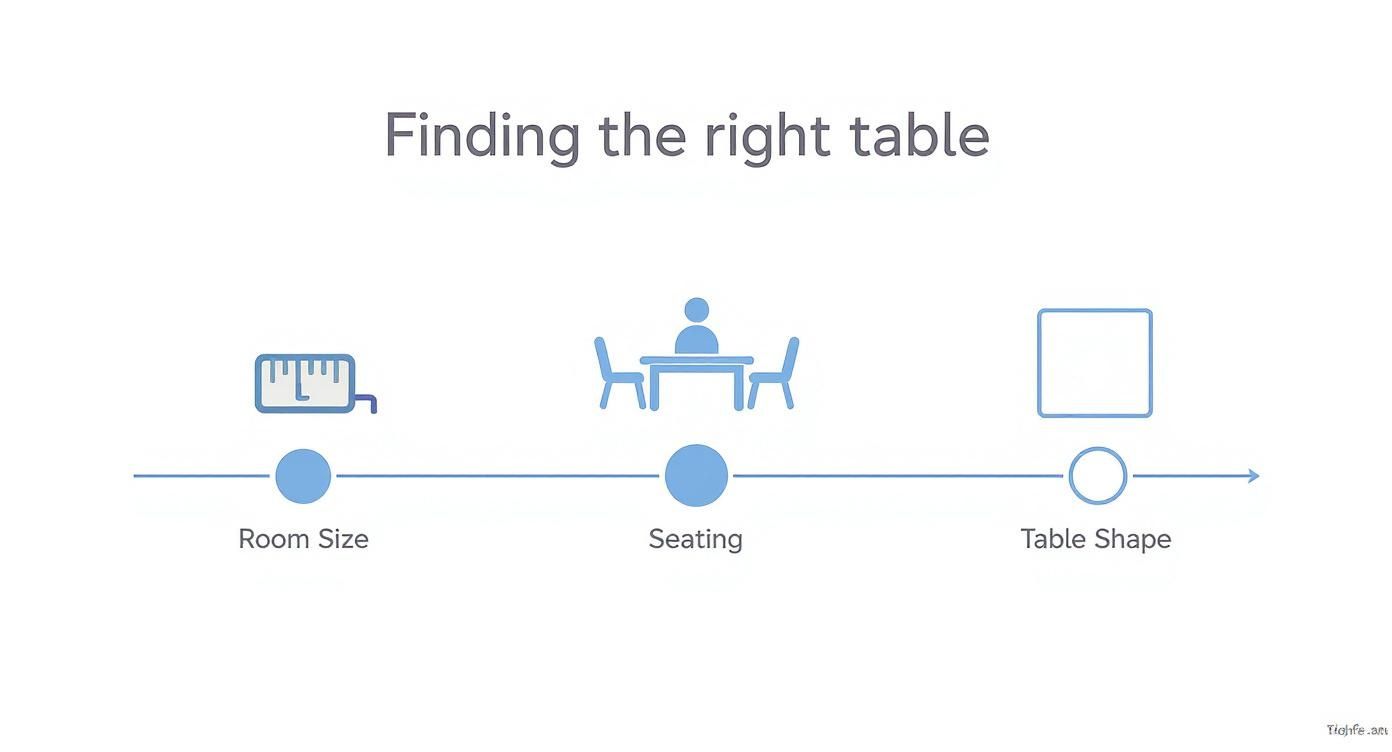
As you can see, picking a conference table is a step-by-step process. Your room measurements, how many people you need to seat, and the kind of meetings you’ll be having are all connected.
The Classic Rectangular Table
When you picture a traditional boardroom, you’re probably imagining a rectangular table. It’s a classic for a reason: it fits the maximum number of people along its length, which makes it perfect for large groups and formal presentations.
The clear “head” of the table establishes a focal point, which is great for meetings where a leader is speaking to the team. On the flip side, that same feature can sometimes make it harder for people sitting at opposite ends to have an open, back-and-forth conversation.
The Collaborative Round Table
When you want to encourage equality and open discussion, you can’t beat a round table. With no head of the table, everyone has an equal seat and a clear line of sight to everyone else. This setup naturally creates a more collaborative and less formal vibe.
Round tables are a perfect fit for:
- Small team meetings: They’re fantastic for brainstorming and group problem-solving where every voice matters.
- Huddle spaces: Their smaller footprint makes them a great choice for informal areas designed for quick check-ins.
- Cafes and break rooms: They help create a friendly, social atmosphere that encourages casual chats.
The main drawback of round tables is that they don’t scale up very well. As you increase the diameter to fit more people, the middle becomes a dead zone, making it tough for people to hear and talk to those on the other side. For a smaller, collaborative space, a simple piece like this round non-powered conference table can be an excellent choice.
Boat-Shaped and Oval Tables
Boat-shaped and oval tables are a brilliant compromise between the formal feel of a rectangle and the all-in-this-together vibe of a circle. They are wider in the middle and get narrower toward the ends—a subtle design change that has some big benefits.
This unique shape dramatically improves sightlines, letting people on the sides see each other and the presentation screen more easily. It’s a huge plus for video conferencing, as it avoids the “tunnel vision” you can get with long, straight tables.
A boat-shaped table is designed to make every seat a good seat. By gently curving the sides, it ensures that no one feels visually cut off from the conversation, blending authority with accessibility.
These shapes keep a sense of structure with defined ends but soften the hierarchy. This makes them a versatile pick for modern boardrooms that need to accommodate all kinds of meeting styles.
Square and Modular Tables
For smaller groups, square tables work a lot like round ones, creating an intimate setting for teams of up to eight. They give each person a generous amount of personal space, which is great for working sessions where you need to spread out documents or use laptops.
If you’re looking for ultimate flexibility, modular tables are an incredible solution. These systems are made of smaller sections—often trapezoids or rectangles—that you can arrange in all sorts of configurations.
Think about modular tables if your space has to wear multiple hats:
- Push them together to create one large table for a board meeting.
- Break them apart for small-group breakout sessions.
- Set them up in a U-shape for training or presentations.
This adaptability is a smart investment for dynamic offices where the room’s needs can change from one day to the next.
To help you visualize how these shapes translate to real-world spaces, we’ve put together a quick-reference table. This chart breaks down the common dimensions for each table shape, along with the ideal seating capacity and the minimum room size you’ll need to accommodate it comfortably.
Detailed Comparison of Table Dimensions and Seating
| Table Shape | Table Dimensions (Feet) | Seats | Minimum Room Size (Feet) |
|---|---|---|---|
| Rectangular | 4′ x 8′ | 6-8 | 12′ x 16′ |
| Rectangular | 5′ x 12′ | 10-12 | 13′ x 20′ |
| Rectangular | 6′ x 20′ | 18-20 | 14′ x 28′ |
| Round | 4′ Diameter | 4 | 12′ x 12′ |
| Round | 6′ Diameter | 6-8 | 14′ x 14′ |
| Boat-Shaped | 5′ x 10′ | 8-10 | 13′ x 18′ |
| Square | 5′ x 5′ | 4-6 | 13′ x 13′ |
This table should give you a solid starting point for figuring out what will work best for you. Remember to always factor in clearance for chairs and walkways to ensure your meeting room is functional, not just furnished.
Mastering Your Room Layout and Clearance
A beautiful, high-end conference table can feel completely wrong if it’s shoehorned into a room that’s too small. The secret to getting it right isn’t just about the table itself; it’s all about clearance—the essential “breathing room” you leave around it. Getting the layout right is what makes a space feel comfortable, accessible, and ready for business.
Think of clearance as a personal “comfort bubble” for each person at the table. To create a room that actually works, you need enough space for chairs to slide back, for people to walk behind seated colleagues without a major disruption, and for everyone to get in and out easily. It’s the difference between a functional workspace and a frustrating obstacle course.
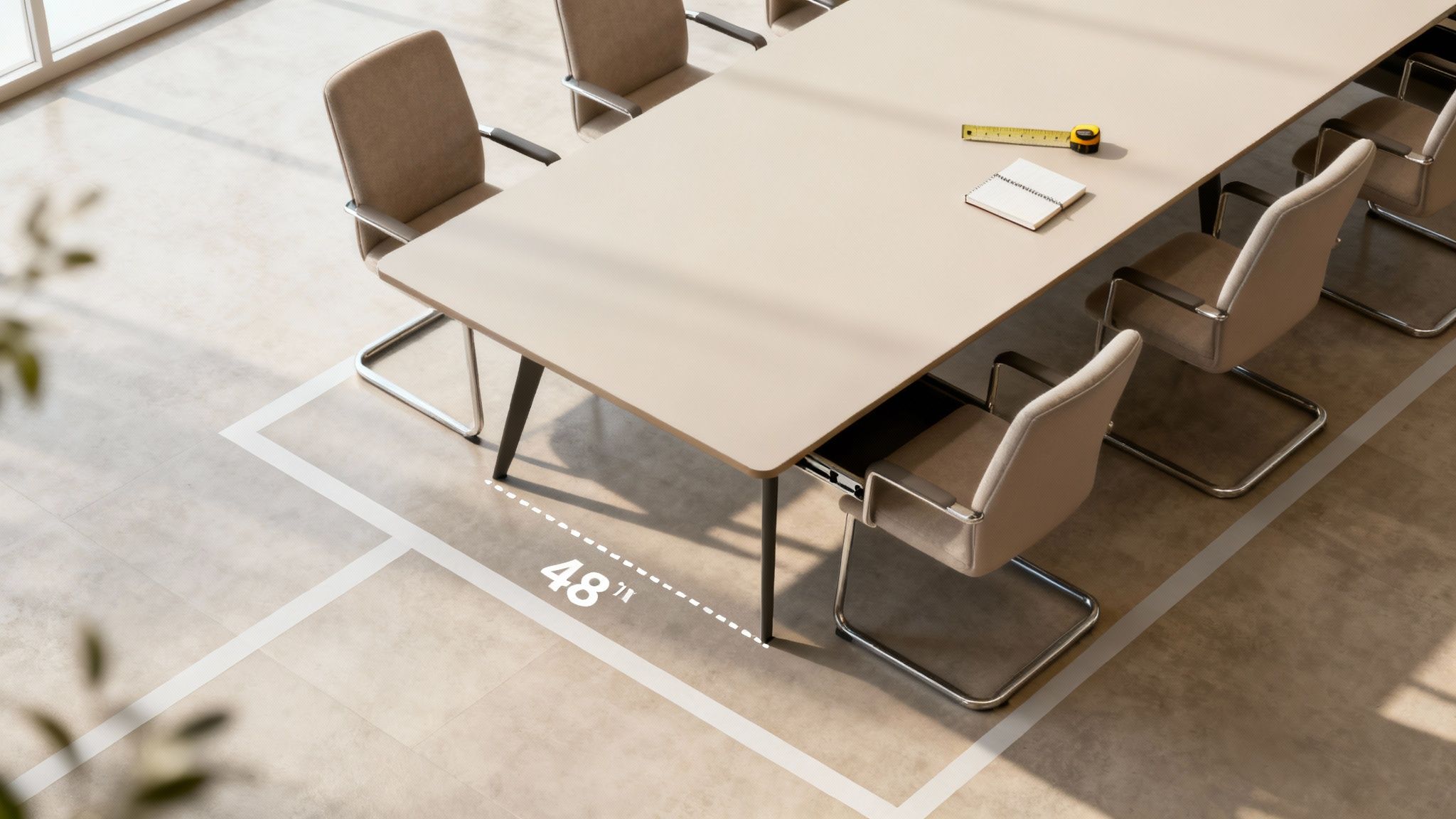
This might sound complicated, but it really just boils down to some simple math. By understanding a few key measurements, you can figure out the maximum table size your room can handle, ensuring your final choice enhances the space instead of overwhelming it.
The Golden Rule of Clearance
The industry-standard rule of thumb is to leave 48 inches (4 feet) of open space between the edge of your conference table and any wall or obstruction. This isn’t just a random number; it’s a measurement grounded in creating a comfortable and efficient environment.
Here’s why that much space is so important:
- Seating Space: A person needs about 24 inches just to pull their chair out and sit down comfortably.
- Walking Path: You need another 24 inches for someone to walk behind that seated person without forcing everyone to squeeze by.
- Total Clearance: Add them together, and you get the recommended 48 inches.
This buffer zone prevents those awkward “excuse me” traffic jams and makes the entire room feel more open and professional. While you might be able to get by with a bare minimum of 36 inches in a very tight space, aiming for 48 inches is always the best practice. For a deeper dive into creating functional layouts, explore our expert advice on office space planning and design.
Calculating Your Maximum Table Size
Okay, let’s turn these principles into a practical formula you can use right now. Grab a tape measure and get your room’s length and width. With those two numbers, you can easily pin down the largest table that will fit without compromise.
The calculation is really straightforward:
- Measure Room Length: Start by getting the total length of your conference room, wall to wall.
- Subtract Clearance: Now, subtract 8 feet (96 inches) from that length. This covers the 48-inch clearance zone you need at both ends of the table.
- Measure Room Width: Do the same for the width of the room.
- Subtract Clearance: Again, subtract 8 feet (96 inches) from the width to account for the 48 inches of space on both sides.
The two numbers you’re left with are the absolute maximum length and width for your new conference table.
Example Calculation
Let’s say your room is 20 feet long by 14 feet wide.
- Maximum Table Length: 20 feet – 8 feet = 12 feet
- Maximum Table Width: 14 feet – 8 feet = 6 feet
In this room, the largest table that would fit comfortably is 12 feet by 6 feet.
This simple formula takes all the guesswork out of the process. It empowers you to shop for tables with confidence, knowing exactly what size will work and preventing the costly mistake of ordering something that just won’t fit.
Planning for Other Furniture and Obstructions
Of course, your conference table is rarely the only thing in the room. You have to account for all the other elements that take up valuable floor space and affect your clearance.
Before you finalize that table size, take a look around for these common obstructions:
- Credenzas or Cabinets: If you have storage furniture against a wall, you must measure your clearance from the edge of the furniture, not the wall itself.
- Whiteboards or AV Carts: Make sure there’s enough room for someone to stand and present without being backed up against the table.
- Inward-Swinging Doors: The arc of a swinging door can easily eat into your clearance zone. Check that it can open fully without hitting a chair.
- Columns or Pillars: Structural elements can create awkward pinch points. Always measure your clearance from the widest point of any obstruction.
For rooms with trickier layouts or multiple pieces of furniture, visualizing the space can be a massive help. Planning ahead ensures every piece of your meeting room fits together perfectly.
Planning for Accessibility and Technology
Getting the raw dimensions right is just the start. A truly modern and effective conference room has to be inclusive and ready for the tech we use every day. Smart design isn’t just about the table’s footprint; it’s about thinking through how every single person will use the space and how technology will either help or hinder their work.
This means planning for accessibility and integrating power and data right from the get-go. A thoughtfully designed room ensures everyone, regardless of physical ability, can pull up a chair and contribute. Likewise, a room that anticipates your team’s tech needs keeps meetings on track and frustration-free. These details are every bit as important as the table’s shape or how much clearance you leave.
Ensuring ADA Compliance
Accessibility is non-negotiable—it’s a core requirement for any shared space. The Americans with Disabilities Act (ADA) gives us clear guidelines to make sure our rooms are usable for everyone, including those who use wheelchairs. For conference tables, this boils down to providing enough clearance for someone to comfortably approach and use the table.
Here are the key ADA numbers to keep in mind:
- Knee and Toe Clearance: The table must have at least 27 inches of vertical space for knees. This clearance should extend at least 8 inches deep from the table’s edge.
- Clear Floor Space: You need a clear patch of floor measuring at least 30 inches by 48 inches at each accessible seating spot.
- Clear Pathways: The paths for walking around the table and moving through the room must be at least 36 inches wide.
These measurements guarantee that a wheelchair user can easily pull up to the table and navigate the room without running into obstacles. As you plan your layout, make sure to designate specific accessible seating positions and double-check that your table choice meets these crucial standards. It’s about building a welcoming environment for your whole team.
Integrating Power and Connectivity
Let’s be real—meetings today run on laptops, presentation screens, and video calls. A conference table without easy access to power is like a car with no charging ports. It technically works, but it’s missing something essential for how we operate now.
Many modern tables solve this problem with built-in power modules. These can include:
- Standard electrical outlets
- USB-A and USB-C charging ports
- HDMI or other data ports for easy screen sharing
A tech-ready conference table transforms from a passive surface into an active hub for productivity. By centralizing power and data access, it eliminates cable clutter and keeps teams focused on collaboration, not finding an open outlet.
Cable management is the other piece of the puzzle. You’ll want a table with built-in grommets, troughs, or even hollow legs to hide all the wires. This keeps the tabletop clean and, more importantly, prevents a tangled mess of trip hazards on the floor. For a deeper dive into wiring your office furniture, our guide on cubicle electrical setup has some great tips that apply just as well to conference rooms.
Optimizing for Hybrid Meetings
With hybrid work here to stay, video conferencing is now a permanent part of business. The design of your room and the shape of your table can make a huge difference for your remote team members. The goal is to make them feel just as present as the people physically in the room.
Boat-shaped and oval tables are fantastic for video calls. Their tapered ends give the camera better sightlines, allowing it to capture more faces in one shot without that weird “tunnel” effect you get with long, narrow tables. By placing your main screen and camera at one end, you give remote attendees a clear, commanding view of the action, ensuring everyone feels included.
Choosing the Right Table for Different Meeting Types
The right conference table does more than just fill a room; it sets the stage. It can turn a generic space into a high-energy hub for quick decisions, a formal chamber for executive strategy, or a flexible classroom for team development. Let’s move beyond the theory of sizes and shapes and see how this plays out in the real world.
By looking at common meeting spaces, we can see exactly why a specific table is the perfect fit. The goal is to choose furniture that actively supports the work happening around it, making every meeting more productive. This practical approach will help you picture the ideal setup for your own office.
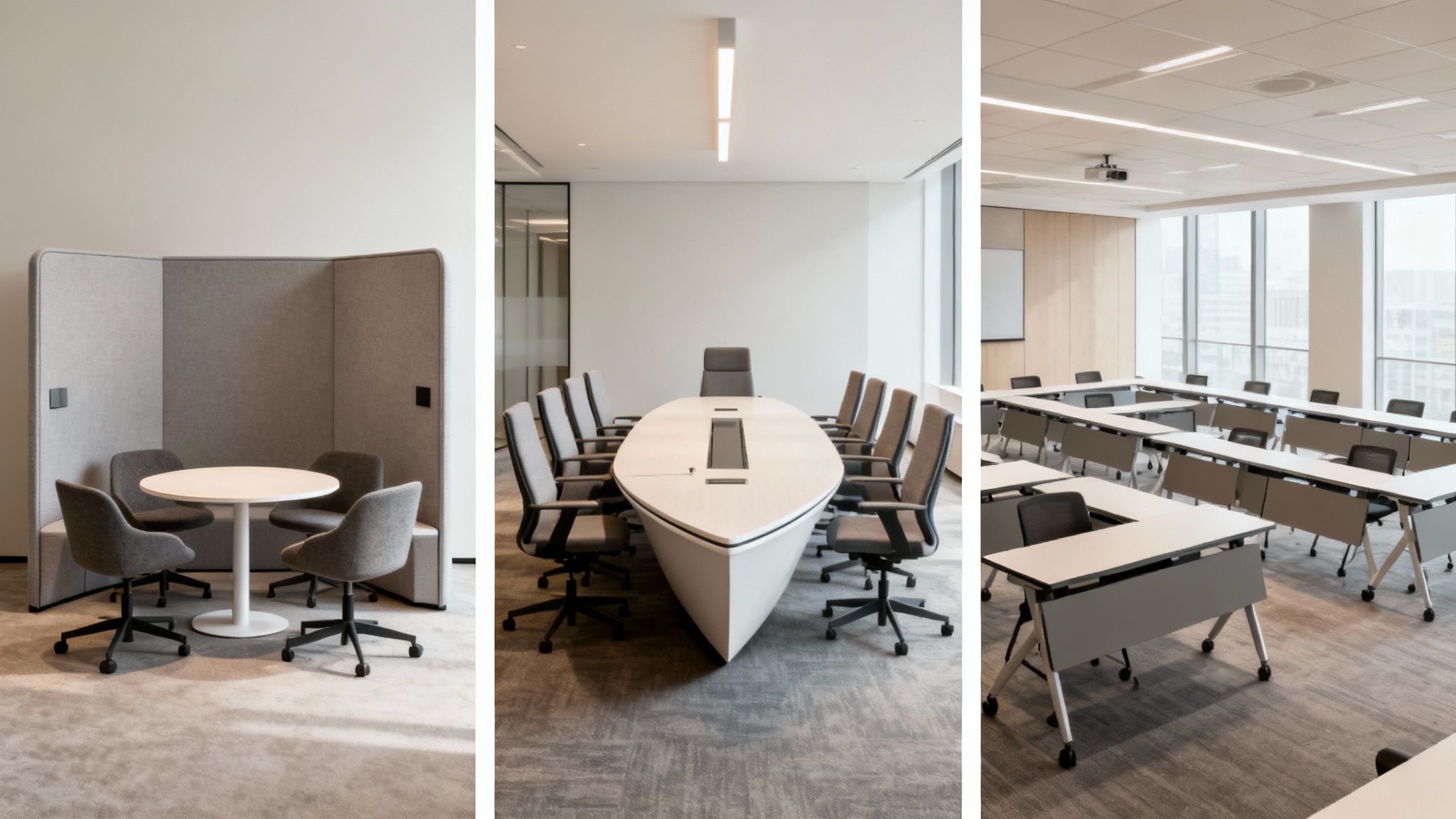
The Small Huddle Room
The huddle room is the modern office’s answer for spontaneous, get-it-done collaboration. These small, informal spaces are designed for 2-4 people to sync up for a quick check-in, brainstorm, or solve a problem without tying up a large boardroom. The furniture has to match this fast-paced, egalitarian vibe.
A compact round table is the undisputed champion here. Its circular shape gets rid of any sense of hierarchy, putting every participant on equal footing where they can easily see and hear one another. This encourages a natural, free-flowing conversation—exactly what you want for agile teamwork.
Think of a huddle room table less as a piece of furniture and more as a launchpad for ideas. Its small scale and open design remove physical and psychological barriers, helping collaboration happen faster.
Dimensions for a huddle room table are typically small, usually between 36 to 48 inches in diameter. This is just enough space to fit a few laptops and notebooks without anyone feeling squeezed. For furnishing these collaborative nooks, a dedicated small round conference table offers the perfect blend of function and compact design.
The Executive Boardroom
The executive boardroom is all about projecting authority, professionalism, and confidence. This is where the big decisions get made, high-stakes negotiations unfold, and important clients are hosted. The conference table is the undeniable centerpiece, and its size and style have to reflect the room’s gravitas.
A large, elegant boat-shaped or rectangular table is the traditional choice, and for good reason. A table measuring 12 to 20 feet or more commands the space and gives directors plenty of elbow room. The boat shape, with its gently curved sides, has a modern edge by improving sightlines down the length of the table—a crucial detail for presentations and video calls. It helps everyone, even those at the far ends, feel connected to the conversation.
This demand for high-end, functional boardrooms is a major force in the furniture market. North America and Europe make up about 75% of global conference table sales, with North America alone accounting for roughly 40% of the market as of 2024. This trend shows how much established corporations continue to invest in quality office furnishings.
The Versatile Training Room
Training rooms are dynamic spaces that need to adapt to different learning styles, from lectures and workshops to group activities. A single, massive conference table just won’t cut it. The keyword here is flexibility, and the furniture needs to be reconfigured in a snap.
Modular tables are the perfect answer. These are smaller, lightweight tables—often in rectangular, square, or trapezoid shapes—that can be arranged in countless ways:
- Classroom Style: Rows of tables facing a presenter, perfect for lectures.
- U-Shape: Great for fostering interaction between the speaker and the audience.
- Pods: Small clusters of tables for collaborative breakout sessions.
This adaptability allows one room to serve many purposes, which maximizes the value of your office space. When you invest in modular tables, you’re choosing furniture that can evolve with your company’s training needs, ensuring the room is always set up for effective learning and development.
Putting It All Together: Your Final Measurement Checklist
You’ve explored the different table shapes, learned how clearance space makes or breaks a room’s flow, and thought about the practical needs of technology and accessibility. Now it’s time to pull all that knowledge together. Before you even think about browsing options, use this final checklist to get all your critical data in one place.
Having these numbers in hand transforms a potentially overwhelming decision into a simple, confident process. This isn’t just about dodging the mistake of a table that’s too big or too small; it’s about proactively designing a space that actually works. With this information, you can explore solutions from Cubicle By Design and know exactly what you’re looking for.
Essential Room and Furniture Details
Use this quick list to record your space’s vital statistics. This is no time for estimates—grab a tape measure and get it right.
- Room Length and Width: Start by measuring wall-to-wall. These are your foundational numbers.
- Ceiling Height: This is surprisingly important, especially if you’re planning on any statement-making hanging light fixtures.
- Obstructions: Take careful note of any columns, inward-swinging doors, low-hanging windows, or existing credenzas.
- Outlet Placement: Where are your power and data ports already located? This is a huge factor in deciding where the table can even go.
Define Your Functional Needs
Next, get honest about how the room will actually be used day-to-day. This step ensures your final choice genuinely supports how your team works.
- Desired Seating Capacity: What’s your typical meeting size? More importantly, what’s the absolute maximum number of people you need to fit?
- Primary Meeting Style: Is this room for formal board meetings with clients? Or is it more for collaborative brainstorming sessions and hybrid video calls?
With this checklist complete, you officially have a blueprint for success. You’re now perfectly equipped to find a conference table that fits not just your room, but your company’s culture and goals. You can even start visualizing how different pieces work together with our Cubicle Designer tool. Let’s build a conference room that’s as functional as it is beautiful.
Got Questions? We’ve Got Answers.
We get a lot of questions about getting conference table dimensions just right. Here are some quick answers to the most common ones we hear, helping you clear up any lingering doubts and choose with confidence.
How Much Room Does Each Person Need at the Table?
As a general rule of thumb, you’ll want to give each person 24 to 30 inches of table space. That’s usually enough for a chair and some decent elbow room for taking notes without bumping into their neighbor.
But, if you’re outfitting an executive boardroom or know your team will be spreading out with laptops, documents, and coffee, it’s smart to aim for the higher end of that range. Pushing that to 30 to 36 inches per person gives everyone the breathing room they need to work comfortably and effectively.
What’s the Best Table Shape for Video Calls?
For hybrid meetings and video conferencing, boat-shaped and oval tables are hands-down the best choice. Their gently curved sides and tapered ends give everyone at the table—especially those at the far ends—a much clearer line of sight to the camera.
This shape naturally pulls everyone into the frame, preventing that awkward “tunnel view” you often get with long, rectangular tables. It makes remote participants feel more included and helps the whole conversation flow more naturally.
Will a 10-Foot Table Work in a 15-Foot Room?
Technically, yes, a 10-foot table will physically fit inside a 15-foot room. But that doesn’t mean it’s a good idea. You’d be left with a measly 30 inches of clearance at each end, which is barely enough to slide a chair out, let alone walk behind someone who is already seated. It’s a recipe for a cramped, awkward space.
To keep things comfortable and allow people to move around freely, you really need a minimum of 48 inches (or 4 feet) of clearance on all sides of the table. A much better fit for a 10-foot table would be a room that’s at least 18 feet long.
Are Modular Conference Tables a Good Idea?
Absolutely. Modular tables are a fantastic investment, particularly for dynamic, multi-purpose rooms that need to adapt on the fly. Because they’re made of smaller sections, you can easily pull them apart and rearrange them into different shapes and sizes.
This kind of flexibility is a game-changer for growing businesses. One day you might need a large table for a formal presentation, and the next you might need smaller breakout pods for a training session. A modular system lets your furniture do it all, ensuring you get the most out of every square foot of your office.
At Cubicle By Design, our specialty is creating workspaces that work as hard as you do. From commanding conference tables to productive workstation cubicles and focused private office cubicles, we have the cubicles you need to build a better office.
Ready to design your ideal space? Find the perfect office solutions with our Cubicle Designer or visit us at https://cubiclebydesign.com/.