


Your Guide to Temporary Office Walls
Temporary office walls are just what they sound like: modular, non-permanent partitions you can use to divide up your space. They’re a flexible and much more affordable alternative to putting up traditional drywall. With these systems, you can create private offices, huddle rooms, or collaborative zones without the chaos and downtime of a major renovation, making them perfect for today’s ever-changing workplace.
Why Your Modern Office Needs Flexible Walls
Let’s face it, the old-school office layout—that static grid of cubicles and corner offices—is becoming a thing of the past. Businesses today have to be nimble. They need to scale teams up or down at a moment’s notice and rearrange layouts to support hybrid work models. This is where the headache of permanent construction really becomes a problem.
Imagine your fast-growing startup just hired ten new developers. That open-plan office, which was once great for collaboration, is now a noisy mess of distractions. Building new offices with drywall would take weeks, kick up a ton of dust, and lock you into a layout that might not even make sense six months from now.
The Problem with Permanent Solutions
Traditional construction is slow, expensive, and completely inflexible. Once a drywall partition is up, it’s there for good—unless you’re ready to shell out for costly, disruptive demolition and rebuilding. That kind of rigidity just doesn’t work for the modern business.
This is exactly why temporary office walls have become so popular. They offer a practical, scalable solution that actually keeps pace with the agile nature of today’s work environment.
Think of them as high-end, architectural building blocks for your office. You can build, take down, and reconfigure your space whenever you need to, creating a workspace that evolves right alongside your company.
To give you a clearer picture, let’s break down the key differences.
Temporary Walls vs Permanent Drywall Construction
| Feature | Temporary Office Walls | Permanent Drywall Construction |
|---|---|---|
| Flexibility | Highly reconfigurable and reusable. | Fixed and permanent once built. |
| Installation | Quick, clean, and with minimal disruption. | Slow, messy (dust, paint fumes), and very disruptive. |
| Cost | Lower upfront cost and can be a depreciable asset. | High upfront cost for labor and materials. |
| Timeline | Can be installed in a matter of days. | Takes weeks or even months from start to finish. |
| Customization | Wide range of finishes, glass, and integrated tech. | Limited to paint and basic trim options. |
| Sustainability | Reusable and reduces construction waste. | Creates significant demolition waste. |
As you can see, temporary wall systems are designed from the ground up for adaptability, a stark contrast to the set-in-stone nature of drywall.
A Market Driven by Adaptability
The shift toward flexible workspaces isn’t just a fleeting trend; it’s a massive market movement. The global modular partition wall systems market, valued at USD 3.34 billion, is expected to skyrocket to USD 5.21 billion by 2031. This explosive growth is being driven by the huge adoption of hybrid work, with over 70% of companies now using flexible policies.
This data tells a simple story: businesses are actively looking for smarter ways to manage their physical office space. They need environments that can be tweaked on the fly to support new project teams, changing headcounts, and unpredictable in-office schedules.
By looking into solutions like modular office walls, companies can effectively future-proof their offices. Instead of being trapped by rigid architecture, they get the freedom to design a workplace that truly works for them—both today and for whatever comes next.
Exploring the Main Types of Office Partitions
When you start looking into temporary office walls, you’ll find a whole range of solutions, each built to solve a specific problem in the workplace. It’s less about a single product and more like a toolkit for shaping your environment. Getting to know the main players—modular partitions, demountable walls, and acoustic dividers—is the first step toward building a more flexible and productive office.
Each system brings its own mix of flexibility, style, and function to the table. Once you understand what makes them different, you can find the perfect match for your team, whether you’re setting up a busy call center or carving out a quiet corner for focused work.
This infographic really gets to the heart of what makes temporary walls such a smart move for modern businesses.
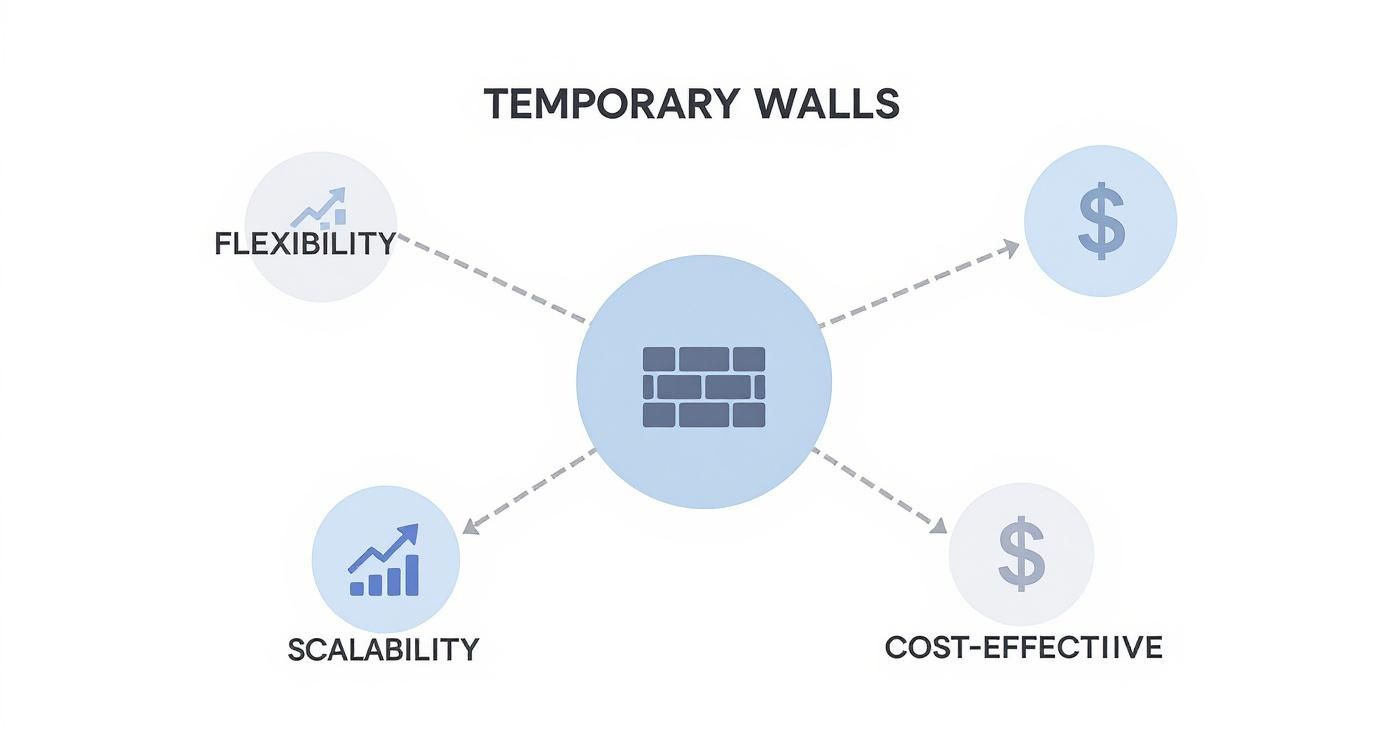
As you can see, these benefits all work together, letting a company adapt its physical space on the fly without breaking the budget.
Modular Partitions: The Building Blocks of Your Office
Imagine having a set of professional-grade LEGOs for your office. That’s pretty much what modular partitions are. These systems are made of prefabricated panels that click together to create cubicles, workstations, and dedicated team areas. They are the true workhorses of office flexibility, built for quick setup and easy reconfiguration.
What makes modular partitions so popular is their sheer versatility. Panels come in all sorts of materials—fabric-covered surfaces to soak up sound, tough laminates for durability, and even glass elements to let natural light flow through. Because it’s all panel-based, you can create just about any layout you can dream up.
Take a growing tech startup, for instance. They could start with small “pods” for two-person teams. As they hire more people, they can simply add more panels to expand the existing pods or build new ones entirely, all without major construction. This adaptability makes them a favorite for dynamic companies where team sizes and project needs are always changing. If you’re curious about the possibilities, you can explore a complete overview of different cubicle configurations and an overview of their benefits to see just how customized these systems can get.
Demountable Walls: The Best of Both Worlds
If modular partitions are the building blocks, then demountable walls are like high-end, movable fixtures. These systems give you the solid, finished look of permanent construction, but with one huge advantage: they can be taken down and reinstalled somewhere else. We call them “demountable” because they’re designed to be uninstalled without the dust, debris, and waste of drywall demolition.
Demountable systems often use floor-to-ceiling glass panels, which create a modern, open feel while still delivering real acoustic privacy. This makes them a perfect choice for private offices, conference rooms, or any client-facing area where a polished, professional look is non-negotiable.
A key advantage is their long-term value. While the initial investment might be higher than for basic dividers, their reusability means you aren’t throwing money away on construction every time your company reorganizes its floor plan. A law firm, for instance, could use demountable glass walls to build partner offices, and if they move to a new building, they can take the entire wall system with them.
Acoustic Panels and Room Dividers: The Sound Tamers
In today’s open-plan offices, noise is one of the biggest productivity killers. Acoustic panels and room dividers are designed specifically to fight back. While they don’t always form a complete “wall,” these solutions are essential for creating quiet zones and visual separation in larger spaces.
Acoustic panels are made from sound-absorbing materials and can be freestanding, hung from the ceiling, or mounted on existing walls. They work by literally trapping sound waves, cutting down on echo and background chatter. Freestanding room dividers, on the other hand, are simple visual barriers that can be moved in a flash to section off a space for an impromptu meeting or create a temporary quiet zone.
- Noise Reduction: They absorb ambient sound, making it easier for employees to concentrate on deep-focus tasks.
- Visual Privacy: Simple dividers can block sightlines, reducing distractions in high-traffic areas.
- Ultimate Flexibility: Often lightweight and on wheels, they can be deployed in seconds to adapt a space on the fly.
These are perfect for creating temporary “huddle rooms” for brainstorming or carving out a quiet nook for someone to take a private call. They offer a simple yet incredibly effective way to manage the chaos of an open office.
Why Flexible Walls Are More Than Just Dividers
When you start thinking beyond simple drywall, you realize temporary office walls aren’t just about splitting up a room. They offer real, strategic advantages that can directly impact your company’s budget, agility, and even how happy your employees are. Choosing a flexible wall system isn’t just a construction decision; it’s a forward-thinking business move that pays you back long after the installation is done.
These aren’t just isolated perks. The financial savings, the ability to adapt on the fly, and the boost in employee comfort all work together. It’s about creating a workspace that is strategically designed for modern business challenges, not just physically divided.
The Financial Advantage of Flexibility
Let’s be honest, one of the first things everyone looks at is the cost. Traditional construction is messy and expensive. You’re paying for labor, materials, and the inevitable cleanup and disruption. Temporary office walls flip that script. Since they’re prefabricated and built for quick assembly, you slash those upfront costs. Less mess, fewer labor hours, and your team can keep working without a construction crew in their way.
But the savings don’t stop there. Because these walls are considered tangible personal property—like furniture—they can often be depreciated much faster than permanent construction, which can be a nice little bonus come tax time. Plus, their biggest superpower is reusability. That initial investment keeps delivering value year after year as your company grows and changes.
Agility and Scalability on Demand
In business today, you have to be able to pivot. Fast. Temporary walls give you that power. You can completely reconfigure a layout in a few hours or a couple of days—not the weeks or months you’d be stuck waiting for with drywall. This means you can react instantly to a new project team, a sudden growth spurt, or a shift to a new work model.
Think about it: your company lands a big client and needs a dedicated project room, like, yesterday. With a modular system, you can build out a fully functional, private space over a weekend. When the project wraps up, those same walls can be taken down just as easily and either stored or used somewhere else. You simply can’t get that kind of on-demand adaptability from a permanent wall.
It’s no surprise the demand for these solutions is growing. The global market for removable wall partitions was valued at USD 4.75 billion and is expected to hit USD 8.18 billion by 2033. That’s a clear sign that businesses everywhere are putting a premium on adaptable spaces. You can read the full research about this market growth to see how flexibility is truly shaping the future of office design.
Boosting Privacy and Acoustic Comfort
The open-plan office was supposed to be great for collaboration, but it often killed focus and privacy. Modern temporary walls are engineered to fix that exact problem by delivering enhanced acoustics and privacy. They’re built with sound-dampening cores and sealed connections that do a surprisingly good job of cutting down on noise bleeding from one space to another.
This is how you strike the perfect balance. You can create quiet zones for deep work, private offices for confidential calls, and meeting rooms where a lively discussion won’t derail the entire office. You get the collaborative vibe without sacrificing the essential need for people to just focus.
A Commitment to Sustainability
Opting for temporary walls is also a much greener choice. Think of all the waste from a traditional demolition—drywall, studs, and insulation all heading straight for a landfill. Because temporary walls are designed from the ground up to be reused, they support a far more sustainable approach to building out your workspace.
Instead of tearing down and throwing away, you just reconfigure. This “circular” way of thinking not only keeps tons of debris out of landfills but also reduces the demand for new raw materials. For any company serious about its environmental footprint, flexible walls are a practical, visible way to put that commitment into action.
How to Plan Your Temporary Wall Project
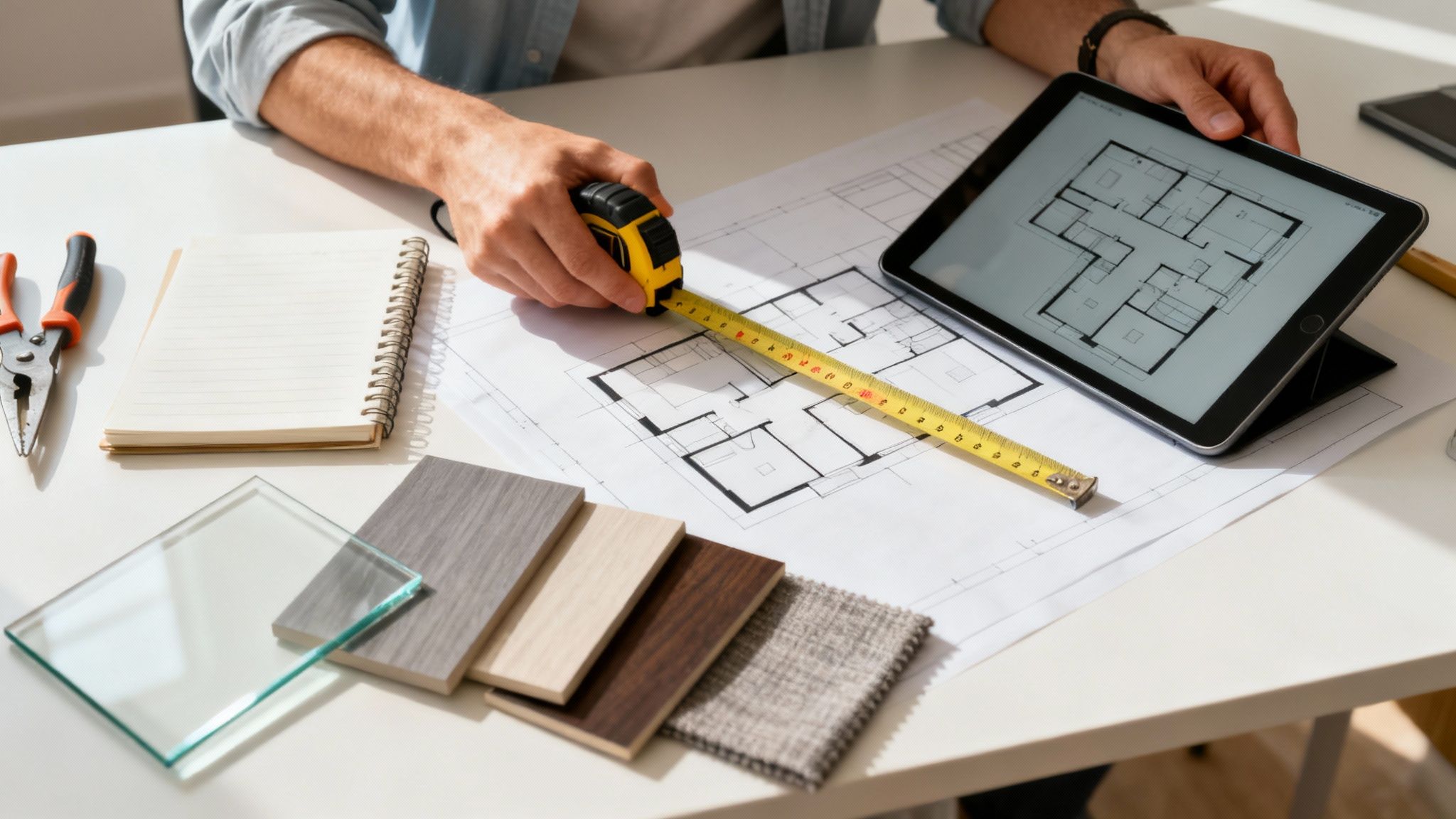
Jumping into a workspace redesign without a solid game plan is like trying to drive somewhere new without a map. You’ll get somewhere, sure, but probably not where you intended. Taking the time to plan is the single most important step to make sure your temporary office walls actually solve the problems you have and give you the return you expect.
A well-thought-out plan doesn’t just make the process smoother; it lets you have a much more productive conversation with a design partner. It helps you spell out your vision, sidestep common pitfalls, and make sure the final layout truly helps your team get their work done. This early effort is what prevents expensive changes and frustrating delays later on.
Defining Your Project’s Purpose
Before you even think about fabrics or finishes, you have to answer one huge question: What problem are you trying to solve? The “why” behind your project is the North Star that will guide every other decision. Are you trying to carve out quiet zones for deep focus, build a private conference room from scratch, or just create some visual separation in a loud, open-plan office?
Your goal directly points to the right kind of wall system.
- For Noise Reduction: Your top priority will be walls with high acoustic ratings (STC) and materials designed to dampen sound.
- For Visual Privacy: The focus shifts to frosted glass or solid fabric panels instead of see-through glass.
- For Collaboration Hubs: Maybe all you need are some semi-private, lower-height walls to outline team areas without completely closing them off.
Getting this core purpose nailed down is the foundation of a great project. A smart way to start is by getting some professional help with office space planning and design, which helps you align the physical space with what your business is trying to achieve.
The Essential Specification Checklist
Once you know your “why,” it’s time to dig into the nuts and bolts. Having clear answers to the questions in this checklist will make your consultation and the whole design process incredibly smooth.
Here’s a handy checklist to walk you through the key decisions you’ll need to make for your temporary office wall installation.
| Consideration | Key Questions to Ask | Example Options |
|---|---|---|
| Dimensions & Layout | What are the exact height, width, and length measurements of the space? Where will doors or openings be located? | 8-foot ceiling height, 12-foot wall length, single door entry. |
| Material & Finish | What aesthetic are you aiming for? Do you need durability, transparency, or a specific color? | Tempered glass, fabric-wrapped acoustic panels, wood grain laminate. |
| Privacy Level | How much visual separation is needed? Do you want to maintain an open feel or create full seclusion? | Clear glass, frosted or etched glass, fully opaque solid panels. |
| Acoustic Needs | What is the target Sound Transmission Class (STC) rating? Is sound-blocking or sound-absorbing more important? | STC 35 for general privacy, STC 45+ for confidential meetings. |
| Power & Data | Do the walls need to support electrical outlets, data ports, or AV equipment? | Integrated power raceways, pre-wired panels, cutouts for media ports. |
Thinking through these specifics ahead of time saves a world of trouble. A simple mistake in measurements or forgetting about power outlets can cause major headaches and unexpected costs during installation.
Navigating Compliance and Safety Codes
Finally, no office project—temporary or permanent—gets to ignore building codes and accessibility standards. While temporary walls often have a much simpler approval process than traditional drywall, they still have to meet critical safety rules. Skipping this step can lead to failed inspections and expensive rework.
You’ll need to pay close attention to a few key areas:
- Fire Safety: Your new layout can’t block fire exits, sprinkler heads, or fire extinguishers. The wall materials themselves also need to meet local fire code ratings.
- Egress Paths: You have to maintain clear, wide-enough paths for everyone to exit the building in an emergency. There are minimum width requirements for hallways and corridors that must be respected.
- ADA Accessibility: Any new spaces, doorways, or hallways you create must comply with the Americans with Disabilities Act (ADA). This ensures the office is accessible to everyone.
When you work with an experienced team like Cubicle By Design, you get the peace of mind that these critical compliance factors are baked into your plan from day one. It’s the proactive way to create a space that’s not just functional and stylish, but also safe and up to code.
Understanding Costs, Timelines, and Long-Term ROI
Choosing temporary office walls isn’t just a design decision—it’s a financial one that touches your budget, your team’s efficiency, and your company’s ability to adapt down the road. To make a smart choice, you need to look past the initial price tag and understand the full picture: how long it takes, what it costs, and what the real return on investment (ROI) looks like.
Unlike traditional construction, which can drag on with messy, unpredictable schedules, temporary wall systems are all about speed and clarity. The magic happens off-site. Your panels are built to precise specifications in a factory, so when they show up at your office, the job is mostly about assembly, not demolition and dust. This approach drastically cuts down on installation time and keeps disruption to your daily operations at an absolute minimum.
Breaking Down the Installation Timeline
The speed of installation is easily one of the biggest draws of temporary office walls. While every project is different, the process is always significantly faster than putting up drywall.
A typical project usually unfolds like this:
- Consultation and Design (1-2 weeks): This is where we nail down the details. We’ll finalize the layout, choose materials and finishes, and plan for any power or data needs.
- Production and Fabrication (3-6 weeks): Once you sign off on the design, your custom wall panels and parts are manufactured.
- On-Site Installation (2-5 days): A professional crew puts everything together. A single private office might be done in a day, while an entire floor of workstations can be up and running in less than a week.
This streamlined process means you can get your team into a new, more effective space in a fraction of the time of a standard renovation.
Demystifying the Cost of Temporary Walls
So, what do they cost? It’s a bit like buying a car—the base model is one price, but the final cost depends on the features you add.
Several key factors influence the price:
- Materials: Glass panels, especially those with high acoustic ratings, will cost more than standard fabric or laminate options.
- Customization: Special sizes, unique finishes, or built-in tech like media cutouts will impact the final investment.
- Complexity: A simple, straight wall is naturally going to be more budget-friendly than a complex layout with multiple offices, doors, and corners.
While the upfront cost can sometimes be similar to basic drywall, the real financial story is about the long-term savings. For a more detailed look at what to expect, check out our comprehensive cubicle price guide—it offers some great insights for budgeting.
Calculating the Long-Term ROI
The real financial power of temporary walls comes from their reusability. This is where you see a massive return on your initial investment, and it’s a concept that’s hard to overstate.
Think about it this way: A company spends $15,000 on a drywall renovation. Two years later, they restructure and need to change the layout. That $15,000 is gone—it’s a sunk cost. They have to pay for demolition and start building all over again. With temporary walls, that initial investment is an asset you can simply reconfigure for a fraction of the cost.
This incredible adaptability is a huge reason why the global market for flexible solutions like folding temporary walls is exploding. Valued at USD 1.5 billion recently, it’s projected to hit USD 2.8 billion by 2033. Businesses are catching on to the value of infrastructure that can change with them. You can discover more insights about these market trends to see just how big this shift is.
When you factor in avoiding repeated construction costs, minimizing the need for larger leases, and potential tax advantages, the ROI on temporary walls becomes undeniable within just a few years.
Designing Your Space with Cubicle By Design
Turning a rough idea into a real, functional workspace that people actually enjoy working in takes a clear head and the right partner. At Cubicle By Design, we don’t just sell temporary office walls; we work with you, step-by-step, to build a space that genuinely solves your team’s problems. It’s a collaborative process where we make sure every detail, from the layout down to the finishes, lines up with what you actually need.
It all starts with a simple conversation about your goals. Are you trying to cut down on office noise? Carve out some much-needed private offices? Or maybe build dedicated hubs for your teams to brainstorm? Our design experts listen first, then help you find the right temporary wall system for the job. We’ll balance your budget, style, and day-to-day needs to land on a solution that fits your company culture.
From 3D Visualization to Professional Installation
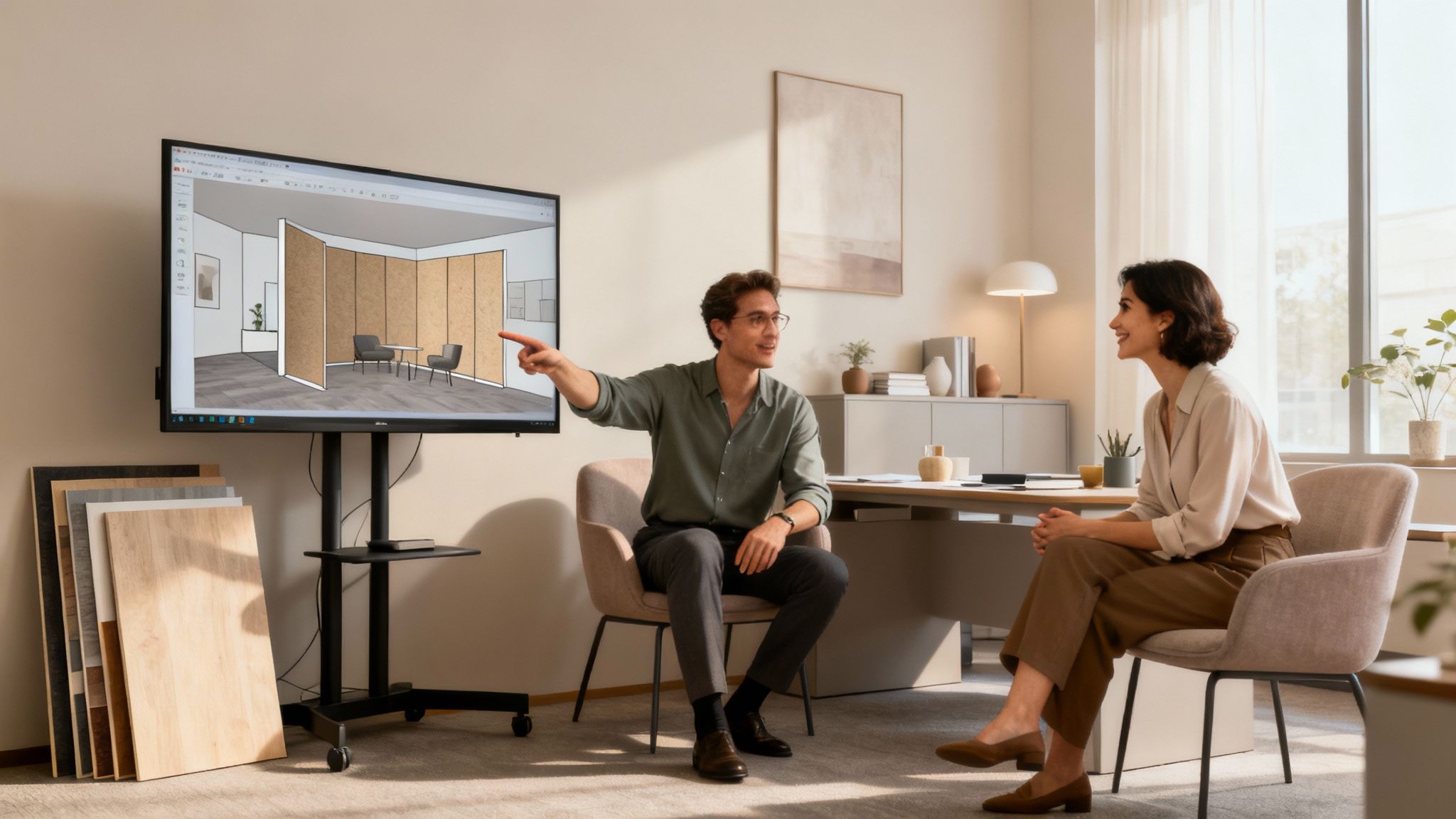
Once we’ve got a solid plan, we bring it to life with detailed 3D space planning. This is a game-changer. It lets you see exactly how the new layout will look and feel before a single panel is ordered. You can play around with different setups and tweak things with total confidence, which gets rid of all the guesswork and prevents expensive do-overs.
Our whole process is designed to be straightforward. We’ll walk you through our product lines, showing you all the ways you can customize—from glass clarity and fabric finishes to built-in power outlets—so your new space is as practical as it is polished.
Want to get a head start? You can start playing with ideas right now using our easy-to-use online cubicle designer tool. It’s a great way to build out and customize your ideal workstation setup and get a feel for the possibilities before we even talk.
The last step is the professional installation. Our experienced crew handles the entire setup with skill and efficiency, keeping the disruption to your daily routine to an absolute minimum. We manage the project from the first screw to the final walkthrough, making sure your new temporary walls are installed correctly, on schedule, and ready for your team to move in.
Start Your Workspace Transformation Today
Ready to see how temporary office walls can create the flexible, productive space you’ve been picturing? The best way to get started is with a conversation. We invite you to schedule a free design consultation with one of our experts. Let’s work together to build an environment that can adapt as your business grows and helps your team do their best work.
Answering Your Questions About Temporary Walls
Stepping into a workspace redesign naturally brings up a lot of practical questions. As you think about shifting to a more flexible layout, you’re probably wondering how these temporary office walls actually perform in the real world. We’ve gathered some of the most common questions we hear to give you clear, straightforward answers and help you move forward with confidence.
Our goal here is to clear up any lingering uncertainties you might have. From day-to-day practicalities to long-term performance, getting these key details sorted out will help you make a fully informed decision about transforming your space.
Are Temporary Walls Strong and Durable?
This is a common concern, but modern temporary walls are far from flimsy. Many systems are built with seriously robust materials like steel or aluminum framing and solid cores designed for durability. In fact, they’re engineered to meet or even exceed the same building codes as traditional construction, making them a totally reliable choice for long-term use in busy offices.
Unlike drywall, which can get dinged up, crack, or bow over time, high-quality modular systems keep their structural integrity. They’re built to handle daily wear and tear, and many can even support heavy items like cabinets or monitors when they’re properly reinforced.
How Do They Handle Office Noise?
This is where modern temporary walls really shine. Effective sound control is a major advantage, and many are specifically engineered with acoustic performance in mind. They use sound-dampening cores and tightly sealed connections to stop noise in its tracks.
You can even choose walls with a specific Sound Transmission Class (STC) rating to match your needs. A higher STC rating means better soundproofing, ensuring private conversations in an office or conference room actually stay private. It’s an incredibly effective way to solve the noise and distraction problems that plague so many open-plan layouts.
Can Temporary Walls Be Moved and Reused Easily?
Absolutely—that’s their whole point! Temporary walls are designed from the ground up for disassembly and reassembly. If you need to change your layout down the road, move to a new building, or scale your team up or down, the entire system can be taken down and reinstalled.
This reusability delivers an incredible long-term return on investment. Instead of paying for demolition and new construction every single time your needs change, you have a flexible asset that adapts right alongside your business. The whole process is clean, fast, and creates virtually zero construction waste.
Do They Meet Building and Fire Codes?
Yes, any reputable temporary wall system is designed to comply with all the essential safety regulations. This includes meeting fire code ratings for materials and ensuring that any new layout maintains clear paths for emergency egress. They are also planned to accommodate ADA accessibility requirements. Working with an experienced provider ensures your final design is not only functional but also safe and fully compliant.
Ready to create a workspace that can keep up with your business? The team at Cubicle By Design is here to help you plan, design, and install the perfect flexible office solution.
Start designing your ideal workspace with Cubicle By Design today.