

Glass office walls typically cost $1,500 to $18,000 for many projects, with installed pricing often landing between $30 and $140 per square foot depending on size, glass type, framing, doors, and labor. If you're budgeting a new office buildout or reworking an existing floor plan, the fastest way to avoid sticker shock is to treat the system as a full project, not just a finish material.
A lot of teams start in the same place. They want more light, cleaner sightlines, and a workplace that feels open without turning every conversation into public audio. Then the proposals arrive, and the numbers vary more than expected.
That spread isn't random. One quote may reflect a basic interior divider. Another may include acoustic glazing, heavier framing, code-driven details, and door hardware that changes both installation time and daily usability. The cost of glass office walls comes from those specification decisions, and from how well the design matches the way people work.
Cost of Glass Office Walls A 2026 Budget Guide
Planning Your Glass Wall Project Budget
The most common budgeting mistake is assuming glass wall pricing works like paint or carpet. It doesn't. A glass wall package behaves more like a small construction scope, with layout, measurements, framing conditions, hardware, access, and finish coordination all affecting the final number.
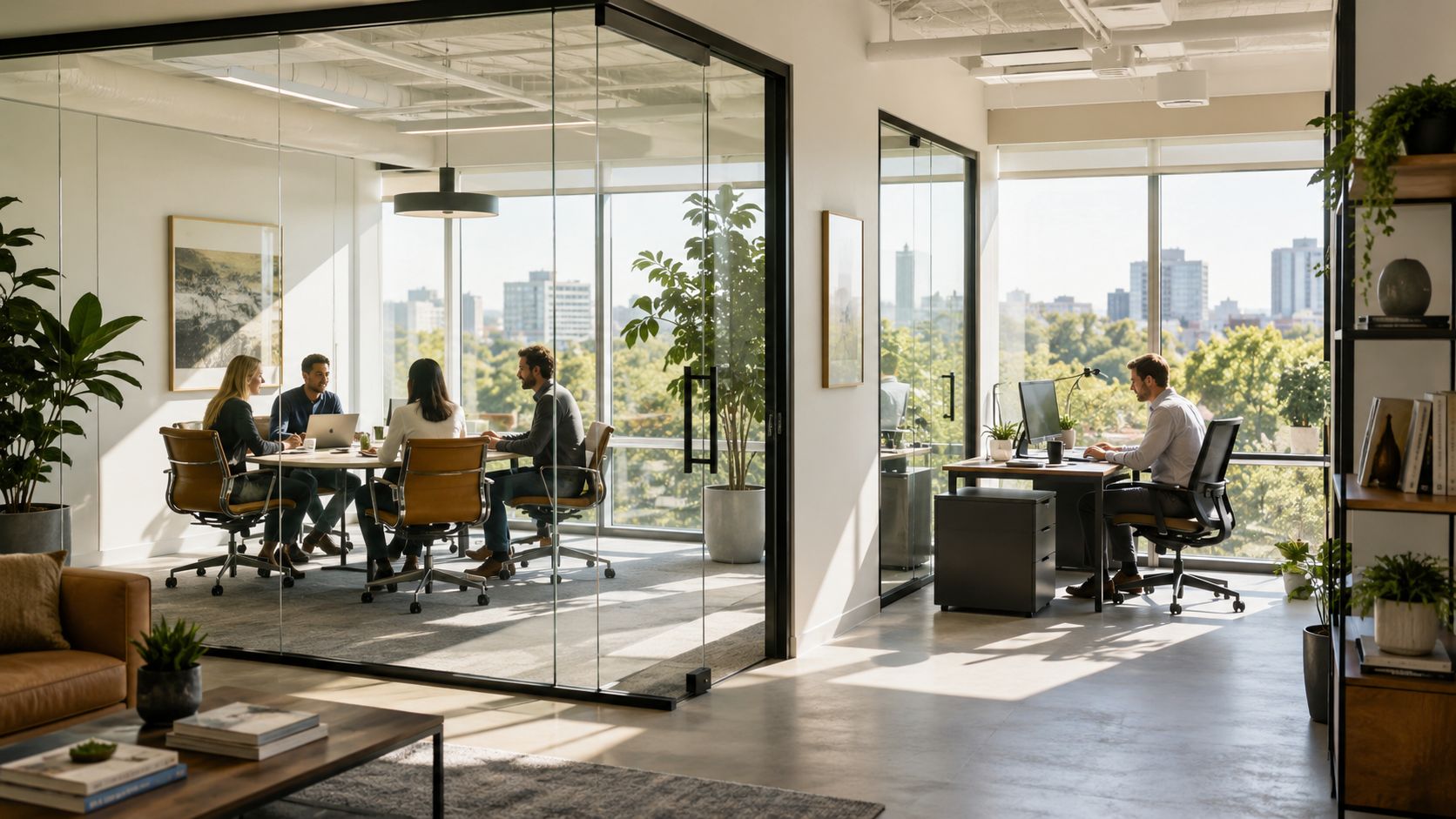
An office manager might begin with a simple request: create two quiet rooms and one conference space while keeping daylight moving across the floor. On paper, that sounds straightforward. In practice, the budget starts shifting as soon as the team decides whether those rooms need speech privacy, a frameless look, or doors that can handle constant traffic.
Start with the room use, not the finish
Before asking for pricing, define what each enclosure needs to do.
- Focus rooms: These often need better sound control than open collaboration zones.
- Conference rooms: Door choice and hardware matter more because usage is heavier.
- Manager offices: Many teams want visual openness here, but not always premium specs.
- Open-plan dividers: These usually don't need the same level of performance as enclosed rooms.
That early sorting step keeps you from overbuilding every wall line. If a glass partition only needs to divide space visually, a simpler specification often works. If it needs to support private conversations, the budget changes for a reason.
Practical rule: Spend money where the room function demands it. Don't pay for executive-level privacy in spaces that only need light separation.
Planning also gets easier when layout is resolved before product selection. A rough sketch isn't enough if doors swing into circulation, panels hit uneven ceilings, or electrical paths haven't been considered. Teams that need help at this stage usually benefit from dedicated office space planning and design, because layout errors are much more expensive to fix after fabrication.
If your project touches broader buildout work, tenant improvements, or coordination with other trades, it also helps to review how experienced firms structure commercial construction services. Even when your glass package is modular, it still has to fit the realities of the site.
A Detailed Glass Office Wall Cost Breakdown
Most buyers ask for a square-foot number first. That's useful, but it hides the full picture. Installed pricing for glass walls generally runs $30 to $140 per square foot, with a typical total project cost of $1,500 to $14,000 for a 50 to 100 square foot wall according to HomeGuide's glass wall cost guide. That same source notes a broader market view from Angi, with an average glass wall cost of $5,000 and most homeowners paying $1,500 to $18,000.
That range makes more sense once you separate the package into components.
Where the money usually goes
You aren't just paying for glass. You're paying for a system that has to be measured accurately, fabricated correctly, delivered without damage, and installed so doors align, gaps stay tight, and the finished wall looks intentional from every angle.
| Component | Standard Range (per linear foot) | Premium Range (per linear foot) | Notes |
|---|---|---|---|
| Glass panels | Qualitatively lower within the overall installed range | Qualitatively higher within the overall installed range | Larger panels, upgraded glazing, and specialty finishes push this upward. |
| Framing system | Qualitatively lower for simpler framed systems | Qualitatively higher for refined or minimal-look systems | Framing affects both appearance and installation tolerance. |
| Door and sidelites | Included as a major add-on item | Included as a major add-on item | Door packages often shift budgets faster than buyers expect. |
| Hardware | Moderate share of total | Higher share with upgraded finishes or mechanisms | Hinges, pulls, closers, tracks, and locks add up quickly. |
| Labor and installation | Significant share | Significant to high share | Site conditions, access, and alignment demands affect labor time. |
| Site prep and adjustments | Minimal on clean sites | Higher on renovation sites | Uneven floors, ceiling conditions, and demolition increase effort. |
That table uses a per-linear-foot format for planning conversations, but most vendors still price from the full installed scope. The key point is simple: line items interact. A refined frameless aesthetic can require tighter tolerances. Better acoustics can require thicker glazing and sturdier perimeter conditions. A more complex door can drive both hardware cost and labor.
Doors deserve their own budget line
Buyers often underestimate doors because the wall itself gets most of the attention. In reality, the door is where a lot of daily function lives. It affects privacy, swing clearance, maintenance, user experience, and the look of the whole run.
A useful sanity check is to ask for quotes that separate:
- Wall panels
- Door package
- Hardware
- Installation labor
- Site prep or field condition allowances
That format makes it easier to compare proposals fairly. If one vendor rolls everything into a single number and another breaks out the scope, the second quote is usually easier to evaluate.
For teams comparing partition systems to more conventional glazing work, it can even help to compare bay window installation costs just to see how glass, framing, labor, and access often interact in another part of the market. The categories aren't identical, but the budgeting logic is familiar.
If you're planning partitions as part of a wider workplace layout, reviewing different glass partition wall options for offices can help you organize the scope before you request pricing.
Key Factors That Drive Your Final Price
Two projects can look similar on a floor plan and land at very different totals. The reason is specification, not mystery. Once you move past simple visual separation, cost follows performance.
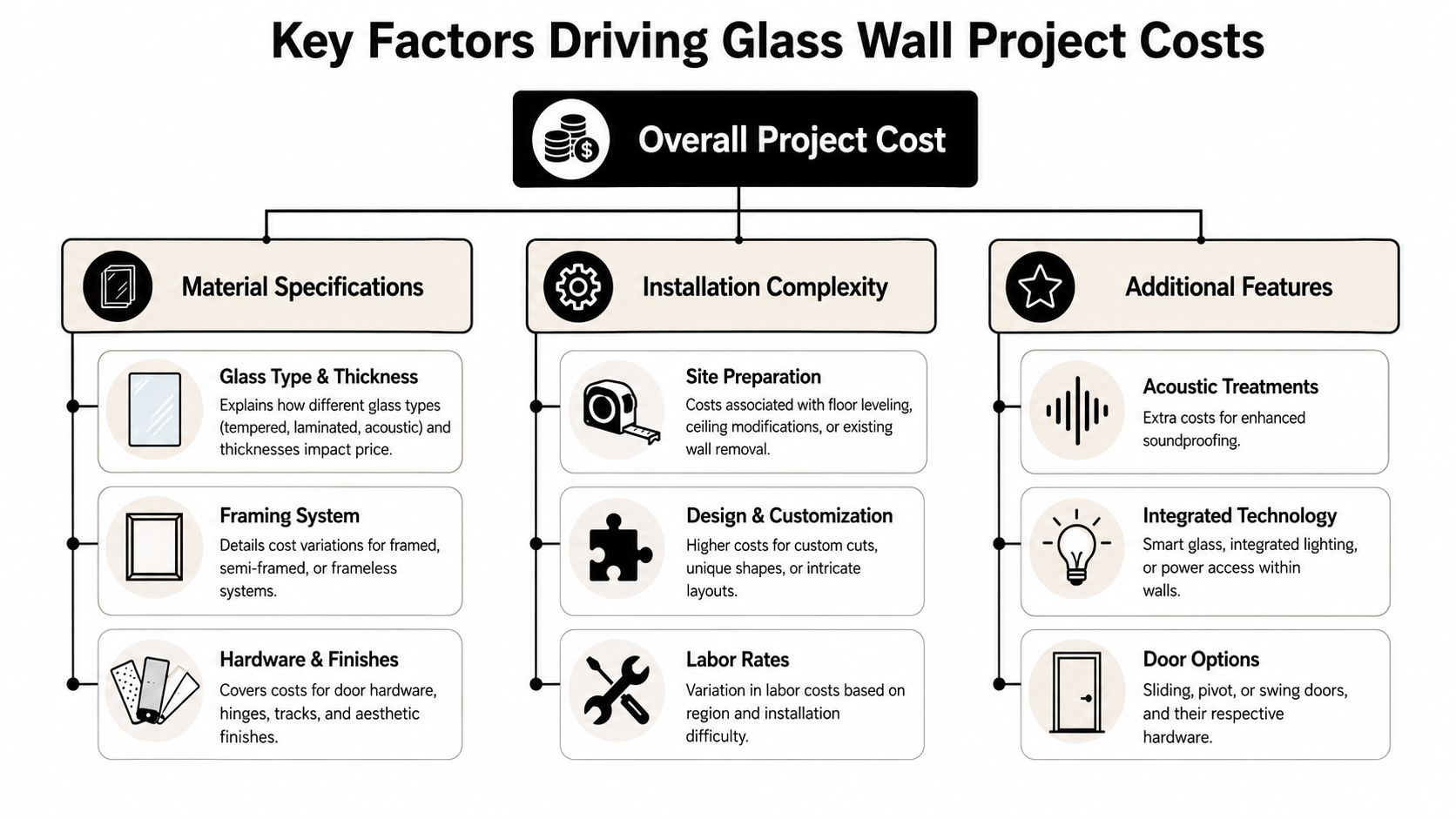
A standard installation may run $30 to $90 per square foot, while premium options such as fire-rated glass partitions can reach $100 to $200 per square foot. The door alone can add $700 to $3,000, and once a project shifts toward noise control or other specialized requirements, thicker glass, stronger framing, and more precise labor drive the budget upward, as outlined in this glass partition cost overview.
Glass type changes both performance and labor
Basic tempered glass is usually the lower-cost baseline. It gives you openness, daylight, and a clean finish. It does not solve every privacy problem.
Acoustic and other specialty systems cost more because installers aren't performing a straightforward swap of one panel for another. They may be working with heavier material, more demanding seals, and tighter fit expectations.
Better sound control isn't a cosmetic upgrade. It's a different scope with different material and installation requirements.
If your office struggles with noise spill from meetings, phone calls, or collaborative zones, it's worth reviewing dedicated office acoustics solutions before you finalize the wall spec.
Framing, hardware, and site conditions matter more than buyers expect
A framed system often gives you more forgiveness in real-world buildings. That's useful when floors aren't perfectly level or ceilings vary. A more minimal system can look excellent, but it usually asks more from the field conditions and the installer.
The same principle applies to hardware. A simple swing door package is different from a more design-forward or higher-traffic entry. Hardware isn't just a style choice. It affects wear, alignment, and serviceability.
A few cost drivers show up repeatedly:
- Site preparation: Existing wall removal, patching, and floor correction change labor time.
- Customization: Odd angles, custom heights, and unusual door locations increase complexity.
- Code requirements: Fire separation and compliance details can move a project into a different pricing tier.
- Finish expectations: Minimal reveals and premium hardware usually demand more precision.
Match the spec to the room
Strategic planning is key to good budgeting. Use stronger acoustic or specialty specifications where they solve an actual problem. Keep other zones simpler.
A conference room used for hiring interviews or leadership meetings may justify a higher-performance assembly. A divider that just creates visual organization in an open office usually doesn't.
Sample Budget Scenarios For Different Office Sizes
Real projects become easier to price when you think in patterns instead of abstract square footage. Most office glass wall packages fall into a few common scenarios, and each one behaves differently at quoting time.
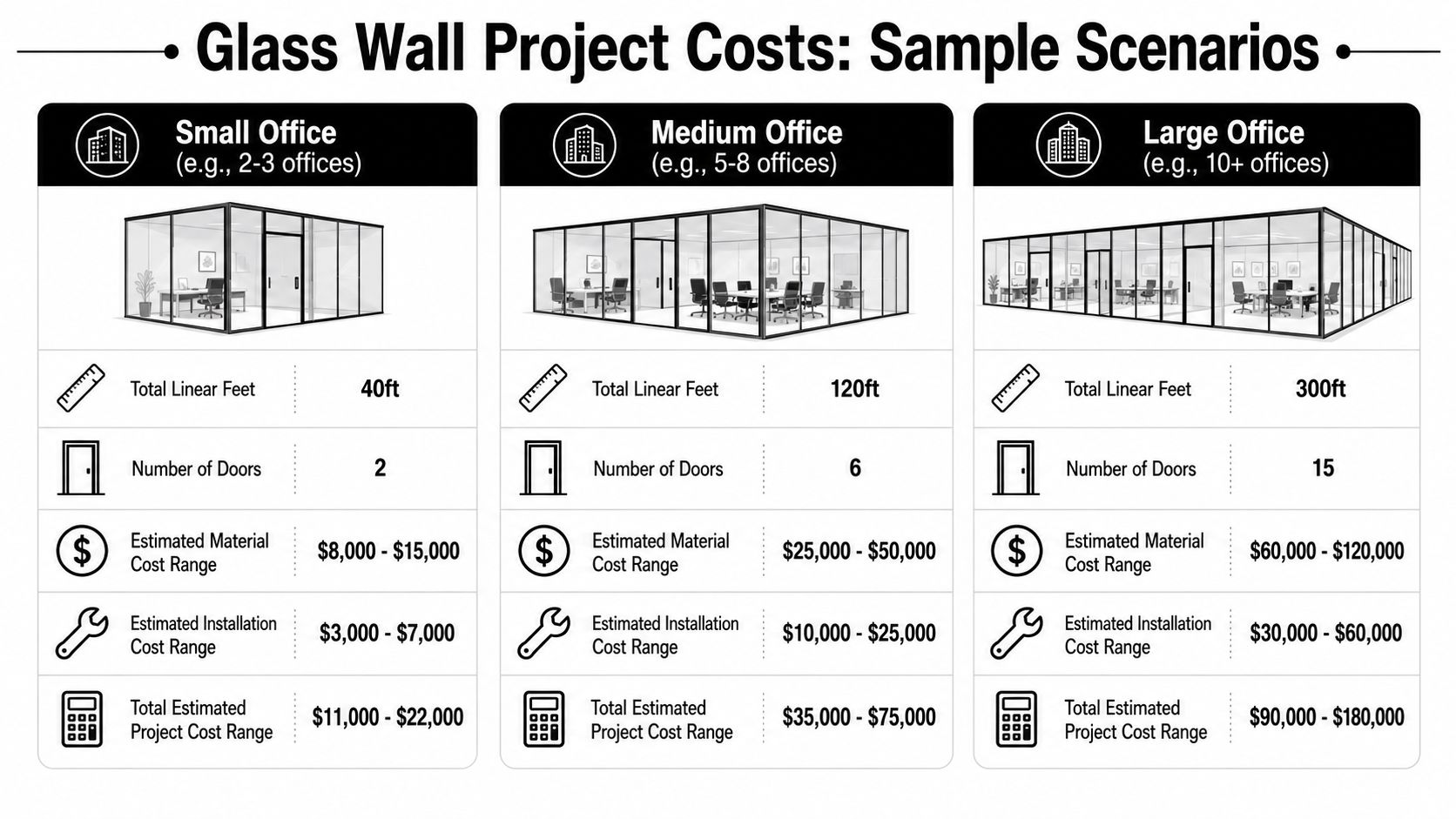
The examples below stay qualitative on purpose. Every office has its own mix of circulation, ceiling conditions, privacy requirements, and finish goals. What matters is how scope grows.
Small office fit-out
A startup or professional office often begins with one enclosed meeting room and one private office near an open workstation area. The team usually wants glass because the footprint is limited and daylight matters.
In this setup, the most budget-friendly approach is often a standard glazed partition with straightforward framed construction and simple door hardware. The project can still look polished, but it avoids adding premium specifications in spaces where they won't return much value.
This is also the point where teams should verify whether the floor plan is properly sized for enclosed rooms, corridor widths, and workstation density. A quick check with an office space size planning resource can help prevent a layout that looks efficient on paper but feels cramped once doors and furniture are in place.
Mid-sized office reconfiguration
A growing company usually adds several enclosed offices, one conference room, and a few touchdown or focus spaces. With such additions, the cost of glass office walls starts to hinge on consistency.
If every room gets the same premium spec, the budget climbs fast. A better move is to reserve stronger sound control for the conference room and any rooms used for private conversations, while keeping secondary spaces on a simpler wall package.
The middle-market mistake is over-standardizing. Not every room needs the same wall, the same door, or the same acoustic target.
Teams in this range also start feeling the impact of phasing. If installers have to work around occupied areas, after-hours access, or staggered turnover, labor planning becomes part of the budget conversation.
Large office or full-floor project
At the larger end, the challenge isn't just product cost. It's coordination. Full-floor or multi-zone projects typically combine offices, meeting rooms, support spaces, and open-plan work areas that all use glass differently.
Here, standardization becomes helpful again, but only at the system level. Repeating compatible wall modules, door families, and hardware finishes can make procurement and installation more manageable, while still allowing select rooms to carry upgraded specs.
These larger layouts often sit next to other furniture programs too, especially dense operational environments where quiet rooms support open seating. That's common in projects that include customer service zones or adjacent call center cubicle layouts.
A large project also benefits from early decisions about future moves. If leadership expects headcount shifts, mergers, or departmental changes, the best budget isn't always the lowest first number. It's the one that gives the facility options later.
Smart Strategies To Manage Your Installation Budget
Controlling cost doesn't mean stripping the project down until it stops working. It means making a few disciplined decisions early and refusing expensive changes late.
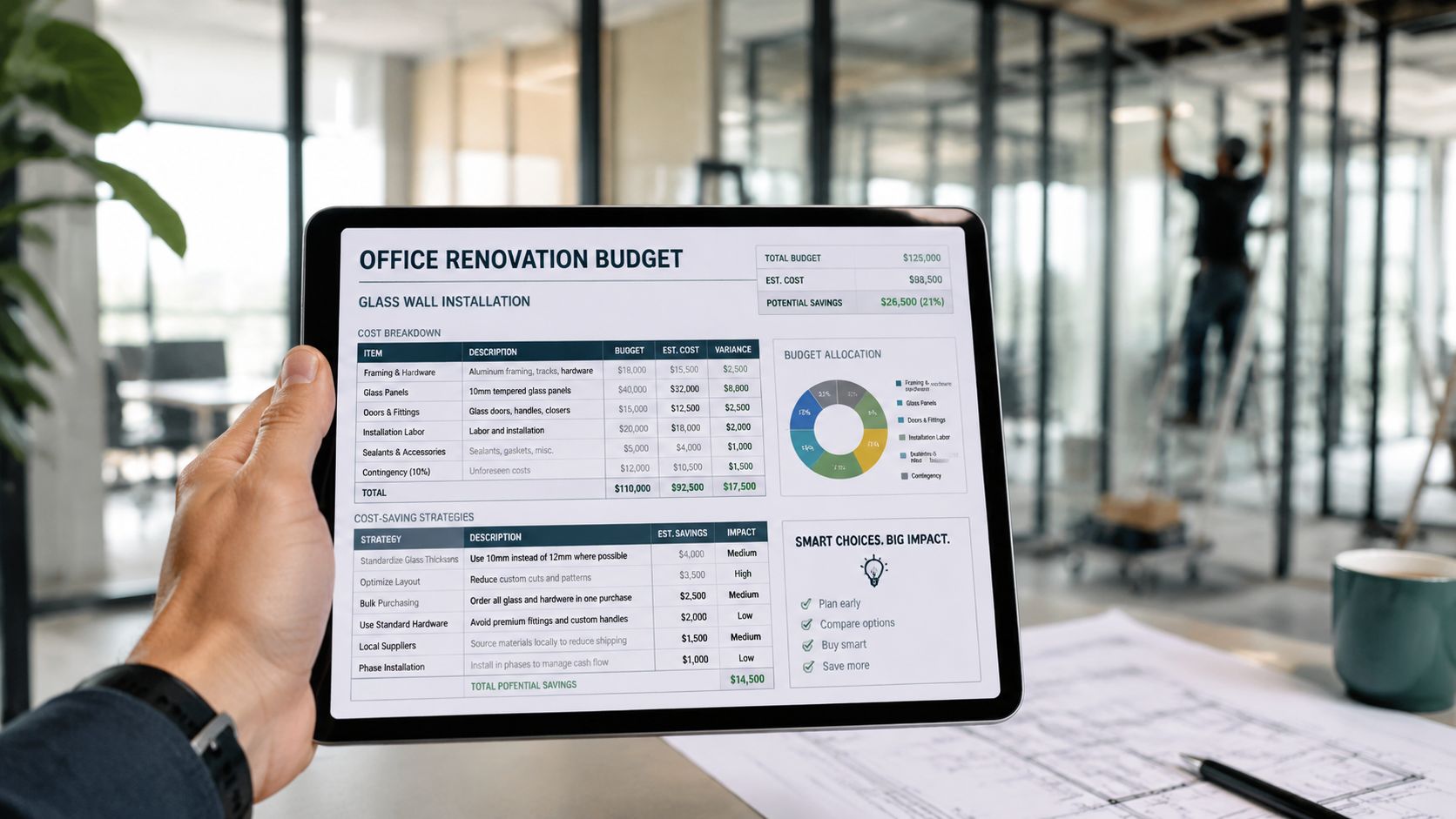
The first strategy is simple. Finalize the layout before you fall in love with details. Glass projects get more expensive when teams approve a concept, then shift door locations, room sizes, or ceiling interfaces after measurements are already underway.
Spend on the rooms that earn it
A smart budget usually mixes specifications across the floor.
- Protect privacy where it matters: Boardrooms, HR rooms, and interview spaces often justify acoustic upgrades.
- Keep open-office dividers simpler: If the goal is zoning and light flow, standard assemblies are often enough.
- Standardize hardware where you can: Too many unique door packages complicate procurement and maintenance.
- Limit one-off custom shapes: Custom geometry can look sharp, but it often adds fabrication and installation friction.
That approach helps preserve both function and appearance. It also makes vendor quotes easier to compare because the scope is more disciplined.
Another budget saver is installation planning. If the site is occupied, sequence matters. Clean access paths, confirmed delivery windows, and coordination with electricians or data teams reduce delays and field changes. That's why experienced teams often bring in office furniture installation support early instead of treating it as the last step.
Use planning tools before you buy
The cheapest change is the one you make on screen instead of in the field. If you're testing workstation adjacencies, room placement, privacy levels, and finish direction, the Cubicle Designer gives you a practical way to think through the whole environment before orders are locked.
Video walkthroughs can also help teams understand how modular planning affects both budget and flexibility:
One more guideline matters. Don't optimize only for installation day. If your team expects churn, reorganization, or phased growth, a modular system often holds budget better over time than construction that has to be demolished and rebuilt.
Beyond Upfront Cost ROI And Long-Term Value
The best glass wall decision usually isn't the cheapest quote. It's the one that still looks sensible after you account for light, maintenance, reconfiguration, and how the office may change.
Industry guidance on the life-cycle view notes that glass partitions can reduce lighting bills by around 25%, and many projects "break even in 2–3 years" when daylighting and reuse benefits are included. The same source notes annual maintenance can run $100–$300 depending on size and features, while standard partitions may be $30–$90 per square foot and premium frameless systems about $130–$160 per square foot, as discussed in this review of office glass wall partition costs and value.
Daylight and adaptability change the math
Glass does something drywall can't do well. It shares light across the floor plate while still creating defined space. In offices with good perimeter exposure, that can improve the economics of the buildout over time instead of only on install day.
Maintenance also deserves a realistic view. Glass is visible, so fingerprints and smudges get noticed. But maintenance is usually straightforward, and many teams prefer that tradeoff to enclosed rooms that block light and feel heavier than they need to.
The long-term value of a glass system often comes from what you don't have to rebuild later.
That matters most in modular environments. If departments grow, shrink, or change seats, reconfigurable systems can preserve more of the original investment than fixed construction. It also gives facility teams more flexibility when leadership changes direction.
For offices that need more privacy without giving up daylight, some teams also explore residential and commercial window film as a secondary measure for glare control or selective visual privacy. It's not a replacement for proper wall specification, but it can support the finished environment.
Frequently Asked Questions About Glass Wall Projects
Do glass wall projects usually require permits
Sometimes. It depends on the scope, the building, and whether the work affects egress, fire separation, or other code-related conditions. Interior reconfiguration that looks simple can still trigger landlord review or local permitting, so confirm that early with your architect, contractor, or property manager.
Can electrical and data cabling be integrated cleanly
Yes, but it needs to be planned before fabrication and installation. Cable routing, floor feeds, adjacent furniture, and device locations should be coordinated as part of the layout. Clean results usually come from designing the wall system and workstation plan together instead of treating them as separate purchases.
What's the practical difference between framed and frameless options
Framed systems generally offer a more forgiving installation path and a different balance of structure, acoustics, and detailing. Frameless systems prioritize a lighter visual effect and cleaner sightlines, but they often demand tighter site conditions and careful specification.
How should teams compare system families during planning
Start with room function. Then compare appearance, privacy, ease of reconfiguration, and how the walls will relate to the rest of the office. That matters if you're also coordinating enclosed rooms with adjacent workstation cubicles or planning around broader furniture packages such as custom office cubicles.
Where should I begin if I'm pricing both partitions and the wider office
Begin with the full workplace plan, not the walls in isolation. If you're still shaping the overall environment, it's worth reviewing the main Cubicle By Design website and the company's dedicated glass office partitions page so you can align room enclosures, open-plan seating, and future reconfiguration from the start.
If you're planning the cost of glass office walls and want a layout that fits your budget, workflow, and long-term space needs, Cubicle By Design can help you evaluate options before small design choices turn into expensive field changes. Use their tools and product resources to compare modular workplace solutions, test configurations, and move from rough idea to install-ready plan with more confidence.