

Open offices often have a design problem disguised as a people problem.
According to 2026 workplace noise statistics, open-plan offices can reach up to 70 dB, well above the optimal 50 dB. That gap correlates with productivity loss of over 66%, and 69% of employees report dissatisfaction with workplace acoustics. Noise isn't a minor comfort issue. It changes how people think, how well they remember information, and how clearly they communicate.
Organizations often respond ineffectively. They buy a few panels, add a white noise machine, remind employees to keep it down, and hope the complaints fade. Sometimes that helps a little. It rarely fixes the underlying system.
The practical way to reduce office noise is to treat it like any other operational issue. Measure it. Identify the main sources. Apply the right level of intervention. Then verify whether the change improved focus, privacy, and day-to-day output.
How to Reduce Office Noise
First Understand Your Office Noise Problem
Noise control starts with diagnosis, not shopping.
When people say an office is loud, they usually mean one of three things. Speech carries too far. Mechanical systems create a steady background hum. Hard surfaces bounce sound around so even moderate activity feels amplified. If you don't separate those causes, you'll spend money in the wrong place.
Take a baseline reading
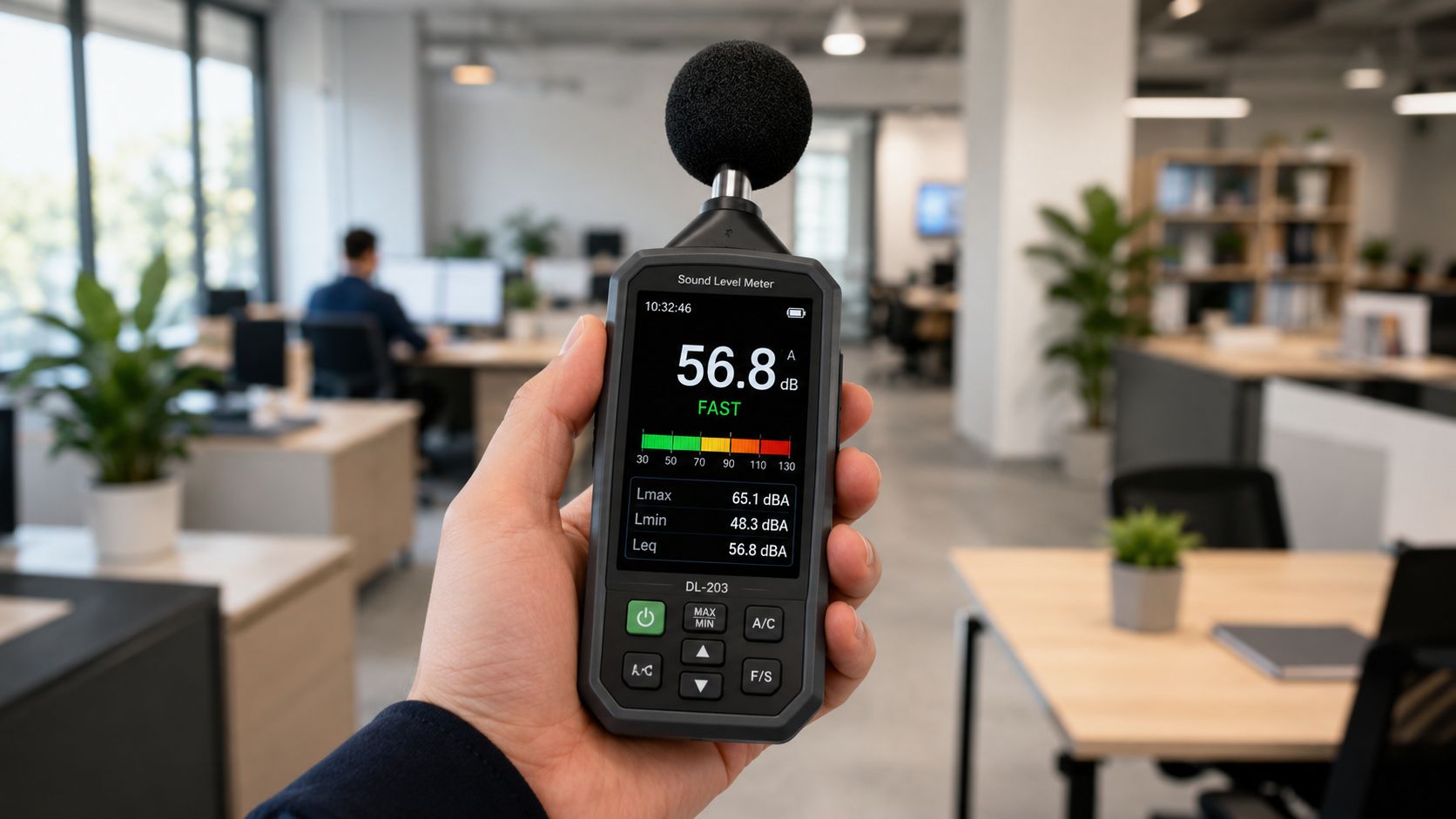
Start with a simple noise audit. A smartphone app can give you a directional read. A professional sound level meter is better if you're making layout or purchasing decisions.
Walk the office at several times during the day. Check focus areas, printer zones, circulation paths, conference rooms, reception, and any place where people take calls at their desks. Record what you hear and when it peaks.
Use this basic checklist:
- Measure different moments: Check early morning, mid-morning, after lunch, and during common meeting windows.
- Track the location: Note where the noise is happening, not just the decibel level.
- Log the trigger: Separate speech noise, HVAC rumble, ringing phones, office equipment, and foot traffic.
- Mark the impact: Identify where people lose focus, repeat themselves, or leave their seats to find a quieter place.
A good audit turns complaints into a map. If you're already reworking your layout, then space planning best practices become useful because acoustics and circulation are tightly linked.
Practical rule: If the same complaint appears in multiple departments, the problem usually isn't employee sensitivity. It's the room.
Identify the top noise sources
In most offices, the biggest offenders are predictable:
- Conversation spill: Open-plan seating lets speech travel farther than managers expect.
- Mechanical noise: HVAC fans, duct vibration, and poorly isolated equipment often create constant fatigue.
- Shared devices: Printers, shredders, break-room appliances, and entry doors add intermittent disruption.
- Reflective finishes: Glass, polished concrete, tile, and exposed ceilings increase reverberation.
The point isn't to remove all sound. Offices need collaboration. The point is to stop unnecessary sound from spreading into every task zone.
A useful noise map has two labels for each area. First, what kind of work happens there. Second, what kind of sound dominates there. Once those don't match, you know where to intervene.
Immediate and Low-Cost Noise Fixes
Not every office needs construction work on day one.
Some of the most effective first moves are layout and policy adjustments you can make this week. These won't solve a significantly flawed acoustic environment, but they can reduce friction fast and show employees that the issue is being handled seriously.
Rearrange before you renovate
Desk placement matters more than many teams assume. Historical workplace acoustics research found that grouping frequent communicators into designated zones and using headsets for phone calls reduced noise levels by 25% while improving speech intelligibility. OSHA and long-term acoustics research also show that targeted noise-reduction strategies can cut ambient office noise by 30% to 40% in the right conditions.
Apply that logic practically:
- Separate work modes: Move sales, support, or highly collaborative teams away from finance, admin, or other concentration-heavy groups.
- Pull noise off main paths: Don't place focus desks beside corridors, copiers, or break areas.
- Use headsets consistently: Phone-heavy teams create less spill when calls stay close to the speaker.
- Create small buffers: Even a storage run, planter line, or file area can interrupt direct sound paths.
Add more absorption with what you already have
Soft surfaces absorb reflected sound. Hard surfaces reflect it. That principle drives almost every low-cost acoustic improvement.
Start with the easiest changes:
- Rugs and carpet tiles: They reduce footfall and chair movement noise better than bare hard flooring.
- Curtains and fabric panels: They help in rooms with large glass areas or lots of echo.
- Fabric-covered boards: These perform better acoustically than decorative hard-surface wall pieces.
- Soft seating zones: Upholstered lounge pieces often calm a noisy corner better than another hard conference table.
WHO-related research and acoustical engineering findings from 2024 to 2025 confirm that acoustic ceiling baffles, wall panels, and soft furnishings can absorb up to 60% of reflected sound in open-plan offices.
Move from the cheapest reversible fix to the most permanent one. That order keeps you from paying twice.
Use plants carefully
Greenery can help, especially for high-frequency ambient sound and visual softening. It won't replace true acoustic treatment, but it can support it. The main benefit in practice is that plants break sightlines and psychologically cue quieter behavior while adding some absorption.
Set fast rules for ringing and interruptions
A 2023 meta-analysis found that offices with designated quiet hours and mobile phone silent policies saw a 35% reduction in disruptive ringing and conversation noise. That's one of the few policy changes that tends to work quickly because it targets preventable interruptions.
Low-cost fixes work best as first response tactics. If they help but don't solve the problem, that's a clear signal to invest in structural acoustic control rather than piling on more temporary patches.
Implementing Strategic Acoustic Treatments
Once the easy changes are in place, the next gains come from treating the room itself.
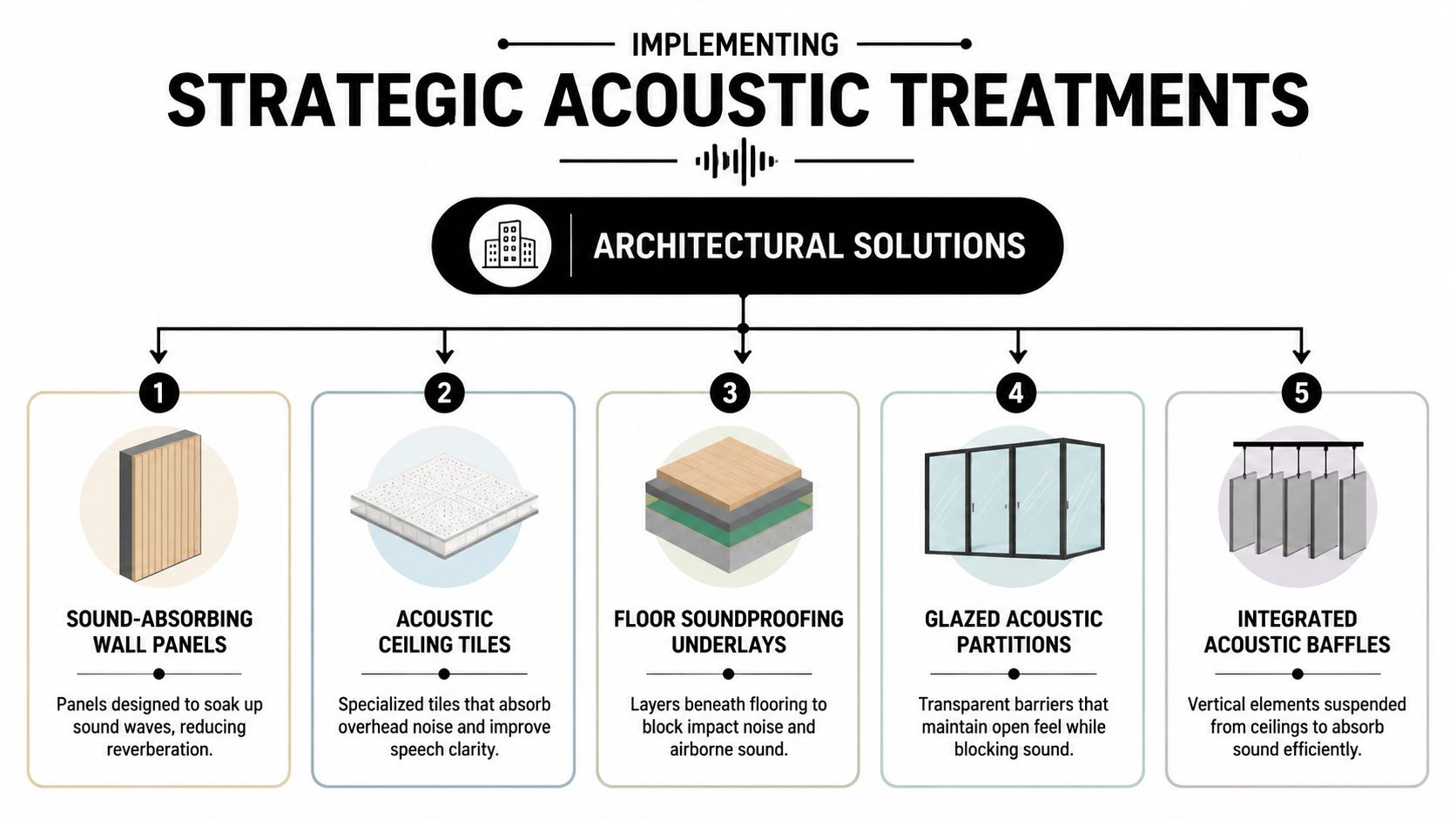
In noise reduction efforts, many offices either overspend on decorative products that don't perform or underspend on one small intervention and expect it to fix everything. Acoustic treatment works when you layer it across the surfaces driving reverberation and sound transfer.
Start with the ceiling
In open-plan offices, the ceiling is often the biggest missed opportunity. Sound rises, reflects, and spreads across the space. Treating only the walls leaves that major reflection path untouched.
Ceiling baffles and panels are consistently one of the most effective interventions because they absorb sound where open offices have the least obstruction. If you're evaluating envelope-related noise at the same time, Superior Home Improvement's window guide is a useful reference for understanding how glazing choices affect sound transfer from outside and across perimeter zones.
Understand NRC before you buy
NRC, or Noise Reduction Coefficient, is a simple way to judge how much sound a material absorbs rather than reflects. Higher NRC means better absorption.
For high-frequency office noise, a step-by-step methodology recommends absorption materials with a minimum NRC of 0.85. The same guidance notes that roughly 1 inch of fiberglass under decorative fabric provides effective absorption, while carpet placed directly on walls is ineffective. That methodology also stresses that partitions should extend slab-to-slab, because failing to do so can cause 30% to 40% higher sound transmission, as explained in this office acoustics guide from Colden.
Treat walls and floors as a system
Wall panels matter most at reflection points, not randomly scattered for appearance. Flooring matters most where impact noise and rolling movement carry across the room.
A quick decision table helps:
| Surface | What it solves | What to look for |
|---|---|---|
| Ceiling | Broad reverberation in open areas | Baffles, clouds, or acoustic panels |
| Walls | Echo and speech reflection | Panels placed at key reflection zones |
| Floor | Footfall, chair noise, rolling carts | Cork, rubber, or thick carpet with underlayment |
For flooring, acoustic specifications show that cork, rubber, or thick carpet installed directly to the floor can reduce impact noise by 12 to 18 dB compared with hard surfaces. For wall and partition assemblies, acoustic panels with STC 55 are the benchmark when preventing leakage through adjacent spaces matters.
If the room has exposed concrete, glass, and a hard floor, don't expect one wall panel package to change the experience. The reflections are coming from every direction.
Know what doesn't work well on its own
White noise and noise-cancelling headphones are often treated as complete solutions. They aren't. The Colden guidance is clear that they're partial fixes that mask noise rather than reduce ambient noise levels.
Likewise, decorative finishes that look soft but have little acoustic value can create false confidence. If you're introducing enclosed team areas while keeping daylight and visual openness, glass partition walls for offices can help segment work modes without turning the whole floor into closed private offices.
Leveraging Furniture and Partitions for Noise Control
Furniture isn't just what fills the floor plan. It is part of the acoustic infrastructure.
That point gets missed when teams approach office noise as a matter of etiquette or add-on accessories. In practice, the wrong furniture system can lock in poor speech privacy, weak absorption, and constant distraction for years.
Why cheap cubicles become expensive
The budget-first mistake is common. A company needs seats fast, buys thin-walled cubicles or very low partitions, then tries to patch the resulting noise problem with desk accessories and scattered panels.
A 2023 industry study found that 45% of organizations replace their initial low-cost cubicle systems within 3 years due to poor acoustic performance. That's the acoustic regret gap in one number. Cheap systems often fail because the furniture itself doesn't absorb enough sound and doesn't provide enough separation between tasks.
Here are the trade-offs facilities teams should weigh:
- Low upfront cost: Thin panels and basic benching can reduce initial spend.
- Higher operational friction: More distraction, more complaints, and more demand for enclosed rooms.
- Faster replacement cycle: The furniture may fit the budget but not the work.
- Lower flexibility: Fixed, low-performance systems are harder to reconfigure when teams change.
By contrast, modular systems with integrated acoustic surfaces do more than divide space. They shorten sound paths, reduce direct speech transfer, and create visual boundaries that support quieter behavior.
Match partition type to work type
Not every team needs the same enclosure.
- Focus-heavy departments: Higher panels and more absorption are usually worth it.
- Manager and HR areas: Stronger speech privacy matters more than open visibility.
- Hybrid touchdown zones: Reconfigurable dividers help because occupancy shifts day to day.
- Call-intensive teams: Dedicated call center cubicles are built around speech containment and repeated phone use.
When desk-level privacy is the main problem, desk divider panels can help reduce direct line-of-sight and cut some conversational spread. They are usually a support layer, not a full acoustic strategy.
A practical example from adjacent furniture planning is storage. Large, dense pieces can help break up long sound paths if they're placed intelligently. Something like the Slone Brothers Bella 40 shows the broader point. Storage isn't acoustic treatment, but substantial furnishings can contribute to zoning when they're used to separate active and quiet areas.
Use modular systems to design noise out
The strongest furniture strategy starts early, during layout and specification.
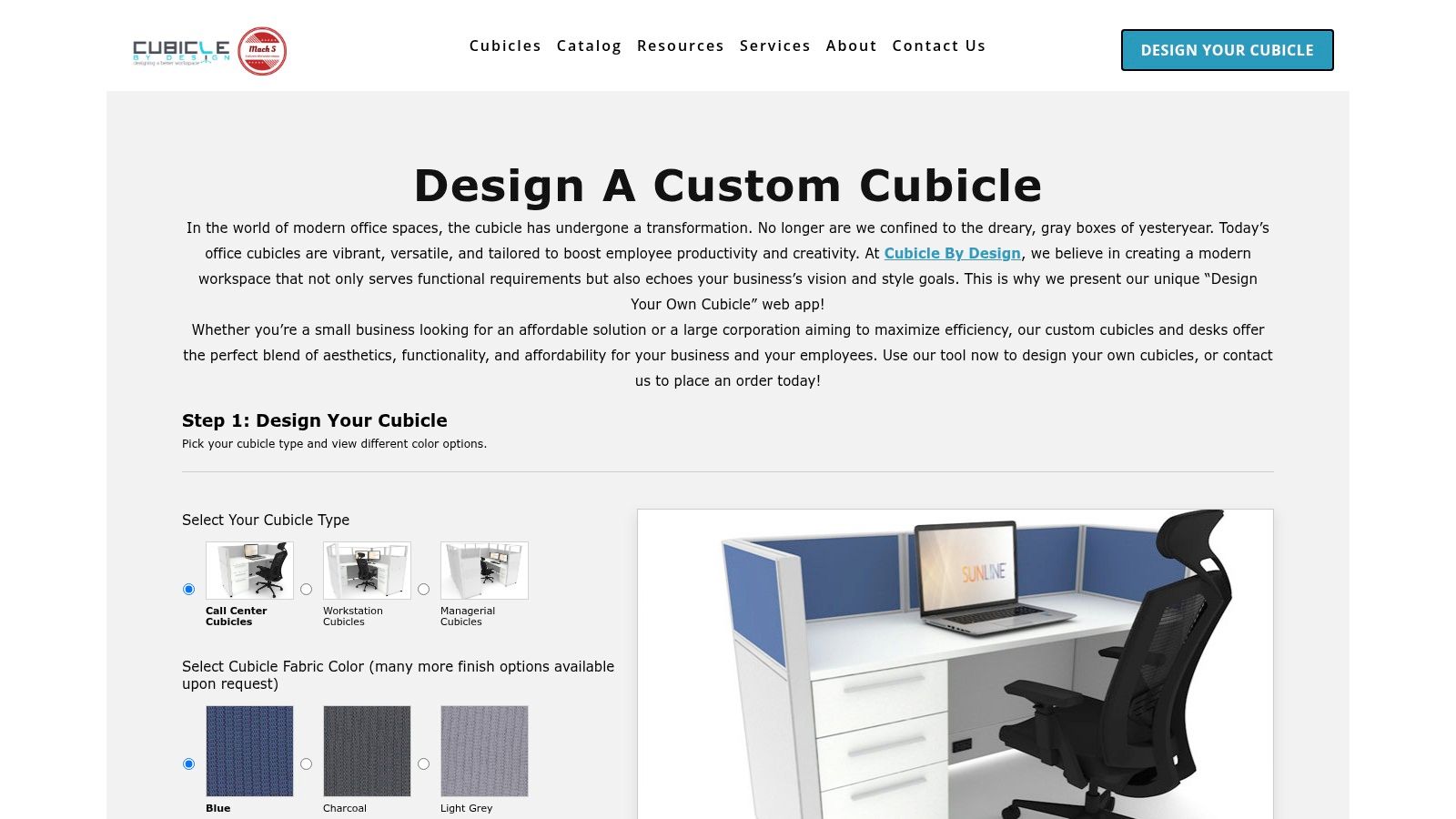
In planning scenarios, a configurable planning tool becomes useful. A system like the Cubicle Designer lets teams test privacy height, workstation dimensions, finishes, storage, and electrical options before committing to a layout that may be hard to fix later.
Custom systems matter because acoustic performance isn't one-size-fits-all. Custom office cubicles can be configured around department needs, while glass office partitions can create enclosed quiet zones without sacrificing borrowed light. If you're building out benching alternatives, workstation cubicles can provide a more controlled middle ground between open desks and fully enclosed offices.
Cubicle By Design is one example of a modular furniture provider that combines cubicles, glass walls, and planning support in a way that allows teams to address layout and acoustic control together rather than as separate purchases.
Acoustic performance should be specified at the furniture stage, not discovered after move-in.
Creating a Culture of Quiet with Policies and Dynamic Zoning
Even a well-designed office gets noisy if the workplace rules fight the layout.
The most effective acoustic environments pair physical interventions with clear behavioral norms. People need to know where it's appropriate to collaborate, where calls should happen, and when focused work has priority.
Build a simple policy set
Good office noise policies are specific and easy to enforce. Vague reminders to be respectful don't usually change behavior.
A workable policy set often includes:
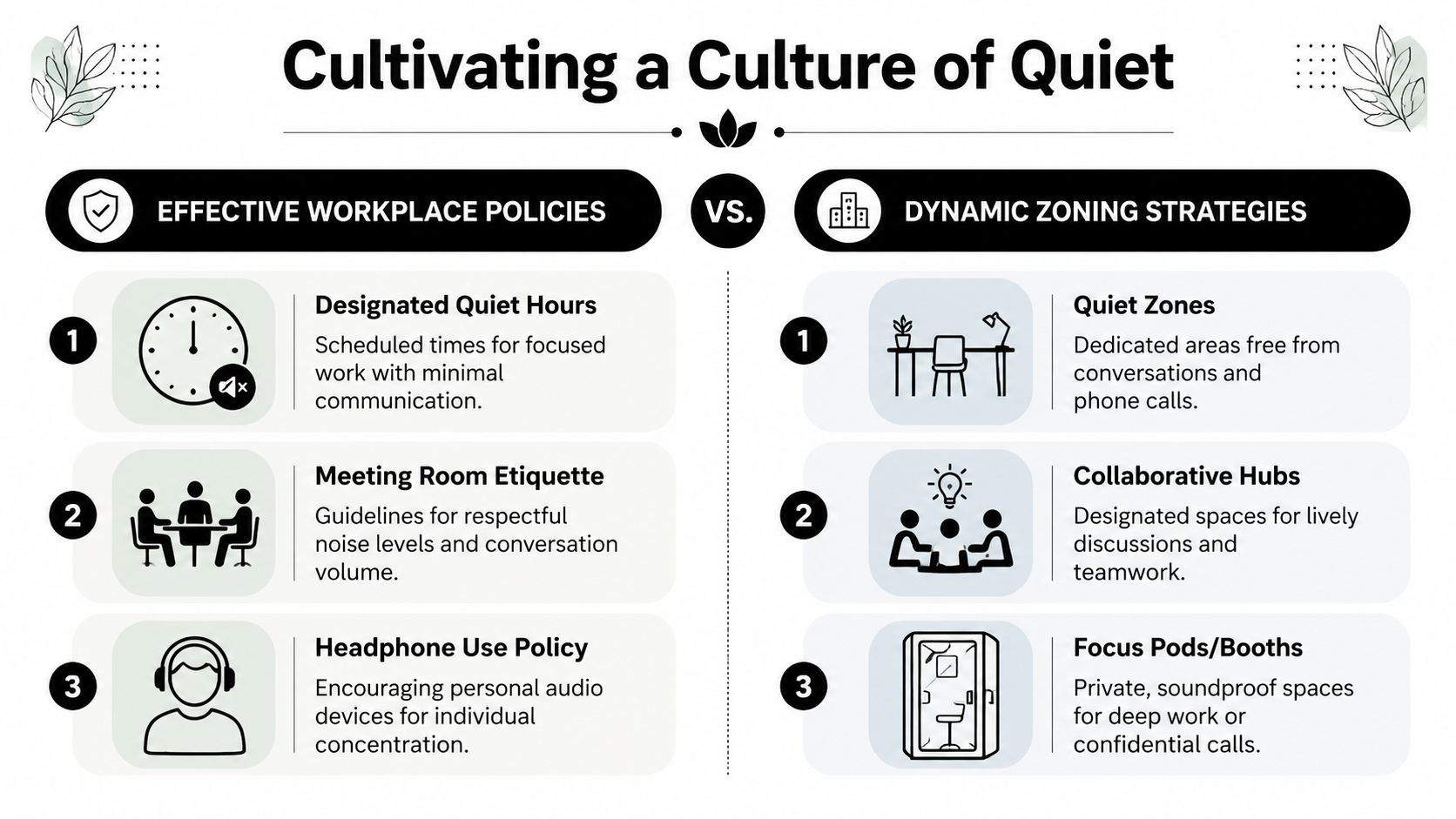
- Quiet hours: Reserve part of the day for heads-down work with minimal conversation.
- Call rules: Push longer calls and video meetings to enclosed rooms, booths, or designated call areas.
- Meeting etiquette: Keep ad hoc collaboration out of focus zones.
- Phone settings: Default devices to silent or vibration.
- Headphone norms: Allow them as a focus cue, but don't rely on them as the primary acoustic fix.
The privacy pods for offices category fits into this model well when teams need a predictable place for calls or concentrated solo work without building permanent rooms.
Adapt the office to hybrid reality
Hybrid work changed the acoustics problem. The challenge isn't just excessive volume. It's inconsistency.
A 2025 McKinsey Global Survey found that 68% of hybrid workers report unpredictable noise levels as their top frustration, and related research shows that dynamic acoustic zoning with modular furniture is 3x more effective at reducing noise complaints than static solutions. Static quiet rooms don't always match daily occupancy patterns. Some days they're underused. Other days the whole floor spills over.
Dynamic zoning is the more practical answer. Use modular screens, movable boundaries, reconfigurable cubicles, and small enclosed booths to reshape the office around the day's actual work mix.
A better zoning model
Instead of one fixed quiet room and one fixed collaboration room, divide the floor into work modes that can shift:
| Zone type | Best use | Key requirement |
|---|---|---|
| Quiet zone | Deep focus, admin work, writing | Low conversation and no speakerphone use |
| Collaborative hub | Team discussion, quick reviews | Separation from focus seating |
| Phone or pod space | Calls, video meetings, private discussion | Reliable speech privacy |
The office doesn't need to be silent. It needs to be predictable.
That predictability is what employees respond to. When people know where to go for quiet and where they can talk freely, noise stops feeling random and starts feeling managed.
Measuring Your Success and Calculating ROI
Noise projects often stall because teams stop after installation. They assume the job is done once the panels are mounted or the partitions are in place.
The smarter move is to measure the after state with the same discipline used in the initial audit. That gives you proof, not impressions.
Re-run the audit
Go back to the same locations and time windows you measured before. Use the same meter or app if possible. Record the same categories of sound and compare them against the original map.
Look for changes in these areas:
- Ambient noise level: Is the general background lower or more stable?
- Speech spill: Are conversations carrying less distance?
- Interruption frequency: Are fewer people being disrupted by nearby calls and meetings?
- Use of quiet spaces: Are enclosed or designated focus areas solving the need they were built for?
Historical workplace acoustics data shows that isolating noise sources, using quieter equipment, and enforcing quiet periods can reduce ambient office noise by 30% to 40%. If your result falls well short of that range, the issue is often incomplete treatment, poor zoning, or furniture that doesn't support the intended behavior.
Track business outcomes, not just decibels
The financial case gets stronger when you combine acoustic readings with operational metrics.
Use a before-and-after review that includes:
- Employee survey feedback: Ask specifically about focus, privacy, and ability to take calls without disturbing others.
- Manager observations: Identify whether teams report fewer accidental interruptions.
- Space utilization: Check whether conference rooms are being misused as quiet work refuges.
- Retention and morale signals: Noise doesn't act alone, but better acoustic conditions often support a calmer workplace experience.
A simple ROI discussion can start with this logic. Noise was interfering with work. The business invested in reducing that interference. The return appears in reclaimed focus time, smoother communication, and fewer complaints requiring management attention.
If you're evaluating larger layout or furniture investments, workspace price guidance helps frame cost discussions around the scale of change rather than isolated product line items.
Treat acoustics as an operating asset
The best office noise projects don't end with a product order. They become part of workplace management.
Review the space after move-ins, headcount changes, and hybrid policy shifts. Acoustic performance changes when seating density changes. It also changes when one quiet department becomes a call-heavy team six months later.
That's why the strongest acoustic plans are measurable, adjustable, and tied directly to how people work.
A quieter office doesn't come from one trick. It comes from better diagnosis, smarter zoning, stronger acoustic treatment, and furniture systems that support the way teams work. If you're planning a reconfiguration or replacing underperforming workstations, Cubicle By Design provides modular cubicles, glass walls, planning tools, and layout support that can help turn noise control into a practical workplace design decision instead of an ongoing patch job.