



You're probably dealing with the same tension most facility and office managers face on a first major furniture buy. Finance wants the lower quote. Staff want comfort. Leadership wants the space to look sharp for recruiting, clients, and hybrid teams moving in and out all week.
That's where a lot of furniture decisions go wrong. Buyers treat desks, chairs, panels, and storage like a commodity purchase, then spend the next few years managing wobble complaints, failed mechanisms, fabric wear, awkward workstation fit, and replacement requests that arrive much sooner than anyone expected.
Good office furniture quality isn't about chasing premium finishes for their own sake. It's about buying products that hold up under real use, support the people using them, and make sense when you look at lifecycle cost instead of invoice price alone.
Maximize ROI Office Furniture Quality Guide 2026
Beyond the Price Tag Why Office Furniture Quality Matters
A furniture project looks simple until you have to live with the result. A low bid can feel like a win on ordering day, but furniture keeps costing money long after procurement closes. It affects maintenance calls, user complaints, reconfiguration flexibility, replacement timing, and how people feel in the space every day.
The wider market reflects that shift in priorities. The global office furniture market reached USD 109.26 billion in 2025 and is projected to hit USD 183.52 billion by 2032, growing at a 7.69% CAGR, according to Stellar Market Research's office furniture market report. Buyers aren't just filling floor plans. They're investing in furniture that can support modern work environments over time.
That matters because furniture is tied to more than appearance.
What quality changes in daily operations
A better workstation usually does three things well:
- It reduces disruption: Stable desks, durable seating, and reliable hardware create fewer service tickets.
- It supports work habits: Privacy, storage, adjustability, and layout fit the way teams operate.
- It protects the workplace standard: Visitors and employees notice sagging surfaces, chipped edges, and worn upholstery faster than most managers expect.
If you're evaluating a redesign, it helps to think about furniture the same way you'd think about flooring, lighting, or HVAC controls. It's infrastructure. It shapes output, comfort, and retention. The workplace productivity perspective on office design is useful because it frames furniture as part of operational performance, not just décor.
Practical rule: If a product only looks good on install day, it isn't high quality. Good furniture still works, fits, and presents well after repeated use, cleaning, and reconfiguration.
The shift from shopping to asset management
This is why experienced buyers stop asking, “What's the cheapest acceptable option?” and start asking different questions:
| Question | What it reveals |
|---|---|
| How will this perform under constant use? | Durability and maintenance burden |
| What will fail first? | Real lifecycle risk |
| Can it adapt to layout changes? | Future value |
| What documentation backs the claim? | Vendor credibility |
A furniture buy is rarely just a purchase order. It's an operational decision with years of consequences. That's also why many managers start with suppliers that understand complete workplace systems, not isolated pieces, such as Cubicle By Design.
Decoding Quality The Seven Pillars of a Great Build
“Quality” gets thrown around too loosely in this industry. If a vendor can't explain it beyond finish samples and a brochure, keep pushing. A usable standard needs objective checks.

Material durability
Start with what takes abuse first. Worksurfaces, edge banding, chair frames, casters, drawer fronts, and upholstery tell you a lot about how a product will age.
For seating in demanding environments, upholstery for heavy commercial use should meet a minimum of 100,000 Martindale double-rub cycles, and ANSI/BIFMA X5.1 requires rigorous structural and durability testing for office chairs, as outlined in this office furniture specification guide. That gives you a real screening tool. “Commercial grade fabric” by itself doesn't mean much.
Precision craftsmanship
Look closely at how the furniture is assembled. Quality shows up in tolerances and consistency.
Check for:
- Tight seams: Uneven stitching and puckering usually predict early wear.
- Clean joinery: Gaps at corners, misaligned drawer fronts, and visible fastener stress are warning signs.
- Consistent finish: Mismatched sheen or color often signals poor batch control.
Advanced ergonomics
A chair can be expensive and still be wrong for your staff. What matters is whether users can adjust it to fit their body and task.
Height-adjustable desks, task chairs with reliable recline tension, and seating that supports varied postures are stronger indicators than marketing language about comfort. If your office includes focused work areas alongside collaborative zones, products like glass office partitions for acoustic separation and visual openness often matter just as much as the chair itself.
A chair that looks impressive in a showroom but can't be adjusted easily by the person using it all day will generate complaints fast.
Industry certifications
Certifications don't replace inspection, but they help filter out weak options. Safety, durability, and environmental claims should be verifiable, not implied.
A good procurement file should include:
- Performance standard references: Especially for seating and frequently used components.
- Sustainability documentation: Relevant when your organization has environmental purchasing requirements.
- Testing records or product sheets: Useful when comparing similar-looking products from different vendors.
Teams that prioritize environmental impact often benefit from reviewing sustainable office materials and what they mean in practice, because sustainability claims vary widely in substance.
Comprehensive warranty
A strong warranty says the manufacturer expects the product to last. A weak one says they're protecting themselves from predictable failure points. The details matter more than the headline.
Design integrity
Good design isn't just aesthetics. It's whether the furniture layout supports circulation, power access, sightlines, privacy, and future changes without awkward workarounds.
Sustainable sourcing
Sourcing matters when you're balancing durability, compliance, and environmental goals. The strongest products usually combine responsible material choices with realistic maintenance and repairability, not just recycled content on a spec sheet.
Certifications and Warranties Reading the Fine Print
A lot of buyers stop at the phrase “BIFMA compliant” or “10-year warranty” and assume the risk has been handled. It hasn't. Those are starting points.
What certifications actually tell you
BIFMA is the body that sponsors and maintains official safety, performance, and sustainability standards for office furniture, and BIFMA Level certification uses tiers where Level 1 indicates baseline compliance and Level 2 indicates higher thresholds, as explained in BIFMA's standards overview. In practice, that means the certification is useful only if the vendor can identify what standard applies to the product you're reviewing.
For a junior manager, the safest approach is simple. Ask which standard applies to the exact chair, desk, panel system, or storage unit you're buying. Then ask for documentation tied to that exact model, not the brand in general.
What a real warranty looks like
For high-quality commercial furniture, industry standards recommend a minimum 10-year warranty, according to RIT's office standards for furniture. That's a useful benchmark because it signals the maker is willing to stand behind durability and lifecycle value.
But don't stop there. Read the carve-outs.
A weak warranty often breaks coverage into separate buckets, with shorter terms for the parts that fail first:
- Mechanisms: Recline systems, gas lifts, keyboard trays
- Mobility components: Casters, glides, drawer tracks
- Surface wear items: Upholstery, laminate edges, finish coatings
A stronger warranty package is usually easier to understand. It states what's covered, who pays labor, how replacement parts are handled, and whether discontinued finishes can still be serviced reasonably.
Warranty test: If the vendor needs several verbal explanations to make the warranty sound better than the document reads, trust the document.
Custom work needs the same discipline. A custom layout can solve real operational problems, but custom office cubicles should still come with clear support terms, not a handshake promise that “we'll take care of it.”
Red flags worth catching early
| Red flag | Why it matters |
|---|---|
| Warranty language is vague | Hard to enforce after install |
| Upholstery coverage is limited | Fabric often shows wear early |
| Parts availability is unclear | Repairs turn into replacement |
| Labor exclusions are buried | Service costs shift back to you |
The Hands On Inspection A Practical Checklist for Buyers
Specs matter. So does touching the product before you sign off. A showroom sample, mockup, or installed reference project can tell you things a quote never will.
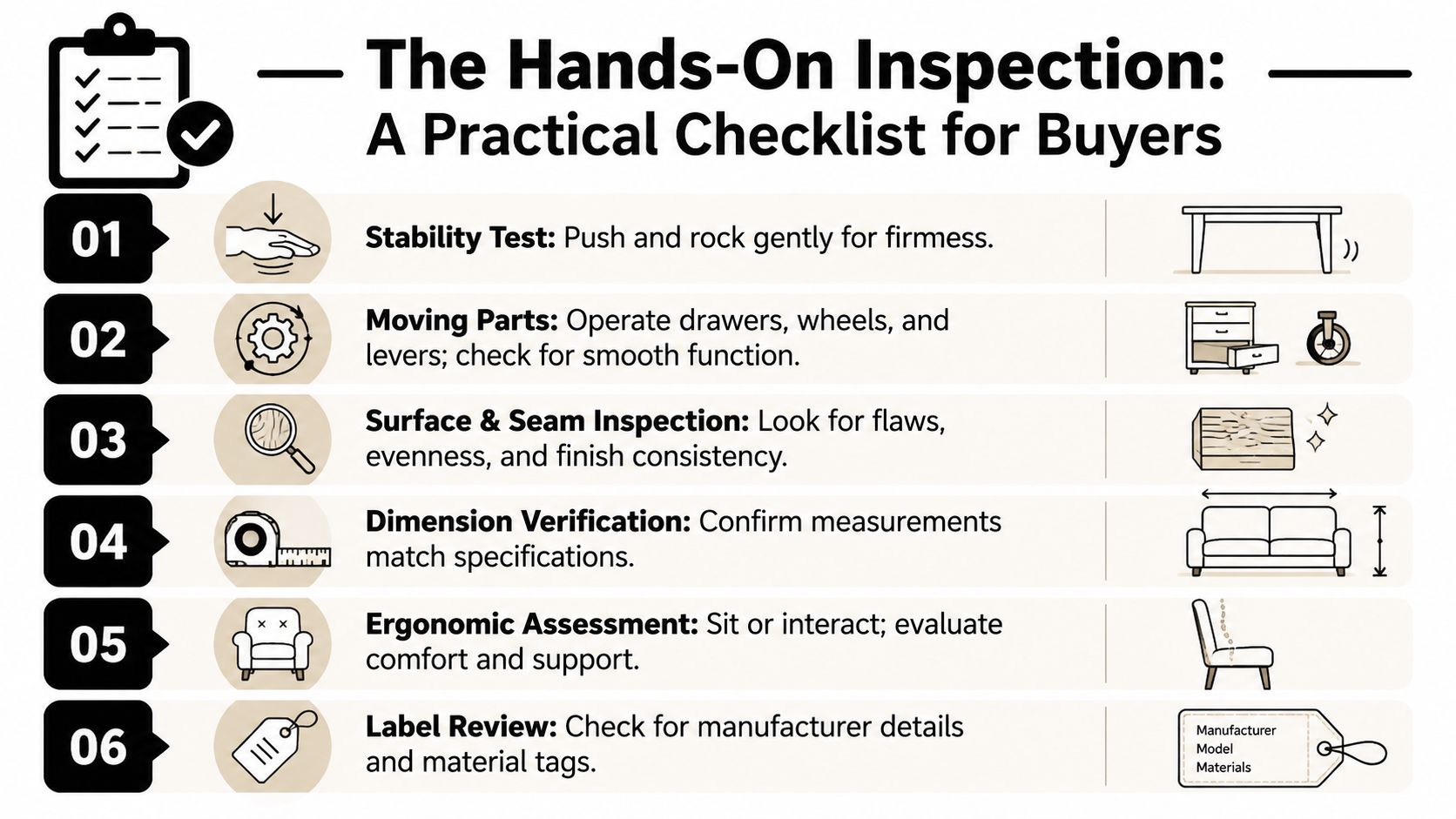
Start with movement and stability
Push on the desk from more than one angle. Sit in the chair and shift your weight. Open drawers fully. Roll mobile pieces over a transition, not just a smooth showroom surface.
If the product feels loose during a brief inspection, it won't improve under daily use.
Use this short field checklist:
- Rock test: Apply light pressure at front and sides. Any wobble in a workstation frame should concern you.
- Drawer cycle: Open and close repeatedly. Glides should track smoothly and return square.
- Caster travel: Roll chairs and pedestals over realistic surfaces. Cheap wheels reveal themselves quickly.
- Adjustment feel: Levers and controls should engage cleanly, without sticking or grinding.
Environments with nonstop seat turnover need extra scrutiny. In call center cubicles where seating and workstations are used hard across shifts, minor hardware weakness becomes a maintenance pattern fast.
Inspect the details buyers often miss
Visual quality isn't just about style. It's about consistency. Run your hand under worksurfaces. Look at the underside of desks, backs of panels, and interior drawer construction. Manufacturers hide shortcuts where buyers don't usually look.
Pay attention to:
- Edge treatment: Chips, sharp transitions, and poorly bonded banding fail early.
- Seams and upholstery pull: Seams should be straight, tight, and uniform.
- Finish continuity: The same product family should have matching tone and sheen.
- Panel fit: Gaps and uneven reveals suggest weak assembly control.
Don't inspect only what the user sees from five feet away. Inspect the places maintenance staff will end up dealing with later.
Match the product to the spec
Many teams often get burned. They approve one sample and receive a value-engineered variation later.
Bring a printed checklist or digital markups and confirm:
- Dimensions match approved drawings
- Specified materials are delivered per order
- Storage, power, and accessories match the order
- Labels or documentation identify the correct model
For teams considering pre-owned inventory, buying used office furniture can make financial sense, but the hands-on inspection becomes even more important because wear history varies.
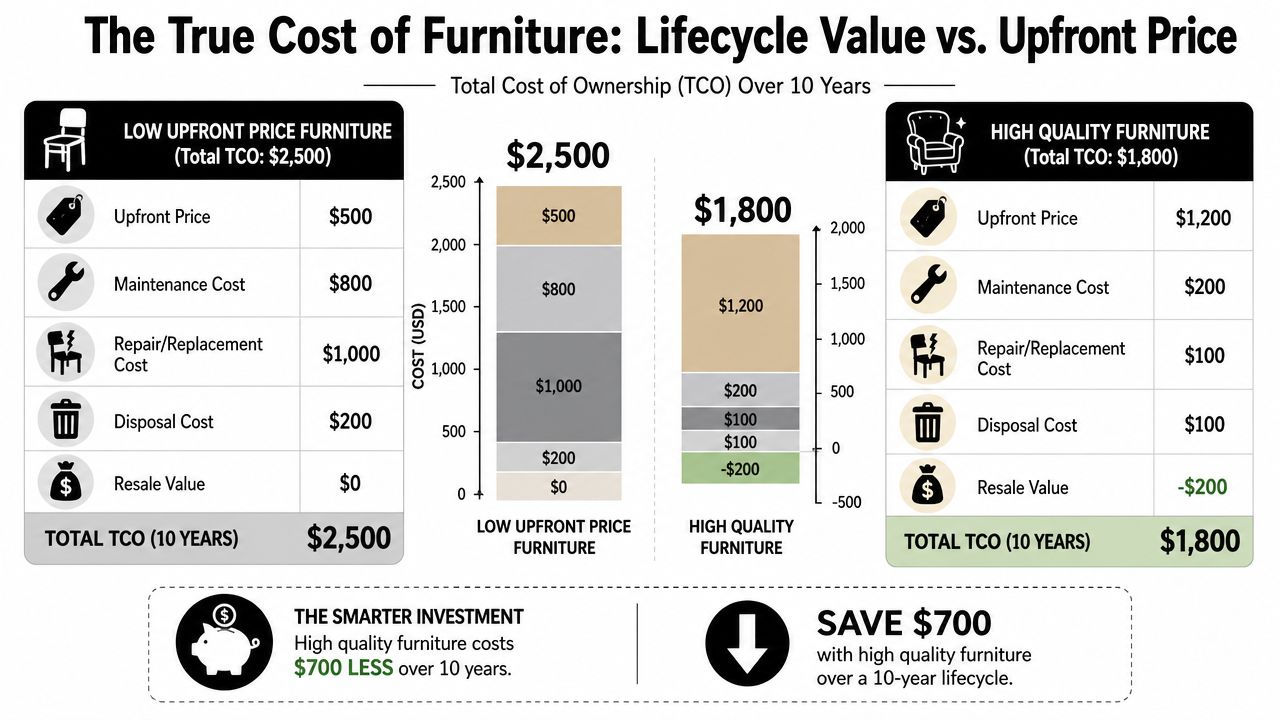
The True Cost of Furniture Lifecycle Value vs Upfront Price
A cheap chair that needs service calls, frustrates staff, and wears out early isn't cheaper. It's just cheaper to approve.
That's the core of a total cost of ownership approach. You're not buying furniture for delivery day. You're buying years of use, support, upkeep, reconfiguration, and eventual replacement.
To visualize the difference, this comparison is helpful:
The hidden costs most budgets miss
The biggest miss in many procurement discussions is labor and people impact. Poor fit, weak support, and constant adjustability problems don't stay isolated as “furniture issues.” They turn into employee complaints, facilities workload, and in some cases health-related costs.
Poor ergonomic furniture can increase musculoskeletal disorder claims by up to 30%, according to Office Worx's discussion of what buyers should ask before purchasing office furniture. That's one of the clearest reasons office furniture quality belongs in an operational budget conversation, not just a furnishing line item.
When I review a low-cost bid, I look past unit price and ask what the organization is agreeing to absorb later:
- Maintenance burden: How often will staff need to tighten, realign, or replace parts?
- Downtime and disruption: What happens when stations fail in active departments?
- Workforce impact: Are chairs and desks contributing to discomfort, complaints, or churn?
- Disposition: What will removal and replacement require when the furniture ages out?
Hybrid offices raise the stakes further. Hot-desking puts more adjustment cycles on gas lifts, arms, tracks, and work surfaces because more people are changing settings constantly. Furniture that performs adequately in assigned seating can struggle when the same station is reconfigured throughout the week.
Use TCO when planning larger moves
If the furniture purchase is part of a relocation or expansion, pair your furniture review with the broader cost categories in this Constructive-IT office relocation guide. It's a useful way to keep furniture from being evaluated in isolation when power, cabling, move management, and occupancy readiness all affect the overall budget.
This short video also gives useful context on how buyers think through furniture investment decisions over time.
For workstation-heavy layouts, durable workstation cubicles usually justify themselves when you compare service life, reusability, and lower disruption over the full lifecycle rather than the first invoice.
Smarter Procurement Sample RFP and Vendor Questions
A good RFP saves you from vague promises later. If your document only asks for finish options, lead times, and pricing, vendors will compete on appearance and discounting. If you ask for evidence, you'll learn who controls product quality.

Ask for documentation before production
Effective quality control starts earlier than many buyers realize. Reviewing technical documents such as drawings and schematics, then establishing specific quality control metrics for dimensions, weight, and strength before production begins, is a core best practice, as outlined in Deskera's guide to furniture manufacturing quality control.
That means your RFP should ask for more than brochures.
Include requests like these:
- Technical drawings: Provide model-specific drawings with dimensions, materials, and assembly details.
- Performance documentation: Identify standards or test references relevant to each major product type.
- Substitution rules: State that no material or hardware substitutions may be made without written approval.
- Service path: Explain warranty claims, replacement parts process, and escalation contacts.
- Installation scope: Clarify who verifies field dimensions and building conditions before install.
Vendor questions that reveal real capability
Some questions create fluff answers. Others expose whether a vendor has control over manufacturing, project management, and after-install support.
Ask these in a review meeting:
| Question | What you're listening for |
|---|---|
| What typically fails first on this product line? | Honest knowledge of lifecycle risk |
| Which parts are field-replaceable? | Repairability and downtime control |
| How do you verify dimensions before production? | Process discipline |
| What documentation can you share now? | Transparency |
| How do you handle change orders late in the project? | Project management maturity |
The best vendors don't just answer quickly. They answer specifically, with documents that match the exact product you're evaluating.
If you're planning around tech-heavy departments, it's smart to align your furniture procurement with IT planning. A practical companion resource is this guide to selecting the right IT provider in Essex, because workstation deployment, cabling access, and support readiness often overlap more than furniture teams expect.
Build maintenance into the buy
Procurement shouldn't end at install. Ask vendors for cleaning guidance, touch-up options, replacement part lists, and reconfiguration support. Those details keep the furniture useful longer.
If you're still shaping the layout, a planning tool such as the Cubicle Designer for testing dimensions, privacy levels, storage, and electrical options can help you define requirements before sending anything to vendors.
Conclusion Designing a Workplace That Lasts
Office furniture quality isn't a luxury line item. It's part of how a workplace operates. Strong furniture decisions reduce service issues, hold up under real use, support employee comfort, and make future reconfiguration easier instead of harder.
The best buyers don't rely on showroom impressions or broad claims. They check measurable durability standards, read warranty exclusions, inspect samples by hand, and compare lifecycle value against the hidden cost of failure. That's the difference between a furniture project that stays quiet for years and one that keeps showing back up in complaints, repair requests, and replacement budgets.
Hybrid work makes that discipline even more important. Shared stations and frequent adjustments put more stress on chairs, desks, and mechanisms, so product selection has to reflect actual use patterns, not ideal conditions.
If you approach procurement with a clear scorecard, documented vendor requirements, and a total cost of ownership mindset, you'll make better decisions and defend them confidently.
If you're planning a new office, expansion, reconfiguration, or furniture replacement project, Cubicle By Design can help you evaluate options, configure practical layouts, and choose systems built for long-term workplace performance.