

Installed office glass partition walls typically range from $75 to $250 per linear foot. That starting point is useful, but the actual budget can move quite a bit once you factor in glass type, framing, doors, site conditions, labor, and the details many online calculators leave out.
You're probably in the same spot most facilities teams reach sooner or later. The office needs more privacy, more daylight, and a cleaner layout than drywall gives you, but the pricing feels slippery. One vendor talks about linear feet, another quotes by panel, and a third gives a low material number that doesn't include demolition, delivery, or after-hours installation.
That's why office glass partition walls cost often feels harder to pin down than it should. The product itself is only part of the spend. The all-in number depends on how the system is designed, how your building is built, and how much coordination the install takes.
Office Glass Partition Walls Cost Your 2026 Guide
Planning Your Budget for Modern Glass Partitions
Most office managers start with a sketch, a floor plan, or a rough idea like “we need two private offices and one conference room.” That's enough to begin. It's not enough to budget accurately.
The installed range of $75 to $250 per linear foot gives you a working baseline. What matters next is identifying what's included in that number. Some quotes cover only the glass system. Others include doors, hardware, field measurement, delivery, and installation. A few go even further and account for coordination with electrical, flooring transitions, and permit support.

A practical budget starts with four questions:
- What are you enclosing? A single office, a boardroom, or a full suite of perimeter rooms all price differently because the door count, corners, and wall intersections change.
- How much privacy do people need? Clear glass costs differently than frosted film, laminated glass, or stronger acoustic assemblies.
- What does the building allow? Ceiling type, slab conditions, sprinkler layout, and access routes can all change labor.
- What level of finish are you expecting? Minimal framed systems and premium frameless systems don't land in the same budget band.
For a broad pricing reference tied to workstation and partition planning, it helps to compare your project against a workspace pricing guide. That gives you context before you lock into a specific wall specification.
If solar heat, glare control, or privacy film are also part of your renovation, reviewing Atlanta commercial tinting services can be useful. It's a separate scope from partitions, but it often comes up in the same conversations when teams want more control over transparency and comfort.
Practical rule: Never approve a glass wall number until you know whether it includes doors, hardware, delivery, installation, and site readiness.
For design direction and system options, a good place to compare layouts is glass office partitions.
How Glass Wall Costs Are Calculated
The first source of confusion is the unit of measure. Vendors don't all price glass walls the same way, because not every system is built or sold the same way.
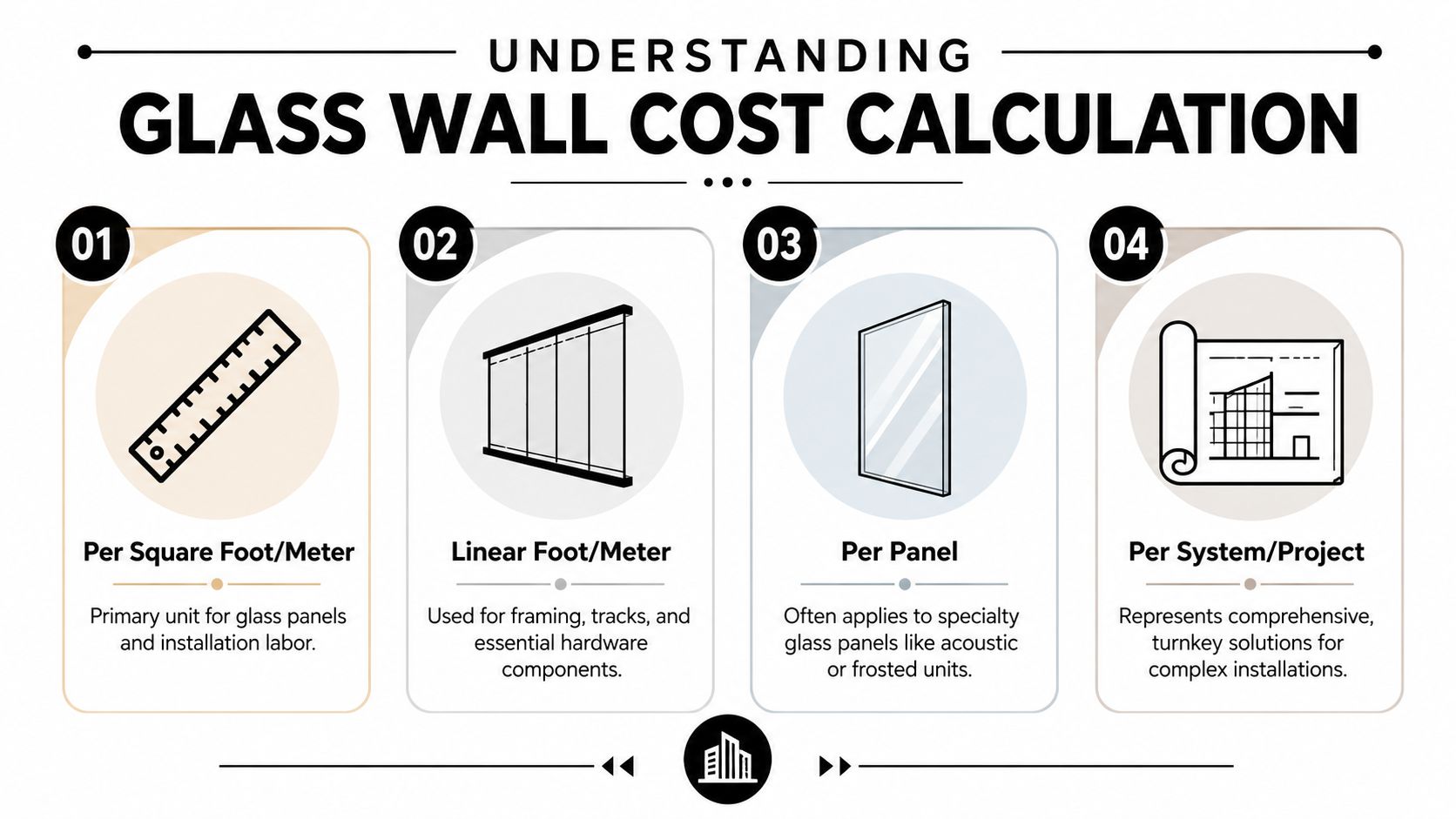
Per linear foot
This is the format most buyers run into first. It works well for straight runs of wall where ceiling height is standard and the spec is relatively straightforward.
A linear-foot quote is easy to compare at a glance, but it can hide a lot. One supplier may include track, glazing, and standard install. Another may exclude doors, returns, corner conditions, film, and freight. That's why a low number can become a high invoice.
This model is best for:
- Straight office fronts
- Simple room enclosures
- Early budgeting before full engineering
Per square foot
Square-foot pricing is often more useful once wall height and glass specification become major variables. Taller glass, thicker glass, acoustic assemblies, and specialty glazing are easier to account for this way.
This method tends to produce clearer apples-to-apples comparisons on technically different systems. If one room has a standard height and another rises to the deck, square-foot pricing usually reflects that difference more accurately than a flat linear-foot rate.
A product overview like glass for office spaces helps when you want to understand how glass choices affect what's being measured.
If a quote uses square feet for glass and linear feet for framing, that's not a red flag. It usually means the estimator is breaking out the system the way it's actually procured.
Per panel
Modular systems are sometimes quoted by panel. That approach is common when the manufacturer works from standard module widths, repeatable door kits, and interchangeable frame components.
Per-panel pricing can work well when:
- The design follows standard module sizes
- The layout may change later
- The buyer wants easier reconfiguration
It can be less useful for custom footprints with odd angles, uneven field conditions, or heavy customization. In those situations, the panel count may not capture all the complexity.
Per system or project
Some of the most accurate quotes don't emphasize one unit at all. They package the work as a full project number. That often includes measuring, engineering, material, freight, installation, punch work, and closeout.
That's usually the format serious buyers prefer once they move past rough planning. It's also the best way to understand office glass partition walls cost in practice, because occupancy schedules, access restrictions, and field conditions rarely fit neatly into one simplified metric.
Key Factors Driving Your Final Cost
Two offices can need the same amount of glass and still end up with very different project totals. I see this early in budgeting. One client is pricing a clean, standard conference room line. Another wants premium sightlines, stronger acoustic privacy, custom hardware, and a phased install around active staff. The wall length may match. The all-in cost does not.
Framed and frameless systems
System style is usually the first major cost decision.
Framed glass partitions are often easier to budget with confidence because they give the installer more tolerance in real-world conditions. Existing floors are not always level. Ceiling conditions are not always perfect. Framed systems absorb some of that variation and usually offer more finish flexibility at a lower premium.
Frameless systems deliver the cleanest visual result. They also raise the standard for field conditions, alignment, and detailing. That can increase fabrication coordination and installation precision, which affects your final number even before labor and site prep are broken out elsewhere in the quote.
| Feature | Framed Systems (e.g., Series 700/800) | Frameless Systems (e.g., Series 500) |
|---|---|---|
| Appearance | More defined lines and visible profiles | Minimal look with cleaner sightlines |
| Budget fit | Usually easier to control | Often higher due to detailing and finish expectations |
| Field tolerance | Better for imperfect existing conditions | Less forgiving of uneven substrates |
| Acoustic approach | Good with the right seals and glazing | Strong potential, especially with upgraded glass |
| Custom finish options | Broad range of frame colors and details | More dependent on glass and hardware selections |
| Best use case | Multi-room office buildouts and practical renovations | Executive offices, conference rooms, and design-led spaces |
The practical question is not which system looks better. It is which system fits the space you have, the privacy you need, and the budget you want to hold.
Glass type and performance
Glass specification changes cost fast, especially once privacy or acoustics enter the conversation. Clear tempered glass is a common baseline. Laminated glass adds cost, weight, and handling requirements, but it can improve sound control and perceived quality in the right application.
Clients often focus on the panel and miss the assembly. A conference room that needs better speech privacy may also need tighter door seals, better bottom sweeps, and more careful perimeter detailing. If those details are skipped, upgraded glass alone will not deliver the result people expect.
That is where online cost calculators fall short. They price glass. They do not price performance.
Glazing choices and privacy treatments
Privacy can be handled with glass type, applied film, decorative treatments, or a mix of all three. The right choice depends on whether the goal is visual screening, branding, light transfer, or acoustic separation.
- Clear glass keeps the office open and usually costs the least.
- Frosted film is often the most flexible option because it can be targeted to eye level and changed later.
- Etched or custom decorative treatments create a more permanent look but usually increase fabrication cost.
- Gradient or partial privacy bands work well when you want openness above and privacy where people are seated.
A common budgeting mistake is applying premium privacy treatment to every panel. In many offices, selective frosting on conference rooms, HR spaces, and a few executive fronts solves the core problem without pushing the whole project into a higher price bracket.
Doors, hardware, and finish details
Doors are one of the fastest ways to move a project from standard to custom. A basic swing door with standard hardware is one cost path. Sliding doors, pivot hardware, privacy locks, soft-close features, and upgraded pulls can change the quote quickly.
Finish selection matters too. Standard finishes are usually easier on both budget and lead time. Custom powder coat, specialty anodized finishes, bronze tones, and black hardware may be worth the look, but they often shift the job away from stocked components.
Small details add up:
- Closer type
- Threshold treatment
- Handle style
- Frame color matching
- Manifestation or code-required markings
I advise clients to rank these choices by daily impact. People interact with doors and hardware every day. That often matters more than spending extra on a decorative upgrade that reads well in renderings but adds little in use.
If your glass partition project also involves phased reconfiguration, workstation moves, or support for occupied teams, office furniture installation services should be considered during budgeting, not after the glass order is placed.
Beyond the Glass Labor Site Prep and Other Expenses
Material cost is only half the story. Sometimes it's less than half.
Labor is not a flat line item
Installation labor shifts with project conditions. A clean, empty suite with easy elevator access and standard hours is one thing. A busy office with occupied departments, tight delivery windows, and restricted work hours is another.
Labor usually rises when crews have to:
- Work after hours to avoid disrupting staff
- Carry material long distances from loading area to install location
- Coordinate around active operations like support teams, executives, or call floors
- Handle more complicated door alignments and specialty hardware
If your project includes related furniture moves or phased installation support, office furniture installation is part of the same real-world budget conversation.
Site prep changes the number quickly
Many underbudgeted projects fail here. The quote looked fine because it assumed the site was ready. Then the crew arrives and finds uneven floors, obstructed ceilings, old walls that need removal, or missing backing where new components need support.
Common prep items include:
- Demolition of existing partitions
- Patching and paint touch-up
- Floor leveling or transition work
- Ceiling modifications
- Electrical or data relocation
- Sprinkler and HVAC coordination
A frameless glass system installed on a floor that isn't reasonably level can create alignment problems you'll notice every day. The wall may still stand, but the finished result won't feel premium.
Freight, logistics, and project management
Glass is heavy, fragile, and schedule-sensitive. Shipping isn't just a trucking charge. It may involve crating, liftgate service, inside delivery, staged arrivals, and storage coordination if the site isn't ready.
Project management is another expense buyers sometimes question until they've lived without it. Someone has to verify dimensions, sequence deliveries, coordinate trades, track punch items, and keep the install from colliding with occupancy deadlines.
A cheap quote with vague logistics language usually means the buyer is absorbing the risk.
Permits and compliance
Depending on the scope, the project may need permit review, code checks, life-safety coordination, or accessibility verification. Even when the partition system itself is straightforward, the surrounding conditions may trigger additional review.
That's why the most reliable budget isn't the one with the lowest product number. It's the one that acknowledges the building as it exists, the schedule as it really is, and the install team's actual path to completion.
For broader workplace planning and support services, Cubicle By Design offers a useful overview of related project categories.
Sample Budgets Small Medium and Large Projects
A client might start with a simple question: what does one glass office cost? By the time we price the door, confirm field dimensions, account for privacy treatment, and review install conditions, the better question is what the full room or suite will cost to deliver without surprises.
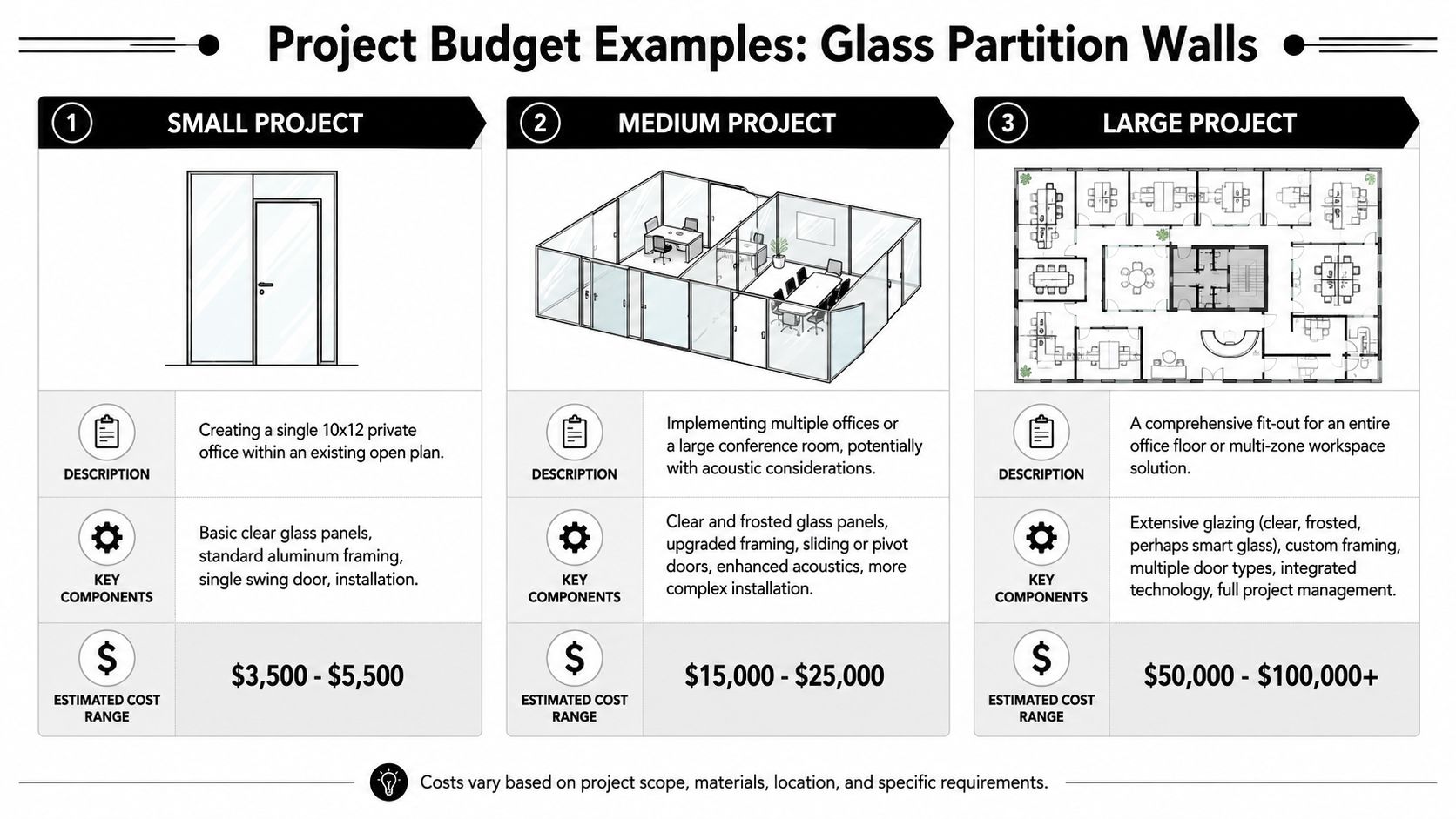
Small project
A small project is usually one private office, one meeting room, or a short glass front added inside an open plan. On paper, this looks straightforward. In practice, small jobs can swing more than buyers expect because a single door, a single site visit, and a short run of glass still carry fixed labor and coordination costs.
A typical small-project budget often includes:
- One enclosed room or short wall run
- One standard door assembly
- Clear glass or limited privacy film
- Basic hardware and standard installation access
The best-case version uses standard sizes and clean site conditions. The price climbs when the opening needs custom sizing, the client wants a heavier acoustic door, or adjacent finishes need repair after layout changes. Those are not huge scope items by themselves, but on a compact project they take up a larger share of the total.
Some clients also decide the enclosed room should be reserved for management, HR, or focused meetings, while the rest of the team uses open modular furniture. In that case, reviewing modular workstation pricing for open office areas helps compare where glass gives the best return.
Medium project
A medium project usually includes a conference room plus several private offices or focus rooms. This is the range where budgets stop behaving like a simple per-foot exercise. Corners, door count, frosting patterns, and hardware quality start to matter as much as the glass itself.
The budget often reflects:
- Several enclosed rooms with more intersections
- A mix of clear and privacy glazing
- Multiple doors and upgraded hardware
- More installation time for alignment and finish quality
This size also forces clearer decisions about where performance matters. A leadership room used for confidential calls may justify better acoustic detailing. A small internal huddle room may not. Spending evenly across every room sounds fair, but it usually is not the most efficient use of the budget.
Large project
A large project can cover a full floor or a major department restack with private offices, conference rooms, touchdown spaces, and support areas. At that point, glass is only one line item in a much bigger execution plan. The cost is shaped by sequencing, access, room variety, and how much work has to happen while the office stays active.
Large-project budgets are commonly driven by:
- A higher number of doors, openings, and room types
- More custom conditions in the field
- Phased installation around ongoing operations
- Coordination across several trades and stakeholders
- Schedule pressure tied to move-in dates
I tell clients to watch the all-in number here, not just the material subtotal. Two proposals can show similar glass footage and still land far apart in final cost because one includes better coordination, cleaner phasing, and fewer assumptions that turn into change orders later.
Larger projects usually miss budget because scope gaps were left outside the original quote, not because the glass itself was mispriced.
Cost Saving Strategies Without Compromising Quality
A project usually goes over budget in small decisions, not one big mistake. The best savings come from controlling scope early, choosing the right specs for each room, and protecting the parts people use every day.
Standardize what you can
Every custom panel, odd angle, and one-off room width adds fabrication time and raises the chance of field adjustments. If the layout is still being refined, I usually look for a few inches we can give back or gain before drawings are finalized. That small planning change often avoids a custom condition that costs far more later.
Repetition helps. Using the same panel widths, door types, and hardware package across several rooms keeps material ordering cleaner and installation faster.
Match privacy upgrades to the room
Not every space needs the same level of screening. Conference rooms used for client meetings may need a stronger privacy treatment than an internal focus room. Full specialty glazing across the entire office can push the budget up fast without adding much day-to-day value.
Vinyl frosting is often the practical middle ground. It handles seated sightlines well, costs less than upgrading all the glass, and can be changed later if branding or privacy needs shift.
Protect the user experience at the door
If money has to move, move it away from cosmetic upgrades before cutting door quality. People notice a bad door immediately. They feel the drag, hear the rattle, and deal with alignment issues every time the room is used.
I would rather simplify a trim detail than downgrade these items:
- Hinges or sliding hardware that hold alignment
- A closer and latch that work consistently
- A handle set that matches the finish level of the office
- Careful installation at the opening
That is where cheaper quotes often show up later as service calls.
Use glass where it earns its keep
Full-height glass across every boundary is not always the smartest plan. In many offices, the better value is to enclose the rooms that need visibility, acoustics, or client-facing polish, then use furniture-based planning in open team areas.
That approach works well in denser operational spaces. As noted earlier, high-capacity team zones often make more financial sense with modular workstations than with hard-wall construction everywhere.
Lock in utility decisions before fabrication
Late changes to power, data, access control, or floor penetrations are one of the fastest ways to lose budget discipline. Glass systems are less forgiving once dimensions are approved and materials are in production.
Good coordination saves real money here. Confirm who is bringing power to the room, where devices sit, and whether any security hardware needs support before release. If you are comparing options and want pricing built around the full scope, request an all-in glass wall quote instead of a glass-only number.
The goal is simple. Spend where performance, durability, and daily use justify it. Trim cost where the change stays invisible to the people working in the space.
Your Next Steps to a Clear and Accurate Quote
A reliable quote starts with clean information. Rough dimensions are fine for a first conversation, but a firm number needs more than a sketch on a notepad.
What to gather before requesting pricing
Bring these items together before you ask for a final proposal:
- Floor plan or marked-up layout
- Ceiling height and ceiling type
- Photos of the install area
- Door preferences
- Privacy and acoustic goals
- Move-in or completion date
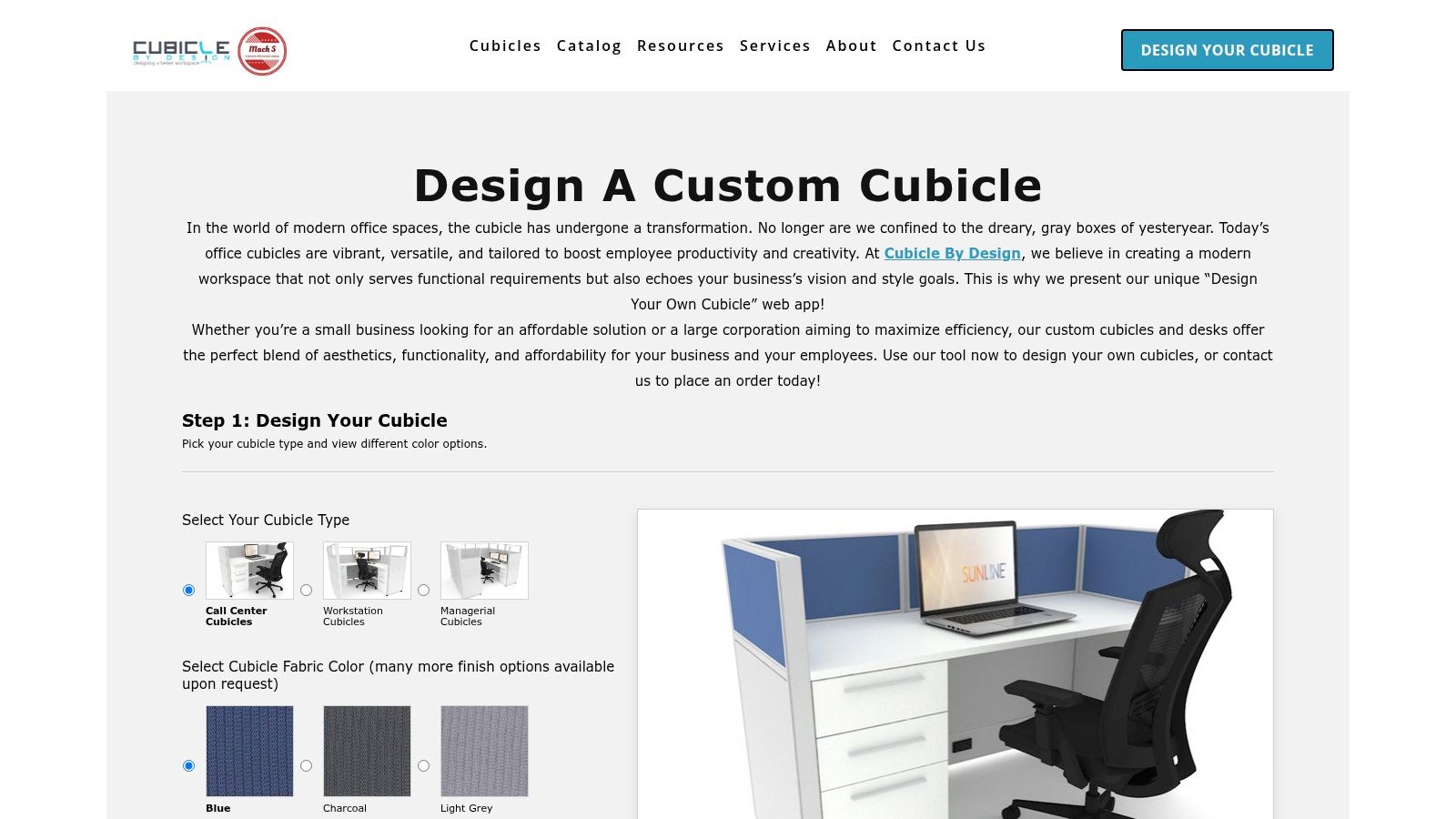
If you want to visualize the space before finalizing specs, the Cubicle Designer tool is a practical place to start. It helps turn a rough idea into something quote-ready.
What a solid quoting process looks like
A good estimator will usually confirm field dimensions, review access conditions, and ask questions that affect labor and finish scope. That isn't overkill. It's what keeps the number accurate.
Expect discussion around:
- Site survey timing
- Lead time for fabrication
- Installation sequencing
- Any demolition or prep required
- Who is handling permits or trade coordination
Here's a helpful visual overview of the planning process in action.
When you're ready for a firm estimate, request one through the glass wall quote page. The clearer your inputs, the cleaner the number will be, and the fewer surprises you'll face once the project moves from concept to installation.
If you're planning glass offices, conference rooms, or a mixed workspace with modular stations, Cubicle By Design can help you move from rough budget to buildable plan with practical guidance, layout support, and product options that fit real workplaces.