

Staring at a small office floor plan can feel like trying to solve a puzzle, especially when you're not sure you have all the pieces. The answer for a lot of growing businesses is surprisingly simple: small office cubicles. They can transform a cramped, awkward space into a real powerhouse of productivity. Modern modular systems from a supplier like Cubicle By Design give you a level of flexibility that old-school, rigid furniture just can't touch.
Transform Your Space with Smart Cubicle Planning
For startups, hybrid teams, and any business on the rise, making the most of every square foot isn't just a nice-to-have—it's essential for survival. Traditional office furniture tends to lock you into one specific layout, leaving you with zero room to adapt as you grow.
Modular small office cubicles, on the other hand, are more like building blocks. You can reconfigure them, add to them, and adjust your entire workspace as your team's needs evolve. This saves you from the headache and expense of a complete office overhaul down the road.
This kind of adaptability is exactly why the demand for modular workstations keeps climbing. The global office cubicle market, valued at $783.5 million in 2025, is set to grow steadily, which really shows how the entire industry is shifting toward more flexible office designs.
The real key to a great layout is thinking through the essentials before you even look at fabric swatches or desk finishes. Here are the core components to nail down first:
- Strategic Layout: Think about how people will actually move through the office. Where do you need quiet zones for focused work versus open areas for collaboration?
- Privacy and Acoustics: How much sound and visual separation does your team need to do their best work without constant distractions?
- Power and Data Integration: Where will everyone plug in? Planning for seamless access to power and internet from the start prevents a chaotic mess of extension cords and cables later.
Getting these questions answered from day one is the foundation of a smart, efficient workplace. For some great ideas on optimizing smaller spaces, you can find a lot of inspiration in innovative home office design ideas that translate surprisingly well to a small cubicle environment.
At Cubicle By Design, we truly believe that a well-planned office is the bedrock of a successful business. Our approach to office space planning and design means we sweat the details, from mapping out traffic flow to planning every electrical outlet. This guide will walk you through the big decisions so you can create a workplace that genuinely works for you.
Finding the Perfect Fit for Your Team
Choosing the right cubicles for a small office isn't a simple plug-and-play decision. It’s about creating a workspace where your team can actually get work done, and that means the footprint and layout have to be just right. If you just grab a standard size without thinking about how your people work, you'll end up with a cramped, inefficient office.
Think about it this way: a call center agent who lives on the phone with a single monitor has completely different needs than a developer running three massive screens and surrounded by schematics. Giving them the right amount of elbow room directly impacts how well they can do their job. It's that simple.
Matching Cubicle Size to Employee Roles
A great starting point for many businesses is the classic 5’x5’ cubicle. This little 25-square-foot workhorse is fantastic for high-density setups where employees need to focus on individual tasks. It gives them enough personal space for a desk, a chair, and a computer without gobbling up your entire floor plan.
But for roles that demand more gear or a bigger surface area, a 6’x6’ cubicle is usually the better call. That extra foot in each direction makes a huge difference. It's more than enough room to spread out papers, add more monitors, or keep essential equipment within arm's reach. For a deeper dive into how these footprints feel in the real world, check out our guide on standard cubicle dimensions.
The goal is to walk that fine line—give everyone enough personal space to feel comfortable, not confined, while still making the most of every square foot of your office.
Popular Layouts for Small Offices
Beyond the size of each individual station, how you arrange them completely changes the vibe of the office. A good layout affects traffic flow, how easily teams can collaborate, and the overall energy of the space. Getting it right is like choreographing a dance; when it works, everything just flows effortlessly.
This decision tree gives you a bird's-eye view of the planning process, starting with the big layout choices.
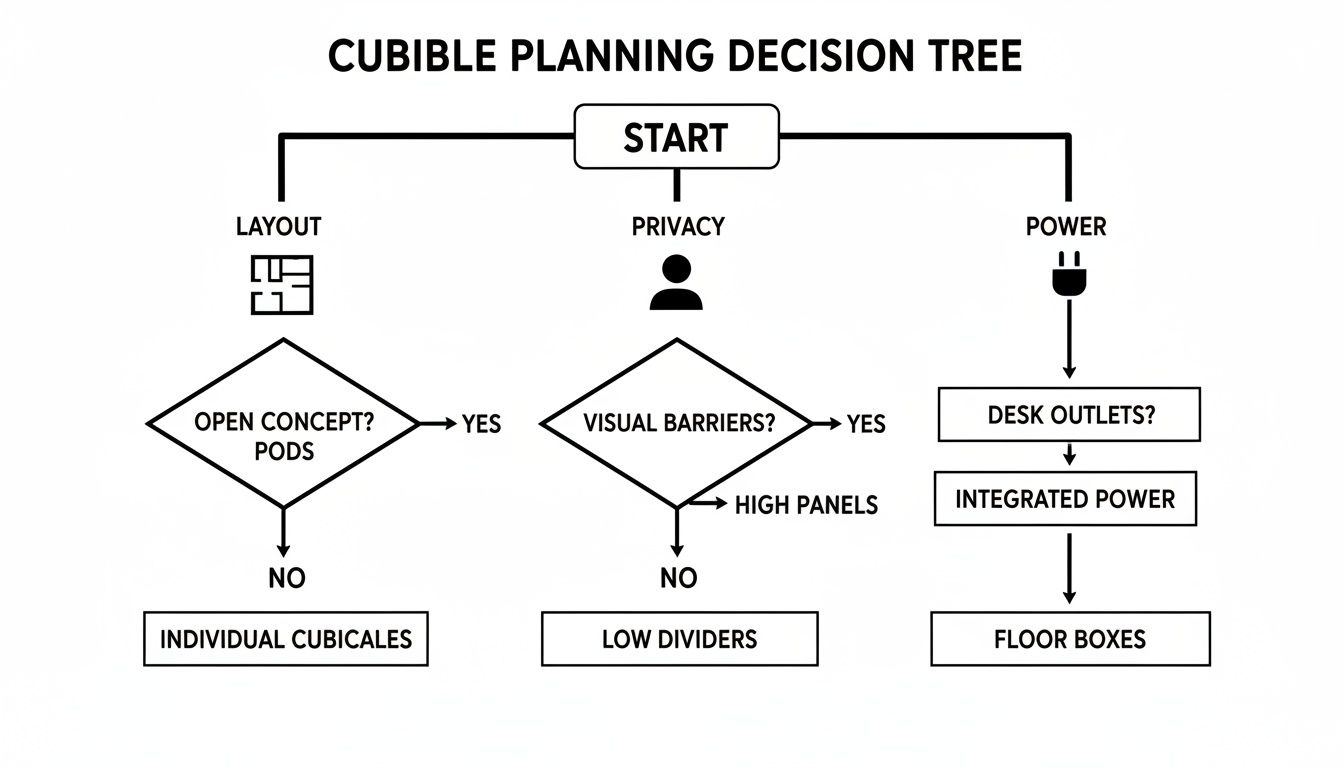
As the chart shows, your layout, privacy needs, and power requirements are all tangled together. You really have to think about them as a package deal to nail the design.
To get you started, here’s a quick comparison of some of the most popular layouts we see in small offices.
| Layout Type | Best For | Space Efficiency | Collaboration Level |
|---|---|---|---|
| Linear / In-Line | Narrow spaces, departments with independent tasks. | Moderate | Low |
| Back-to-Back | High-density areas, balancing focus with team access. | High | Moderate |
| Pinwheel / Quad | Small, project-based teams needing frequent interaction. | High | High |
A few of these configurations stand out for their practicality and are worth a closer look:
- Linear or In-Line: This is the most straightforward setup, with cubicles lined up in a row. It’s a lifesaver for long, narrow rooms and works perfectly for teams where people work on their own but need to be in the same general area.
- Back-to-Back: You've seen this one everywhere for a reason. Two rows of cubicles are placed facing away from each other, sharing a central panel down the middle. It’s incredibly space-efficient and strikes a nice balance between individual focus and easy team access.
- Pinwheel or Quad: This is where you cluster four workstations together, usually around a shared central power hub. It creates a more dynamic, collaborative pod for a small team, making it ideal for project work where people need to talk often but still have their own defined space.
Ultimately, the perfect layout comes down to your team’s unique workflow and the quirks of your actual building. By carefully weighing both the cubicle dimensions and the overall arrangement, you can build a workspace that feels both functional and harmonious.
Crafting the Right Mix of Privacy and Collaboration
In a small office, the real challenge isn't just about square footage—it's the constant tug-of-war between quiet focus and team collaboration. This is where your choice of small office cubicles, specifically their height and materials, becomes your secret weapon for creating a productive workspace. You're aiming for that sweet spot where everyone can work effectively.
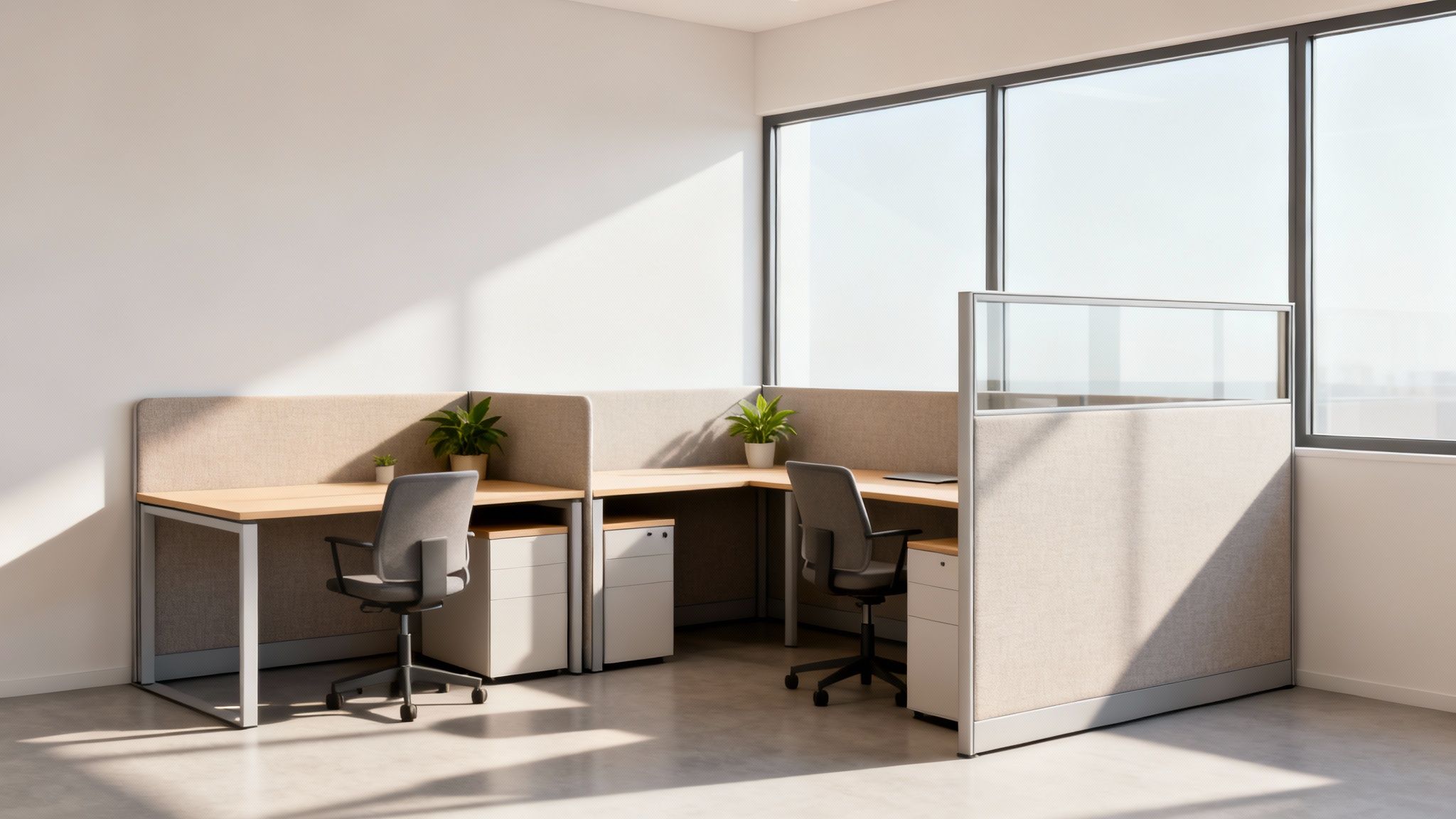
Think of it like conducting an orchestra. Tall panels act as sound dampeners, creating quiet zones where people can really dig into deep work without getting sidetracked. On the flip side, lower panels invite collaboration, making it a breeze for teammates to bounce ideas off each other or ask a quick question.
It’s no surprise that businesses are investing in these kinds of flexible setups. The global market for cubicles and partitions hit USD 7.75 billion in 2024 and is expected to climb past USD 13 billion by 2035, all because of the growing demand for dynamic office environments.
Using Panel Height to Shape Your Office Culture
The height of your cubicle walls does more than just divide space; it actively shapes how your team interacts. Getting this right is a strategic move that can define your whole office vibe.
- Low Panels (42-48 inches): These are the ultimate teamwork facilitators. They give you privacy when you're sitting down but make it easy to have a spontaneous chat when you stand up. Perfect for high-energy sales teams or creative departments where constant communication is part of the job.
- Mid-Height Panels (53-60 inches): This is the go-to for many businesses, and for good reason. It provides a solid amount of visual privacy and a sense of personal space, but you can still see who's walking up to your desk. It strikes a great balance, preventing that feeling of total isolation.
- High Panels (65+ inches): When uninterrupted concentration is critical, these tall panels are your best bet. They create true private office cubicles, cutting down on both noise and visual clutter. Think roles in finance, HR, or coding where focus is everything.
The Modern Touch of Glass Panels
You don't need solid, opaque walls to create a sense of privacy. Modern glass panels are a brilliant way to define individual spaces without killing the natural light—a precious commodity in any small office. Glass makes the whole place feel bigger, brighter, and more open.
Glass panels are a game-changer for small offices. They create a visual boundary that says "this is my space," but their transparency prevents the office from feeling like a maze of dark, confining boxes.
While cubicles set the foundation, you can take your privacy and light control to the next level by also choosing the best office window coverings. For the cubicles themselves, there are a couple of great glass styles to think about:
- Framed Glass: These often sit on top of a fabric panel, giving you a clean, structured look that marries classic cubicle function with a contemporary feel.
- Frameless Glass: If you're going for a sleek, minimalist vibe, frameless glass is the way to go. It offers a seamless look that really maximizes the flow of light and keeps sightlines open.
Finding the right mix is an art. For a deeper dive, check out our guide on how to achieve office cubicle privacy. By mixing and matching different panel heights and materials, you can build a workspace that truly supports every person and every task.
Getting Power and Storage Right
A great cubicle isn't just a desk with some walls around it—it's a self-contained workstation. For small office cubicles to truly work, they need to have power and storage built right in, and that’s something you have to think about from the very beginning.
This goes way beyond just adding a filing cabinet. We're talking about creating a blueprint for a workspace that's as functional as it is efficient, stopping clutter before it even has a chance to start.

Smart Storage for Small Spaces
In a cozy office, every single square inch is prime real estate. The smartest move is to think vertically and flexibly, giving you maximum storage without making the cubicle itself any bigger. Nothing kills productivity like a cluttered desk, but the right storage solutions can keep everything you need close by, but neatly out of the way.
Here are a few practical options that just plain work:
- Overhead Bins and Shelves: These are the real MVPs of cubicle storage. By using that empty space above the desk, you can stash binders, books, and supplies without sacrificing an inch of your active workspace.
- Mobile Pedestals: A small, wheeled filing cabinet that tucks right under the desk is a total game-changer. It gives you secure, easy-to-reach storage for files and personal items, and you can roll it out of the way whenever you need to.
- Accessory Rails: These nifty rails let you hang paper trays, pen holders, and other small organizers directly on the cubicle walls. This keeps your desk surface clear for the tasks at hand.
Storage planning isn't something you do at the end; it's a fundamental part of designing the workstation. The goal is to create a space where everything has its own home, making it effortless for employees to stay organized and focused.
Power and Data, Demystified
You can't have a clean, functional workspace without wrangling the cables. A spaghetti mess of cords isn't just ugly—it's a serious trip hazard. A professional layout for workstation cubicles solves this by building the power distribution right into the panel system itself.
This usually starts with a base-in power feed. Think of it as an electrical whip that connects to a wall or floor outlet and runs into the base of the very first cubicle panel. From there, the electricity is channeled through the panels to the next workstation, and the next, creating a clean, daisy-chained system.
Placing the outlets strategically is crucial. You’ll want them both above and below the desk surface to handle computers, monitors, phone chargers, and anything else your team needs, all without creating a tangled mess. For an even cleaner setup, you can explore options like an under-desk power strip that puts all your plugs and USB ports in one convenient spot.
Proper cable management, using the channels and grommets built into the cubicle, keeps all those wires hidden and protected. This kind of careful planning ensures every single cubicle is a safe, fully-powered, and ready-to-go station from day one.
Bring Your Vision to Life with Our Online Designer
All the planning in the world for layouts, panel heights, and storage solutions eventually has to come together. That’s where our powerful, easy-to-use platform, the Cubicle Designer, comes in. Instead of trying to guess how a certain fabric might look or if glass panels will feel right, you can stop imagining and start building.
Our Custom Cubicle Designer puts you in the driver's seat, turning abstract ideas into a solid, visual plan. Think of it as a virtual test drive for your office furniture. You get to play around with different configurations, swap out materials, and see exactly how your choices affect the final design and cost—all in real-time.
A Step-by-Step Design Experience
We built our designer tool to guide you through the whole process, making it simple to create even complex layouts from scratch. It’s incredibly intuitive, so you don’t need any fancy design software or technical skills to map out a professional-grade office. The interface walks you through each key decision, making sure you don't overlook any important details.
The entire process is broken down into a few clear, manageable steps:
- Choose Your Shape: Start with a basic layout that fits your vision, whether it’s a single unit, a back-to-back setup, or a collaborative quad cluster.
- Set Your Dimensions: Punch in the exact height and width you need for your panels and work surfaces to guarantee a perfect fit for your space.
- Select Finishes: This is the fun part. Browse our huge library of fabrics, laminates, and paint colors to match your company's branding and vibe.
- Add Glass and Doors: Want to let more light in? Integrate framed or frameless glass panels. Need more privacy? Add a door for a true private office feel.
- Configure Storage and Power: Finally, add the functional pieces like overhead bins and mobile pedestals, and tell us where you need electrical access to create a fully equipped workstation.
As you click through the options, the 3D model updates on the fly, giving you a realistic preview of your creation from every angle.
From Design to Instant Quote
One of the best things about the designer is its total transparency. As you add or change elements, the price updates automatically. You’ll always know exactly where you stand with your budget—no hidden fees, no surprises.
The Custom Cubicle Designer bridges the gap between imagination and reality. It empowers you to create a detailed, accurate plan and quote for your small office cubicles without ever leaving your desk.
Once you’re happy with your design, you can submit it directly to our team. We’ll personally review your plan to make sure it’s practical, compliant, and perfectly optimized for your office. This tool is the final, exciting step in bringing your vision to life.
Thinking Past the Price Tag: Budgeting for the Long Haul
It’s easy to get tunnel vision and focus only on the upfront cost when you’re looking at small office cubicles. But the sticker price is just the first chapter of the story. A truly smart investment is about the total cost of ownership—thinking about how your office will bend and stretch as your company grows.
This long-term mindset means looking at how every little detail impacts your budget, both now and down the road. The materials you choose, the finishes you select, and how complex your electrical needs are will all factor in. For instance, splurging on premium fabrics or more glass panels will nudge the initial price up, but it could also mean a more durable, inviting workspace that pays for itself in employee satisfaction and longevity.
Don't Skimp on Professional Installation
If there’s one place you should never cut corners, it's installation. The DIY route might look like a tempting way to save a few bucks, but professional installation is non-negotiable for safety, compliance, and simple durability.
Think of it this way: trained installers make sure every panel is locked in tight, every wire is up to code, and every desk is perfectly level. This is what prevents wobbly workstations, dangerous electrical mishaps, and costly repairs a year from now.
Investing in professional installation is like buying insurance for your office furniture. It’s the guarantee that your cubicles are put together correctly, protecting your people and your investment for years to come.
Getting this professional touch is just part of the package when you work with Cubicle By Design.
Future-Proofing with Modular Systems
This is where modular small office cubicles really prove their worth. Their biggest advantage isn't just how they work on day one, but how easily they can be reinvented for day one thousand. As your business changes—and it will—these systems can be reconfigured, expanded, or even packed up and moved to a new building with minimal fuss.
That flexibility turns your furniture from a simple expense into a strategic asset. Instead of having to buy a whole new set of desks when you hire five more people or shuffle a department, you just re-work the cubicles you already own. That adaptability saves a massive amount of money and headaches over the life of your office, making it a truly future-proof investment.
Got Questions About Small Cubicles? We’ve Got Answers.
Even with a great plan in hand, a few last-minute questions always seem to pop up before you pull the trigger. We get it. Here are some quick, straightforward answers to the most common things we’re asked about small office cubicles, so you can finalize your layout with total confidence.
What Is the Smallest Practical Cubicle Size?
For a truly compact but still functional workstation, you're generally looking at 5’x5’. That gives you 25 square feet, which is just enough room for a standard desk, a chair, and a computer without feeling like you're working in a closet. It’s a great fit for roles that are mostly task-based.
That said, if your employees need more elbow room for multiple monitors, paperwork, or just to spread out a bit, a 6’x6’ footprint is a much more comfortable starting point. It’s often the sweet spot between saving space and giving someone a practical workspace.
How Can I Make Small Cubicles Feel Less Confining?
This is a big one, and thankfully, there are some easy wins here. The quickest way to open things up is to use lower panel heights, somewhere around 42-48 inches. This maintains privacy when someone is sitting down but keeps the sightlines open across the office, which makes a huge difference.
Another fantastic strategy is to add frosted or clear glass panels near the top of the walls. It lets all that great natural light pour through the office, making the whole place feel brighter and bigger, while still muffling some of the noise. Lighter-colored fabrics and surface finishes also do wonders for making a space feel more open and airy.
One of the best things about modular cubicles is how flexible they are. They’re literally designed to be put together and taken apart easily, making them a smart, adaptable asset for any growing business.
Are Modular Cubicles a Pain to Install?
Not at all. In fact, it’s quite the opposite. The components in our systems are engineered to lock together simply and securely, which makes the initial assembly a breeze for professional installers.
The real beauty of modularity, though, is what happens down the road. As your company grows or your needs change, your workstation cubicles can be disassembled, moved, and reassembled in a totally new layout with minimal fuss. That’s a level of adaptability you just can't get with permanent walls or built-in furniture. Your space can evolve right along with your business, whether you're creating individual private office cubicles or collaborative team pods.
At Cubicle By Design, we're here to help you figure all this out. When you're ready to see how these ideas could look in your own space, give our free online tool a try. Design your ideal small office cubicles today with the Custom Cubicle Designer!