
A Guide to Cubicle Wall Decoration That Inspires Productivity | Cubicle By Design

Decorating your cubicle walls is about so much more than just making your space look nice. It's about turning a standard, cookie-cutter workspace into a personal hub that genuinely boosts your mood and productivity. By adding simple things like photos, art, or even just some functional organizers, you can transform those blank panels into a source of daily inspiration and efficiency. It makes the workday feel more focused, and frankly, a lot more enjoyable.

Why Your Cubicle Walls Matter More Than You Think

That blank cubicle wall isn't just empty space; it’s a powerful tool for improving your focus, mood, and sense of ownership at work. Personalizing your cubicle isn't just a fun little project—it's a direct investment in your own well-being. With so many companies embracing hybrid work models, making your personal corner of the office inviting and efficient is more important than ever.

This is all about transforming a standard-issue box into a hub of creativity that feels uniquely yours. At Cubicle By Design, we're big believers in creating employee-centric workspaces, and we know that personalization is a huge part of that philosophy.

This shift toward personalization isn't just some passing trend; it’s a real reflection of how modern offices are evolving. Cubicles are making a strong comeback post-pandemic, largely driven by a renewed demand for privacy and individual control in shared environments. A 2022 report from Business Research Insights found that the global cubicle market, valued at $6.3 billion, is projected to hit $8.3 billion within five years. That resurgence is directly tied to our desire for personalization—those tackable panels let us add photos, artwork, and notes that give us a real sense of ownership.

Fostering a Productive Mindset

When you're strategic about it, decorating your cubicle walls can directly impact your daily workflow. A well-organized wall keeps essential tools right where you need them, while a few inspiring visuals can be just the thing to spark creativity when you're feeling stuck.

  • Boosts Morale: Surrounding yourself with things that make you happy, like family photos or pictures from a favorite trip, can seriously lift your spirits during a stressful day.
  • Enhances Focus: By creating a defined and pleasant visual field, you can minimize distractions from the busy office around you. If you're curious about this, you might be interested in our guide on how cubicles improve office privacy.
  • Increases Ownership: Taking control of your environment creates a stronger connection to your work and the company, which often leads to higher engagement and better performance.

To get a better sense of the impact your choices can have, it's worth exploring how to select artwork for an office that inspires. The right piece can boost morale and productivity, even in a small cubicle.

Of course, before you start pinning things up, you need to consider your cubicle’s material and your company’s rules to make sure your decoration project goes off without a hitch.

Your Pre-Decoration Checklist

Before you get swept up in the fun of peel-and-stick wallpaper and slick new organizers, it’s worth doing a little prep work. Think of this as laying the groundwork for your cubicle makeover. Getting this part right ensures the whole process is smooth, successful, and doesn't end in a trip to the manager's office.

We've seen it happen time and again: someone gets excited, buys a bunch of cool decor, and then… frustration. That awesome magnetic board has nothing to stick to, or the beautiful fabric they planned to hang is a direct violation of company policy. A few minutes of planning now will save you a world of time, money, and headaches down the road.

Get to Know Your Cubicle Walls

First things first, you need to play cubicle detective. What are your walls actually made of? The material dictates absolutely everything about what you can hang and how you can hang it. Most office cubicles fall into a few common categories, and each one plays by its own set of rules.

  • Fabric-Covered Panels: This is the most common type you'll find. Test if they are tackable by gently pushing a thumbtack into an out-of-the-way corner. If it slides in easily, you’re in luck—pins, fabric-safe clips, and lightweight hooks are all on the table.
  • Metal or Steel-Backed Walls: Here's an easy test: grab a simple refrigerator magnet and see if it sticks. If it does, you've hit the jackpot for damage-free decorating. Think magnetic hooks, shelves, and all sorts of organizers.
  • Laminate or Hard Surfaces: These smooth, non-porous walls are the perfect canvas for removable adhesives like Command Strips. Quick pro tip: wipe the surface with a bit of rubbing alcohol first to get the best possible grip.

This little flowchart can help you connect your goals—whether you want to boost your mood, sharpen your focus, or just claim your space—to the right decoration choices.
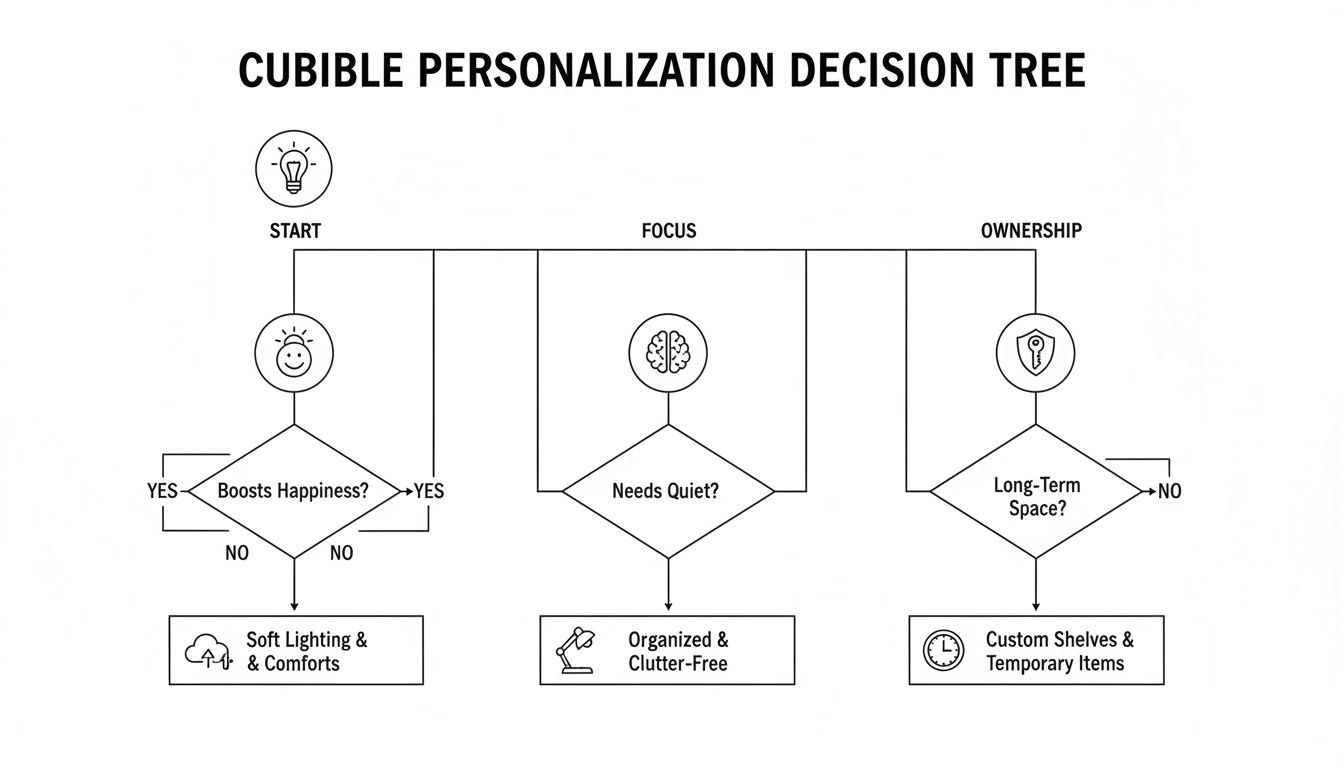
A decision tree flowchart for cubicle personalization, guiding choices based on happiness, focus, and space ownership.

The big idea here is to start with your "why" before you decide on the "what." That way, your decorations aren't just pretty—they're purposeful.

To make it even easier, here's a quick cheat sheet for matching your decor plans to your wall type.

Matching Decorations to Your Cubicle Wall Type

Wall Material Best Mounting Options Recommended Decorations Things to Avoid
Fabric-Covered Push pins, T-pins, cubicle clips, lightweight hooks Photos, unframed art, calendars, fabric swatches Heavy framed art, shelves with significant weight
Metal/Steel-Backed Magnets, magnetic hooks, magnetic organizers Whiteboards, file holders, lightweight shelves, art Anything requiring drilling, strong adhesives
Laminate/Hard Surface Removable adhesive strips (e.g., Command), suction cups Framed photos, lightweight mirrors, small organizers Nails, tacks, permanent tapes that leave residue

This table should give you a solid starting point and help you avoid any rookie mistakes when you're out shopping for supplies.

Don't Skip the Company Policy Check

Okay, this next part isn't the most glamorous step, but it's absolutely critical. Before you start hanging anything, find your company's employee handbook or just ask the office manager about guidelines for personalizing your workspace. Many companies have specific rules designed for safety and to maintain a professional look.

Knowing the rules is your best defense. Always check for policies on electrical items (like string lights), permanent alterations (no drilling or painting allowed!), and anything that might violate fire codes. A quick confirmation upfront saves you from the awkward task of tearing down all your hard work later.

When you know the rules, you can decorate with confidence. It’s also a simple sign of respect for the shared office and your company's property.

Measure Twice, Decorate Once

Finally, grab a tape measure. You wouldn't buy a sofa without measuring your living room, right? Same principle applies here. Knowing the exact dimensions of your walls helps you visualize how everything will fit together. It’s also helpful to understand the standard cubicle size to get a sense of what’s possible in the space you have.

Even a quick, rough sketch on a piece of paper can be a huge help. Map out where you want to put the big stuff, like a whiteboard or shelves, and then figure out how you'll arrange the smaller pieces like photos and organizers around them. This simple plan is the key to creating a design that’s balanced and uncluttered—turning your vision into a reality that’s both functional and easy on the eyes.

Damage-Free Decorating Tools and Materials

Now for the fun part—diving into all the creative ways you can personalize your cubicle walls without leaving a single mark behind. This is your complete toolkit for stylish, non-permanent solutions that make customization easy and totally worry-free.

Forget about nails, screws, or anything else that might get you a stern email from facilities management.
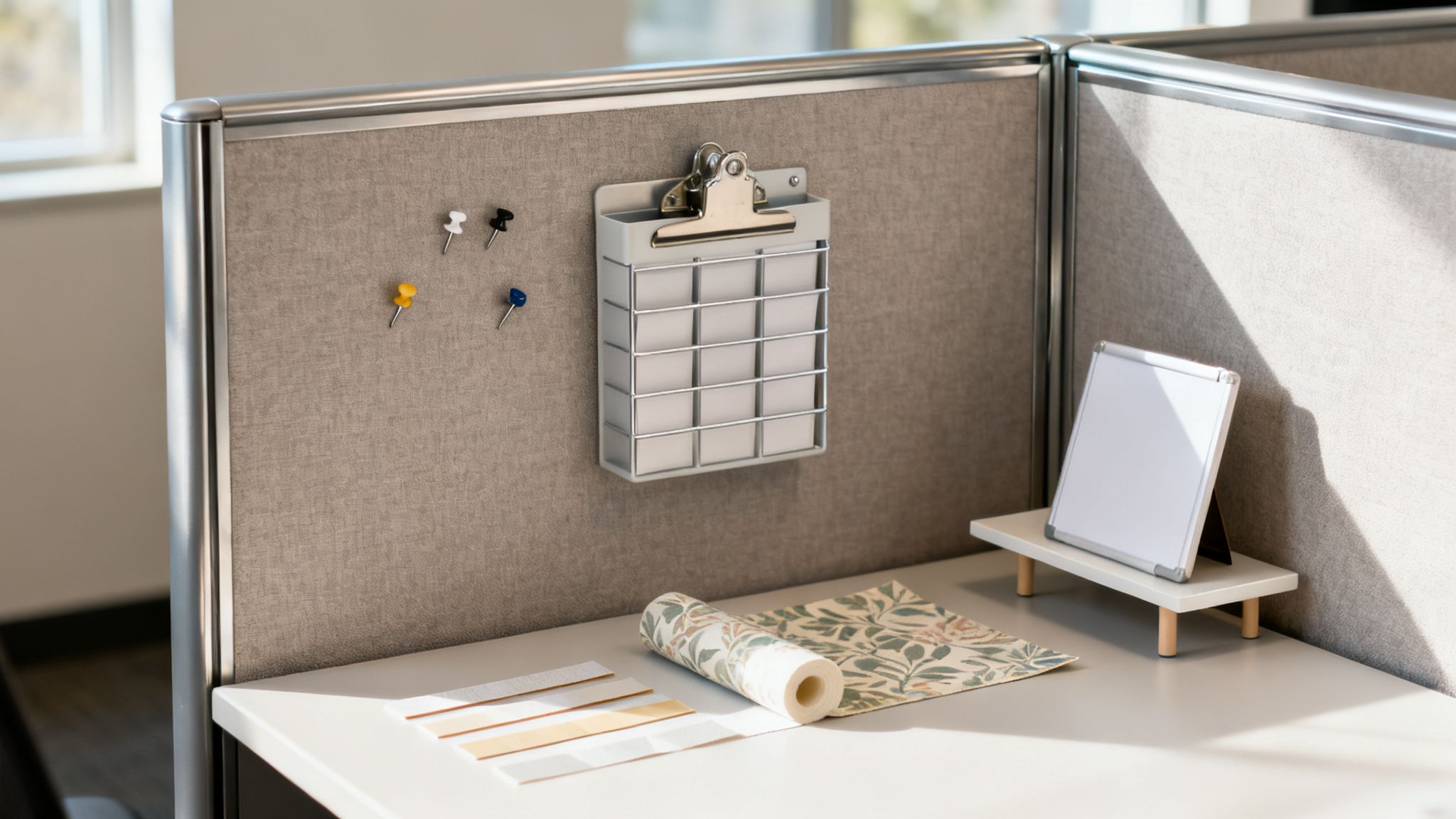
A cubicle wall is decorated with pushpins and a wall organizer, with a desk below holding design samples.

The key to successful, damage-free decorating is to work with your cubicle’s existing features, not against them. Think of your walls as a blank canvas with some built-in advantages. Whether you've got soft fabric panels or sleek metal surfaces, there’s a perfect tool for the job.

Leveraging Tackable and Fabric Walls

If your cubicle has those classic fabric-covered, tackable walls, you're in an excellent position to start decorating right away. These surfaces are literally designed to be pierced without causing any lasting harm.

  • Push Pins and T-Pins: Sometimes the simplest tools are the best. Use them to hang lightweight items like unframed photos, calendars, inspirational quotes, or even a few thin fabric swatches for a pop of color.
  • Specialized Cubicle Clips: These handy gadgets are designed to grip the top edge of a cubicle wall or slide securely into the fabric. They're perfect for hanging small whiteboards, file organizers, or even lightweight art without making a single hole.
  • Fabric-Safe Hooks: Look for hooks with a flat, pin-like backing that slides gently into the fabric weave. They can hold slightly heavier items, like a small clock or an accessory holder.

Mastering Magnetic and Hard Surfaces

For metal-backed or laminate cubicle walls, your approach shifts from piercing to adhesion and magnetism. These surfaces offer a sleek, modern backdrop for a different kind of creative expression.

Magnetic walls are a decorator’s dream. Strong magnetic hooks can hold a surprising amount of weight, making them ideal for hanging everything from your headset to small bags. You can also find magnetic shelves, pencil holders, and document trays that snap right into place. This is a fantastic way to clear your desk and use that vertical space effectively.

Laminate surfaces, on the other hand, are the perfect partner for removable adhesives.

The gold standard here is Command Strips. The trick is to choose the right type for your item's weight and to prep the surface by cleaning it with rubbing alcohol. This ensures a strong bond that will hold firm but peel off cleanly when it's time for a change.

Removable wallpaper or vinyl decals also work beautifully on laminate, letting you add a bold pattern or texture without any commitment.

Functional Decor That Works for You

Your cubicle decor shouldn't just look good; it should also make your workday easier. Think about adding elements that serve a dual purpose, blending aesthetics with functionality. This is where you can truly customize your space to match your workflow.

For instance, a mini whiteboard is perfect for jotting down quick reminders or brainstorming ideas. Lightweight shelving can get plants or personal trinkets off your desk, creating more room to work. If you're looking for more robust storage, our guide on cubicle hanging shelves has some great ideas.

Acoustic panels are another brilliant option. They come in various colors and shapes, looking more like modern art than sound-dampening tools. By absorbing ambient noise, they help you focus while adding a sophisticated design element to your wall. This blend of form and function is what transforms your cubicle into a truly productive sanctuary.

Designing a Smart and Inspiring Layout

Now that you’ve got your damage-free decorating tools ready, we can shift from materials to strategy. The most effective cubicle wall decoration isn't just about the items you choose, but how you arrange them. A well-thought-out layout can turn a cramped space into a functional, visually appealing, and genuinely inspiring place to work.

A smart layout does more than just look good; it actively supports your daily tasks. The real goal is to create a space that feels intentional, organized, and perfectly suited to your specific role and personality.
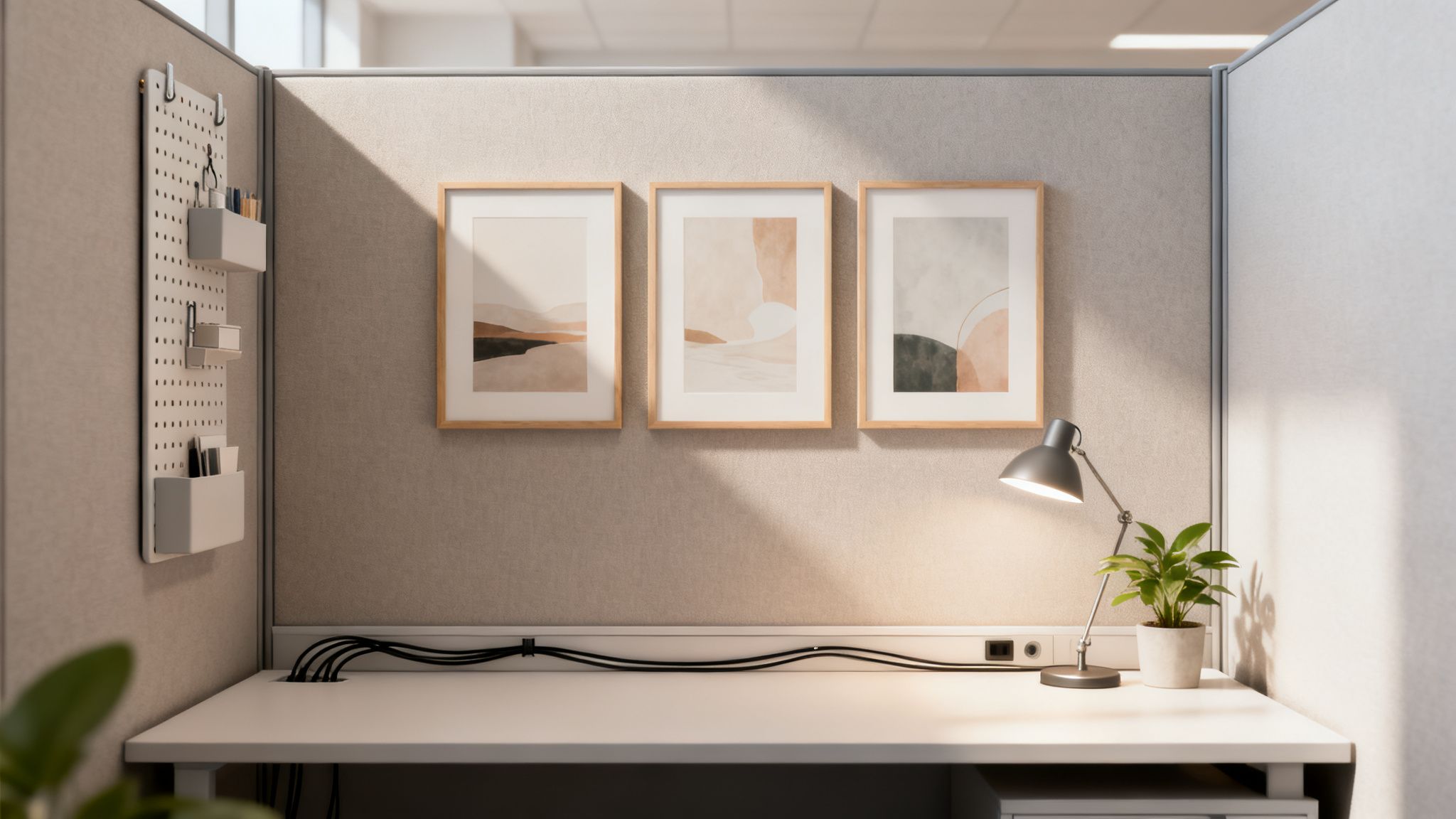
A well-organized modern office cubicle featuring a white desk, abstract art, pegboard, lamp, and a plant.

Create a Focal Point and Use Vertical Space

The first thing to do is establish a focal point. This is the main visual element that draws the eye and anchors your entire design. It could be a large corkboard, a favorite piece of art, or a meticulously organized calendar. We always suggest placing this item at eye level on the wall you face most often—it creates an immediate sense of order.

Once that focal point is set, think vertically. Your desk is valuable real estate, and we all know clutter is the enemy of productivity. You need to get things off your desk and onto the walls.

  • Install lightweight shelving for personal items, plants, or reference books.
  • Use wall-mounted organizers for pens, files, and notebooks.
  • Hang your headset on a dedicated hook to free up that precious surface area.

This approach not only maximizes your workspace but also keeps your essential tools within easy reach, creating a much smoother workflow. To get the most out of your vertical space and add a touch of green, consider integrating hanging plants into your cubicle's design.

Tailor the Layout to Your Role

There’s no such thing as a one-size-fits-all layout. The best design for you depends entirely on what you do all day. Let’s look at two completely different scenarios we've seen play out.

Scenario 1: The Creative Professional
A graphic designer, for example, needs space for inspiration to strike. Their layout might feature:

  • A massive cork or magnetic board for mood boards and project sketches.
  • Shelving filled with vibrant art books and personal trinkets.
  • An energetic and stimulating color palette, probably with a few bold accents.

Scenario 2: The Data Analyst
On the other hand, a data analyst requires a clean, distraction-free environment for deep focus. Their layout would look very different:

  • A large, clean whiteboard for mapping out formulas and processes.
  • Minimalist organizers to keep data sheets and reports perfectly orderly.
  • A calm, neutral color scheme, like blues or grays, to promote concentration.

Your cubicle layout should be a direct reflection of your daily workflow. Ask yourself: what do I need to see, and what do I need to access easily to do my job well? The answer will guide your entire design.

For more inspiration on how to adapt your space, check out our gallery of office cubicle design ideas.

Master Your Cable Management

Nothing—and we mean nothing—ruins a beautiful layout faster than a tangled mess of cords. Smart cable management is that final touch that elevates your space from cluttered to clean.

We recommend using adhesive cable clips to run wires discreetly along the edges of your desk or behind your monitors. A simple cable management box can hide that bulky power strip, giving your workspace a polished, professional look. It’s a small step, but it makes a massive difference in the overall feel of your cubicle.

Cubicle Decorating Ideas for Every Budget

Making your workspace your own doesn't have to drain your wallet. Whether you're working with a shoestring budget or you're ready to invest in a more polished setup, there are plenty of smart ways to transform your cubicle walls.

A fantastic cubicle wall decoration can come from just a few clever, inexpensive touches. It’s all about seeing the potential in everyday items and repurposing them with a bit of style. Honestly, a small budget just means you get to be more inventive.

Thrifty and Creative Decor Hacks

Decorating on a dime is where your creativity really gets to shine. With a little DIY spirit, you can pull off a high-impact look without spending much at all.

  • Washi Tape Wonders: This decorative paper tape is a budget decorator's secret weapon. Use it to map out geometric patterns, frame photos right on the wall, or even outline a faux calendar. It’s vibrant, cheap, and peels off without leaving a single mark.
  • Stylish Office Supplies as Art: Don't hide those cool bulldog clips or colorful sticky notes. Arrange them in a neat grid or an interesting pattern on a corkboard, and you've created a piece of functional art. It’s practical, looks great, and costs nothing extra.
  • Printable Art: The internet is overflowing with free, high-quality printable art. Find a few designs that fit your vibe, print them on some nice cardstock, and hang them with simple clips or pins. You'll have an instant gallery wall.

For anyone looking to stretch their budget, exploring options like buying used office furniture can free up funds for these personal touches that make a space feel like yours.

Investing in Premium and Cohesive Designs

If you've got a larger budget, or if you're an office manager aiming for a unified look across the floor, you can explore more high-end and integrated solutions. Premium options often blend aesthetics with serious functionality, creating a workspace that’s a cut above.

Think about investing in custom acoustic art panels. These pieces don't just look stunning; they also absorb sound, which is a massive plus in a bustling office. Another great option is smart lighting, like dimmable LED strips, that you can adjust to your mood or task. It can seriously reduce eye strain and help you focus.

For a truly cohesive and professional environment, the foundation of the workspace is crucial. High-quality, modular systems create the perfect canvas for any level of personalization, from a single employee's corner to an entire corporate floor.

This is where the flexibility of modern workstations becomes so important. For instance, you can use our intuitive Cubicle Designer to plan a space that accommodates integrated tech accessories and high-end finishes from the ground up. This approach ensures every decorative element feels intentional and perfectly suited to the environment, whether it's for a dynamic startup or a large, established corporation.

Answering Your Top Cubicle Decorating Questions

When you start thinking about redoing your cubicle walls, a few common questions always seem to pop up. Let's tackle some of the most frequent ones we hear from people trying to make their workspace feel a little more like their own.

How Can I Decorate Without Damaging the Walls?

This is the big one, and the golden rule is to always go with non-permanent mounting options. The last thing you want is a chat with HR about damaging company property.

For any hard or laminate surfaces, removable adhesive strips are an absolute lifesaver. If you're working with those classic fabric-covered walls, stick with fabric-safe pins, T-pins, or even those clever little clips made just for cubicles. Got metal surfaces? Magnets are your best friend—zero damage, maximum flexibility. Just stay away from anything permanent like nails, screws, or aggressive glues.

Pro Tip: When in doubt, just ask. A quick conversation with your office manager can save you a lot of guesswork and potential trouble down the road.

What's the Best Way to Reduce Noise with Decorations?

In a buzzing office, a little bit of sound dampening can make a huge difference for your focus. The trick is to use decorations made from soft, sound-absorbing materials.

Fabric-covered acoustic panels are a fantastic choice because they're designed for this exact purpose and come in some really stylish designs that look more like art than office equipment. You could also hang thick felt organizers, a big cork board, or even a textile wall hanging to help soak up some of that ambient chatter. This works especially well in more modern layouts, like those with sleek private office cubicles that can benefit from a bit of extra sound absorption.

Where Can I Find Some Good Decorating Ideas?

Honestly, inspiration is all around you. Start by thinking about what you actually like—your hobbies, favorite travel spots, or even just a color palette that makes you feel good.

Visual-heavy sites like Pinterest and Instagram are goldmines for this stuff. Just type in "cubicle decor" or "office personalization" and see what comes up. You can also check out design blogs or even browse through our own cubicle product gallery to see how different setups come together. The real goal is to create a space that feels like yours and keeps you motivated through the day.

How Do I Keep Plants Alive in a Low-Light Cubicle?

Adding a bit of green to your desk is a proven way to lower stress, but not all cubicles are blessed with a sunny window. The key is to pick the right plant for the job.

Look for tough, low-light survivors like snake plants, ZZ plants, or pothos. If you have a black thumb, don't sweat it—today's high-quality artificial plants look incredibly realistic and require zero effort. To keep your desk clear, think vertically with small hanging planters or shelves. Preserved moss art is another cool option that gives you that natural vibe without needing any light or water. These little touches can make even standard workstation cubicles feel so much more vibrant and welcoming.


Ready to build a workspace that’s the perfect blend of style and function? At Cubicle By Design, we specialize in designing and installing modern, flexible office solutions that work for you. See what's possible or start building your vision with our free Cubicle Designer tool today.
Read More

What Is Modular Furniture? A Guide to Flexible Office Design

Think of your office like a set of LEGOs. You can click them together, pull them apart, and build something entirely new whenever you need to. That’s the simple idea behind modular furniture: a system of individual pieces that you can arrange and rearrange to create truly custom workspaces. It’s a concept that frees your business from being locked into a rigid, static layout, giving you the power to adapt your space on the fly.

Redefining the Modern Workspace

For decades, office furniture was a permanent decision. Desks were heavy, unmoving fixtures. Walls were built-in. If you wanted to change the layout, you were looking at a disruptive and expensive construction project.

Modular furniture completely flips that script. Instead of a fixed environment, it gives you a dynamic ecosystem of interconnected parts, each serving a specific function.

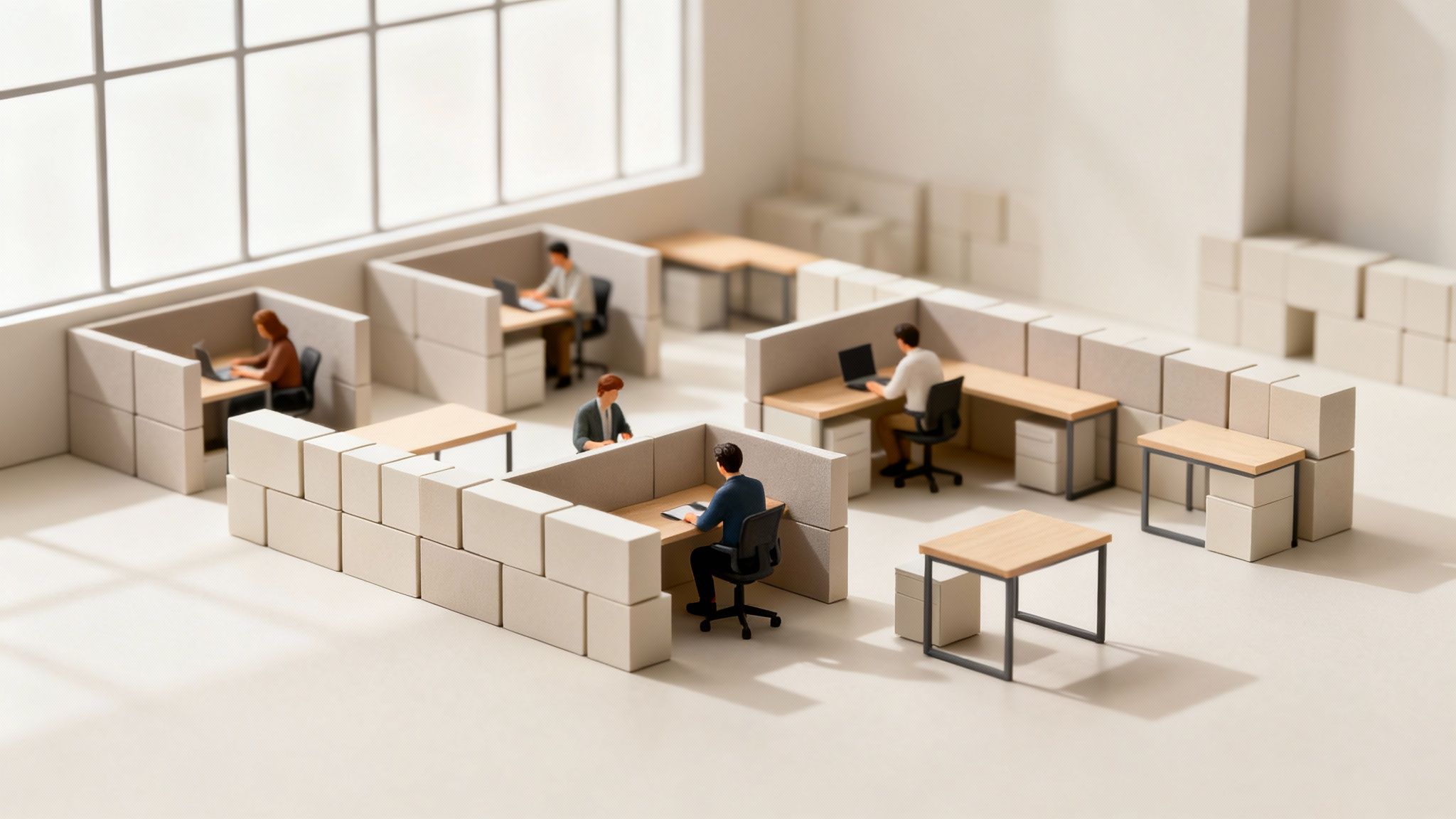
Miniature office scene showing people working in modular cubicles with desks and laptops.

This approach is a massive strategic advantage, especially for businesses that are growing or constantly evolving. Having the ability to easily reconfigure your space is a game-changer for things like effective office relocation project management or just adjusting to new team structures without a huge capital investment.

To give you a quick snapshot of the differences, here’s a simple breakdown.

Modular vs Traditional Office Furniture At a Glance

Attribute Modular Furniture Traditional Furniture
Flexibility High Low
Installation Quick, minimal disruption Lengthy, disruptive construction
Scalability Easy to add or remove units Difficult and expensive
Relocation Simple to disassemble and move Often impossible; a sunk cost
Cost Lower upfront & long-term cost High upfront & modification costs
Customization Highly customizable finishes & layouts Limited to initial design

This table just scratches the surface, but it highlights the core reason why so many modern offices are making the switch.

The Power of Adaptability

The real strength of modular design is its incredible adaptability. It allows your physical space to evolve just as quickly as your business strategy does. No more being stuck with a layout that made sense two years ago but feels outdated today.

This agility is exactly why the global modular furniture market hit USD 55.2 billion in 2024 and is projected to climb to USD 86.15 billion by 2030. That growth is a direct reflection of how modern businesses need agile, multifunctional work environments to thrive.

Think about these real-world scenarios where modularity just makes sense:

  • Accommodating Team Growth: A startup hires five new developers. Instead of a major renovation, they can simply add a new cluster of workstations over a weekend, ready for the new team on Monday.
  • Creating Project Hubs: The marketing team needs a “war room” for a big product launch. They can set up a temporary, semi-private collaboration zone and then easily dismantle it when the project wraps.
  • Supporting Hybrid Work: As more employees split time between home and the office, you can create flexible “hot desking” areas alongside permanent private office cubicles to support everyone’s needs.

This shift from static to dynamic is all about matching the office environment to the way we actually work now. An office isn’t just a place to sit anymore—it’s a tool for collaboration, focus, and getting things done. A flexible layout empowers your team to shape their environment for peak performance.

Of course, a great modular setup starts with a great plan. To get the most out of it, you need a solid foundation. You can learn more by checking out our guide on what is space planning, which shows how a thoughtful layout truly unlocks the potential of these solutions. Whether you’re designing from scratch or rethinking your current space, modularity is a future-proof investment in your team’s success.

The Core Benefits of a Flexible Workspace

Knowing what modular furniture is is one thing, but the real “aha!” moment comes when you see how it can directly benefit your business. When you go modular, your office stops being a fixed, rigid expense and transforms into a dynamic asset—one that actively supports your company’s growth, efficiency, and even your team’s well-being.

At its core, modular furniture is about striking a perfect balance between adaptability, smart financial planning, and a genuinely better work environment. These aren’t just small perks; they represent a fundamental shift in how you can control and optimize your physical space.

Unlocking True Workplace Flexibility

If there’s one standout advantage to modular systems, it’s their incredible flexibility. Traditional office furniture locks you into a single layout. Any change, big or small, becomes a costly, disruptive headache. Modular components, on the other hand, are built from the ground up to be reconfigured with minimal fuss.

Imagine your sales team is about to grow by three people next month. With a fixed layout, that might mean starting a frantic search for more office space. With a modular system, you can simply rearrange existing workstation cubicles or add a new cluster over a weekend. No downtime, no drama.

This adaptability makes a difference in day-to-day operations, too. You can:

  • Create temporary project zones for a team on a tight deadline.
  • Set up quiet pods for deep, focused work.
  • Tweak layouts to improve the flow of communication between departments.

Achieving Significant Cost-Effectiveness

While the upfront cost of high-quality modular furniture can be similar to traditional options, the long-term savings are where it really shines. The magic word here is reusability. When your company grows, reorganizes, or moves, you don’t have to toss out all your old furniture and start from scratch. You simply reconfigure or add to what you already have.

This “buy it once, use it for years” approach completely breaks the expensive “rip and replace” cycle that plagues so many businesses. Over the life of your office, this can easily add up to tens of thousands of dollars in savings. Plus, since installation and reconfigurations are so much faster, you also slash labor costs and minimize business disruption.

Scaling Your Office with Ease

For any growing business, scalability is everything. Your office space should be an enabler of that growth, not a roadblock. Modular furniture allows your physical footprint to scale right alongside your headcount, seamlessly. You can begin with a small, focused setup and gradually add components as your team expands, ensuring you only pay for what you need, right when you need it.

This on-demand scalability makes modular furniture a smart, future-proof investment. It ensures your office can evolve from a small startup hub to a bustling corporate headquarters without requiring a complete and costly overhaul at every stage of growth.

This isn’t just a niche idea; it’s a global movement. The modular furniture market was valued at USD 81.3 billion in 2023 and is projected to hit USD 117.6 billion by 2032. Businesses everywhere are demanding spaces that can adapt on the fly, save space, and promote sustainable, reusable design.

Improving Acoustics and Privacy

It’s no secret: open-plan offices can be noisy and full of distractions, killing productivity. Modular systems give you the power to fight back by engineering acoustics and privacy directly into your floor plan.

Panel systems can be ordered at different heights and with sound-absorbing materials to create real acoustic barriers. Taller panels around a specific team’s area can instantly dampen chatter and create a more focused atmosphere. For total quiet, you can use modular walls to build fully enclosed private office cubicles without the mess, expense, and permanence of drywall construction.

This ability to tailor privacy levels across the office is a game-changer for supporting different work styles. To see how this fits into the bigger picture, you can learn more about how office trends boost employee productivity and help create a better work experience for everyone.

The Building Blocks of a Modular Office

Knowing the benefits of modular furniture is one thing, but the real fun begins when you see the actual pieces that make up this adaptable ecosystem. Don’t think of it as just buying a desk; it’s more like putting together a custom toolkit for your office. Every component, every “building block,” is made to fit together, giving you the power to build a workspace that’s a perfect match for your team.

So, what are these core components? They’re the versatile elements that let you build, adapt, and rebuild your office without the cost and headache of traditional construction. From lively collaboration hubs to quiet focus zones, these are the pieces that form the foundation of a truly flexible office.

Modular Cubicles and Workstations

The cornerstone of any modular office is the cubicle or workstation system. You can forget the old, soul-crushing cubicle farms with their monolithic gray walls. Today’s modular cubicles are sleek, incredibly customizable, and built for how people actually work now. They are your primary tool for carving out individual workspaces and defining team areas.

These systems are made of interlocking panels, work surfaces, and storage units that you can snap together in endless configurations. You can set up open-plan benching for a sales team that thrives on buzz, or you can build out stations with higher walls for an accounting department that needs to buckle down. And because nothing is permanently fixed, bringing in a new workstation for a new hire or rearranging a whole cluster of desks can be a simple weekend project.

Demountable Walls for Privacy on Demand

One of the most powerful building blocks in the toolkit is the demountable wall. These are non-load-bearing, movable wall systems—often made of glass—that let you create completely private offices or conference rooms without needing a contractor to put up drywall, studs, and paint. They deliver the same acoustic privacy as a traditional room but with the freedom to be moved or taken down as your needs shift.

This is a complete game-changer for any business trying to strike a balance between open, collaborative zones and quiet spaces for confidential meetings or deep-focus work. You can get a better sense of how these systems work by looking into modular office walls, which are quickly becoming a staple in smart office design. Best of all, unlike drywall, you can take these walls with you if you ever move, protecting your initial investment.

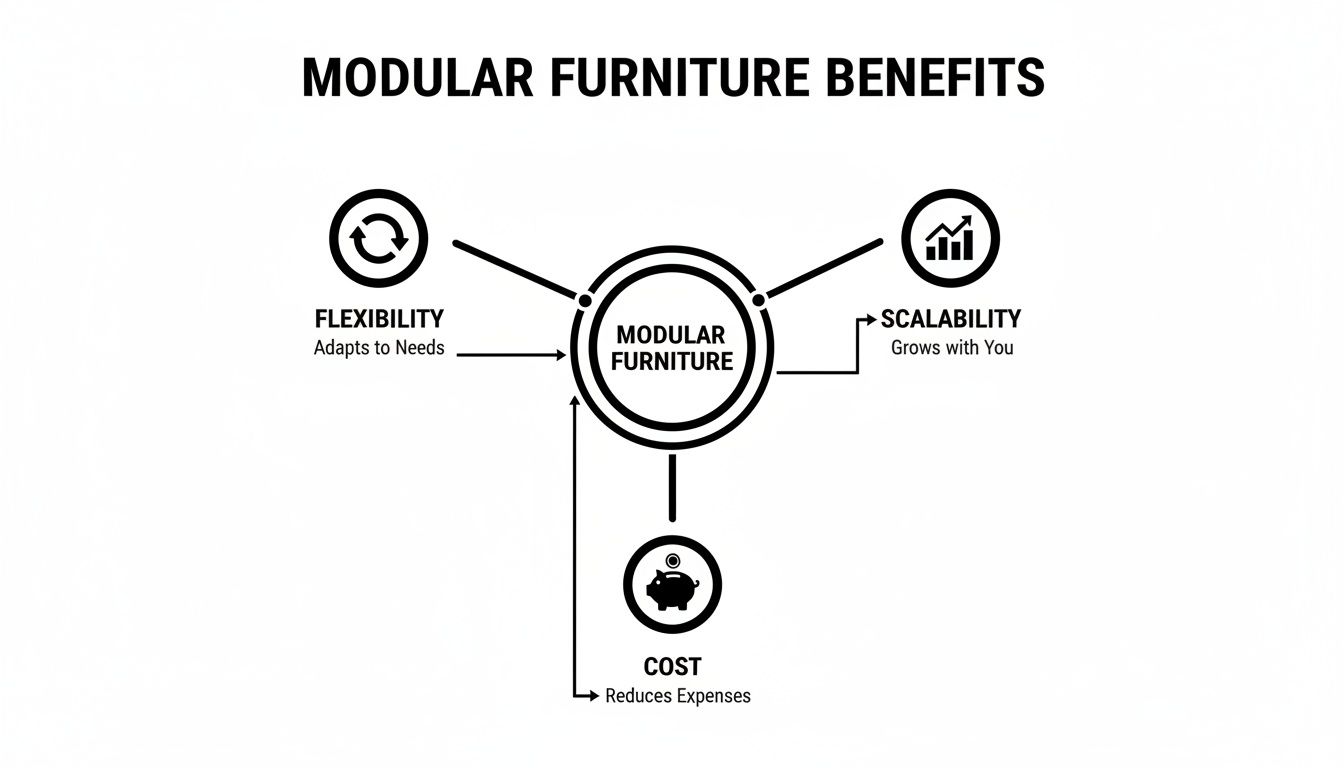
This image really drives home the core benefits these building blocks deliver.

A diagram illustrating the benefits of modular furniture: flexibility, scalability, and cost savings.

As you can see, the key advantages—flexibility, scalability, and cost savings—are all interconnected. They work together to support a smarter, more agile workplace strategy.

Configurable Desks, Tables, and Seating

Beyond the walls and cubicles, the furniture inside the space has to be just as adaptable. This category covers a whole range of components designed for movement and multiple uses.

  • Height-Adjustable Desks: These let employees easily switch between sitting and standing, which is great for health and accommodating different work styles.
  • Mobile Tables: Think lightweight tables on wheels that can be quickly rolled together for a training session, team huddle, or breakout meeting.
  • Modular Seating: This could be anything from sectional sofas in the reception area to soft seating pods that can be arranged to create casual meeting spots right in the middle of an open floor plan.

For a workplace that’s truly dynamic, smaller elements like standing desk converters can be fantastic building blocks, adding another layer of easy personalization to each workstation.

Integrated Power and Data Management

A modern office runs on technology, and a well-designed modular system plans for this right from the start. The final, and arguably most critical, building block is integrated power and data management. Modular furniture panels often come with built-in channels or “raceways” that neatly tuck away all the electrical wiring and data cables.

This isn’t just about looking tidy; it’s about pure function and safety. Integrated cabling gets rid of trip hazards and makes it incredibly simple to get power and network access right to each desk without a spiderweb of extension cords snaking across the floor.

When you decide to reconfigure your layout, the power and data infrastructure moves right along with the furniture. This pre-wired capability is what makes a modular office truly plug-and-play. It allows your business to adapt its physical space without being boxed in by the location of fixed electrical outlets. Together, all these building blocks create a cohesive system that lets you shape—and reshape—your workspace as your company grows.

Designing Your Custom Modular Workspace

Once you get a feel for the individual building blocks, you get to step into the role of an office architect. This is where the real potential of modular furniture comes alive—it’s not just about pushing pieces around, but about creating a workspace that’s a direct reflection of your team’s DNA and your company’s culture. Customization is what turns a pile of parts into a fully functional, branded environment.

This process is so much more than just picking a desk. It’s about intentionally engineering your floor plan for different work styles, from heads-down focus sessions to dynamic group brainstorms. By mixing and matching components, you can build a varied landscape inside your office that supports every single workflow.

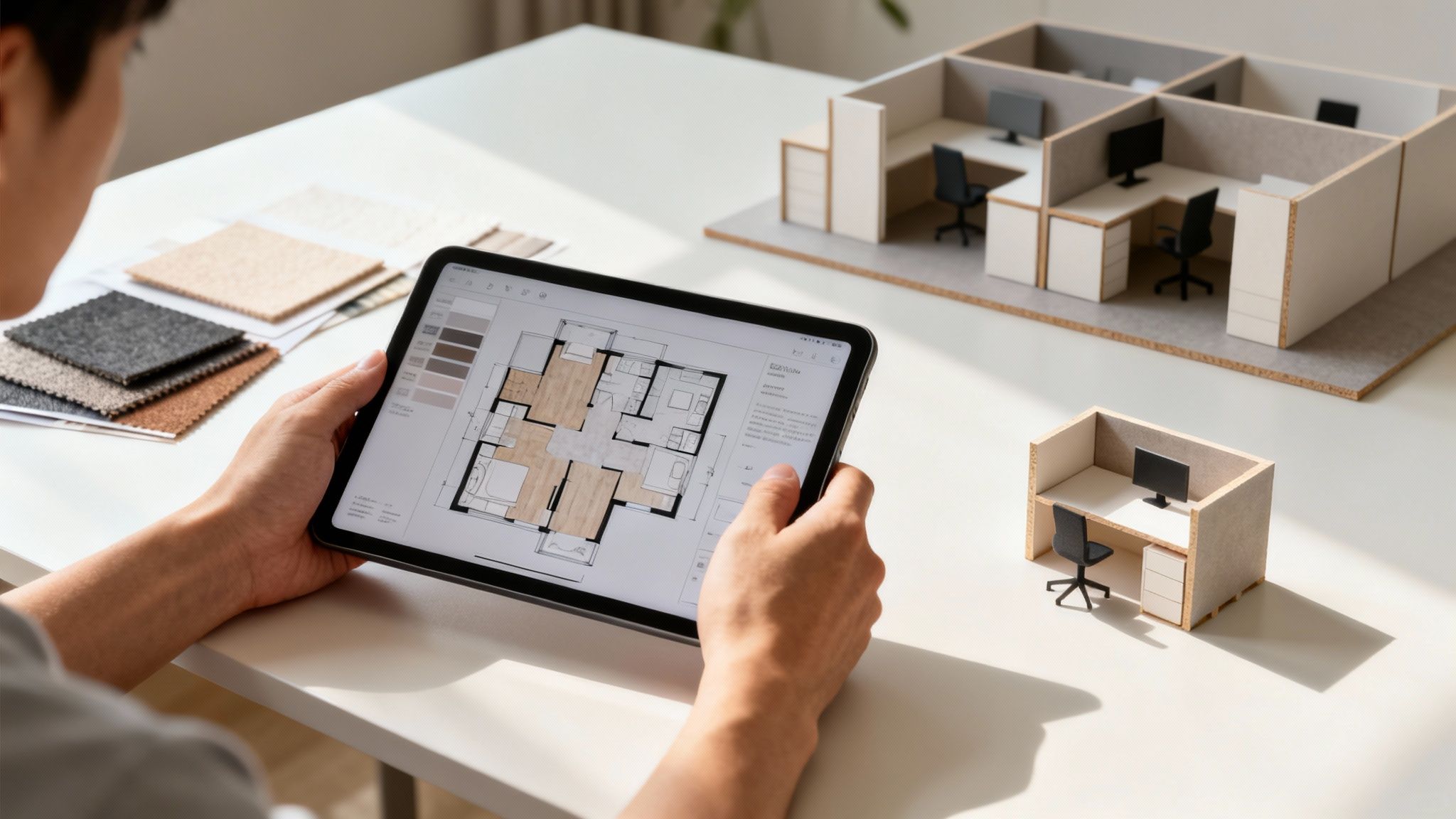
Person holds a tablet showing a floor plan, surrounded by fabric samples and miniature modular office models.

Engineering Different Levels of Privacy

One of the first—and most important—decisions is figuring out the right privacy level for different teams and roles. A one-size-fits-all approach almost never works. Modular systems give you the tools to create a whole spectrum of privacy, all within the same office.

  • Low-Privacy Benching: Perfect for high-energy sales or creative teams. Benching systems use low or no panels at all to encourage constant communication and a shared sense of purpose.
  • Mid-Privacy Workstations: By using panels around 42-53 inches high, you can give seated privacy to employees in roles like customer service or marketing. This lets them focus but still easily see and talk to colleagues when they need to.
  • High-Privacy Cubicles: For jobs that demand deep concentration or confidentiality, like accounting or HR, taller panels of 65 inches or more create a serious acoustic and visual barrier. This design kills distractions and supports focused work.

For a deeper dive into making the most of a tight footprint, check out our guide on modular office furniture for small spaces. It’s packed with practical tips on maximizing every square foot without giving up an ounce of function.

Choosing Finishes and Materials

The look and feel of your office have a huge impact on morale and how clients see your brand. Modular furniture opens up a massive palette of finishes and materials, letting you line up your workspace with your company’s identity. You’re definitely not stuck with one color or texture.

You can customize:

  • Panel Fabrics: Pick from dozens of colors and patterns to match your brand, from calm, neutral tones to bold colors that create an energetic vibe.
  • Work Surfaces: Choose from a huge variety of laminates, including classic wood grains, solid colors, and modern patterns to fit your aesthetic.
  • Trim and Accents: Even the metal trim on panels and legs can often be specified in different finishes like black, silver, or white to pull the whole look together.

This level of detail ensures your office isn’t just a place to work, but a physical extension of your brand. It sends a powerful message to both your team and your visitors.

Integrating Storage and Technology

A great workspace is an organized one. Modular systems are brilliant at providing built-in storage solutions that keep clutter from taking over. You can add components like overhead flipper door units, mobile pedestals for personal items, or even full-height tower closets, all designed to fit seamlessly into the workstation.

It’s the same story with technology—planning for it is built right in. As you design your layout, you’ll specify exactly where power and data access points need to go. This proactive planning makes sure every employee has easy access to outlets for their computers and devices, all managed through clean, hidden channels inside the panels. No more messy extension cords tripping everyone up. Your office will be ready for the demands of a modern, tech-heavy workflow from day one.

Ready to see how all this works in the real world? The best next step is to start experimenting yourself. We invite you to explore the Cubicle Designer tool from Cubicle By Design, where you can move from learning to doing. This interactive tool lets you build a custom layout, select finishes, and bring your vision for the perfect modular workspace to life.

The Smart Investment in Modular Furniture

Choosing modular furniture isn’t just a design choice—it’s a strategic financial move that pays you back for years. While the upfront cost might look similar to a traditional office build-out, the real story unfolds over the long haul. That’s where modular systems pull way ahead, delivering a serious return on investment (ROI).

The secret is looking at the total cost of ownership. Traditional construction and fixed furniture have a nasty hidden price tag: the staggering expense of making changes later on. When your company needs to shuffle the floor plan, you’re often stuck with demolition, new construction, and the dead loss of tossing out perfectly good furniture.

Modular furniture completely sidesteps that wasteful “rip and replace” cycle. Since every single piece is designed to be taken apart and put back together in a new way, your initial purchase becomes a permanent asset. This incredible adaptability makes future layout changes faster, cheaper, and way less disruptive to your daily business.

Calculating the Long-Term ROI

The financial upside becomes crystal clear once you look past the first invoice. The real ROI of modular furniture comes from its power to adapt to your business as it grows and changes, all without hitting you with huge new expenses.

Think about these factors:

  • Slashed Reconfiguration Costs: Tweaking a modular layout takes just a fraction of the labor and material costs you’d face with a traditional renovation. You’re simply rearranging assets you already own.
  • Minimal Downtime: An office overhaul can happen in a few hours or over a weekend, not drag on for weeks. Your team stays productive and focused on their work.
  • Asset Retention: Modular parts are assets you can pack up and take to a new office, holding onto their value. Drywall and built-in fixtures? They just get demolished and become a total loss.

By investing in a system that can evolve with you, you’re essentially future-proofing your workspace against the costs of growth, reorganization, and shifting work styles. It’s a proactive way to manage your facility that treats your office furniture like the flexible, long-term asset it is.

The Powerful Sustainability Angle

Beyond the direct savings, modular furniture brings a powerful sustainability benefit to the table, which fits perfectly with modern corporate responsibility. Being able to reuse and reconfigure components drastically cuts down on the amount of waste headed for the landfill. Instead of junking old desks and partitions, you just give them a new purpose in a new layout.

This sustainable approach is a huge reason modular furniture is taking over globally. These solutions slash waste by design, helping companies hit their broader sustainability targets. In fact, manufacturers have reported 20-30% material savings just by using modular production methods, which really shows how efficient the whole system is.

This commitment to sustainability isn’t just good for the planet—it’s good for your brand. It shows a forward-thinking attitude that connects with employees and customers who care about being environmentally conscious. Of course, the installation is a key part of this smart investment, and you’ll want to know what to expect. For more on the logistics, you can learn about our professional office furniture installation process and how we make the transition totally seamless.

Your Top Questions About Modular Office Furniture, Answered

Making a big change to your office layout is a major decision, and it’s smart to have questions. You’re investing in your company’s future, and you need to feel confident about the path forward.

To give you that clarity, we’ve pulled together straight answers to the questions we hear most often from business owners and facilities managers. Think of this as a no-nonsense guide to the practical side of modular furniture, from setup and durability to acoustics and tech.

How Big of a Hassle Is Installation and Reconfiguration?

One of the most common myths we have to bust is that modular systems are complicated to put together. The reality is, a professional office furniture installation is incredibly fast and clean—especially when you compare it to the dust, noise, and weeks (or months!) of disruption that come with traditional construction.

A skilled crew can build out an entire office in a fraction of that time, which means you get back to business with almost no downtime.

But the real magic happens when your needs change. Reconfiguration is what these systems were born to do. What would be a massive renovation project with drywall and contractors becomes a simple weekend job for a small team. Your people can leave on Friday and come back Monday to a space that’s perfectly set up for their new workflow.

Is This Stuff Really Durable Enough for a Busy Office?

Absolutely. There’s a lingering concern that “modular” is just a code word for “flimsy,” but that couldn’t be further from the truth. Commercial-grade modular furniture is engineered specifically for the wear and tear of a high-traffic workplace.

We’re talking heavy-gauge steel frames, high-pressure laminates that resist scratches and spills, and tough fabrics designed to look good for years. The manufacturing standards for quality systems are incredibly strict, often blowing past what you’d find in conventional office furniture.

Here’s the key difference: reparability. If someone damages a single panel or a desktop, you just swap that one piece out. You don’t have to replace the entire workstation. This not only makes modular a smarter financial choice long-term, but it’s also a more sustainable one.

This built-in durability means your investment is secure, giving you a solid foundation for your office for years to come.

Can Modular Systems Keep Up With Our Tech Needs?

Modern modular systems are built from the ground up with technology in mind. You can forget about the messy jungle of extension cords and power strips you see in older offices. These systems are designed with built-in channels and raceways that hide all your power and data cabling.

This integrated approach delivers a few huge wins:

  • Convenient Access: Power outlets and data ports are brought right to the desk surface, exactly where your team needs to plug in laptops, charge phones, and connect to the network.
  • A Clean Look: All that wiring is tucked neatly out of sight, keeping your office looking professional and uncluttered.
  • A Safer Space: Getting loose cables off the floor eliminates one of the most common trip hazards in any office.

This isn’t an afterthought; it’s a core feature. It ensures your office isn’t just flexible in its layout, but also fully capable of supporting your team’s tech.

How Does Modular Furniture Help with Office Noise?

Noise is one of the single biggest complaints in today’s offices. A wide-open floor plan is an acoustic nightmare, but a modular layout gives you the power to control the soundscape.

The panels themselves are your first line of defense. You can specify them with sound-absorbing materials and choose different heights to create physical barriers that cut down on ambient chatter. Putting up taller, fabric-covered panels around a team that needs to focus can make a world of difference.

And for spaces where confidentiality is key, like HR or executive offices, you can go a step further. We can build in demountable walls or even full-height private office cubicles to create truly sound-insulated rooms—all without the cost and permanence of building with drywall. It’s all about finding that perfect balance between collaborative buzz and quiet concentration.


Ready to see how a modular approach could reshape your workspace? The experts at Cubicle By Design are here to help you plan, design, and install a flexible office that’s built for your business. Visit our homepage to see our solutions and start building a better office today.

Read More

Office Design Ideas for Small Spaces: Maximize a Tiny Office

The secret to unlocking great office design ideas for small spaces isn't about finding more square footage—it's about a smarter strategy. It all comes down to three simple but powerful principles: thinking vertically to make the most of your wall space, picking multi-functional furniture to keep clutter at bay, and zoning the area to carve out distinct, productive work environments.

Get these right, and even the most compact office can become a powerhouse of efficiency and style.

Rethinking Your Small Office For Big Results

Staring at a small floor plan can feel like a major limitation. But what if you saw it as an asset instead? A compact space forces you to be intentional. Every single design choice has a real impact, making it an opportunity to create something truly purposeful.

With hybrid and flexible work models becoming the norm, making every square foot count is more important than ever. The mission is to build a space that feels open, stays organized, and is primed for deep, focused work.

This means moving past the clunky, traditional layouts of yesterday and embracing solutions built for modern flexibility. Today’s teams need environments that can pivot and adapt. A thoughtfully designed small office can actually boost communication and create a much stronger sense of community than a sprawling, impersonal one. Here at Cubicle By Design, we specialize in transforming these tight quarters into highly functional workspaces that people love to be in.

The Foundation of Smart Small Space Design

A successful project starts with understanding the core principles that make a small office not just work, but thrive. These aren't just little decorating tips; they are foundational strategies that directly shape how productive and happy your team will be. By focusing on these key areas, you can create a workspace that punches well above its weight class.

To get you started, here is a quick-reference table summarizing these core ideas.

Core Principles for Small Office Design

Principle Key Action Primary Benefit
Think Vertically Use tall shelving, wall-mounted storage, and high-back cubicles. Frees up valuable floor space and reduces physical clutter.
Embrace Multi-Functionality Choose furniture that serves two or more purposes (e.g., storage benches). Maximizes utility without adding more items to the room.
Zone Strategically Use partitions, rugs, or paint to define separate functional areas. Creates psychological separation for focus, collaboration, and breaks.
Master Light & Color Prioritize natural light and use a light, neutral color palette on walls. Makes the space feel significantly larger, brighter, and more open.

These principles are the bedrock of any effective small office layout. A well-executed plan addresses each one right from the start.

For a much deeper dive into the nuts and bolts of structuring your layout, our guide on office space planning and design gives you a complete framework for mapping out your vision from start to finish.

A thoughtfully designed small office proves that you don’t need a massive footprint to achieve big results. It's about making smart, efficient choices that support your team's workflow and well-being, turning limitations into an advantage. This guide provides actionable strategies to help you get there.

Creating Your Blueprint For Productivity

Before you even think about ordering furniture, the first step to a great small office is a smart plan. This is where you map out your space with purpose, making sure every single decision you make down the line actually helps your team get their work done and moves your company forward.

Think of yourself as an architect for a moment. You have to start by measuring everything—the exact dimensions, where the windows and doors are, and where you've got power outlets. But this blueprint is about more than just measurements; it's about figuring out how your team really works day-to-day.

Mapping Your Team's Workflow

To get a layout that truly functions, you have to watch how the space is used. Think about the natural pathways people will take. Where do they walk? Where does someone need to sit for quiet, heads-down work? And where can a couple of people have a quick chat without derailing everyone else's focus?

One of the most effective tricks for small spaces is creating distinct zones for different kinds of work. You don't need to build walls to do this. Something as simple as an area rug, a change in lighting, or clever furniture placement can signal that you're moving from a collaborative area to a quiet zone.

This kind of thoughtful planning helps you sidestep common small-office headaches, like traffic jams next to desks or loud conversations happening right beside someone trying to concentrate. The goal is a layout that feels natural and helpful, not like an obstacle course.

Planning for Modern Flexibility

Today's workplace, especially a smaller one, has to be able to change on a dime. With hybrid teams and projects that shift constantly, a rigid layout just won't cut it. The real trend isn't just about downsizing; it's about making a smaller footprint work smarter. In fact, around 77% of businesses are rethinking their office layouts to make every square foot more flexible. For companies where only about 30% of the team is in the office on a given day, shared desks are quickly replacing dedicated ones to maximize space. You can get more great insights on space planning trends from this guide by Coram.ai.

A flexible blueprint might include:

  • Modular Furniture: Pieces that can be easily moved and reconfigured, like the workstation cubicles we offer. They can adapt as your team shrinks or grows.
  • Hot-Desking Areas: Unassigned desks that different employees can use when they're in the office.
  • Multi-Purpose Zones: A small meeting spot that can double as a quiet lunch area or a casual place to catch up.

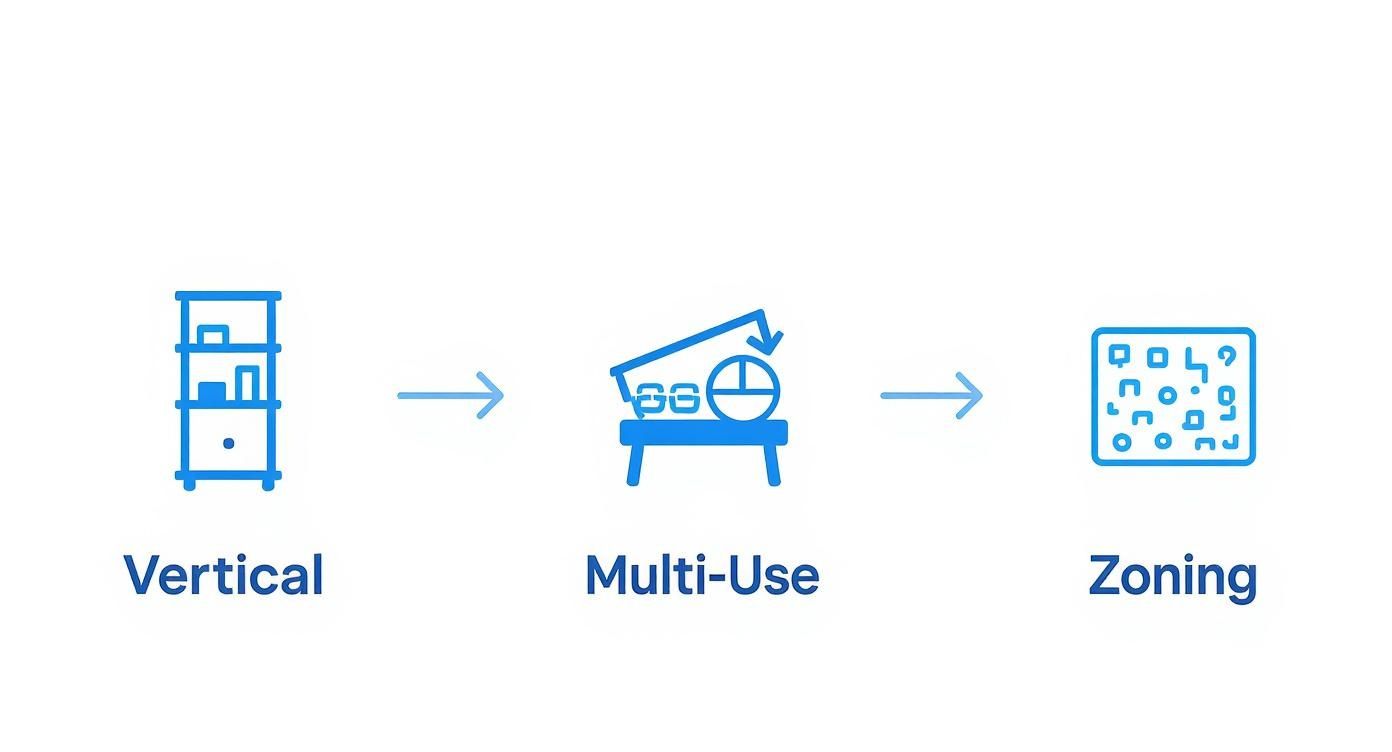
This infographic really nails down the core ideas of optimizing your space.

Icons illustrating a progression from vertical storage to multi-use concepts and efficient space zoning.

It shows you how to layer these strategies perfectly—start by thinking vertically, bring in multi-use items, and then zone the whole layout for peak efficiency.

Visualizing Your Future Workspace

The final step is turning your rough sketches and ideas into a solid plan you can actually see. This is where your vision for a smarter small office really comes together. And you don't need to be a professional designer to pull this off.

By visualizing your layout before you commit, you can catch potential issues, experiment with different arrangements, and refine your plan until it's perfect. This step saves both time and money down the line.

To bring your ideas to life, we highly recommend using a visual tool. You can start playing around right now with our free Cubicle Designer tool. It lets you test different layouts and see how our various cubicles and private office cubicles can fit into your unique space. It's a hands-on way to design a better workplace with total confidence.

Selecting Furniture That Works Harder

When you're working with a small office, your furniture can't just look good—it has to be a strategic tool. The right pieces can make a compact area feel surprisingly spacious and hyper-functional. Get it wrong, and you've got instant clutter. Honestly, smart furniture choices are the secret sauce to unlocking the full potential of your limited square footage.

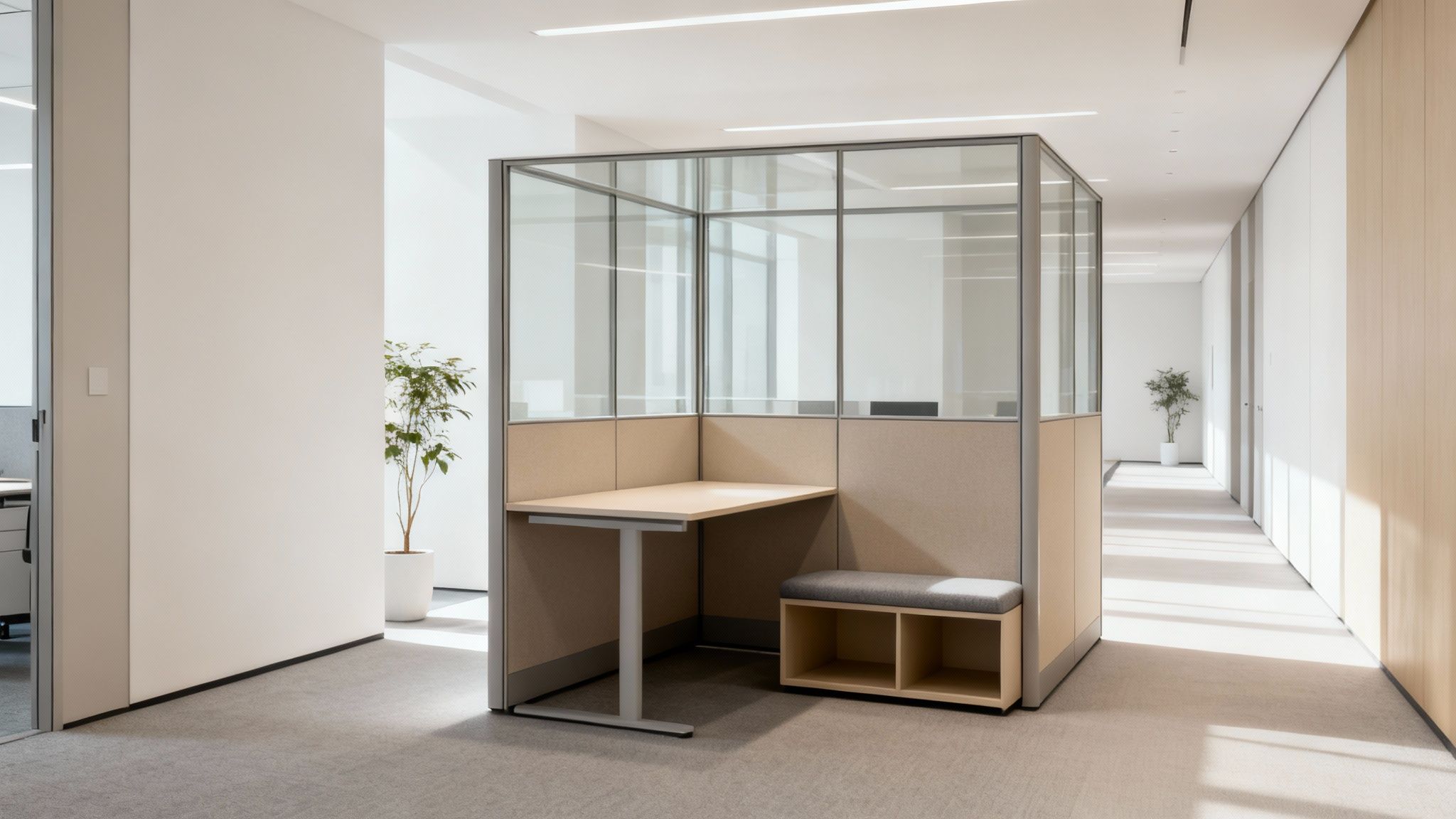
Bright, minimalist office corridor with a semi-enclosed work pod, desk, and storage bench.

This means every single desk, chair, and partition has to pull its weight. Think of your furniture as an active player in your office workflow, not just a passive object sitting there. Each item should either save space, serve multiple roles, or help create distinct work zones without boxing everyone in.

Embracing Modularity and Flexibility

If there's one quality that matters most for small-office furniture, it's adaptability. A static, one-size-fits-all approach is a recipe for frustration as your team grows and projects change. This is exactly where modular systems prove their worth.

Modular furniture is like a professional-grade LEGO set for your office. You can arrange it, reconfigure it, and add to it as your needs shift, which means you're never locked into a layout that no longer works.

Our workstation cubicles, for example, are designed for this exact problem. You can set them up as individual pods for deep focus, then easily reconfigure them into collaborative clusters for a new project. For a growing business, that kind of flexibility isn't just nice to have—it's essential.

A recent study on office design found that flexible, reconfigurable furniture is a top priority for 68% of facility managers in small spaces. They know that the ability to adapt is a real competitive advantage, letting them get the most out of every square foot.

Balancing Privacy and Openness

One of the trickiest parts of designing a small office is giving people privacy without making the space feel like a shoebox. Your team needs quiet spots to concentrate, and managers need places for confidential chats. But building traditional drywall offices? That's often a non-starter due to space and budget.

This is where modern cubicles and partitions offer the perfect middle ground.

  • Private Office Cubicles: These solutions create a self-contained "room-within-a-room," giving you the acoustic and visual privacy needed for leadership or sensitive work. Modern private office cubicles can even feature tall walls and a door for that true office feel, without the construction crew.

  • Glass Panels and Partitions: Using glass is one of the best moves you can make in a small space. Glass walls keep the atmosphere feeling open and airy, letting natural light flood the entire office and making it feel significantly larger. You get the sound separation you need without losing that visual connection.

  • Low-Wall Dividers: Got a team that needs some personal space but thrives on easy collaboration? Low-wall dividers are perfect. They define individual workstations and cut down on desk-level distractions, but team members can still talk to each other just by looking up.

The right balance really comes down to your team's workflow. A sales team might need more acoustic separation for all their calls, while a design team could benefit from a more open, collaborative vibe. For a deeper dive into workstation options, check out our guide on good desks for small spaces.

Choosing The Right Solution For Your Team

Not all furniture solutions are created equal, and the "best" choice is the one that fits your team's day-to-day reality. Do you need to prioritize heads-down focus, or is your success built on constant collaboration? Thinking through these questions will point you toward the ideal setup.

To help you decide, we've put together a simple breakdown of the most common furniture types.

Furniture Solutions for Small Office Spaces

Furniture Type Best For Space Impact Cubicle By Design Solution
Modular Workstation Cubicles Teams needing a mix of collaborative access and individual focus. Highly efficient and adaptable to changing team sizes or project needs. Workstation Cubicles
Private Office Cubicles Managers, HR, or any role requiring high confidentiality and concentration. Creates defined, private spaces within a larger open-plan area. Private Office Cubicles
Glass Partitions/Walls Creating distinct zones while maximizing natural light and an open, airy feel. Visually expands the space and promotes a sense of transparency. Custom Design Options
Benching Desks Highly collaborative teams, creative agencies, and hot-desking environments. Maximizes the number of seats in a linear footprint for high-density areas. Custom Design Options

By being selective and choosing furniture that truly works harder, you can transform your small office from a place of limitation into a strategic asset. Each piece will contribute to a more organized, productive, and comfortable environment for everyone.

Winning The War Against Clutter

Clutter is the ultimate productivity killer in a small office. It makes the space feel chaotic, cramped, and frankly, stressful. Winning the war against clutter isn't just about a quick tidy-up; it's a strategic battle for focus and efficiency. The goal is to move beyond old-school filing cabinets and embrace creative, space-saving organization.

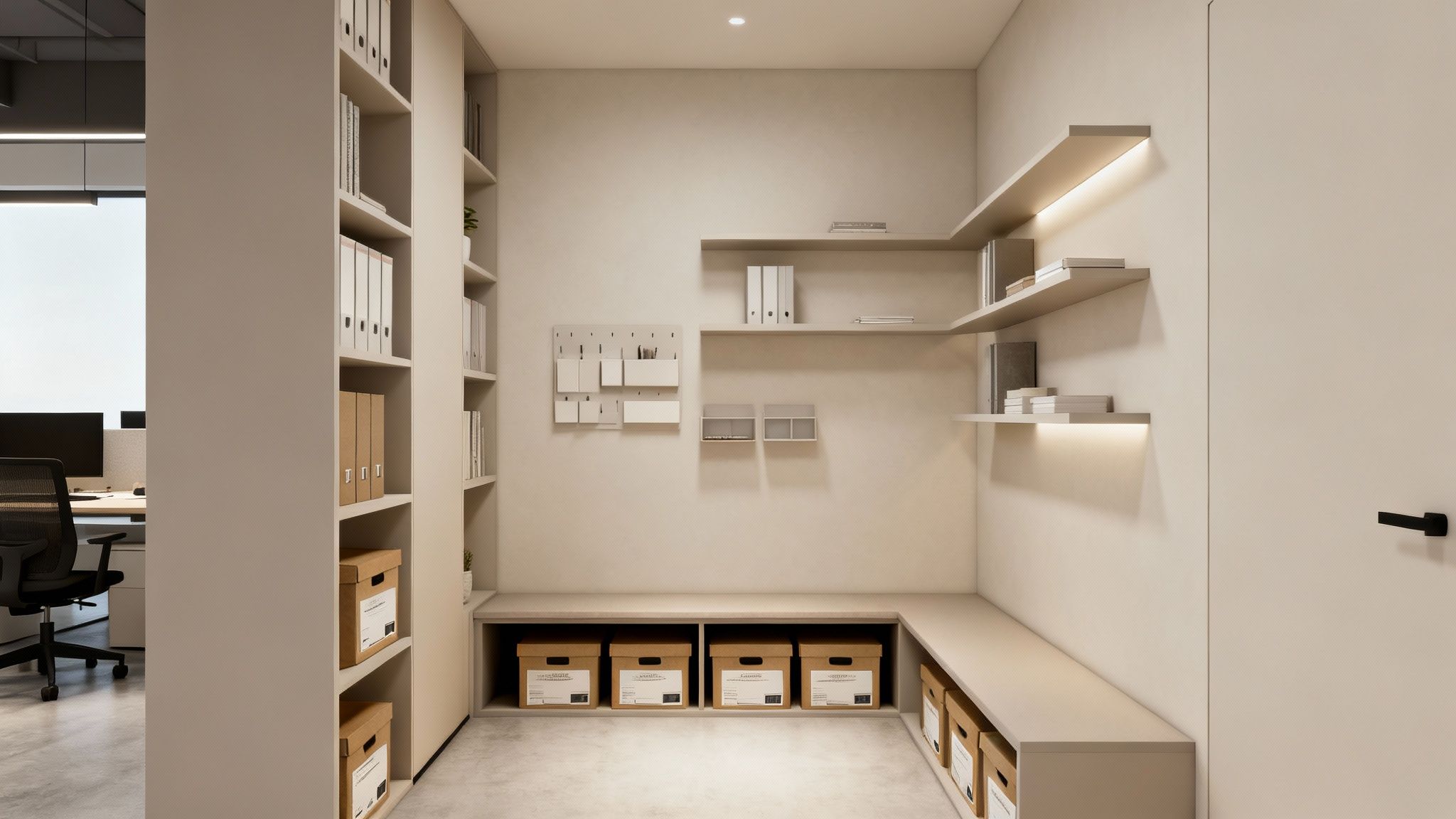
A minimalist office storage room with shelves, document boxes, and a doorway to another workspace.

It all starts by rethinking how you use every surface. By finding and using those hidden storage opportunities, you can create a workspace that not only looks cleaner and feels larger but actually functions more smoothly for your whole team.

Think Vertically To Maximize Your Walls

The most underused real estate in any small office is right there on the walls. When your floor space is at a premium, the only way to go is up. This simple shift in perspective unlocks a huge amount of organizational potential and keeps your floors clear and open.

Thinking vertically means drawing the eye upward with tall, narrow shelving units, which also has the nice effect of making the room feel higher. Wall-mounted organizers, floating shelves, and even pegboard systems can turn an empty wall into a command center for supplies, documents, and tools.

An organized space is a productive space. Studies show that physical clutter actively competes for your attention, resulting in decreased performance and increased stress. By clearing the clutter, you're clearing the way for better focus.

Well-designed cubicles are a cornerstone of this strategy, often coming with integrated overhead bins and pedestals right out of the box. Even better, you can add specialized storage to make them work even harder. You can learn more about how to get the most out of your vertical cubicle space by exploring cubicle hanging shelves that add tons of storage without taking up a single inch of desk surface.

Find Hidden Storage In Plain Sight

Beyond the walls, some of the best storage solutions are hiding in your furniture. Multi-functional pieces are a must-have in any small office design because they pull double duty without adding more bulk to the room.

Keep an eye out for opportunities to introduce clever, dual-purpose furniture:

  • Storage Ottomans: These are perfect as extra seating for a quick chat and can easily store blankets or less-used equipment out of sight.
  • Benches with Built-in Storage: A great fit for a reception area or a small breakout zone, these provide seating and a spot to tuck away bags, supplies, or even shoes.
  • Desks with Integrated Shelving: Look for desks that have built-in vertical storage or hutches to keep essential items within arm's reach but off the main work surface.

Digitize Your Documents And Reduce Paper

Let's be honest: a huge source of office clutter is paper. Stacks of documents, old files, and random printouts can quickly overwhelm a small space. A key part of modern organization is shifting from a paper-first to a digital-first mindset.

Encourage your team to use cloud storage for documents, digital note-taking apps, and collaborative online platforms. This doesn't just cut down on physical clutter—it also makes information way easier to find and share. When you do need to print, make sure you have a clear and simple filing system in place to prevent those dreaded piles from forming.

This approach lines up perfectly with modern workplace trends, where every inch has to be optimized. As hybrid work models drive tighter space utilization, efficiency is everything. Between 2021 and 2024, the average space per employee in the U.S. tightened by a whopping 27%, with workstations between 35 and 49 square feet becoming the new normal. By digitizing your workflow, you directly support this need for a leaner, more organized office.

Controlling Light And Sound To Enhance Focus

In a small office, light and sound are two of the most powerful—and most ignored—ingredients for success. Their impact gets amplified in a tight space. When you get them right, a cramped room suddenly feels open and a chaotic one feels calm, directly helping your team focus and do their best work.

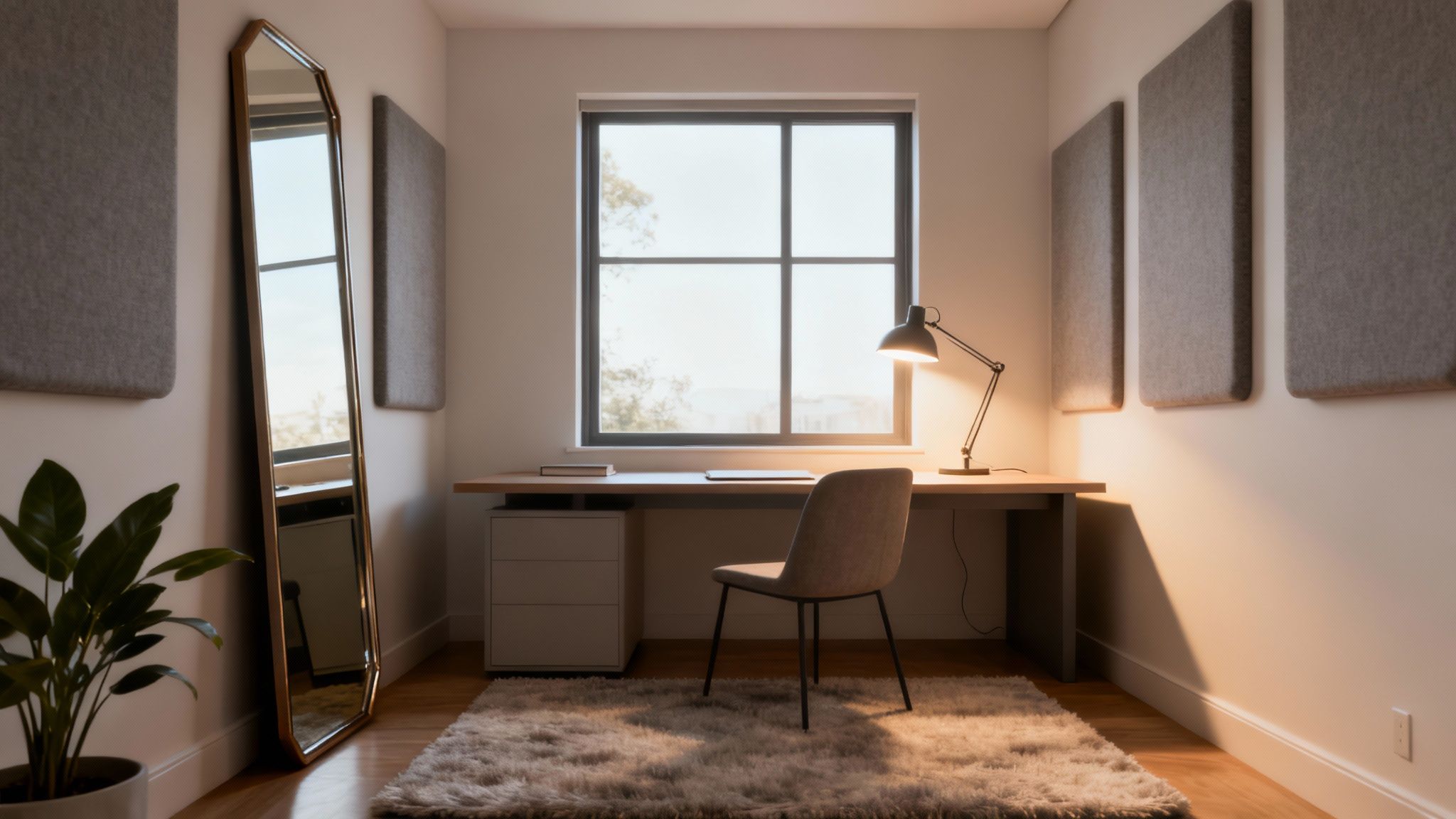
A bright and modern home office with a minimalist desk, chair, window, and acoustic panels.

Think of these elements as tools. By shaping the light and sound in your workspace, you’re shaping the psychological experience for everyone in it. A well-lit, acoustically balanced office isn't just a perk; it's a place where deep work can actually get done.

Let There Be Light

Natural light is your secret weapon in a small office. It has an almost magical ability to make a space feel bigger than it is while lifting everyone's mood and alertness. The number one rule? Never, ever block your windows.

Instead, build your layout around them. Position desks to catch the sunlight, but be smart about it—use low-profile furniture that doesn’t cut off the view. A big mirror on the wall opposite a window can work wonders, bouncing light around the room and creating a feeling of depth.

Of course, the sun isn't always out. That's where a layered lighting strategy comes in, keeping the office functional and inviting all day long. This just means mixing three types of light:

  • Ambient Lighting: This is your general, all-over light from ceiling fixtures or recessed cans. It fills the room and sets the base level of brightness.
  • Task Lighting: This is focused light for getting work done, like an adjustable desk lamp for each person. It’s a must-have for reducing eye strain.
  • Accent Lighting: This is the fun stuff. Use it to highlight cool features like a piece of art or your company logo. It adds personality and character.

Taming The Noise

Noise is the arch-nemesis of a small office. One phone call can throw the entire room off track. Sound loves to bounce off hard surfaces—walls, floors, ceilings—turning your space into an echo chamber where focus goes to die.

The fix is to bring in materials that absorb sound instead of reflecting it. You don't need to tear down walls or get into a major renovation. A few simple, affordable tweaks can make a massive difference.

A workplace study found that out-of-control noise is a top complaint for office workers, with distractions eating up an average of 86 minutes per day. In a small office, sound control isn't a luxury—it's a requirement for getting anything done.

Start by adding soft surfaces anywhere you can. Area rugs on bare floors, fabric curtains instead of blinds, and upholstered furniture are all great places to start. Even something as simple as a felt or canvas wall hanging can help soak up ambient noise. For a more targeted approach, acoustic panels are designed for exactly this purpose and come in all sorts of styles to match your look.

Creating Zones of Quiet

While absorbing general noise helps, the best way to protect your team’s focus is to create dedicated quiet zones. This is where modern cubicles really shine. They aren’t just dividers; cubicles with sound-dampening fabric walls create individual bubbles of quiet, shielding people from conversations and a a flurry of activity just a few feet away.

These systems are one of the smartest ways to give people the separation they need for deep work without putting up permanent walls. They can turn a loud, open-concept room into a collection of productive sanctuaries.

To see how these solutions can transform a workspace, it’s worth exploring the principles of office cubicle privacy to understand how different materials and wall heights contribute to a quieter, more focused environment. By mastering both light and sound, you can turn your small office from a challenge into a major asset.

Bringing Your Small Office Vision to Life

You've got the playbook. You know the strategies to turn a tight space into a productive powerhouse. A thoughtfully designed small office isn't just a dream; it's an achievable goal that pays dividends in team morale, focus, and raw efficiency. It all comes down to being intentional with every square foot.

The core ideas are simple: plan your layout like an architect, pick smart, multi-functional furniture, conquer clutter by thinking vertically, and nail the vibe with the right lighting and sound control. Now for the fun part—turning those concepts into a real, working space.

Turning Ideas Into Reality

The journey from a floor plan to a fully built-out office is where your vision really comes alive. You don't have to look far to see how important smart design is, especially with the boom in flexible work environments. The coworking and small office industry has exploded, now covering over 150 million square feet in the U.S. alone. This isn't just a fad; it’s a clear signal that companies are getting serious about adaptive designs that squeeze maximum value out of every inch. You can learn more about national coworking space trends to see how this movement is shaping modern offices.

At Cubicle By Design, we live for this stuff. Our team is here to help you bridge that gap between a great idea and a finished space that perfectly meets your team's needs. The final steps are all about careful selection, visualization, and professional execution to pull it all together.

A great small office design isn't just about fitting everything in. It's about creating a space that feels intentional, supports deep work, and makes your team feel valued and productive from day one.

Your Next Steps to a Better Workplace

With a solid plan in hand, you can move forward with confidence and build the small office your business deserves. Here’s how you can get started today:

  1. Experiment with Your Layout: Use our free Cubicle Designer tool to play around with different setups. See how workstation cubicles or even private office cubicles might fit your floor plan. It's a no-risk way to see what's possible and refine your blueprint.

  2. Browse Real Solutions: Take a look through our full catalog of cubicles to get a feel for the different styles, heights, and finishes out there. Sometimes, seeing real-world examples is the best way to spark a new idea for your own space.

  3. Consult with the Experts: Let our design team help you put it all together. We can walk you through every decision, from the first sketch to the final touches. Getting the final pieces in place correctly is crucial, and our expert team provides professional office furniture installation services to make sure everything is perfect. Let's create a space you and your team will absolutely love.

Common Questions About Small Office Design

Even the most thorough plan can leave you with a few nagging questions. When it comes to designing a small office, some challenges pop up time and time again. Let’s tackle some of the most common ones head-on so you can keep your project moving with confidence.

How Can I Make My Small Office Look Bigger?

Making a small space feel bigger is all about mastering a few key illusions with light and verticality.

First, embrace natural light like it’s your best friend. Keep your windows completely clear of any obstructions. Then, hang a few well-placed mirrors to bounce that light around the room, which instantly creates a feeling of depth.

Your color choices matter, too. Stick with a light, neutral palette for walls and big furniture items. This makes the whole space feel more open and breezy. And when you're picking out furniture, look for pieces with a smaller physical footprint and exposed legs. Seeing more of the floor tricks the eye into thinking there’s more space than there is.

Finally, get people to look up! It’s a simple trick that makes any room feel taller. Use tall, narrow bookshelves, vertical stripes on an accent wall, or wall-mounted storage to draw the eye upward.

What Is The Best Layout For A Small Rectangular Office?

For those long, skinny rectangular rooms, the best bet is to line the desks up along the longer walls. This strategy keeps a wide, clear path down the middle of the office, which is crucial for avoiding that cramped, bottleneck feeling when people are walking around.

Tuck shared equipment, like printers and scanners, into a corner on a dedicated stand to keep them out of the main traffic path. If you need to add some separation between desks but don’t want to block light, low-profile cubicle partitions or frosted glass dividers are perfect.

Need a small meeting spot? A round table in a corner is a fantastic choice. It takes up much less visual and physical space than a square one, making it far easier to navigate around.

Are Cubicles A Good Idea For A Small Office Space?

Absolutely. But you have to forget the bulky, drab boxes from the past. Modern cubicles are a whole different ballgame—they’re specifically designed to be space-efficient, flexible, and look great.

Modern modular cubicles give you the best of both worlds in a tight space. They deliver the privacy and sound dampening people need for focused work, while options with glass panels or lower walls keep the office feeling bright, connected, and open.

For example, the workstation cubicles we offer at Cubicle By Design can be configured to fit your room’s exact measurements, so not a single inch goes to waste. They give every team member their own designated space, which is a proven way to cut down on distractions and help people concentrate.

How Do I Add Personality Without Creating Clutter?

This is where you get to have some fun, and it’s all about being strategic. To add personality without the mess, start with your walls—they’re your biggest canvas and don't take up any floor space.

  • Make Decor Functional: Instead of just art, hang a stylish whiteboard for brainstorming or a big corkboard for pinning up inspiration.
  • Bring in Some Green: Plants add so much life and color. Use hanging planters or wall-mounted pots to keep your desks and floors clear.
  • Create an Accent Wall: A single wall painted with a bold color or featuring a branded graphic makes a massive impact without adding a single object to the room.
  • Stick to a Cohesive Palette: Pick just one or two accent colors for small things like desk organizers, mouse pads, or chair cushions. This creates a unified, vibrant look that feels intentional, not messy.

By focusing your efforts, you can inject tons of character into the office, making it a space people actually enjoy coming to.


At Cubicle By Design, we're ready to help you turn these ideas into a reality. Take a look at our full range of cubicles or jump right in and start playing with layouts using our free Cubicle Designer tool today.
Read More