
A Practical Office Space Planning Guide for Modern Workplaces

Before you even think about floor plans or furniture catalogs, let’s get one thing straight: a great office design starts with data, not guesswork. At Cubicle By Design, we’ve seen it time and again—companies jump straight to the fun stuff and end up with a space that looks nice but doesn’t actually work. The most important step you can take is to first understand what your people, your company culture, and your business goals truly need from your office.

Setting the Stage for a Smarter Workspace

Skipping a proper needs assessment is a recipe for expensive mistakes. You end up with an office that frustrates employees and gets in the way of productivity. A real assessment translates your company’s unique DNA into a practical blueprint, making sure the final design supports how your teams actually operate day-to-day.

Think about it. A high-energy sales team that thrives on spontaneous huddles needs a completely different setup than a team of engineers who require deep, quiet focus. A one-size-fits-all approach just ends up fitting no one particularly well. Your goal is to create a workspace that feels custom-built for the people using it.

How to Find Out What Your Team Really Needs

To get real, actionable insights, you need to go beyond just asking people what they want. A mix of direct feedback and old-fashioned observation will give you the full picture.

Start with employee surveys, but ask smarter questions. Instead of a generic “Do you like the layout?”, get specific:

  • On a scale of 1-5, how easy is it to find a quiet spot for focused work?
  • What are the biggest roadblocks to collaborating with your team?
  • Walk me through your typical day. Where do you spend your time and what do you do there?

Questions like these uncover the real friction points. Then, back that up by just watching how people use the space. Where do meetings naturally happen? Are there high-traffic bottlenecks near the coffee machine? Which areas are ghost towns? You’ll often spot realities that people don’t even think to mention in a survey.

A well-executed needs assessment ensures every square foot has a purpose. It’s the difference between managing real estate costs and turning your office into a strategic asset that actively helps your business.

This isn’t just a nice-to-have anymore. In fact, 73% of corporate real estate leaders now rank optimizing their portfolio as their number one priority. Companies are focused on using their space more efficiently, which makes every design decision that much more important.

To make this process a bit more structured, here’s a table outlining the key areas you should be digging into.

Key Considerations for Your Needs Assessment

Assessment Area Key Questions to Ask Data to Collect
Workflow & Collaboration How do teams interact? Do they need ad-hoc meeting spaces or formal conference rooms? Employee surveys, observational notes on traffic flow, meeting room booking data.
Focus & Privacy What percentage of the day requires deep concentration? Are noise levels a problem? Survey results on distractions, requests for private spaces, decibel level readings.
Technology & Infrastructure Do teams have enough outlets and data ports? Is the Wi-Fi reliable in all areas? IT help desk tickets, employee feedback on connectivity, inventory of current tech assets.
Storage & Amenities Is there enough personal and departmental storage? What amenities (kitchen, lounge) are most valued? Physical audit of storage usage, employee wish lists, observation of common area use.
Future Growth What are the company’s growth projections for the next 1, 3, and 5 years? Headcount forecasts from HR, business expansion plans from leadership.

Gathering this information at the outset prevents costly changes down the road and ensures your final plan is grounded in reality.

Turning Your Findings Into a Plan

Once you’ve gathered all this info, patterns will start to pop. You might find your marketing team desperately needs a project hub with whiteboards, while the finance department is crying out for secure, private office cubicles. These insights are the foundation of your space plan. If you want to dive deeper into the fundamentals, check out our guide on what is space planning.

This prep work also includes practical operations. For example, now is the perfect time to develop an effective office recycling plan for all your old and new electronics.

By rooting your design in a solid understanding of your team, you create a workspace that doesn’t just look good—it actively boosts efficiency, collaboration, and morale from day one.

Getting Your Space Down on Paper

Now that you have a solid grasp of what your team needs, it’s time to get down to the brass tacks. We’re moving from ideas to the physical world, which means getting intimately familiar with every square inch of your office. A great layout isn’t just about dropping desks onto a floor plan; it’s about understanding the canvas you’re working with—from its permanent structures to its hidden infrastructure.

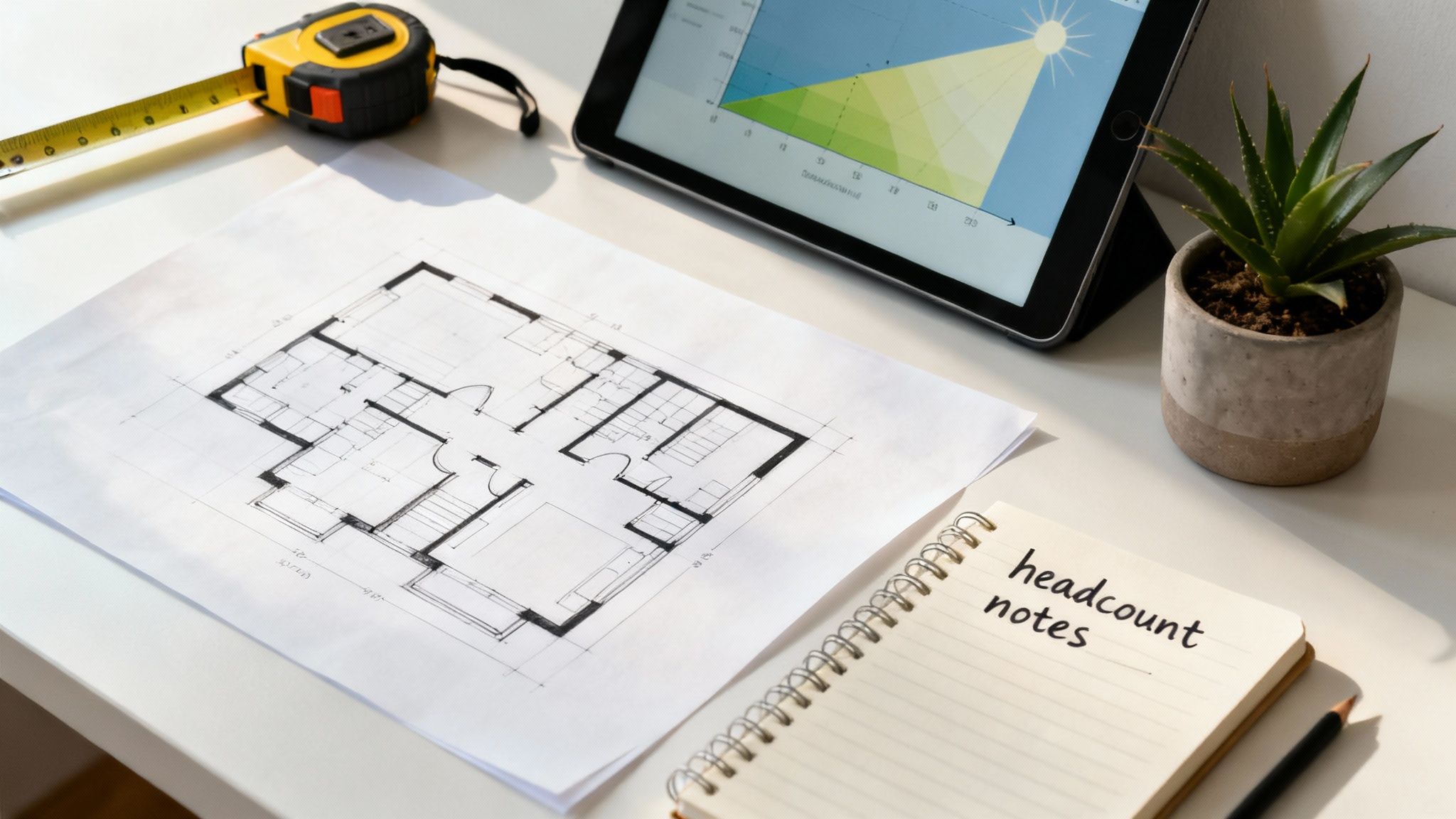
This all starts with a simple, essential tool: the tape measure. Seriously, don’t just trust old or estimated blueprints. You need to walk the floor and physically measure the entire space to create an accurate, up-to-date plan. This isn’t just about wall-to-wall dimensions. It’s about mapping every single element that will shape your final design.

Charting the Unchangeable Elements

Before you can dream up a flexible, modern workspace, you have to account for the parts of the building that aren’t going anywhere. These are the non-negotiable features that your entire layout must flow around. Trying to ignore them is a surefire way to create a plan that looks brilliant on a screen but completely fails in reality.

Your first pass should be to meticulously document these fixed features:

  • Structural Columns: Pinpoint their exact location and dimensions. These will directly impact where you can place furniture and how people will move through the space.
  • Windows and Doors: Measure their size and placement. Don’t forget to note which way the doors swing—it’s a small detail that makes a huge difference in ensuring proper clearance.
  • Load-Bearing Walls: Identify these critical structures. They cannot be moved or altered, period.
  • Ceiling Height Variations: Take note of any areas with lower ceilings, often due to ductwork or other utilities. This can affect everything from acoustics to lighting choices.

This detailed map of fixed elements becomes the foundational layer of your plan. It stops you from designing around spaces that simply don’t exist.

Identifying Your Office’s Nervous System

With the structural skeleton mapped out, the next critical step is to find the building’s infrastructure—its “nervous system.” Forgetting to map power outlets, data ports, and HVAC units is one of the most common and frustrating mistakes in office planning. It almost always leads to a tangled mess of extension cords and forces costly, last-minute electrical work.

Planning where your teams will sit without knowing where they can plug in is like designing a car without an engine. Your infrastructure map dictates the functional zones of your office long before any furniture arrives.

Walk the space and mark the precise location of every single power outlet and data jack. This information is non-negotiable and will heavily influence where you can place individual workstations, tech-heavy collaboration hubs, or even the office coffee machine. While you’re at it, find the thermostats and HVAC vents to avoid placing someone’s desk directly under a constant blast of cold air.

Bringing Your Vision to Life with Digital Tools

With your measurements and infrastructure map in hand, you can finally move from a static blueprint to a dynamic digital model. This is where the real fun begins.

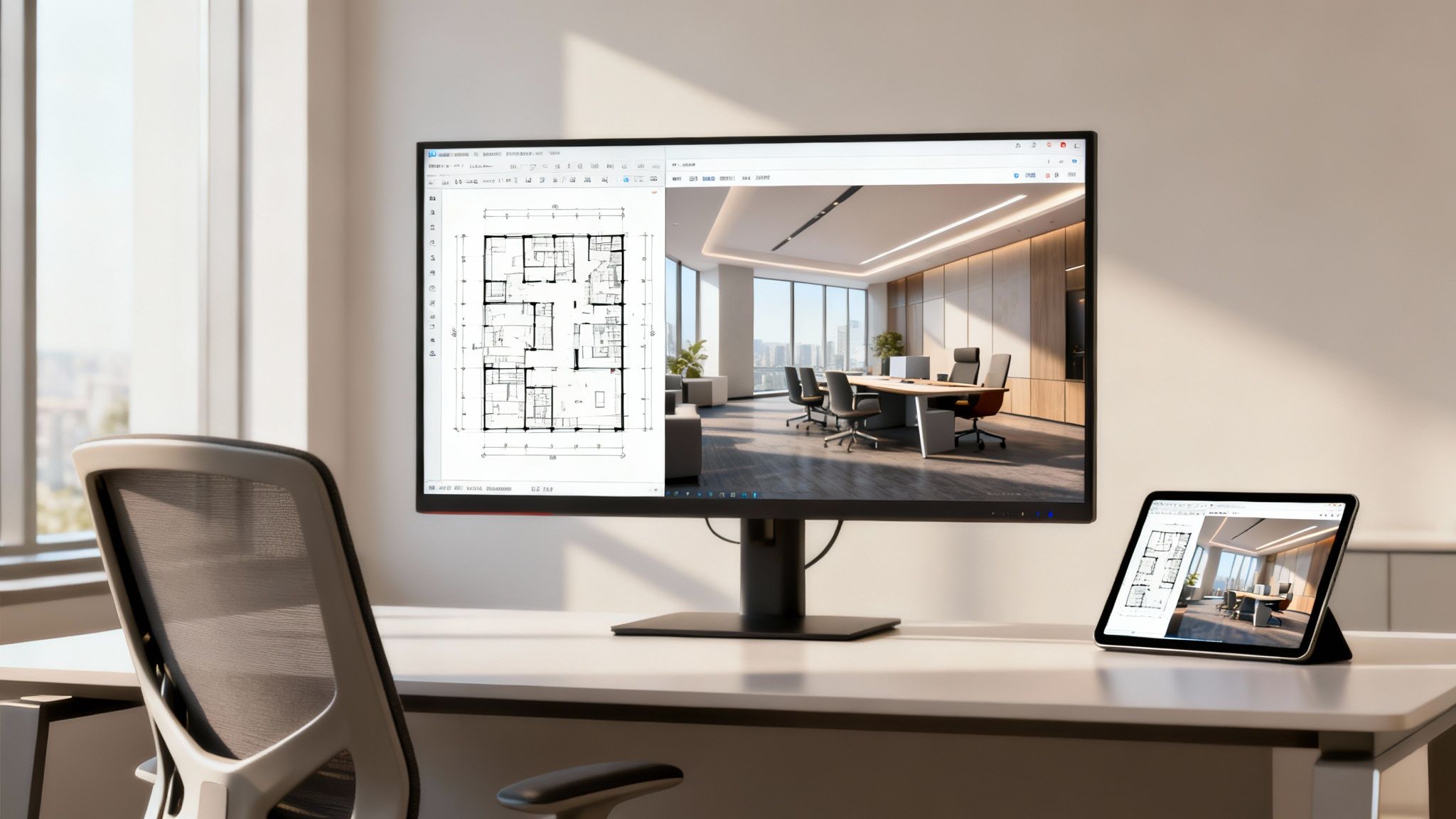
Using a tool like the Cubicle By Design cubicle designer lets you build a 2D and 3D version of your space. This isn’t just for a pretty picture; it’s about practical, real-world testing.

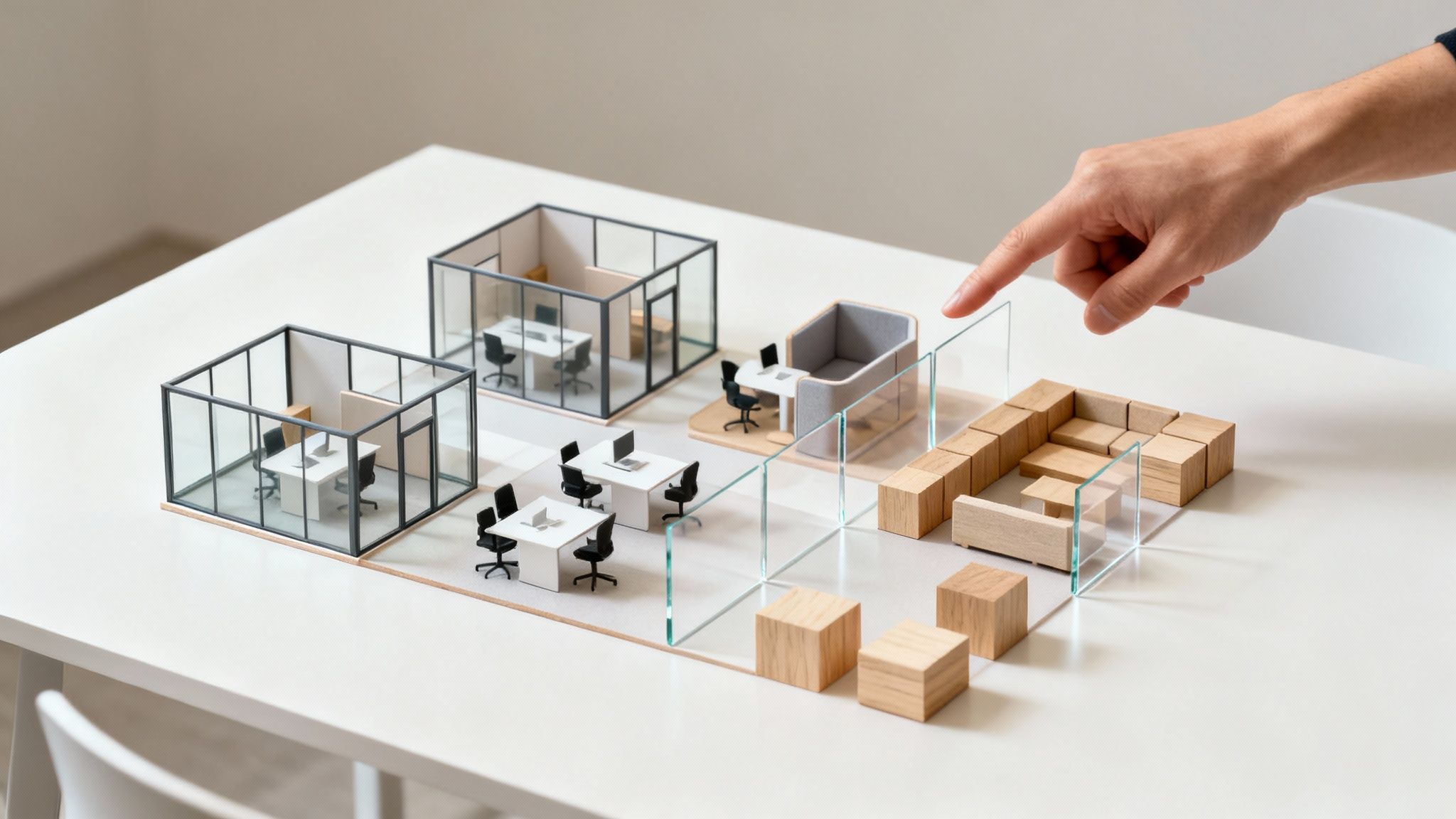
A digital model lets you experiment with different furniture arrangements without moving a single heavy object. You can drop in various workstation cubicles to see how they fit or configure a block of private office cubicles for the management team. This process, often called a “test fit,” helps you immediately see how different layouts affect foot traffic, sightlines, and the overall feeling of spaciousness. It also helps you understand how different furniture sizes will work; for a deeper dive, check out our guide on standard cubicle dimensions.

This digital sandbox is where your raw data transforms into a workable, intelligent vision for your office, ensuring the final layout is perfectly aligned with the needs you identified from the start.

Picking a Layout That Actually Works for Your People

The layout of your office is so much more than where you put the desks. It’s the silent communicator of your company culture. It sets the tone for how people collaborate, focus, and interact, and it has a direct line to morale and productivity. Let’s get past the basic pros and cons and really dig into the three main models—open, private, and hybrid—to figure out what’s truly right for your team.

Making this decision is where your needs assessment starts to take physical shape, turning all that data into a real, functional environment.

Understanding the Open Office Concept

The open-plan office gets a lot of hype for a reason. It’s built to knock down walls (literally) and encourage transparency, spontaneous conversations, and team collaboration. For high-energy, fast-moving teams in sales or marketing, this kind of buzz can be exactly what they need to spark new ideas and solve problems on the fly.

Of course, the big elephant in the room is noise and distraction. Without a solid plan, an open office can quickly become a hotbed of frustration for anyone trying to do deep, focused work. The real trick is creating an open space that also has pockets of quiet—something the hybrid model tackles head-on.

This whole process of choosing a layout starts with understanding the space you have. You can’t just pick a style without knowing your physical constraints.

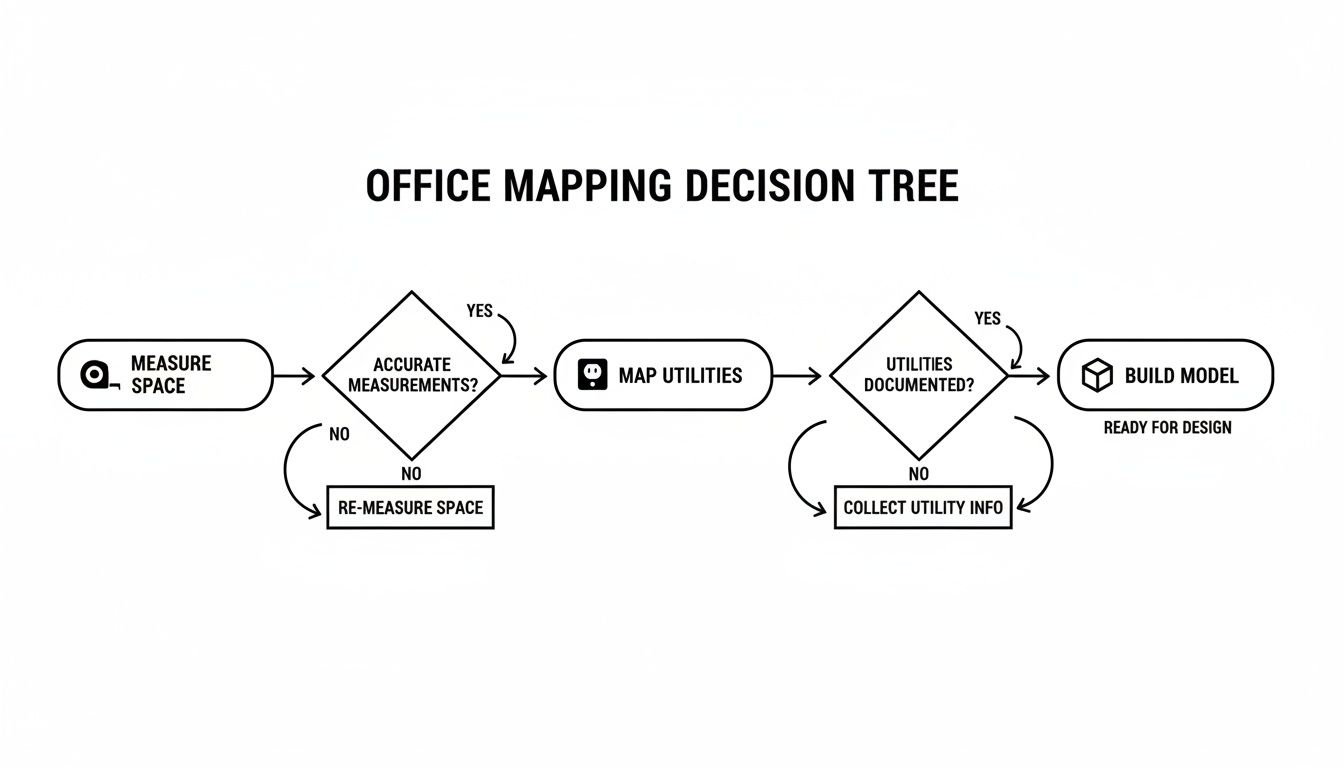
A flowchart illustrating the office mapping decision tree, showing steps from measuring space and identifying outlets to building a digital model for a test fit.

As you can see, everything from measurements to where the outlets are located has to be mapped out before you can seriously start building a model for your layout.

The Case for Private and Semi-Private Workspaces

On the other side of the coin, you have private layouts. These are all about focus, concentration, and confidentiality. This setup is a no-brainer for roles where deep work is the name of the game—think finance, legal, or engineering. Giving someone their own enclosed space cuts down on interruptions and provides a secure spot for handling sensitive information.

But “private” doesn’t have to mean “isolated.” For a detailed breakdown of these classic styles, check out our comparison of open plan offices vs. cubicles.

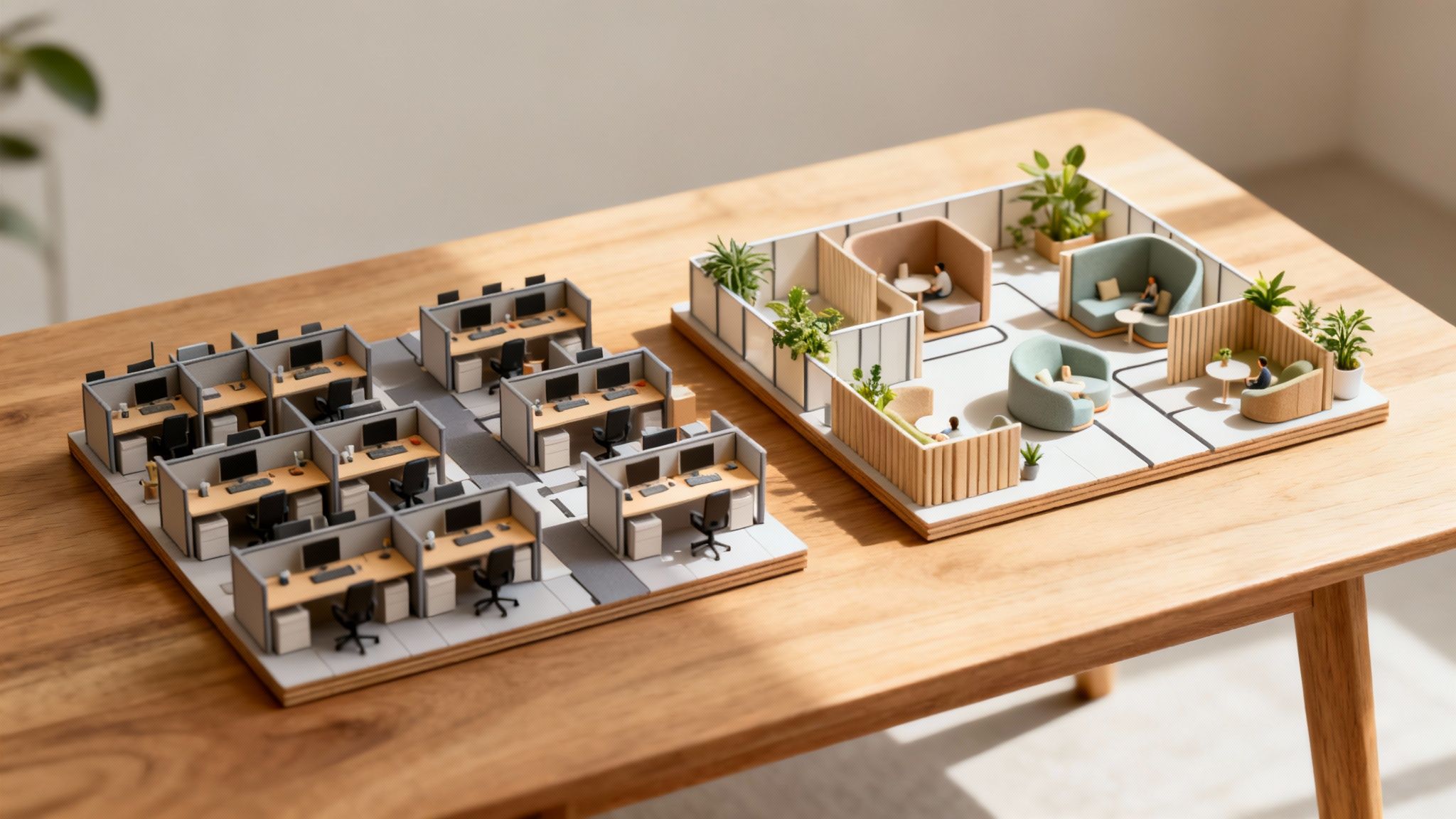
Embracing the Power of the Hybrid Model

For most companies we work with, the answer isn’t black or white. It’s a blend. The hybrid layout is the most flexible and realistic model because it acknowledges that work isn’t one-size-fits-all. The same person who needs to brainstorm with a team in the morning might need absolute silence to write a report in the afternoon.

This is where you get to be strategic by creating different zones for different kinds of work:

  • Collaboration Hubs: Open areas with whiteboards and comfy chairs for team huddles.
  • Focus Zones: Clusters of cubicles with higher walls for heads-down tasks.
  • Quiet Pods: Small, enclosed spots for private calls or one-on-one video meetings.
  • Social Areas: A kitchen or lounge that encourages those casual chats where some of the best ideas happen.

This approach gives your team the freedom to choose the right environment for the task at hand. It’s about empowering them to work smarter.

To help you decide, here’s a quick comparison of how these models stack up against each other.

Comparing Office Layout Models

Layout Type Best For Potential Challenges Cubicle By Design Solution
Open Plan Dynamic, collaborative teams (e.g., sales, marketing); fostering transparency and quick communication. High potential for noise and distractions; lack of privacy for focused tasks or confidential calls. Low-wall cubicles or benching systems that define personal space without completely isolating teams.
Private/Cubicle Roles requiring deep concentration and confidentiality (e.g., finance, legal, engineering). Can feel isolating if not designed well; may hinder spontaneous collaboration. Tall-walled private office cubicles with glass panels to maintain a sense of connection while providing acoustic privacy.
Hybrid Most modern businesses; teams with diverse roles and work styles; activity-based working. Requires careful planning and zoning; can be more complex to manage space utilization. A strategic mix of open-plan benching, mid-height workstation cubicles, and full-height glass office walls to create dedicated zones.

Ultimately, the hybrid model offers the flexibility that most modern teams need to thrive.

Our Takeaway: The best office layouts are designed around activities, not just job titles. When you give people a variety of spaces to choose from, you’re not just giving them furniture—you’re giving them control over their own productivity and building a culture of trust.

Getting the Infrastructure and Acoustics Right

A stunning office design is one thing, but if your team can’t plug in their laptops or hear themselves think on a call, that beautiful layout falls flat. This is where the real nitty-gritty comes in—the technical details of infrastructure and acoustics. They’re the invisible foundation that makes a workspace actually work.

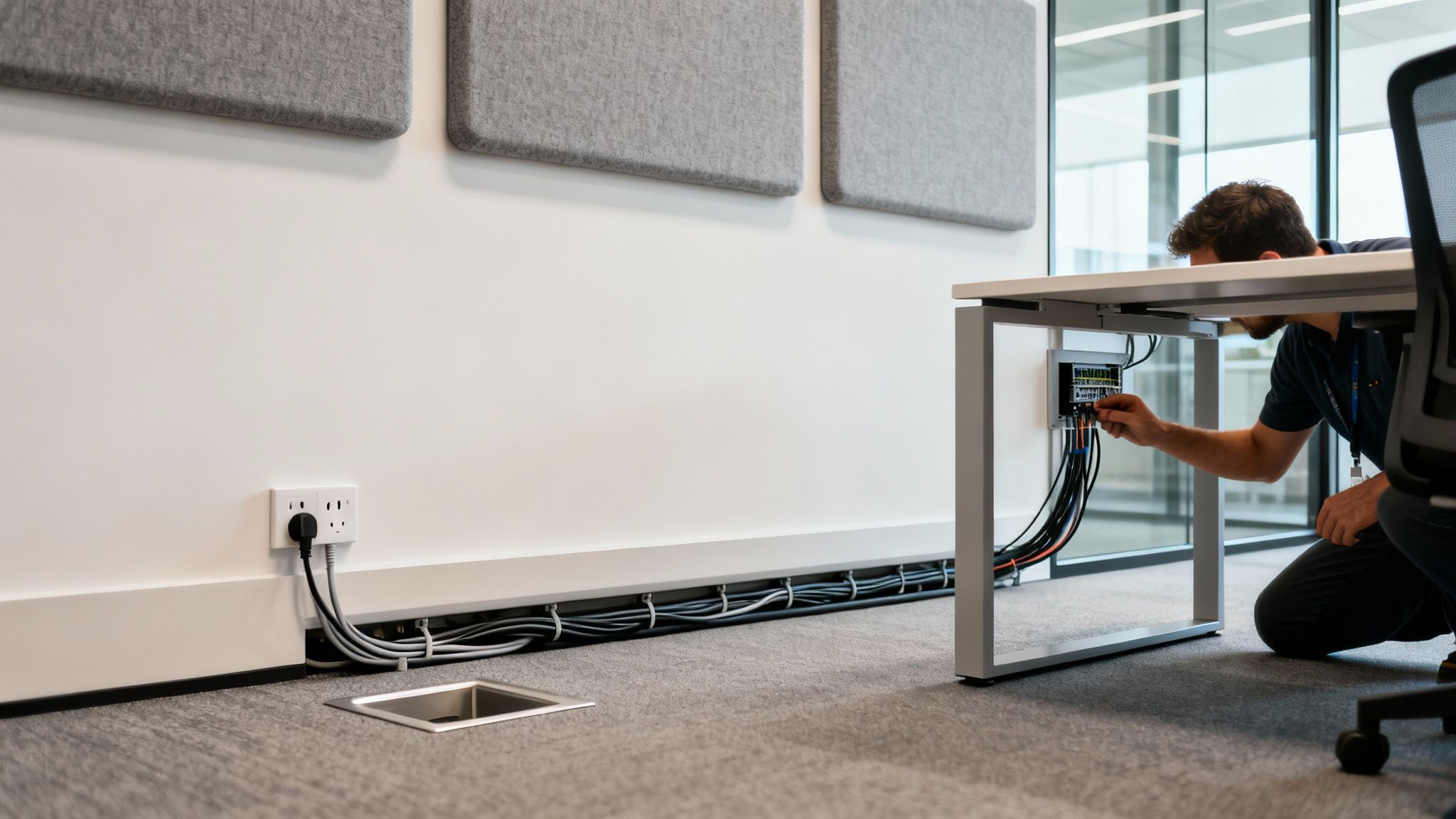
A technician connects network and power cables to an outlet beneath a modern office desk with gray acoustic panels.

Think about your power and data distribution from the very beginning. You’ll save yourself a future tangled in extension cords and plagued by dead Wi-Fi zones. In the same way, getting a handle on sound from the start ensures your office is a hub of productivity, not a den of distraction.

Plan for Power and Seamless Connectivity

Let’s face it, every modern workstation runs on power and data. Your layout has to reflect that reality with easy, accessible connectivity for every single employee. Skipping this step often leads to costly retrofitting down the road and ruins the clean, organized look you worked so hard to create.

When you’re planning the electrical systems, bringing in an experienced commercial electrical contractor is non-negotiable. It’s a matter of safety, efficiency, and meeting building codes. They can help you map out a grid that handles what you need today and what you’ll need tomorrow.

Here are the key things to bake into your infrastructure plan:

  • Workstation Power: Make sure every desk or cubicle has multiple outlets and USB ports. Modular furniture, like the systems we offer at Cubicle By Design, often has integrated power solutions to keep cables completely out of sight.
  • Meeting Room Tech: Conference rooms are power hogs. They need dedicated juice for big displays, video conferencing gear, and all the laptops your guests will bring. Plan for floor boxes or wall-mounted outlets to keep things clean and trip-free.
  • Wi-Fi Coverage: Sit down with your IT team to figure out the best spots for wireless access points. Walls and even large furniture can create frustrating dead zones if you don’t plan the layout carefully.

A rookie mistake is underestimating how many devices one person uses. Think about it: a laptop, a monitor, a phone charger, and other gadgets. A single outlet just doesn’t cut it anymore. Plan for at least four to six power access points per person.

By mapping your power and data needs right alongside your furniture layout, you guarantee the office’s infrastructure can actually support your team from day one.

Master Office Acoustics for Focus and Privacy

In an age of endless Zoom calls and collaborative projects, noise is one of the biggest productivity killers out there. Any good office plan has to tackle acoustics head-on, especially in open or hybrid layouts. The goal isn’t to create total silence; it’s to control the sound.

You’ll need to attack this from a few different angles to create an acoustically comfortable space. Start by thinking about how sound travels through your office and pinpointing where the main noise sources are.

From there, you can bring in solutions that absorb, block, or mask distracting sounds.

  • Absorption: Use soft materials that literally soak up sound waves. Think acoustic wall panels, ceiling baffles, carpeting, and even furniture with sound-dampening fabric.
  • Blocking: Put up physical barriers to stop sound in its tracks. Strategically placed private office cubicles with high walls or glass partitions can create quiet zones for deep work without completely closing off teams.
  • Masking: Introduce a subtle, low-level ambient sound (like airflow) to make human speech less intelligible and, therefore, way less distracting. Sound masking systems are fantastic for open-plan areas.

When you blend these strategies, you can dial down the ambient noise and create an environment where people can actually concentrate. If you’re looking for more ways to boost focus, our article on achieving office cubicle privacy has some great insights. This thoughtful approach to sound ensures your office isn’t just a pretty space—it’s a comfortable, productive, and distraction-free place to get work done.

Managing Budgets, Timelines, and Installation

You’ve nailed down the perfect layout and figured out all the infrastructure details. Now comes the real test: execution. This is the part of the project where blueprints and plans become a physical reality, and it all comes down to sharp project management.

Getting this final phase right is all about mastering your budget, timeline, and installation. These are the three pillars that hold up a successful project. Without a firm grip on these practical details, even the most brilliant office designs can get completely derailed by surprise costs, frustrating delays, and logistical nightmares.

Building a Budget That Bends But Doesn’t Break

The first step toward a stress-free project? A realistic budget. The secret is to think beyond the obvious big-ticket items like desks and chairs. You have to account for all those smaller, easy-to-forget expenses that can sneak up on you and wreck your numbers.

A truly comprehensive budget is your best defense against scope creep. Your checklist should have detailed line items for everything:

  • Furniture and Fixtures: This is the core of it—all your desks, chairs, storage, and specialized pieces like cubicles.
  • Technology and Equipment: Think about any new computers, monitors, video conferencing systems, or network hardware you’ll need.
  • Labor and Installation: Don’t forget the pros. This includes installers, electricians, data cable technicians, and painters.
  • Shipping and Delivery: Freight charges can be a significant cost, especially for large furniture orders. Factor them in from the start.
  • Permits and Fees: A quick call to your local municipality can tell you if you need building or electrical permits.
  • Contingency Fund: This one is non-negotiable. Set aside at least 10-15% of your total budget for the unexpected. Trust us, something always comes up, and this buffer will save you from having to make painful compromises down the road.

A well-planned budget isn’t just a spending limit; it’s a strategic tool. It forces you to prioritize what’s most important and make smart trade-offs that align with your company’s goals without sacrificing quality.

When you break down costs this granularly, you get a crystal-clear financial picture from day one. It’s what empowers you to make smart, informed decisions as the project moves forward.

Mapping Out a Realistic Project Timeline

A detailed timeline is just as crucial as your budget. It’s the roadmap that keeps everyone—from your internal team to outside vendors—on the same page and helps manage expectations. The best timelines are built around clear, sequential milestones that create a logical flow from start to finish.

A solid project timeline should map out these key phases:

  1. Final Design Approval: Get that final sign-off before a single dollar is spent on furniture.
  2. Order Placement: Place all furniture and equipment orders and get firm lead times from every single vendor.
  3. Site Prep: This is for any painting, electrical work, or flooring updates that have to happen before the furniture arrives.
  4. Delivery and Staging: Coordinate a specific delivery window and have a designated area ready to stage the items for installation.
  5. Installation: The main event! This is when the physical build-out happens.
  6. Final Walkthrough: A thorough inspection to create a “punch list” of any issues that need fixing before you sign off on the project.

It’s also smart to keep an eye on the current office market. Recent indicators show the sector is stabilizing, with 10.3 million square feet of positive net absorption reported in Q4 2024 in the U.S.—the strongest demand we’ve seen in three years. For anyone planning a project, this signals a shifting environment where you might find opportunities to renegotiate a lease or invest in a great location as vacancy rates slowly dip.

Ensuring a Smooth and Compliant Installation

The installation phase is where all the puzzle pieces finally click together. A smooth process here is all about tight coordination and making sure you’re compliant with all the necessary standards.

Before a single box is opened, double-check that your plan meets key requirements:

  • ADA Compliance: Your layout must be accessible. This means proper clearances in walkways, at doorways, and around every workstation.
  • Fire Codes: Make sure your plan adheres to local fire safety regulations, which includes clear egress paths and proper clearance for sprinkler systems.

Once you’re ready for the build-out, communication is everything. Stay in close contact with your vendors, especially your furniture installation team. For more complex projects involving modular systems like workstation cubicles or private office cubicles, using professional assemblers is a must.

At Cubicle By Design, we know how critical this final step is. We’ve seen it all. That’s why we provide end-to-end support, including expert guidance on office furniture installation to ensure everything is put together correctly, safely, and exactly as you envisioned.

The very last step is the walkthrough. With your layout blueprint in hand, inspect every single detail. Test every outlet, check every drawer, and look for any scuffs or damage. This meticulous final check is what guarantees your new space is perfect from day one.

Common Questions We Hear About Office Planning

Jumping into an office redesign always kicks up a few questions. To help you feel more confident as you get started, we’ve pulled together some of the most common things we hear from facility managers and business leaders in the middle of the planning process.

How Much Space Do I Really Need Per Employee?

The old rule of thumb was a roomy 200-250 square feet per person, but that’s completely changed. With hybrid work and more dynamic layouts, the new target is much closer to 130-170 square feet per employee.

Honestly, the perfect number boils down to the kind of layout you choose. A wide-open floor plan will naturally have a smaller footprint per person than an office filled with private office cubicles. The real secret is to stop thinking about generic formulas and start looking at how your team actually works. People who need quiet for deep focus or have bulky equipment will always need more dedicated space.

What’s the Biggest Mistake People Make in Office Space Planning?

Easy. The most common—and most expensive—mistake is designing for right now with zero thought for what’s next. When you create a rigid plan that can’t handle company growth, new technology, or changing work habits, you’ve built an office that’s already on its way to being obsolete.

The only way to get ahead of this is to build flexibility into your design from day one. Using modular and adaptable furniture means you can reconfigure your layout with minimal fuss as your team evolves. Always plan with growth and change in mind.

How Can I Fix the Noise Problem in My Open Office?

Controlling the acoustics is make-or-break for a successful open-plan office. A little bit of everything is the best strategy for taming the noise and keeping distractions from derailing your team’s focus.

You’ll want to layer a few different tactics:

  • Soak up sound with absorptive materials. Think acoustic ceiling tiles, wall panels, and even carpeting.
  • Choose furniture that pulls double duty, like high-walled workstation cubicles or felt dividers that physically block sound waves.
  • Install a sound-masking system. These systems introduce a subtle, engineered background sound that makes nearby conversations less intelligible and much less distracting.
  • Create dedicated quiet zones. Give people an escape hatch with enclosed pods or designated quiet rooms for focused work and private calls.

What’s the Best Way to Get My Team on Board?

Involve them. Early and often. The shift to a new layout goes so much more smoothly when employees feel like they’re part of the conversation, not just having a change dictated to them.

Kick things off with a simple survey to find out what isn’t working for them now and what they need to do their jobs better. As you start mocking up ideas with a tool like our cubicle designer, share the concepts and ask for honest feedback. When your team feels heard—and actually sees their input reflected in the final plan—they’re way more likely to be excited about the new space.


Think of this Cubicle By Design guide as your starting point for creating a workplace that genuinely works for your people. Ready to make it happen? Explore our full range of flexible office solutions at https://cubiclebydesign.com/.

Read More
A Guide to Office Space Planning and Design

A Guide to Office Space Planning and Design

A Guide to Office Space Planning and Design

Effective office space planning is more than just arranging desks. It’s a strategic process that digs into how your company works, its future direction, and the practical details of the building itself. The goal is to create a workspace that’s not just efficient and comfortable but one that genuinely supports your company’s mission.

Building Your Foundation for Office Design Success

Before a single wall comes down or a new chair is ordered, a great office design starts with a deep dive into your organization’s unique DNA. This discovery phase is critical. It sets the stage for every decision you’ll make later, ensuring the final product is truly functional, not just nice to look at.

Many managers make the mistake of rushing this part, but it’s a shortcut to expensive problems. You can learn more about the risks of redesigning your office without a plan in our detailed guide.

Think of it as creating the architectural brief for the entire project.

Architects reviewing office blueprints during the initial planning phase, focusing on office space planning and design.

Conducting a Thorough Site Assessment

Your first real-world step is a solid site assessment. This is much more than just measuring square footage. You’re analyzing the existing conditions that will either be a launchpad for your vision or a major constraint.

Start by getting familiar with the architectural realities. Document every structural column, load-bearing wall, and the existing HVAC and electrical systems. These are the “immovable objects” of your design—expensive or impossible to change—so your layout has to flow around them.

Don’t forget to pay close attention to natural light. Where are the windows? How does sunlight move through the space during the day? Maximizing daylight is a proven way to boost morale and productivity, so it’s a smart move to orient key work zones to soak up as much as possible.

Defining Your Spatial Needs Through Programming

Once you have a handle on the physical space, it’s time for “programming.” This is where you translate your company’s day-to-day operations into a concrete list of what you actually need. It’s less about picking paint colors and more about data-driven space planning.

Kick things off with your headcount and departmental needs. How many people are on the payroll now? And what’s your growth projection for the next three to five years? It’s crucial to think ahead.

Then, figure out which departments absolutely need to be near each other to collaborate effectively. Your sales and marketing teams might thrive on proximity, while your engineers might need a quieter, more insulated zone to do their best work.

Your analysis should cover:

  • Headcount Projections: Always plan for future growth to avoid a costly do-over in a couple of years.
  • Departmental Adjacencies: Map out who talks to whom most often.
  • Shared Resource Needs: Tally up the requirements for meeting rooms, break areas, and storage.
  • Specialty Spaces: Don’t forget any unique needs like server rooms, labs, or dedicated wellness rooms.

The real secret to effective programming is understanding workflow. It’s not just about counting heads; it’s about watching how people interact, what tools they rely on, and what environment helps them achieve their goals.

Looking to the Past to Inform the Future

Modern office design has a fascinating history, evolving over a century as technology and work philosophies changed. Early 20th-century offices, inspired by “Taylorism,” looked like factories with rigid rows of desks for maximum supervision.

Then, as things like air conditioning became standard, designs shifted. The 1950s brought us the classic model: managers in private window offices overlooking a sea of workers in open bullpens. The iconic cubicle finally arrived in 1964 from Herman Miller’s “Action Office” system, striking a balance between privacy and openness that would define the workplace for decades to come.

Choosing the Right Office Layout for Your Team

Your office layout is more than just where you put the desks. It’s a powerful tool that directly shapes company culture, how people collaborate, and their ability to concentrate. Finding the right fit isn’t about chasing the latest trend; it’s about understanding how your teams actually work and designing a space that supports them. This decision will define the daily rhythm of your workplace.

A modern hybrid office with distinct zones for collaborative work and quiet focus, a key element in today's office space planning and design.

If you look back, the evolution of office design tells a story. In the 1960s, Robert Propst’s Action Office introduced the three-walled workstation to break up rigid, bullpen-style offices. That gave birth to the cubicle, which dominated for decades. Then, by the 1990s, the pendulum swung hard toward open-plan designs to spark collaboration, though often at the cost of focus.

The Classic Debate: Open Plan vs. Cubicles

The open-plan office gets a lot of praise for fostering spontaneous interaction. With minimal barriers, it can feel energetic and transparent—perfect for sales teams or creative departments where quick, informal chats are part of the job. But that lack of barriers is also its biggest weakness. The constant noise and visual distractions can torpedo any task that requires deep concentration.

On the flip side, you have the traditional cubicle. Cubicles provide a dedicated, semi-private space where employees can zero in on their work without the constant buzz of an open office. This setup is ideal for roles that demand focus or handle sensitive information, like accounting, HR, or programming.

While some people think of cubicles as outdated, modern systems offer incredible flexibility and style. We dive deep into this in our guide to open plan offices vs. cubicles. Ultimately, the best choice is the one that actually matches the work being done.

Embracing Modern Alternatives

Today, the most effective office designs have moved beyond a simple “open or closed” choice. The real magic happens when you blend privacy with connection, catering to different work styles under one roof.

  • Glass-Walled Offices: These are a fantastic middle ground. You get complete acoustic privacy for meetings or focus work, but the visual transparency prevents the feeling of isolation that solid walls can create. It’s a great way for leaders to have a private office while still feeling connected and accessible to their team.
  • Hybrid and Zoned Layouts: This is where things get really interesting. The hybrid or “activity-based” model is easily the most popular modern approach. Instead of assigning a permanent desk to everyone, you divide the office into distinct zones designed for different kinds of work.

A hybrid layout empowers employees with choice. When they can select the environment that best suits their task, you’re not just designing a space—you’re building a culture of autonomy and trust.

Designing a Dynamic Hybrid Environment

A successful hybrid layout is all about intentional zoning. It’s a practical acknowledgment that an employee’s needs shift throughout the day. A great design will incorporate several of these specialized areas.

Below is a quick breakdown to help you compare the most common layout models at a glance.

Comparing Office Layout Models

Layout Type Key Benefit Primary Drawback Best For
Open-Plan Fosters collaboration and transparency High potential for noise and distractions Creative agencies, sales teams, collaborative project groups
Cubicles Provides individual focus and privacy Can feel isolating and limit spontaneous interaction Accounting, programming, roles requiring deep concentration
Glass-Walled Offices Balances acoustic privacy with visual connection Higher cost and less layout flexibility Executive suites, HR departments, client-facing roles
Hybrid/Zoned Maximum flexibility and employee choice Requires clear communication and management Tech companies, modern corporate environments, flexible workforces

This kind of zoned model supports a truly dynamic workflow. A team might kick off their day with a brainstorm in a collaborative lounge, then break off to quiet pods or hot desks to execute on their individual tasks. This approach to office planning is less about where people sit and more about giving them what they need to do their best work.

Mastering the Details of Your Workspace

A brilliant layout concept can fall completely flat if you overlook the small, functional details. True success in office planning hinges on mastering the elements that impact daily work: privacy, acoustics, and the unseen infrastructure that powers it all.

These components are the difference between a space that just looks good and one that actually works.

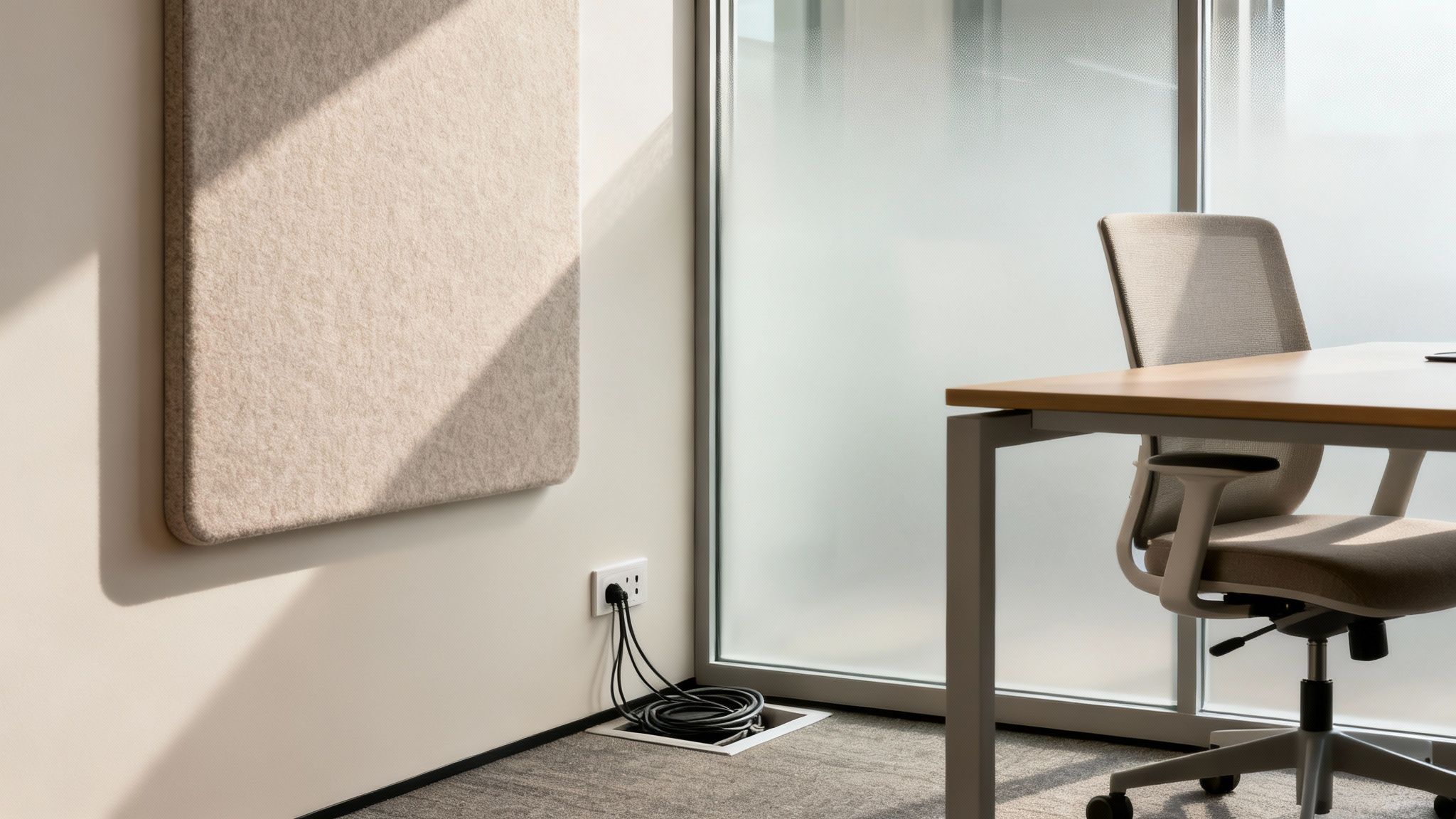
A close-up of an acoustic panel on an office wall, demonstrating sound absorption technology for better office acoustics.

Getting these details right is about more than just comfort; it’s a direct investment in productivity. When employees can focus without constant interruptions, their performance and job satisfaction skyrocket.

Managing Privacy and Acoustics

Noise is, without a doubt, the biggest complaint about modern offices, especially in open-plan setups. You absolutely need a multi-layered approach to sound management to create a functional, focused workspace. Your strategy should tackle both sound absorption and sound blocking.

Sound absorption is all about using soft materials to soak up ambient noise, which cuts down on echo and the overall volume. Think of it like adding sponges for sound throughout the office.

  • Acoustic Panels and Baffles: These can be installed on walls or hung from ceilings. They come in all sorts of colors and shapes, so they can double as cool design elements.
  • High-Pile Carpeting: Hard surfaces like concrete or wood floors just bounce sound around. Carpet, on the other hand, absorbs it.
  • Upholstered Furniture: Sofas, soft chairs, and fabric-covered partitions in common areas all help to dampen noise.

Sound blocking, on the other hand, is about creating physical barriers to stop noise from traveling from one area to another. This is non-negotiable for meeting rooms and private offices where confidentiality is key.

A well-designed acoustic plan isn’t just about silence. It’s about creating different soundscapes for different activities, ensuring the collaborative buzz doesn’t bleed into quiet zones meant for deep work.

Visual privacy is just as important. No one likes feeling like they’re on display all day. Simple solutions like frosted glass films, strategically placed tall planters, or freestanding modular screens can create a sense of personal space without having to build solid walls.

Planning Your Power and Data Infrastructure

In our tech-driven world, an office without enough accessible power and data is practically useless. This technical backbone needs to be planned meticulously from the very beginning—not as an afterthought. A poor cabling plan leads to a messy, unsafe environment cluttered with extension cords and tangled wires. It’s a nightmare.

Start by creating a detailed map of every single workstation, meeting room, and collaborative area. For each spot, figure out the exact power and data requirements. Does a workstation need two outlets or four? Does that conference table need integrated ports for laptops and A/V equipment?

This is also the perfect time to think about the future. Technology will change, and your team will grow. Installing floor boxes or using modular wall systems with integrated raceways gives you the flexibility to add or move connections later without ripping up the floors or walls.

Creating a Functional Infrastructure Checklist

To make sure nothing gets missed, use a simple checklist to guide your power and cabling plan. This forces you to think through the needs of every single corner of your office.

A well-organized system of cable trays, raceways, and ties keeps everything neat and accessible for your IT team. Properly managed cables don’t just look more professional; they improve safety and make troubleshooting a whole lot easier down the line.

And don’t forget, a clean setup contributes to the overall ergonomics of a workstation. You can learn how to maximize the ergonomics of office spaces in our complete guide, which covers everything from cable management to chair posture.

By focusing on these critical details—acoustics, privacy, and infrastructure—your office design will result in a space that isn’t only visually appealing but also highly functional, adaptable, and ready to support your team’s success for years to come.

Selecting Furnishings That Define Your Space

This is where your design vision becomes real. Furniture is the tangible part of your plan, the physical items your team will use every single day. It directly impacts everything from their comfort and productivity to how clients perceive your brand. Choosing the right pieces isn’t just about aesthetics; it’s a direct investment in your company’s future.

Making smart, intentional choices here is the practical application of all that planning you’ve been doing. It’s about finding pieces that support employee health, can adapt as your company changes, and create a cohesive environment that actually feels like your company.

Function and Flexibility First: Think Modular

The modern workplace is anything but static. Teams grow, projects shift, and how we work is always evolving. That’s why modular furniture isn’t just a nice option anymore—it’s pretty much a strategic necessity if you want to future-proof your office.

Modular components like customizable desks, movable partitions, and reconfigurable storage give you the power to adapt your space without a massive, costly overhaul. A row of workstations can be reconfigured into smaller pods for a new project team, or a collaborative area can be quickly divided for a temporary war room. That kind of adaptability is how you maximize your real estate investment over the long haul.

Think of modular furniture less like buying individual pieces and more like investing in a flexible ecosystem. It lets your physical space grow and change right alongside your business, which is a huge advantage.

This flexibility is even more critical as offices become more efficient. Recent analysis shows a major trend toward “densification,” with the average space per employee now hovering around 150-175 sq ft in many U.S. markets. That’s a steep drop from the 250+ sq ft that was common not too long ago. This shift forces us to be smarter about our layouts, and modular systems are a fantastic solution for making denser spaces feel more functional and less cramped. You can dig into the numbers and see how office space utilization has evolved in this detailed report.

Prioritizing Employee Well-Being with Ergonomics

Employee wellness must be at the heart of every furniture decision. An uncomfortable workstation doesn’t just cause aches and pains; it kills productivity and morale. Ergonomic furniture is designed to fit the person using it, which reduces physical strain and promotes healthier postures all day long.

When it comes to ergonomic workstations, here are the absolute must-haves:

  • Ergonomic Seating: Look for chairs with adjustable height, seat depth, lumbar support, and armrests. A truly good chair moves with the employee, providing constant support.
  • Adjustable-Height Desks: These are often called sit-stand desks, and they are genuine game-changers for employee health. Just giving people the option to easily switch between sitting and standing is proven to reduce back pain and boost energy levels.

Investing in ergonomics sends a powerful message to your team: we care about your health and well-being. It’s also a surprisingly effective tool for attracting and keeping great people.

Furnishing Your Entire Office for a Cohesive Feel

Your office furniture tells a story, and you want that story to be consistent from the reception area to the break room. While individual workstations are obviously critical, don’t forget about all the other zones that shape the daily experience for your employees and visitors.

Creating a cohesive look requires a careful selection of finishes, fabrics, and colors that align with your brand. For some inspiration, check out our guide on 5 furniture pieces that make a modern office to see how a few key items can totally refresh a space.

Make sure you’re thinking about these key areas:

  1. Reception and Waiting Areas: This is your first impression. The furniture here needs to be welcoming, comfortable, and a clear reflection of your brand’s style.
  2. Collaborative Spaces: Furnish these zones with a mix of options. Think high-top tables for quick huddles, comfy lounge seating for brainstorming, and mobile whiteboards that can go wherever the ideas are.
  3. Break Rooms and Kitchens: This is where your team recharges. Go for durable, easy-to-clean surfaces and provide different types of seating that encourage people to relax and socialize.

By thoughtfully furnishing every corner of your office, you create a complete, supportive environment where your team can really do their best work.

Managing Your Office Design Project and Budget

A brilliant design is one thing, but bringing it to life without blowing your budget or timeline is where the real work begins. This is the part of the project where your vision for a new office meets the reality of schedules, vendor coordination, and cold, hard numbers. A disciplined project management approach is what keeps everything on track.

Successfully pulling off a redesign means you’re juggling dozens of moving parts at once. You’re coordinating contractors one minute and tracking furniture deliveries the next. Without a solid game plan, it’s frighteningly easy for small hiccups to snowball into massive, costly delays.

Creating a Comprehensive Budget

First things first: you need a budget that accounts for everything, not just the big, obvious costs. Too many projects go off the rails simply because the initial budget was full of holes. A truly comprehensive budget is your best defense against nasty surprises down the road.

Start by breaking down every conceivable expense into clear categories. This gives you a bird’s-eye view and helps you see where the money is really going. A typical breakdown will look something like this:

  • Construction and Renovation: This is all your heavy-lifting costs—demolition, framing, drywall, painting, and new flooring.
  • Furniture and Fixtures: Often one of the biggest line items, this covers every desk, chair, storage unit, and collaborative piece you’ll need.
  • Technology and Cabling: Don’t forget to budget for all the data wiring, AV equipment in conference rooms, and any new hardware your team requires.
  • Professional Fees: This bucket includes the costs for your designer, architect, engineers, and project manager.

A critical piece of advice for every client: the most important line item in any budget is your contingency fund. You absolutely must set aside 10-15% of your total estimated cost for the unexpected. Trust me, something will come up. This fund is your safety net for everything from surprise structural issues to a key vendor having shipping delays.

Here is a sample budget template to help you start thinking about cost allocation for a typical mid-size office renovation.

Office Design Project Budget Template
Budget Category Estimated Percentage of Total Budget Key Considerations
Construction & Renovation 35-45% Labor, permits, materials (flooring, paint, lighting). This can vary wildly based on the scope.
Furniture & Fixtures 20-30% Desks, seating, storage, conference tables. Ergonomics and modularity are key factors.
Technology & Cabling 10-15% Network infrastructure, Wi-Fi, AV systems, security. Plan for future tech needs.
Professional Fees 10-15% Designer, architect, project manager fees. Don’t skimp on expertise.
Moving & Installation 3-5% Costs for professional movers, furniture installers, and IT setup.
Contingency Fund 10-15% Non-negotiable. For unexpected costs, scope changes, or delays.

This table provides a solid starting point, but remember to adjust the percentages based on the specific priorities and complexities of your own project.

Phasing Your Project for Minimal Disruption

For any large-scale redesign, trying to do it all at once is a recipe for chaos that can bring your entire business to a grinding halt. This is where a phased approach becomes a lifesaver. By breaking the project into smaller, manageable stages, you can execute the redesign while keeping day-to-day operations running.

It’s a simple concept. For instance, you could renovate the west wing of your office while the team temporarily relocates to the east wing. Once that phase is complete, everyone moves into the beautiful new space, and you can start work on the next section.

Phasing demands meticulous coordination and, most importantly, clear communication with your team. Keep everyone in the loop on the timeline, what to expect, and how it will impact their work. A well-managed phased project keeps your business humming along smoothly through the entire transition.

The Procurement and Installation Process

With a budget and plan locked in, your focus shifts to buying and installing everything. This is a detail-heavy process that lives or dies by your ability to track it all. A simple spreadsheet can be your best friend here, letting you monitor every single item—order dates, lead times, delivery schedules, and payment status.

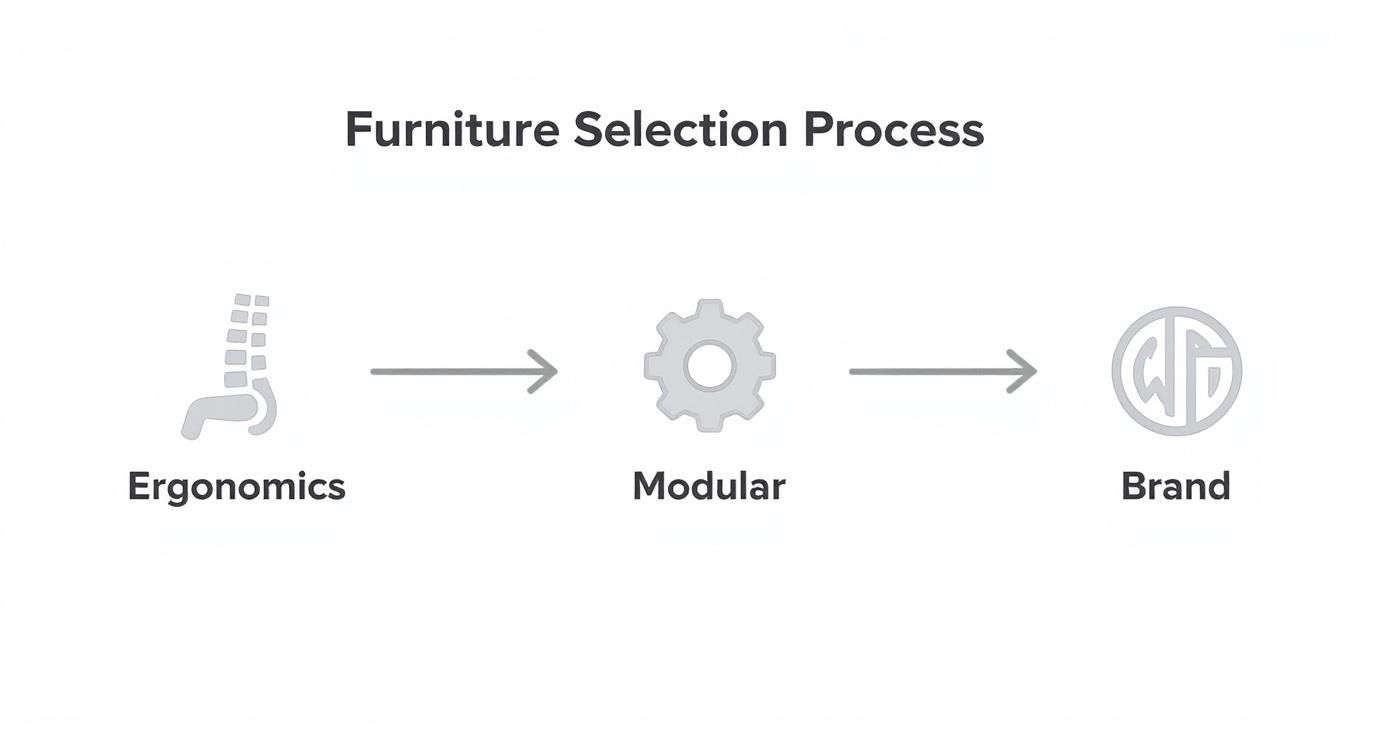
When it comes to selecting the actual furniture, your decision-making should be guided by a few key principles: ergonomics for your team’s health and comfort, modularity for future flexibility, and brand alignment to create a cohesive look.

This infographic breaks down a smart way to approach furniture selection.

Infographic on the furniture selection process covering ergonomics, modularity, and brand alignment for office space design.

As you can see, the process flows from human needs (ergonomics) to business needs (modularity), ultimately landing on a final selection that reinforces your company’s identity.

Your Final Installation Checklist

The final push is all about coordination. An installation checklist is your guide for those last few critical days, ensuring the move into your new space is seamless and nothing falls through the cracks.

Your checklist needs to cover a few key areas:

  1. Compliance and Inspections: Double-check that all work has passed final building inspections and meets local codes. This means fire safety, electrical, and ADA accessibility are all signed off.
  2. Vendor Coordination: Get firm, confirmed dates from all your key players—furniture installers, IT techs setting up equipment, and the professional movers.
  3. Site Walkthrough: Before anyone moves in, do a thorough “punch list” walkthrough with your designer and contractor. This is your chance to spot any last-minute fixes, like paint touch-ups or loose cabinet hardware.
  4. Employee Communication: Get your team excited! Prepare a welcome packet or email with a floor plan, instructions for new equipment, and a quick guide on how to use the new shared spaces.

This level of meticulous management is what ensures your office design project ends on a high note, delivering a space that’s not just beautiful, but fully compliant and ready for your team on day one. For a deeper dive into the nuts and bolts of coordination, our guide on professional project management has some great additional insights.

Answering Your Office Planning Questions

Even the most detailed blueprint can’t anticipate every question that pops up during an office redesign. It’s a big project, and you’re bound to run into a few practical challenges. Let’s tackle some of the most common questions we hear from people in the thick of planning their new workspace.

How Do You Plan an Office for a Hybrid Work Model?

Planning for a hybrid team isn’t about cramming in desks anymore. It’s about shifting your mindset from “one desk per person” to creating an ecosystem of different work environments. The real goal is to give your team choice and flexibility for whatever they need to do when they come into the office.

First things first: you have to survey your employees. Find out why they’re coming in. Is it for heads-down, deep-focus work? Quick, spontaneous collaboration? Big, formal team meetings? Or just to connect with colleagues? Their answers are your design roadmap.

Once you have that feedback, you can start creating specific “zones” to support those activities:

  • Hot Desks: A bank of unassigned workstations is perfect for employees who just need a place to land for a few hours.
  • Quiet Pods: Think small, soundproof enclosures. They’re a lifesaver for confidential video calls or any task that demands serious concentration.
  • Collaborative Lounges: Get some comfy seating, add a few whiteboards and make sure there are plenty of outlets. You’ve just created the perfect spot for informal brainstorming.
  • Formal Meeting Rooms: Don’t skimp here. Make sure they’re decked out with top-notch video conferencing gear to bridge the gap between your in-office and remote team members.

The secret to a great hybrid office is giving your employees choices. When people can pick the right space for the task at hand, it builds a culture of autonomy and trust that you can see in their productivity.

What Is a Realistic Budget for a New Office Design?

I wish there was a magic number, but a realistic budget really depends on your location, the scale of the project, and the quality of finishes you’re after. The best way to get an accurate estimate is to break down the costs into a few major buckets.

Think in terms of construction, furniture, technology, and professional fees. As a rough guideline, you can expect furniture to eat up about 20-30% of your total project cost. But the most critical part of any budget is the contingency fund. You absolutely have to set aside 10-15% of your total estimated cost. Trust me, surprises always pop up during a renovation, and you’ll be glad you have it.

How Can We Make Our Open Office Less Distracting?

Noise is the number one complaint in any open-plan office, but it’s a problem you can solve with a few smart moves. Your first line of defense is to bring in sound-absorbing materials anywhere you can. We’re talking acoustic ceiling baffles, fabric-covered wall panels, and even high-pile carpeting to soak up that ambient chatter.

Next, you need to create some physical and visual barriers. This doesn’t mean you have to build solid walls. Strategically placed bookcases, some tall planters, or freestanding modular screens can do wonders to break up sightlines and block the direct path of sound. It creates a feeling of psychological privacy, even when you’re in an open area.

Finally, give people an escape route. Designate a few spots as official “quiet zones” where talking is off-limits, and install a few enclosed pods or small rooms for private calls. This gives everyone a place to retreat to when they really need to focus, which makes the whole layout work better for the entire team.

How Long Does This Process Typically Take?

The timeline for an office project is tied directly to its size and complexity. A simple furniture refresh for a small space could take just 4-8 weeks from planning to installation.

If you’re doing a mid-sized renovation that involves some light construction, it’s safer to plan for 3-6 months. That gives you enough time for design development, pulling permits, the actual construction, and getting all the furniture in place. A full build-out from a raw, empty shell is a much bigger beast—that can easily take 9-12 months, sometimes even longer.


At Cubicle By Design, our specialty is turning these complex questions into practical, beautiful solutions. Our modular cubicles, glass walls, and ergonomic furniture are designed to create flexible, productive workspaces that actually fit your budget and timeline. Let’s start designing your ideal office today.

Explore our office furniture solutions at Cubicle By Design

Read More