

Your Guide to Buying Office Furniture Sets in 2026 | Cubicle By Design

Choosing the right office furniture sets feels like a huge decision, and it is. But let's simplify it. This isn't just about buying desks and chairs; you're building the physical foundation for your team's success and day-to-day happiness. Looking out over an empty floor plan isn't just a challenge—it's the first step to creating a workspace that actually works.

From Empty Space to Productive Place

Turning an empty office into a powerhouse of productivity is about much more than just filling it up. It’s about being strategic. The right furniture can sharpen focus, spark collaboration when you need it, and show everyone who walks in the door what your company is all about. It's a tangible piece of your brand and a direct investment in the people who make your business run.

The industry itself is booming because more businesses are finally getting it. The global office furniture market is projected to climb from roughly $75.52 billion to an incredible $115.06 billion by 2033. This isn't just random growth; it's fueled by companies realizing that flexible, comfortable setups are non-negotiable for modern work. Even with all the new designs, the classic desk and table setup is expected to hold a 38.7% market share, proving the core workstation is still king.

The Big Questions to Ask Before You Buy

Before you get lost in catalogs and finish samples, take a step back and think about the big picture. Your choices here will impact everything from workflow to whether your employees dread or enjoy coming to work.

Start with these fundamentals:

  • How Your Team Actually Works: Do they need quiet zones for deep concentration, or are they constantly bouncing ideas off each other? Your answer is the first clue pointing toward either private cubicles or more open, collaborative setups. Find the perfect solution in our extensive cubicles category.
  • Your Company's Vibe: Your office should feel like you. A high-energy tech startup will naturally have a different furniture footprint than a buttoned-up financial advisory firm.
  • Planning for Growth: Is your team going to get bigger? Choosing modular, adaptable furniture from day one can save you from a massive, expensive overhaul a year or two down the road.

A well-designed office isn't just a place to put people. It's a tool that actively improves how they perform. When you get both the look and the function right, you create a space where your team feels valued and ready to do their best work.

Thinking this through is the difference between an office that just looks nice and one that genuinely makes your business run better. It’s about moving from simply buying furniture to strategically designing your workplace. These principles hold true whether you’re a brand-new startup or a company that’s been around for decades. If you're a smaller company looking for tailored advice, you'll find our guide on office furniture for small businesses especially helpful.

At Cubicle By Design, our specialty is helping businesses like yours figure all this out. We're with you from the initial space planning and design all the way to the final installation, making sure your investment pays you back in productivity and happy, effective employees.

Exploring Different Types of Furniture Sets

When you hear “office furniture sets,” it’s easy to picture a single, standard setup. But that’s selling the concept short. The reality is that different systems are designed to solve different problems, and choosing the right one directly impacts how well your team can actually work.

It’s not about forcing your people to adapt to the furniture; it's about choosing furniture that supports the work they already do.

Let's walk through the three main categories you'll come across. Each one offers a unique solution for the modern workplace.

Modular Cubicles: The Office Building Blocks

Think of modular cubicles as the ultimate office Legos. Their biggest advantage is flexibility. You aren't stuck with one layout forever; you can reconfigure, expand, or shrink your setup as your team’s needs change. This is a huge plus for any growing business.

And forget the dreary, gray-walled mazes from old sitcoms. Today's cubicles are built for focus and style.

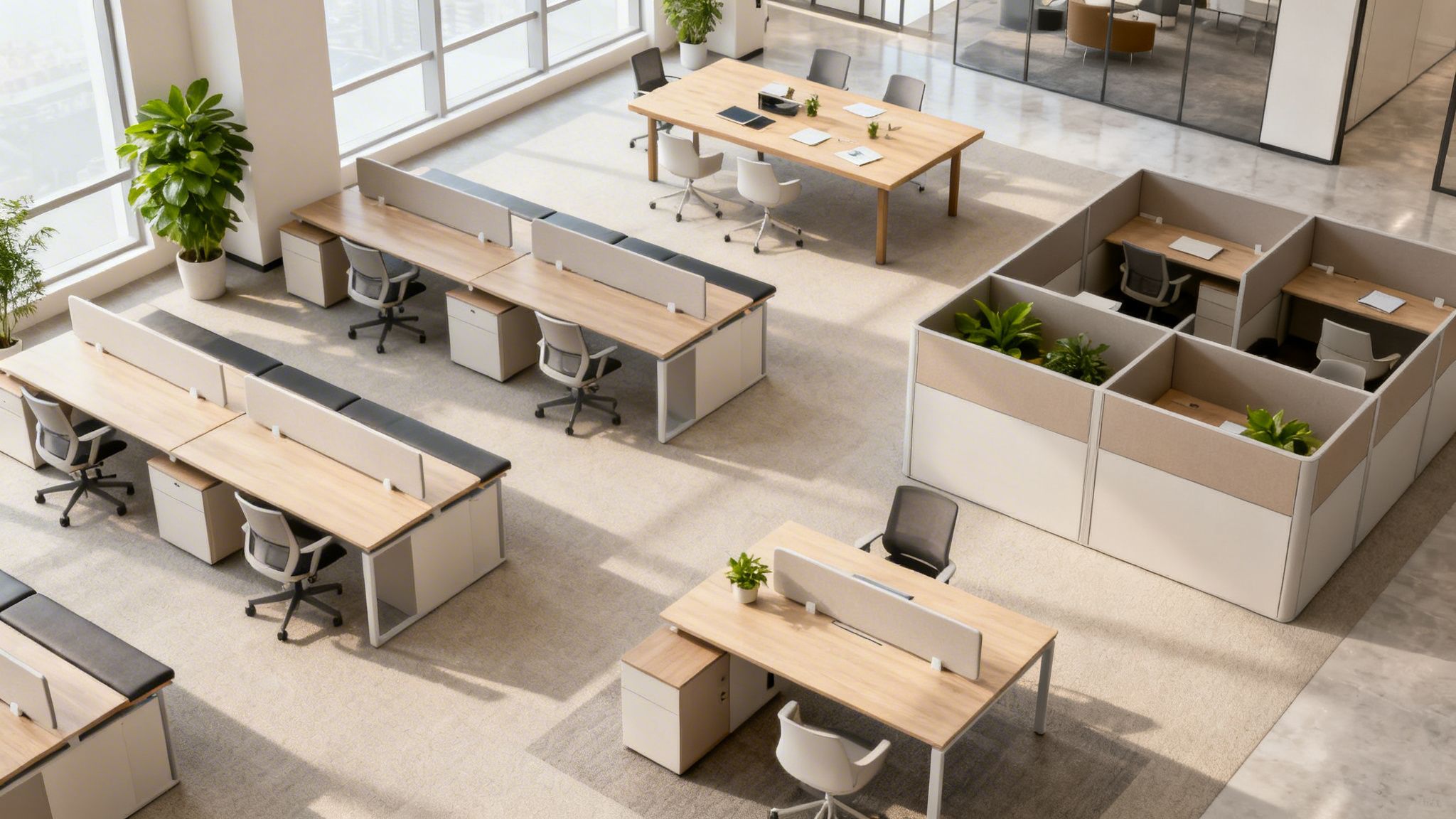
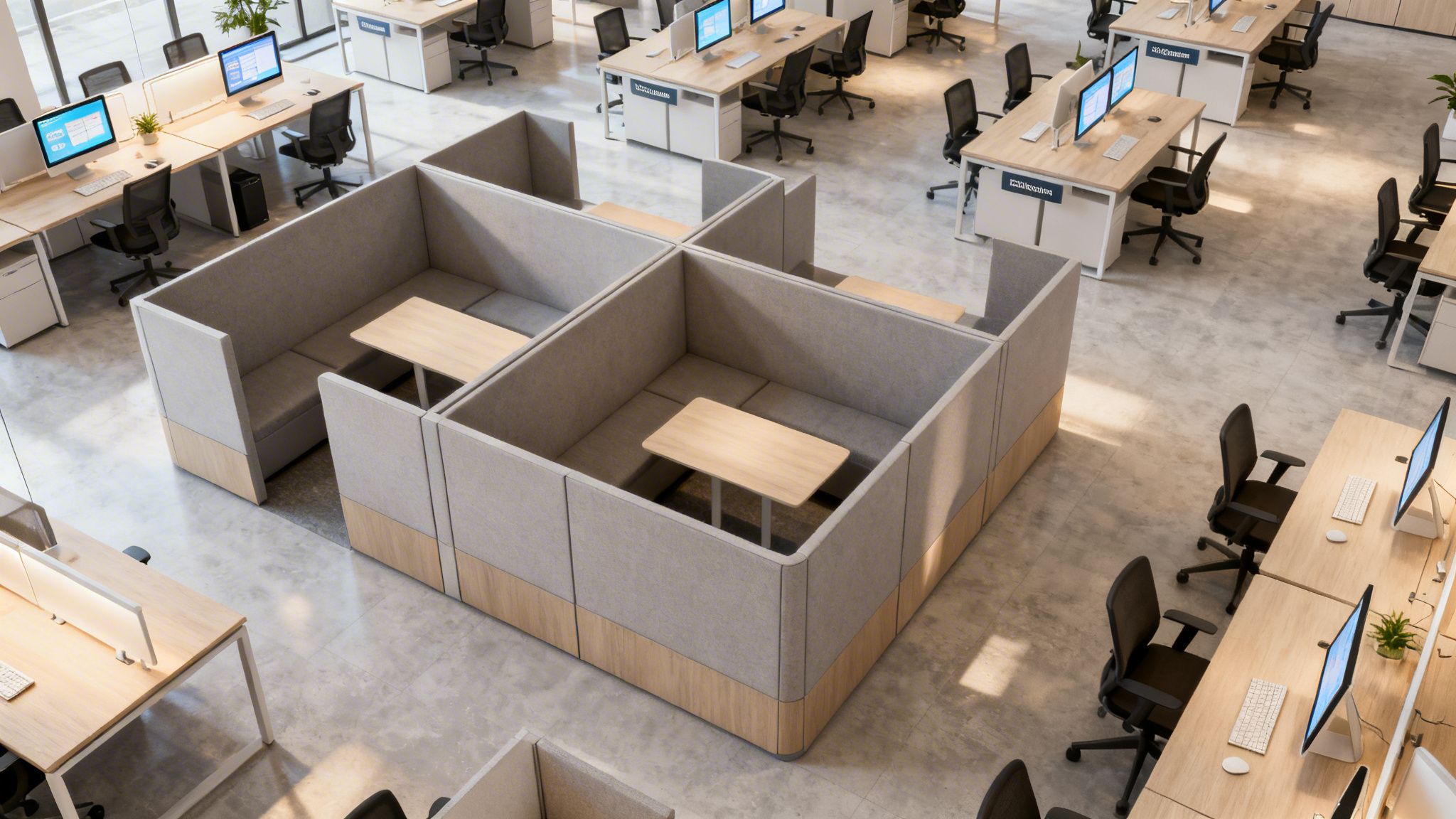
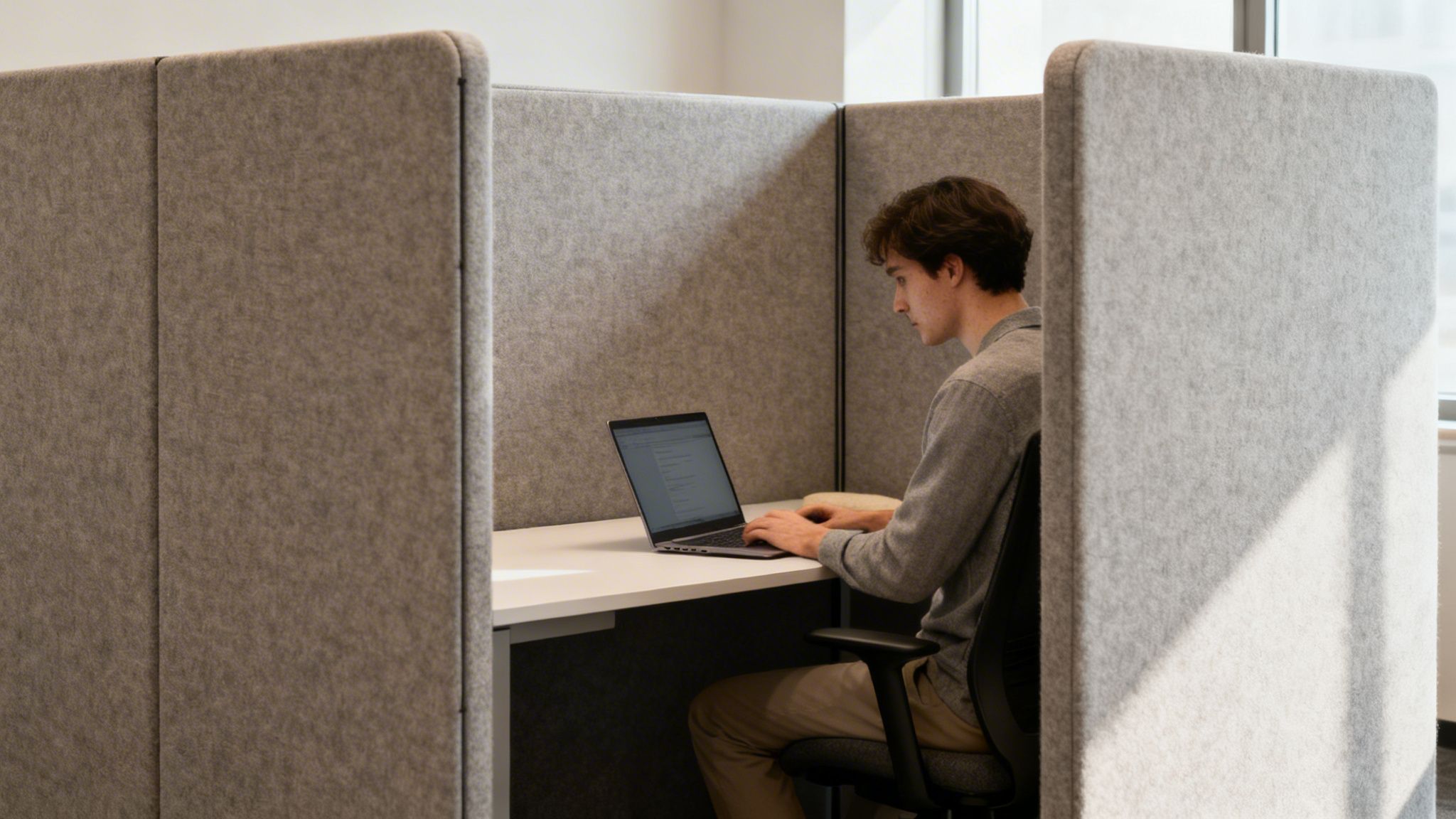
  • Private Office Cubicles: These are essentially a "mini-office" without the expensive and permanent construction. With high walls and better acoustics, Private office cubicles are perfect for roles needing confidentiality, like managers or HR, or anyone who just needs to concentrate without distraction.
  • Workstation Cubicles: These strike a great balance. They give each person a defined personal space while keeping them connected enough to easily chat with a neighbor. Workstation cubicles are the dependable workhorses for all sorts of industries.

The real magic of modular systems is that they grow with you. A setup for 10 people can be reconfigured or expanded for 15 without throwing out your initial investment and starting over.

This adaptability makes modular furniture a smart long-term play. If you're new to the concept, getting a handle on what modular furniture is and its benefits will show you why it’s such a popular, future-proof choice.

Workstation Clusters: The Collaborative Hub

Where modular cubicles are built for individual focus, workstation clusters are all about team energy. You’ll often hear them called “benching systems.” They group several desks into a single, shared configuration, knocking down physical barriers to create a more open, buzzing atmosphere.

These are basically pre-built hubs for your teams, perfect for departments that thrive on spontaneous brainstorming and constant communication.

  • Best for: High-energy sales teams, marketing departments, creative agencies, and fast-moving software scrums.
  • Key benefit: It creates a strong sense of teamwork and makes it incredibly easy for managers to check in or for colleagues to lean over and help each other out.

This style is a direct answer to how many teams work today. Instead of walking down a hall to ask a question, you just turn your head. Problems get solved faster, and ideas flow more freely.

Glass-Walled Systems: The Best of Both Worlds

So, what if you need the quiet of a private office but hate the closed-off, stuffy feeling? That’s exactly where glass-walled systems come in. They give you serious acoustic privacy without sacrificing the open, light-filled feel of the rest of the office.

These systems use full-height glass panels to create private offices and meeting rooms. They effectively block sound while letting natural light pour through the space, keeping everyone connected. It prevents that "siloed" feeling and is the perfect modern solution for leaders who want to be both accessible and focused.

Whether you're starting fresh in a new building or just want to breathe new life into your current space, Cubicle By Design has a solution that fits. You can even experiment with layouts using our intuitive Cubicle Designer tool.

How to Select the Perfect Furniture for Your Space

Choosing the right office furniture sets is a practical process, not a guessing game. It's about moving past the pretty pictures in a catalog and digging into the factors that make or break a smart investment. This is your playbook for making a choice that serves your team, your space, and your bottom line for years to come.

Getting this right is the difference between a great purchase and a costly mistake. It all comes down to a clear-eyed look at your physical office, how your team actually works, and your budget's hard realities.

Map Your Physical Space

Before you even think about looking at a desk, grab your floor plan. The goal here is simple: create a space where people can move around easily and find their way without thinking. A cramped, confusing layout is a silent productivity killer, creating small frustrations that add up every single day.

Start by thinking about these physical elements:

  • Pathways and Flow: Are the main walkways wide enough for two people to pass without doing a clumsy shuffle? Trace the daily routes to the breakroom, restrooms, and meeting areas. Keep them clear.
  • Natural Light: Where are the windows? Try to position workstations to give as many people as possible access to natural light. Studies consistently show it can boost moods and cut down on eye strain.
  • Structural Obstacles: Take note of every column, support beam, and permanent wall. Your furniture plan needs to work with these fixed elements, not fight against them.

And this isn't just for corporate offices. For anyone setting up a home workspace, picking the right furniture is just as critical as having reliable work-from-home IT support. A well-planned home office helps keep a firm line between work life and home life.

Match Furniture to Job Roles

Different teams have wildly different needs, and your furniture has to reflect that reality. A one-size-fits-all approach is a shortcut to inefficiency. Things like privacy and quiet aren't universal wants; they are specific requirements tied to a job function.

Think about the distinct personalities of your departments:

Team Type Primary Need Best Furniture Fit
Sales or Customer Service High aural privacy for calls High-walled private office cubicles
Engineering or Development Deep, uninterrupted focus Semi-private workstation cubicles
Marketing or Creative Spontaneous collaboration Open-plan workstation clusters
Leadership or HR Confidential conversations Private offices or glass-walled systems

What works for a loud, high-energy sales team is often the exact opposite of what an engineering team needs to do their best work. Aligning your furniture with your teams' functions is one of the most powerful moves you can make. If you need a hand laying out these different zones, our guide on professional office space planning and design can give you a clear roadmap.

Prioritize True Ergonomics

Ergonomics isn't just some buzzword; it's a direct line to your employees' health, focus, and long-term output. Bad ergonomics leads to physical strain, which in turn leads to distraction, burnout, and sick days. The right office furniture sets have adjustable parts that let people fine-tune their own workspace.

An ergonomic workspace isn't a luxury—it's a performance tool. Research indicates that companies investing in ergonomic solutions can see productivity rise by up to 25%.

Look for adjustability in these three key areas:

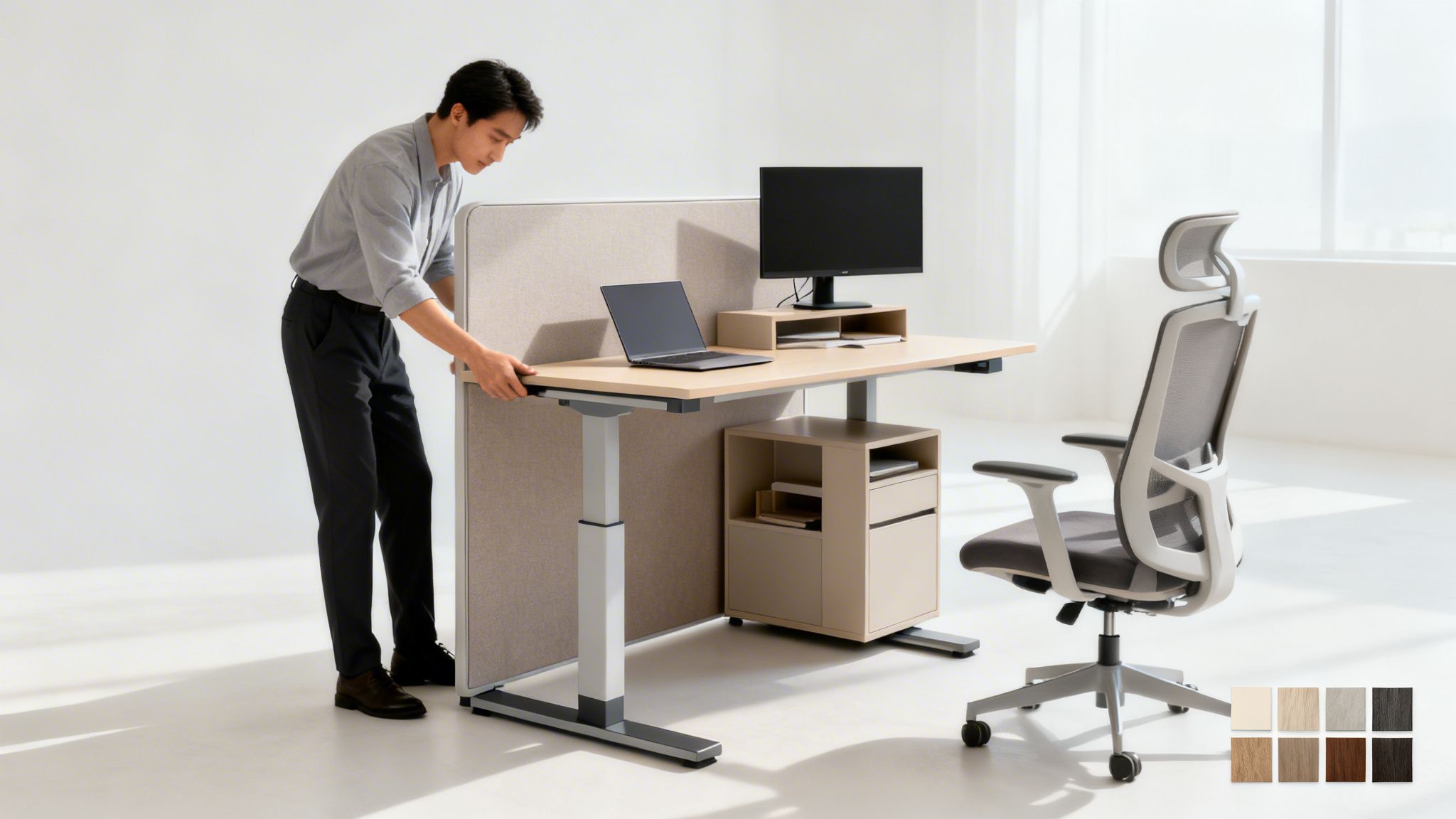
  • Adjustable-Height Desks: These let employees switch between sitting and standing, which is proven to boost energy and fight the health risks of sitting all day.
  • Monitor Arms: Giving users the power to place their screens at the perfect height and distance is a simple way to prevent nagging neck and eye strain.
  • Ergonomic Chairs: A good chair with adjustable lumbar support, armrests, and seat height is the foundation of any healthy workstation. It's non-negotiable.

These features aren't just "nice-to-haves." They're essential tools for keeping your workforce healthy and focused, which directly impacts your company's bottom line.

Evaluate Long-Term ROI

Finally, you have to look beyond the initial price tag. The cheapest option is almost never the most cost-effective one in the long run. A low upfront cost can easily hide future expenses like repairs, replacements, and the lost productivity that comes from an uncomfortable team.

True value is found in durability, flexibility, and the positive effect on your people. A quality modular system from Cubicle By Design, for instance, can be reconfigured as your company grows, saving you from having to start from scratch in a few years. Investing in well-built, ergonomic furniture is an investment in employee retention and performance—a return that keeps paying you back long after the credit card bill is paid.

Bringing Your Vision to Life with Customization

Let's be honest: standard, off-the-shelf furniture rarely feels like it was made for your office. It might be functional, but does it reflect your company's culture? This is where customization comes in. It’s the difference between a space that simply holds your people and one that actually supports how they work and feels like a part of your brand.

Think of it as moving beyond just picking a color. Customization is about strategically shaping your environment by selecting finishes, fabrics, and even the type of glass for partitions. It's about integrating the practical stuff, too, like smart storage and enough power and data ports for everyone. A simple desk becomes a high-performance workstation, and you become a partner in designing a space that truly works.

Matching Finishes and Fabrics to Your Brand

Your office is a physical part of your brand identity, and the materials you choose say a lot. Customization lets you build a look that’s intentional and cohesive. For example, a law firm might go for dark wood finishes and rich, textured fabrics to project an image of stability and tradition. A tech startup, on the other hand, could use light wood tones, bright accent colors, and sleek metal to create a vibe of innovation and energy.

Here are the key choices you'll make:

  • Laminates and Veneers: You can pick from a huge spectrum of wood grains, solid colors, and patterns. This choice defines the primary look of your desks and storage units.
  • Fabric and Upholstery: Choose colors that match your brand palette, but also make sure the materials are rated for high-traffic use. You need them to look good for years, not just on day one.
  • Glass Options: Decide between clear, frosted, or tinted glass. This is a great way to control how light moves through the office and to create different levels of privacy.

The goal is to create an environment that feels authentic. This is a huge step in creating personalized workspaces that boost both morale and productivity.

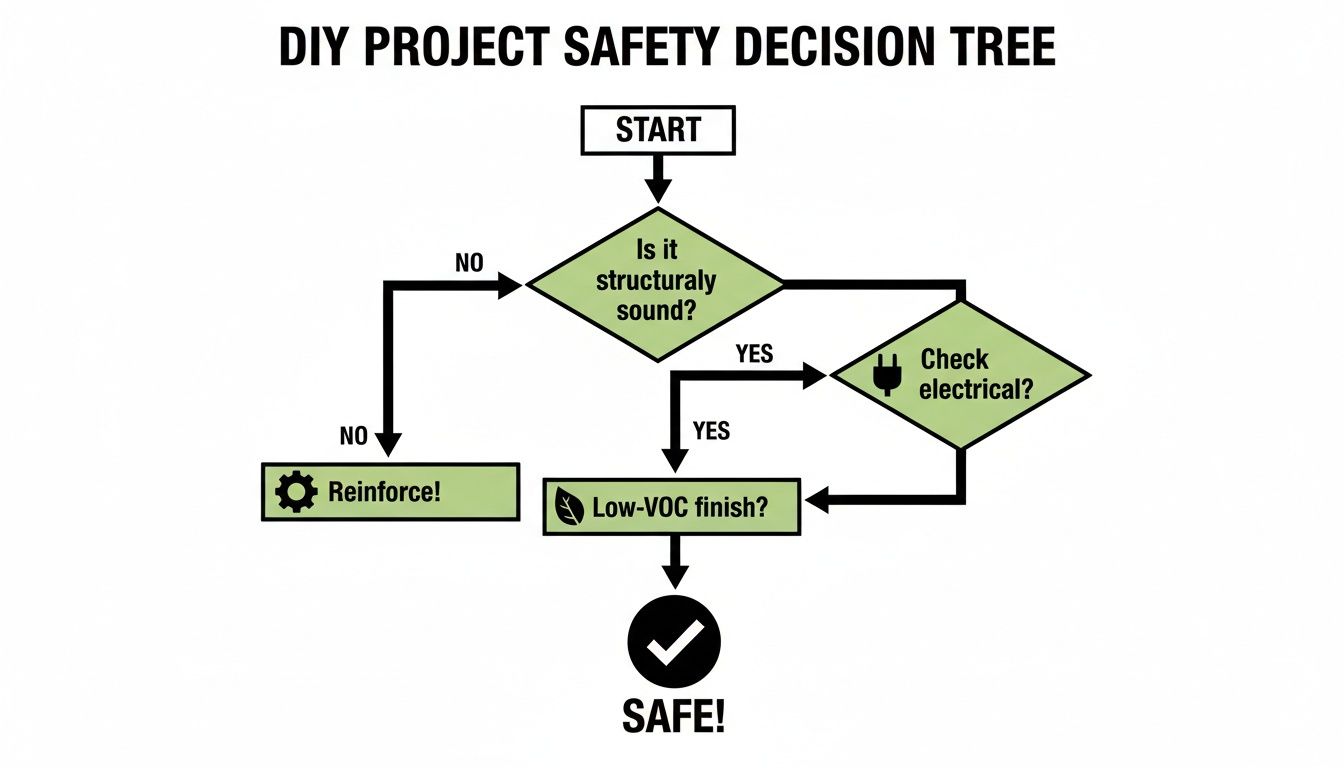
This decision tree can help you start thinking through the big questions for your space.

As you can see, a good selection process always starts with the practical stuff—your space, your team's function, and their ergonomic needs—before you even get to aesthetics.

Integrating Power and Functionality

Nothing kills workflow faster than tangled extension cords and a hunt for the last open outlet. A modern office has to be built for connectivity. Customizing your furniture with built-in power and data isn't a luxury anymore; it's a flat-out necessity for an efficient workplace.

Options for making your office tech-friendly include:

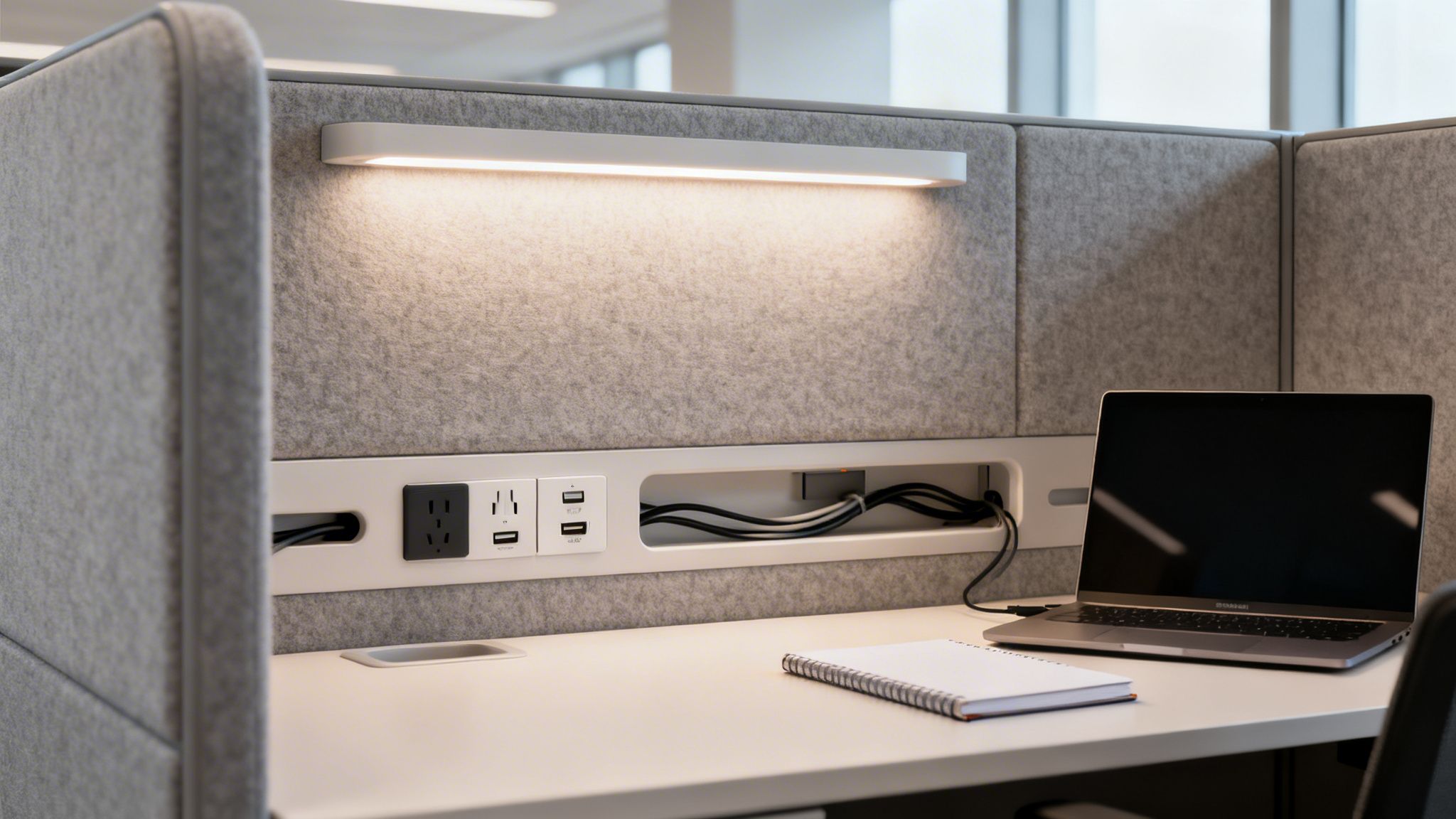
  • Built-in Power Modules: These units are often placed right at desk level, giving your team outlets and USB ports exactly where they need them. No more crawling under the desk.
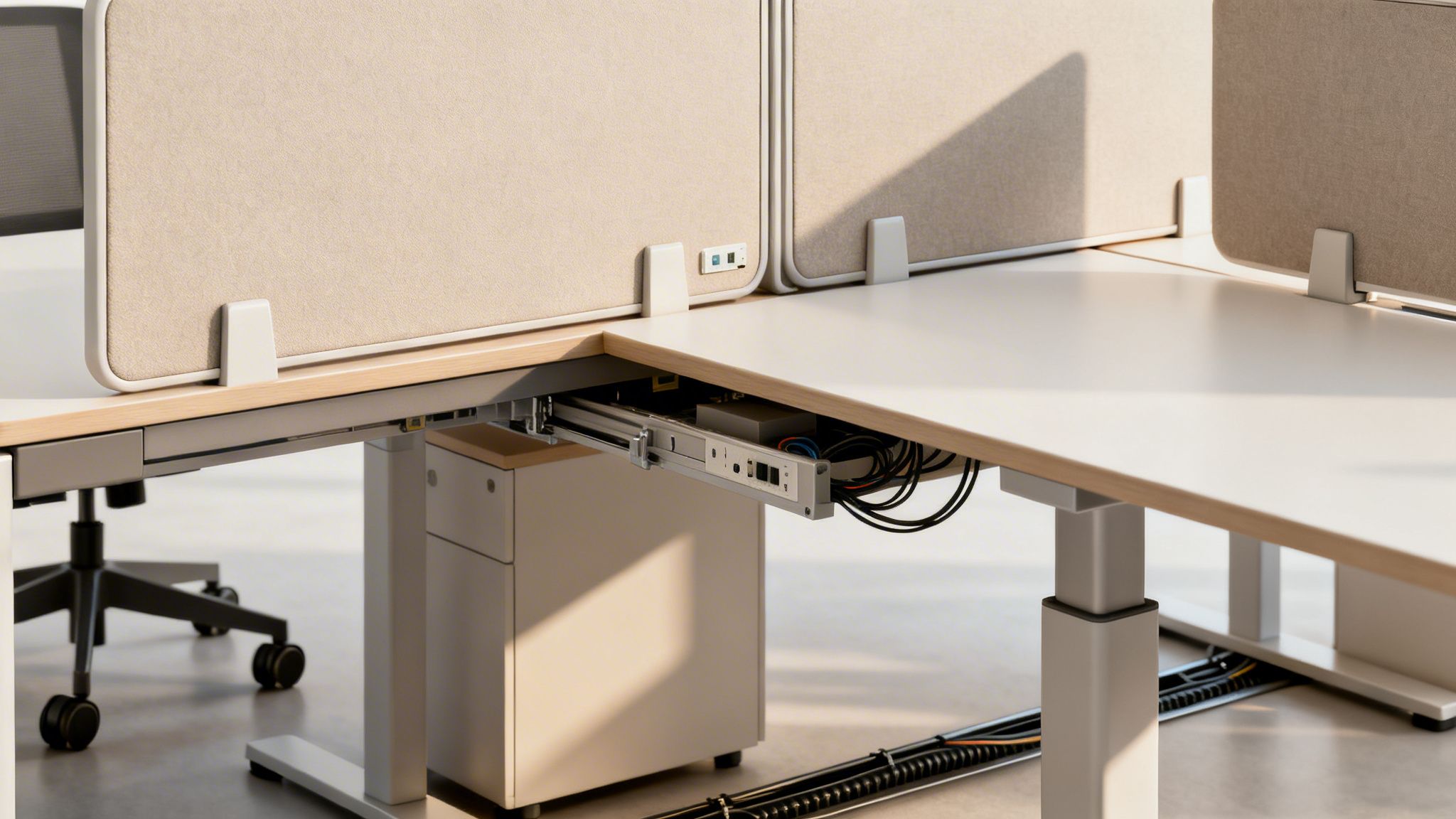
  • Cable Management Trays: These hidden channels and trays keep wires organized, out of sight, and off the floor. It’s safer, and it looks infinitely better.
  • Data Ports: Integrating Ethernet ports directly into the workstations means every team member gets a stable, high-speed connection.

Demand for these kinds of modern, functional solutions is skyrocketing. The global office furniture market is projected to jump from $65.63 billion in 2026 to $115.16 billion by 2034. A huge piece of that growth is happening in the Asia Pacific region, which is expected to command a 41.62% market share as startups and new businesses demand flexible, wired workspaces.

At Cubicle By Design, we make this part of the process easy. Our team is experienced in designing layouts that look great and have all the power and data integration your team needs to stay productive. We'll help you configure every aspect of your new workspace, from layout and dimensions to power and finishes, putting you in control.

Real-World Office Layouts That Work

Theory is helpful, but seeing office furniture sets in action is what really makes it all click. Let's get practical and look at some real-world layouts that solve specific problems for businesses, just like yours. These examples will help you start visualizing how the right furniture can turn an empty room into a powerhouse of productivity.

Think of each layout as a story about a company’s culture and workflow. By looking at how others have set up their space, you can get a much clearer picture of what will work for your own team.

The High-Growth Startup

Picture a fast-moving tech startup where everything is about speed and flexibility. The team is growing fast, roles are always changing, and great ideas pop up from spontaneous chats. In this kind of environment, a rigid layout with private offices would just get in the way.

The answer is a flexible, open design built around workstation clusters.

  • Furniture Choice: Benching systems or low-walled workstation cubicles are the way to go. They let you group four to six people together, creating natural "neighborhoods" for different project teams.
  • Strategic Thinking: This setup gets rid of physical barriers and lets ideas flow freely. A developer can easily lean over to talk to a designer, or a marketing specialist can sync up with a sales rep without booking a meeting room.
  • Adaptability: As you hire, you can simply add new clusters to the floor plan without tearing the whole office apart. This kind of modularity is a lifesaver when you're managing rapid growth and can't afford a major renovation every six months.

The Focused Call Center

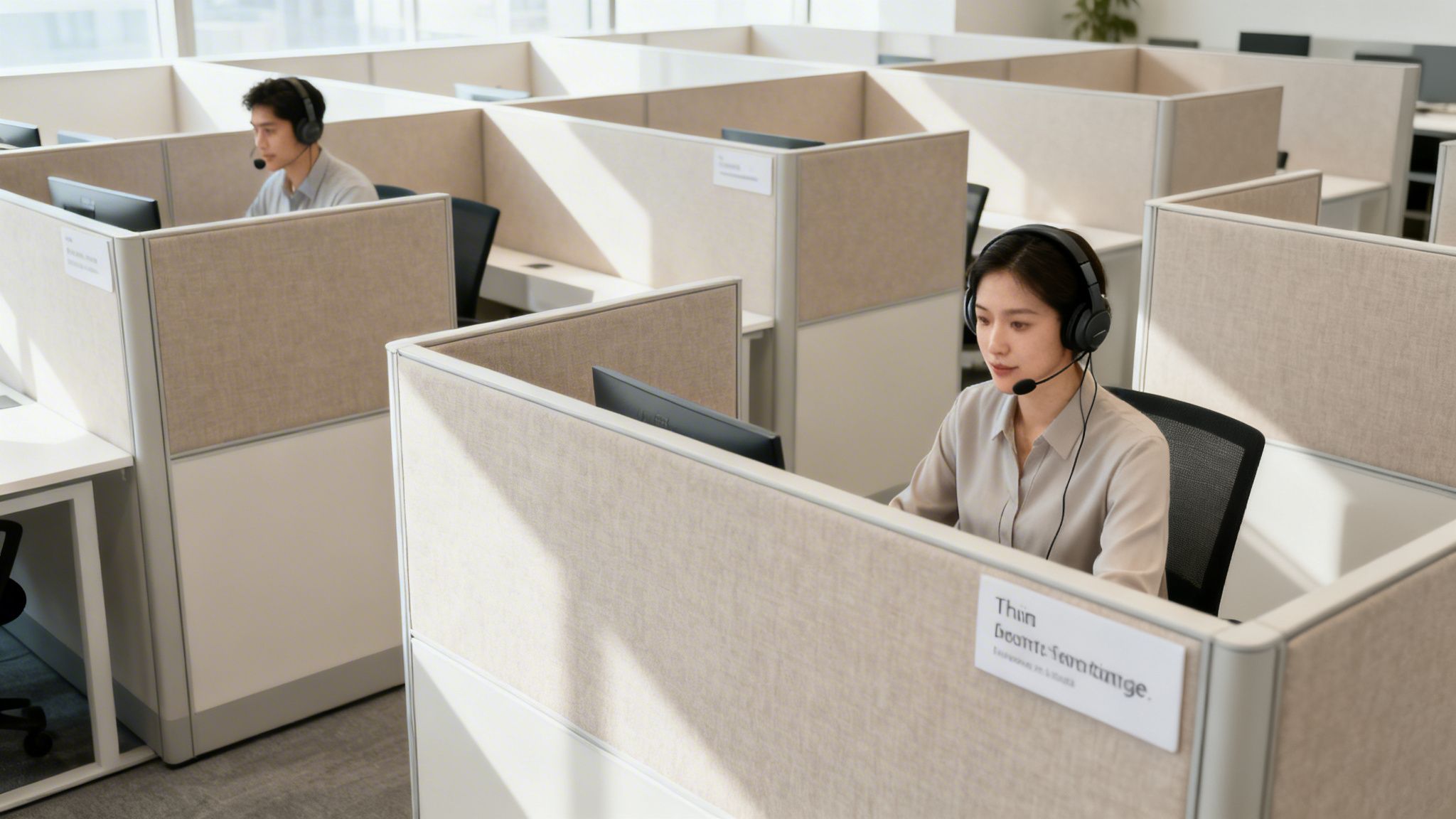
Now, let’s shift gears to a completely different scene: a call center or an accounting department. Here, the number one priority isn't collaboration—it's deep, uninterrupted focus and acoustic control. An open-plan office would be a complete disaster for productivity and call quality.

For these roles, the design has to prioritize individual concentration above all else.

  • Furniture Choice: High-walled cubicles are the undisputed champion here. We’re talking about private office cubicles with sound-absorbing fabric panels, which are an absolute must.
  • Strategic Thinking: The high walls act as a buffer, both visually and acoustically. They cut down on distractions and give employees the quiet they need to focus on their work or handle sensitive phone calls.
  • Layout: The cubicles are typically arranged in clean, efficient rows. This layout makes the most of your square footage while giving every single person a dedicated, quiet workspace and keeping walkways clear.

The right layout isn't about following a trend; it's about giving your employees the exact environment they need to excel. A setup that works wonders for a creative agency could be completely counterproductive for a legal team.

For companies with truly unique needs, exploring bespoke office furniture can bring a one-of-a-kind vision to life. But for most, a well-planned modular system strikes the perfect balance between custom-fit function and practicality.

The Modern Corporate Hub

Finally, let’s look at the hybrid model that’s become so popular in the corporate world. This layout gets that "one-size-fits-all" just doesn't work anymore. It’s all about providing the "best of both worlds" by mixing private, quiet zones with open, collaborative spaces.

This approach is perfect for a company with diverse departments and different job functions all under one roof.

  • Furniture Mix: The floor plan strategically combines glass-walled private offices for managers, semi-private workstation cubicles for teams that need to focus, and open benching systems in common areas for quick huddles and group projects.
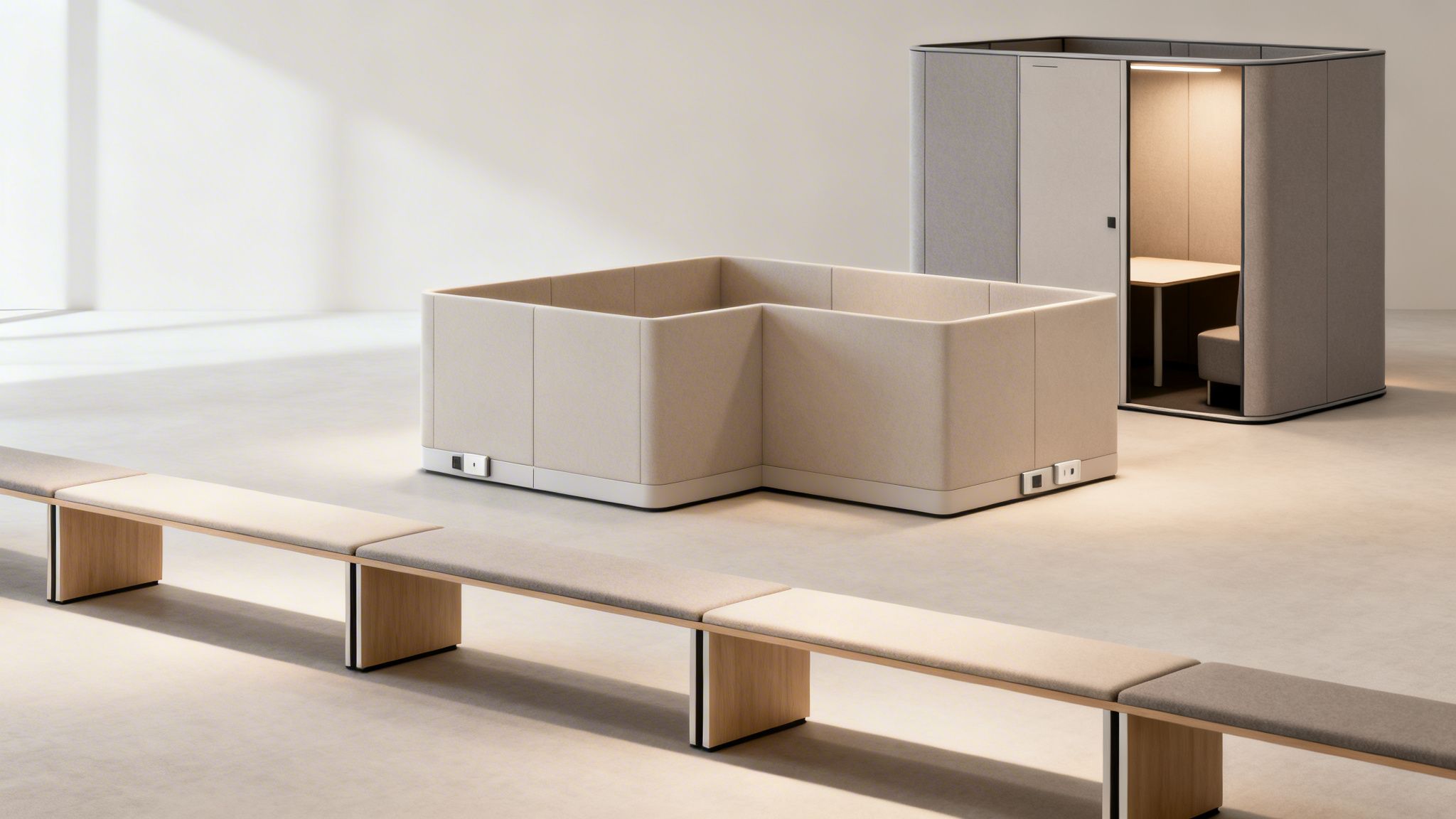
  • Strategic Thinking: This "activity-based" model empowers people to choose the space that fits the task. Need to take a sensitive call? Duck into a private phone booth. Need to brainstorm with your team? Huddle up at a collaborative table.
  • The Result: The office transforms into a dynamic, multi-functional space. It balances the need for quiet and privacy with the desire for community and teamwork, supporting different work styles all in one cohesive design. You can find a ton of other office furniture layout ideas to get your own creative juices flowing.

Your Checklist for a Smooth Installation

After all the planning and design work, the final piece of the puzzle is installation. This is where your vision gets built, piece by piece. A seamless installation day doesn't just happen by luck—it comes from a little bit of smart prep.

This final checklist is your guide to navigating the big day without the usual headaches. Think of it as your roadmap to ensuring the final result is exactly what you dreamed of.

Pre-Installation Site Prep

Before the delivery trucks even pull up, your space needs to be ready. You're essentially setting the stage for a big performance, and a clean, clear, and accessible site is the only way to get a standing ovation.

  • Clear the Area: The installation zone has to be completely empty. That means all old furniture, boxes, and any other odds and ends need to be moved out of the way.
  • Confirm Access: Get out the measuring tape. Double-check that doorways, elevators, and hallways are wide and tall enough for the new office furniture sets to pass through without a scratch. You’ll also want to coordinate with your building’s management to book the service elevator.
  • Protect Your Space: Lay down some protective coverings on floors and walls along the delivery path. This simple step can prevent a lot of scuffs and dings.

A smooth installation begins long before the furniture arrives. By coordinating with your building management and internal teams ahead of time, you eliminate 90% of potential day-of problems.

This kind of proactive thinking shows just how a full-service partner like Cubicle By Design supports you from the first sketch to the final handshake.

Coordinating with Your Teams

Your beautiful new furniture won't do much good without power and data. This is exactly why getting your IT and facilities teams involved early isn't just a good idea—it's critical.

These conversations should happen way back in the planning phase. Where you put power outlets and data ports has a huge impact on your final layout. Chatting with your IT team about your plans ensures every single workstation, from a private office cubicle to a shared workstation cubicle, is ready for plug-and-play on day one. A great furniture partner will help you fold these technical needs right into the design, which you can see for yourself with our custom Cubicle Designer.

The Post-Installation Walkthrough

Once the last screw is tightened and the crew is packing up, it's time for the final inspection. Don't rush this. This is your chance to walk through the new space with the installation manager and make sure every single detail is perfect.

As you do your walkthrough, keep an eye out for these things:

  1. Check for Stability: Give each desk and cubicle panel a gentle push. Nothing should wobble or feel loose.
  2. Inspect Surfaces: Look closely for any scratches, dents, or other blemishes that might have happened during shipping or the build-out.
  3. Test All Components: Open and close every drawer. Swing every cabinet door. Make sure it all moves smoothly and latches correctly.
  4. Verify the Layout: Pull out the floor plan you approved and compare it to what's in front of you. It should be a perfect match.

This final, careful review is what guarantees your new workspace is flawless, giving you total confidence and satisfaction from the moment your team walks in.

Common Questions About Office Furniture Sets

Even with a solid plan in hand, you're bound to have questions when it's time to choose your office furniture sets. We hear many of the same practical questions from business owners and office managers as they get closer to making a final decision.

Let's walk through some of the most common ones we answer every day.

How Do I Choose Between Cubicles and an Open Plan?

This is the big one. And the right answer always, always comes back to how your team actually works. It's the classic trade-off between individual focus and group collaboration.

  • Cubicles for Focus: These are your best bet for any role that requires serious concentration or acoustic privacy. Think about your accountants, programmers, writers, or anyone spending their day on sensitive phone calls. They need a quiet space to do their best work. You can explore all options in our cubicles collection.
  • Open Plan for Collaboration: On the flip side, workstation clusters and benching systems are designed to spark teamwork and those impromptu brainstorming sessions. This setup is perfect for creative departments, marketing teams, and sales floors where high energy and shared ideas are the currency of the day.

Many of the most successful offices we've designed in recent years use a hybrid approach. This gives you dedicated quiet zones and dynamic team spaces, all under one roof—the best of both worlds.

The most common mistake we see is focusing only on the initial price instead of the total value and long-term performance. Cheaper furniture often means poor ergonomics and less durability, leading to higher costs from employee discomfort, lost productivity, and the need for earlier replacement.

How Long Does the Entire Process Take?

The timeline for getting new office furniture really depends on the size and complexity of your project. As a general rule of thumb, you can expect a standard project to take several weeks from the day you sign off on the design to final installation.

Things like the size of your order, how much you customize the finishes and fabrics, and current manufacturing lead times all play a role. The absolute key to a smooth process is to start planning early. Here at Cubicle By Design, we map out a clear and realistic timeline with you right from the start so there are no surprises along the way.


Ready to create a workspace that works as hard as you do? Cubicle By Design offers end-to-end support, from initial space planning to professional installation. Start building your ideal office today.
Read More

Create Impactful Modern Office Spaces: Trends & Strategies | Cubicle By Design

Forget everything you thought you knew about the office. The modern office isn't just a building with desks anymore—it's a space built around how people actually work in 2026. It’s less like a container for your team and more like a dynamic hub that fuels creativity and connection. Crafting a modern office space that inspires is what we do best at Cubiclebydesign.com.

What Defines Modern Office Spaces Today

The whole idea of "the office" has changed. It's no longer just a place people are required to show up. Instead, it’s a powerful tool that can make or break your productivity, team collaboration, and even your company culture. Today's best workspaces are flexible, tech-savvy, and designed to support a wide range of tasks and work styles, especially with hybrid schedules becoming the norm.

For a while there, everyone was talking about the "death of the office." But the data tells a different story. After a few years of adjustment, people are coming back. A 2026 Global Workplace & Occupancy Insights report from CBRE shows that global office use has climbed from just 38% in 2024 to 53% in 2026. The office isn’t dead; it’s just evolved.

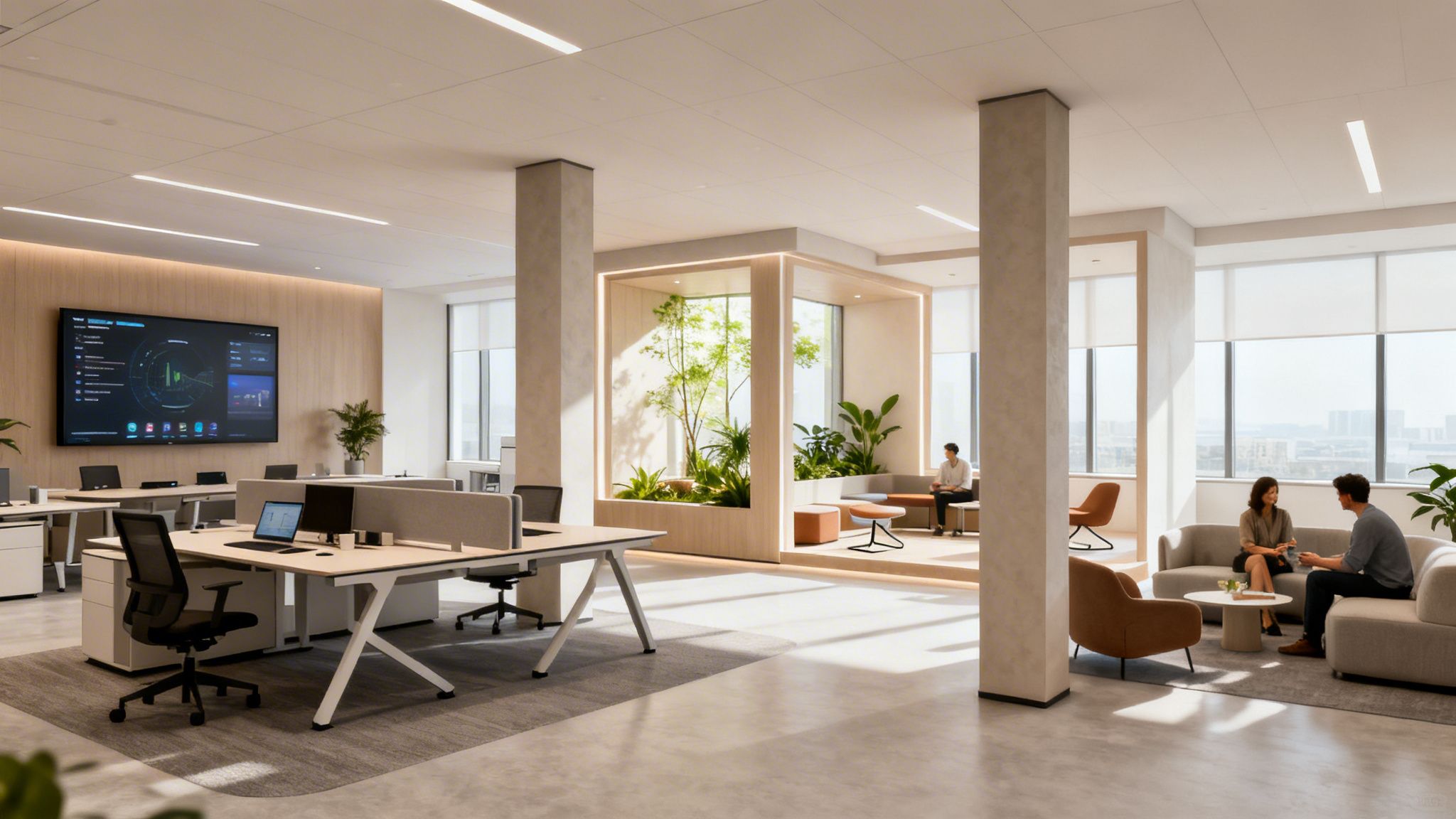
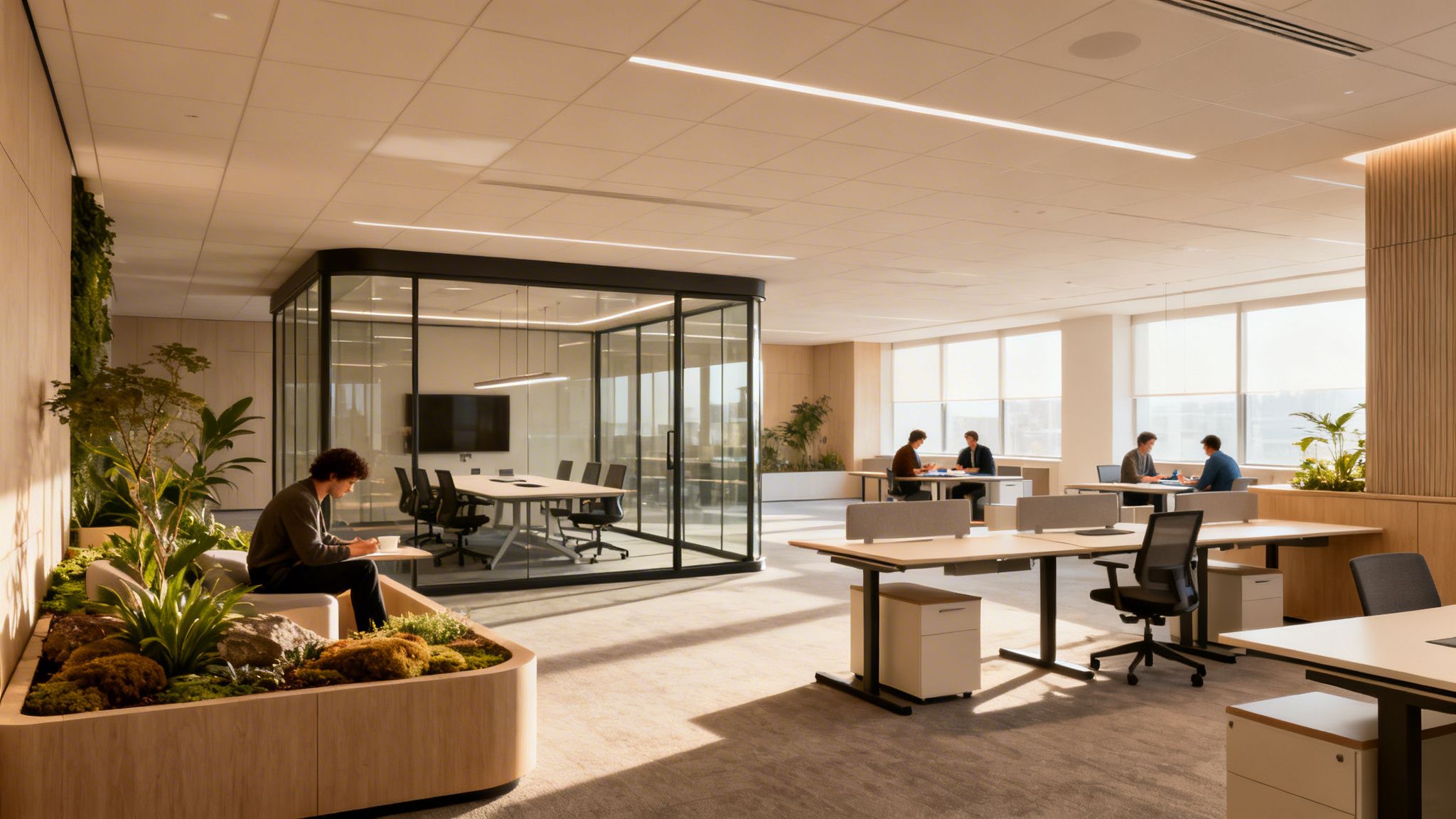
A bright, modern office showcasing biophilic design with people working at desks, a glass meeting room, and a lounge area with plants.

From Static Rooms to Strategic Hubs

Traditional offices were all about cramming as many identical desks as possible into a fixed floor plan. Modern design flips that script. It’s not about forcing people to work one way; it's about giving them choices that match what they need to do throughout the day. This is the core of what we do at Cubicle By Design—creating smart, responsive spaces that work for you, not against you.

To see this shift in action, it helps to compare the old way of thinking with the new.

Key Shifts from Traditional to Modern Office Design

This table breaks down how much has changed, moving from the rigid models of the past to the dynamic spaces we see taking over today.

Design Aspect Traditional Office (Pre-2020) Modern Office (2026+)
Layout Fixed, uniform rows of desks or cubicles Dynamic zones for different activities
Purpose A place for mandatory attendance A destination for collaboration and community
Flexibility Static and hard to change Modular and easily reconfigured
Technology Basic power and wired internet Fully integrated power, data, and AV tools
Focus Space efficiency and hierarchy Employee well-being and choice
Atmosphere Formal, sterile, and functional Comfortable, inspiring, and human-centric

What this really shows is a move away from the office as an obligation and toward the office as a valuable resource.

So, what makes these new spaces tick? A few key ideas stand out:

  • Activity-Based Working (ABW): This means offering different kinds of spaces for different tasks. Think quiet pods for deep focus, open lounges for brainstorming, and private rooms for calls.
  • Seamless Technology: Power, fast Wi-Fi, and easy-to-use video conferencing tools are everywhere, so your team can connect with anyone, anywhere, without a hitch.
  • A Focus on Well-being: Good design makes people feel good. This includes bringing in lots of natural light, adding plants (biophilic design), and providing truly ergonomic chairs and desks.
  • Modularity and Flexibility: The best offices can adapt. Using elements like modular workstation cubicles and movable walls means you can change your layout as your team's needs evolve.

A modern office is defined by its ability to adapt. It functions as a dynamic hub for collaboration, a quiet sanctuary for deep work, and a cultural anchor that brings teams together, all within a single, flexible footprint.

Ultimately, today's office needs to be a destination—a place employees want to go because it helps them do their best work and connect with their colleagues. It’s a world away from the old model where showing up was just part of the job description.

For more inspiration, you can dive into our guide on the latest workplace design trends.

The Four Pillars of High-Performing Office Design

Putting a few desks and chairs in a big room doesn't magically create a modern office. A truly great workspace isn't just about looking good—it's built on a foundation of four core principles that work together. Getting these right is the difference between an office that just exists and one that actively helps your team thrive.

Think of these as the four legs of a very sturdy table. If one is wobbly, the whole thing is off-balance.

A bright, contemporary open-plan office interior featuring work desks, a lush plant wall, and casual seating areas.

Pillar 1: Flexibility and Adaptability

The first and most important pillar is flexibility. Your business changes, so why should your office be set in stone? A modern office has to keep up, whether you're bringing on a new team, starting a sprint project, or simply need to switch between group work and quiet focus.

This is where modular design comes into play. It's about thinking of your office like a set of building blocks, not a static floor plan. For instance, our versatile workstation cubicles can be put together, taken apart, and rearranged to create brand new layouts without calling in a construction crew.

A flexible office lets you react to business needs in real time. You can expand a project team's area overnight or carve out a quiet zone for deep work with minimal fuss, making sure your space always serves the task at hand.

Pillar 2: Technology Integration

In any office today, technology is the central nervous system. The second pillar is making sure that system works without a hitch. Power, data, and communication tools need to be so easy to access that no one even thinks about them. Your team should never have to crawl under a desk to find an outlet or drop a video call because of a weak signal.

This means getting the little things right:

  • Integrated Power and Data: Workstations must have built-in electrical and data ports. No more extension cords snaking across the floor.
  • Smart Room Booking: Simple booking systems for meeting rooms and private booths eliminate the friction of scheduling conflicts.
  • High-Quality AV Tools: Every conference room needs reliable video conferencing gear. Clear audio and video are non-negotiable for connecting with remote colleagues.

When the tech just works, your team can focus on their actual jobs instead of playing IT support.

Pillar 3: Employee Well-Being

A healthy team is a productive team, and a happy team sticks around. The third pillar, employee well-being, is about much more than a fruit bowl in the breakroom. It’s about designing a space that actively supports your employees' physical and mental health. This is such a critical topic that we have a whole guide exploring what workplace ergonomics really involves.

A few key components make a huge difference:

  • Ergonomic Furniture: High-quality, adjustable chairs and desks aren't a luxury; they're essential for preventing strain and burnout.
  • Biophilic Design: Simply adding natural elements like plants, wood tones, and stone textures has been proven to lower stress and spark creativity.
  • Natural Light: Getting as much daylight as possible into the office is a massive mood and energy booster. Good lighting design, with tools like architectural downlights, fills in the gaps to create a comfortable, glare-free environment.

Investing in your team's well-being shows you care, and in today's market, that’s a powerful tool for attracting and keeping great people.

Pillar 4: Fostering Community

Last but not least, a modern office has to be a place that builds a real sense of community. While remote work has its perks, the office is where spontaneous conversations happen, where mentorship takes root, and where your company culture comes to life. This fourth pillar is about designing a space that encourages those connections.

You need to create "collision points"—areas where people naturally run into each other. Think strategically placed coffee bars, comfy lounges, and open common areas. The goal is to create an atmosphere where a casual chat can spark the next big idea and strengthen the bonds between teammates. At Cubicle By Design, we believe a great workplace finds the perfect balance between individual focus and that incredible collective energy.

Creating Adaptable Layouts for a Flexible Future

Flexibility is the engine that drives a modern office. Think of your workspace less like a permanent, fixed structure and more like a dynamic 'kit of parts' that you can reconfigure whenever you need to.

An adaptable layout gives you the power to react to new projects, shifting team sizes, and evolving work styles—all without a complete and costly overhaul.

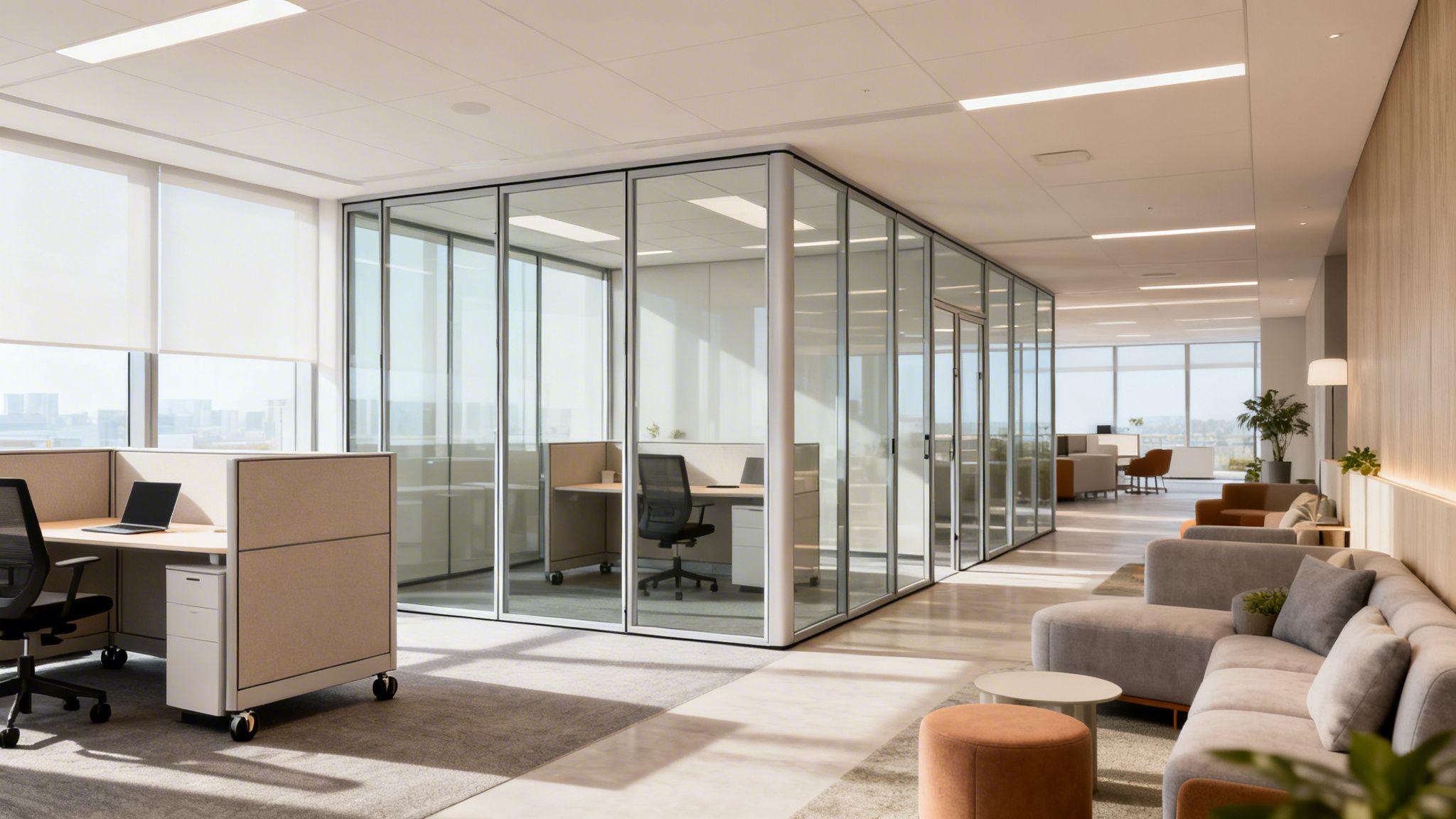
A bright modern office interior with glass-enclosed private office cubicles, open workstation cubicles, and a comfortable lounge area.

The goal here is a responsive environment that serves your team right now, not just how it was set up years ago. You want a workspace that can be changed quickly and easily, ensuring your real estate remains a true asset.

Mastering Smart Zoning

One of the biggest mistakes we see is companies feeling forced to choose between a totally open floor plan or a sea of isolating cubicles. The reality is, the most effective modern office spaces use a hybrid approach called zoning. It’s a strategy that involves creating different zones, each designed for a specific kind of work.

With smart zoning, you get to balance the collaborative energy of an open area with the quiet focus people need to get deep work done. You might set up one area for team brainstorming with whiteboards and casual seating, while another corner becomes a 'library' or quiet zone where calls are off-limits. This gives employees control over their own environment.

Zoning isn't about building permanent walls; it's about using furniture, movable partitions, and acoustic elements to create distinct 'neighborhoods' within your office. It allows for both collaboration and concentration to coexist peacefully.

The Power of Modular Systems

The real key to unlocking this flexibility is modular design. Modular furniture and architectural pieces are specifically designed to be reconfigured, making them the perfect fit for an office that needs to adapt. Instead of being locked into one layout for years, you can make meaningful changes practically overnight.

This isn't just a trend; it's a measurable advantage. We've seen that offices with flexible zoning achieve a 25% higher occupancy rate than those with old-school, fixed layouts. And the confidence in this model is clear, with the global coworking market projected to grow from $20.96 billion in 2025 to over $58 billion by 2033, as noted by researchers at Allwork.Space.

This is where thoughtfully designed systems really shine. Our own configurable cubicles, for instance, can be arranged to create anything from private touchdown spots to collaborative pods for team projects. To get a better handle on the concept, check out our guide that explains what modular furniture is and how it can completely change a space.

Designing a Dynamic and Responsive Office

Putting together a layout that can evolve with your business means combining a few key elements. Each one contributes to a workspace that feels both open and functional, giving your team plenty of choice.

Here are a few practical strategies to build out a flexible floor plan:

  • Use Demountable Glass Walls: These are fantastic for creating semi-private offices or meeting rooms. They keep things bright and open by letting light flow through the space, but they still provide crucial acoustic separation. Best of all, unlike drywall, they can be moved and reinstalled as your needs change.
  • Create 'Third Spaces': These are the areas outside of a traditional desk where people can work, meet, or just relax. Think comfy lounges, café-style high-top tables, or small nooks for informal chats. These spaces encourage spontaneous interaction and give employees a welcome change of scenery.
  • Deploy Movable Furniture: Put your furniture on wheels! Using mobile whiteboards, lightweight tables, and movable storage empowers your team to customize their immediate environment for whatever they're working on at that moment.
  • Invest in High-Performing Cubicles: Not all cubicles are the same. Modern workstation cubicles are designed for flexibility, with different panel heights and integrated tech. Need a quiet zone for the finance team? Our Private Office Cubicles offer enhanced privacy without the permanence of fixed walls.

By embracing these strategies, you're building an office that's ready for whatever comes next. It’s an investment in agility that pays off every time your company grows or pivots. For a closer look at our solutions, visit Cubicle By Design or get started with our Custom Cubicle Designer.

Solving For Acoustics And Privacy In The Modern Office

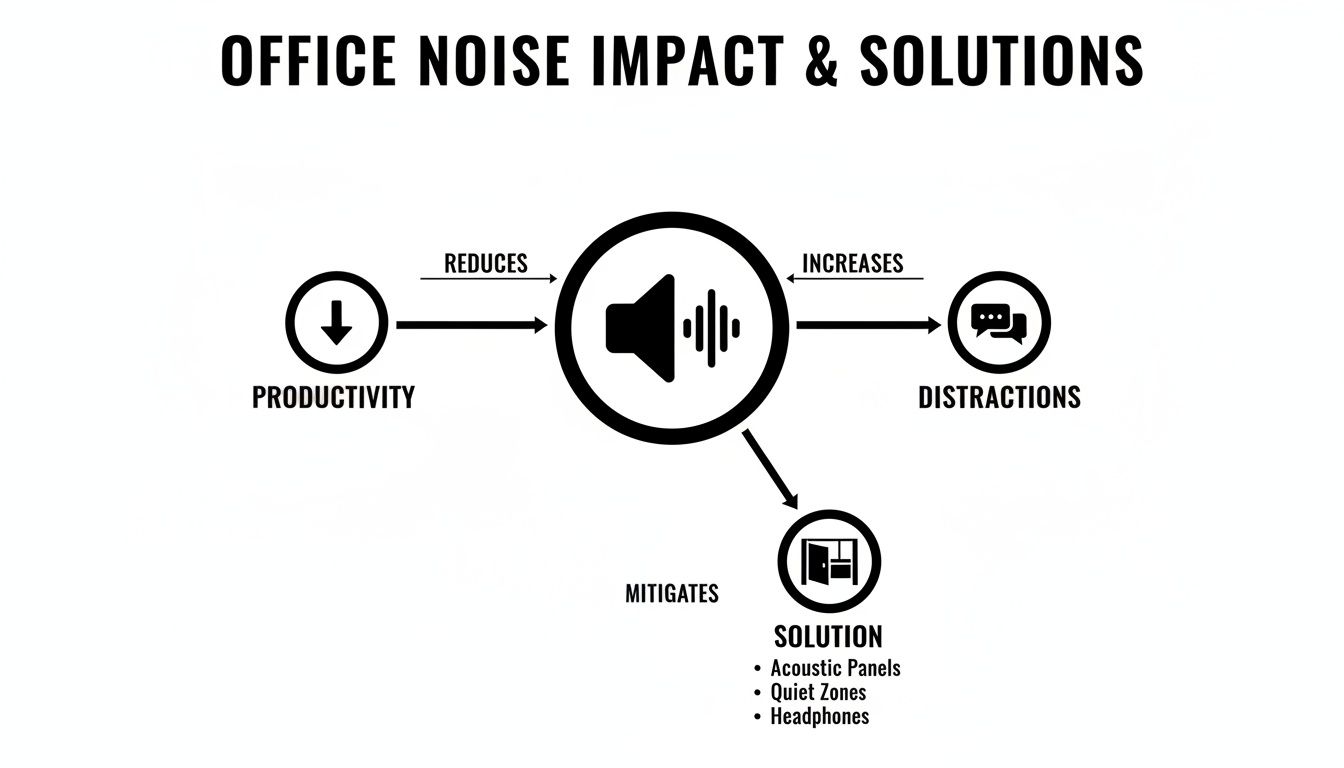
In any office trying to foster open collaboration, finding a quiet spot for deep work can feel downright impossible. Let's be honest: unwanted noise is probably the number one complaint you hear, and it's a massive productivity killer. With video calls now a daily routine for hybrid teams, getting a handle on your office's soundscape is more critical than ever. It's not just about making things quieter; it's about giving your team the ability to actually perform.

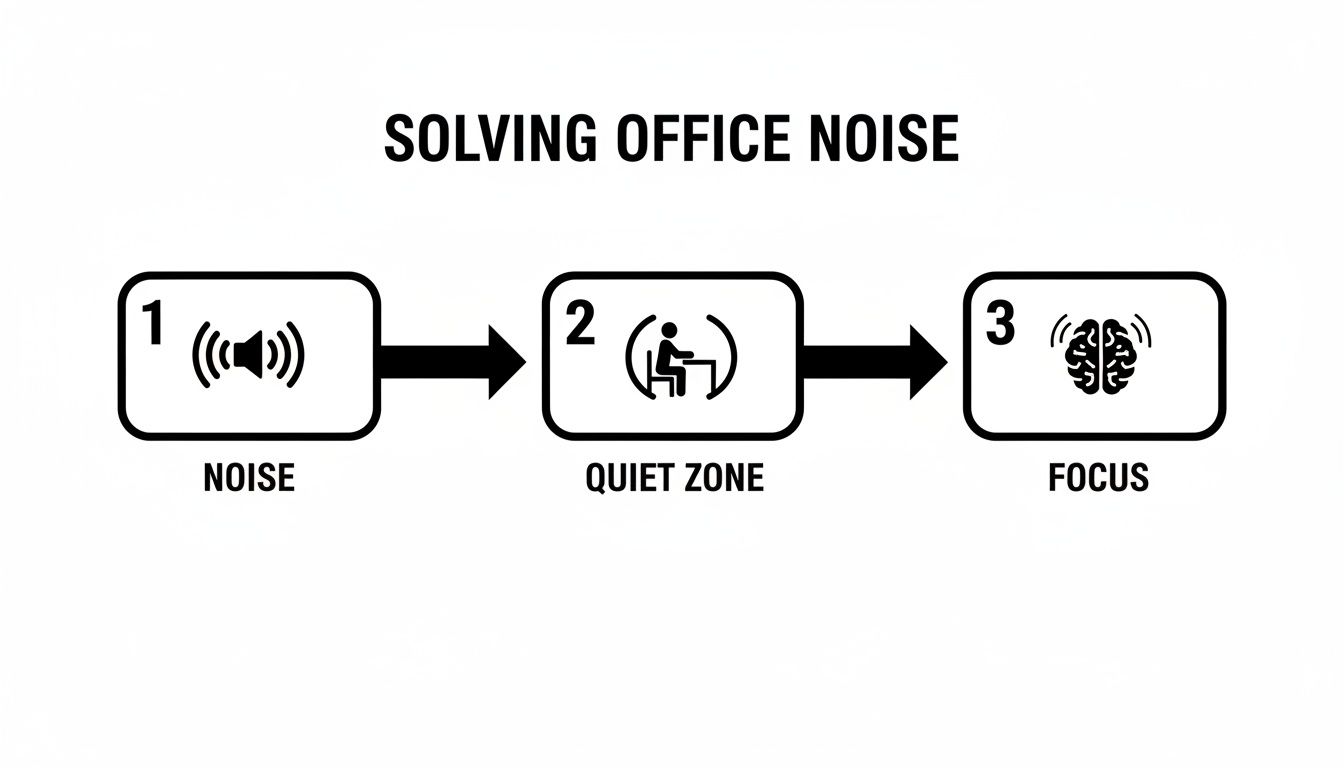
So, how do you fix it? The path from a noisy, distracting office to a focused one is simpler than you might think.

A diagram illustrating a three-step process for solving office noise: identifying noise issues, implementing acoustic solutions like private cubicles, and achieving focused work.

The idea is straightforward: when you carve out dedicated quiet zones, you can turn that disruptive chatter into a productive hum where real work gets done. It's a simple fix for a very common problem.

The Rising Demand For Quiet

The big push toward open layouts had a side effect nobody wanted—a focus crisis. Poor acoustics are a top complaint in almost every workplace, and people have less patience for noise than ever before. This has kicked off a huge demand for enclosed focus rooms, office pods, and quiet zones. It's a major behavioral shift that means modular cubicles with good acoustic separation are no longer just a "nice-to-have." They’re essential.

The real trick to modern office design is finding that sweet spot between encouraging spontaneous collaboration and protecting an individual's need to concentrate. A great workspace has a clear plan for both.

This is where your furniture choices can completely change the game. Instead of building permanent, rigid walls that close everyone off, you can solve the noise problem with high-performing furniture.

Using Furniture As Your Acoustic Solution

One of the smartest ways to manage noise is to build acoustic solutions right into your floor plan with your furniture. You can create different zones for different noise levels without losing that open, modern feel.

Here are a few practical ways to help your team reclaim their focus:

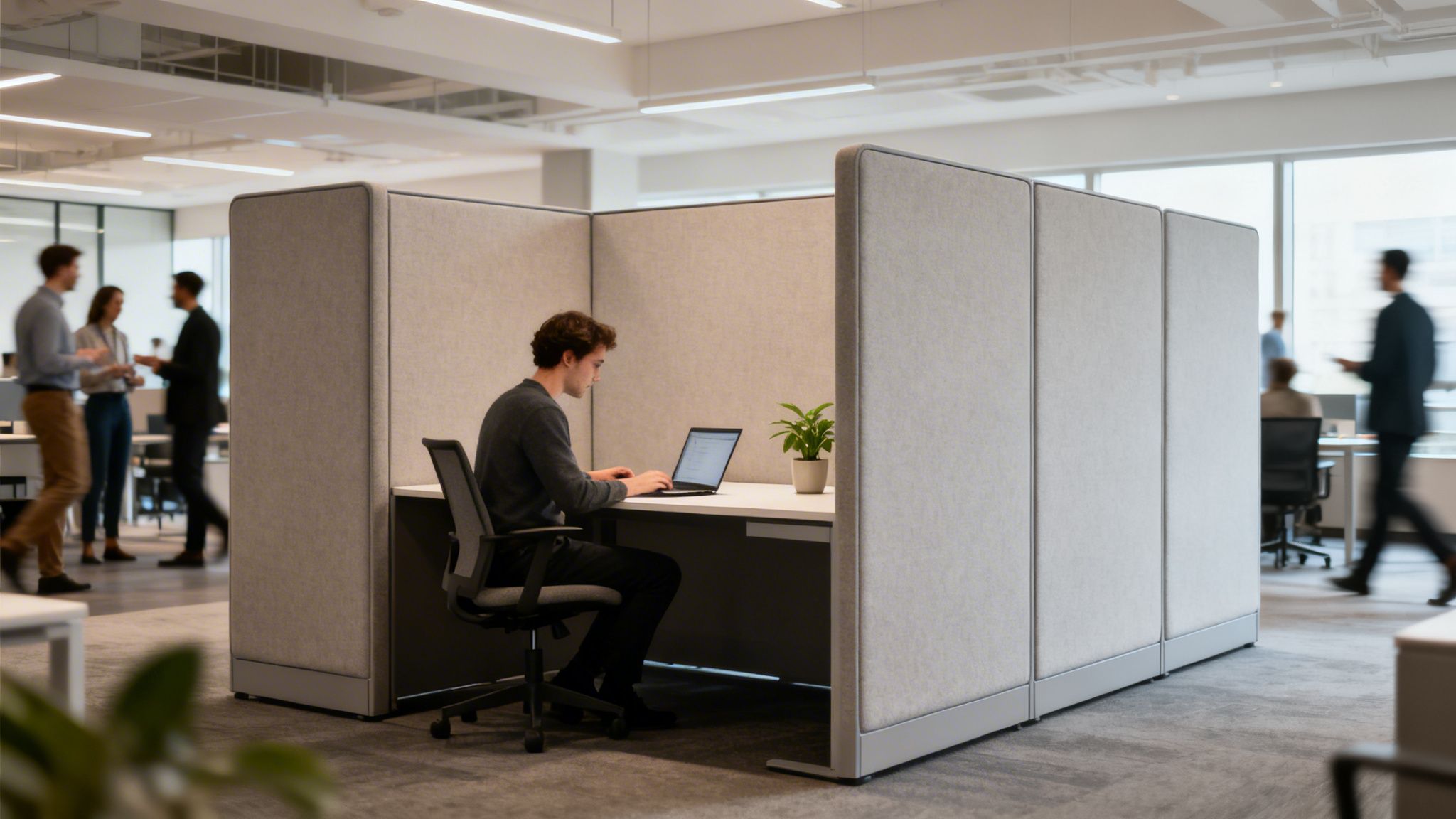
  • Bring in High-Panel Cubicles: Not all cubicles are the same. Modern systems with higher, sound-absorbing fabric panels give each person a buffer from ambient noise. They're perfect for teams who are on the phone a lot or handle detailed work.
  • Create Designated Quiet Zones: You can use furniture to set up "library rules" areas. Arrange seating and desks in a specific zone and let everyone know its purpose. It becomes a sanctuary for heads-down work.
  • Add Acoustic Dividers: Freestanding acoustic panels and desk-mounted screens are a super flexible way to add sound-dampening right where you need it. You can move them around as your team's needs change.

We cover this topic in much more detail in our guide to office acoustics solutions.

Achieving Privacy Without The Isolation

Privacy isn't just about blocking sound. It's about giving employees their own personal space where they can concentrate without feeling like they're on stage. In most modern office spaces, the goal is to provide that sense of enclosure without going back to the isolating, high-walled offices of the past.

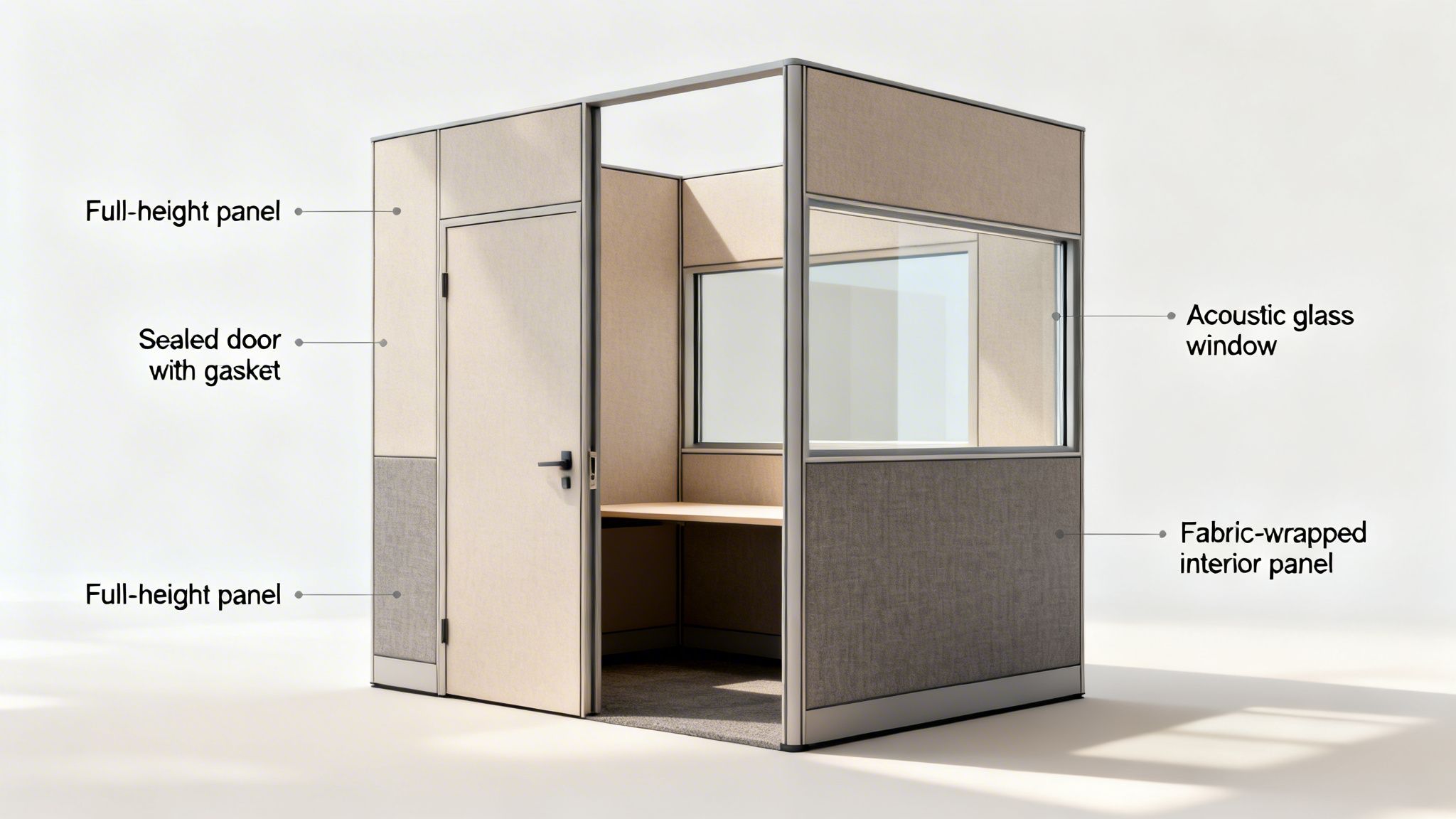
This is where really thoughtful product design makes a difference. For example, our Private Office Cubicles are built specifically to provide fantastic acoustic and visual privacy. They use higher panels and can even be set up with doors, giving you a true "office within an office."

This approach gives people the focus they need while still keeping them connected to the rest of the team. It's the perfect solution for managers, HR professionals, or anyone who deals with sensitive information, letting them work securely right inside an open-plan office. You can check out our full range of cubicles or even start mocking up a layout with our Custom Cubicle Designer.

Your Action Plan for a Modern Office Transformation

So, you’re ready to transform your office. It's a big project, but don't let that intimidate you. The key is breaking it down into a clear, manageable plan. We think of it as a four-phase journey: Assessment, Design, Procurement, and Implementation.

Following this simple roadmap takes you from a rough idea to a workspace that genuinely supports your team and your company's future.

Phase 1: The Assessment Phase

Before you pick out a single chair or paint swatch, you have to do your homework. This first phase is all about understanding what your people actually need to do their best work. Honestly, rushing this part is the biggest mistake we see companies make.

Start by getting direct feedback. Anonymous employee surveys are a great tool. Ask specific questions about their daily tasks, noise levels, what they love, and what drives them crazy about the current setup. Then, watch how your spaces are actually used. You’ll quickly spot which meeting rooms are ghost towns and which common areas have become bottlenecks.

All this research becomes the foundation for your new design, ensuring every choice you make is backed by real data, not just assumptions.

The Modern Office Planning Timeline

Mapping out a major office project can feel overwhelming, but a clear timeline turns a mountain into a series of manageable hills. Below is a sample timeline to give you a realistic idea of the process, from the first conversation to move-in day. Think of it as your project's North Star.

Phase Key Activities Estimated Duration
1. Assessment & Strategy Employee surveys, space utilization studies, leadership workshops, defining project goals and budget. 2-4 weeks
2. Design & Visualization Developing floor plans, creating 3D renderings, selecting finishes and materials, getting initial quotes. 3-6 weeks
3. Procurement Finalizing vendor selection, placing furniture orders, coordinating with contractors (electrical, data). 1-2 weeks
4. Manufacturing & Delivery Furniture and materials are manufactured and shipped. This is often the longest lead-time item. 6-10 weeks
5. Implementation & Install Site prep, furniture delivery and assembly, electrical/data installation, final walkthrough. 1-3 weeks
6. Move-In & Review Team moves into the new space, followed by post-occupancy feedback collection. 1 week

Remember, this is a general guide. Your specific timeline will depend on the scale of your project and the lead times for your chosen materials, but it gives you a solid framework to start planning.

Phase 2: The Design Phase

With all that valuable feedback in hand, it's time for the fun part: designing the new layout. This is where you get to solve the problems you uncovered and build a floor plan that truly works for your team. The goal isn't just to make it look good; it's to create different zones for different kinds of work—collaboration, deep focus, and casual social moments.

This is the perfect moment to play with ideas using a visualization tool. Our online Custom Cubicle Designer lets you experiment with different layouts, cubicle heights, and finishes right in your browser. You can map out how private office setups, like our popular Private Office Cubicles, can exist alongside more open and collaborative workstation cubicles.

The design phase is where your modern office stops being an idea and starts becoming a tangible plan. A well-considered design aligns your physical space directly with your business goals and work processes.

During this phase, it's also smart to think about the day-to-day reality of running the new space. For any office owner, understanding the basics of good commercial building maintenance is key to keeping your new environment functional and looking great for years.

Phase 3: The Procurement Phase

Once your design is locked in, it’s time to order the furniture and materials. This is all about making smart investments that hit the sweet spot between your budget, quality, and long-term durability. You want to find vendors who are partners in the process, not just order-takers.

Here are a few quick tips for a smooth procurement process:

  • Think Modular: Invest in systems that can be reconfigured down the road. It’s a much better long-term value than furniture that’s fixed in place.
  • Get Detailed Quotes: Make sure your quotes include everything—delivery, installation, and site prep—so there are no nasty surprises on the final invoice.
  • Check Warranties & Lead Times: Know the warranty on your big-ticket items like chairs and workstations, and double-check that the delivery timeline fits your project schedule.

Making the right choices here ensures your modern office spaces are built to last. You can explore our entire collection of cubicles and workstations to see systems that fit all kinds of design and budget needs.

Phase 4: The Implementation Phase

This is it—the final push where your plans and drawings become a physical reality. A smooth installation is all about clear communication and tight coordination between your furniture provider, installers, and your own team.

A detailed project schedule is your best friend here. It should map out every key date for furniture delivery, installation, IT setup, and the final move-in. Having a single point of contact, like a dedicated project manager from Cubicle By Design, can make this final stage feel almost effortless. For a much deeper dive, check out our detailed office space planning guide for more expert tips.

By moving through these four phases, you can tackle your office transformation with confidence, creating a space that sets your team up for success.

Budgeting for Your New Office Without Surprises

Talking about the budget for a new office can be stressful, but it helps to think of it as a strategic investment instead of just a cost. A great modern office space is the result of smart financial choices that will support your company's growth for years.

A realistic budget is much more than the sticker price on the furniture. It needs to account for installation, tech infrastructure, and a cushion for those little "just-in-case" moments that always seem to pop up. A good budget is your financial roadmap, turning a vision into a functional reality without any painful surprises.

Building a Realistic Financial Plan

Your first move is to break down the costs into clear, simple categories. This is the best way to keep small items from falling through the cracks and blowing up your budget later. While furniture is often the biggest line item, it’s definitely not the only one.

A solid, comprehensive budget should cover:

  • Furniture & Workstations: This includes all your desks, chairs, and of course, our range of cubicles.
  • Installation & Labor: Don't forget the cost of having professionals assemble and place everything correctly.
  • Technology & Cabling: Factor in the expense of running power and data to every single workstation.
  • Shipping & Delivery: These costs can be surprisingly significant, so make sure they're included in your quotes.
  • Contingency Fund: Always set aside 10-15% of your total budget for unexpected costs. It's far better to have it and not need it than the other way around.

By creating this detailed breakdown, you get a much clearer picture of the total investment, which makes the whole financial planning process a lot more accurate.

Maximizing Your Return on Investment

It's tempting to just go for the lowest initial price when you're working with a budget. However, the smartest investments are always the ones that deliver long-term value. This is especially true with office furniture, where adaptability is the real key to a great return on investment (ROI).

Modular furniture, for example, offers a fantastic long-term ROI simply because it can be reconfigured as your business grows and changes.

Look beyond the initial price tag. A slightly higher upfront cost for flexible, durable furniture can save you thousands down the road by eliminating the need to buy all new workstations every time your team structure changes.

This is exactly how we approach projects at Cubicle By Design. We help clients find solutions like our versatile workstation cubicles and private office cubicles that can adapt right along with them.

You can even play around with different layouts using our Custom Cubicle Designer to see for yourself how a modular system can meet your needs today and tomorrow. When you choose an adaptable system, you’re not just buying furniture—you’re investing in your company's agility.

Your Modern Office Questions, Answered

Moving to a modern office layout brings up a lot of questions for business owners and office managers. We get it. You want to get it right. Here are the answers to some of the most common things we're asked about designing the future of your workplace.

How Do I Choose Between an Open-Plan Layout and Cubicles?

This is the big one, and the good news is you don’t have to choose. The most successful modern office spaces today rarely go all-in on one or the other. Instead, they think in terms of zones.

Use open, collaborative areas for team projects and brainstorming sessions where you want that buzz and easy communication. Then, you can place modular cubicles to carve out quiet zones for focused, heads-down work. This "activity-based" approach gives your team the best of both worlds, letting them pick the right space for the task at hand. For example, our versatile workstation cubicles can create team "neighborhoods" that still offer the acoustic and visual privacy people need to concentrate.

What Is the Biggest Mistake to Avoid When Designing a Modern Office?

Hands down, the single biggest mistake is falling in love with a look while completely ignoring how your team actually works. A beautiful office that makes it harder for people to do their jobs is a failed investment, plain and simple.

Before you even think about paint colors, you have to dig into your team's daily workflows. Ask them about their biggest frustrations, especially around noise and privacy. Plan for the tech you have now and the tech you'll need in a few years. Putting function first ensures your office will be a real asset for years. This is the core of how we at Cubicle By Design help our clients build spaces that truly work.

An office should be a tool for productivity, not just a showpiece. Functionality, flexibility, and employee well-being should always drive the design process, with aesthetics serving to enhance—not dictate—the final layout.

How Can I Implement a Modern Office Design on a Tight Budget?

You can absolutely create a fantastic modern office on a tight budget. The secret is to be smart about where your money goes. Focus your spending on high-impact, long-term investments.

Prioritize two key areas: high-quality ergonomic chairs and flexible, modular workstations. They might seem like a bigger upfront cost, but these systems can be reconfigured as your company grows or your needs change. This saves you the huge expense of starting over from scratch down the road.

From there, you can use more affordable elements like paint, branded wall graphics, and live plants to bring the space to life. We specialize in creating modern layouts that get the most value out of real-world budgets. You can play around with different setups and see how they affect cost with our Custom Cubicle Designer.

How Important Is Employee Well-Being in Modern Office Design?

It's everything. Well-being isn't a "nice-to-have" anymore; it’s a core part of attracting and keeping great people, not to mention boosting productivity. In 2026, a workplace that clearly cares about its employees' health gives you a serious competitive edge.

And it’s about more than just a comfy chair. It means:

  • Letting in the light: Making the most of natural daylight.
  • Breathing easy: Ensuring great air quality and ventilation.
  • Bringing nature in: Using plants and natural materials (biophilia).
  • Moving around: Offering options like sit-stand desks and different types of seating to encourage movement.

Solutions like our Private Office Cubicles can deliver that quiet, low-stress environment people need to do their best thinking.


Ready to get more of your questions answered and start planning your perfect modern office? The team at Cubicle By Design is here to help with everything from space planning to the final installation. Explore our complete range of solutions and let's build a better workplace together.

Read More

L Shaped Desk Simple: Ultimate Guide to Modern Workspace Efficiency | Cubicle By Design

An L shaped desk simple design is one of the easiest ways to upgrade a workspace. It can instantly turn a forgotten corner into a real powerhouse of productivity. The magic is in how it creates two distinct surfaces—one for your computer work, another for everything else—without making your office feel crowded. This smart use of space gives you plenty of room for multiple monitors while keeping things from getting cluttered.

Why a Simple L-Shaped Desk is Your Smartest Choice

Think of a simple L-shaped desk like the "work triangle" in a kitchen. A chef sets up their stove, sink, and fridge for peak efficiency, and this desk does the same for your workflow by creating logical zones. This separation is a game-changer for cutting down on mental clutter and helping you focus.

For example, you can dedicate one wing of the "L" as your main digital hub—home to your computer, monitors, and keyboard. The other wing becomes your analog space for spreading out documents, jotting down notes, or taking calls without disrupting your primary screen setup.

This design is also brilliant for getting the most out of your floor space. By tucking right into a corner, an L-shaped desk makes use of an area that usually just collects dust, giving you a massive worksurface that doesn't dominate the room. Since studies show more than half of remote workers have a dedicated desk, making every square foot count is more important than ever. A desk that's too big can make a room feel cramped, while one that's too small is a recipe for frustration. The L-shape hits that perfect sweet spot.

A quick look at the advantages makes it clear why this design is so popular.

Simple L-Shaped Desk At-a-Glance Benefits

Feature Primary Benefit for Your Office
Corner-Fit Design Maximizes floor space by using often-wasted corner areas.
Dual Work Surfaces Creates separate zones for digital and analog tasks, improving focus.
Expansive Area Provides ample room for multiple monitors and other equipment.
Clean Footprint Offers a large work area without making the room feel crowded.

Ultimately, it’s about creating a more organized and efficient workspace from the ground up.

Creating a Scalable Foundation

The real beauty of a simple L-shaped desk is its flexibility. It acts as a starting point that can grow with you. For a small business that's expanding or a home office that needs to adapt, that's a huge plus. You can start with the basic desk and easily add storage, privacy panels, or other accessories later without having to buy a whole new unit.

This scalability fits right in with modern work trends, like hybrid models where an office has to be ready for anything. It’s also a key thing to think about when you're learning how to set up a home office for real, long-term comfort and productivity. The right desk is the heart of any good workspace.

The core benefit of an L-shaped desk is its ability to create distinct work zones. This separation reduces task-switching friction and keeps your primary digital workspace clear, which directly supports deeper focus and higher productivity.

Aligning with Modern Office Needs

Today's offices need furniture that does more than just hold a computer. It needs to support employee well-being and flexible work styles. A simple L-shaped desk delivers by giving you plenty of room for an ergonomic setup, including multiple monitors, adjustable keyboard trays, and space for proper posture. This is a big part of the conversation around the future of the office desk and its impact on employee health.

At Cubicle By Design, we help businesses put these kinds of smart solutions into practice. A simple L-shaped desk can be the first building block of a complete, integrated workspace. When you combine these desks with modular cubicles, you can create environments that are both structured and adaptable. Whether you need private office cubicles or open-plan workstation cubicles, the L-shape offers a solid and efficient foundation for each user. Using a tool like our Cubicle Designer lets you see exactly how this foundational piece fits into your bigger office plan, making sure your investment pays off in productivity for years to come.

Finding the Perfect Fit for Your Office Space

Picking the right L shaped desk simple design is about much more than just finding a style you like. It's about making sure the desk actually works in your room. Think of it like a custom suit—the fit is everything. A desk that’s just a little off can make even a great-looking office feel cramped and clumsy.

Before you even start looking at models, your first job is to grab a tape measure. But don't just measure from wall to wall. You have to think about the office as a living, breathing space. How will people move around? A desk might technically squeeze in, but if it blocks a door, creates a bottleneck in a walkway, or stops a cabinet from opening, it’s the wrong desk.

To sidestep these common headaches, start by measuring the corner where the desk will go. Then, map out these essential clearances:

  • Chair Space: You'll want to leave at least 36 inches behind the desk. This gives you enough room to push your chair back without bumping into a wall or file cabinet.
  • Walkways: Any path around the desk needs to be at least 36 inches wide. This keeps the space from feeling tight and lets people walk by easily.
  • Drawer and Door Clearance: Pull out any desk drawers all the way. Swing open nearby closet doors and the main entryway door. Make sure nothing collides.

Demystifying Desk Dimensions

Once you know your room's workable dimensions, you need to speak the language of desks. For an L-shaped desk, the two terms you'll hear most are the main desk (the longer part you'll likely face) and the return (the shorter side piece). Understanding this helps you picture the final layout.

Desk sizes are usually written as length by width (or depth). A 72" x 72" desk, for instance, is symmetrical. A 72" x 60" desk has one side longer than the other. The depth of the work surface is just as important. Most are between 24 and 30 inches deep. Someone who needs to spread out blueprints might love a 30-inch depth, but if your work is all on a computer, 24 inches is often plenty.

If you're trying to furnish a more compact area, check out our guide on good desks for small spaces for some great ideas and inspiration.

The "return" is the shorter wing of an L-shaped desk. Choosing a left-hand or right-hand return depends entirely on your room's layout and personal workflow—not just your dominant hand. The goal is to optimize flow, not fight against your environment.

Right Hand vs. Left Hand Configuration

Figuring out if you need a right-hand or left-hand return is one of the most critical choices. It's simple: if you're sitting at the main desk, a right-hand return extends out to your right side. A left-hand return extends to your left.

So, which one is for you? Let the room decide.

  • Where are the windows and doors? You don't want the return blocking your main entrance or a great view.
  • Where are the power outlets? Position the desk to make running your cables as clean and simple as possible.
  • What's your natural workflow? Do you tend to reach right for your phone or left for your papers? Let the room's layout guide you first, then factor in your personal habits.

A Tale of Two Spaces

Let's see how this works in the real world. Imagine you need to furnish two different spots: a 10'x10' private office and a 6'x6' cubicle.

The 10'x10' Private Office:
With 100 square feet, you’ve got some room to play. You could easily fit a generous 72" x 72" L shaped desk simple model in here. That gives you an executive-style workspace with plenty of surface area, plus room for a guest chair and extra storage, all without feeling crowded.

The 6'x6' Cubicle:
In a tight 36-square-foot cubicle, every inch counts. A huge desk would just feel overwhelming. A smaller 60" x 48" or even a 48" x 48" L-shaped desk is the perfect solution. You still get the benefit of two work surfaces but save that precious floor space for moving your chair.

Matching Materials and Finishes to Your Brand

Your L-shaped desk simple design does more than just hold up a computer; it tells a story about your company. Think of it as the business suit of your office furniture—it sets the tone for professionalism, durability, and brand identity. Picking the right material and finish isn't just about looks; it's a key decision that affects how long the desk will last and the overall feel of your workspace.

For a busy, high-traffic spot like a call center or an open-plan office, you need a material that can take a beating. This is where high-pressure laminate (HPL) really shines. It's incredibly tough, standing up to scratches, stains, and heat, which makes it a smart, long-lasting choice for active teams.

On the other hand, if you're outfitting an executive office or a client-facing area, the classic elegance of wood veneer sends a powerful message of tradition and prestige. It does require a bit more care, but the rich, natural grain of wood creates a sophisticated look that laminate can't quite match.

Finding a Cohesive Aesthetic

Beyond just the surface, the desk's frame and finish play a huge role in defining your office’s character. A simple L-shaped desk with a sleek metal frame can project a modern, industrial vibe that's perfect for a tech startup or a design agency. It feels light, airy, and forward-thinking.

The finish you choose is your chance to tie everything together. Solid colors, like a crisp white or a bold gray, create a clean, minimalist canvas that makes a space feel organized and focused. Wood grain finishes, even on laminate, can add warmth and a touch of nature, which has been shown to boost employee morale.

But before you fall in love with a finish, you have to know what fits. The simple infographic below breaks down the crucial first step: measuring your space.

As you can see, planning for walkways and clearance is just as important as the desk's footprint. You need a desk that fits both the room and the way people move through it.

Aligning Finishes with Your Brand Identity

The demand for versatile, good-looking furniture is driving major growth in the office furniture market. In fact, the global L-shape desks market is growing so fast that one related segment is expected to hit USD 3.66 billion by 2035. This boom is all about companies wanting furniture that is both functional and reflects their brand.

So, how do you connect a finish to your specific brand? Here are a few ideas:

  • For a Tech Startup: Try a light wood grain laminate with black or white metal legs. The look is innovative, clean, and full of energy.
  • For a Law Firm: A dark cherry or mahogany wood veneer finish communicates authority and tradition. Paired with classic hardware, it creates an atmosphere of stability and trust.
  • For a Creative Agency: Don't be shy with color. A bold, solid-colored desk can spark creativity and make a strong brand statement. For a different kind of modern, you might also consider the benefits of tempered glass desks.

The goal is to create a unified look. Your desk shouldn't feel like an afterthought. It should be an intentional part of your company's story, reinforcing your values and culture through its design.

At Cubicle By Design, we know how critical it is to create a cohesive office. That’s why we offer a huge selection of finishes and materials. Our systems let you perfectly match your L-shaped desk simple design with other furniture, like our workstation cubicles, for a polished and professional look across the entire office. From mapping your layout with our Cubicle Designer to choosing the final touches, we're here to help you build a space that truly reflects your brand.

Optimizing Your Layout for Wellness and Productivity

A simple L-shaped desk offers a fantastic ergonomic advantage, but only if you set it up with intention. Just having the extra surface area isn't the magic bullet; how you arrange your workspace is what supports real comfort and focus. The goal is to build a layout that fits your workflow, cutting down on physical strain and mental clutter.

The most practical approach we've seen is creating primary and secondary work zones. Think of it like a pilot's cockpit—the most critical controls are right in front, while other instruments are just a quick glance away. Your desk should work the same way.

  • Primary Zone (The Main Desk): This is where your immediate, high-focus tasks happen. It should hold your main monitor, keyboard, and mouse. You'll spend most of your time facing this surface, so getting it right is non-negotiable.

  • Secondary Zone (The Return): This is your support station. Use it for reference documents, your phone, a notepad for quick ideas, or a laptop dock. This keeps your main digital workspace clean and free from distractions.

Zoning your desk this way brings instant order to your workflow. By physically separating your tools based on how often you use them, you create a far more streamlined and less chaotic environment—a true cornerstone of productivity.

Achieving Perfect Ergonomic Posture

Aches and pains from a bad setup can absolutely kill productivity. While a simple L-shaped desk gives you the perfect canvas for an ergonomic workstation, you have to follow the rules of posture.

Here’s a quick guide to aligning your body for all-day comfort.

  1. Start with Your Chair: Adjust your chair so your feet are flat on the floor with your knees bent at roughly a 90-degree angle. Your arms should hang comfortably at your sides.

  2. Set Your Keyboard Height: The keyboard should be at a height where your elbows are also at a 90-degree angle while you type. Keep your wrists straight, not bent up or down.

  3. Position Your Monitor: The top of your screen should sit at or just below your eye level. This simple adjustment prevents you from craning your neck or hunching your shoulders, which are major culprits for pain. As a rule of thumb, the screen should be about an arm's length away.

Following these steps turns your desk from just a piece of furniture into a genuine tool for well-being. You can find even more tips on how to maximize the ergonomics of your office in our detailed guide.

Integrating Ergonomic Accessories

To really elevate your setup, consider adding a few accessories designed for comfort and flexibility. An L-shaped desk gives you plenty of room to add these tools without making things feel cluttered.

Ergonomics isn't about one magic product. It's a complete system where your desk, chair, and accessories all work together to support your body's natural posture all day long.

These are some of the most powerful additions you can make:

  • Monitor Arms: These are a total game-changer. They clear up desk space and let you perfectly adjust the height, depth, and angle of your screens for that ideal eye-level position.
  • Keyboard Trays: An under-desk keyboard tray is a great solution for getting that perfect elbow height and neutral wrist posture, especially if your desk’s height isn't quite right for your body.
  • Ergonomic Seating: The right chair is non-negotiable. At Cubicle By Design, we offer a range of task seating built to provide the lumbar support and adjustability you need for lasting comfort.

The Sit-Stand Revolution

The simple L-shaped desk has also become a star player in the modern sit-stand movement. Height-adjustable desks are now a central part of improving employee wellness by fighting the health risks of sitting all day. This isn't just a trend; the global market for standing desks is projected to hit USD 15.1 billion by 2035.

Studies have even shown that using a standing desk can slash back pain by 32%. By bringing in a sit-stand L-shaped desk, you empower people to switch between sitting and standing, which improves circulation, boosts energy, and sharpens focus.

Achieving a Clean and Powered Workspace

There's nothing that ruins the clean look of a simple L-shaped desk quite like a tangled mess of wires. That "cable chaos" isn't just ugly; it's distracting and can even be a safety hazard. When you get the wires under control, you amplify the desk's simple aesthetic, making your whole workspace look more professional and feel less cluttered.

The trick is to think about your power and data needs right from the start. If you plan ahead for how you'll plug everything in—monitors, laptops, phones, lamps—you can create a sleek, fully powered workstation without the spaghetti junction of cords. Think of it like the electrical and plumbing in a house; you have to plan where the pipes and wires go before you put up the drywall.

Foundational Cable Management Solutions

The first step to taming the wire beast is using a few simple, effective tools to get them out of sight. These solutions are usually cheap and a breeze to install, giving you an immediate win for organization and safety.

Start by grouping loose cables together. Then, wrangle them with one of these go-to tools.

  • Adhesive Cable Clips: These little clips are great. They just stick to the underside of your desk or down the legs, creating a clean path for your cords to follow. They're perfect for routing one or two main cables neatly out of the way.
  • Velcro or Fabric Cable Ties: Unlike those plastic zip ties you have to cut off, these are reusable. They're fantastic for bundling a group of wires together, and you can easily add or remove a cable later without needing scissors.
  • Cable Sleeves: This is one of my favorite tricks. It's a fabric or plastic sleeve that zips around a whole bundle of cords, turning an octopus of wires into one clean-looking tube. It’s an ideal fix for that main bundle of cables running from your desk to the wall outlet.

Integrated Power and Data Systems

If you want a truly professional setup, you need to look at systems built right into the desk or the cubicle itself. These integrated solutions hide wires completely and bring power outlets right to you, so you never have to crawl under your desk again just to plug in your phone.

A well-managed workspace is a productive workspace. When your desk is clear of cable clutter, your mind is clearer, too. It’s a simple change that removes a major source of visual distraction, helping you stay focused on the task at hand.

These options can turn a basic L-shaped desk into a legitimate high-performance workstation.

  • Desktop Grommets: These are just circular cutouts on the desktop, usually with a plastic or metal cap. They let you feed cables straight through the top, keeping your primary work surface completely clear.
  • Under-Desk Wire Trays: This is basically a wire basket that mounts to the underside of your desk. It’s the perfect place to stash a power strip and all those bulky power adapters, keeping them off the floor for good.
  • Built-in Power Modules: A lot of modern desks can come with power outlets and USB ports built right into the surface. It’s the ultimate convenience, giving you easy access to power for charging laptops, tablets, and phones. For more ideas on organizing power, you might find our guide on choosing an under-desk power strip helpful.

At Cubicle By Design, we engineer our systems with all this in mind. Our cubicles and workstations are designed with integrated raceways—dedicated channels that carry power and data cables discreetly through the panels. This means your L shaped desk simple design becomes part of a fully powered, professional system where every wire is hidden from day one.

Whether you're setting up private office cubicles or a row of workstation cubicles, our systems keep the look clean and streamlined. You can even play around with these integrated power options using our free Cubicle Designer to see how it all comes together.

Planning for the Future with Modular Desk Systems

Good office furniture should never be a one-time purchase. It’s an investment that ought to grow and adapt right along with your business. A simple L-shaped desk might look like a standalone piece, but when it’s part of a modular system, it’s the key to making your workspace ready for anything.

Think of it like building with LEGOs. You start with a core piece—your L-shaped desk—and then you can add, move, or reconfigure other components as time goes on. For any business that expects to grow, especially startups or those with hybrid teams, this flexibility is a huge advantage.

The Power of Scalability

A static desk paints you into a corner. A modular system, on the other hand, gives you the freedom to evolve. As your team gets bigger or job roles shift, you can simply add new elements to the L-shaped desks you already have.

This approach gives you some incredible options:

  • Add Privacy: Quickly turn an open desk area into a series of focused workstations just by adding privacy panels.
  • Increase Storage: Need more space for files or supplies? Integrate filing pedestals, overhead hutches, or shelving whenever you need them.
  • Reconfigure Layouts: You can completely change your office floor plan without having to buy all-new furniture.

This kind of adaptability is more important than ever. The corner desk market, which is a great indicator for simple L-shapes, was valued at USD 2.41 billion in 2026 and is on track to hit USD 3.35 billion by 2033. A lot of that growth is because of their flexibility; 55% of new office setups now use modular L-desks, which can slash reconfiguration costs by up to 18%. You can explore more data on this trend to see just how much modular design is shaping modern offices.

Future-Proofing Your Investment

When you choose a modular system, your initial investment keeps paying off for years. You’re no longer stuck with a fixed layout; instead, you have a workspace that you can fine-tune whenever you need to. That’s the entire idea behind the systems we offer at Cubicle By Design.

Your office furniture shouldn't hold you back; it should move forward with you. A modular L-shaped desk system ensures your workspace is an asset that adapts to growth, not an obstacle that hinders it.

Our Private Office Cubicles and Workstation Cubicles are built from the ground up to be fully scalable. A simple L-shaped desk can be the starting point for a complete workstation, giving you the exact amount of privacy, storage, and power access you need.

This proves that "simple" can also mean "ready for anything." With a tool like our free Cubicle Designer, you can map out exactly how to build your space from day one while also planning for future changes. It’s a smart way to protect your budget and keep your team working efficiently. When you pair these desks with our full range of cubicles, you get an office that’s truly built for the long haul.

Frequently Asked Questions About L-Shaped Desks

When you start looking at L-shaped desks, a few common questions always seem to pop up. Let's tackle them head-on so you can feel confident you’re making the right choice for your office.

Are L-Shaped Desks Better for Productivity?

For a lot of people, the answer is a definite yes. The real magic of an L-shaped desk is that it gives you two distinct zones to work with. You can keep your main computer setup on one side and have a completely separate surface for paperwork, reviewing blueprints, or spreading out reference materials.

This simple act of "zoning" your work cuts down on surface clutter and the mental mess that comes with it. By keeping your main digital workspace clear, it's just plain easier to focus. The result is a more organized workflow and a more productive day.

How Do I Choose Between a Left or Right Return?

The "return" is simply the shorter leg of the L. Deciding whether you need a left-hand or right-hand return is all about your room's layout and your personal workflow, not just which hand you write with.

Before you decide, take a quick look at the space:

  • Room Layout: Where are the doors, windows, and main foot traffic paths? You never want the return to block a doorway or make the room feel cramped.
  • Power and Data: Think about where your outlets are. You want the desk positioned so you can run your cables cleanly without creating a trip hazard.
  • Workflow: Do you instinctively reach to your right for the phone or your notepad? A right-hand return means the shorter side is on your right as you sit.

Let the room's physical layout be your primary guide. It’s always better to have a desk that works with the space, not against it.

Can a Simple L-Shaped Desk Be Ergonomic?

Absolutely. A truly ergonomic setup is less about the desk's shape and more about how everything is arranged on it. A simple L-shaped desk actually provides the perfect foundation for good ergonomics precisely because of its generous space.

That extra depth lets you push your monitor back to the proper distance—about an arm's length away—which helps prevent eye and neck strain. You also have plenty of room to position your keyboard and mouse for a neutral wrist posture. Pair it with a good adjustable chair, and you've created a comfortable and supportive workstation.

What Is the Main Advantage of a Modular L-Shaped Desk?

In one word: scalability. A fixed, one-piece desk is just that—one piece. But a modular system from a provider like Cubicle By Design is a smart investment that can grow and change right along with your business.

This means you can easily rearrange your office layout, add more workstations as your team expands, or bring in new components like storage cabinets and privacy panels whenever you need them. It's a future-proof strategy that protects your initial investment, allowing it to adapt to your needs for years without forcing you to start from scratch.


Ready to find the perfect L-shaped desk for your workspace? Explore the flexible and scalable solutions at Cubicle By Design and see how a simple design can make a big impact on your office’s productivity and comfort.

Design Your Perfect Workspace with Our Custom Cubicle Designer

Read More

The Ultimate Guide to Soundproof Office Cubicle Solutions | Cubicle By Design

The constant buzz of an office—phones ringing, side conversations, keyboard clicks—isn't just a minor annoyance. It's a productivity killer. A soundproof office cubicle is more than just a workstation; it’s a dedicated space engineered to block and absorb that noise, carving out a quiet zone for focus and private conversations. It’s the key to turning a chaotic environment into a powerhouse of efficiency.

The High Cost of Noise in the Modern Workplace

In today's popular open-plan offices, sound has nowhere to go but everywhere. A single sales call can easily derail an entire team's focus. All those small, constant interruptions really add up, chipping away at concentration throughout the day. Studies have shown that workers lose a shocking amount of productive time every single day simply because of noise. That's not just a nuisance; it's a real, tangible cost hitting your bottom line.

Think of it this way: a noisy open office can quickly become a "distraction factory." Every ringing phone and impromptu chat pulls your employees' attention away from what they need to be doing. Their brains have to work overtime just to filter out the background chatter, which leads to mental fatigue, more mistakes, and higher stress levels. This makes it incredibly difficult for people to do deep, focused work or handle sensitive client calls.

A man works on a laptop inside a modern, soundproof office cubicle designed for focus and privacy.

Restoring Focus and Privacy

A soundproof office cubicle is the most direct fix for this problem. Standard cubicles might offer some visual separation, but they do very little for acoustics. These specialized workstations, on the other hand, are built from the ground up with sound-absorbing materials and designs that create a real acoustic barrier.

By containing sound, these cubicles give individuals their focus back without completely isolating them from the team. They provide a much-needed sanctuary for any task that requires serious concentration, like writing, analyzing data, or holding confidential calls.

The payoff from creating a quieter workspace is almost immediate. When you implement a soundproof cubicle system, you’ll see some major improvements:

  • Improved Employee Concentration: With fewer distractions, employees can get into "the zone" faster and stay there longer. The result is a dramatic boost in their quality and quantity of work.
  • Enhanced Confidentiality: For anyone in HR, sales, legal, or healthcare, a sound-dampened space isn't a luxury—it's a necessity for protecting private information.
  • Reduced Workplace Stress: A calmer environment lowers the mental load and chronic stress that comes from being in a noisy office all day. That means better morale and higher job satisfaction.
  • Increased Overall Efficiency: Less time spent being interrupted means less time wasted trying to get back on track. Your whole team can get more done, which directly fuels business growth.

A Strategic Investment in Performance

It's a mistake to think of a soundproof cubicle as just another piece of furniture. It’s a strategic tool for getting the best performance out of your team. At Cubicle By Design, we help businesses solve these exact challenges with sophisticated systems.

Whether you need fully enclosed Private Office Cubicles for total privacy or high-paneled Workstation Cubicles for focused team pods, the goal is always the same: create an environment where your people can thrive. You can start exploring what it takes for improving workplace productivity with a smarter layout designed with our Cubicle Designer. When you invest in acoustic control, you're investing directly in your team's success—and your company's.

Decoding the Science of Soundproof Cubicles

What’s the real difference between a regular cubicle and a genuinely soundproof office cubicle? It all comes down to the science of acoustics. Once you get a handle on a couple of key ideas, you can see past the marketing fluff and find a workspace that actually delivers peace and quiet.

Think about office noise in two ways: it can either punch straight through a wall, or it can bounce around the room like a pinball, creating echo and distraction. To quiet a space down, you have to tackle both. This is where a couple of important ratings come into play.

The Dam and The Sponge Analogy

Let's imagine all that unwanted office chatter is a river flowing right at your desk. To manage it, you need two things: a solid dam to stop the flow and a big sponge to soak up any water that makes it into your space.

  • Sound Transmission Class (STC): This is your dam. STC is a number that tells you how good a wall is at stopping sound in its tracks. A higher STC rating means the wall is a better sound blocker, turning a loud conversation just outside into a faint, distant murmur.

  • Noise Reduction Coefficient (NRC): This is your sponge. NRC measures how much sound a surface can absorb. The rating goes from 0 to 1, and the closer you get to 1, the more sound gets soaked up, killing echoes and reverb inside your cubicle.

A truly effective soundproof office cubicle has both. It’s built with high-STC walls to act as a dam against outside noise and high-NRC surfaces to work as a sponge for any sound inside, creating a quiet, balanced workspace.

Essential Components of an Acoustic Cubicle

Hitting those high STC and NRC numbers doesn't happen by accident. It's all about using the right materials and smart design, because a cubicle's sound control is only as good as its weakest point. A few gaps or cheap, thin panels can ruin the whole effect.

The goal is to create a complete seal. Even a tiny opening can let in a shocking amount of noise, just like a small crack in a window can let in a bone-chilling draft. Every single component matters.

Here are the key pieces that have to work together to build an effective sound barrier:

  • Full-Height Walls: The biggest factor, by far, is wall height. You need panels that go from the floor all the way to the ceiling (or very close to it). This stops sound from just hopping over the top, a problem that makes standard low-walled cubicles useless for acoustic privacy.

  • High-Density Core Materials: Mass blocks sound. It’s that simple. Soundproof cubicles are built with heavy, dense materials in their core, like compressed mineral wool or special composites that physically stop sound waves. This is a world away from the hollow, lightweight panels in most cubicles.

  • Acoustic Fabric and Surfaces: To crank up the NRC "sponge" effect, panel surfaces are wrapped in special sound-absorbing materials. These acoustic fabrics have a porous texture that traps sound waves instead of letting them bounce around, which cuts down on echo within the space.

  • Airtight Seals and Gaskets: Sound travels on air, so any gap is a potential leak. True acoustic cubicles use specialized gaskets and seals to close every gap—between panels, around the door, and along the floor and ceiling. This creates an airtight box that sound struggles to get into.

When you understand these basics, you can start looking at different office acoustics solutions and see why a purpose-built system is so much better than trying to patch up a standard cubicle. It's the combination of blocking mass and absorbing surfaces that gives you real speech privacy and the focus you need.

Strategic Office Design for Acoustic Privacy

Getting real control over office noise means looking beyond a single soundproof office cubicle. A truly effective plan takes the entire office layout into account. When you thoughtfully design the space, you can create an environment that naturally quiets distractions and helps people focus.

Instead of just banking on cubicle walls to do all the work, you can use the layout itself to manage sound. This means creating specific zones for different kinds of work, which helps keep noise contained right where it starts and stops it from spilling across the entire floor.

Creating Dedicated Acoustic Zones

A smart move is to divide your office into zones based on how loud the activities are. Think of it like a well-designed library—you have your silent reading areas, and then you have separate rooms for group study. The same idea works wonders in an office, making sure loud conversations don't derail tasks that require deep concentration.

  • Quiet Zones: These spots are reserved for heads-down, focused work. You’ll want to place them far from high-traffic hallways, break rooms, and the reception desk. Outfitting these zones with high-paneled cubicles can make them even quieter.
  • Collaboration Hubs: These are the energetic spaces built for team meetings, brainstorming, and quick chats. By grouping these activities together, you keep the noise bundled up and away from the quiet zones.
  • Mixed-Use Areas: For areas that serve multiple purposes, flexible furniture and movable partitions are your best friend. For more on this, check out our guide on panel privacy screens, which can help create temporary sound separation whenever you need it.

Even modern office trends like hot desking strategies, which are all about flexibility, show just how much demand there is for good acoustic solutions. The more open and dynamic the layout, the more you need reliable options to give people a quiet place to land.

A well-thought-out office layout can significantly cut down on noise pollution. The table below outlines a few strategies and the kind of acoustic impact you can expect from each.

Acoustic Layout Strategies and Their Impact

Layout Strategy Description Best For Acoustic Impact
Zoning Creating separate areas for quiet work, collaboration, and breaks. Offices with diverse work styles and activity levels. High. Effectively contains noise at its source and protects quiet areas.
Buffer Zones Using hallways, storage areas, or plant life to create physical separation. Large open-plan offices needing to break up the space. Medium. Reduces direct sound travel between different functional areas.
Staggered Layout Arranging cubicles in a non-linear, staggered pattern. Preventing a direct line of sight and sound travel down long rows. Medium. Disrupts sound waves and adds a degree of perceived privacy.
Centralized Hubs Placing high-noise equipment (printers, copiers) in a central, enclosed room. Any office looking to isolate a major, consistent source of noise. High. Removes a significant source of background distraction from the main floor.

By choosing the right combination of these strategies, you're not just placing furniture—you're actively shaping the acoustic character of your workspace.

Supporting Your Cubicles with Environmental Acoustics

The walls of your cubicles shouldn't be your only line of defense against noise. The room itself—the floors, ceilings, and walls—plays a huge part in either echoing sound or soaking it up. Weaving sound-absorbing materials into the broader office environment gives you a strong acoustic foundation.

Think of your office like a concert hall. The shape of the room, the materials on the walls, and the seating arrangement all work together to control the sound. Your office is no different—every surface contributes to the overall acoustic experience.

This boils down to two core ideas in acoustic design: blocking sound and absorbing it.

A mind map illustrating acoustic design principles for soundproof office cubicles, differentiating sound blocking (mass, isolation) from sound absorption (porosity, material density).

As you can see, blocking sound relies on heavy, dense materials to stop it in its tracks, while absorption uses soft, porous materials to trap sound waves. A great office design uses a bit of both.

Tailoring Your Layout with Smart Design Tools

An effective layout doesn't happen by accident. It takes careful planning that considers how your team actually works, from foot traffic patterns to which departments need to be near each other. This is where modern design tools really shine.

For instance, our Cubicle Designer lets you play with different layouts virtually before you commit. You can test various workstation configurations, see how they fit your floor plan, and find the sweet spot between productivity and acoustic comfort.

When you combine smart zoning, environmental acoustics, and strategic layout planning, you’re doing more than just buying furniture. You’re designing a workspace that actively supports focus and well-being. This big-picture approach ensures your investment in a soundproof office cubicle truly pays off.

Choosing Your Ideal Soundproof Cubicle System

Trying to find the right soundproof office cubicle can feel like a maze. But it really comes down to two main options: fully enclosed private offices or workstations with high panels. Each gives you a different degree of quiet, and the best one for you depends entirely on what you're trying to achieve, your budget, and the kind of work your team does.

This isn't just about picking a product off a shelf. A bustling call center has completely different noise challenges than a quiet zone for developers. Once you understand the key differences, you can pick a system that actually delivers the peace and privacy your team needs to focus.

The Fortress: Private Office Cubicles

When you need absolute speech privacy and the best possible sound isolation, nothing beats a fully enclosed system. These are basically small, modular rooms you can build right on your main office floor, giving you the highest level of acoustic control you can get in a cubicle.

Think of them as your first choice for any work where confidentiality is a must. Our Private Office Cubicles are engineered for this exact purpose, creating a true sanctuary from the noise of an open office.

A private office cubicle is like a protective bubble. It creates a controlled acoustic space where sensitive conversations can’t be overheard and outside distractions are almost totally shut out. This is critical for roles in HR, legal, finance, or for any executive.

You should seriously consider a fully enclosed system if you need:

  • Total Speech Privacy: Perfect for confidential client calls, patient consultations, or any internal meeting where you can't risk being overheard.
  • Maximum Focus: The best solution for employees who do deep, analytical work and can’t afford even small interruptions from office chatter.
  • Executive Spaces: Gives leadership a quiet, professional spot to think, plan, and hold private talks without being isolated from the main floor.

The Barrier: High-Paneled Workstations

For a lot of offices, the goal isn't total silence—it's just cutting down on distracting background noise. This is where high-paneled Workstation Cubicles are the perfect fit. These setups use tall, sound-absorbing panels to build a solid acoustic wall around each person's space.

They aren't completely sealed off, but these workstations do a fantastic job of blocking and soaking up the ambient chatter that drives everyone crazy in open-plan offices. The tall panels stop sound from traveling directly between desks, which dramatically reduces cross-talk and other distractions. It's a great middle-ground, offering privacy while still letting people feel connected to the rest of the team.

Making the Right Choice for Your Team

Picking the right kind of soundproof office cubicle means you need to be honest about how your team actually works. There's no single "best" choice—just the best fit for your specific problems. This chart breaks down how the two systems compare.

Feature Comparison Private Office Cubicles High-Paneled Workstations
Acoustic Performance Highest. The full enclosure provides top-tier sound blocking and absorption. High. Cuts down on ambient noise significantly and gives good speech privacy.
Best Use Case Confidential calls, executive offices, HR, legal, and deep focus work. Call centers, heads-down development teams, and general focus areas.
Spatial Footprint Takes up more space because of the door and full walls. More space-efficient; can be arranged in denser layouts.
Flexibility Very modular but has a more "closed-off" feeling. Balances privacy with a feeling of connection to the rest of the office.

Often, the smartest layout is a mix of both. You might set up a large area with high-paneled workstations for your main teams and then add a few private office cubicles that anyone can use for quiet calls or one-on-one meetings.

No matter what you decide, the real secret is customization. Here at Cubicle By Design, we help you plan a layout that solves your exact acoustic and space challenges. You can browse our huge selection of cubicles or even design your own setup with our Cubicle Designer tool to see exactly how the perfect solution will look in your office.

Integrating Power and Technology

A truly functional soundproof office cubicle is more than just a quiet box—it has to be a fully connected workstation, too. A common mistake we see is treating power and data as an afterthought, which can completely undo your investment in acoustics. Drilling crude holes for wires creates major sound leaks, defeating the whole purpose of high-performance panels.

The right way to do it requires planning from the very beginning. The goal is to run all your wiring for power outlets, USB ports, and network cables through dedicated channels built right into the cubicle’s frame. This approach keeps that critical airtight seal intact while hiding all the clutter.

Modern soundproof office cubicle with integrated task lighting, power outlets, laptop, and notebook on a white desk.

Planning for Your Team's Power and Data Needs

Before you settle on any layout, you need to map out your team's tech requirements. Don't just think about today; consider what they might need a year or two down the road. Will they need dual monitors, charging stations for multiple devices, or hard-wired internet for rock-solid connections?

When planning the electrical side of your soundproof office cubicle, it’s absolutely critical that all wiring and connections meet national regulations. For instance, following standards like the Australian Electrical Wiring Standards is a smart move for safety and efficiency, no matter where you are, because it underscores the importance of certified installation practices.

A well-designed system anticipates your needs. By planning for sufficient outlets and data ports from the start, you avoid the messy and acoustically damaging "daisy-chaining" of power strips and extension cords later on.

A solid power strategy should include:

  • Sufficient Electrical Outlets: Plan for at least two to four outlets per person to handle computers, monitors, phone chargers, and task lighting.
  • Integrated USB Ports: Built-in USB-A and USB-C ports are pretty standard now, offering easy charging for phones and tablets without a clunky adapter.
  • Hard-Wired Data Ports: For any role that depends on a stable, high-speed internet connection, dedicated ethernet ports are a must.
  • Clean Cable Management: Look for systems with raceways or channels in the base of the panels. These hide wires, prevent trip hazards, and keep the whole setup looking clean.

Smart Integration Without Compromise

Modern cubicle systems from Cubicle By Design are engineered with exactly these needs in mind. We can route power and data through base-level raceways that are completely separate from the main acoustic core of the panels. This design ensures that adding technology doesn’t create weak points for sound to bleed through.

This integrated approach also gives you a clean, professional look. All the wiring is tucked away inside the cubicle structure, popping out only where you need an outlet or port. This gets rid of the visual clutter and makes the workspace as functional as it is quiet.

For more complex situations, you might need to bring power down from the ceiling. You can learn more about how to do that safely and cleanly with an office cubicle power pole. By choosing a system designed for smart tech integration from the start, you make sure your investment in a quiet office also supports a productive one.

Measuring the ROI of a Quieter Office

Thinking about a soundproof office cubicle as just another furniture purchase is missing the point. It’s a direct investment in your company’s performance. While there's an initial cost, the return on that investment (ROI) shows up quickly in real, measurable business outcomes. A quieter office is a more profitable one.

The financial upside is all about how people work. When your employees are fighting constant distractions, productivity nosedives, mistakes start piling up, and stress levels go through the roof. Those aren't just feelings; they have a direct, dollars-and-cents impact on your bottom line.

From Cost to Business Growth

A soundproof office cubicle gets right to the heart of these problems. Take a high-stakes sales center, for example, where call clarity is everything. Cutting down the background chatter means fewer misunderstandings with clients, which leads to sharper communication and, ultimately, better sales numbers. The money spent on acoustics directly fuels revenue.

It's a similar story in fields like healthcare administration or financial services, where protecting sensitive information isn't just good practice—it's the law.

An enclosed cubicle isn't just about focus; it's a vital tool for staying compliant with regulations like HIPAA. The cost of a single data breach, both in fines and lost client trust, can easily eclipse the expense of outfitting your entire team with the right acoustic solutions.

This shift in thinking is crucial. You aren't just buying cubicles; you're buying risk mitigation and a smoother, more efficient operation.

Quantifying the Gains

The returns aren't just theoretical. They appear as solid metrics that actively drive your business forward. By creating a space where people can actually concentrate, businesses consistently see improvements in a few key areas. These gains are what build the case for a powerful ROI.

Think about these concrete business results:

  • Higher Productivity: With fewer interruptions, employees can get into a state of deep work and stay there. That means more tasks get done right each day.
  • Fewer Costly Errors: When people can focus, mistakes in data entry, coding, or financial reports drop significantly.
  • Improved Employee Morale: A less chaotic and stressful environment makes for happier, more engaged employees. It’s a huge boost for your company culture.
  • Reduced Turnover: Happy employees stick around. Given how much it costs to recruit, hire, and train someone new, employee retention is a massive financial win.

For anyone in charge of workplace efficiency, our guide on facilities management best practices offers even more ideas for building a high-performance environment.

In the end, a soundproof office cubicle isn't a simple capital expense. It’s an asset that fuels productivity, safeguards your operations, and gives you a competitive edge that pays for itself again and again.

Your Soundproof Cubicle Questions Answered

Even when you see the benefits, you probably have some practical questions about how a soundproof office cubicle actually works in the real world. Let’s get into the most common questions we hear about performance, cost, and customization so you can feel confident about your decision.

How Much Noise Can a Soundproof Office Cubicle Really Block?

A high-quality soundproof cubicle makes a massive difference—far more than a standard setup could ever hope to. Systems with a high Sound Transmission Class (STC) rating are engineered to turn disruptive office chatter and nearby phone calls into a barely-there hum. This is what you need for true speech privacy during sensitive conversations and deep, focused work.

But its real effectiveness comes down to a few key elements working together:

  • High-Density Materials: The panels are built with a dense core that physically stops sound waves from punching through the wall.
  • Full-Height Panels: Walls that go all the way to the ceiling (or very close to it) are critical for preventing sound from just spilling over the top.
  • Airtight Sealing: Gaskets and seals around every panel and door eliminate the tiny gaps where sound loves to leak through.

These are the features that define a true acoustic solution from Cubicle By Design and create a workspace where you can actually hear yourself think.

Are Soundproof Cubicles Much More Expensive?

Acoustic cubicles do have a higher upfront cost, and that’s because of the advanced materials and engineering involved. But their real value is in the return on investment. The gains in productivity, the reduction in costly errors, and improved employee happiness often mean they pay for themselves over time. A quieter office directly translates to a healthier bottom line.

Think of it this way: the cost is upfront, but the benefits—like better focus and fewer mistakes—compound every single day. It's an investment in your team's performance, not just another furniture expense.

At Cubicle By Design, we have options to fit different budgets. Whether you need a fully enclosed Private Office Cubicle or a set of high-paneled Workstation Cubicles, our team can help you find a solution that delivers the acoustic performance you need without breaking the bank.

Can I Just Add Soundproofing to My Existing Cubicles?

Retrofitting your current cubicles with acoustic panels is a decent first step. It can definitely help absorb some of the ambient sound in the room, cutting down on echo and general background buzz. However, if you're looking for true sound blocking and speech privacy, a purpose-built soundproof system is in another league entirely.

A purpose-built cubicle is designed from the ground up as a complete acoustic system. That means it’s engineered to eliminate all the structural weak points and gaps where sound sneaks through in a standard setup. Retrofitting helps, but it just can’t provide the same level of comprehensive isolation.

How Long Does It Take to Design and Install These Cubicles?

The timeline really depends on the size of your project and how much customization you need. The good news is that modern tools have made the process much, much faster. Using our online Cubicle Designer tool, for example, you can create and visualize entire layouts in a fraction of the time it used to take.

Once you’ve settled on a design, our production and professional installation process is built to be efficient and minimize disruption to your business. We give you a projected timeline with every quote, so you’ll know exactly what to expect from start to finish.


Ready to create a quieter, more productive office? The experts at Cubicle By Design can help you plan, design, and install the perfect acoustic solution for your team. Explore our full range of customizable cubicles to get started.

Read More

Your Guide to Finding the Perfect Soundproof Cubicle

A soundproof cubicle is more than just a box—it’s an enclosed, modular workspace that actively blocks outside noise while soaking up sound from within. For anyone trying to get deep work done, take a confidential call, or just escape the constant buzz of an open office, it's an absolute game-changer.

The Rising Demand for Quiet Workspaces

The modern open-plan office was sold as a hub of collaboration, but for many, it's become a major source of distraction. While the goal was to bring people together, these wide-open layouts often create a storm of noise that crushes focus and privacy. For office managers and business leaders, finding a solution isn't just about employee comfort anymore; it's a strategic move for a healthier bottom line.

The numbers don't lie. With over 65% of modern workplaces now using open-plan designs, the complaints about constant interruptions are getting louder. In fact, research shows that all that extra noise can slash productivity by a staggering 40%. It’s no surprise the global market for soundproof office booths is projected to leap from $400 million in 2026 to $704 million by 2034. The demand for quiet is real.

To put this into perspective, here are some of the most common noise problems we see and how a soundproof cubicle directly solves them.

Common Noise Problems and Soundproof Cubicle Solutions

Common Office Distraction Impact on Employees Soundproof Cubicle Solution
Nearby conversations and chatter Inability to focus on complex tasks, frequent errors. High-wall panels and sealed doors block conversational noise, creating a "cone of silence."
Unrelated phone calls and video meetings Difficulty hearing on their own calls, privacy concerns. An enclosed space ensures private calls remain private and keeps external noise out.
General foot traffic and movement Constant visual and auditory interruptions break concentration. Solid or frosted glass walls provide a visual barrier, reducing the "fishbowl" effect.
Loud equipment (printers, etc.) Adds to the overall ambient noise level, increasing stress. The insulated structure dampens all external sounds, providing a calm environment.

As you can see, these aren't minor annoyances—they're significant roadblocks to productivity and employee well-being that soundproof cubicles are specifically designed to overcome.

Why Acoustic Privacy Matters

Acoustic privacy isn't just about making things quieter. It’s about giving your employees the right environment to do their best work. Without a place to escape the noise, your team faces real challenges that hit your business right where it hurts.

Here’s what you gain by focusing on acoustic privacy:

  • Enhanced Focus and Concentration: People can finally dive into deep work without being pulled away by a conversation happening ten feet away. The result is higher-quality, more efficient output.
  • Improved Confidentiality: Roles in HR, finance, or leadership require discretion. Sensitive phone calls and one-on-one meetings can happen without an audience.
  • Reduced Employee Stress: Let's face it, constant noise is draining. Giving people a quiet refuge helps lower cognitive overload and makes for a much happier, less-stressed team.

A Practical and Effective Solution

This is where a soundproof cubicle from a trusted provider like Cubicle By Design becomes your most powerful tool. These structures let you reclaim quiet and privacy without needing to tear down walls or completely rethink your office layout. It's a targeted investment that pays you back with better efficiency and happier employees.

For those looking to implement quiet productivity solutions in a broader office context, it's worth a look to explore premium office solutions designed for efficient work environments.

This guide will walk you through everything you need to know about creating a quieter, more productive workplace. We’ll get into the science behind soundproofing, check out different options like our private office cubicles and workstation cubicles, and even show you how to use our Custom Cubicle Designer to map out your perfect space. Feel free to explore our full range of cubicles to get started.

How Soundproofing Actually Works in an Office

If you want to create a genuinely quiet workspace, you have to realize that "soundproofing" isn't a single magic bullet. It’s really a two-part strategy. Think of it like this: some materials are built to block sound from getting into a space, while others are made to absorb the sound that’s already bouncing around inside. A truly effective soundproof cubicle has to do both.

This infographic really puts the problem—and the solution—into perspective.

An infographic showing that office noise from open-plan designs reduces productivity and increases distractions, with solutions like acoustic panels, soundproof cubicles, quiet zones, and headphones.

The connection is crystal clear: when office noise goes unchecked, distractions shoot up and productivity plummets. This is exactly why purpose-built solutions like acoustic cubicles are no longer a luxury, but a necessity. To choose the right one, you need to get familiar with two key ratings that measure acoustic performance.

Blocking Sound With STC

First up is the Sound Transmission Class (STC). This number tells you exactly how well a barrier—like a cubicle wall, a door, or a piece of glass—stops sound from passing straight through it. The higher the STC rating, the better it is at isolating you from the outside world.

Imagine sound as water trying to get into a boat. A cubicle with a low STC is like a boat with a flimsy, leaky hull; the water just seeps right in. But a cubicle with a high STC rating? That's a boat with a thick, perfectly sealed hull that keeps every last drop of water out.

Even the smallest gap can completely undermine your efforts. A tiny 1% gap in a wall can let 30% of sound leak through. A 5% gap can let in as much as 90% of sound. This is why high-STC materials and airtight construction are non-negotiable for a truly soundproof space.

This "blocking" action is what prevents distracting hallway chatter, a coworker's phone call, and the general office buzz from derailing your focus.

Absorbing Sound With NRC

While STC handles noise trying to get in, the Noise Reduction Coefficient (NRC) deals with sound inside the cubicle. This rating, on a scale from 0 to 1, measures how much sound a material soaks up, stopping echoes and reverberation in their tracks. A 0 means it absorbs nothing (like a concrete wall), while a 1 means it absorbs everything (like an open window).

Think of NRC like adding a sponge to a room. If you’re in a space with hard, reflective surfaces like bare drywall and a tile floor, any sound you make just bounces around endlessly, creating a harsh, distracting echo. That's a low-NRC environment.

Now, picture that same space with soft, fabric-covered walls, plush carpeting, and acoustic ceiling tiles. These materials act like sponges, grabbing and trapping sound waves before they can bounce. This high-NRC environment feels quieter, more comfortable, and makes conversations much clearer. For a private cubicle, a high NRC is crucial for making sure your phone calls sound crisp and the space doesn’t feel like an echo chamber.

Bringing It All Together for a Quiet Space

An effective soundproof cubicle strikes the perfect balance between high STC and high NRC ratings. It’s a team effort.

  • High STC: You get this from dense, solid materials. Think full-height panels, solid-core doors with proper seals, and acoustic glass. These elements form a robust barrier to block external noise.
  • High NRC: This comes from porous, sound-absorbing materials on the inside surfaces, like fabric-wrapped acoustic panels. These trap sound waves, killing echo and improving the clarity of sound within the space.

By combining these two principles, you create a space that’s not only shielded from outside distractions but is also acoustically comfortable on the inside. This dual approach is the foundation of any effective quiet zone in a bustling office. For a deeper look at creating these dedicated areas, you can learn more about our comprehensive office acoustics solutions.

The Anatomy of an Effective Soundproof Cubicle

What really separates a truly soundproof cubicle from a standard office partition? It all comes down to the construction details. A genuinely quiet space is built from the ground up with a clear purpose, combining different materials that work in harmony to both block and absorb sound. The result is a true sanctuary from the constant hum of office noise.

A detailed view of a modern soundproof cubicle office pod featuring an acoustic glass window, a sealed door, and an interior desk setup for focused work.

Let’s pull back the curtain and look at the key features that create an effective acoustic enclosure.

Full-Height Panels Are Essential

The very first thing you need for serious sound blocking is height. Think of sound waves like water—they will find and flow through any opening they can. Low-walled cubicles simply let conversations and distractions spill right over the top, making any other acoustic features pretty much useless.

A proper soundproof cubicle has to have full-height panels that either reach the ceiling or are topped with a solid roof. This creates a complete six-sided box that physically traps sound, maximizing its STC (Sound Transmission Class) rating by cutting off the easiest path for noise to travel. If you don't have this, you're not getting true sound isolation.

Even a tiny gap can completely derail your sound control efforts. A mere 1% gap in a barrier can let in as much as 30% of sound, while a 5% gap can torpedo performance by up to 90%. This is exactly why floor-to-ceiling construction is a non-negotiable for real acoustic performance.

Airtight Seals and Solid-Core Doors

Following that same "no gaps" principle, the door is the next major weak point you have to address. A typical hollow-core office door offers almost no defense against sound. For an effective soundproof cubicle, you need a solid-core door and, just as importantly, high-quality acoustic seals that run around the entire frame.

When the door closes, these seals compress to create an airtight barrier, stopping sound from sneaking through the cracks. It’s a simple feature, but it makes a massive difference in the unit's overall STC rating. Without it, the door is basically an open invitation for noise.

The Role of Acoustic Glass

Privacy doesn't have to feel like a penalty box. Modern acoustic setups use specialized acoustic glass to keep things feeling open and bright, all without giving up sound performance. This is a far cry from your standard window pane.

Acoustic glass is usually made of laminated panes with a special interlayer designed to dampen sound vibrations. This allows you to build private offices that still feel connected to the rest of the workspace but remain an acoustic island. It’s the perfect compromise between visual openness and auditory privacy, so employees can focus without feeling "boxed in."

Absorptive Interior Panels for Clarity

Once you’ve successfully blocked noise from getting in, you have to manage the sound inside the cubicle. Hard, reflective surfaces like bare walls or glass can create a distracting echo chamber—a nightmare for phone calls and video meetings. This is where materials with a high NRC (Noise Reduction Coefficient) save the day.

A quality soundproof cubicle will be lined with soft, porous materials like fabric-wrapped acoustic panels. Instead of reflecting sound, these surfaces are designed to absorb sound waves, stopping them from bouncing around the small space.

This accomplishes two critical things:

  • It sharpens speech clarity, making virtual meetings and calls sound crisp and professional.
  • It creates a more comfortable and less draining acoustic environment for the person working inside.

The demand for these quiet spaces is skyrocketing for a reason. The sound-proof booths sub-market is projected to jump from $500 million in 2025 to $850 million by 2033. The ROI is clear: pods that deliver 40dB+ noise reduction can boost employee focus by 35-50%. You can explore the materials that make this possible by checking out our guide to office cubicle panels.

Designing Your Ideal Acoustic Workspace

Now that you've got the basics of acoustics down, the fun part begins: designing a space that actually solves your office's noise problems. This is where your ideas for a quieter, more productive workplace meet our solutions. At Cubicle By Design, we give you the building blocks to turn that vision into a reality.

The trick is to match the right product to your specific needs. Whether you’re just trying to carve out a few quiet corners or build an entire department of private workstations, the configuration you choose is everything.

Matching Products to Your Acoustic Goals

Every office is different. A high-energy call center has far more demanding acoustic needs than a quiet administrative area. That's why we don't believe in a one-size-fits-all approach. We offer a whole range of products so you can tailor the solution to your environment.

Think about it like building a private meeting room. You'd use things like specialized conference room doors to get the privacy you need. The same idea applies here—you have to pick the right components for the job when selecting your cubicles.

A great starting point for many offices is our popular Flagship Series 7 Cubicles. They’re incredibly flexible, with different panel heights and material options that let you strike the right balance between privacy, collaboration, and your budget.

For jobs that demand total quiet and confidentiality, our private office cubicles give you a complete, six-sided enclosure. But for teams that need to focus while still feeling connected to the office buzz, our workstation cubicles are an excellent middle ground. It all comes down to the work being done inside them.

Matching Cubicle By Design Products to Your Needs

To help you narrow down the options, we've put together a quick comparison of how our different product lines can help you manage office sound. Compare our product series to find the perfect acoustic solution for your office environment.

Product Series Key Acoustic Feature Ideal Application
Flagship Series 7 Cubicles Configurable panel heights and absorptive fabric options. Creating focused workstations in an open-plan office where some ambient noise is acceptable.
Private Office Cubicles Full-height walls, a solid roof, and a sealed door for maximum sound blocking (high STC). Confidential meetings, HR functions, executive work, or any task requiring deep, uninterrupted concentration.
Glass Wall Systems Laminated acoustic glass that blocks sound while maintaining visual openness. Building separate quiet zones, meeting rooms, or team pods without sacrificing natural light or a modern look.

This push for dedicated quiet zones isn't just a hunch; it's a major trend. The market for indoor soundproof cabins shot up to USD 8.27 billion in 2024 and is expected to climb to USD 12.51 billion by 2032. This surge shows that more and more businesses realize that controlling sound is a must-have for productivity today.

Turn Your Vision into a Plan

The best way to figure out what your space needs is to play around with different layouts and features. That's exactly why we created our interactive Custom Cubicle Designer—it puts you in the driver's seat.

Using the designer, you can:

  • Select your privacy level: Choose from low, medium, or high walls to get just the right amount of sound isolation.
  • Pick your materials and finishes: Test out different fabrics and surfaces to boost sound absorption (NRC).
  • Configure your layout: Arrange desks, storage, and power to build a workstation that fits your team's workflow perfectly.

This tool closes the gap between a rough idea and a solid plan, giving you a clear picture of how your soundproof cubicles will look and feel in your office. It's a crucial step in creating a space that doesn’t just look good, but works even better.

To see how these principles come to life, check out our guide on modern office cubicle design.

Soundproof Cubicles in Real-World Scenarios

The technical ratings and acoustic specs are one thing, but how do soundproof cubicles actually hold up in a real, bustling office? It’s time to move past the theory and see what these principles look like in practice. Let’s look at a couple of stories of how smart cubicle design solved some serious noise problems for different businesses.

Two customer service representatives wearing headsets work in modern call center office cubicles with sound-absorbing panels.

These examples really show how acoustic solutions from Cubicle By Design aren't a one-size-fits-all product. They can be shaped to fit exactly what your workspace needs, whether it's a high-volume call center or a flexible hybrid office.

The Busy Call Center Transformation

Picture this: a booming customer service company with a big problem. Their open-plan call center was a mess of noise. Agents couldn't hear their customers clearly over the chatter of their colleagues, which led to mistakes, having to repeat information, and some very unhappy clients. Concentration was shot, and the constant noise was leading to serious employee burnout.

The Solution:
The firm decided to overhaul their layout, bringing in high-panel, fabric-wrapped cubicles. These weren’t just basic dividers; they were chosen specifically for their sound-dampening qualities.

  • Height for Blocking: The tall panels reached well above a seated person's head. This created a solid physical barrier that stopped sound from traveling directly between agents, giving each workstation a much-needed STC boost.
  • Fabric for Absorption: The fabric-covered panels were key for improving the NRC rating. They soaked up ambient sound and echoes, preventing agents' own voices from bouncing around the room and adding to the chaos.

The Outcome:
The results were immediate and frankly, pretty dramatic. Call clarity improved so much that customer satisfaction scores jumped by over 20% and handle times dropped. Agents reported feeling way less stressed and found it much easier to focus, which meant better performance and lower staff turnover. You can get a closer look at this kind of setup and explore more options for effective call center office cubicles.

The Hybrid Corporate Headquarters

A large corporation went all-in on a hybrid work model, but their office space just wasn't built for it. The open floor plan, once a beacon of collaboration, was now a source of frustration. People on Zoom calls were constantly being talked over by their in-office coworkers, and those in the office were distracted by one-sided virtual meetings happening all around them.

This situation is a perfect example of why you need dedicated quiet zones. The answer wasn't to get rid of the open areas, but to balance them with purpose-built private spaces.

The Solution:
They found a great middle ground by blending their existing open workstation cubicles with new, dedicated private office cubicles. These fully enclosed pods were strategically placed around the office, giving anyone an on-demand quiet spot when they needed it.

The Outcome:
These soundproof pods quickly became the most popular spots in the office for important video calls, confidential chats, or just buckling down on deep-focus work. The open areas still served as hubs for casual collaboration, but the office finally had a healthy balance of "quiet zones" and "active zones." The feedback from employees was fantastic, with 85% of staff saying they could now manage their workday much more effectively. The booking system they set up for the pods was an instant hit, proving just how badly a solution like this was needed.

Planning Your Installation and Investment

So, you’re sold on the idea of bringing acoustic privacy into your office. That’s the easy part. Now for the practical side: how do you actually get from a great idea to a fully installed, quiet workspace? Let's walk through the details, from the budget and real value to the technical nuts and bolts that make it all work.

First things first, think of this as an investment, not just an expense. The upfront cost is one thing, but the return on investment (ROI) is where the real story is. The payoff comes from a workforce that can finally focus. Studies have shown that cutting down on noise can sharpen employee focus by a staggering 35-50%, a number that goes straight to your bottom line.

Calculating the True Value

Just think about the hidden cost of lost productivity. When an employee is constantly fighting off distractions, the wasted time and drop in work quality can cost a company thousands each year. A soundproof cubicle carves out a dedicated zone for deep work, private calls, and focused projects, putting a stop to that loss. When you look at it that way, the ROI isn't just a number on a spreadsheet—it's undeniable.

Key Technical Considerations

Beyond the budget, a few technical details make the difference between a good installation and a great one. Planning for these upfront means no headaches down the road.

  • Power and Data Integration: Modern work runs on connectivity. Our cubicles are built from the ground up to easily integrate power outlets and data ports, so your team has everything they need, right where they need it.
  • HVAC and Airflow: An enclosed space needs fresh air. We’ll work with you to make sure your new layout doesn't block your building’s HVAC system, keeping the air comfortable and healthy for everyone.
  • Building and Fire Code Compliance: Safety is something we never compromise on. Our designs are created with building codes in mind, accounting for things like sprinkler coverage and emergency exits to ensure every single installation is 100% compliant.

Your Partner from Start to Finish

This might sound like a lot to juggle, but you’re not in it alone. The team at Cubicle By Design is here to guide you through every step of the process.

Our whole process starts with a simple conversation to understand exactly what you need. We'll help you use tools like our Custom Cubicle Designer to turn your vision into a real plan, whether that's a single private office cubicle or an entire floor of focused workstation cubicles.

From that point on, our experts take over with full project management to handle all the moving parts. We coordinate everything from delivery to the final build-out, making sure the entire process is smooth and efficient. If you want a peek behind the curtain, you can learn more about our professional office furniture installation services. Our one and only goal is to make your switch to a quieter, more productive office completely seamless.

Common Questions About Soundproof Cubicles

Making a big change to your office always brings up a few questions. Investing in a soundproof cubicle is a major decision, and you want to be sure you're making the right call. We get it. Here are the answers to the questions we hear most often from business owners and facility managers, laid out plain and simple.

How 'Soundproof' Are These Cubicles Really?

Let’s be honest: "soundproof" is a strong word. A better way to think about it is sound-isolating. No cubicle in an open office can create a vacuum of absolute silence, but a well-designed one can knock down the noise so much that it's no longer a distraction.

Think of our private office cubicles. They're built to turn normal conversational speech into an unintelligible murmur. The goal is what we call "speech privacy"—you can focus without hearing every word your neighbors say, and they can't overhear your confidential calls.

Can They Be Moved or Reconfigured Later?

Absolutely. In fact, that's one of their biggest selling points. Unlike building out traditional drywall offices, our cubicle systems are completely modular.

When your company grows, teams get reorganized, or you just want to refresh the layout, these cubicles can be taken apart, moved, and reassembled in a new configuration. It’s a smart investment that can actually change and grow right along with your business.

This modularity is a core principle of modern office design. It allows companies to respond quickly to changing needs without the high cost and disruption of a major renovation, ensuring your workspace remains efficient for years to come.

What About Ventilation and Fire Safety?

The safety and comfort of your team are never something to compromise on. Our cubicles are specifically designed to work with your building's existing HVAC and safety systems, not against them.

During the space planning phase, we map everything out to make sure every soundproof cubicle gets proper airflow. We also design every layout to comply with local fire codes, ensuring sprinkler coverage and clear pathways are always maintained. You get the quiet you need without cutting corners on safety.

How Does the Ordering Process Work?

We’ve made it as straightforward as possible. It all starts with your ideas, which you can start playing with right now using our online Custom Cubicle Designer. After that, our team is with you every step of the way.

  1. Consultation & Design: We’ll talk through what you need, what your team does, and help you lock in the perfect layout.
  2. Quotation: You get a clear, itemized quote. No guesswork, no hidden fees.
  3. Project Management: We take care of all the logistics, from placing the order to scheduling the delivery and installation day.
  4. Professional Installation: Our own experienced crew will build your new workstation cubicles quickly and correctly, minimizing disruption to your workday.

Think of us as your partner from that first sketch to the final walkthrough. We’re here to make sure it all goes off without a hitch.


Ready to create a quieter, more productive workplace? At Cubicle By Design, we specialize in designing flexible and modern office solutions. Explore our full range of cubicles to find the perfect fit for your team.

Read More

Your Guide to Modular Office Desk Systems | Cubicle By Design

The old way of thinking about office layouts—static, heavy, and built to last in one spot forever—just doesn't work anymore. Modern businesses need to be able to pivot, and that means their physical space has to be just as agile. This is where modular office desk systems come in.

Think of them less like traditional furniture and more like a set of building blocks for your office. They are a collection of interchangeable parts that you can arrange, and then rearrange, as your company’s needs change. For a comprehensive overview, visit our main page at Cubicle By Design.

Why Modern Workspaces Are Going Modular

Let's face it, the way we work is always changing. Team sizes fluctuate, new projects demand different kinds of collaboration, and hybrid schedules are now the norm. You need an office that can keep up. That’s why modular desks have gone from a nice-to-have to a core part of smart business strategy.

Unlike that massive oak desk that takes four people to move, modular systems are built for adaptation. Imagine being able to expand a department's footprint overnight. Or what if you could create a temporary, focused "war room" for a critical project in just a few hours? That's the real power of modular design—you can transform your space without calling in a construction crew.

The Rise of the Flexible Office

With the move to more flexible work arrangements, adaptable furniture has become a flat-out necessity. Companies are quickly learning that a static office can kill productivity and lead to a lot of expensive, unused space. Modular systems tackle these problems head-on, letting you:

  • Scale up or down easily: Add, remove, or reconfigure components to accommodate a growing team or a smaller on-site crew.
  • Support different work styles: Quickly shift from open, collaborative zones to semi-private workstations for focused tasks.
  • Improve employee well-being: Giving people some control over their immediate environment is a proven way to boost job satisfaction.

You can see this shift reflected in the market numbers. The U.S. office furniture market is expected to grow from USD 17.43 billion to USD 18.25 billion by 2026, with much of that driven by the adoption of hybrid work. More telling, modular systems are projected to grow at a CAGR of 5.6% from 2026 to 2033, a faster pace than other furniture types as businesses put a premium on flexibility. If you're new to the concept, we have a great primer on what is modular furniture.

Beyond Layouts to Long-Term Value

The benefits here go way beyond just being able to move things around. Because these systems are designed to adapt over the long haul, they offer a much better return on your investment. Instead of a complete (and expensive) overhaul every few years, you can simply reconfigure your setup to meet new challenges. This is not only smarter financially, but it’s a more sustainable approach, too.

Thinking sustainably goes beyond just reusing furniture. It's also about responsibly managing the lifecycle of your office technology. For any company looking to be more eco-conscious, understanding the Benefits of E-Waste Recycling for Modern Businesses is a critical piece of the puzzle.

This forward-thinking mindset is exactly why so many companies choose a partner like Cubicle By Design. We help you create a workspace that doesn't just work for you today—it's ready for whatever comes next.

Understanding the Components of a Modular System

To really get what makes modular office desks so powerful, you have to stop thinking of them as a single piece of furniture. Instead, picture a high-end, commercial-grade toolkit where every individual part is designed to work together in almost endless combinations.

Think of it like a set of sophisticated building blocks. The magic isn’t in any single piece, but in how you can connect them to build exactly what your team needs. This is how you can create anything from a wide-open benching system for your collaborative teams to fully private office cubicles for heads-down, focused work.

It all boils down to a few key ideas that feed into each other: adaptability, cost, and employee well-being are all tied together.

A concept map illustrating the interconnected elements of modern work: adaptability, flexibility, cost, well-being, and productivity, key benefits of modular office desk systems.

As you can see, making your space adaptable isn't just a design choice—it's a business strategy that gives you better cost control and a more flexible, productive environment for your people.

The Core Building Blocks

At the heart of any modular system are a few fundamental components. Once you know what they are and how they click together, you're on your way to designing a truly functional office. Let's break down the essential pieces you'll be working with.

  • Work Surfaces: This is the desktop itself—where the work gets done. They’re the foundation of each station and come in a huge variety of shapes (rectangular, L-shaped, curved), sizes, and finishes to match your look.
  • Support Structures: These are the legs, bases, and frames holding everything up. They’re engineered for stability but also for quick connection and disconnection, which is the secret sauce for easy reconfigurations down the road.
  • Privacy Panels: These are the walls that give each workstation its footprint and sense of place. They can be low dividers that keep the office feeling open or full-height panels that create enclosed cubicles with excellent sound control.

Storage and Power Integration

A well-designed modular system does more than just give your team a place to sit. It has to organize their gear and power their tech, which is where integrated storage and power solutions come in. These aren't just add-ons; they are designed right into the system from the start.

Think of it as building organization directly into the workstation. Common options include:

  • Pedestals: These are the classic drawer units, either mobile or fixed, that slide right under the work surface.
  • Overhead Bins: Flipper-door cabinets that mount directly onto the privacy panels, making great use of vertical space.
  • Shelving and Wardrobes: Taller units that can be built into a cubicle’s structure for more substantial storage needs.

Power and data management are the central nervous system of a modern office. In modular systems, this is handled through raceways—discreet channels built into the base or beltline of the panels that hide all the wiring, keeping the workspace clean, organized, and safe from trip hazards.

The Power to Connect

Those raceways are what make modular setups so perfect for today’s tech-heavy offices. They create a clean, hidden pathway for all your electrical and data cables, running them from the building’s main source to each individual desk. Everything stays out of sight but remains easy to access when you need to make a change.

With options for multi-circuit power, you can ensure every workstation has plenty of juice for computers, multiple monitors, and chargers without tripping a breaker. For a closer look at your options, check out our guide to under-desk power strips to see how these components fit into the bigger picture. This integrated approach ensures your office can handle the technology you have now and whatever comes next.

Designing a Workspace for Productivity and Comfort

Okay, we’ve covered the individual parts. Now for the fun stuff—putting it all together. This is where you move from theory to practice and start creating a workspace that’s built specifically for your team. Every decision from here on out directly impacts your people's comfort, their productivity, and even your company culture.

It’s a bit like getting a custom-tailored suit. You start with great fabric (the modular components), but the real magic is in the fit. It’s the precise measurements and functional details that make it uniquely yours. The same goes for modular office desk systems.

A man adjusts a light wood modular office desk system, including a standing desk with partition, laptop, monitor, and ergonomic chair.

The Panel Height Question: Privacy vs. Collaboration

One of the first big decisions you’ll make is choosing the right panel height. This one choice really sets the tone for your office, striking a balance between heads-down focus and open collaboration. It’s less about aesthetics and more about engineering the right vibe for different roles.

Here’s how we typically see panel heights used:

  • Low Panels (32"- 42"): Perfect for open, collaborative zones where teams need to talk frequently. They give a sense of personal space without boxing anyone in.
  • Mid-Height Panels (48"- 54"): This is a very popular middle ground. It gives employees privacy while seated, cutting down on visual distractions, but they can still pop their heads up to chat with a neighbor.
  • Tall Panels (65" and up): When you need serious acoustic control and privacy, this is the way to go. We often use these to create semi-private offices or quiet zones for roles that demand deep concentration.

There's a reason the market for these systems is growing so fast. Starting 2025 at USD 628 million, it's on track for a 5.4% CAGR because businesses see the value in flexibility. Studies show that good ergonomic design in these systems can cut the risk of musculoskeletal issues by up to 20-30%. Plus, facilities managers can save 15-25% on reconfiguration costs compared to tearing out fixed walls and desks. You can see more on the market's direction and financial upsides of modular furniture.

Getting the Look and Feel Just Right

Beyond the physical layout, this is your chance to really inject your brand’s personality into the space. The colors you choose for panel fabrics, the finish on the work surfaces—these details bring the office to life and create a look that feels polished and intentional.

At the same time, this is where you can make a huge impact on employee well-being by choosing ergonomic solutions. This isn’t just a nice-to-have; it's a direct investment in your team's health and daily performance.

A height-adjustable desk is a fantastic place to start. Building sit-stand desks into your modular plan empowers employees to switch up their posture throughout the day. It’s proven to reduce physical strain and keep energy levels up. It's a simple, powerful way to support a healthier work style. For a deeper dive, check out our guide to ergonomic office equipment.

Bringing Your Vision to Life

Let’s walk through a real-world example. A growing marketing agency needed to reconfigure their space to support both team collaboration and individual client work. Using a tool like our online Custom Cubicle Designer, they were able to play with different layouts in real-time.

They created a central "hub" using low panels and shared surfaces for their creative team. For the account managers who spend all day on the phone, they designed clusters of mid-height stations to provide seated privacy. They even planned out all the power and data needs to make sure every desk could handle dual monitors and other tech.

This is exactly how you can use these tools to solve your own challenges—turning a basic floor plan into a strategic asset for your business.

How to Plan Your Office Layout Strategically

Great office design is about so much more than just filling a room with furniture. It’s really about mapping out the flow of work and energy. Planning your layout with modular office desk systems is a bit like being a city planner for your company. You get to lay down the highways for foot traffic, create quiet residential zones for focused work, and build bustling downtown districts for collaboration.

A well-thought-out layout can be the difference between a chaotic, distracting office and a productive, streamlined one. The real goal is to build a space that just feels intuitive, where your team can easily find the right spot for whatever they're working on—whether that's a quiet call, a team huddle, or a deep-focus project.

High-angle view of a contemporary open-plan office designed with modular office desk systems, including a meeting table, and various cubicle configurations.

Creating Purposeful Zones

One of the most powerful strategies you can use is zoning. This just means carving out distinct areas in your floor plan, each with its own specific purpose. Think of it as creating different "neighborhoods" in your office. This simple approach helps manage noise, cut down on distractions, and guide employees to the space that best supports their task.

An effective zoning plan usually includes a mix of these:

  • Focus Zones: These are your quiet spots for heads-down, individual work. Taller panels and sound-absorbing materials are your friends here. This is the perfect place for Private Office Cubicles to give people the seclusion they need to really concentrate.
  • Collaborative Zones: Think open, energetic spaces designed for teamwork. Benching systems or clusters of desks with low panels are great for encouraging those spontaneous conversations and brainstorming sessions.
  • Social Zones: This is the heart of your office culture—the break rooms, coffee bars, and lounge areas. These spaces are vital for giving people a place to recharge and connect on a human level.

When you start thinking in terms of zones, you move beyond just assigning desks and begin designing for how work actually happens.

Mapping Traffic Flow and Accessibility

Once you have your zones figured out, it's time to map out the "streets" of your office. Traffic flow is absolutely critical for an efficient and safe workspace. You have to make sure there are clear, easy-to-navigate pathways between different zones, desks, and key areas like exits, restrooms, and meeting rooms. Bad traffic flow creates frustrating bottlenecks, constant interruptions, and a cramped feeling.

A huge piece of this puzzle is ADA (Americans with Disabilities Act) compliance. Walkways must have a clear width of at least 36 inches to accommodate wheelchairs. This isn't just about following the law; it's about building an inclusive and accessible workplace for every single person.

When you're planning your layout, try to physically walk the path an employee would take. Can they get from their desk to the printer without running an obstacle course? Is the path to the fire exit completely clear? Getting these practical details right is what makes a layout work in the real world. You can see more on how we approach this in our guide to office space planning and design.

Using Modular Solutions for Different Environments

Here's where the magic of modular office desk systems really shines: they can support any layout strategy you come up with. Different departments have different needs, and your furniture should be able to adapt right along with them.

For instance:

  • High-Density Call Centers: In this kind of environment, you need to maximize your square footage but still provide some acoustic privacy. Rows of mid-height Workstation Cubicles strike this balance perfectly, offering seated privacy and noise reduction without making the space feel boxed in.
  • Collaborative Hubs: For a creative team in marketing or design, you might set up a "pod" configuration. This just means grouping four or six workstations together with low panels, creating a little team neighborhood that makes communication effortless.
  • Hybrid Workspaces: If your team splits their time between the office and home, you can create flexible "hoteling" stations or unassigned desks that anyone can use when they're in.

At the end of the day, strategic layout planning is about making deliberate choices to build an environment that actively supports your business goals and company culture. It's your chance to create a workspace that works as hard as your team does.

Calculating the True Cost and ROI

It’s tempting to just look at the upfront price when you're planning a new office. But with modular office desk systems, that initial number is just the beginning of the story. To really understand the value, you have to look at the total cost of ownership (TCO) and the long-term return on investment (ROI).

Think of it like buying a car. One model might have a lower sticker price, but if it’s a gas-guzzler that’s always in the shop, it's going to cost you a lot more over five years. It’s the same with office furniture. A modular system might have an initial cost similar to fixed furniture, but the real savings show up down the road.

Factors That Influence Initial Cost

So, what goes into that initial price tag? Just like building a custom home, the choices you make will shape the final budget.

Here are the key cost drivers:

  • Materials and Finishes: Of course, high-end laminates, premium fabrics, and glass panels will cost more than the standard, workhorse options.
  • Component Complexity: A simple, straightforward workstation is always going to be more budget-friendly than one loaded up with L-shaped surfaces, height-adjustable bases, and tons of storage.
  • Technology Integration: The amount of power outlets and data ports you need at each station plays a big role. The more connections, the higher the cost.
  • Panel Height and Type: Taller panels, especially acoustic ones designed to absorb sound, are a bigger investment than low, simple dividers.

Knowing these factors helps you make smart trade-offs. You can get the functionality your teams need without blowing the budget, just by being strategic about where you invest.

The Hidden Savings and Long-Term ROI

This is where modular systems really start to shine. The true financial power comes from the savings they create after installation. These aren't always obvious line items on an invoice, but they have a huge impact on your bottom line.

This is where the business case for modular systems becomes undeniable. The U.S. office furniture market is projected to reach USD 26 billion by 2034, and the shift towards flexibility is a huge reason why. For example, organizations often reduce their required office space by up to 30%, and firms report 15% higher satisfaction with modular setups versus traditional furniture. Get more insights into the office furniture market's growth.

Here’s where that ROI really comes from:

  • Reduced Reconfiguration Costs: When a team grows or a department moves, you don’t need a demolition crew. A small team can reconfigure modular workstations in just a few hours. That saves you thousands in labor and material costs compared to tearing down and rebuilding fixed offices.
  • Better Space Utilization: As your headcount goes up or down, you can adjust your layouts to fit more people comfortably without having to lease more square footage. You end up paying for the space you actually use, not for empty, fixed offices.
  • Increased Productivity: Studies have shown that height-adjustable desks—a very common feature in modular systems—can lift employee output by 10-12%. When people have more control over their own workspace, they’re more focused and engaged.

Let’s picture a startup over its first five years. With fixed furniture, every time a team expands, it means buying all-new desks and paying for costly, disruptive renovations. But with a modular system from a partner like Cubicle By Design, they simply rearrange their existing components and maybe buy a few extra parts. They save a ton of money and avoid massive downtime. That agility is the very core of a strong ROI.

Your Step-by-Step Procurement and Installation Plan

Getting from the decision to buy new modular desks to the final walkthrough can feel like a huge undertaking. But it doesn't have to be a chaotic free-for-all. Think of it less like a massive construction project and more like a well-executed game plan, moving your office from where it is now to where it needs to be.

We want to pull back the curtain on the whole process. With a solid checklist and the right team on your side, you can steer your project with confidence and end up with a space that’s on-budget and perfectly suited to your team.

Phase 1: Define Your Needs and Find a Partner

The first, and most important, step is to look inward. Before you even think about browsing products, you need a crystal-clear picture of what you're trying to accomplish.

Start by asking your team the tough questions:

  • What are our biggest goals here? Are we chasing more privacy, trying to foster better collaboration, or just looking for a modern facelift?
  • What are the loudest complaints about our current setup? Is it the noise, the lack of storage, or desks that are just plain uncomfortable?
  • How many workstations do we need right now? And what does our growth look like over the next few years?

Once you have those answers in hand, it’s time to bring in a full-service partner like Cubicle By Design. A great partner doesn’t just sell furniture; they act as a translator, turning your company’s needs into a functional, real-world plan.

Phase 2: Finalize Your Design and Specifications

This is where your ideas start to look like a real office. Using powerful visualization tools, you’ll go from abstract concepts to a concrete blueprint for your new modular office desk systems.

A huge part of this phase is getting hands-on with a tool like our Custom Cubicle Designer. It lets you play with different layouts, pick panel heights, test out finishes, and see how storage and power options fit into the big picture—all in a simple, visual way.

Getting this step right is critical for an accurate quote and ensuring there are no surprises on installation day. You’ll nail down every last detail, from the fabric on the panels to the number of outlets at each desk, making sure the system is ready to go from day one.

Phase 3: Coordinate Logistics and Installation

With your design locked in and approved, the project shifts from planning to pure logistics. Your partner will handle the nitty-gritty of ordering and scheduling, but your job is to get your physical space prepped and ready for the new arrivals.

This phase breaks down into three key parts:

  1. Site Preparation: Make sure the installation area is clean, clear, and completely ready for the assembly crew to get to work.
  2. Scheduling Delivery: Work with your partner to find a delivery window that causes the least amount of disruption to your team's workday.
  3. Overseeing Installation: A professional crew will handle the actual assembly. While they’re the experts, it’s always smart to have someone from your team on-site as a point person to answer any questions that pop up.

A smooth installation is the key to a successful project. For a deeper dive, check out our guide on planning for a hassle-free office furniture installation. By sticking to a clear plan, you can make sure your new office comes together perfectly.

Frequently Asked Questions About Modular Desk Systems

When you're planning a new office layout, a lot of questions come up. It's a big investment, and you want to get it right. We get it. Here are the answers to some of the most common questions we hear about modular office desk systems to help you move forward with confidence.

How Hard Is It to Reconfigure a Modular Desk System?

It’s much easier—and less expensive—than you probably think. Forget the idea of calling in a demolition crew. Quality modular systems are designed from the ground up to be changed.

Most of these systems use what are called non-progressive connections. In plain English, that means you can change one single workstation without having to disassemble the entire row. A small, trained crew can often reconfigure a whole section in just a few hours, keeping disruption to your business at an absolute minimum.

Can Modular Systems Actually Support All Our Office Tech?

Absolutely. Any modern modular system worth its salt is built for today's technology needs. They come with built-in channels, called raceways, that hide all your power and data cables right inside the desk panels.

This keeps your office looking clean and, more importantly, eliminates dangerous trip hazards from messy cords. Every employee gets the power and data they need for their computers, multiple monitors, and other gadgets, all neatly managed.

One of the biggest advantages is durability. High-quality modular systems are built for demanding commercial use with steel frames and resilient surfaces. If a single component gets damaged, you can replace just that part instead of the entire desk, extending the life of your furniture and protecting your investment.

How Do Modular Desks Help with Employee Wellness?

This is a big one. Modular systems give you the tools to create a healthier and more comfortable workplace. By choosing height-adjustable desks for your setup, you give employees the power to switch between sitting and standing throughout the day, a practice proven to reduce physical strain and keep energy levels up.

You can also fine-tune panel heights and materials to create better acoustics. This cuts down on distracting noise, helping your team stay focused and reducing the overall stress of a busy office. Giving people this kind of control over their personal space is a major factor in job satisfaction and well-being. At Cubicle By Design, we help you design a space that supports your team from day one.


Ready to build a workspace that works for you? Explore our flexible cubicle solutions or start designing your own layout today with the free Cubicle By Design Custom Cubicle Designer.

Read More

Creative DIY Office Furniture Ideas for a Modern Workspace | Cubicle By Design

Building your own workspace furniture is one of the most effective DIY office furniture ideas out there. It puts you in complete control of the style, the function, and, most importantly, the budget. Whether you're talking about simple shelving or a completely custom-built conference table, going the DIY route lets you create pieces that fit your space and your company culture perfectly.

Why DIY Office Furniture Is a Smart Move for Modern Workplaces

The old-school office—a sea of identical desks under fluorescent lights—is a thing of the past. Today's workspaces need to be flexible, adaptable, and built for the people who actually use them. This shift is a huge reason why so many businesses are looking at DIY office furniture ideas. It's about so much more than just saving a few dollars; it's a way to build a more effective and inspiring place to work.

Two modern mobile height-adjustable desks with a portable privacy screen in a bright, flexible office space. The desks feature a light wood finish and are positioned on a grey carpet, showcasing DIY office furniture ideas for a flexible office.

When you build it yourself, you move beyond the one-size-fits-all furniture that clutters most catalogs. You get the chance to craft an environment from the ground up that actually helps your team do their best work.

The Real Drivers Behind the DIY Trend

So, what's really fueling this trend? It’s not just one thing. A few key factors are making custom-built furniture a surprisingly practical choice for everyone from scrappy startups to established corporations. For more inspiration on reimagining your office space, check out these creative ideas.

Here's what's pushing businesses toward DIY:

  • The Need for Flexibility: Hybrid work is here to stay, and that means your office has to be able to change gears quickly. DIY projects like mobile partitions or modular tables let you reconfigure a space in minutes, not days.
  • A Unique Company Culture: Off-the-shelf furniture is, by definition, generic. Building your own pieces, even small ones, injects your company's personality into the physical space. It’s a tangible way to show what you're all about.
  • Budgetary Control: Let's be honest, cost is always a factor. While it's not the only reason, DIY can give you a high-end, custom-fit look without the high-end price tag, freeing up cash for other important things.
  • Solving Specific Problems: Ever had an awkward corner that nothing fits into? Or needed a collaboration table that’s a very specific, non-standard size? DIY is the perfect answer for creating pieces that solve your unique spatial puzzles.

A well-designed office isn’t just about looking good; it's a tool that can directly impact how people work, think, and feel. Taking on DIY projects is a hands-on way to make sure that tool is perfectly suited for your company's mission.

This thinking lines up with how modern office trends boost employee productivity, focusing on design that supports performance.

Ultimately, mixing in smart DIY projects helps you create a more thoughtful, purpose-built workspace. But you also have to know when a project is too big to handle on your own. That’s where blending your custom creations with professional solutions from a provider like Cubicle By Design makes all the sense in the world.

Inspiring DIY Projects You Can Actually Build

Alright, enough with the theory. The best DIY office furniture projects are the ones you can actually finish and that genuinely improve how your workspace feels and functions. This is where your bright ideas meet a hammer and nails.

Let's walk through a few concrete projects that deliver a high-end look without the matching price tag, ranging from beginner-friendly to a bit more involved.

A rustic wooden workbench covered in sawdust, showcasing a DIY office furniture woodworking project. On the bench are a blueprint, sander, measuring tape, and clamps, ready for construction.

It’s no surprise that the appeal of DIY is exploding. The global DIY furniture market is on track to jump from USD 201.48 billion in 2026 to a staggering USD 353.36 billion by 2031. That’s fueled by a powerful 11.89% annual growth rate, with younger folks in North America and Europe really pushing the trend.

For office and facility managers, this translates directly into real savings—often a cost advantage of over 2% on certain pieces compared to buying them off the shelf.

Here are a few projects you can get started on.

The Reclaimed Wood Standing Desk

A standing desk is a game-changer in a modern office, boosting both health and focus. When you build one yourself from reclaimed wood, you get a piece with character and a great story.

  • Materials: Reclaimed wood planks (old barn wood or scaffolding boards work great), sandpaper, wood sealant or oil, and a standing desk frame kit (you can get electric or manual versions).
  • Cost Estimate: $200 – $500. The frame kit is your biggest line item here; the wood itself can often be found for cheap or even free.
  • Build Summary: Start by cleaning up the wood and sanding it until it’s smooth, but try to keep some of that unique, weathered texture. If you need a wider surface, join a few planks together. Seal it for protection, then attach your new desktop to the standing desk frame by following the manufacturer’s guide.

The result is a one-of-a-kind desk that feels both rustic and perfectly modern.

Industrial Pipe Shelving

If you need a storage solution that's both tough and stylish, industrial pipe shelving is a fantastic choice. It fits right into creative, modern, or industrial-themed offices.

These shelves are incredibly easy to customize, making them one of the most flexible DIY office furniture ideas out there, especially for odd-shaped corners or a blank wall that needs a statement piece.

The beauty of pipe shelving lies in its modularity. You can start with a small unit and easily expand it as your storage needs grow, all while maintaining a cohesive look. This makes it a smart, long-term investment for an evolving office.

  • Materials: Black iron or galvanized pipes and all the fittings (flanges, elbows, tees), solid wood planks (pine is a good, affordable option), wood stain, and sturdy wall anchors.
  • Cost Estimate: $150 – $400, which really depends on how big and complex your design is.
  • Build Summary: First, map out your shelf layout and cut the wood planks to the right length. Stain and seal them. Next, assemble the pipe structure—it’s a lot like building with adult-sized LEGOs. Secure the flanges to the wall with heavy-duty anchors, then simply place your finished shelves onto the pipe supports.

The Upcycled Collaborative Table

Have an old, forgotten table taking up space in a storage closet? Don't get rid of it. Upcycling is a brilliant, low-cost way to create a large, functional table for team huddles and brainstorming.

If you're interested in breathing new life into old pieces, you can find some easy and creative furniture upcycling tips to get you started. This approach isn't just about saving money; it’s about being resourceful, keeping a perfectly good item out of a landfill, and adding a unique piece with a history to your office.

Choosing the Right Materials for a Lasting Build

A great design idea is one thing, but the materials you choose are what will make or break your DIY office furniture. The right choice affects everything—the look, the feel, and most importantly, how well your new desk or shelf stands up to the daily grind. It's a classic balancing act between your budget, the durability you need, and the style you're going for.

Various construction materials for DIY office furniture ideas laid out on a floor. The materials include wood planks, plywood sheets, MDF boards, black metal pipe fittings, and reclaimed wood boards.

Let’s get practical and look at the most common materials people use. We'll go beyond the basics to talk about what it’s actually like to work with them and how they hold up over time. This way, you can be sure that custom piece you're so proud of on day one is still looking good years from now.

Solid Wood and Reclaimed Lumber

For pure, timeless appeal, you just can't beat solid wood. Softer woods like pine are a great starting point—they're affordable and pretty forgiving to work with. If you need something tougher, hardwoods like oak and walnut bring serious durability and a high-end finish.

Then there's reclaimed wood. It has a story built right in, giving your project an incredible texture and character that’s impossible to replicate. But be prepared for some prep work. You’ll often need to pull old nails, do a lot of sanding, and apply a good sealer. It's an investment of both time and money, but you end up with a true one-of-a-kind piece.

Plywood and MDF

Plywood and Medium-Density Fiberboard (MDF) are the real workhorses for most DIY builders. You're not just getting "cheap wood" here; high-quality Baltic birch plywood, for example, is incredibly strong and far less likely to warp than solid wood. It's perfect for big desktops and has a clean, modern look with those cool-looking layered edges.

MDF is your best friend when you’re on a tight budget and plan to paint the final piece. It gives you a perfectly smooth surface that takes paint beautifully. The trade-offs? It's heavy, will swell up if it gets wet before it's sealed, and doesn't hold screws quite as tenaciously as real wood.

A lot of DIYers use these engineered woods to build pieces that look just as sleek as professional systems. If you're curious about that world, it's worth understanding what modular furniture is to get ideas for your own custom builds.

Metal and Industrial Components

Want to add an industrial vibe and some serious strength? Bring in some metal. Black steel pipes are the classic go-to for building desk legs and shelving units. They're surprisingly easy to work with and can be configured in almost any shape or size you can imagine.

Working with metal might sound intimidating, but many projects just involve screwing together pre-threaded pipes and fittings—it’s like an adult-sized erector set. It’s a fantastic way to guarantee your furniture is rock-solid while adding a modern, utilitarian feel.

Choosing the right material is a critical first step. The table below breaks down the pros and cons of each to help you match the material to your skill level, budget, and project goals.

DIY Office Furniture Material Comparison

Material Type Average Cost (per sq. ft.) Durability Rating (1-5) Best For Beginner Friendliness (1-5)
Solid Wood (Pine) $5 – $15 3 Desks, shelves, tabletops 4
Solid Wood (Oak) $10 – $25 5 High-traffic desktops, long-lasting builds 3
Reclaimed Wood $10 – $30+ 4 Accent pieces, rustic desks 2
Plywood (Birch) $4 – $8 4 Large desktops, cabinets, modern designs 4
MDF $2 – $5 2 Painted furniture, cabinet doors, budget builds 5
Metal Pipe & Fittings Varies by project 5 Legs, frames, industrial shelving 5

After reviewing the options, you can see there's no single "best" choice—it all depends on your specific needs. For a beginner-friendly painted bookshelf, MDF is a clear winner. For a statement desk that will last a lifetime, investing in oak or walnut makes perfect sense.

Finally, don't forget about the finish. A quality stain, paint, or sealant does more than just define the look; it's your first line of defense against spills, scratches, and daily wear. Always try to pick low-VOC (Volatile Organic Compound) finishes. They’ll keep the air in your office healthier for you and your team.

How to Keep Your DIY Office Project Safe and Compliant

Building your own office furniture is incredibly satisfying. But when you move from a personal project to a professional workspace, your beautiful creation has to be more than just good-looking—it has to be completely safe. A desk that can't handle the weight of a computer or shelves that aren't anchored properly quickly become serious liabilities.

Getting this right means thinking beyond the aesthetics and focusing on the non-negotiables that make any piece of furniture truly office-ready. Every choice you make, from the screws you use to the paint you apply, has an impact.

Prioritizing Structural Integrity

The absolute foundation of any safe DIY furniture is its structural integrity. A wobbly desk or a sagging bookshelf isn’t just an annoyance; it’s an accident waiting to happen. For any piece that will hold significant weight, like big desks or storage units, this is your number one job.

  • Reinforce Your Joints: You need strong joinery methods. Think pocket holes, mortise and tenon joints, or at least sturdy metal brackets. Simple butt joints held with just glue and a few screws often aren't cut out for heavy-duty office life.
  • Use the Right Materials: As we’ve talked about, a material like MDF is fine for a painted finish, but it will never hold the weight that solid oak or high-grade plywood can. You have to match your material to the job it needs to do.
  • Secure It to the Wall: This is a big one. Any tall or heavy shelving unit must be anchored directly to wall studs. This is a non-negotiable step to prevent tipping, a major safety hazard in any environment.

Think of it like a building's foundation—without a solid base, everything built on top is at risk. Your DIY furniture's structural integrity is that foundation. A few extra screws or stronger brackets are a small price to pay for peace of mind.

Managing Electrical and Ergonomic Safety

Many modern DIY office furniture ideas incorporate power outlets and charging stations. While it's a great feature, adding electrical components demands extreme care. An improperly wired desk isn't just a tech problem; it's a serious fire risk.

  • Use Certified Components: Only buy UL-listed power strips, grommets, and wiring. These components have been tested and approved for safety. Don't cut corners here.
  • Plan for Ventilation: Power bricks and chargers get hot. If you're enclosing them, make sure there's enough ventilation to let heat escape and prevent overheating.
  • Consult an Expert: If your plan is more complex than just plugging in a pre-made power strip, stop and consult a licensed electrician. It's not worth the risk.

Beyond the electrical side, poor ergonomics can cause real, long-term problems for your team, from chronic pain to a nosedive in productivity. A desk built to the wrong height is a classic mistake. Make sure your custom builds stick to standard ergonomic dimensions for desk height (typically 28-30 inches) and leave plenty of legroom.

Choosing Healthy Finishes and Respecting Codes

The final touches on your project are just as important for safety as the construction. Many common paints, stains, and sealants release Volatile Organic Compounds (VOCs), which can seriously degrade your office's indoor air quality.

Always look for products labeled "low-VOC" or "zero-VOC." This is especially critical in an enclosed office where people spend most of their day breathing the air.

Finally, you have to know your local building and fire codes. These regulations can dictate everything from where you can place furniture to the types of materials you can use. They also specify how much clearance is needed in walkways and near exits. A quick call to your local municipality or property manager can save you from making a costly—and dangerous—mistake. If a project feels too complex, bringing in professional help for office furniture installation is the smartest move to ensure everything is safe and up to code.

Knowing When to Call in the Professionals

There’s a special kind of satisfaction that comes from building something with your own two hands. For a few key pieces, a DIY approach can be a great way to put a personal stamp on your office. But there’s a tipping point—a moment where the sheer scale and complexity of outfitting a workspace calls for a different game plan.

Knowing when you’ve hit that point is crucial. It’s the key to side-stepping expensive delays, serious safety risks, and an end result that just doesn’t live up to professional standards.

A single custom desk? That’s a fun, manageable weekend project. But outfitting an entire office for a team of ten, twenty, or more is a whole different beast. It's a logistical puzzle where a DIY approach can quickly fall apart, especially when you’re facing tight deadlines, the need for perfect uniformity, and a web of compliance rules.

The Real-World Limits of a DIY Approach

DIY truly shines when you're creating standalone statement pieces. Once you need to scale up, though, the limitations become glaringly obvious. Handcrafting ten identical desks that are perfectly level, ergonomic, and built to last is a monumental undertaking, even for a seasoned woodworker. This is where professionally manufactured systems just make more sense.

Think about these factors that signal it’s time to bring in the pros:

  • Project Scale: Furnishing more than a few workstations yourself is rarely practical. Achieving real consistency by hand is next to impossible, which can leave your office looking disjointed and unprofessional.
  • Tight Deadlines: Let's be honest—DIY projects almost always take longer than you think. If you have a hard move-in date, betting on custom builds puts your entire timeline in jeopardy.
  • Compliance and Safety: Commercial spaces have to follow strict building, fire, and accessibility codes. Professional furniture is engineered from the ground up to meet these standards, taking the guesswork and liability off your plate.
  • Need for Uniform Quality: As your business grows, you need a workspace that’s consistent and reliable. Professionally made furniture is built for heavy daily use and comes with warranties, ensuring a level of long-term performance that one-off DIY pieces simply can't promise.

Bridging the Gap Between DIY and Professional Solutions

Going with a professional furniture provider doesn't mean you have to abandon your custom vision. In fact, it's often the best way to bring your unique DIY office furniture ideas to life on a larger scale. Modern modular systems offer a fantastic blend of personalization and professional-grade engineering.

For instance, high-quality workstation cubicles can be configured to fit the specific workflow of your teams, whether you need to foster collaboration or deep focus. You get the tailored feel of a custom build but with the assurance of structural integrity and safe, integrated power solutions.

The goal isn’t to abandon your creative ideas, but to execute them with the right tools. A professional partnership allows you to focus on the big-picture design while experts handle the complexities of fabrication, code compliance, and installation.

The market size alone tells the story. While the home office furniture market is a respectable USD 25.3 billion in 2024, the commercial sector is projected to hit a massive USD 61.35 billion in 2025. This gap really highlights the different demands of professional settings, where modular systems are essential for turning creative concepts into productive, code-compliant realities. You can review the full report on the global office furniture market to dig deeper into the numbers.

Making the Smart Strategic Choice

Ultimately, the build-or-buy decision comes down to a clear-eyed look at your resources, timeline, and long-term goals. For any company on a growth trajectory, the efficiency, safety, and scalability of professional systems are simply invaluable.

This decision tree can help you walk through the key safety checks for any DIY project you’re considering.

A flowchart illustrating a DIY project safety decision tree. It guides users through structural, electrical, and finish checks for DIY office furniture ideas to ensure project safety.

As the flowchart shows, structural soundness, electrical safety, and non-toxic finishes are non-negotiable. Each of these steps requires specific expertise that can be a real challenge for an amateur builder.

When you need the privacy and prestige of individual offices without the mess and expense of traditional construction, solutions like private office cubicles offer a sophisticated look with the flexibility to adapt as your company grows. You can even play around with layouts and finishes using an interactive tool like our Custom Cubicle Designer to see exactly how your vision translates to the real world.

For complex projects, having professionals handle the office furniture installation and disposal ensures a smooth, safe transition. It’s all about making the smartest investment for your business’s future.

Got Questions About DIY Office Furniture? We’ve Got Answers.

Jumping into a DIY office furniture project is an exciting prospect. But before you break out the saws and drills, it's completely normal to have a few questions swirling around.

A little bit of planning upfront can be the difference between a project you love and a frustrating pile of lumber. Let's walk through some of the most common questions we hear to get you pointed in the right direction.

What Are the Most Budget-Friendly DIY Office Furniture Ideas?

You don't need a massive budget to get creative. Some of the smartest, most cost-effective ideas rely on simple, accessible materials. Think desks made from a solid-core door laid across two filing cabinets, or open shelving built with stained pine boards and basic metal brackets. Even a simple workbench made from 2x4s can look surprisingly sharp.

And don't forget upcycling. A fresh coat of paint or some new hardware can completely transform a piece of furniture you already own, giving your office a major facelift for very little cash.

How Can I Make Sure My DIY Desk Is Ergonomic?

This is a big one, and getting it right is crucial for comfort. For a standard seated desk, you'll want the surface height to be somewhere between 28-30 inches. Of course, if you're building a standing desk, you can make it adjustable or customize it perfectly to your own height.

Make sure you leave plenty of legroom underneath and that the desktop is deep enough so your monitor can sit at least 20 inches from your eyes. Adding an aftermarket keyboard tray is also a fantastic way to keep your wrists in a healthy, neutral position.

Can I Build Power and Data Into My DIY Furniture?

Absolutely, but safety has to be your top priority here. You can buy and install grommets to keep cables tidy or even install recessed power strips directly into your desktop for a clean look.

If you go this route, it's critical to only use UL-certified electrical components. When in doubt, especially with any complex wiring, always bring in a licensed electrician.

For a much simpler and fully integrated approach, professional systems are designed from the ground up with safe, built-in power and data. Systems like our cubicles are already engineered to manage all these connections safely and out of sight.

How Much Time Should I Really Budget for a DIY Office Project?

The honest answer? It varies wildly. You might knock out a simple bookshelf in a weekend. A more complex, custom multi-person workstation, on the other hand, could easily take several weeks of your time.

Always factor in time for planning, gathering materials, the actual build, and finishing touches like sanding and painting. A good rule of thumb is to add a 20-30% time buffer to whatever you first estimate. Unexpected hiccups almost always pop up. If you're on a tight deadline, professionally manufactured workstation cubicles offer a much faster and more predictable path to a finished office.


At Cubicle By Design, we specialize in bridging that gap between your unique vision and a professional, polished reality. If you need a solution that’s scalable, code-compliant, and still feels like your brand, let’s talk about how we can design the perfect workspace for you. Find out more at https://cubiclebydesign.com/.

Read More

12 Modern Office Furniture Layout Ideas for 2026

Staring at a blank office floor plan can feel a little daunting. Where do you even begin? But thinking about office furniture layout isn't just about where the desks go—it's about building a powerhouse for productivity and collaboration. Your layout is one of the most powerful tools you have to shape company culture and drive real performance.

Thinking Beyond the Desk: Your Guide to Smarter Office Design in 2026

A well-designed office isn't just another line item on an expense report; it's a strategic asset. The goal is to move past the idea of a room full of desks and create a space that actually helps your team work in all the different ways they need to. This guide is here to cut through the noise, giving you practical blueprints and solid strategies to build a workspace that works for you.

This isn't just a niche idea; it's a huge industry shift. The global office furniture market was valued at a massive USD 107.26 billion in 2024 and is expected to climb to USD 180.20 billion by 2032. What’s driving that growth? The demand for smart, flexible furniture that supports modern work, especially now that 58% of U.S. companies have settled into permanent hybrid models.

Before we jump into specific layouts, it’s helpful to have a quick reference for the core ideas that make an office design truly effective.

Core Principles of Modern Office Layouts

Principle Objective Key Benefit
Zoning Create distinct areas for different work activities (focus, collaboration, social). Empowers employees to choose the right environment for their task.
Circulation Design clear, intuitive pathways for movement throughout the office. Reduces disruptions and improves flow between different zones.
Adjacency Place teams and zones that frequently interact near each other. Fosters spontaneous collaboration and streamlines workflows.
Acoustics & Privacy Manage noise levels to support both quiet work and active discussion. Increases concentration and reduces workplace stress.
Lighting Maximize natural light and provide quality task lighting where needed. Boosts employee mood, well-being, and productivity.
Power & Cabling Ensure convenient access to power and data ports in all work areas. Supports a flexible, tech-enabled workforce without tripping hazards.

These principles are the foundation. Now, let's look at how to put them into action with a smart framework.

Adopting a Strategic Framework

The first real step is to see your floor plan not as one big space, but as a collection of zones. This approach, often called activity-based zoning, is incredibly effective.

Think of it like planning a small town with different districts:

  • The Library: These are your quiet zones, designed for deep focus and individual work.
  • The Town Square: These are collaborative hubs where teams can meet, brainstorm, and hash out ideas.
  • The Park Cafe: These are your social spots for breaks, informal chats, and building a sense of community.

This way of thinking acknowledges that one person does many different things in a day. By creating dedicated zones, you give your team the freedom to pick the space that fits what they’re doing right now, leading to better focus and more organic teamwork.

Your office layout is the physical expression of your company culture. A layout that offers flexibility, choice, and comfort sends a powerful message: you trust and value your team's unique ways of working.

The Right Furniture for the Job

Of course, these ideas need the right tools to become a reality. This is where modular furniture systems are a game-changer. Flexible solutions give you the power to create and adapt these zones without getting into expensive, permanent construction.

For truly forward-thinking offices, you can even integrate smart building solutions that manage lighting and climate control automatically. These technologies work hand-in-hand with a flexible furniture strategy. As you'll see, these concepts connect directly to the major workplace design trends reshaping offices today. This guide will give you a clear roadmap to turn these principles into real, tangible results for your business.

Mastering the Fundamentals of Space Planning

It's tempting to jump right into sketching a floor plan or imagining where the new desks will go. But before you move a single piece of furniture, it's worth understanding the handful of core ideas that separate a truly functional office from a frustrating one. The best office furniture layout ideas are always built on a few time-tested, human-centered concepts.

This is all about balancing how your team works best (productivity), what your company feels like (culture), and your ability to adapt down the road (flexibility).

A diagram illustrating how smarter office design boosts productivity, fosters culture, and enables flexibility.

As you can see, these three pillars are completely connected. A layout that helps people get work done almost always improves the office vibe, and both depend on having the flexibility to make changes. Once you get a feel for these key principles, you can plan your space with real confidence.

Understanding Office Circulation

Think of your office’s circulation as its circulatory system—the main arteries people use to get from the entrance to their desks, to meeting rooms, and over to the coffee machine. When circulation is bad, you get workflow traffic jams, constant distractions, and a low-grade sense of chaos.

A smart layout keeps these pathways clear, wide, and intuitive. The goal is simple: let people move around without having to weave through a maze of desks or interrupt colleagues who are deep in focus. Good circulation is the unsung hero of an organized and efficient office.

The Power of Adjacency

Adjacency is a straightforward but incredibly powerful concept: put people and teams who work together often, near each other. If your sales and marketing teams are in constant communication, it makes zero sense to stick them on opposite ends of the floor. That just creates an invisible barrier to getting things done.

By strategically grouping departments, you don’t just save steps—you encourage the spontaneous conversations and quick problem-solving sessions that drive innovation. This principle is a cornerstone of effective office layouts.

This goes for more than just teams. It also means putting shared resources, like printers or supply closets, in central locations that are easy for everyone to get to.

Managing Acoustic and Visual Privacy

Let's be honest: noise is probably the biggest complaint in modern offices, especially in open-plan setups. Acoustic privacy isn't about creating a library-like silence. It’s about managing sound so people can actually concentrate when they need to. This is where zoning becomes your best friend—creating dedicated quiet zones away from loud, collaborative hubs.

Visual privacy is just as critical. Even in a quiet area, constant movement in someone's peripheral vision can completely break their concentration. Here’s how to strike a balance between openness and personal space:

  • High-Paneled Cubicles: For roles that demand deep, uninterrupted work, using private office cubicles can create a protected bubble that blocks out both noise and visual clutter.
  • Sound-Absorbing Materials: Think about incorporating materials like acoustic panels, carpeting, and even certain fabrics on furniture to soak up ambient noise.
  • Glass Wall Systems: Modern glass partitions offer a fantastic compromise. They keep the office feeling bright and visually connected while providing serious acoustic separation. It’s the best of both worlds.

This strategic approach isn't just a hunch; it's a global trend. The Asia-Pacific region, with its commanding 41.2% share of the office furniture market, is a hotbed for this, driven by rapid urbanization that demands smarter layouts. In that region, 60% of new setups now include ergonomic furniture. The results? Firms using flexible, well-zoned layouts have seen 22% lower absenteeism and 12% higher employee satisfaction.

These are lessons you can apply directly when using modular workstation cubicles to get that perfect mix of private and open spaces.

With these fundamentals in your back pocket, you're in a much better position to start planning a space that actually works for your team. For a deeper look, you can learn more about the specifics of the space planning process.

Actionable Layout Ideas for Every Work Style

Alright, let's get down to brass tacks. Theory is one thing, but you need inspiration you can actually use. The best office layout isn't just about looking good—it's about directly supporting the way your team gets work done. Here, we'll shift from general principles to real-world blueprints for today's most common office styles.

High-angle view of a modern open-plan office with individual desks and collaborative upholstered pods.

We'll look at four different models and see how the right furniture and flow can solve real business problems. Whether you need to spark creativity, protect deep focus, manage a hybrid schedule, or supercharge a call center, there's a layout that can help.

The Collaborative Hub

The collaborative hub is all about buzzing energy and easy interaction. Think of it as your company's town square—a place designed to get people talking and ideas flowing. It’s a natural fit for creative agencies, marketing departments, or any team that thrives on constant communication.

This layout ditches the long, isolating rows of desks. Instead, you create "neighborhoods" by clustering workstation cubicles into pods of four or six. The real magic, though, happens in the spaces between these work zones. You’ll want a mix of agile breakout areas:

  • Whiteboard walls for those sudden brainstorming breakthroughs.
  • Lounge areas with comfy seating for casual chats and check-ins.
  • High-top tables for quick, stand-up team huddles.

The whole point is to tear down the physical barriers to communication. Of course, the downside is just as obvious: a high potential for noise and distraction. It's not the right setup for roles that demand quiet concentration. Digging into the trade-offs of an open office vs a cubicle can help you figure out if this high-energy model is truly for you.

The Focused Retreat

At the complete opposite end of the spectrum is the focused retreat. This layout puts individual concentration and privacy above all else. It's the go-to choice for law firms, accounting practices, software developers, and any profession where deep, uninterrupted work is what really moves the needle.

The foundation of this design is the high-paneled private office cubicle. These workstations act as personal sanctuaries, effectively blocking out both the sights and sounds that kill focus. The floor plan is usually more linear and organized, with clear boundaries between each person's space.

A well-designed focused retreat acknowledges a simple truth: for many jobs, productivity is directly tied to the ability to concentrate without interruption. This layout is an investment in deep work.

To keep it from feeling too isolated, you can mix in small, bookable meeting rooms and a central café or break area. The main drawback is that you lose the spontaneous collaboration that open plans are known for. It’s all about finding the right balance for your team.

The Dynamic Hybrid Office

With hybrid work here to stay, the purpose of the office has fundamentally changed. It’s not just a place to sit and type anymore; it’s a destination for connection, collaboration, and reinforcing company culture. A dynamic hybrid layout is built for this new reality.

This model is all about flexibility and giving people choices. It's a blend of different spaces:

  • Hot Desks: Unassigned workstations that anyone can grab when they're in the office.
  • Quiet Zones: Areas with reservable desks or pods for heads-down tasks.
  • Team "Anchors": Dedicated zones where specific departments can gather and work together.
  • Social Hubs: Large, inviting common areas designed to encourage connection and casual conversation.

This approach lets you optimize your office space for a headcount that changes daily. The biggest hurdle is managing it all—it demands a good desk booking system and a company culture where everyone respects the shared spaces. You can see how these different zones could fit together using our powerful custom cubicle designer tool to visualize your ideal mix.

The High-Performance Call Center

A call center is a unique beast with very specific needs. Success is all about employee comfort, focus, and efficiency. The layout must be meticulously planned to control acoustics and promote good ergonomics, as these factors directly impact agent performance and, just as importantly, job satisfaction.

While the layout often involves rows of workstations to maximize space, modern designs put employee well-being first. Using cubicles with sound-absorbing panels is non-negotiable; they cut down on cross-talk and make the environment far less chaotic.

Here are the key things to get right in a high-performance layout:

  • Acoustic Panels: Cubicles should have fabric-covered, high panels to absorb sound.
  • Ergonomic Seating: High-quality, adjustable chairs are absolutely essential for people sitting for long shifts.
  • Clear Sightlines: Supervisors need a clear view of their team so they can offer support when needed.
  • Breakout Spaces: Accessible quiet rooms or comfortable lounges give agents a place to decompress.

By focusing on these elements, you create a call center that isn’t just efficient but is also a more pleasant and supportive place to work. At Cubicle By Design, we have deep experience designing layouts that nail these specialized requirements.

Turning Your Office Layout Ideas Into a Plan

Alright, you've got some great ideas floating around for your new office layout. Now comes the part that can feel a bit daunting: turning that vision into a real, workable plan. It's easy to feel overwhelmed, but breaking it down into a step-by-step process makes it not only manageable but even exciting. Think of it like this: you wouldn't build a house without a blueprint, right? The same logic applies here.

Following a clear process is your best defense against those little details that can turn into massive headaches down the road. Let's walk through the five checkpoints that will get your layout planned out perfectly.

Step 1: Get to Know Your Space and Your Team

Before you even glance at a furniture catalog, you need to start with the fundamentals: the physical space you have and the people who work in it. Grab a tape measure and map out your floor plan. You need to know exactly where every pillar, window, door, and existing power outlet is. These are your non-negotiables.

At the same time, take a hard look at how your team actually works. Who needs to be in constant communication? Who needs absolute quiet to do their best work? How many people are actually in the office on a typical Tuesday? This initial data gathering is the single most important step. Every decision you make from here on out will be built on this foundation.

Step 2: Ask Your Employees What They Need

Your team members are the real experts on how the current office works—and how it doesn't. Skipping this step is a huge missed opportunity. A simple, anonymous survey can uncover a goldmine of information about their daily frustrations and what they need to be productive.

Try asking questions like:

  • What’s the biggest roadblock to your productivity in our current office?
  • Can you easily find a quiet spot when you need to focus?
  • Are there enough spaces for our team to collaborate effectively?
  • If you could change one thing about our office, what would it be?

This isn't just about making people feel included; it's about collecting critical on-the-ground intelligence. Their feedback can shine a light on problems you didn't even know existed and point you toward a layout that genuinely supports the way they work.

Step 3: Block Out Your Activity Zones

Now that you have your measurements and your team's feedback, you can start zoning. This is where you mentally carve up your floor plan into distinct areas for different types of work, just like we talked about earlier. Dedicate specific spots for:

  • Focus Work: Think areas with private office cubicles with higher panels or designated quiet desks.
  • Collaboration: Create open clusters of workstation cubicles, whiteboard walls, and small, informal meeting tables.
  • Socializing: A comfortable breakroom or lounge that invites people to relax and chat.
  • Support: A central hub for printers, office supplies, and shared storage.

A well-zoned office is a productive office. By giving every activity a designated home, you reduce distractions and empower employees to find the right environment for their task at hand.

Step 4: Don't Forget the Critical Infrastructure

This step is so often overlooked, but it's absolutely vital. A gorgeous new layout means nothing if no one can plug in their laptop. You have to map out your power and data needs before you decide where every piece of furniture goes. Are there enough outlets? More importantly, are they in the right places?

Modern furniture systems often solve this problem for you. For instance, modular cubicles from a provider like Cubicle By Design often come with integrated raceways that hide all the cabling and bring power right to the desktop. Planning for this now saves you from a future tangled in extension cords and tripping hazards. For a deeper dive into the nuts and bolts, be sure to check out our complete office space planning guide.

Step 5: See Your Design in 3D Before You Buy

Finally, before you sign a single purchase order, you need to see your plan come to life. Trying to visualize a 2D floor plan in three dimensions is harder than it sounds, and mistakes at this stage get expensive fast. This is where visualization tools become your secret weapon.

Instead of just hoping for the best, use a tool like our free Custom Cubicle Designer. It lets you drag and drop different furniture pieces, play with spacing, and see a realistic 3D model of your proposed layout. You can spot potential traffic jams, make sure everything truly fits, and test out a few different ideas—all without any risk. This final check turns your plan from guesswork into a confident, well-executed reality.

Why Modular Furniture Is Your Smartest Investment

In a fast-moving business, a fixed office layout can feel like an anchor holding you back. That's why it's so important to stop thinking about just "buying furniture" and start thinking about "investing in a system." Modular office furniture isn't about desks and panels; it’s a strategy for staying agile that protects your workspace and your budget for the future.

Unlike building out drywall offices or buying bulky, standalone desks, modular systems are built to adapt. You can easily reconfigure them, expand them as your team grows, or even pack them up and move them to a new office with very little disruption. This flexibility saves you from the huge costs and downtime that come with a traditional renovation.

Modern office desks with privacy panels, integrated power, and efficient cable management systems.

This ability to change on the fly is a massive financial win. Businesses that can scale their physical space up or down without calling in the construction crews see a much higher return on their furniture investment. Instead of buying all new furniture when you need a new floor plan, you just rearrange the pieces you already have.

A Startup's Smart Growth in Action

Let's look at a real-world scenario. Imagine a small tech startup with 12 employees. They start out with an affordable open-plan layout using low-paneled workstation cubicles to build team spirit and keep communication flowing. It’s a simple setup that encourages everyone to collaborate while they get their product off the ground.

A year later, they’ve secured funding and hired a new sales team and a few senior developers. Suddenly, their needs are completely different. The sales team needs more acoustic privacy for calls, and the developers need quiet zones to do deep, focused work.

Instead of tearing the office apart, they just reconfigure their modular system. Using the same core components from Cubicle By Design, they:

  • Add taller panels to the existing developer desks, creating a dedicated "focus zone."
  • Build a new pod of private office cubicles for the sales team, giving them the privacy they need for calls.
  • Repurpose the original low panels to create a small collaborative hub in another corner of the office.

The result? They completely transformed their office to meet their new business needs over a single weekend, all with the furniture they already owned. That's the power of a modular strategy.

The Technical Details That Make a Difference

Beyond just moving panels around, a quality modular system solves some of the most common office headaches. These systems are engineered from the ground up to make your space more functional and a lot easier to manage.

One of the biggest wins is integrated cable management. We’ve all seen the nightmare of extension cords and power strips snaking across the floor—it’s ugly, unprofessional, and a serious trip hazard.

Modular cubicle systems are designed with built-in "raceways" or channels that neatly hide all power and data wiring. This brings connectivity directly to the desktop, creating a clean, professional, and safe environment.

This built-in infrastructure also makes reconfiguring your layout incredibly simple. You don't have to call an electrician every time you want to move a desk. If you want a closer look at these systems, you can check out our guide on what modular furniture is and how it works.

The Perfect Balance of Privacy and Openness

Another key feature is the ability to use different panel heights within the same system. This lets you fine-tune your office furniture layout ideas to create the perfect mix of privacy and connection, zone by zone.

  • Low Panels (39” to 47”): These are great for collaborative teams. You get privacy when you're sitting down, but it’s still easy to talk to your neighbors.
  • Medium Panels (53”): This height gives you full visual privacy while seated, cutting down on distractions without making the space feel closed off.
  • High Panels (65” and up): For true acoustic and visual separation, high panels are the way to go. They’re perfect for creating quiet zones or private offices without having to build walls.

By mixing and matching these panel heights, you can design a space that supports every kind of work style, all within one cohesive system. This level of customization is what makes modular furniture the smartest investment for any growing business.

Answering Your Top Office Layout Questions

Embarking on a new office design always brings up a host of questions. To help clear up any lingering doubts, we’ve gathered some of the most common queries we hear from office managers and business owners just like you. Here are our straightforward answers to get you planning with confidence.

How Much Space Do I Really Need Per Employee?

This is almost always the first question, and the truth is, there's no single magic number. As a good rule of thumb, a modern office that needs to balance different work styles should aim for 125 to 175 square feet per person. That gives you enough breathing room for individual workstations, pathways to get around, and shared amenities.

Of course, that average can swing quite a bit depending on your industry and how you work.

  • High-Density Layouts: A bustling call center or a super-collaborative tech space might tighten things up to 75 to 100 square feet per person to get the most out of their floor plan.
  • Executive-Heavy Layouts: On the other end, a law firm or financial services company with a lot of private offices could easily need 200 to 250 square feet per person to accommodate those larger, enclosed spaces.

Before you do anything else, though, check your local building and fire codes for mandatory minimums per occupant. Once you have that baseline, you can play around with different densities using a free tool like our Custom Cubicle Designer. It’s a great way to see how a layout will feel before committing, ensuring it’s functional and comfortable, not cramped.

What Is the Best Way to Reduce Noise in an Open Office?

Ah, the classic open-office complaint: noise. It’s a real problem, but it’s absolutely manageable. The key is to think in layers—one single solution won’t cut it. Imagine you’re building sound-blocking defenses throughout your space.

First, use smart zoning to put some physical distance between loud and quiet activities. Carve out designated "quiet zones" far from high-traffic spots like the kitchen or main entrance. Using high-paneled private office cubicles in these areas is an easy way to create an instant sound buffer.

Next, start adding sound-absorbing materials anywhere you can. Think about:

  • Acoustic panels on the walls or hanging from the ceiling.
  • Plush, high-pile carpeting instead of hard floors.
  • Upholstered furniture in lounges and common areas.
  • Cubicle panels made with sound-dampening fabrics.

Finally, you have to contain the biggest culprits. Installing small, enclosed phone booths or "escape pods" gives people a private place for calls and virtual meetings. Even a simple perk like providing company-sponsored, noise-canceling headphones can empower employees to control their own focus. The systems from Cubicle By Design are specifically engineered with acoustics in mind, helping you build a workplace where people can actually concentrate.

How Do I Create a Layout That Works for a Hybrid Team?

When it comes to hybrid teams, one word reigns supreme: flexibility. The office isn't just a place to sit and work anymore. It’s become a destination for collaboration, team-building, and the kind of focused work that’s tough to do at home. Your layout has to support this new role by offering a menu of different work environments.

The goal is an "agile" office that can easily adapt to a headcount that changes daily. This means designing a healthy mix of spaces:

  • Unassigned "Hot Desks": Open workstations available on a first-come, first-served basis.
  • Reservable Focus Stations: Private or semi-private desks people can book when they need a full day of deep work.
  • Collaborative Zones: A variety of spaces for teamwork, from casual lounges to formal conference rooms.
  • Team "Neighborhoods": Designated zones where specific departments can gather when they’re in the office on the same day.

The successful hybrid office is a "destination office"—a place that offers more value than an employee's home setup. It achieves this by providing choice, connection, and the right tools for every type of work.

This is where modular furniture becomes your best friend. It lets you reconfigure your space on the fly as your team's on-site needs evolve. A cluster of workstation cubicles might serve as hot desks one month and become a dedicated project hub the next. That adaptability is what makes sure your office investment continues to pay off.

Where Do I Start When Planning a New Office Layout?

It’s tempting to jump right into picking out furniture and finishes, but the best plans always start with a little homework. Resist that urge and focus on gathering data first. I promise, it will make every other step smoother and more effective.

A solid plan really just begins with three steps:

  1. Measure and Analyze Your Space: Get a totally accurate floor plan and be sure to note where every fixed element is—columns, windows, doors, and especially power outlets.
  2. Analyze Your Team's Workflows: Talk to your people. Watch how they work and send out surveys. You need to understand who collaborates with whom, who needs quiet, and what your true daily occupancy looks like now.
  3. Define a Clear Budget: Figure out what you can realistically spend on the whole project: furniture, installation, tech, and any construction or electrical work you might need.

Once you have that information, you can start blocking out your zones and exploring different office furniture layout ideas. At this stage, we can’t recommend using an online planning tool enough. Seeing your layout in 3D helps you catch potential issues—like awkward traffic flow or a desk that’s nowhere near an outlet—before you’ve spent a single dollar on new cubicles.


Ready to turn these ideas into a reality for your workspace? The experts at Cubicle By Design are here to help you plan, design, and install a layout that perfectly fits your team's needs and your company's budget. Explore our solutions and start designing your better workplace today!

Read More

Office Cubicle Panels: Choose the Perfect Setup for a Productive Workspace

Office cubicle panels are what turn an empty room into a functional office. They’re the modular walls you use to define individual workspaces, but they’re so much more than simple dividers. Think of them as the core structural pieces that let you build a custom environment that balances privacy and teamwork, tames acoustics, and neatly manages all your power and data cables. At Cubicle By Design, we help businesses create these productive spaces every day.

More Than Just Walls

Imagine your open office floor plan is a blank plot of land. It’s just empty space with potential. Cubicle panels are the architectural tools—the walls, windows, and doorways—you use to build a working community on that land. They transform a wide-open area into a place built for purpose, letting you design specific zones for different kinds of work.

Just like a home builder chooses different materials for a reason, a savvy office manager picks specific panel types to get the job done right. Making the right choice here is absolutely critical for creating a space that actually helps your employees get work done and feels like your company.

Panels Do a Lot More Than Just Divide Space

The days of clunky, one-size-fits-all cubicles are long gone. Modern systems, like the ones we offer at Cubicle By Design, are built from the ground up to be flexible. This means your panel choices will shape almost every part of the office experience.

  • Privacy and Focus: Need quiet zones for deep work? Taller, sound-absorbent panels are your best friend. They’re perfect for roles in finance, HR, or development that require intense concentration. Think of these as the solid interior walls of your office.
  • Collaboration and Connection: Want to encourage brainstorming and teamwork? Lower panels, or even sleek glass ones, create clear sightlines and invite those spontaneous conversations that spark great ideas. These are your "low fences" or "large windows" that connect people.
  • Aesthetics and Brand: Panels aren't just functional; they're a huge part of your office's look and feel. With custom fabrics, finishes, and colors, you can turn them into a design statement that reinforces your brand identity.
  • Future-Proofing Your Office: The best part about a modular panel system is the freedom it gives you. As your team grows or projects change, you can reconfigure the entire layout without the headache and cost of a major renovation.

The real job of an office cubicle panel is to bring structure and control to an open environment. By being strategic about their height, material, and layout, you can guide how your team works, manage noise, and create a space that’s both productive and a genuinely great place to be.

Ultimately, these aren't just partitions; they are a foundational investment in your workplace. Getting a handle on what they can do is the first step toward designing a smarter, more agile office.

For a closer look at how different systems work, check out our detailed guide on office panels and partitions. It’s a great resource for exploring specific options that line up with your goals. The right choices here lay the groundwork for a workspace that doesn't just look good but functions brilliantly.

How to Choose the Right Panel Materials and Construction

Choosing the right panel for your office cubicles goes way beyond just picking a color. The materials you select directly impact the look, feel, and even the sound of your entire workspace. This isn’t just about aesthetics; it's a strategic choice that affects acoustics, how well the panels hold up over time, and your team's comfort.

Think of it like buying tires for a car. You wouldn't put skinny racing slicks on a truck you're taking off-road. In the same way, the panels you choose for a busy call center should be completely different from what you'd put in a quiet executive area.

Core Panel Construction: Monolithic vs. Segmented

Before you get lost in fabrics and finishes, you need to understand the two main ways panels are built: monolithic and segmented.

A monolithic panel is one single, solid piece, usually wrapped in one material like fabric. They create a clean, uniform look and are often a great, cost-effective option for simpler, more straightforward office layouts.

On the other hand, segmented panels are made of multiple smaller tiles that fit together inside a single frame. This setup is brilliant for mixing materials. You could put a glass tile on top of a fabric one to get the best of both worlds—privacy and natural light. Segmented construction gives you a ton of design freedom and makes it much easier to swap out a single damaged section instead of the whole wall.

This simple decision tree can get you started thinking about what your space is really for—individual focus or teamwork? The answer will point you toward the right materials.

Flowchart illustrating a cubicle purpose decision tree for individual work, team collaboration, or shared resources.

As the chart shows, figuring out the main job of a workspace—whether it’s for quiet, focused tasks or open collaboration—is the very first step in choosing your panels.

Common Panel Materials and Their Best Uses

Once you've got the construction type figured out, you can get to the fun part: the surface materials. Each one has its own strengths when it comes to performance, looks, and price.

  • Fabric-Covered Panels: These are the workhorses of the cubicle world, and for good reason. Fabric is fantastic at absorbing sound, which makes it perfect for cutting down on chatter and creating a more focused atmosphere. With a massive variety of colors and textures, they're also incredibly easy to customize to your company's brand.
  • Laminate and Wood Veneer: If you need something that can take a beating or want a more upscale feel, laminate and wood veneer are top-notch choices. Laminate is super tough against scratches and spills, making it a smart pick for hallways and other high-traffic spots. Wood veneer gives you that classic, high-end look of real wood, perfect for executive suites or reception areas.
  • Glass Panels: Is your main goal to let in as much natural light as possible and create a more open vibe? Then glass is your answer. Modern glass systems can be framed or completely frameless. They help you maintain a visual connection across the office while still blocking a surprising amount of sound, blending the benefits of open and closed plans. You can always add frosted or decorative films later if you need a bit more privacy.

Picking the right material is really about solving a problem. Is the office too noisy? Go with an acoustic fabric. Is it dark and gloomy? Use glass panels to share light. Is a wall going to get bumped and scraped? Protect it with durable laminate.

It’s also important to think beyond full-sized cubicles. For smaller-scale privacy needs, our guide on desk divider panels can show you how to add separation to existing desks and tables.

Ultimately, a smart mix of materials lets you build a workspace that’s not only beautiful but also works hard for you, tailored to what each person and department really needs.

Solving Office Noise With Smart Acoustic Design

Let's be honest: nothing kills productivity faster than a noisy office. The constant chatter, ringing phones, and general background buzz can make it impossible to focus and seriously ramp up employee stress. The great news is that you're not powerless against the noise. The right office cubicle panels, chosen with a little acoustic know-how, can completely transform your soundscape.

Young man working on a laptop in a modern grey felt office cubicle with natural light.

Figuring out how panels handle sound isn't rocket science. It really just boils down to two things: blocking sound and absorbing sound. Once you can translate the technical jargon into what it actually does in your office, you'll be able to pick the perfect panels to create a calmer, more productive space for your team.

Acoustic Ratings: What Do STC And NRC Mean For You?

When you start looking at panel specs, you're going to see two acronyms pop up everywhere: STC (Sound Transmission Class) and NRC (Noise Reduction Coefficient). They sound complicated, but they measure two very different—and equally important—jobs.

To make sense of these ratings, let's use a simple comparison.


Acoustic Ratings Explained: STC vs. NRC

Acoustic Rating What It Measures Analogy Best For
STC A panel's ability to block sound from passing through it. A solid wall or a dam. Creating speech privacy and stopping conversations from leaking between cubicles.
NRC A panel's ability to absorb sound that hits its surface. A sponge or acoustic foam. Reducing echo and soaking up general background noise within a room.

So, a panel with a high STC rating is your privacy guard, stopping a confidential call from being overheard next door. A panel with a high NRC rating is your room's sound sponge, soaking up the general clatter to lower the overall volume.

For a truly quiet office, you can't just pick one. You need a smart combination of both. To go even deeper on controlling your office sound, our complete guide to office acoustics solutions is a great next step.

Panel Height And Density: The Unsung Heroes Of Privacy

Acoustic performance isn't just about fancy materials; it’s also about simple physics. The height and density of your office cubicle panels are huge factors in how much peace and quiet you actually get.

Think of panel height as your first line of defense against distractions.

  • Low Panels (around 42 inches): These are fine for defining space in a collaborative area, but they do next to nothing for blocking sound. They're a visual barrier, not an acoustic one.
  • Mid-Height Panels (54-66 inches): This is the sweet spot for a lot of offices. You get "seated privacy," which means conversations stay mostly contained when people are at their desks, but it’s still easy to pop up and talk to a neighbor.
  • Full-Height Panels (over 66 inches): When you need true, head-down focus and confidentiality, taller is always better. Panels that go above a person's head are a game-changer for blocking direct sound travel.

Beyond just height, the panel's guts matter. A dense, solid-core panel will naturally block way more sound (giving it a higher STC) than a flimsy, hollow one. Pair that dense core with a porous, sound-absorbing fabric on the outside, and you’ve got a powerful one-two punch that tackles both sound blocking and absorption. A great installation with tight seals is the final piece, ensuring noise can't sneak through the cracks.

Designing a Flexible Layout with Modular Panels

Your office floor plan should never be set in stone. The real magic of modern office cubicle panels is their modularity, giving you the power to create an agile workspace that can actually grow and change right along with your team. This means you can design a layout that’s perfect for today’s workflow and easily reconfigure it tomorrow as business needs shift.

A contemporary workspace with soundproof office pods, modular cubicle panels, and long upholstered benches.

Think of modular panels like a high-end LEGO® set for your office. You get a collection of standardized, interlocking pieces that can be arranged in countless ways. This approach lets you build, adapt, and refine your environment without the cost and headache of traditional construction, ensuring your space always helps your team do their best work.

Matching Panel Height to Your Workflow

The height of your cubicle panels is one of the most important strategic decisions you’ll make. Each height level has a distinct job, shaping how your employees interact, focus, and collaborate all day long. Getting the height right is about intentionally creating zones for specific kinds of work.

  • Low Panels (36" to 47"): These panels do a great job of defining personal space without completely closing people off. They’re ideal for highly collaborative teams, like marketing or design groups, who thrive on clear sightlines for spontaneous chats and a constant flow of ideas.
  • Mid-Height Panels (53" to 65"): This is often the sweet spot and our most popular choice. It offers an excellent balance of seated privacy for focus and standing accessibility for quick collaboration. An employee can get their head down without visual distraction but can easily stand up to connect with neighbors. It’s perfect for most general office roles.
  • Full-Height Panels (66" and above): When confidentiality and deep concentration are absolute must-haves, full-height panels are the answer. These are essential for creating Private Office Cubicles for managers, HR personnel, or anyone handling sensitive information.

To make this all work, you need a solid plan from the start. A comprehensive office space planning guide is a great resource for getting a handle on space utilization and workflow analysis before you buy.

Common Configurations and When to Use Them

Beyond just the height, the way you arrange your panels creates different kinds of workstations. Certain layouts are naturally better for certain job functions, and a modular system lets you mix and match to build a truly dynamic office.

The L-shape configuration, for example, gives an employee two distinct work surfaces—perfect for multitasking between a computer screen and physical paperwork. Benching systems, on the other hand, line up workers along a continuous table with low dividers, which maximizes interaction and space for highly collaborative teams. Thoughtfully combining these layouts means you can support a variety of work styles, even within the same department. You can dive deeper into how these flexible setups work by exploring modular office walls and seeing how they adapt.

The goal of a modular design is not just to fit more people into a space, but to create a responsive environment. The layout should actively support the task at hand, whether it's a private call, a team huddle, or a quiet hour of deep work.

Integrating Power, Data, and Custom Finishes

A modern office absolutely depends on technology, but it’s your brand identity that makes the space feel like home. Once you’ve settled on the perfect layout and handled the acoustics, it's time for the final, crucial touches that make your office cubicle panels truly functional for your team. This means getting power and data exactly where they're needed and choosing finishes that reflect who you are as a company.

Think about it this way: a cubicle without power or thoughtful finishes is like a house with just the framing up. It gives you the basic structure, but you can’t exactly live in it. The right finishes and integrated power are what transform a generic box into a productive command center for each employee.

Power and Data Integration

Let's be honest, a desk that doesn't offer easy access to power and a network connection is pretty much useless today. Nobody wants to see a mess of extension cords and power strips snaking across the floor. Not only is it an eyesore, but it's a major safety hazard and a real productivity drain. This is exactly why modern office cubicle panels are designed with built-in electrical raceways.

These raceways are simply hidden channels, usually running along the base or middle of the panel. They’re engineered to house all your electrical wiring and data cables, keeping them tucked away and out of sight.

  • Clean and Safe: Raceways get rid of that "cable spaghetti," which immediately reduces trip hazards and gives your office a much cleaner, more professional look.
  • Convenient Access: Outlets and data ports are placed right at desk height where they make sense. No more crawling under the desk to plug in a laptop or phone.
  • Future-Ready: A good raceway system makes it easy to add or change cabling down the line as your technology needs evolve.

When it's time to wire up your cubicles, it's vital to bring in professional commercial electrical services to make sure everything is installed safely and up to code. For a closer look at how power gets from your building’s ceiling or floor into the panel system, check out our article on the office cubicle power pole.

Custom Finishes that Define Your Brand

While plugging in is about pure function, custom finishes are all about the feel of your workspace. The colors, textures, and materials you choose for your panels are a powerful, visual way to reinforce your company culture and build a more inviting office. It's a proven fact: employees are happier and more productive when they work in a space that’s visually engaging and feels connected to the brand.

At Cubicle By Design, we see finishes as one of the most exciting parts of the design process. Our versatile Workstation Cubicles can be tailored to match your specific vision, turning a basic necessity into a standout design feature.

The look and feel of your workspace sends a constant, subtle message to your team and your visitors. Custom finishes give you control over that message, whether you want to project vibrant creativity, quiet focus, or sophisticated elegance.

So, what are your main options? Let's break down the primary choices you can make to customize your panels.

Panel Customization Options Overview

This table outlines the key choices you have for tailoring your panels, from aesthetics to function.

Customization Category Available Options Primary Benefit
Fabric Hundreds of colors, patterns, and textures. Enhances brand identity and improves acoustics by absorbing sound.
Trim and Paint Multiple paint finishes for the metal frames. Creates a cohesive look, matching or contrasting with fabric choices.
Glass Clear, frosted, or patterned glass panels. Increases natural light and visual openness while maintaining separation.

By mixing and matching these elements, you can create a workspace that is truly your own. Imagine using your primary brand color on fabric panels in common areas, shifting to a calmer, neutral tone in heads-down work zones, and tying it all together with a sleek, consistent trim finish. This is the kind of detail that makes an office feel intentional and well-designed, proving that practical function and great design should always go hand in hand.

Budgeting for Your Panels and Understanding Long-Term Value

When you get a quote for new office cubicle panels, it’s tempting to zero in on the bottom-line number. But that’s only part of the story. The smartest way to approach this is to see your panels as a strategic investment in your team's productivity, not just a line item expense.

Thinking this way means you’re looking at the total cost of ownership. You have to consider everything from the materials you choose and the cost of installation to how easily the system can adapt as your business grows and changes. This approach ensures you’re not just buying partitions; you're investing in an adaptable, efficient workspace.

A well-planned budget considers both your immediate needs and future possibilities, delivering a much higher return over the life of your office. By partnering with an experienced provider like Cubicle By Design, you get expert guidance to help you maximize every dollar.

Breaking Down the Costs of Office Cubicle Panels

So, what actually goes into the price of a cubicle panel system? Several key factors influence the final cost. Once you understand them, you can make smart trade-offs that fit your budget without sacrificing the quality or function you really need.

Here’s what drives the cost:

  • Materials and Finishes: The surface material is a big one. Standard fabric panels are usually the most budget-friendly option. From there, the price goes up for premium acoustic fabrics, durable laminates, and elegant glass partitions. Custom colors and high-end trim will also add to the final price tag.
  • Size and Height: It’s simple, really: taller and wider panels use more material, so they cost more. A layout of 66-inch-high panels for Private Office Cubicles will naturally have a higher price point than a collaborative area using shorter 42-inch panels.
  • Acoustic Performance: Panels with a high STC and NRC rating have a more complex internal structure and use denser core materials to block and absorb sound. This increases their cost, but the investment often pays for itself through huge gains in employee focus and productivity.
  • Installation and Labor: Don’t forget to budget for professional installation. It’s critical. The complexity of your layout, the condition of your site, and the need to integrate power and data all factor into the final labor costs.

The Value of Professional Space Planning

It can be tempting to save a few bucks by trying to plan the space yourself, but this is often a costly mistake in the long run. Professional space planning, which is a core service we provide at Cubicle By Design, makes sure your layout is efficient, compliant, and perfectly matched to your team’s workflow from day one.

A great layout doesn’t just look good; it actively works for you. By optimizing traffic flow, creating appropriate work zones, and planning for future growth, professional space planning turns your furniture budget into a powerful investment in operational efficiency.

An expert can help you optimize your floor plan to fit the right number of workstations without making the space feel cramped. This kind of guidance helps you avoid common pitfalls, like ordering the wrong size panels or creating a layout that accidentally kills collaboration.

With tools like our free Custom Cubicle Designer, you can visualize and tweak your plan with our team’s support, guaranteeing the final result is exactly what you need. Investing in this expertise upfront prevents expensive reconfigurations down the road and makes sure your team can be productive from the moment they sit down. You can explore our huge collection of cubicles to see how different configurations can come to life.

Got Questions About Cubicle Panels? We’ve Got Answers.

When you're diving into the world of office furniture, a lot of practical questions pop up. We hear them all the time from business owners just like you. To clear things up, here are some straight answers to the most common questions about office cubicle panels.

How High Should Our Panels Be?

The right panel height really comes down to how your teams work day-to-day. You need to think about the kind of work happening in each specific area of your office.

  • Low Panels (around 42"): These are a great fit for collaborative teams. They keep sightlines open and make it easy for people to chat and share ideas without leaving their seats.
  • Mid-Height Panels (54" to 66"): This is the sweet spot for many offices. It gives employees privacy while they're sitting down to focus, but they can still easily see and talk to colleagues by simply standing up.
  • Full-Height Panels (above 66"): When deep concentration or confidentiality is a must, you'll want taller walls. Think HR departments, legal teams, or anyone who needs a private, distraction-free space, like our Workstation Cubicles and Private Office Cubicles.

Can I Just Rearrange the Cubicles Myself?

You might be able to handle a few small tweaks, but a full-office reconfiguration is a much bigger job than it looks. It takes special tools and know-how to make sure everything is structurally sound, not to mention reconnecting all the integrated power and data lines correctly.

For both safety and to protect your furniture investment, we always tell clients to bring in professional installers for any major layout changes.

Trying to tackle a big reconfiguration on your own can easily lead to damaged parts and, worse, unsafe electrical connections. Trusting the pros ensures the job is done right, protecting your people and your furniture.

What’s the Wait Time for a Custom Cubicle Order?

Lead times can really vary depending on what you’re ordering. The two biggest things that affect the timeline are the complexity of your design and the availability of the materials you choose. A standard setup with in-stock fabrics will obviously get to you faster.

On the other hand, if you're going for a highly custom look with special-order fabrics, unique paint colors, or a complex floor plan, it will naturally take a bit longer to produce. The best way to get a firm timeline is to talk directly with your provider about your specific design.


Ready to build a workspace that truly works for your team? The experts at Cubicle By Design are here to help you with everything from space planning to choosing the perfect high-quality furniture.

Start designing your perfect office today with Cubicle By Design.

Read More
Perfect Size of a Conference Room

A Guide to the Perfect Size of a Conference Room

Trying to figure out the right size for a conference room can feel like you’re doing complicated math, but it’s usually more straightforward than it seems. As a good starting point, we always recommend planning for about 20-25 square feet per person. This simple rule of thumb gives everyone enough elbow room and space for equipment without feeling cramped.

Why the Right Conference Room Size Matters

Getting the dimensions of your conference room right is so much more than a detail on a floor plan. Think of it as a strategic investment in your team’s productivity and your company’s culture. A well-sized room means no awkward shuffling to get to a seat and meetings that just flow without unnecessary distractions. It’s the difference between a frustrating, stuffy experience and a comfortable, collaborative space where great ideas can actually happen.

This guide is your roadmap to creating a room that just works. We’ll dig into why the right dimensions are so critical for everything from productive brainstorming sessions to basic employee comfort, framing it as a smart move for your company’s future.

The Impact of Poor Sizing

An incorrectly sized room, whether too big or too small, creates persistent headaches that get in the way of daily work. Knowing these common pitfalls makes it obvious why getting it right from the start is so important.

  • Underutilized Space: A massive boardroom that’s too large for your typical meetings just becomes wasted real estate. We’ve seen it time and again. In fact, research shows that a whopping 75% of meetings involve three people or fewer, which means those giant, empty rooms are often just inefficiently used by small groups.
  • Reduced Productivity: On the flip side, a room that’s too small creates a cramped, uncomfortable vibe. It can easily stifle creativity, kill attention spans, and make even short meetings feel like they drag on forever.
  • Accessibility Challenges: Not having enough clearance makes it tough for team members to move around, especially for anyone with mobility needs. Proper planning ensures that everyone can participate easily and feel included.

At Cubicle By Design, we believe a great office starts with smart planning. A conference room should be a hub of innovation, not a source of frustration. Getting the size right is the first step toward building a better workplace.

Effective office space planning and design looks at more than just the room itself; it considers how that room fits into the overall flow of your office. By carefully thinking through capacity, technology, and circulation, you can create a space that truly supports your team’s best work. From small, agile huddle rooms to impressive boardrooms, every space should have a clear purpose.

Diving Into the Core Sizing Principles

Moving beyond quick estimates, it’s time to understand the ‘why’ behind the numbers. Figuring out the right size for a conference room is a lot like planning a perfect dinner party—you need enough space for your guests, clear paths for people to move around, and designated spots for all the essentials.

You’ve probably heard the industry guideline to allocate 20-25 square feet per person. But where does that number actually come from?

This benchmark isn’t just pulled out of thin air. It’s a calculated balance of comfort, function, and collaboration that has held firm for years. Workplace demands are always evolving, but this standard ensures there’s enough room for both people and the technology they use. In markets like North America and Europe, a typical small-to-medium room for 6 to 12 people runs from 150 to 400 square feet. Larger boardrooms for 20 or more can easily top 1,200 square feet. That 20 to 25 square feet per seat is the constant that makes it all work.

To really get it right, you have to break the space down into three distinct zones. The total square footage is just the sum of its parts.

The Three Foundational Zones of a Conference Room

Think of your conference room as having three invisible layers of space, each with its own job. If you neglect any one of them, the room will feel awkward and impractical, no matter how big it is.

  1. The Table Zone: This is the heart of your meeting space—the actual footprint of the conference table itself. Its size and shape set the stage for everything else.
  2. The Personal Space Zone: This is the “elbow room” for each person. It includes the chair and the immediate area needed to comfortably take notes, use a laptop, or just sit without feeling jammed in.
  3. The Circulation Zone: These are the critical pathways around the table and chairs. It’s the space people use to get in and out of the room or walk to a whiteboard without tripping over their colleagues.

A well-planned conference room respects all three zones equally. It ensures the table fits, people are comfortable, and movement is effortless. This balanced approach is the secret to creating a space that feels both spacious and efficient.

Understanding how these zones interact is the first real step toward a smart layout. A wider table, for instance, doesn’t just take up more floor space; it demands a larger room to keep those circulation paths clear and usable. Our cubicle designer tool can help you visualize these layouts effectively.

Calculating Your Space Needs

Let’s put this into practice. The 20-25 square foot rule is a great starting point because it automatically accounts for these three zones. For a 10-person meeting, you’d be looking for a room somewhere between 200 and 250 square feet.

But other factors can completely change a room’s feel. The shape of the table and where the door is located can make or break the layout.

A long rectangular table, for example, creates very different traffic patterns than a round one. Likewise, a door that opens directly behind a chair can make that seat practically unusable, which instantly shrinks your room’s real capacity. For a deeper dive, check out our guide on conference tables dimensions to see how different shapes impact your layout.

This foundational logic will empower you to look at any potential space and make smart decisions that go way beyond simple measurements. By keeping these core principles in mind, you’ll design a conference room that truly works for your team and becomes a real hub for collaboration.

Designing for People and Easy Movement

A conference room that looks perfect on paper can be a total failure if people are constantly bumping chairs or squeezing past each other. The real measure of a room’s design is how it feels when people are actually using it. This is where we move past simple square footage and get into the nitty-gritty measurements that guarantee comfort and an intuitive flow.

The whole point is to create a space that feels open and is a breeze to navigate, not some kind of obstacle course. When you plan for circulation from the get-go, you’re making sure the room helps collaboration, rather than getting in the way. A meeting space should make movement easy, not restrict it.

The Golden Rule of Clearance

The single most important measurement in your conference room isn’t the length or width—it’s the clearance around the furniture. This is that invisible buffer zone that lets people pull out their chairs, walk behind seated colleagues, and move around without causing a fuss. Without enough of it, even a huge room will feel cramped and awkward.

Here’s the non-negotiable standard: you absolutely need 36 to 48 inches of clearance behind every occupied chair. This isn’t just a friendly suggestion; it’s the bare minimum for comfortable, disruption-free movement. This “circulation path” is what allows someone to slip in late or step out for a call without making the whole table shuffle around.

Think of it this way: 36 inches (3 feet) lets one person carefully walk behind someone who’s seated. Bumping that up to 48 inches (4 feet) gives enough room for two people to pass one another without doing the awkward side-step. For rooms that see a lot of traffic, that extra foot makes a world of difference.

Ensuring Accessibility for Everyone

A truly great conference room works for every single member of your team. That means designing your space to meet—or, even better, exceed—the standards set by the Americans with Disabilities Act (ADA). Getting accessibility right isn’t a box to check at the end; it’s a fundamental part of inclusive, smart design.

Planning for ADA compliance means factoring in a few key numbers that directly impact your room’s size:

  • Doorways: Your entrance needs a clear width of at least 32 inches when the door is swung open 90 degrees.
  • Pathways: All the main walkways inside the room have to be at least 36 inches wide.
  • Turning Space: The room must have a clear floor space of 60 inches in diameter (a 5-foot circle) or a T-shaped area so a wheelchair can turn around easily.
  • Table Access: Make sure you have enough knee and toe clearance under the conference table for wheelchair users to pull up comfortably.

By making these accessibility standards a priority, you’re not just complying with regulations—you’re creating a more welcoming and functional space for all your employees. It’s a core part of designing a better workplace, which is something we’re passionate about at Cubicle By Design.

Sightlines and the Surrounding Office

Beyond just letting people walk around, a well-designed room considers visual flow. Every single person in that meeting should have a clear, unobstructed view of the main screen, the whiteboard, or whoever is speaking. This is absolutely critical for keeping people engaged and making sure no one feels like they’re stuck with the bad seat.

Before you lock in your layout, do a simple test: sit in every chair. Can you see the presentation screen without craning your neck? Is a support column blocking half the whiteboard? These little details feel minor on a floor plan but can kill the effectiveness of a meeting.

And don’t forget to think about how the conference room fits into the rest of the office. The flow of foot traffic from nearby workstation cubicles can dictate the best place for the door and how the interior should be arranged. A room that’s easy to get in and out of without disturbing neighboring work areas makes for a more productive and harmonious office for everyone.

How Technology Shapes Your Room Dimensions

Let’s be honest: in today’s world, a conference room without technology is just a box with a table. The right audiovisual (AV) tools have gone from a “nice-to-have” to a core part of how we collaborate. That means their physical footprint has a direct impact on the size of a conference room you’ll need.

It’s a classic mistake to design the room first and try to cram the tech in later. That’s a recipe for a cluttered, hazardous mess of tangled wires and equipment that doesn’t quite work right. When you plan your room dimensions around your tech stack from the start, you create a space that’s clean, functional, and ready for action.

The market is screaming this from the rooftops. The global conference room solutions market was pegged at USD 1.9 billion in 2025 and is on track to hit USD 7.6 billion by 2035. This explosion shows just how critical it is to design rooms that can handle advanced AV equipment, which all begins with thoughtful sizing.

Planning for Screens and Sightlines

The first domino to fall in your layout is almost always the main display. Whether it’s a massive monitor, a projector screen, or an interactive whiteboard, its size and placement dictate the entire room’s orientation and, most importantly, its depth.

Here’s a simple rule of thumb: the person sitting farthest away should be no more than four to six times the height of the screen. For a standard 55-inch display (which is about 27 inches high), that means your back row can’t be more than 13.5 feet from the screen. This one calculation is a crucial starting point for figuring out the minimum length of your room.

Think of your screen as the anchor point of the entire room. The right viewing distance ensures that everyone, from the head of the table to the person in the back corner, can clearly see the content without straining their eyes.

Allocating Space for AV Hardware

It’s not just about the screen. Your video conferencing gear needs its own real estate. That high-quality PTZ (pan-tilt-zoom) camera needs a clear line of sight, usually mounted right above or below the display. Microphones, whether they sit on the table or are installed in the ceiling, also have specific placement requirements to capture clear audio from everyone.

You’ll need to account for the space these common components take up:

  • Cameras: Wall-mounted cameras need solid support and the right angle to capture the whole room.
  • Microphones: Tabletop mics eat up valuable surface area, while ceiling mics need to be clear of noisy HVAC vents.
  • Control Panels: A touchscreen controller needs to be within easy reach on the conference table.
  • Credenzas: Many rooms use a credenza to hide away equipment racks, mini-PCs, and other hardware, which adds to the room’s overall footprint.

The Critical Role of Power and Cabling

This is the big one that everyone forgets: the power outlets and data ports that make everything run. Nothing ruins the look of a sleek, modern conference room faster than a tangle of extension cords snaking across the floor. They’re not just ugly—they’re a major tripping hazard.

You have to plan your power and data needs from day one. That means outlets near the display, power integrated directly into the conference table for laptops, and data ports for a rock-solid wired connection. Planning this infrastructure in advance is the only way to get a clean, professional, and safe environment. If you’re laying out your whole office, understanding the basics of a proper cubicle electrical setup gives you a huge head start on managing power everywhere. This proactive thinking ensures your room works today and can adapt to whatever tech comes next.

Looking Beyond Square Footage

Getting the dimensions right for your conference room is a huge step, but it’s really just the beginning of the story. A room with the perfect square footage can still be a total dud if the environment itself is distracting. To create meeting spaces that people actually want to use, we need to look at three critical, and often forgotten, elements: acoustics, lighting, and ventilation.

Think of these as the finishing touches that transform a functional box into a genuinely productive workspace. Without them, even the most meticulously planned layout can leave your team feeling drained and unfocused.

Taming Sound and Echoes

Ever been in a meeting where every little cough echoes off the walls? Or you struggle to hear the person across the table over the low hum of the air conditioning? That’s the classic sign of a room with bad acoustics. Hard surfaces like glass, concrete, and even drywall are notorious for bouncing sound waves around, creating an echo chamber that makes it tough to hear.

This gets even worse on video calls, where all that background noise can make your team sound like they’re in a cave. The room’s shape plays a part, too. Long, narrow rooms can create a weird “flutter echo” that is especially grating.

The good news? You don’t have to tear down walls to fix it. Here are a few simple but effective solutions:

  • Acoustic Panels: These are your best friend for soaking up excess noise. You can mount them on walls or ceilings, and they come in tons of designs to match your office vibe.
  • Soft Furnishings: It’s amazing what a difference a rug, some fabric chairs, or even curtains can make. They give sound waves something soft to land on, instantly cutting down on reverb.
  • Strategic Layout: Think about what’s next door. A well-placed bank of private office cubicles can act as a natural sound buffer, helping to quiet the entire floor.

Lighting That Engages, Not Drains

Lighting does so much more than just let you see. It sets the entire mood of a room and has a real impact on people’s energy levels. If the lighting is too dim, too harsh, or creates a nasty glare on screens, you’re just inviting eye strain and fatigue—a guaranteed productivity killer for long meetings.

The best strategy is a layered lighting approach. This just means combining different types of light to create a balanced, flexible environment. You want bright, even light for taking notes, but you also need to kill those harsh shadows and screen glares that make video calls a nightmare. On that note, think about the materials you use; for instance, see how glass partition walls for offices can help bring in natural light while still keeping things quiet.

Keeping the Air Fresh and Comfortable

Finally, let’s talk about something most people completely forget: fresh air. A stuffy, warm room is a recipe for drowsy, distracted people. As a meeting fills up, carbon dioxide levels climb, and you can literally feel the focus leave the room.

Your HVAC system needs to be sized for the room’s maximum capacity, keeping the temperature comfortable and consistent. Just as important, it needs to run quietly so it doesn’t become another source of distracting noise. A comfortable climate keeps everyone alert and ready to contribute, turning a potentially draining meeting into one where great ideas happen.

Sample Layouts and Your Planning Checklist

Trying to juggle all the rules for sizing, traffic flow, and technology can feel a bit overwhelming. Sometimes, the best way to make sense of it all is to see it in action. Let’s look at a few common examples to visualize how these principles play out in the real world.

Seeing a layout on paper is often the easiest way to understand how specific dimensions create a meeting space that’s both functional and comfortable for everyone inside. These examples should give you a solid starting point.

Three Common Conference Room Layouts

To bring these concepts to life, we’ve sketched out three sample layouts, each built for a different purpose and capacity. You’ll see how the right size of a conference room directly supports what it’s meant to do, from quick huddles to formal board meetings.

  • The Compact Huddle Room (4 People): Perfect for those quick check-ins or one-on-one video calls. These spaces are usually around 10′ x 10′ (100 sq ft). You’ll typically find a small round table (about 48″ in diameter) and a wall-mounted monitor, which leaves just enough room to move around comfortably without any wasted space.
  • The Versatile Meeting Room (10 People): This is the workhorse of most offices. A room measuring about 12′ x 20′ (240 sq ft) easily fits a 12-foot rectangular table. This setup gives you plenty of clearance (at least 42 inches) and leaves space at one end for a large display and a credenza to house AV gear.
  • The Tech-Ready Boardroom (20 People): When you need to host large, formal meetings, you’ll want a room around 16′ x 30′ (480 sq ft). This size can handle a substantial table, allows for generous 48-inch circulation paths, and supports integrated tech like ceiling microphones and multiple displays.

To make these layouts even clearer, here’s a quick-reference table summarizing the key specs for each room type.

Sample Conference Room Layout Specifications

Room Type Capacity Minimum Room Dimensions Typical Table Size Key Features
Huddle Room 2-4 People 10’ x 10’ 48” Round Small footprint, ideal for quick, informal meetings and video calls.
Mid-Size Meeting Room 8-10 People 12’ x 20’ 12’ Rectangular Versatile for team meetings, presentations, and client discussions.
Large Boardroom 16-20 People 16’ x 30’ 18’+ Rectangular Designed for formal meetings with integrated A/V and ample circulation.

These numbers provide a great baseline, but always remember to adjust for your specific furniture and technology choices, including a wide range of cubicles.

Your Essential Planning Checklist

Before you sign off on any floor plans, take a minute to run through this checklist. Answering these questions now will help you catch any oversights and save you from expensive mistakes down the road. A little foresight prevents major headaches, especially when it’s time for the build-out. For a seamless setup, getting professional help with office furniture installation can ensure your vision is executed perfectly.

  1. Define Primary Use: What is this room’s main job? (e.g., video calls, brainstorming, formal presentations?)
  2. Determine Max Capacity: How many people really need to fit in here at one time?
  3. Confirm Table Shape & Size: Is a round, square, or rectangular table the best fit for the room’s purpose?
  4. Map Out Circulation Paths: Have you left at least 36-48 inches of clearance behind every chair?
  5. Plan for Technology: Where will the screen, camera, and microphones actually go?
  6. Locate Power & Data: Are outlets and ports planned for both the table and the walls?
  7. Assess Environmental Factors: Have you thought about acoustics, lighting, and ventilation?

This visual summary highlights the key environmental factors that turn a sized room into a functional one.
As you can see, a great conference room isn’t just about square footage—it’s about balancing these three elements to create a space where people can actually be productive and comfortable.

Still Have Questions? Here Are Some Common Ones

Even with all the guidelines, planning the perfect conference room can feel a bit like a puzzle. Getting clear, straightforward answers to those nagging questions is the best way to move forward with confidence and sidestep the common pitfalls that can derail a project.

Let’s dig into some of the most frequent questions we hear about getting the size of a conference room just right. Answering these helps nail down the small details that make a huge difference in the final layout.

How Much Space Should I Plan For Per Person?

A solid rule of thumb is to plan for 20-25 square feet per person. This isn’t just an arbitrary number. It’s a balanced calculation that gives each person enough personal space at the table, room to pull their chair out, and a clear path to walk behind others without causing a disruption.

Could you technically squeeze it down to 15 square feet per person? Sure, but it will feel cramped, especially during longer meetings. Sticking to that 20-25 square foot range is the key to creating a comfortable and productive environment.

What’s a Good Size for a 10-Person Conference Room?

For a 10-person meeting, you’ll want a room that is at least 200 to 250 square feet. A common and highly effective dimension for this capacity is around 12 feet by 20 feet.

This size comfortably fits a large conference table (think 4 ft x 12 ft) and still provides about four feet of clearance on all sides for easy movement. It also leaves dedicated space at one end for a presentation screen, whiteboard, or credenza without making the room feel cluttered.

How Do You Calculate a Room’s Capacity?

First, start by measuring the room’s length and width to get the total square footage. Don’t forget to subtract any unusable space taken up by permanent fixtures like support columns or bulky built-in cabinets.

Next, just divide that usable square footage by your target space per person (let’s use 25 sq ft for a comfortable setup). So, a room with 250 usable square feet would have a capacity of 10 people (250 / 25 = 10). Always remember that the conference table itself is often the real limiting factor.

What Common Mistakes Should I Avoid?

The most frequent error we see is underestimating how much circulation space people actually need. People often calculate size based only on the table and chairs, forgetting to leave at least 36-48 inches behind chairs so others can walk past without disrupting the meeting.

Another big one is not planning for the footprint of technology. AV equipment, credenzas, and whiteboards all consume significant floor and wall space. We also see companies overbuilding, creating massive boardrooms when most of their day-to-day meetings are small. For instance, tech firms often find their rooms are sized larger than needed, with actual occupancy being 15-20% lower than what booking rates suggest. This highlights a growing need for more small-to-medium rooms. You can read more on meeting room utilization benchmarks to see how data is shaping modern office design.


At Cubicle By Design, we help you move beyond questions and start building solutions. From efficient workstation cubicles to collaborative meeting spaces, our team is here to help you design a better workplace.

Read More